

 Download PDF
Market Overview
The KSA Food Traceability Market was valued at USD ~ Million in 2024 and is anticipated to expand at a CAGR of ~% during 2026–2035. The market is primarily driven by Saudi Arabia’s exceptionally high dependence on food imports, which exceed 80% of domestic consumption according to Saudi FoodTech, alongside Vision 2030-aligned food security investment and government-led digitalisation initiatives. According to Persistence Market Research, Saudi Arabia holds approximately 32% share of the Middle East and Africa food traceability solutions market, the second-largest share in the region behind the United Arab Emirates, with the Kingdom focusing on smart logistics systems to trace meat and packaged food imports. Invest Saudi reports that the Kingdom is driving food sector transformation with more than SAR 90 billion in planned food and agriculture investments and an annual sector growth rate of 7.3%, creating substantial underlying demand for traceability infrastructure across the country’s food import, processing, and retail value chain.

Market Segmentation
By Technology Type
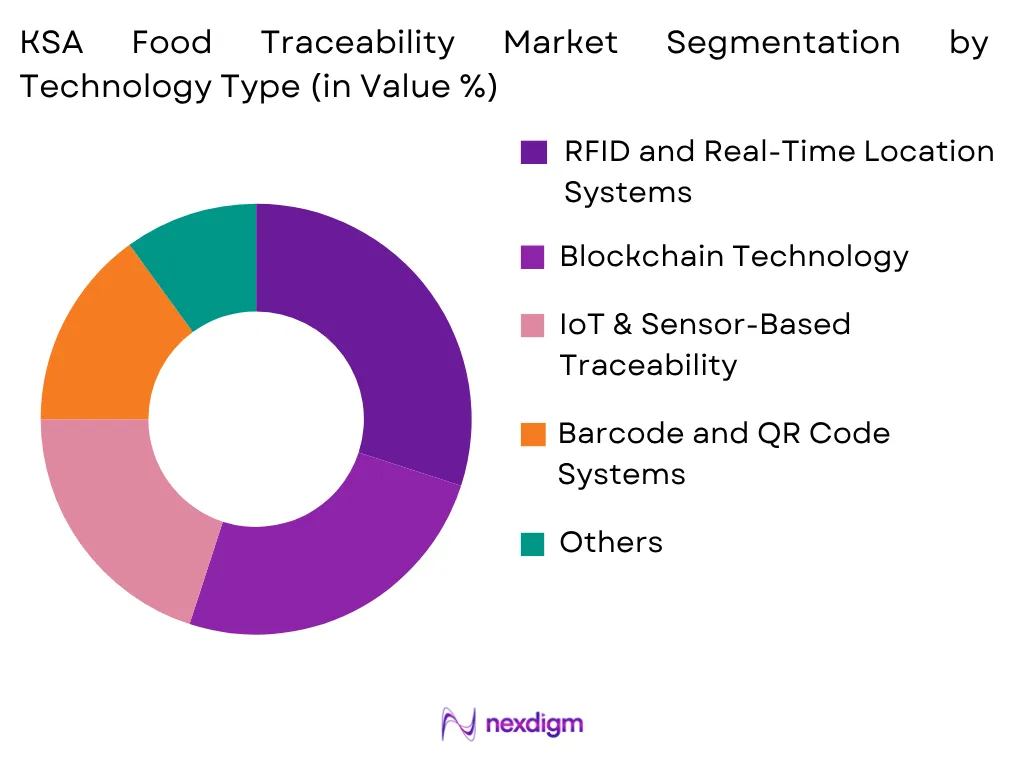
Among these, RFID and Real-Time Location Systems (RTLS) hold a significant share of the KSA Food Traceability Market, reflecting the technology’s established use in tracking imported meat and packaged food products as they move through the Kingdom’s ports, warehouses, and distribution networks. Blockchain-Based Platforms represent the fastest-growing segment, anchored by the Saudi Food and Drug Authority’s (SFDA) proof-of-concept study conducted in cooperation with the Digital Government Authority (DGA), which explored blockchain’s use in tracking products from farm to point of sale, covering the farm, slaughterhouse, and retailer stages of the supply chain, and providing end consumers with transparency and confidence regarding a product’s journey through decentralised, immutable data recording. SGS Saudi Arabia’s TRAKKEY digital traceability platform, launched in partnership with ENSESO4Food in December 2024, further illustrates the growing commercial availability of enterprise-grade blockchain and digital traceability solutions tailored to Saudi food businesses of all sizes.
By Application
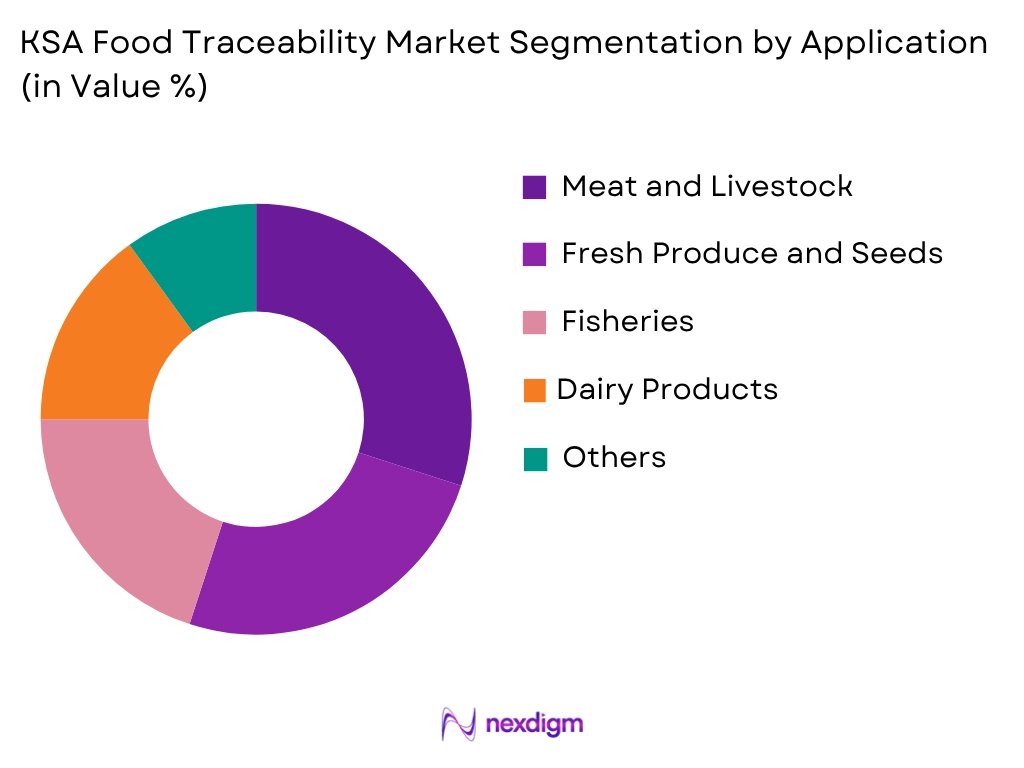
The Meat and Livestock segment, alongside Fresh Produce and Seeds, commands a substantial share of the KSA Food Traceability Market, directly reflecting Saudi Arabia’s structural dependence on imports for more than 80% of its food consumption, according to Saudi FoodTech. The Saudi Agricultural and Livestock Investment Company (SALIC), a Public Investment Fund subsidiary established in 2009, supplies approximately 1.6 million tons of food commodities to Saudi Arabia annually through investments spanning grain, meat, poultry, and rice sectors across 14 international projects in eight countries, underscoring the scale and complexity of the import-dependent supply chains that traceability technology must monitor. Fisheries and Dairy applications are also expanding, supported by domestic agritech ventures such as Pure Harvest Smart Farms, backed by the National Agricultural Development Company (NADEC) in which SALIC holds a stake, and NEOM’s food company Topian, which is pioneering climate-resilient agriculture and regenerative aquaculture as part of the Kingdom’s broader food security diversification strategy.
Competitive Landscape
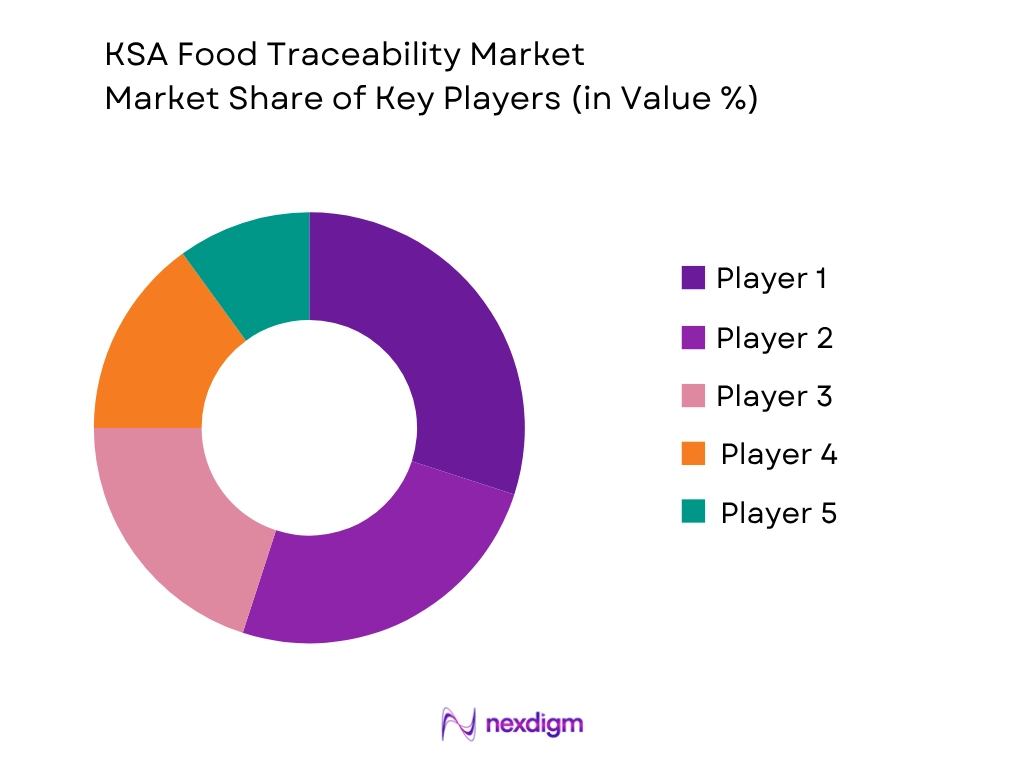
The KSA Food Traceability Market is dominated by multinational technology and certification providers operating through local Saudi entities, alongside sovereign wealth fund-backed strategic investors shaping the Kingdom’s underlying food supply infrastructure. SGS Saudi Arabia has emerged as a particularly active commercial player, launching its TRAKKEY digital traceability platform in December 2024 through a partnership with ENSESO4Food, a subsidiary of global traceability technology provider ENSESO, explicitly targeting food businesses seeking to meet international compliance requirements such as the United States’ FSMA 204 rule. The Saudi Agricultural and Livestock Investment Company (SALIC), wholly owned by the Public Investment Fund, plays an outsized role in shaping the traceability-adjacent food supply chain through investments including the National Grain Company, established in Yanbu in 2020 in partnership with Bahri at a cost of SAR 412 million. Global technology leaders including IBM Corporation, Zebra Technologies Corporation, and Tetra Pak International S.A. compete on blockchain infrastructure, RFID and barcode hardware, and aseptic packaging-integrated traceability policy respectively, while the Saudi Food and Drug Authority’s own blockchain proof-of-concept signals significant government appetite for further digitalisation of the Kingdom’s food traceability infrastructure.
| Company | Establishment Year | Headquarters | Primary Product Portfolio | Traceability Solution Portfolio
|
Deployment Presence | Major End-Use Industries | Key Strategic Focus | Certifications & Compliance |
| Saudi Agricultural and Livestock Investment Company (SALIC) | 2009 | ~ | ~ | ~ | ~ | ~ | ~ | ~ |
| SGS SA | 1878 | ~ | ~ | ~ | ~ | ~ | ~ | ~ |
| Tetra Pak International S.A. | 1972 | ~ | ~ | ~ | ~ | ~ | ~ | ~ |
| IBM Corporation | 1911 | ~ | ~ | ~ | ~ | ~ | ~ | ~ |
| Zebra Technologies Corporation | 1969 | ~ | ~ | ~ | ~ | ~ | ~ | ~ |
KSA Food Traceability Market Analysis
Growth Drivers
High Food Import Dependency and Government Digitalisation Initiatives
The KSA food traceability market is experiencing sustained growth due to the Kingdom’s exceptionally high dependence on food imports, which Saudi FoodTech reports exceed 80% of domestic consumption, creating structural demand for robust import verification and traceability infrastructure. The Saudi Food and Drug Authority (SFDA), in cooperation with the Digital Government Authority (DGA), has conducted a proof-of-concept study exploring blockchain technology’s use in tracking products from farm to point of sale, describing the initiative as one of the first of its kind in tracing the movement of products on a large scale using blockchain technology in the Kingdom. This government-led digitalisation push, undertaken as part of broader efforts to elevate Saudi Arabia’s digital economy, is expected to establish standardised frameworks that private technology providers can build upon, accelerating commercial adoption of blockchain and digital traceability solutions across the Kingdom’s food import, processing, and retail sectors.
Vision 2030 Food Security Investment and Rising Agriculture Sector Growth
Saudi Arabia’s Vision 2030 economic diversification strategy is driving substantial investment in food security and agricultural technology, with Invest Saudi reporting more than SAR 90 billion in planned food and agriculture investments and an annual sector growth rate of 7.3%. The Saudi Agricultural and Livestock Investment Company (SALIC), a Public Investment Fund subsidiary, has grown its investment portfolio from SAR 5 billion in 2019 to SAR 27 billion, supplying approximately 1.6 million tons of food commodities to Saudi Arabia annually through 14 international projects across eight countries. Domestic agritech ventures further reinforce this trend, including Green Dunes, a vertical farming venture backed by food retailer Tamimi Markets that uses 95% less water than traditional agriculture, and Pure Harvest Smart Farms, which deploys high-tech hydroponic systems backed by NADEC, both of which require robust traceability infrastructure to verify sustainability claims and product origin as Saudi Arabia works toward its food security and self-sufficiency goals.
Market Challenges
Heavy Reliance on Imported Traceability Technology and a Limited Domestic Vendor Base
The KSA Food Traceability Market remains heavily dependent on multinational technology providers, as the Kingdom currently lacks a substantial base of domestically founded, commercially proven food traceability technology vendors comparable to those emerging in other major markets. Most traceability solutions available to Saudi food businesses, including SGS Saudi Arabia’s TRAKKEY platform and enterprise blockchain offerings from global providers such as IBM, are developed and headquartered outside the Kingdom, requiring local implementation partnerships to serve Saudi market needs. This reliance exposes Saudi food manufacturers, retailers, and government agencies to global technology pricing, licensing, and support dependencies, even as the Kingdom’s Vision 2030 strategy increasingly emphasises building domestic technology capabilities across sectors including food and agriculture.
Fragmented Legacy Systems and Desert Climate Equipment Durability Requirements
The KSA Food Traceability Market faces practical implementation challenges stemming from the need to integrate diverse existing government and private sector systems spanning food manufacturers, warehouse and pack farm operators, food retailers, and multiple government departments, including defence and security agencies with distinct compliance requirements. Equipment used in traceability systems, including PDA devices with GPS, thermal printers, and RFID tags, must additionally withstand Saudi Arabia’s extreme desert climate conditions, including high ambient temperatures and dust exposure, adding durability and maintenance considerations not present in more temperate markets. These factors, combined with the interoperability challenges inherent in connecting the SFDA’s emerging blockchain infrastructure with pre-existing private sector enterprise resource planning and warehouse management systems, represent a significant practical barrier to comprehensive, Kingdom-wide traceability coverage.
Market Opportunities
Blockchain-Based Import Verification and NEOM Giga-Project Integration
The Saudi Food and Drug Authority’s blockchain proof-of-concept study, which successfully demonstrated farm-to-point-of-sale product tracking across the farm, slaughterhouse, and retailer stages of the supply chain, presents a substantial opportunity for technology providers to support the Kingdom’s transition from pilot-stage blockchain traceability to full commercial deployment, particularly for verifying the origin and safety of the more than 80% of food that Saudi Arabia imports. NEOM’s food company, Topian, which is pioneering climate-resilient agriculture and regenerative aquaculture as part of the giga-project’s broader sustainability ambitions, represents a further opportunity for traceability technology providers to embed origin verification and sustainability reporting directly into next-generation Saudi food production facilities from their inception, rather than retrofitting traceability onto existing infrastructure.
FSMA 204 Compliance Services and Growth of the Domestic FoodTech Ecosystem
Saudi food exporters seeking access to the United States market present a growing opportunity for traceability compliance service providers, exemplified by SGS Saudi Arabia’s TRAKKEY platform, developed in partnership with ENSESO4Food specifically to help Saudi food businesses of all sizes navigate FSMA 204 compliance requirements and build consumer trust. Saudi FoodTech, which established the RedSea FoodTech event series as the first initiative of its kind in the region, has drawn increasing engagement from venture capitalists, corporations, and startups across Jeddah and Riyadh, with its third edition receiving support from the Ministry of Environment, Water, and Agriculture, signalling growing institutional momentum behind building a domestic Saudi foodtech ecosystem that could, over time, reduce the market’s current reliance on imported traceability technology and services.
Future Outlook
The KSA Food Traceability Market is expected to witness steady expansion over the forecast period, supported by the Kingdom’s structural dependence on food imports, continued Vision 2030-aligned investment in food security and agricultural technology, and the maturation of government-led blockchain digitalisation initiatives led by the Saudi Food and Drug Authority and the Digital Government Authority. Growing investment from sovereign wealth fund-backed entities such as SALIC, expansion of domestic controlled environment agriculture ventures requiring sustainability and origin verification, and rising demand from Saudi exporters seeking compliance with international requirements such as FSMA 204 will further accelerate market development. The market is also likely to benefit from the emerging domestic foodtech ecosystem being fostered through initiatives such as Saudi FoodTech’s RedSea FoodTech events, even as the industry continues to navigate heavy reliance on imported traceability technology, a limited domestic vendor base, and the practical challenges of achieving interoperability across fragmented government and private sector systems.
Major Players
- IBM Corporation (IBM Food Trust)
- Zebra Technologies Corporation
- SGS SA
- Bureau Veritas SA
- Tetra Pak International S.A.
- FoodChain ID Group
- ENSESO4Food
- Schneider Electric SE
- KROHNE Messtechnik GmbH
- Cognex Corporation
- C.H. Robinson Worldwide, Inc.
- Saudi Agricultural and Livestock Investment Company (SALIC)
- Bilytica
- National Grain Company (Saudi Arabia)
- Pure Harvest Smart Farms
Key Target Audience
- Food Traceability Technology Providers
- Food Manufacturers and Importers
- Warehouse and Pack Farm Operators
- Food Retailers and Supermarket Chains
- Food Exporters Seeking International Market Access
- Investment and Venture Capitalist Firms
- Government and Regulatory Bodies (Saudi Food and Drug Authority (SFDA), Digital Government Authority (DGA), Ministry of Environment, Water and Agriculture)
- Sovereign Wealth Fund-Backed Agricultural Investment Entities
Research Methodology
Step 1: Identification of Key Variables
The research process begins with identifying the complete ecosystem of the KSA Food Traceability Market, including hardware and software technology providers, blockchain platform developers, certification and audit bodies, food importers and manufacturers, retailers, and regulatory authorities. Extensive secondary research is conducted using company annual reports, government publications, trade associations, customs statistics, industry journals, and proprietary databases to determine the variables influencing market demand, pricing, deployment, adoption, and technological developments.
Step 2: Market Analysis and Construction
Historical market information is collected and analysed to estimate market size, deployment volumes, technology adoption rates, application-wise demand, and pricing trends. A combination of top-down and bottom-up approaches is used to estimate market revenues and validate segment-level performance. Adoption patterns across meat and livestock, fresh produce, dairy, beverages, and fisheries are evaluated to establish an accurate representation of the industry.
Step 3: Hypothesis Validation and Expert Consultation
The preliminary findings are validated through Computer-Assisted Telephone Interviews (CATIs) and structured discussions with traceability technology providers, procurement managers, food importers, manufacturers, regulatory experts, and senior executives operating within the Saudi food and agribusiness industries, spanning Riyadh, Jeddah, and the Eastern Province. These interviews help verify market assumptions, competitive developments, technology adoption trends, pricing dynamics, and future investment opportunities while refining the overall market estimates.
Step 4: Research Synthesis and Final Output
The final stage integrates insights obtained from primary interviews with quantitative information collected through secondary sources. Data triangulation techniques are applied to reconcile differences between supply-side and demand-side estimates, ensuring robust market forecasting. The report is then reviewed through multiple quality assurance checkpoints to deliver a comprehensive analysis covering market size, segmentation, competitive landscape, future outlook, and strategic recommendations for industry stakeholders.

- Executive Summary
- Research Methodology (Market Definitions and Assumptions, Abbreviations, Market Sizing Approach, Top-Down Analysis, Bottom-Up Analysis, Demand-Side Assessment, Supply-Side Assessment, Primary Industry Interviews, Secondary Research Validation, Data Triangulation, Forecasting Framework, Limitations and Future Conclusions)

- Definition and Scope
- Market Evolution and Industry Genesis
- Timeline of Major Industry Developments
- Food Traceability Industry Value Chain Analysis
- Supply Chain Analysis

- Growth Drivers (High Food Import Dependency, Vision 2030 Food Security Strategy, SFDA Blockchain Digitalisation Initiatives, Rising Food and Agriculture Investment, Growth of Controlled Environment Agriculture, US and EU Export Compliance Requirements)
- Market Challenges (Heavy Reliance on Imported Traceability Technology, Limited Domestic Traceability Vendor Base, Fragmented Legacy Systems, High Implementation Costs for SMEs, Interoperability Across Government and Private Systems, Desert Climate Equipment Durability Requirements)
- Market Opportunities (Blockchain-Based Import Verification, NEOM and Giga-Project Food Traceability Integration, Local Agritech Ecosystem Development, Controlled Environment Agriculture Traceability, FSMA 204 Compliance Services for Exporters, Hajj and Umrah Food Supply Chain Verification)
- Market Trends (Farm-to-Point-of-Sale Blockchain Pilots, Sovereign Wealth Fund Agritech Investment, Rise of Domestic FoodTech Startup Ecosystem, Consumer-Facing QR Code Transparency, Smart Logistics for Imported Food Verification, Multi-Commodity Platform Expansion)
- Government Regulations (SFDA Food Traceability Requirements, Table of Food Law (MOMAH and SFDA), Digital Government Authority (DGA) Standards, Food Labelling Requirements, Import Compliance Requirements, Halal Certification Requirements)
- Import and Export Analysis (Food Import Volume, Major Import Sources, Re-Export Destinations, HS Code Analysis, Trade Balance)
- Technology Landscape (Blockchain Proof-of-Concept Platforms, RFID and RTLS Systems, IoT-Enabled Cold Chain Sensors, Precision Measurement and Process Control Systems, Cloud-Based Traceability Software)
- Sustainability Assessment (Water-Efficient Controlled Environment Agriculture, Food Security Strategy Alignment, Traceability-Linked ESG Reporting, Regenerative Aquaculture Verification, Energy-Efficient Cold Chain Infrastructure)
- PESTLE Analysis
- SWOT Analysis
- Porter’s Five Forces Analysis
- Stakeholder Ecosystem
- Competition Ecosystem

- By Market Value (2020-2025)
- By Volume of Deployments (2020-2025)
- By Average Selling Price (2020-2025)

- By Technology (In Value %)
RFID and Real-Time Location Systems (RTLS)
Blockchain-Based Platforms
Barcode and QR Code Systems
GPS and IoT Sensor-Based Tracking
ERP and Cloud Software Platforms - By Equipment (In Value %)
PDA with GPS
Thermal Printers
2D and 1D Scanners
Tags and Labels
Sensors - By Application (In Value %)
Meat and Livestock
Fresh Produce and Seeds
Dairy
Beverages
Fisheries - By End User (In Value %)
Food Manufacturers
Warehouses and Pack Farms
Food Retailers
Defence and Security Departments
Other Government Departments - By Region (In Value %)
Riyadh Region
Makkah Region
Eastern Province
Other Regions

- Market Share of Major Players (By Value, Deployment Volume, Technology Type, Application Industry, Customer Segment)
- Cross Comparison Parameters (Technology Portfolio Breadth, Blockchain and AI Capability, Field Deployment Support, Application Technical Support Capability, Government Relationship and Compliance Track Record, Regulatory Compliance & Certifications, Customer Base Across Industries, Innovation & New Product Launch Frequency)
- SWOT Analysis of Major Players
- Pricing Analysis by Solution Category
- Deployment Capacity Analysis
- Technology Footprint Analysis
- Distribution and Partner Network Analysis
- Innovation Benchmarking
- Detailed Profiles of Major Companies
IBM Corporation (IBM Food Trust)
Zebra Technologies Corporation
SGS SA
Bureau Veritas SA
Tetra Pak International S.A.
FoodChain ID Group
ENSESO4Food
Schneider Electric SE
KROHNE Messtechnik GmbH
Cognex Corporation
C.H. Robinson Worldwide, Inc.
Saudi Agricultural and Livestock Investment Company (SALIC)
Bilytica
National Grain Company (Saudi Arabia)
Pure Harvest Smart Farms

- Consumption Pattern Analysis (Enterprise Adoption Rate, Import Verification Adoption Rate, Product Category Penetration, Regional Adoption Variation, Reformulation Activity)
- Purchasing Criteria (Regulatory Compliance, Interoperability with Government Systems, Cost Efficiency, Equipment Durability, Data Security, Scalability)
- Procurement and Supplier Selection Analysis
- Import Compliance Adoption Assessment
- Large Enterprise vs SME Adoption Demand
- Product Attribute Preference Analysis (Real-Time Data Capture, Heat and Desert Climate Durability, Blockchain Immutability, Consumer-Facing Interface, Multi-Commodity Support, Ease of Integration)
- Consumer Trust and Transparency Influence on Adoption
- Pain Point Analysis
- Decision-Making Process

- By Market Value (2026-2035)
- By Volume of Deployments (2026-2035)
- By Average Selling Price (2026-2035)


 Request a Sample
 Ask for Customization
 Get a Quote
 Enquire Now