
 Download PDF
Market Overview
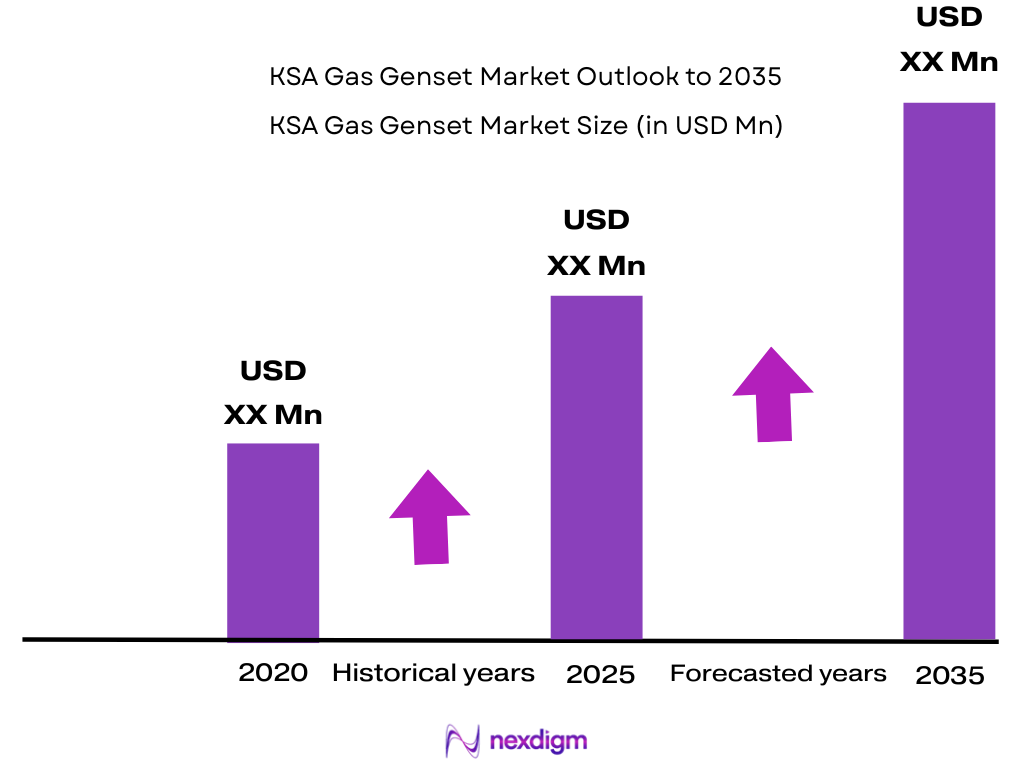
The KSA Gas Genset Market is valued at approximately ~ million, supported by expanding construction, temporary-worksite power and small-business backup requirements. Saudi Arabia added 3,800 construction-sector licences, taking the active licence base to about 8,900, while the industrial transformation programme continued adding licensed factories and logistics assets. Gasoline gensets remain relevant where users require compact, transportable power for tools, lighting, maintenance equipment, outdoor operations and emergency electricity without permanent installations. Riyadh, Jeddah, Dammam and the broader Eastern Province constitute the principal demand centres because they combine construction activity, workshops, logistics operations, industrial estates and high concentrations of commercial establishments. Saudi industrial policy continues expanding manufacturing and logistics capacity, while giga-project development creates temporary electricity requirements beyond established grid connections. Portable gasoline gensets are particularly suitable for contractors and mobile service teams because they can be transported between worksites and operated without fixed power infrastructure.
Market Segmentation
By Power Output
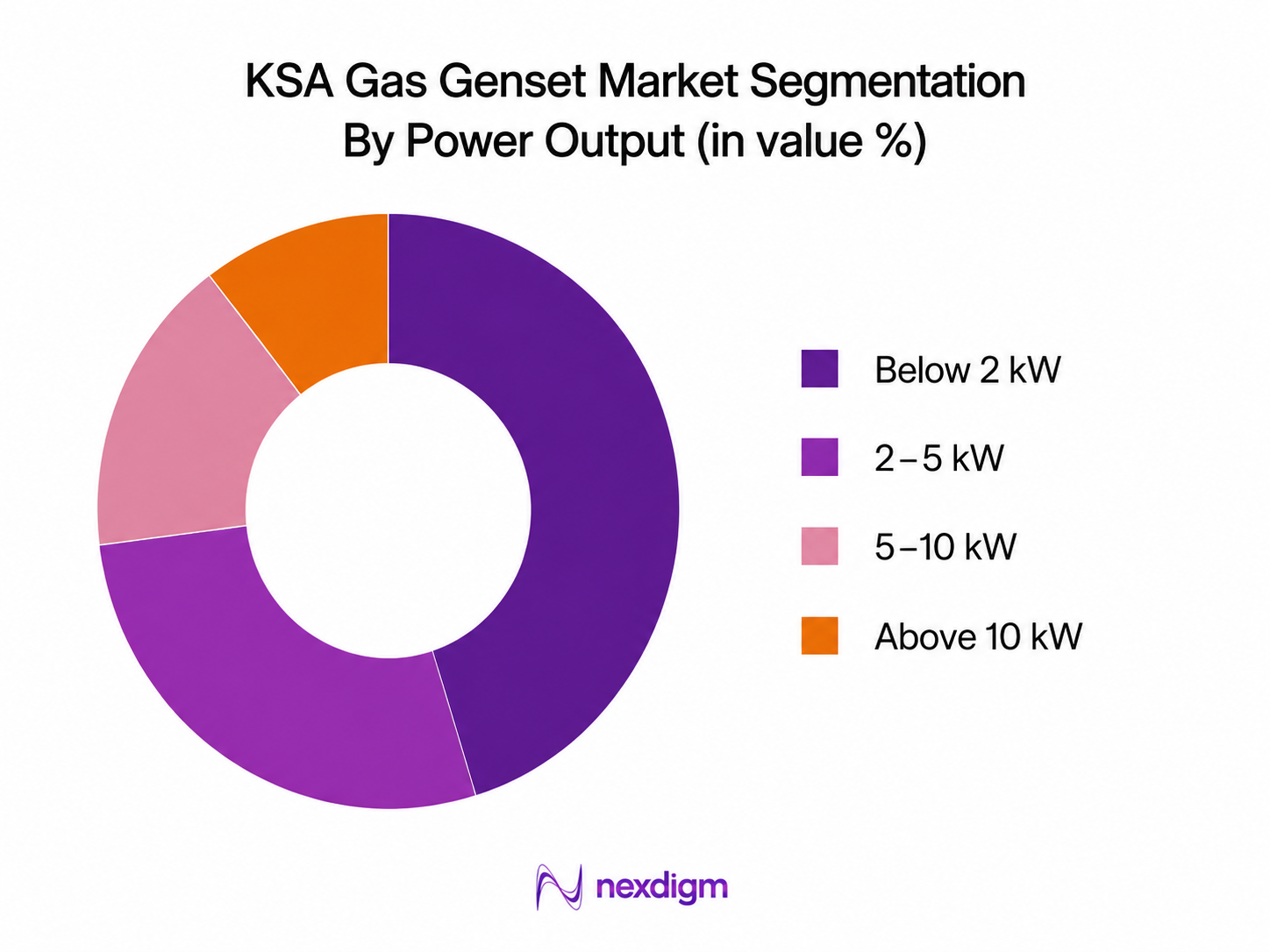
The KSA Gas Genset Market is segmented into below 2 kW, 2–5 kW, 5–10 kW and above 10 kW gasoline generator sets. The 2–5 kW category holds the dominant market position because it balances portability with sufficient output for contractor tools, pumps, workshop equipment, lighting, small appliances and emergency household loads. Honda’s Saudi power-products portfolio specifically positions portable generators for circumstances where electricity is unavailable, reflecting the strong practical role of compact petrol-driven units. Units within this band can generally be transported by one or two operators, stored in service vehicles and deployed without permanent electrical infrastructure. They also accommodate a broad customer base covering residential buyers, maintenance contractors, roadside technicians, farms, small shops and recreation users. Lower-power units are highly portable but cannot operate multiple loads simultaneously, whereas larger gasoline systems lose some of the mobility advantage that differentiates petrol gensets from diesel equipment. Consequently, the middle-output segment offers the strongest combination of portability, flexibility and application breadth.
By Application
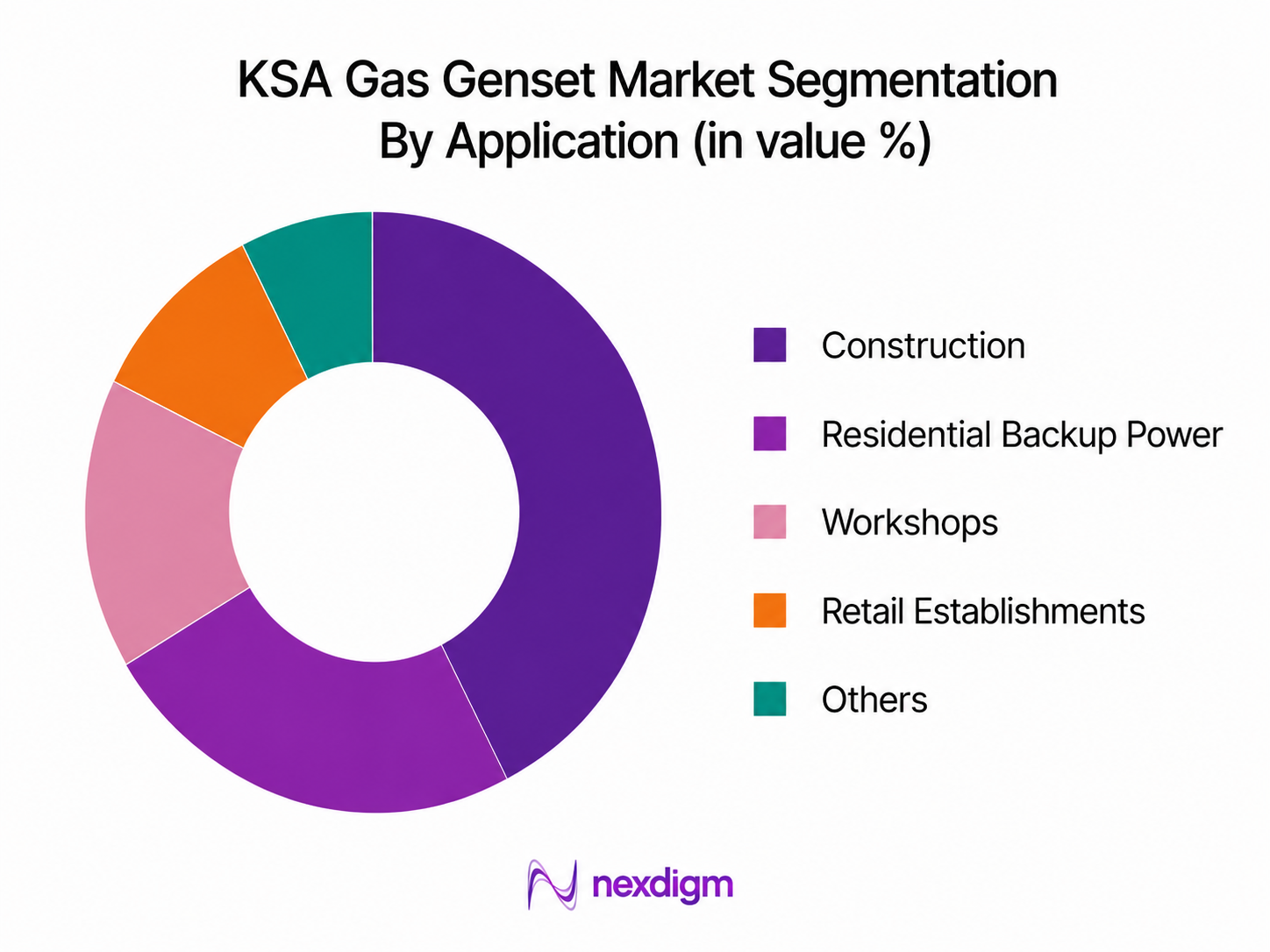
The KSA Gas Genset Market is segmented into construction and worksites, residential emergency backup, workshops and automotive service, commercial and retail establishments, recreation and outdoor applications, and agriculture or remote operations. Construction and worksite applications represent the dominant sub-segment because Saudi Arabia’s infrastructure and real-estate development pipeline requires temporary electricity during site preparation, fit-out, maintenance and commissioning. The construction industry added approximately 3,800 licences, bringing the active licence base to around 8,900, while Vision 2030 programmes continue directing activity toward infrastructure, logistics and industrial development. Portable petrol generators are particularly suited to small contractors that need power for drills, saws, lighting, chargers, welding-support equipment and site cabins before permanent grid connections become available. Compared with large stationary diesel units, compact petrol gensets are easier to move between projects and require relatively limited installation. Residential emergency backup and workshops form other important demand pools, especially for low- and medium-capacity units.
Competitive Landscape
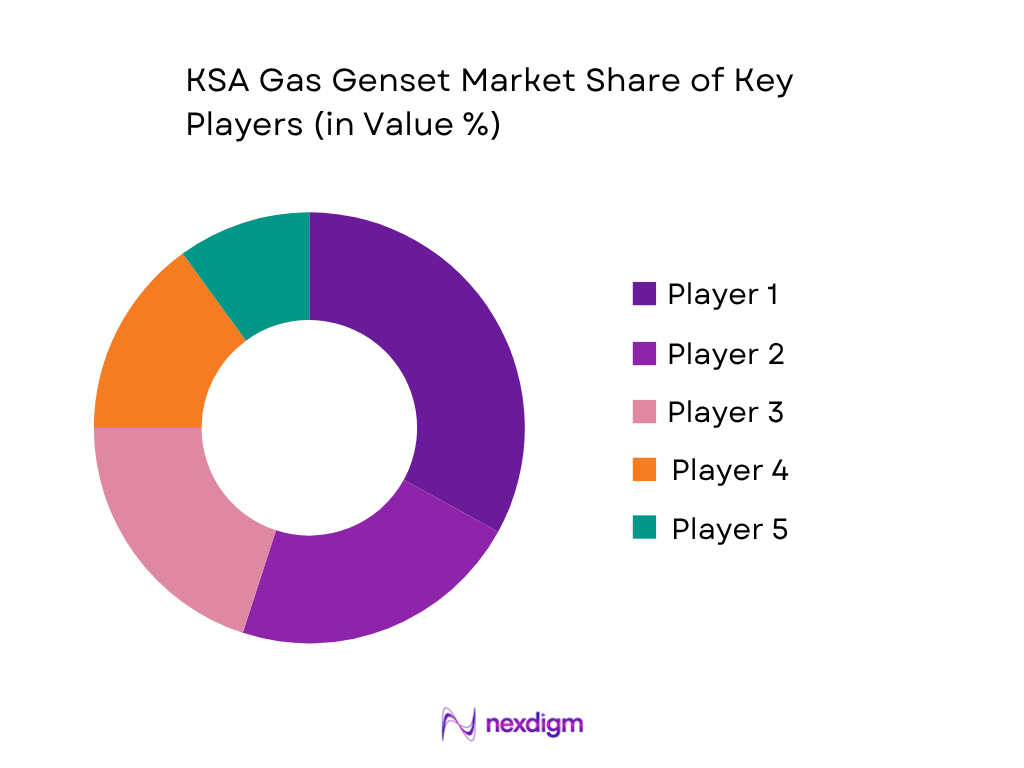
The KSA Gas Genset Market includes established Japanese power-equipment manufacturers, international backup-power companies and value-oriented Asian portable-generator brands. Honda has a dedicated Saudi power-products presence and promotes portable generators for off-grid tasks. Other globally established manufacturers compete on inverter technology, engine durability, fuel efficiency, noise control, electrical output stability and dealer support. The resulting competitive structure ranges from compact recreation-focused inverter units to contractor-grade open-frame gasoline generators and higher-output portable systems.
| Major Player | Establishment Year | Headquarters | Gasoline Genset Portfolio | Typical Output Positioning | Inverter Technology | Low-Noise Capability | Electric Start Availability | Distribution / Service Position |
| Honda Motor Co. | 1948 | Tokyo, Japan | ~ | ~ | ~ | ~ | ~ | ~ |
| Yamaha Motor Co. | 1955 | Iwata, Japan | ~ | ~ | ~ | ~ | ~ | ~ |
| Generac Holdings | 1959 | Wisconsin, USA | ~ | ~ | ~ | ~ | ~ | ~ |
| Briggs & Stratton | 1908 | Wisconsin, USA | ~ | ~ | ~ | ~ | ~ | ~ |
| Pramac | 1966 | Siena, Italy | ~ | ~ | ~ | ~ | ~ | ~ |
KSA Gas Genset Market Analysis
Growth Drivers
Expansion of Construction, Infrastructure and Non-Oil Project Activity
Saudi Arabia’s accelerating construction and infrastructure pipeline is increasing the addressable operating base for automotive and mobile gas gensets used at temporary worksites, workshops, project offices, equipment yards and locations where permanent grid connections are not yet operational. GASTAT reported nominal GDP of approximately SAR 4.703 trillion in 2024, while construction activities accounted for roughly SAR 362 billion when the published construction contribution is applied to national output. Construction is particularly relevant for mobile gas gensets because projects require dependable electricity for lighting, tools, temporary accommodation, security systems and auxiliary equipment before utility infrastructure is commissioned. Saudi Arabia’s population reached 35.3 million people in 2024, according to the IMF, reinforcing demand for housing, transport systems, utilities and commercial facilities. The Kingdom’s infrastructure-led economic diversification is also visible in GASTAT’s revised national accounts, which indicate a substantially larger construction base than previously captured. For gas-genset suppliers, this creates demand for trailer-mounted and portable systems capable of operating across changing project locations while reducing dependence on liquid fuel delivery. Natural gas availability strengthens this proposition: Aramco’s gas-processing capability reached approximately 19.6 billion standard cubic feet per day by the end of 2025, supporting a larger domestic gas ecosystem. This combination of large construction activity, population-linked infrastructure needs and expanding gas-processing capacity creates a practical operating environment for gas-powered temporary and standby generation in construction-intensive regions such as Riyadh, Makkah and the Eastern Province.
Expanding Domestic Gas Infrastructure and Industrial Energy Demand
The expansion of Saudi Arabia’s domestic gas system is a direct structural driver for the KSA Gas Genset Market because gaseous-fuel generators become commercially more practical as fuel processing, distribution and industrial gas availability deepen. Saudi Aramco reported gas-processing capacity of approximately 19.6 billion standard cubic feet per day at the end of 2025, compared with 2 billion standard cubic feet per day in 2000, demonstrating the scale of infrastructure already available to support increasing domestic gas consumption. Aramco has explicitly linked its gas investment programme to meeting domestic energy demand and reducing the burning of liquid fuels in power applications. This transition is important for mobile and stationary gas gensets deployed at industrial sites, workshops, logistics facilities, construction camps and commercial buildings requiring supplementary or emergency power. The industrial base also provides a substantial demand foundation. GASTAT’s Industrial Production statistics cover mining, manufacturing, electricity, gas, steam and air-conditioning supply, reflecting the broad network of facilities where backup and distributed power systems can be deployed. Saudi Arabia’s economy reached approximately USD 1.24 trillion in 2024, according to the World Bank, while the IMF estimated the population at 35.3 million, indicating substantial national infrastructure and commercial energy requirements. Gas gensets can serve sites where operators want to reduce dependence on diesel storage while retaining dispatchable generation capability. The availability of domestically produced gas also gives equipment manufacturers an incentive to expand natural-gas and dual-fuel engine portfolios, remote monitoring systems and modular generator packages suited to Saudi operating temperatures. As gas-processing infrastructure becomes more extensive, suppliers can address industrial customers seeking reliable distributed generation without relying exclusively on diesel-powered equipment.
Market Challenges
Strong Grid Coverage and Increasing Renewable Power Availability
The KSA Gas Genset Market operates within a country where grid electricity is already extensively available, limiting the need for gensets as a primary electricity source and pushing the market toward temporary, emergency and specialised applications. World Bank data shows electricity access reached approximately 100 out of every 100 residents in 2024, indicating that gas gensets generally compete with a mature national electricity system rather than filling widespread electrification gaps. The competitive pressure is increasing as renewable generation capacity expands. GASTAT reported that Saudi Arabia had 10 operating renewable-energy projects by the end of 2024, comprising 9 solar projects with 6,151 MW of capacity and 1 wind project with 400 MW, giving total operating renewable capacity of 6,551 MW. These projects were estimated to provide electricity equivalent to the requirements of approximately 1,140,800 housing units. This creates a structural challenge for genset suppliers because new residential, commercial and industrial developments increasingly have access to grid electricity supplemented by utility-scale renewable generation. Gas gensets therefore cannot rely solely on a lack-of-electricity proposition. Manufacturers must instead compete around emergency response, rapid deployment, power quality, project mobility, remote-site operation and resilience. The challenge becomes more pronounced as customers consider battery-energy-storage systems alongside solar installations for short-duration backup. Gas-powered gensets retain advantages for longer runtime and dispatchability, but suppliers must demonstrate those benefits against increasingly capable alternatives. For the automotive and mobile segment specifically, differentiation will depend on compact packaging, rapid connection, low-noise operation, reliable starting, telemetry and fuel flexibility rather than simple electricity provision. Sources: World Bank and General Authority for Statistics.
Gas Distribution, Site Connectivity and Mobile Fuel-Supply Constraints
Saudi Arabia possesses very large upstream and processing capabilities, but the commercial viability of an gas genset depends on whether natural gas or an appropriate gaseous fuel can actually reach the operating site. Aramco’s gas-processing capability stood at approximately 19.6 billion standard cubic feet per day at the end of 2025, yet processing capacity does not automatically provide pipeline connectivity to construction sites, temporary camps, mobile workshops or remote industrial locations. This creates a practical constraint compared with conventional liquid-fuel gensets, which can be refuelled using portable tanks and established road-fuel logistics. Gas-powered systems may require fixed pipeline access, compressed natural gas storage, liquefied gas infrastructure or dedicated fuel-delivery arrangements, depending on engine design and location. The challenge is particularly relevant because Saudi construction and industrial activity extends across 13 administrative regions, according to GASTAT’s national statistical coverage, including remote areas where temporary power is often required. Gas supply equipment adds operational requirements related to pressure regulation, storage cylinders, valves, leak detection, ventilation and trained installation personnel. In mobile automotive applications, additional gas storage can also reduce usable payload or increase package complexity. At the same time, the Kingdom’s 35.3 million population and approximately SAR 4.703 trillion nominal economy create widely dispersed commercial and infrastructure activity, making standardised fuel access difficult across every site. Consequently, gas gensets can be highly attractive where pipeline gas or organised gas supply is already present but less straightforward for short-duration or frequently relocated applications. Suppliers therefore need to integrate fuel-management systems, pressure-control equipment and service support rather than selling the generator alone.
Market Opportunities
Smart Gas Gensets with Remote Monitoring and Automated Load Management
Digitalisation creates an opportunity for KSA Gas Genset suppliers to move beyond mechanical generator packages toward connected power systems incorporating remote telemetry, automatic start-stop controls, fault diagnostics, load management and predictive maintenance. Saudi Arabia already has a substantial digital operating environment. GASTAT reported that the Kingdom’s digital economy contributed approximately SAR 752 billion when its published contribution is applied to the SAR 4.703 trillion national GDP recorded in 2024. This scale of digital activity supports customer familiarity with connected equipment, cloud-based monitoring and automated asset management. Gas gensets deployed at construction sites, logistics yards, telecommunications locations and industrial facilities can benefit particularly from remote operation because many units run intermittently or at unmanned sites. Telemetry can transmit engine hours, coolant temperature, gas pressure, output voltage, battery condition and fault codes to a central fleet platform, allowing operators to manage multiple units without continuous on-site staffing. This opportunity is supported by Saudi Arabia’s broad industrial ecosystem and the continuing implementation of major non-oil projects. For rental companies and fleet owners, connected gensets can improve equipment utilisation by identifying idle units and coordinating preventive maintenance based on operating hours rather than fixed calendar intervals. Automated load-sharing can also allow multiple smaller gas units to operate modularly instead of maintaining one oversized generator at inefficient load. The opportunity does not depend on speculative future market volumes; it is grounded in a large existing economy, extensive construction activity and a rapidly digitising business environment. Manufacturers that combine gas engines with controller platforms, remote alerts and fleet dashboards can therefore differentiate themselves from suppliers competing primarily on generator hardware.
Gas-Hybrid Distributed Power for Industrial and Commercial Applications
An important growth opportunity lies in combining gas gensets with renewable generation and battery storage rather than positioning them solely as alternatives to those technologies. Saudi Arabia had 6,551 MW of operating renewable-energy capacity at the end of 2024, consisting of 6,151 MW of solar generation and 400 MW of wind generation, according to GASTAT. Renewable projects represented approximately SAR 19.839 billion of deployed investment, demonstrating that solar and wind are becoming established parts of the Kingdom’s electricity system. Gas gensets can complement this installed renewable base because they provide dispatchable power when solar production declines, when batteries reach minimum charge levels, or when industrial loads exceed the output available from intermittent sources. The model is particularly relevant for construction camps, logistics facilities, workshops, remote commercial sites and industrial operations that need power beyond daylight hours but want to reduce continuous engine operation. Saudi Arabia’s domestic gas-processing infrastructure provides a strong technical foundation: Aramco reported approximately 19.6 billion standard cubic feet per day of gas-processing capability at the end of 2025. Integrating this gas availability with renewable generation allows genset suppliers to compete as part of a hybrid energy architecture. Advanced controllers can prioritise solar electricity, charge battery systems during surplus generation and automatically start the gas genset only when required. This reduces engine operating hours while preserving longer-duration resilience that battery-only configurations may not provide. Suppliers can therefore expand beyond standalone generator sales into integrated packages covering gas engines, alternators, battery storage, solar interfaces, energy-management controls and remote monitoring. Saudi Arabia’s approximately SAR 4.703 trillion economy and continued industrial and construction expansion provide a substantial current customer base for these systems without relying on future market-size assumptions.
Future Outlook
The KSA Gas Genset Market is expected to expand at approximately ~ CAGR during 2026–2035, supported by construction activity, industrial diversification, infrastructure development and demand for mobile electricity. Portable gasoline generators will remain particularly relevant at smaller construction sites, maintenance operations, workshops, temporary retail facilities, outdoor events and remote service locations where installing large diesel backup systems is unnecessary. The technology mix is likely to shift toward inverter generators, automatic engine-speed control, improved voltage regulation, electric starting, low-oil shutdown and digital monitoring. International manufacturers already incorporate inverter technology, Bluetooth connectivity and safety monitoring in premium portable platforms, establishing a technology pathway that can progressively penetrate the Saudi market. At the same time, stricter electrical-product conformity and environmental requirements will raise the importance of documented product standards. Saudi Arabia’s SASO framework covers safety and conformity requirements for electrical and electronic equipment, making compliant importation, product documentation and certified distribution increasingly important for generator suppliers.
Major Players
- Honda Motor Co.
- Yamaha Motor Co.
- Generac Power Systems
- Kohler Energy
- Briggs & Stratton
- Champion Power Equipment
- FIRMAN Power Equipment
- Westinghouse Outdoor Power Equipment
- Hyundai Power Products
- Pramac
- Loncin Motor
- Kipor Power
- SENCI Power
- Sawafuji Electric / ELEMAX
- WEN Products
Key Target Audience
- Gasoline generator manufacturers
- Portable power-equipment distributors
- Construction and infrastructure contractors
- Automotive workshops and mobile service operators
- Equipment rental and temporary-power companies
- Retail, hardware and industrial-equipment distributors
- Investments and venture capitalist firms
- Government and regulatory bodies
Research Methodology
Step 1: Identification of Key Variables
The initial phase constructs the ecosystem of the KSA Gas Genset Market, including petrol-generator manufacturers, importers, distributors, construction contractors, equipment-rental businesses, workshops and residential buyers. Key variables include rated output, starting wattage, engine displacement, fuel-tank capacity, runtime, inverter configuration, noise level, portability, electrical output quality, starting mechanism and safety systems.
Step 2: Market Analysis and Construction
Historical market demand is constructed through a top-down and bottom-up framework using construction activity, industrial development, generator imports, dealer availability and end-user applications. Unit demand is assessed across power-output categories and applications including construction, residential backup, workshops, commercial facilities and outdoor use. Saudi government industrial indicators and manufacturer product data are triangulated to establish demand relationships.
Step 3: Hypothesis Validation and Expert Consultation
Market hypotheses are validated through CATIs and structured discussions with generator distributors, construction contractors, equipment-rental operators, workshops and electrical-equipment dealers. Consultations evaluate preferred output ranges, gasoline-engine configurations, inverter adoption, noise requirements, runtime expectations, starting methods, service frequency, parts availability and compliance requirements.
Step 4: Research Synthesis and Final Output
The final stage reconciles demand-side estimates with supplier portfolios, dealership structures and Saudi conformity requirements. Brand availability, generator specifications and channel feedback are compared against industrial and construction indicators. The resulting dataset is then triangulated to develop the final market structure, competitive analysis, segment positioning and long-term outlook for the KSA Gas Genset Market.

- Executive Summary
- Research Methodology (Market Definitions and Assumptions, Natural Gas and LPG Genset Scope, kVA/kW Conversion Framework, Top-Down Market Sizing, Bottom-Up Installed-Base Assessment, Gas Availability Mapping, End-User Demand Assessment, Distributor and EPC Interviews, Supplier Validation, Data Triangulation, Forecasting Framework, Limitations and Future Conclusions)

- Definition and Scope
- Market Evolution and Industry Genesis
- Evolution of Gas-Fired Distributed Power in Saudi Arabia
- Gas Genset Industry Business Cycle
- Natural Gas Availability and Genset Adoption Ecosystem

- Growth Drivers (Expansion of Domestic Natural Gas Supply, Development of Industrial Gas Distribution Networks, Growth of Data Centres, Expansion of Automotive and Industrial Manufacturing, Critical Backup Power Requirements, Development of Logistics Facilities, Increasing Distributed Generation Requirements)
- Market Challenges (Gas Pipeline Accessibility, Higher Engineering Complexity, Installation Permitting, Fuel Pressure Requirements, Specialized Maintenance, Competition from Diesel Gensets and Battery Storage)
- Market Opportunities (Jafurah Gas Supply Expansion, Industrial City Gas Networks, High-Efficiency Gas Engines, CHP Applications, Hybrid Gas-Battery Systems, Rental Gas Power, Remote Industrial Power)
- Market Trends (Lean-Burn Engines, Digital Controllers, Remote Monitoring, Gas-Battery Hybridisation, Modular Power Plants, Predictive Maintenance, Low-NOx Combustion)
- SWOT Analysis
- Porter’s Five Forces Analysis
- PESTLE Analysis

- By Market Value (2020-2025)
- By Units Sold (2020-2025)
- By Installed Gas Genset Capacity (2020-2025)

- By Power Rating (In Value %)
Below 25 kVA
25–75 kVA
76–200 kVA
201–500 kVA
501–1,000 kVA
Above 1,000 kVA - By Fuel Configuration (In Value %)
Pipeline Natural Gas Gensets
LPG-Fired Gensets
Biogas-Compatible Gas Gensets
Dual-Fuel Gas–Diesel Gensets
Multi-Gas / Fuel-Flexible Gensets - By Application (In Value %)
Emergency Standby Power
Prime Power
Continuous Power
Peak Shaving
Distributed Generation
Temporary and Rental Power - By End User (In Value %)
Automotive Manufacturing and Assembly Facilities
Vehicle Dealerships and Service Centres
Warehouses and Automotive Logistics Facilities
Commercial Buildings and Retail Facilities
Oil and Gas Facilities


- Automotive Manufacturing Facility Demand Assessment
- Vehicle Assembly and Component Manufacturing Power Requirements
- Automotive Dealership and Workshop Backup-Power Requirements
- Warehouse and Automotive Logistics Power Requirements
- Oil and Gas Facility Genset Utilisation

- By Market Value (2026-2035)
- By Units Sold (2026-2035)
- By Installed Gas Genset Capacity (2026-2035)


 Request a Sample
 Ask for Customization
 Get a Quote
 Enquire Now