
 Download PDF
Market Overview
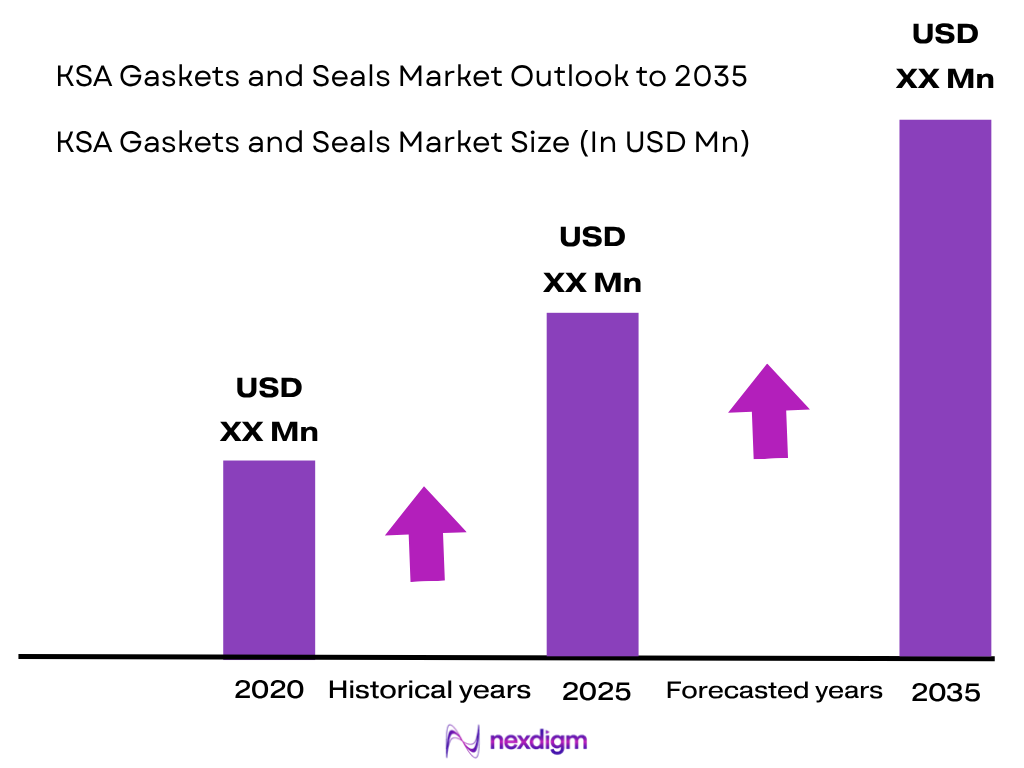
The KSA Gaskets and Seals Market is valued at approximately USD ~XX million, supported by one of the region’s largest installed bases of pumps, compressors, valves, pipelines, heat exchangers and pressure vessels. Aramco’s hydrocarbon production moved from 12.8 million to 12.4 million barrels of oil equivalent per day, while capital investment increased from USD 49.7 billion to USD 53.3 billion, sustaining recurring demand for static and dynamic sealing products across upstream, refining and gas-processing assets.
Dammam, Dhahran, Jubail and Yanbu dominate KSA gasket and seal demand because they concentrate hydrocarbon processing, petrochemical plants, refineries, rotating-equipment service centres and domestic gasket manufacturing. Aramco’s gross refining capacity moved from 7.9 million to 7.7 million barrels per day, while Saudi facilities include Ras Tanura at 550,000 barrels per day, SATORP at 460,000, YASREF at 430,000 and SASREF at 305,000, creating dense recurring requirements for flange gaskets and mechanical seals.
Market Segmentation
By Product Category
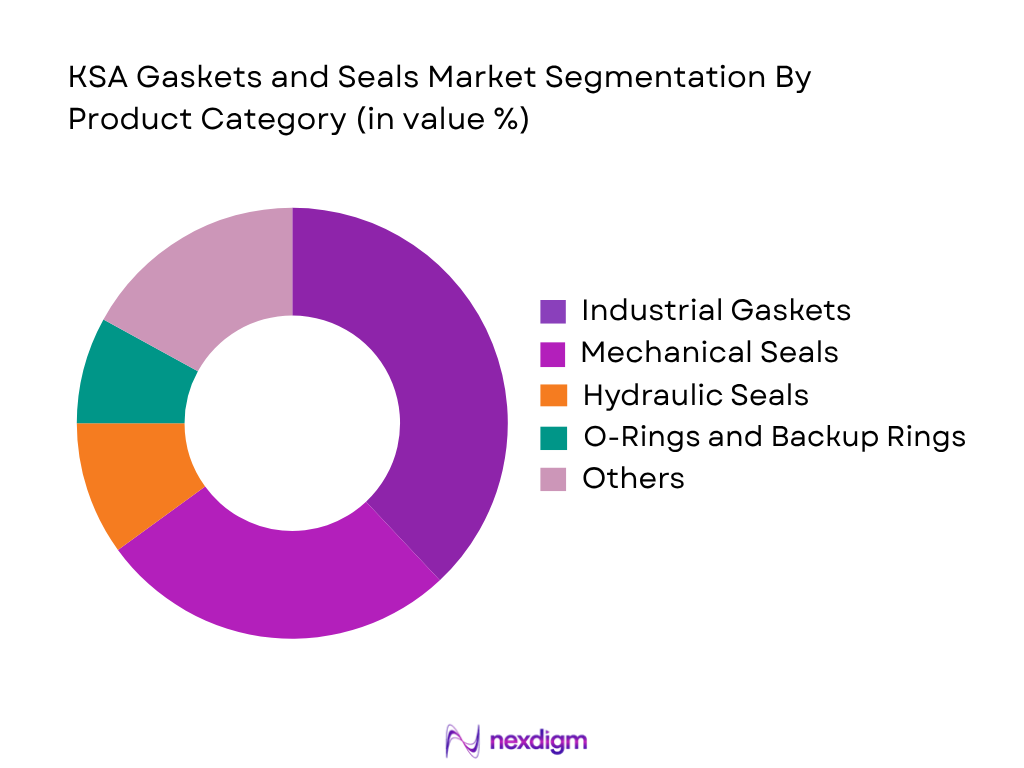
The KSA Gaskets and Seals Market is segmented into industrial gaskets, mechanical seals, hydraulic seals, pneumatic seals, rotary shaft seals, O-rings, compression packings and seal support systems. Industrial gaskets hold the dominant report-model share because Saudi Arabia’s extensive refinery, petrochemical, pipeline, gas-processing and power infrastructure contains a very large population of bolted flange joints, pressure vessels and heat exchangers requiring periodic replacement sealing. Spiral wound, ring-type joint, Kammprofile and graphite gaskets are particularly relevant to high-pressure and high-temperature hydrocarbon services. The Kingdom also hosts established domestic gasket manufacturing in Dammam, including Al-Iman Gasket Factory, operating since 1988, and Gulf Gasket Factory, established in 1993. Their local production of spiral wound, ring joint, metallic and non-metallic gaskets supports shutdown responsiveness and reduces lead times for maintenance-intensive industrial customers. Mechanical seals form the second major category due to widespread use in pumps, compressors, mixers and other rotating equipment.
By End-Use Industry
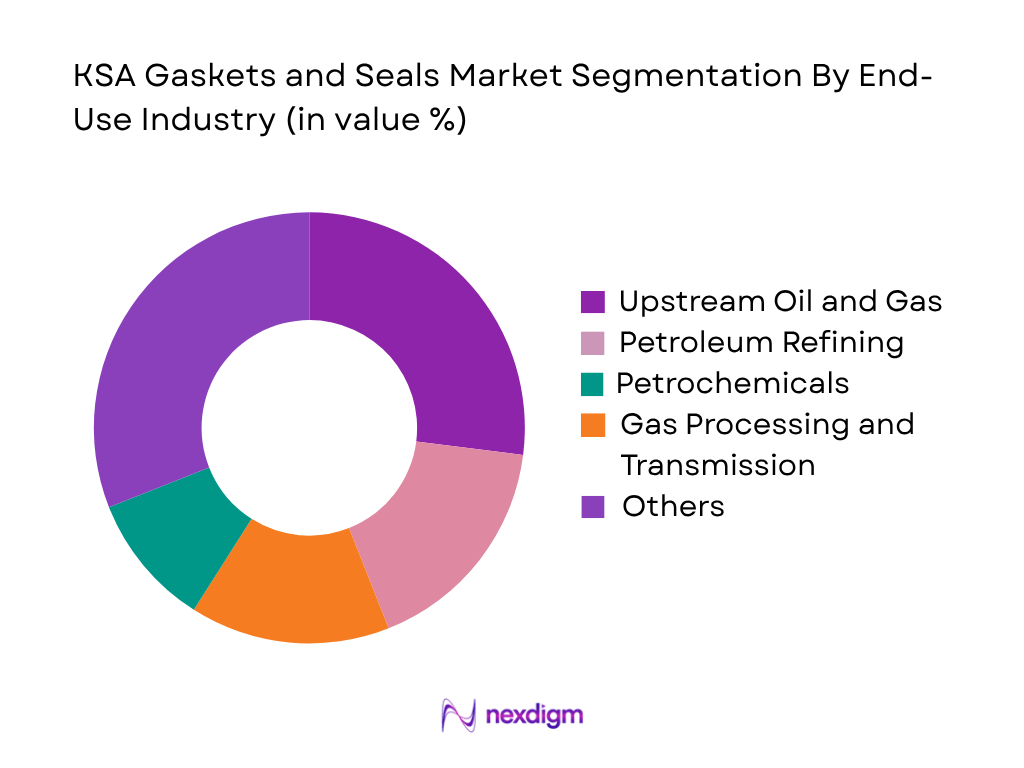
The KSA Gaskets and Seals Market is segmented into upstream oil and gas, gas processing, petroleum refining, petrochemicals, chemicals and fertilizers, power generation, desalination, mining, metals, marine and industrial manufacturing. Oil and gas represents the dominant report-model segment because the Kingdom’s hydrocarbon system operates an exceptionally large network of wells, processing facilities, pipelines, pumping stations and compressor trains. Aramco produced 12.403 million barrels of oil equivalent per day of hydrocarbons in 2024, including 10.292 million barrels per day of liquids and 10.833 billion standard cubic feet per day of gas. These operating volumes create continuous sealing requirements across flanged piping, valves, pressure equipment and rotating machinery. Refining and petrochemicals add significant secondary demand, while desalination is particularly mechanical-seal intensive because high-capacity pumps operate continuously in corrosive water service. Chemical compatibility, leakage control, rapid replacement availability and approved-material specifications therefore strongly shape supplier selection within the dominant hydrocarbon customer base.
Competitive Landscape
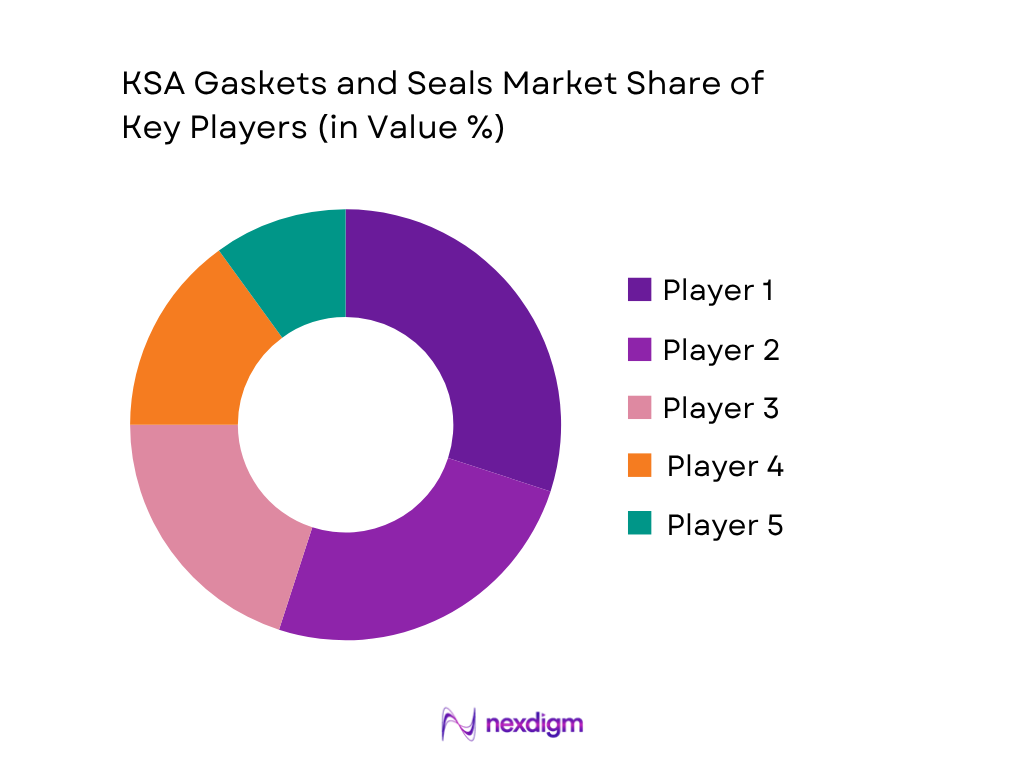
The KSA Gaskets and Seals Market combines established Saudi gasket manufacturers with domestic mechanical-seal engineering companies and international sealing specialists. Local participants are particularly competitive in spiral wound, ring-type joint, Kammprofile, soft-cut and emergency replacement gaskets, while global mechanical-seal companies differentiate through API-oriented pump and compressor technologies, seal-support systems and refurbishment capabilities. Dammam and Jubail form the core competitive service corridor because of proximity to oil, gas, refining and petrochemical customers. Al-Iman operates its gasket factory in Dammam, Gulf Gasket Factory manufactures from Dammam’s Second Industrial City, Arabian Seals is a Saudi mechanical-seal manufacturer based in Dammam, and EagleBurgmann maintains a Saudi location on the Jubail-Dammam Highway.
| Major Player | Establishment Year | Headquarters | Core Sealing Portfolio | KSA Manufacturing Capability | Critical-Service Capability | Oil & Gas / Petrochemical Exposure | Mechanical Seal Capability | Local Technical & MRO Support |
| Al-Iman Gasket Factory | 1988 | Dammam, KSA | ~ | ~ | ~ | ~ | ~ | ~ |
| Arabian Seals Company | 1990 | Dammam, KSA | ~ | ~ | ~ | ~ | ~ | ~ |
| Gulf Gasket Factory | 1993 | Dammam, KSA | ~ | ~ | ~ | ~ | ~ | ~ |
| AESSEAL | 1979 | Rotherham, UK | ~ | ~ | ~ | ~ | ~ | ~ |
| EagleBurgmann | Established global sealing group | Wolfratshausen, Germany | ~ | ~ | ~ | ~ | ~ | ~ |
KSA Gaskets and Seals Market Analysis
Growth Drivers
Expansion of Oil, Gas and Refining Operations Sustaining Critical Sealing Demand
Saudi Arabia’s large hydrocarbon-processing base is a direct growth driver for the KSA Gaskets and Seals Market because pumps, compressors, valves, heat exchangers, pressure vessels and flanged pipelines require recurring replacement of mechanical seals, spiral-wound gaskets, ring-type joints, packings and O-rings. Aramco reported 12.4 million barrels of oil equivalent per day of hydrocarbon production, 10.3 million barrels per day of liquids production and 10.8 billion standard cubic feet per day of gas production in 2024. The operating base expanded to 12.9 million barrels of oil equivalent per day, 10.7 million barrels per day of liquids and 11.4 billion standard cubic feet per day of gas in 2025. Aramco also maintained 4.1 million barrels per day of net refining capacity in 2024, rising to 4.2 million barrels per day in 2025. These operating volumes create recurring requirements for high-pressure, high-temperature and hydrocarbon-compatible sealing systems across process equipment. The World Bank recorded Saudi Arabia’s 2024 GDP at USD 1,239.8 billion and GDP per capita at USD 35,121.7, indicating the scale of the industrial economy supporting continued expenditure on process reliability, maintenance and engineered sealing products.
Petrochemical Production and Plant Maintenance Expanding Engineered Gasket and Seal Consumption
Saudi Arabia’s petrochemical manufacturing footprint provides another strong demand foundation for the KSA Gaskets and Seals Market because continuous-process chemical plants contain extensive populations of reactors, pumps, compressors, mixers, columns, heat exchangers and pressure piping. SABIC reported 35.6 million tonnes of chemical production and 22.1 million tonnes of chemical sales in 2024, alongside 9.9 million tonnes of polymer production and 15.8 million tonnes of polymer sales. Agri-nutrient production added another 8.4 million tonnes, demonstrating the breadth of Saudi process manufacturing requiring chemical-resistant static and dynamic sealing components. Mechanical seals are particularly important for rotating pumps handling hydrocarbons, solvents and process chemicals, while graphite, PTFE, metallic and semi-metallic gaskets are used across flanged joints and heat-transfer equipment exposed to demanding temperature and media conditions. The scale of petrochemical throughput also creates recurring replacement requirements during preventive maintenance and plant turnaround activity. This industrial demand is supported by Saudi Arabia’s broader macroeconomic capacity: the World Bank recorded USD 1,239.8 billion of GDP and USD 35,121.7 GDP per capita in 2024. Together, the petrochemical operating base and national industrial capacity support sustained demand for higher-specification sealing products rather than solely commodity gasket materials.
Market Challenges
Extreme Process Conditions Raise Qualification and Engineering Requirements for Sealing Products
A major challenge for the KSA Gaskets and Seals Market is the technical severity of Saudi hydrocarbon and petrochemical operations, where sealing components must withstand pressure, temperature, corrosive media, sour-gas exposure and continuous operation without compromising plant integrity. Aramco operated 7.7 million barrels per day of gross refining capacity and 4.1 million barrels per day of net refining capacity in 2024. Individual Saudi refining facilities included Ras Tanura at 550,000 barrels per day, SATORP at 460,000, YASREF at 430,000, Jazan at 400,000, SAMREF at 400,000, Petro Rabigh at 400,000 and SASREF at 305,000 barrels per day. Such operating environments demand precisely specified RTJ, spiral-wound, Kammprofile, graphite and alloy gaskets together with API-oriented mechanical-seal systems, compatible seal faces and engineered support systems. Suppliers therefore face considerable technical barriers involving material traceability, dimensional tolerances, testing, documentation, failure analysis and end-user qualification. Inadequate product selection can result in leakage or premature failure in critical process equipment. The World Bank recorded Saudi Arabia’s 2024 GDP at USD 1,239.8 billion and GDP per capita at USD 35,121.7, underscoring the large industrial economy in which sealing suppliers must meet increasingly sophisticated asset-reliability requirements.
Broad Product and Material Requirements Increase Inventory and Rapid-Supply Complexity
The KSA Gaskets and Seals Market faces substantial supply-chain complexity because Saudi industrial customers require thousands of combinations of flange dimensions, pressure classes, gasket constructions, elastomer compounds, seal-face materials and mechanical-seal configurations. The challenge is amplified by the geographical and technical breadth of the Kingdom’s process industries. Aramco’s Saudi refinery network alone includes facilities ranging from 130,000 barrels per day at Riyadh refinery to 550,000 barrels per day at Ras Tanura, alongside 250,000 barrels per day at Yanbu, 305,000 at SASREF, 400,000 each at Jazan, SAMREF and Petro Rabigh, 430,000 at YASREF and 460,000 at SATORP. Meanwhile, SABIC produced 35.6 million tonnes of chemicals, 9.9 million tonnes of polymers and 8.4 million tonnes of agri-nutrients in 2024, widening material-compatibility requirements across chemical services. Distributors and manufacturers must consequently maintain combinations of graphite, PTFE, elastomers, stainless steels, nickel alloys, silicon carbide and carbon-graphite components while providing rapid replacement during unplanned maintenance and shutdowns. The World Bank’s 2024 Saudi GDP of USD 1,239.8 billion and GDP per capita of USD 35,121.7 illustrate the scale of the underlying industrial economy, but servicing that scale requires considerable inventory planning, engineering expertise and local availability.
Market Opportunities
Localization of Gasket, Seal and Precision-Engineered Component Manufacturing
Domestic industrial localization presents a significant future opportunity for the KSA Gaskets and Seals Market because Saudi Arabia is expanding manufacturing activities directly relevant to metallic gaskets, elastomer seals, PTFE components and precision-machined sealing products. The Ministry of Industry and Mineral Resources reported 11,672 factories operating or under construction in the Kingdom at the end of January 2024 and issued 152 new industrial licenses during that month. Importantly for the sealing value chain, the licenses included 19 for fabricated metal-product manufacturing, 18 for rubber and plastic-product manufacturing and 14 for chemical and chemical-product manufacturing. These categories provide an industrial base for local spiral-wound gasket fabrication, RTJ machining, elastomer seal production, hydraulic-seal machining, polymer components and specialized sealing compounds. Localization can also improve emergency availability for refineries, gas processors, petrochemical plants and maintenance contractors that cannot tolerate extended replacement lead times. The opportunity is strengthened by the size of Saudi industrial activity and investment capacity. According to the World Bank, Saudi Arabia generated USD 1,239.8 billion in GDP in 2024, while GDP per capita reached USD 35,121.7. This combination of a large manufacturing base and significant macroeconomic capacity creates favorable conditions for additional Saudi-based sealing production, repair centers and engineered MRO services.
Expanding Gas Processing and Downstream Asset Base Creates Higher-Value Sealing Opportunities
The growing scale and complexity of Saudi gas and downstream infrastructure creates substantial future opportunity for suppliers of engineered mechanical seals, dry-gas seals, high-performance gaskets and seal-support systems. Aramco recorded 10.8 billion standard cubic feet per day of gas production in 2024, increasing to 11.4 billion standard cubic feet per day in 2025. Total hydrocarbon production simultaneously moved from 12.4 million barrels of oil equivalent per day to 12.9 million barrels of oil equivalent per day, while net refining capacity increased from 4.1 million barrels per day to 4.2 million barrels per day. These current operating indicators point to a larger population of compressors, centrifugal pumps, control valves, process piping and pressure equipment requiring reliable sealing throughout their service lives. The opportunity is particularly attractive for suppliers capable of API-oriented cartridge seals, compressor gas seals, metal bellows systems, high-alloy RTJs, flexible graphite gaskets and engineered seal-support packages. Local refurbishment, condition assessment and failure-analysis capabilities can further capture recurring maintenance expenditure from these assets. The World Bank recorded Saudi Arabia’s 2024 GDP at USD 1,239.8 billion and GDP per capita at USD 35,121.7, providing macroeconomic support for continued industrial asset development and advanced reliability solutions.
Future Outlook
The KSA Gaskets and Seals Market is forecast to expand at approximately ~XX% CAGR during 2026–2035, supported by continued gas processing investment, downstream integration, refinery maintenance, desalination infrastructure, industrial localization and expansion of domestic MRO capabilities. Future competition will increasingly shift from simple component supply toward engineered sealing systems, rapid-turnaround manufacturing, seal refurbishment, flange-integrity management and application-specific material engineering.
Gas processing provides one of the most significant future demand pathways. Aramco awarded more than USD 25 billion of contracts during 2024 for strategic gas expansion, including approximately USD 12.4 billion for the second phase of Jafurah and USD 8.8 billion for expansion of the Master Gas System. It separately awarded USD 7.7 billion of contracts for the Fadhili Gas Plant expansion, designed to raise processing capacity from 2.5 billion to as much as 4 billion standard cubic feet per day. These facilities contain compressors, pumps, process piping and pressure equipment requiring engineered mechanical seals, dry gas seals, spiral wound gaskets, RTJs and high-performance graphite and alloy sealing materials.
Major Players
- Al-Iman Gasket Factory
- Al-Etihad Gasket Factory
- Delmon Gasket Factory
- Saudi Bisan Gasket Factory
- Gulf Gasket Factory
- Arabian Seals Company
- AESSEAL Saudi Arabia
- EagleBurgmann Saudi Arabia
- KLINGER / Zamil Trade & Services
- Technical Seal Company
- Simple Solutions Co. for Industry
- SAB TECH
- Sama Integrated Trading Company
- Arabian Industrial Sealings Company
- Trelleborg Sealing Solutions
Key Target Audience
- Industrial Gasket Manufacturers
- Mechanical Seal and Rotating Equipment Sealing Manufacturers
- Oil, Gas, Refining and Petrochemical Operators
- EPC, Plant Maintenance and Turnaround Contractors
- Pump, Compressor, Valve and Rotating Equipment OEMs
- Industrial Distributors and MRO Supply Companies
- Investments and Venture Capitalist Firms
- Government and Regulatory Bodies (Ministry of Industry and Mineral Resources, Ministry of Energy, Saudi Standards Metrology and Quality Organization, Local Content and Government Procurement Authority, Royal Commission for Jubail and Yanbu, Saudi Water Authority)
Research Methodology
Step 1: Identification of Key Variables
The initial phase involves constructing an ecosystem map covering major stakeholders in the KSA Gaskets and Seals Market, including gasket manufacturers, mechanical-seal producers, elastomer processors, metallic raw-material suppliers, pump and compressor OEMs, EPC contractors, MRO providers and industrial end users. Critical variables include gasket consumption, installed rotating-equipment population, shutdown frequency, sealing material, pressure class, service temperature, end-use exposure and localization capability.
Step 2: Market Analysis and Construction
Historical market construction applies both top-down and bottom-up approaches. The top-down framework assesses Saudi oil and gas production, refinery capacity, gas-processing infrastructure, petrochemical assets, desalination plants and industrial development. The bottom-up model evaluates company revenues, gasket output, mechanical-seal installations, replacement activity, distributor sales, local manufacturing capacity and imported sealing-product volumes to build a consistent market framework.
Step 3: Hypothesis Validation and Expert Consultation
Market hypotheses are validated through CATI-based discussions and direct engagement with gasket manufacturers, mechanical-seal engineers, refinery maintenance personnel, rotating-equipment specialists, distributors and EPC contractors. Validation focuses on spiral wound and RTJ demand, API-oriented mechanical-seal usage, turnaround replacement cycles, material compatibility, vendor qualification, Saudi localization, emergency lead-time requirements and customer preferences for domestic versus imported engineered sealing products.
Step 4: Research Synthesis and Final Output
The final stage triangulates company disclosures, industrial statistics, oil and gas operating indicators, refinery asset data, manufacturing information and primary market inputs. Top-down industrial equipment demand is reconciled with bottom-up supplier sales and replacement activity. The resulting model provides a structured assessment of product segmentation, end-use exposure, competitive positioning, localization opportunities, MRO intensity and technological development across the KSA Gaskets and Seals Market.

- Executive Summary
- Research Methodology (Market Definition and Scope, KSA Gaskets and Seals Market Classification, Industrial Gasket Demand Assessment, Mechanical Seal Consumption Mapping, Hydraulic and Pneumatic Seal Demand Assessment, Domestic Manufacturing Capacity Assessment, Import Dependency Analysis, Graphite PTFE Elastomer and Metallic Raw Material Assessment, Gasket Cutting Winding and Precision Machining Technology Mapping, Installed Rotating Equipment Base Assessment, Replacement and MRO Demand Assessment, Plant Turnaround and Shutdown Demand Mapping, Application-Level Demand Assessment, End-Use Industry Demand Mapping, Primary Industry Interviews, Top-Down Market Sizing, Bottom-Up Company Revenue and Sales Volume Assessment, Trade Flow Analysis, Data Triangulation, Pricing Assessment, Forecasting Framework)

- Definition and Scope
- KSA Gaskets and Seals Industry Evolution and Development of Industrial Gaskets, Mechanical Seals, Hydraulic Seals, Pneumatic Seals and Engineered Fluid-Sealing Ecosystem
- Metallic Gasket, Semi-Metallic Gasket, Soft Gasket, Mechanical Seal, O-Ring, Hydraulic Seal, Compression Packing and Seal Support System Industry Structure
- KSA Gaskets and Seals Value Chain Analysis
- KSA Gaskets and Seals Supply Chain Analysis
- Metal and Alloy Supplier, Graphite and PTFE Material Supplier, Elastomer Compounder, Gasket Manufacturer, Mechanical Seal Manufacturer, Precision Seal Machining Provider, Distributor, MRO Contractor, EPC Contractor, Rotating Equipment OEM and Industrial
- End-User Ecosystem Analysis
- Gaskets and Seals Integration Across Upstream Oil and Gas, Gas Processing, Refineries, Petrochemicals, Chemicals, Power Generation, Desalination, Water Treatment, Mining, Metals, Marine and General Manufacturing Applications

- Growth Drivers (Large Upstream Oil and Gas Equipment Installed Base, Refinery and Petrochemical Maintenance Demand, High Replacement Gasket Consumption During Plant Turnarounds, Mechanical Seal Demand from Pumps and Compressors, Expansion of Desalination and Water Infrastructure, Asset Reliability and Leakage-Control Requirements, Mining and Metals Processing Development, IKTVA-Driven Localization of Industrial Components, Growth of Domestic Precision Manufacturing)
- Market Challenges (Dependence on Imported Specialty Seal Materials, Qualification Requirements for Critical Hydrocarbon Service, Price Competition in Standard Gasket Categories, Counterfeit and Non-Compliant Sealing Products, Extreme Temperature Pressure and Corrosive-Service Requirements, Long Vendor Approval Cycles, Inventory Complexity Across Sizes Materials and Pressure Classes, Emergency Shutdown Lead-Time Requirements, Skilled Seal Repair and Failure-Analysis Requirements)
- Market Opportunities (Localization of Mechanical Seal Manufacturing, Expansion of Saudi Gasket Production, Dry Gas Seals for Compressors, Low-Emission Gasket and Packing Solutions, Hydrogen and Low-Carbon Process Sealing, Desalination Pump Sealing Systems, Mining Slurry and Abrasion-Resistant Seals, Rapid CNC Manufacturing of Hydraulic Seals, Turnaround Gasket Management Services, Flange Integrity and Bolting Services, Seal Refurbishment and Repair Centers, Local Production of High-Alloy Ring Joint and Kammprofile Gaskets)
- Market Trends (Cartridge Mechanical Seal Adoption, Dry Gas Seal Technology, Low-Emission Spiral Wound Gaskets, ePTFE and High-Purity Graphite Materials, API-Compliant Ring Joint Gaskets, Predictive Seal Condition Monitoring, Local Seal Refurbishment, CNC-On-Demand Seal Manufacturing, Flange Management Services, Advanced Seal Support Systems, High-Performance Elastomers, Saudi Localization of Critical MRO Components)
- Regulatory and Standards Landscape (Saudi Aramco Engineering and Material Requirements, Saudi Aramco Approved Manufacturer Requirements, API 6A Ring Joint Requirements, API 682 Mechanical Seal Requirements, ASME B16.20 Metallic Gasket Requirements, ASME B16.21 Nonmetallic Gasket Requirements, ASME PCC-1 Bolted Flange Joint Requirements, ISO Mechanical Seal and Quality Management Requirements, SASO Product Compliance, IKTVA and Local Content Requirements)
- SWOT Analysis
- Porter’s Five Forces Analysis
- PESTLE Analysis
- Stakeholder Ecosystem
- Competition Ecosystem

- By Market Value (2020-2025)
- By Gasket Consumption Volume (2020-2025)
- By Mechanical Seal Consumption Volume (2020-2025)
- By Hydraulic and Pneumatic Seal Consumption Volume (2020-2025)
- By Domestic Gaskets and Seals Production Value (2020-2025)
- By Domestic Gaskets and Seals Production Volume (2020-2025)
- By Gaskets and Seals Import Value (2020-2025)
- By Average Selling Price (2020-2025)

- By Product Category (In Value %)
Industrial Gaskets
Mechanical Seals
Hydraulic Seals
Pneumatic Seals
Rotary Shaft and Oil Seals
O-Rings and Backup Rings
Compression and Gland Packings
Seal Support Systems and Auxiliary Components - By Gasket Type (In Value %)
Spiral Wound Gaskets
Ring Type Joint Gaskets
Kammprofile and Grooved Gaskets
Metal Jacketed Gaskets
Heat Exchanger Gaskets
Compressed Non-Asbestos Fibre Gaskets
Flexible Graphite Gaskets
PTFE and ePTFE Gaskets
Rubber and Elastomeric Gaskets
Flange Insulation Gasket Kits - By Seal Type (In Value %)
Single Mechanical Seals
Dual and Double Mechanical Seals
Cartridge Mechanical Seals
Dry Gas Compressor Seals
Split Mechanical Seals
Metal Bellows Seals
Agitator and Mixer Seals
Hydraulic Piston and Rod Seals
Pneumatic Seals
Rotary Shaft and Oil Seals - By Material Type (In Value %)
Flexible Graphite
Expanded PTFE and Filled PTFE
Compressed Non-Asbestos Fibre
Stainless Steel
Soft Iron and Carbon Steel
Nickel-Based and Corrosion-Resistant Alloys
NBR
HNBR
EPDM
FKM and Fluoroelastomer
Polyurethane
Engineered Thermoplastics
Silicon Carbide
Tungsten Carbide
Carbon-Graphite Seal Faces - By End-Use Industry (In Value %)
Upstream Oil and Gas
Gas Processing and Transmission
Petroleum Refining
Petrochemicals
Chemical and Fertilizer Manufacturing
Power Generation
Desalination
Water and Wastewater Treatment
Mining and Mineral Processing
Metals and Aluminium
Marine and Shipyard Operations
Industrial Manufacturing
Construction and Building Systems
Food and Pharmaceutical Processing

- Market Share of Major Players (By KSA Revenue, Gasket Sales Volume, Mechanical Seal Sales Volume, Product Category, Material Type, End-Use Industry, KSA Manufacturing and Distribution Footprint, MRO and Service Coverage)
- Cross Comparison Parameters (KSA Gaskets and Seals Revenue, Industrial Gasket and Dynamic Seal Portfolio Breadth, High-Pressure High-Temperature and Corrosive-Service Capability, Saudi Aramco API and Major End-User Qualification Coverage, KSA Manufacturing and Precision Machining Capability, Oil Gas Petrochemical Desalination and Power Customer Exposure, KSA Distribution Repair and Shutdown-Service Footprint, Seal Engineering Failure Analysis and On-Site Technical Support Capability)
- SWOT Analysis of Major Players
- Competitive Positioning Matrix
- Pricing and Sealing Product Category Benchmarking
- Detailed Profiles of Major Companies
Al-Iman Gasket Factory – Spiral Wound, Ring Joint, Kammprofile, Metal Jacketed, Graphite, PTFE and Non-Metallic Industrial Gaskets
Al-Etihad Gasket Factory – Spiral Wound, Ring Joint, Kammprofile, Soft-Cut Gaskets, Sealing Sheets and Industrial Gasket Solutions
Delmon Gasket Factory – Spiral Wound Gaskets, Flange Insulation Sets, Soft-Cut Gaskets, Ring Joints and Heat Exchanger Gaskets
Saudi Bisan Gasket Factory – Spiral Wound, Ring Joint, Metal Jacketed, Kammprofile, Non-Metallic Gaskets and Flange Insulation Kits
Gulf Gasket Factory – Spiral Wound, Ring Type Joint, Double Jacketed, Heat Exchanger and Industrial Fluid-Sealing Products
Arabian Seals Company – Mechanical Seals, Seal Support Systems, Precision Engineering and Rotating Equipment Sealing Solutions
AESSEAL Saudi Arabia – Mechanical Seals, Seal Support Systems, Seal Refurbishment and Engineered Rotating Equipment Solutions
EagleBurgmann Saudi Arabia – Pump and Compressor Mechanical Seals, Dry Gas Seals, Seal Supply Systems and Industrial Seal Services
KLINGER / Zamil Trade & Services – Industrial Gaskets, Graphite, PTFE, CNAF Sealing Materials, Flange Management and Bolting Services
Technical Seal Company – Rubber Sealing Profiles, Extruded Gaskets and Industrial Sealing Solutions
Simple Solutions Co. for Industry – Hydraulic and Pneumatic Seals, O-Rings, Hose Assemblies and Maintenance Solutions
SAB TECH – CNC-Manufactured Hydraulic and Pneumatic Seals, Piston Seals, Rod Seals, Rotary Seals and Wipers
Sama Integrated Trading Company – CNC Hydraulic Seals, Oil Seals, Pneumatic Seals, O-Rings and Customized Sealing Components
Arabian Industrial Sealings Company – Ring Joint Gaskets, O-Rings, Industrial Gaskets and Oil and Gas Sealing Products
Trelleborg Sealing Solutions – Engineered Elastomeric, Hydraulic, Rotary and Specialty Sealing Solutions

- Saudi Aramco and Upstream Operator Gasket and Seal Procurement Assessment
- Refinery Gasket and Mechanical Seal Requirement Analysis
- Petrochemical and Chemical Plant Sealing Requirement Assessment
- Gas Processing and Compressor Seal Procurement Analysis
- Power Generation Mechanical Seal and Gasket Requirement Assessment
- Desalination Plant Pump Seal and Flange Gasket Requirement Analysis
- Mining and Metals Processing Abrasion-Resistant Seal Assessment
EPC Contractor Project Gasket and Seal Procurement Analysis - Plant Turnaround and MRO Contractor Sealing Product Requirement Assessment
- Rotating Equipment OEM Mechanical Seal Integration Assessment

- By Market Value (2026-2035)
- By Gasket Consumption Volume (2026-2035)
- By Mechanical Seal Consumption Volume (2026-2035)
- By Hydraulic and Pneumatic Seal Consumption Volume (2026-2035)
- By Domestic Gaskets and Seals Production Value (2026-2035)
- By Domestic Gaskets and Seals Production Volume (2026-2035)
- By Gaskets and Seals Import Value (2026-2035)
- By Average Selling Price (2026-2035)


 Request a Sample
 Ask for Customization
 Get a Quote
 Enquire Now