
 Download PDF
Market Overview
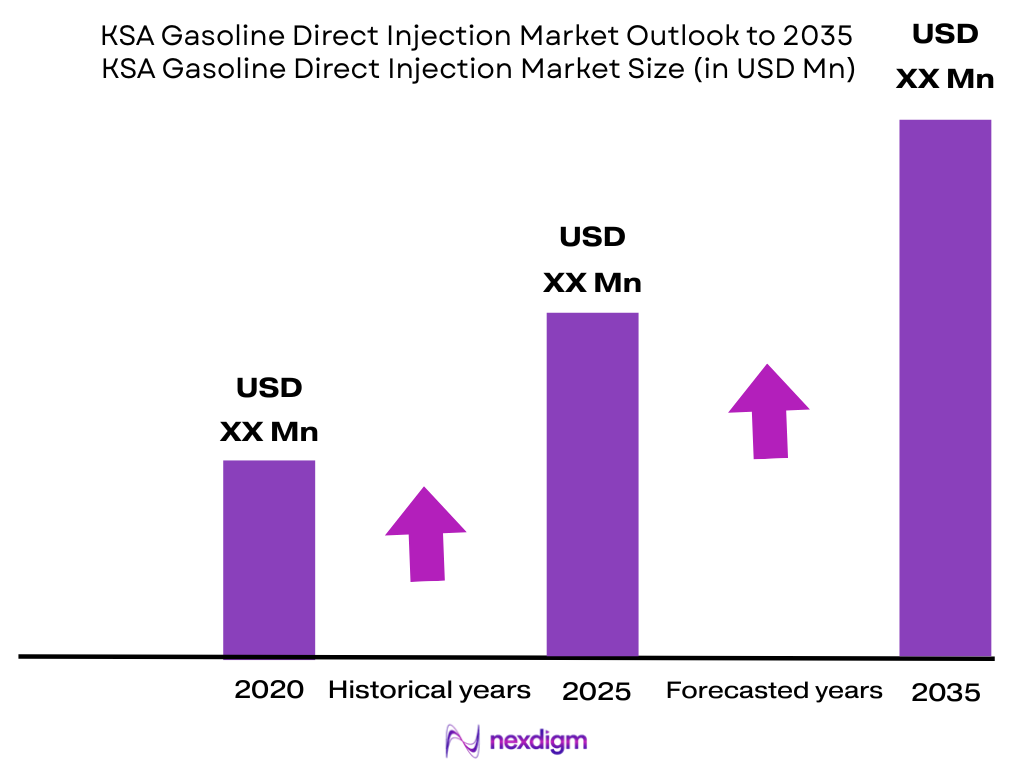
The KSA Gasoline Direct Injection Market is valued at approximately USD ~ million, retained as a placeholder for the requested market model because an audited Saudi-specific GDI revenue series is not publicly reported. The underlying addressable automotive base increased from 15.1 million registered and roadworthy vehicles to more than 15.8 million vehicles, while new vehicle registrations exceeded 1 million units in the latest annual observation. This supports demand for injectors, high-pressure pumps, rails, sensors and electronic controls. Riyadh, Jeddah, Dammam–Khobar and King Abdullah Economic City form the most important KSA Gasoline Direct Injection Market demand and supply centres because they combine large vehicle populations, dealership networks, parts distribution, logistics infrastructure and emerging automotive manufacturing. King Abdullah Economic City is becoming particularly strategic as Hyundai’s new plant is planned to manufacture both internal-combustion and electric vehicles, with initial output targeted at 50,000 vehicles annually, reinforcing the western automotive manufacturing corridor.
Market Segmentation
By Component Type
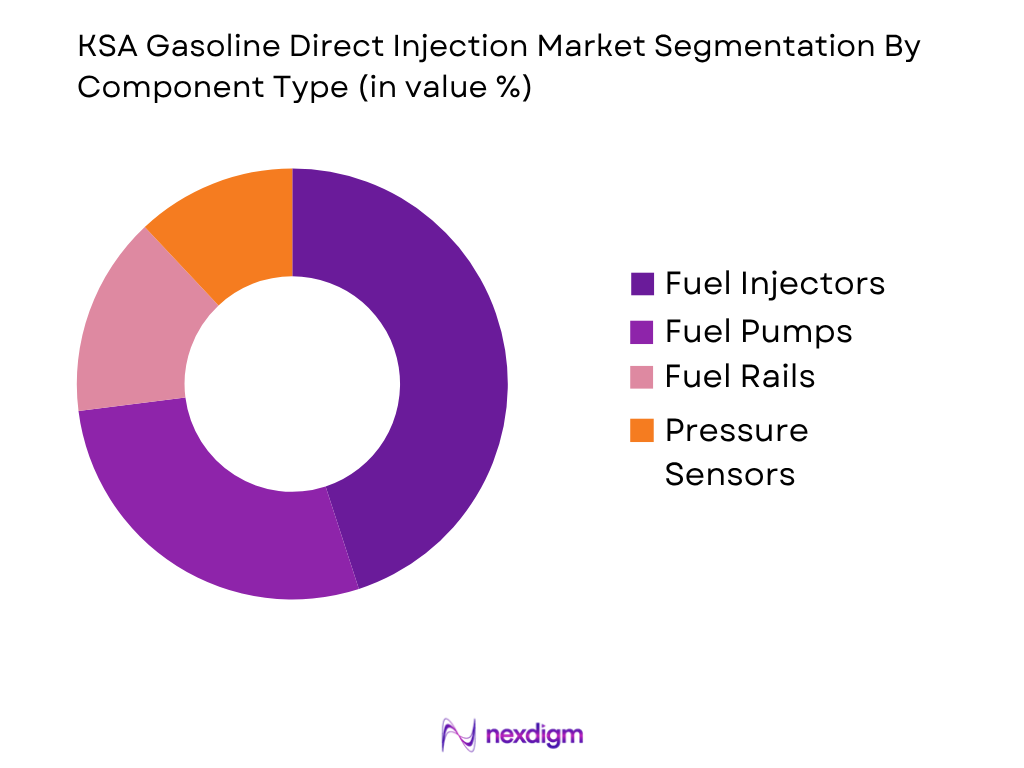
The KSA Gasoline Direct Injection Market is segmented into high-pressure fuel injectors, high-pressure fuel pumps, fuel rails, pressure sensors and control valves, and electronic/supporting components. High-pressure fuel injectors hold the dominant modelled market share because every GDI cylinder requires an injector that precisely meters and atomises gasoline directly inside the combustion chamber. Saudi Arabia’s substantial SUV, crossover and premium gasoline vehicle base also favours multi-cylinder turbocharged applications, increasing injector content per vehicle. Modern systems illustrate the growing technological intensity of this component: Bosch commercial injectors operate at up to 350 bar, PHINIA offers GDI injectors at 500+ bar, and Stanadyne has developed technologies scalable toward 1,000 bar. These pressure levels demand precision nozzle machining, accurate electrical response, controlled spray geometry and resistance to thermal cycling. High-pressure pumps form the second-largest segment because they create the rail pressure necessary for direct injection, while rails, sensors and control valves maintain pressure stability during rapidly changing engine loads.
By Powertrain Type
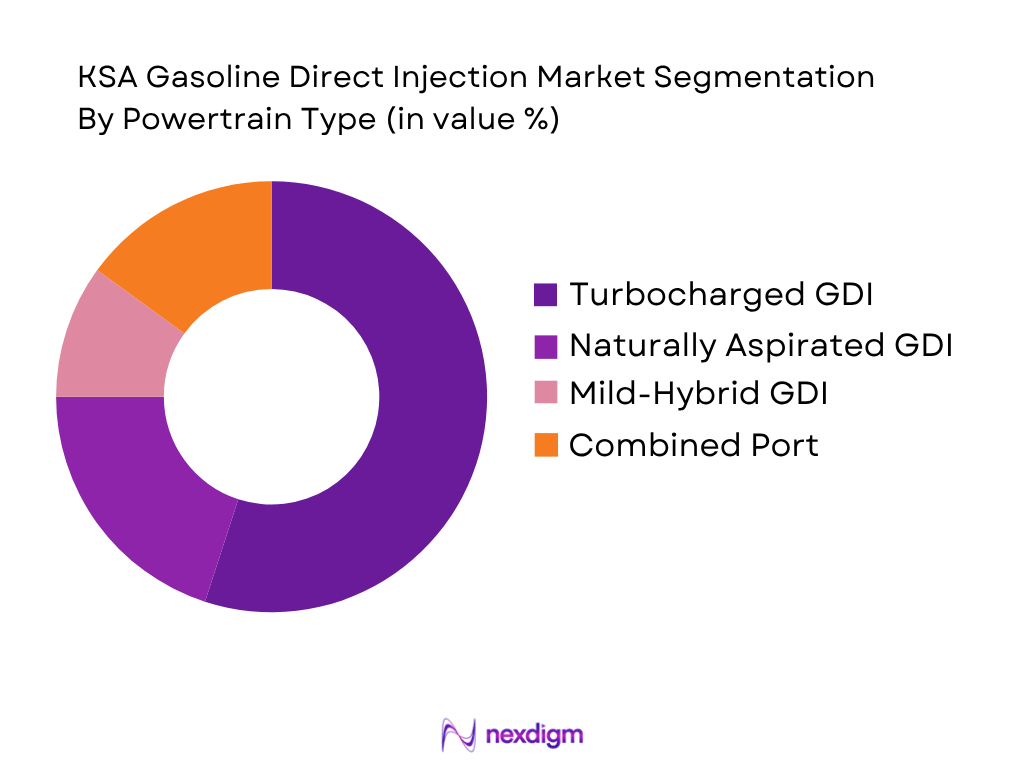
The KSA Gasoline Direct Injection Market is segmented into turbocharged GDI, naturally aspirated GDI, mild-hybrid GDI, strong-hybrid GDI and combined port/direct-injection systems. Turbocharged GDI represents the dominant modelled segment because Saudi Arabia has a large addressable base of SUVs, crossovers, premium sedans and performance vehicles in which automakers increasingly combine turbocharging with direct injection. The architecture provides higher specific output from smaller engines while direct in-cylinder injection improves charge cooling and mixture formation. Saudi fuel availability supports differentiated gasoline applications: Saudi Aramco currently supplies PG91, PG95 and PG98, with PG98 specifically positioned for high-performance and sports vehicles. Higher-pressure technology also supports increasingly demanding turbo applications; Bosch systems operate at up to 350 bar, PHINIA supplies 350-bar and 500+ bar pumps, and Astemo offers gasoline high-pressure pumps capable of 50 MPa. Hybrid-GDI applications are becoming strategically relevant as Saudi Arabia simultaneously expands electrified vehicle manufacturing and retains internal-combustion production.
Competitive Landscape
The KSA Gasoline Direct Injection Market is technologically concentrated among global Tier-1 fuel-system suppliers because injector manufacturing, pump design, pressure control, calibration and durability validation require specialised intellectual property and precision production. Bosch, PHINIA/Delphi, Astemo, DENSO and Stanadyne represent important suppliers or technology developers across high-pressure gasoline injection. Competitive differentiation increasingly centres on maximum system pressure, injector response, pump flow, integrated fuel-rail capability, hybrid compatibility and the ability to support turbocharged and performance engines under high-temperature operating conditions.
| Major Player | Establishment | Headquarters | GDI Injector Capability | High-Pressure Pump Capability | Pressure Positioning | Fuel Rail/System Integration | Hybrid Readiness | Relevant Market Positioning |
| Robert Bosch GmbH | 1886 | Gerlingen, Germany | ~ | ~ | ~ | ~ | ~ | ~ |
| DENSO Corporation | 1949 | Kariya, Japan | ~ | ~ | ~ | ~ | ~ | ~ |
| PHINIA / Delphi | 2023 as PHINIA | Auburn Hills, USA | ~ | ~ | ~ | ~ | ~ | ~ |
| Astemo Ltd. | 2021 | Tokyo, Japan | ~ | ~ | ~ | ~ | ~ | ~ |
| Stanadyne | 1873 | Jacksonville, USA | ~ | ~ | ~ | ~ | ~ | ~ |
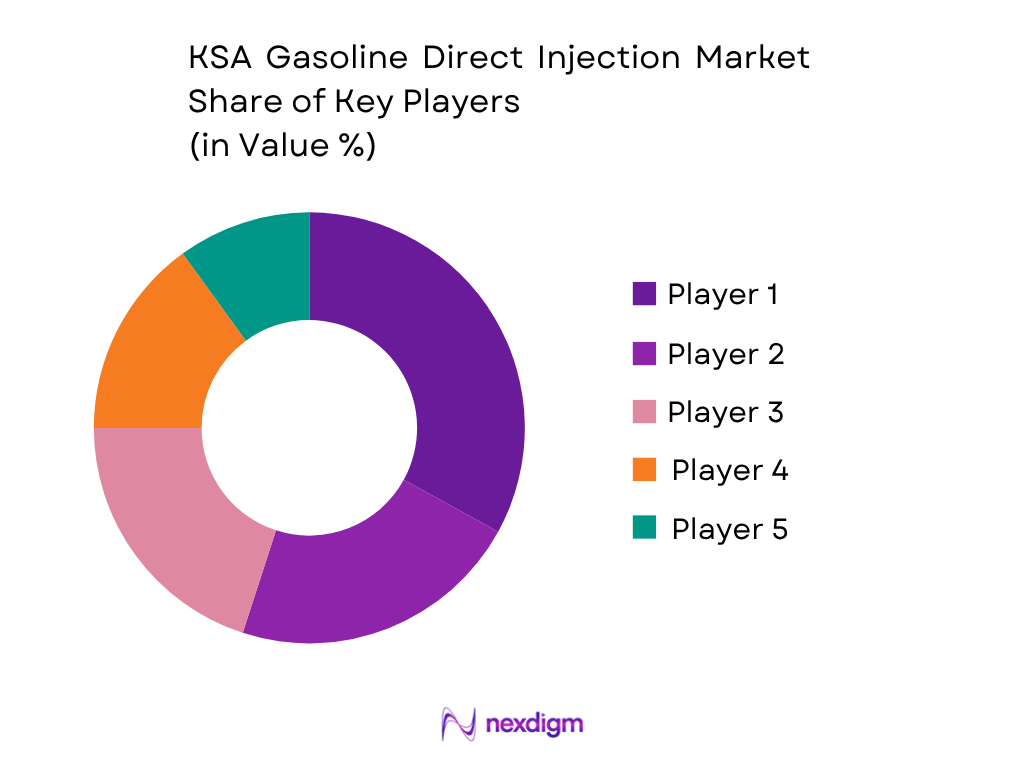
KSA Gasoline Direct Injection Market Analysis
Growth Drivers
Expanding Vehicle Parc and Gasoline Passenger-Vehicle Demand
Saudi Arabia’s expanding vehicle base is strengthening demand for gasoline direct injection components across passenger cars, SUVs, crossovers and performance vehicles. The General Authority for Statistics reported that the Kingdom had more than 15.8 million registered vehicles in use at the end of 2024, creating a substantial installed base requiring fuel injectors, high-pressure pumps, rails, sensors and replacement components. The Ministry of Investment’s automotive sector platform additionally records approximately 860,000 vehicles sold in Saudi Arabia during 2024, demonstrating the scale of annual vehicle additions. These fundamentals are reinforced by national purchasing power: World Bank data place Saudi Arabia’s 2024 GDP at approximately USD 1.24 trillion and GDP per capita at about USD 35,122, while the IMF records a population of 35.3 million people in 2024. The relevance to GDI is direct because many modern gasoline SUVs and passenger vehicles use downsized turbocharged engines requiring cylinder-mounted injectors operating alongside electronically controlled high-pressure pumps. As the active vehicle parc expands, the replacement pool for injectors, pumps and pressure-control hardware also increases. Saudi driving conditions—including long-distance highway operation, intensive air-conditioning use and high engine loads—further make precise fuel delivery and dependable rail-pressure management important for maintaining combustion performance.
Automotive Industrialization and Local Manufacturing Ecosystem
Saudi Arabia’s automotive industrialization programme is creating a structural driver for the GDI ecosystem because the Kingdom is moving from predominantly vehicle importation toward domestic production, supplier localisation and automotive engineering capability. The Public Investment Fund’s joint venture with Hyundai is designed to manufacture 50,000 vehicles annually, including both internal-combustion and electric vehicles, with production scheduled to begin in 2026. The Ministry of Investment also identifies a longer-term industrial objective of producing more than 600,000 vehicles annually, demonstrating the scale of the manufacturing platform being constructed. This industrial transition occurs within a large non-oil economy: the IMF reported that Saudi Arabia’s non-oil activities continued expanding strongly through 2024 and 2025, while World Bank data place total 2024 GDP at approximately USD 1.24 trillion. For GDI suppliers, local ICE production can create demand for high-pressure fuel rails, lines, pump housings, sensors, injector connectors and eventually precision injection assemblies. Automotive plants also attract Tier-1 and Tier-2 suppliers, testing laboratories, machining companies and electronics manufacturers. This ecosystem matters because GDI production requires extremely accurate metal processing, contamination control and electronic calibration. Saudi localisation therefore provides a pathway for the market to evolve from imported finished systems toward locally integrated gasoline fuel-delivery components supporting both conventional and hybrid combustion platforms.
Market Challenges
Rapid Development of the Domestic Electric-Vehicle Ecosystem
The principal strategic challenge for Saudi Arabia’s Gasoline Direct Injection Market is the rapid build-out of domestic electric-vehicle manufacturing because battery-electric vehicles eliminate injectors, high-pressure gasoline pumps, fuel rails and gasoline engine-management hardware entirely. Saudi Arabia is committing substantial industrial resources to this competing propulsion architecture. Ceer awarded a SAR 5 billion construction contract for its electric-vehicle manufacturing complex in King Abdullah Economic City in 2024. By February 2026, Ceer had signed another 16 agreements worth more than SAR 3.7 billion to deepen its domestic automotive supply chain. Lucid is simultaneously developing manufacturing activity in Saudi Arabia, while its global production reached 17,840 vehicles during 2025, with additional vehicles transferred to Saudi Arabia for final assembly. The challenge emerges within an otherwise expanding economy: the IMF reported Saudi GDP growth strengthening in 2025, while the World Bank records approximately 35.3 million residents in 2024 and a sizeable consumer economy. Consequently, future vehicle demand can increase without creating equivalent growth in gasoline injection demand. GDI manufacturers therefore face platform-allocation risk: investments in injectors, pumps and rails must increasingly target turbocharged gasoline vehicles and gasoline hybrids rather than assuming all new passenger vehicles will carry combustion engines. The shift also forces distributors and workshops to balance inventories between conventional GDI components and rapidly expanding electrified-powertrain product categories.
High Technical Complexity and Limited Precision-Fuel-System Localisation
GDI localisation remains technically challenging because high-pressure gasoline systems require considerably tighter manufacturing tolerances than many conventional automotive components. Injectors must deliver accurately metered fuel directly into combustion chambers repeatedly across changing temperature and engine-load conditions, while high-pressure pumps and rails must maintain stable pressure without leakage. Saudi Arabia’s automotive manufacturing base is expanding rapidly, but its local supplier ecosystem is still developing. The Hyundai-PIF manufacturing venture is designed for 50,000 vehicles per year, while Ceer reported 16 localisation agreements valued above SAR 3.7 billion in 2026, illustrating substantial industrial investment but also the ongoing process of building domestic component capability. Saudi Arabia also had more than 15.8 million vehicles in operation at the end of 2024, meaning the aftermarket must support many engine families originating from Japan, Korea, Europe, the United States and China. That diversity creates diagnostic and inventory complexity for GDI injectors and pumps because specifications vary by engine family and manufacturer. Macroeconomic capacity is not the primary constraint: World Bank data place national GDP at approximately USD 1.24 trillion in 2024, indicating substantial investment capability. The constraint is technical depth—precision machining, injector-flow calibration, high-pressure leak testing, particulate-cleanliness control and durability validation. Until those capabilities become widely localised, sophisticated injector nozzles, actuators and pump internals are likely to remain more dependent on international Tier-1 supply chains.
Market Opportunities
Hybrid and Advanced Gasoline Powertrain Localization
Saudi Arabia has a significant opportunity to position GDI technology within hybrid and advanced internal-combustion platforms rather than treating gasoline injection and electrification as mutually exclusive technologies. The Hyundai-PIF joint venture will have capacity for 50,000 vehicles annually and explicitly includes both internal-combustion and electric vehicles, creating an industrial platform capable of supporting multiple propulsion architectures from 2026. Meanwhile, approximately 860,000 vehicles were sold nationally in 2024, according to the Ministry of Investment’s automotive platform, providing a large domestic demand base in which gasoline, hybrid and electric technologies can coexist. World Bank data show Saudi Arabia generated approximately USD 1.24 trillion of GDP in 2024, while the IMF records 35.3 million residents for the same period, demonstrating the economic and demographic scale available to support differentiated passenger-vehicle technologies. Hybrid-GDI creates particular opportunity because a hybrid vehicle retains injectors, pumps and fuel rails while demanding more precise combustion management during frequent engine starts, short operating cycles and rapid transitions between electric and combustion propulsion. Saudi suppliers could initially localise rails, pressure lines, pump housings, connectors and electronic modules before progressing toward higher-precision assemblies. International OEM programmes can also provide engineering standards and production discipline. This creates a future-growth pathway for GDI even as Saudi Arabia simultaneously expands EV manufacturing, allowing fuel-system suppliers to concentrate on technologically advanced gasoline applications rather than conventional low-value combustion systems.
Global Partnerships and Development of a Domestic Precision-Component Supply Base
Saudi Arabia’s growing network of international automotive partnerships creates an opportunity to transfer manufacturing expertise into high-pressure gasoline fuel-system components. PIF’s Hyundai partnership combines local investment with global OEM technology and is structured around a plant capable of manufacturing 50,000 vehicles annually. Saudi Arabia is simultaneously developing the King Salman Automotive Cluster and attracting international Tier-1 suppliers across body systems, seating, tires, engineering and other automotive components. Ceer reported partnerships with 263 local companies carrying approximately SAR 6.6 billion of awarded business in 2025, followed by another 16 agreements worth more than SAR 3.7 billion in 2026. Although many of these projects are EV-focused, the industrial infrastructure they create—precision machining, automated production, quality control, electronics integration and supplier certification—can also support GDI production. Saudi Arabia’s active fleet of more than 15.8 million registered vehicles in 2024 provides an immediate aftermarket base alongside future OEM opportunities. Macroeconomic conditions reinforce the investment case: World Bank data record approximately USD 1.24 trillion in national GDP during 2024, while the IMF reported continued momentum in the non-oil economy through 2025 and into 2026. The practical opportunity is progressive localisation—starting with fuel rails, high-pressure tubing, housings, seals and test services, then advancing toward injector calibration, pump assembly and high-precision components through technology partnerships with established international fuel-system manufacturers.
Future Outlook
The KSA Gasoline Direct Injection Market is forecast to expand at approximately ~ CAGR during 2026–2035, retained as a placeholder for the final forecasting model. The market will increasingly move away from conventional low-pressure gasoline injection toward turbo-GDI, higher injection pressures, hybrid-compatible systems and electronically integrated fuel delivery. Saudi Arabia’s domestic automotive industrialisation creates an additional long-term demand channel. The National Industrial Development Center’s Automotive Cluster targets 3–4 OEMs producing more than 400,000 passenger vehicles, while targeting 40% local gross value added. This creates scope for progressively localising fuel-system supporting components, testing, electronics integration and associated automotive supply-chain activities.
Hyundai’s Saudi manufacturing project is particularly important because its announced output mix includes both internal-combustion engines and electric vehicles, rather than being exclusively battery-electric. The plant targets 50,000 vehicles of annual capacity, providing a direct potential route for local suppliers serving combustion and electrified-combustion powertrains. Fuel quality should support newer gasoline-engine technologies. Saudi Aramco supplies PG91, PG95 and PG98 fuels, while Saudi Arabia introduced Euro 5-compliant gasoline and diesel nationwide. Higher-quality fuels and multiple octane grades enable OEMs to calibrate turbocharged and performance GDI vehicles around increasingly sophisticated combustion strategies. The principal structural risk will remain battery-electric substitution. Saudi Arabia is simultaneously developing an EV manufacturing ecosystem through Lucid and Ceer, meaning GDI suppliers will increasingly need to concentrate on applications where combustion systems retain competitive relevance—particularly hybrids, premium SUVs, high-performance engines and larger gasoline vehicles.
Major Players
- Robert Bosch GmbH
- DENSO Corporation
- PHINIA / Delphi
- Astemo Ltd.
- Marelli
- Stanadyne
- Aisan Industry Co., Ltd.
- Mikuni Corporation
- AUMOVIO
- TI Fluid Systems
- AISIN Corporation
- Schaeffler Group
- Standard Motor Products
- GB Remanufacturing
- Motorcar Parts of America
Key Target Audience
- Gasoline Direct Injection System Manufacturers
- High-Pressure Fuel Injector and Pump Manufacturers
- Passenger Vehicle and Powertrain OEMs
- Automotive Tier-1 and Precision Component Manufacturers
- Automotive Importers, Distributors and Aftermarket Companies
- Vehicle Assembly and Automotive Industrial-Zone Investors
- Investments and Venture Capitalist Firms
- Government and Regulatory Bodies (Ministry of Industry and Mineral Resources, National Industrial Development Center, Saudi Standards, Metrology and Quality Organization, Ministry of Commerce, Ministry of Energy, Zakat Tax and Customs Authority)
Research Methodology
Step 1: Identification of Key Variables
The initial phase constructs a KSA GDI ecosystem covering imported vehicle OEMs, domestic assemblers, authorised distributors, fuel-system Tier-1 suppliers, aftermarket distributors and specialist workshops. Core variables include gasoline vehicle parc, new registrations, turbo-GDI fitment, engine displacement, cylinder count, injection pressure, hybridisation, premium-vehicle penetration and component replacement behaviour.
Official road-transport information from GASTAT is used to establish the vehicle base, while government automotive-industrial plans are used to assess future localisation. Supplier technical documentation defines injector, pump and fuel-rail capability boundaries.
Step 2: Market Analysis and Construction
The top-down model begins with registered and newly registered Saudi vehicles and isolates gasoline-engine platforms using direct injection. The addressable GDI vehicle pool is then converted into component requirements using cylinders per engine, injectors per cylinder, pumps per vehicle, fuel rails and related pressure-control components. The bottom-up assessment maps major passenger-vehicle engines against known GDI architecture and supplier specifications. Benchmarks ranging from Bosch’s 350-bar systems to PHINIA’s 500+ bar systems and Stanadyne’s higher-pressure technology provide the basis for pressure and technology segmentation.
Step 3: Hypothesis Validation and Expert Consultation
Market hypotheses are validated through CATIs with authorised vehicle distributors, gasoline-engine specialists, Tier-1 component suppliers, parts importers, independent workshops and performance-vehicle specialists. Interviews evaluate turbo-GDI penetration, supplier nomination, injector and pump replacement, fuel-quality sensitivity, hot-climate performance and genuine-versus-aftermarket component selection. These interviews additionally test assumptions around hybrid-GDI adoption, high-pressure system migration, local manufacturing feasibility and the extent to which domestic automotive assembly could create component-sourcing opportunities.
Step 4: Research Synthesis and Final Output
The final model triangulates GASTAT road-transport data, Saudi automotive-industrial policy, fuel specifications, OEM engine mapping, supplier documentation and primary interviews. Separate demand models are developed for naturally aspirated GDI, turbo-GDI, hybrid-GDI, combined port/direct injection and performance applications.
Forecast scenarios incorporate vehicle registrations, domestic manufacturing, high-pressure technology migration, premium SUV demand, hybridisation, component replacement, localisation and battery-electric substitution. This creates both a vehicle-level and component-level assessment of the KSA Gasoline Direct Injection Market.

- Executive Summary
- Research Methodology (Market Definitions and Assumptions, GDI System Boundary, Abbreviations, Top-Down Vehicle Platform Analysis, Bottom-Up Component Demand Analysis, Engine Family Mapping, GDI Fitment Assessment, Injectors per Engine Assessment, Pump and Rail Fitment Analysis, OEM Demand Assessment, Aftermarket Demand Assessment, Import Supply Assessment, Primary Industry Interviews, Distributor Interviews, Workshop Interviews, Data Triangulation, Forecasting Framework, Limitations and Future Conclusions)

- Definition and Scope
- Evolution from Port Fuel Injection to Gasoline Direct Injection
- Evolution of Naturally Aspirated Engines to Turbo-GDI Engines
- Saudi Gasoline Passenger Vehicle Ecosystem
- SUV and Crossover Powertrain Ecosystem

- Growth Drivers (SUV Penetration, Turbocharged Gasoline Engines, Premium Vehicle Demand, Engine Downsizing, High-Octane Fuel Availability, Hybrid-GDI Adoption, Automotive Localization, Vehicle Parc Expansion)
- Market Challenges (EV Substitution, Import Dependency, Extreme Heat, Injector Deposits, Pump Wear, Diagnostic Complexity, Counterfeit Parts, Technology Obsolescence)
- Market Opportunities (Higher Injection Pressure, Hybrid GDI, Localization, Remanufacturing, Diagnostics, Performance Upgrades, Regional Distribution, Supplier Partnerships)
- Market Trends (Higher Injection Pressure, Multiple Injection, Dual Injection, Turbo-Hybrid Engines, Digital Diagnostics, Integrated Rails, Performance Calibration, Localization)
- SWOT Analysis
- Porter’s Five Forces Analysis
- PESTLE Analysis

- By Market Value (2020-2025)
- By GDI System Volume (2020-2025)
- By GDI-Equipped Vehicle Volume (2020-2025)

- By Component Type (In Value %)
High-Pressure Fuel Injectors
High-Pressure Fuel Pumps
Fuel Rails
Fuel Rail Pressure Sensors
Pressure Control Valves - By Vehicle Type (In Value %)
Passenger Sedans
Compact SUVs and Crossovers
Mid-Size SUVs
Large SUVs
Premium and Luxury Cars - By Powertrain Type (In Value %)
Naturally Aspirated GDI
Turbocharged GDI
Twin-Turbo GDI
Mild-Hybrid GDI
Strong-Hybrid GDI - By Region (In Value %)
Central Region
Western Region
Eastern Region
Southern Region
Northern Region

- Market Share of Major Players by Value
- Cross Comparison Parameters (Maximum GDI Injection Pressure Capability, High-Pressure Injector Portfolio Breadth, High-Pressure Pump Pressure and Flow Capability, Integrated Fuel Rail and Pressure-Sensor Capability, Turbo and High-Performance Engine Coverage, Hybrid-GDI and Dual-Injection Capability, KSA/GCC Distribution and Service Footprint, Hot-Climate and Fuel-Grade Compatibility)
- SWOT Analysis of Major Players
- Detailed Profiles of Major Companies
Robert Bosch GmbH
DENSO Corporation
PHINIA / Delphi
Astemo Ltd.
Marelli
Stanadyne
Aisan Industry Co., Ltd.
Mikuni Corporation
AUMOVIO
TI Fluid Systems
AISIN Corporation
Schaeffler Group
Standard Motor Products
GB Remanufacturing
Motorcar Parts of America

- Passenger Vehicle Owners
- SUV Owners
- Premium Vehicle Owners
- Luxury Vehicle Owners
- Performance Vehicle Owners

- By Market Value
- By GDI System Volume
- By GDI-Equipped Vehicle Volume


 Request a Sample
 Ask for Customization
 Get a Quote
 Enquire Now