
 Download PDF
 Download PDF
Market Overview
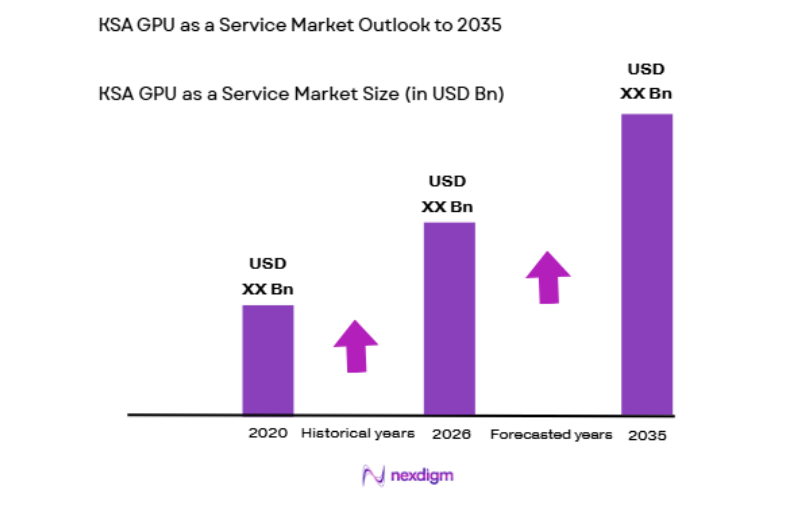
The KSA GPU as a Service market is experiencing robust growth, driven by increasing demand for high-performance computing and the growing adoption of artificial intelligence (AI) and machine learning technologies. The market size is projected to reach USD ~ million, with rising investments in cloud infrastructure and digital transformation initiatives across industries. This demand is further supported by the need for GPU-intensive tasks such as data analytics, AI model training, and advanced simulations.
The dominant cities in the market include Riyadh, Jeddah, and Dammam, driven by their status as economic and technological hubs in the country. These cities benefit from government support for technological development, a growing tech ecosystem, and a favorable regulatory environment for digital infrastructure. The ongoing shift toward digitization and the government’s Vision 2030 initiative contribute significantly to KSA’s leadership in GPU services.
Market Segmentation
By Product Type
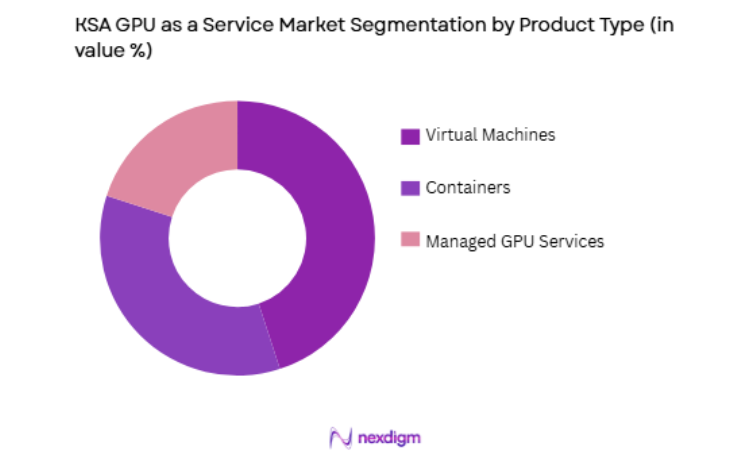
The KSA GPU as a Service market is segmented by product type into virtual machines, containers, and managed GPU services. Recently, virtual machines have dominated the market share due to the increasing demand for scalable and flexible GPU resources for various industries. This trend is driven by factors such as cost efficiency, ease of deployment, and the growing use of cloud-based applications across businesses. The ability to provide on-demand GPU resources for diverse workloads, such as AI and data processing, has led to widespread adoption in sectors like finance, healthcare, and retail.
By End-user Industry
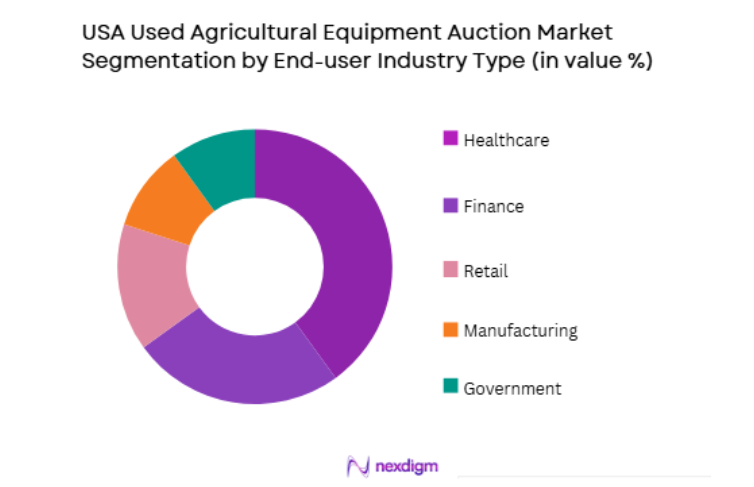
The KSA GPU as a Service market is segmented by end-user industry into healthcare, finance, retail, manufacturing, and government. The healthcare industry has seen the most significant growth in demand for GPU services due to the increasing need for advanced medical imaging, diagnostics, and drug discovery applications powered by AI and machine learning. The rising adoption of AI-driven tools in healthcare to improve patient outcomes and streamline operations is pushing the demand for GPU-accelerated computing, especially in research and clinical settings.
Competitive Landscape
The competitive landscape in the KSA GPU as a Service market is marked by strong consolidation, with key players including global cloud providers and specialized GPU-as-a-Service companies. These players are focused on expanding their market reach, improving service offerings, and investing in local data centers to cater to the growing demand for GPU resources. The influence of major players like Amazon Web Services (AWS), Microsoft Azure, and Google Cloud is significant, driving innovation and competition in the market.
| Company Name | Establishment Year | Headquarters | Technology Focus | Market Reach | Key Products | Revenue | Additional Parameter |
| Amazon Web Services | 2006 | USA | ~ | ~ | ~ | ~ | |
| Microsoft Azure | 2010 | USA | ~ | ~ | ~ | ~ | ~ |
| Google Cloud | 2008 | USA | ~ | ~ | ~ | ~ | ~ |
| Oracle | 1977 | USA | ~ | ~ | ~ | ~ | ~ |
| Nvidia | 1993 | USA | ~ | ~ | ~ | ~ | ~ |
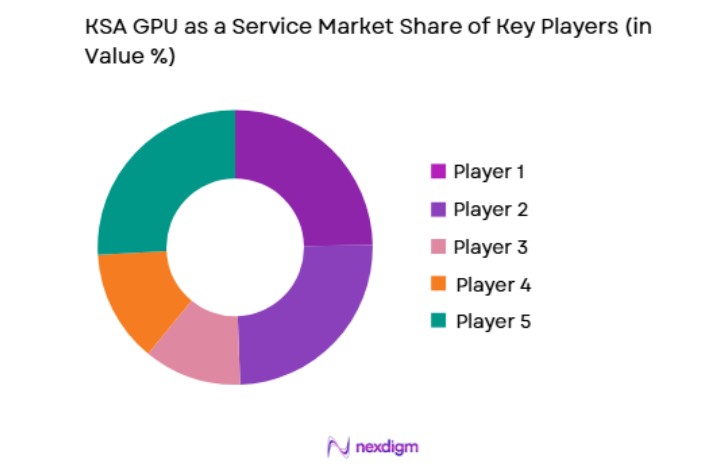
KSA GPU as a Service Market Analysis
Growth Drivers
Government Support for Digital Transformation
The KSA government has placed digital transformation at the core of its Vision 2030 initiative, providing a significant boost to the GPU as a Service market. Investments in smart cities, AI research, and cloud infrastructure development are driving the demand for GPU-intensive services. By encouraging private-public partnerships and creating a favorable regulatory environment, the government is positioning KSA as a leader in technological advancements, which boosts the adoption of cloud and GPU technologies across sectors such as healthcare, finance, and education.
Increasing Demand for AI and Machine Learning
With the growing emphasis on artificial intelligence and machine learning across various industries, the demand for GPU resources has surged. GPUs are essential for tasks like data analysis, natural language processing, and autonomous systems. The healthcare and finance sectors, in particular, are leading this trend, relying on GPUs for running complex AI models that provide valuable insights and improve decision-making. As AI continues to evolve, the need for powerful GPU resources in the cloud is expected to expand.
Market Challenges
High Capital Expenditure for Infrastructure
One of the significant challenges in the KSA GPU as a Service market is the high initial capital expenditure required to establish GPU infrastructure. Building or leasing data centers with the necessary GPU capabilities can be expensive, especially for smaller businesses or startups. Although cloud GPU services mitigate this to some extent, companies are still faced with the challenges of selecting the right GPU service provider and ensuring compatibility with their existing infrastructure. Additionally, the market remains heavily reliant on global players, limiting local competition and reducing the potential for cost reduction through localized solutions.
Data Privacy and Security Concerns
As more businesses move to the cloud, data privacy and security become critical concerns. Many companies remain hesitant to adopt GPU-as-a-Service offerings due to fears of data breaches, unauthorized access, and loss of control over sensitive data. Although cloud service providers are investing heavily in security measures, there are still regulatory and compliance hurdles that must be overcome. Companies must ensure that they adhere to data protection laws and regional cybersecurity standards, which adds complexity to the adoption of GPU-based services.
Opportunities
Rising Adoption of Edge Computing and IoT
Edge computing and the Internet of Things (IoT) are becoming increasingly important in the KSA market. By processing data closer to the source, edge computing reduces latency and enhances the performance of AI-driven applications. GPUs play a key role in powering edge devices, particularly in industries such as manufacturing, logistics, and healthcare. The integration of GPUs in edge computing will drive demand for GPU-as-a-Service models, offering a new growth avenue for providers in KSA.
Expansion of Cloud-Based Solutions Across Sectors
The continued shift toward cloud-based solutions presents a significant opportunity for GPU-as-a-Service providers. Various sectors, including education, government, and retail, are increasingly adopting cloud solutions to meet their computing needs. The flexibility, scalability, and cost-efficiency of cloud-based services make them ideal for organizations seeking to avoid the high costs of maintaining on-premise GPU infrastructure. As KSA continues to embrace cloud adoption, the demand for GPU resources will grow, presenting an expanding market opportunity for service providers.
Future Outlook
The future outlook for the KSA GPU as a Service market is promising, driven by continued government support for digital transformation, growing demand for AI and machine learning, and an increasing reliance on cloud infrastructure. Over the next five years, the market is expected to experience steady growth, with advancements in GPU technology further enhancing performance and affordability. Additionally, the rising adoption of edge computing and IoT will open new avenues for GPU as a Service offerings, particularly in sectors like healthcare and manufacturing. Regulatory support and a favorable business environment will also foster the expansion of cloud-based GPU services.
Major Players
- Amazon Web Services
- Microsoft Azure
- Google Cloud
- Oracle
- Nvidia
- IBM
- Alibaba Cloud
- Huawei Cloud
- Rackspace Technology
- Alibaba Cloud
- Tencent Cloud
- Digital Ocean
- IBM Cloud
- Fujitsu
- Atos
Key Target Audience
- Investments and venture capitalist firms
- Government and regulatory bodies
- AI and machine learning solution providers
- Healthcare technology firms
- Financial institutions and fintech companies
- Large-scale enterprises
- Data centers and hosting companies
- Technology consulting firms
Research Methodology
Step 1: Identification of Key Variables
The first step in our research methodology involves identifying the key variables that impact the KSA GPU as a Service market. This includes analyzing trends in GPU demand, AI adoption, cloud infrastructure investments, and regulatory frameworks.
Step 2: Market Analysis and Construction
Our team analyzes the data from various sources, including government reports, industry publications, and market surveys. Using this data, we construct a comprehensive model to understand the market’s current size, growth potential, and key drivers.
Step 3: Hypothesis Validation and Expert Consultation
Next, we validate our hypotheses through consultations with industry experts, including GPU service providers, cloud computing specialists, and government officials. These consultations help refine our assumptions and ensure accuracy in the final analysis.
Step 4: Research Synthesis and Final Output
Finally, we synthesize the gathered data and insights into a coherent report, presenting a thorough market analysis that covers the KSA GPU as a Service market’s current state, growth drivers, challenges, and future outlook.

- Executive Summary
- Research Methodology (Definitions, Scope, Industry Assumptions, Market Sizing Approach, Primary & Secondary Research Framework, Data Collection & Verification Protocol, Analytic Models & Forecast Methodology, Limitations & Research Validity Checks)

- Market Definition and Scope
- Value Chain & Stakeholder Ecosystem
- Regulatory / Certification Landscape
- Sector Dynamics Affecting Demand

- Growth Drivers
Increased Demand for AI and ML Processing
Government Initiatives in Digital Transformation
Rising Demand for High-Performance Computing
Growth in Cloud Infrastructure Development
Expansion of Smart Cities and IoT Applications - Market Challenges
High Cost of GPU Hardware
Limited Availability of Skilled Workforce
Data Security and Privacy Concerns
Interoperability Issues with Existing Systems
Scalability Challenges in GPU Service Offerings - Market Opportunities
Rising Adoption of AI-Driven Services
Government Investment in Smart Infrastructure
Expansion of 5G Networks and Edge Computing
Strategic Partnerships between Cloud Providers and Tech Giants
Emerging Opportunities in the Autonomous Vehicle Sector - Trends
Increasing Usage of Hybrid Cloud Models
Growth in Multi-cloud GPU Services
Proliferation of Edge Computing for Real-time Processing - Government regulations
Data Protection and Privacy Laws
Regulations on Cloud Service Providers
Government Incentives for Cloud Computing Investments - SWOT analysis
- Porters 5 forces

- By Market Value, 2020-2025
- By Installed Units, 2020-2025
- By Average System Price, 2020-2025
- By System Complexity Tier, 2020-2025

- By System Type (In Value%)
Cloud-based GPU Services
On-premise GPU Solutions
Hybrid GPU Platforms
Edge GPU Computing
AI-Optimized GPU Solutions - By Platform Type (In Value%)
Cloud Platforms
Private Data Centers
Public Cloud Infrastructure
AI Processing Platforms
Integrated Cloud and Edge Platforms - By Fitment Type (In Value%)
On-premise Deployment
Cloud Deployment
Hybrid Deployment
Edge Deployment
Multi-cloud Deployment - By End User Segment (In Value%)
Tech Companies
Research Institutions
Gaming Industry

- Market Share Analysis
- Cross Comparison Parameters (System Type, Platform Type, Procurement Channel, End User Segment, Fitment Type, Technology Adoption Rate, Integration Complexity, Scalability, Security Compliance, Service Level Agreements (SLA)
- SWOT Analysis of Key Competitors
- Pricing & Procurement Analysis
- Key Players
Amazon Web Services
Microsoft Azure
Google Cloud
NVIDIA
Oracle Cloud
Alibaba Cloud
IBM Cloud
Huawei Cloud
Alibaba Cloud
Intel
AMD
Arista Networks
Dell Technologies
Supermicr
Veeam Software

- Rising Demand from Tech Companies for High-Performance Solution
- Increased Adoption by Research Institutions for Scientific Computing
- Gaming Industry’s Drive for Cloud-based Rendering
- Government’s Focus on Digital Transformation

- Forecast Market Value, 2026-2035
- Forecast Installed Units, 2026-2035
- Price Forecast by System Tier, 2026-2035
- Future Demand by Platform, 2026-2035


 Request a Sample
 Ask for Customization
 Get a Quote
 Enquire Now