
 Download PDF
Market Overview
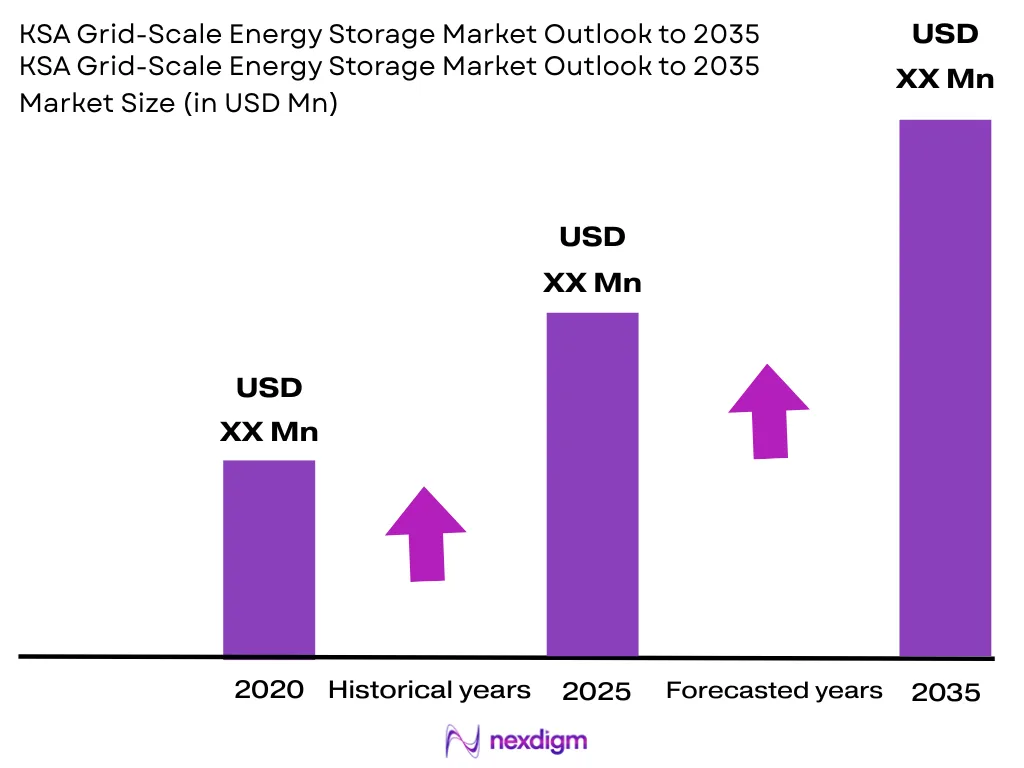
The KSA Grid-Scale Energy Storage Market was valued at USD ~ Million in 2024 and is anticipated to expand at a CAGR of ~ % during 2026–2035. The market is primarily driven by Vision 2030’s target of 50 percent clean energy by 2030, large-scale utility BESS tenders by the Saudi Power Procurement Company, and rising electricity consumption and peak load growth. According to IMARC Group, the Saudi Arabia grid energy storage market reached USD 117.90 million in 2024 and is projected to reach USD 1,142.75 million by 2033, growing at a CAGR of 25.50 percent, while the broader Saudi Arabia energy storage systems (ESS) market reached USD 4.9 billion in 2025 and is expected to reach USD 19.0 billion by 2034. If current operational and under-construction grid-scale BESS capacity is combined, the Kingdom already totals 13 GWh today and is set to reach 33.5 GWh by 2026, making KSA the third-biggest global BESS market after the United States and China, according to ESS News.
Market Segmentation
By Technology
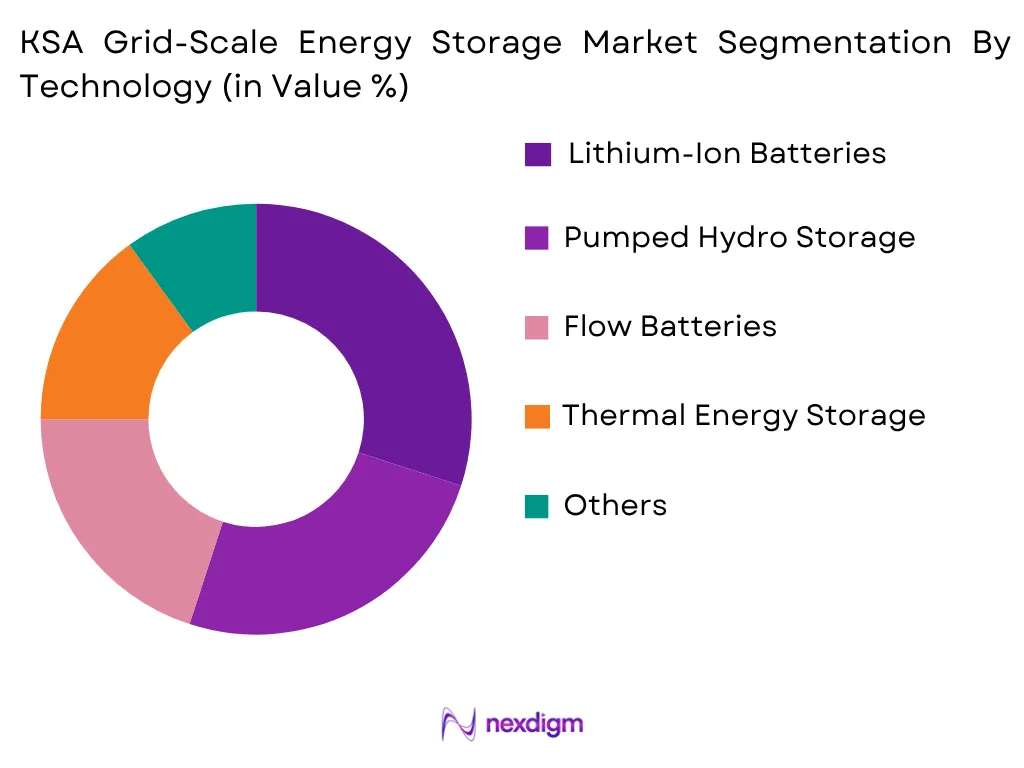
Among these, Lithium-Ion Batteries hold the dominant share of the KSA Grid-Scale Energy Storage Market, supported by a steep decline in battery pack prices, from over USD 1,000 per kWh in 2010 to around USD 139 per kWh in 2023, an approximate 87 to 90 percent reduction, with average prices reaching about USD 115 per kWh in 2024, the steepest annual drop since 2017, according to PS Market Research. Saudi Arabia commissioned its largest battery storage project in Bisha in January 2025, a 500 MW/2,000 MWh facility developed by Saudi Electricity Company using 122 prefabricated units designed by BYD and executed by State Grid Corporation of China and Alfanar Projects, marking the world’s largest single-phase operational BESS project. At the same time, Thermal Energy Storage and other long-duration technologies are gaining attention as the Kingdom’s extreme heat and high solar irradiation, exceeding 2,200 kWh per square meter annually in most regions, create demand for storage technologies engineered for durability in harsh desert conditions.
By Ownership Model
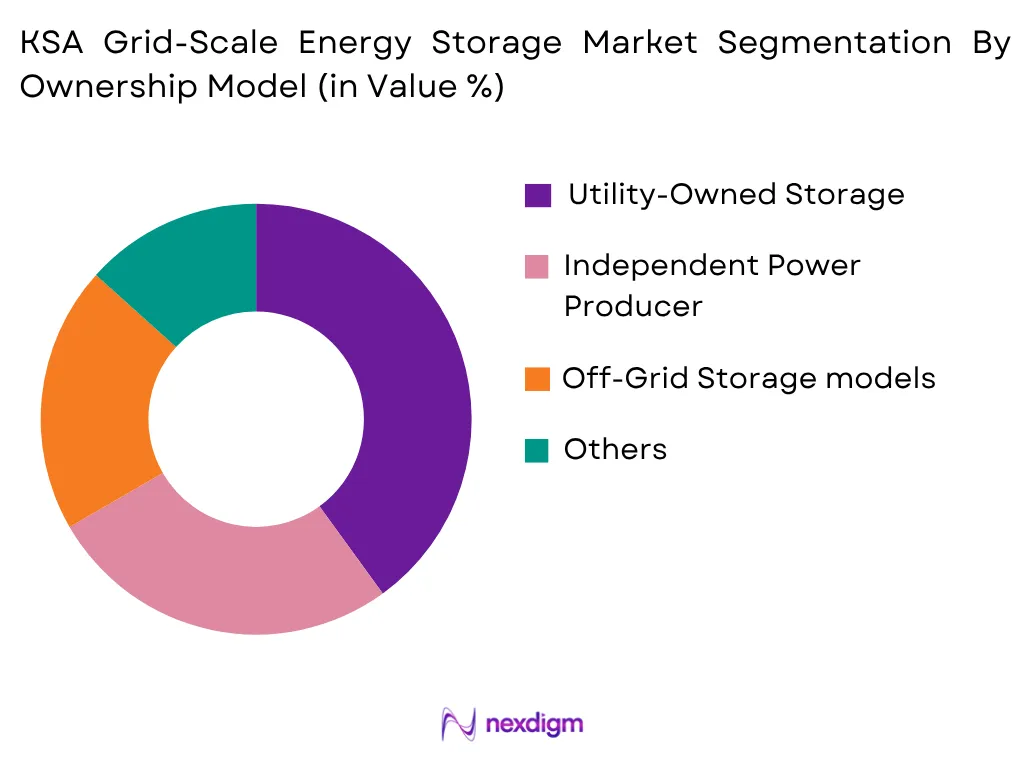
The Utility-Owned Storage category holds the largest share, at 50 percent of the market in 2025, according to PS Market Research, due to the Saudi Electricity Company’s extensive deployment initiatives and the dominance of utility ownership reflecting the Kingdom’s centralized approach to critical infrastructure development. SEC’s strategic deployment of storage systems at key grid nodes has established a foundation for system-wide benefits, including enhanced reliability and reduced operational costs. In February 2025, BYD and Saudi Electricity Company signed a record-breaking 12.5 GWh grid-scale battery energy storage deal, the largest such contract to date, while BYD Energy Storage installed its MC Cube-T ESS with CTS technology at five Saudi sites the same month, integrating large-scale battery storage into the national grid. Meanwhile, Independent Power Producer and Off-Grid Storage models are expanding rapidly to serve giga-projects, exemplified by Huawei’s September 2024 completion of the world’s largest microgrid power station, featuring 400 MW of photovoltaic generation and 1.3 GWh of energy storage, supporting the Red Sea New City project.
Competitive Landscape
The KSA Grid-Scale Energy Storage Market is moderately consolidated, dominated by the Saudi Electricity Company (SEC) as the primary utility off-taker alongside Chinese technology suppliers and Saudi EPC contractors. In April 2025, Saudi Arabia launched a major 2.5 GW/10 GWh grid-scale battery energy storage project across five regions with a total investment exceeding SAR 6.73 billion, among the world’s largest storage projects. The Saudi Power Procurement Company (SPPC) launched an 8 GWh battery storage tender in November 2024, comprising four battery energy storage system projects each with a combined capacity of 2,000 MW/8,000 MWh, representing the world’s largest coordinated storage procurement, according to PS Market Research. Al Gihaz Holding was awarded a 7.8 GWh BESS contract using Sungrow technology in the second quarter of 2024, with commissioning expected in 2025, illustrating the scale of Saudi EPC contractor involvement alongside global technology suppliers such as BYD, Huawei, and Sungrow in the Kingdom’s rapidly expanding grid-scale storage build-out.
| Company | Establishment Year | Headquarters | Primary Technology Portfolio | Energy Storage Portfolio
|
Manufacturing Presence | Major End-Use Industries | Key Strategic Focus | Certifications & Compliance |
| Saudi Electricity Company (SEC) | 2000 | ~ | ~ | ~ | ~ | ~ | ~ | ~ |
| BYD Energy Storage | 1995 | ~ | ~ | ~ | ~ | ~ | ~ | ~ |
| Al Gihaz Holding | 1985 | ~ | ~ | ~ | ~ | ~ | ~ | ~ |
| ACWA Power | 2004 | ~ | ~ | ~ | ~ | ~ | ~ | ~ |
| Alfanar Projects | 1976 | ~ | ~ | ~ | ~ | ~ | ~ | ~ |
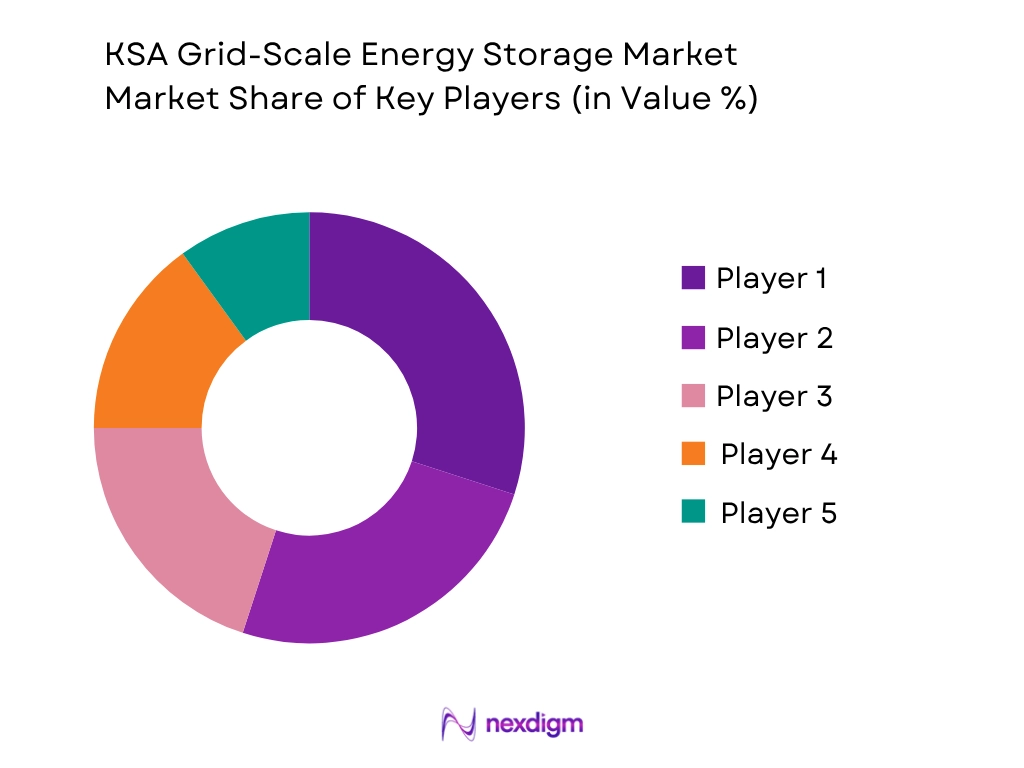
KSA Grid-Scale Energy Storage Market Analysis
Growth Drivers
Vision 2030 Clean Energy Targets and Large-Scale BESS Tenders
The KSA grid-scale energy storage market is experiencing sustained growth due to Vision 2030’s target of 50 percent clean energy by 2030 and a wave of large-scale utility battery storage tenders. Saudi Arabia targets 48 GWh of energy storage by 2030 and is attracting global industry leaders, according to IMARC Group. The Saudi Power Procurement Company’s November 2024 announcement of an 8 GWh battery storage tender, comprising four 500 MW/2,000 MWh projects, followed the Kingdom’s April 2025 launch of a 2.5 GW/10 GWh grid-scale battery energy storage project across five regions with a total investment exceeding SAR 6.73 billion. By 2025, the Kingdom expects to operate 8 GWh of storage capacity, followed by 22 GWh by 2026, ranking third globally behind China and the United States in battery storage capacity, according to PS Market Research.
Rising Electricity Consumption and Peak Load Management Needs
Saudi Arabia’s rising electricity consumption and intensifying peak load management needs remain major drivers for grid-scale energy storage demand. Saudi Arabia’s electricity consumption reached 256.4 TWh in the first nine months of 2024, marking a 5 percent increase year-on-year, driven by population growth, industrial expansion, and high demand for cooling and desalination, according to Research and Markets. Peak load surged 5.8 percent to 74.8 GW during the same period, intensifying pressure on the grid and necessitating effective peak load management solutions. The government is expected to allocate approximately USD 1.5 billion toward energy storage projects in 2024, aiming to enhance energy security and reduce reliance on fossil fuels, creating a favorable regulatory environment encouraging continued investment in battery energy storage systems across the Kingdom.
Market Challenges
High Capital Costs and Import Dependence on Battery Components
Despite steady demand growth, the KSA grid-scale energy storage market remains constrained by the high capital costs required for multi-gigawatt-hour projects and continued dependence on imported battery cells and components. The Kingdom’s landmark projects, including the SAR 6.73 billion 2.5 GW/10 GWh national rollout and the world’s largest single-phase Bisha BESS facility, require substantial capital commitments from the Saudi Electricity Company and its financing partners. The Kingdom’s storage build-out remains heavily reliant on Chinese original equipment manufacturers such as BYD, Huawei, and Sungrow for prefabricated battery units, power conversion systems, and grid-forming inverter technology, creating supply chain concentration risk and exposing project economics to global battery cell price fluctuations and geopolitical trade dynamics.
Extreme Heat Impact and Regulatory Framework Development
Saudi Arabia’s extreme desert heat presents a significant technical challenge for battery energy storage system performance and lifespan, requiring specialized thermal management systems and potentially accelerating battery degradation compared with temperate climate deployments. In addition, the Saudi government is actively formulating regulatory frameworks and incentives to attract investment and innovation in grid energy storage technologies, according to IMARC Group, with policies for energy storage integration, ownership models, and grid access still being established. This regulatory framework development, while progressing steadily, creates near-term uncertainty for independent power producers and developers seeking long-term revenue visibility for storage assets outside the Saudi Electricity Company’s centralized utility-owned deployment model.
Market Opportunities
Rising Investment in Domestic Battery Manufacturing
Saudi Arabia’s massive storage procurement pipeline creates significant opportunities for investment in domestic battery manufacturing and assembly capacity aligned with the Kingdom’s local content requirements. As Saudi Arabia moves toward operating 22 GWh of storage capacity by 2026, ranking third globally behind China and the United States, according to PS Market Research, the scale of demand creates a compelling case for establishing in-Kingdom battery cell assembly, prefabricated enclosure manufacturing, and power conversion system production. Companies investing early in domestic manufacturing capacity aligned with Vision 2030’s in-Kingdom value addition targets are positioned to capture long-term contracts from the Saudi Power Procurement Company and Saudi Electricity Company as the Kingdom seeks to reduce import dependence across its expanding storage build-out.
Expansion of Off-Grid Storage for Giga-Projects
Saudi Arabia’s giga-project pipeline, including NEOM and Red Sea Global developments, creates substantial long-term opportunities for off-grid and microgrid-linked energy storage. Huawei’s September 2024 completion of the world’s largest microgrid power station, featuring 400 MW of photovoltaic generation and 1.3 GWh of energy storage delivering one billion kWh annually, supports what aims to be the world’s first fully renewable-energy-powered city, backed by USD 500 billion in development funding, according to IMARC Group. As giga-project developers continue pursuing 100 percent renewable-powered microgrids for luxury tourism and smart city developments, storage technology providers offering grid-forming inverter capability and battery optimization systems are well positioned to capture growing demand from off-grid and hybrid power system deployments across the Kingdom’s development corridor.
Future Outlook
The KSA Grid-Scale Energy Storage Market is expected to witness sustained expansion over the forecast period, supported by continued Vision 2030 clean energy target implementation, expanding utility-scale BESS tender activity, and rising electricity consumption and peak load management needs. Continued investment in domestic manufacturing capacity, off-grid giga-project storage, and long-duration storage technologies will further accelerate deployment across the industry. The market is also likely to benefit from Saudi Arabia’s position as the world’s third-largest battery storage market behind China and the United States, enabling greater investment in advanced, technology-diverse storage solutions capable of supporting the Kingdom’s renewable energy diversification and grid modernization goals.
Major Players
- Saudi Electricity Company (SEC)
- BYD Energy Storage
- Al Gihaz Holding
- ACWA Power
- Alfanar Projects
- Huawei
- Sungrow
- State Grid Corporation of China
- Saudi Power Procurement Company (SPPC)
- Vision Invest
- Fluence Energy, Inc.
- Tesla Energy
- Red Sea Global
- Masdar
- NEOM Energy & Water Company
Key Target Audience
- Grid-Scale Energy Storage Developers and EPC Contractors
- Saudi Electricity Company and National Grid Operators
- Independent Power Producers and Renewable Developers
- Giga-Project and Smart City Developers
- Industrial and Desalination Facility Operators
- Investment and Project Finance Firms
- Government and Regulatory Bodies (Ministry of Energy, Saudi Power Procurement Company (SPPC), Water and Electricity Regulatory Authority (WERA))
- Battery and Storage Technology Equipment Suppliers
Research Methodology
Step 1: Identification of Key Variables
The research process begins with identifying the complete ecosystem of the KSA Grid-Scale Energy Storage Market, including battery and equipment suppliers, EPC contractors and developers, utility and grid operators, giga-project developers, and regulatory authorities. Extensive secondary research is conducted using company annual reports, government publications, trade associations, regulatory filings, industry journals, and proprietary databases to determine the variables influencing market demand, pricing, project pipeline, and technological developments.
Step 2: Market Analysis and Construction
Historical market information is collected and analyzed to estimate market size, installed capacity, project pipeline activity, and pricing trends. A combination of top-down and bottom-up approaches is used to estimate market revenues and validate segment-level performance. Consumption patterns across renewable integration, peak load management, and off-grid microgrid applications are evaluated to establish an accurate representation of the industry.
Step 3: Hypothesis Validation and Expert Consultation
The preliminary findings are validated through Computer-Assisted Telephone Interviews (CATIs) and structured discussions with storage developers, utility executives, EPC contractors, regulatory experts, and senior executives operating within the KSA grid-scale energy storage industry. These interviews help verify market assumptions, competitive developments, technology adoption trends, pricing dynamics, and future investment opportunities while refining the overall market estimates.
Step 4: Research Synthesis and Final Output
The final stage integrates insights obtained from primary interviews with quantitative information collected through secondary sources. Data triangulation techniques are applied to reconcile differences between supply-side and demand-side estimates, ensuring robust market forecasting. The report is then reviewed through multiple quality assurance checkpoints to deliver a comprehensive analysis covering market size, segmentation, competitive landscape, future outlook, and strategic recommendations for industry stakeholders.

- Executive Summary
- Research Methodology (Market Definitions and Assumptions, Abbreviations, Market Sizing Approach, Top-Down Analysis, Bottom-Up Analysis, Demand-Side Assessment, Supply-Side Assessment, Primary Industry Interviews, Secondary Research Validation, Data Triangulation, Forecasting Framework, Limitations and Future Conclusions)

- Definition and Scope
- Market Evolution and Industry Genesis
- Timeline of Major Industry Developments
- Energy Storage Industry Value Chain Analysis
- Supply Chain Analysis

- Growth Drivers (Vision 2030 Target of 50 Percent Clean Energy by 2030, Large-Scale Utility BESS Tenders by Saudi Power Procurement Company, Rising Electricity Consumption and Peak Load Growth, Declining Lithium-Ion Battery Pack Prices, Giga-Project and Smart City Microgrid Development, Government Investment in Grid Modernization)
- Market Challenges (High Capital Costs for Multi-Gigawatt-Hour Projects, Dependence on Imported Battery Cells and Components, Grid Integration Complexity Across Remote Giga-Projects, Extreme Heat Impact on Battery Performance and Lifespan, Regulatory Framework Still Under Development, Supply Chain Concentration Among Chinese Manufacturers)
- Market Opportunities (Investment in Domestic Battery Manufacturing and Assembly, Growth in Long-Duration and Thermal Storage Technologies, Expansion of Off-Grid Storage for NEOM and Red Sea Giga-Projects, Local Content Requirements Driving Domestic Supply Chain Development, Green Hydrogen-Linked Storage Integration, Export-Oriented Storage Manufacturing for the GCC Region)
- Market Trends (Rising Adoption of World-Record-Scale BESS Contracts, Growth in Utility-Owned Centralized Storage Deployment, Declining Battery Costs Accelerating Project Economics, Giga-Project-Linked Off-Grid Microgrid Storage, Chinese Original Equipment Manufacturer Dominance, Phased National BESS Rollout Under NREP)
- Government Regulations (Vision 2030 Energy Diversification Targets, Saudi Power Procurement Company (SPPC) Tender Frameworks, Energy Storage Regulatory Framework Development, National Renewable Energy Program (NREP) Requirements, Saudi Electricity Company Grid Interconnection Standards, Local Content and In-Kingdom Value Addition Requirements)
- Import and Export Analysis (Trade Volume, Major Import Sources, Export Destinations, HS Code Analysis, Trade Balance)
- Raw Material Availability Analysis (Lithium-Ion Battery Cells, Power Conversion Systems, Prefabricated Battery Enclosures, Grid-Forming Inverter Technology)
- Technology Landscape (Lithium-Ion Battery Systems, Grid-Forming Inverter Technology, Prefabricated Modular BESS Units, Smart Grid and SCADA Integration, Thermal and Long-Duration Storage)
- Sustainability Assessment (Renewable Energy Integration, Carbon Footprint Reduction, Vision 2030 Green Initiative Alignment, Battery Recycling Infrastructure Development, Circular Economy Integration)
- PESTLE Analysis
- SWOT Analysis
- Porter’s Five Forces Analysis
- Stakeholder Ecosystem
- Competition Ecosystem

- By Market Value (2020-2025)
- By Installed Capacity (2020-2025)
- By Average Selling Price (2020-2025)

- By Technology (In Value %)
Lithium-Ion Batteries
Flow Batteries
Pumped Hydro Storage
Thermal Energy Storage
Other Technologies - By Application (In Value %)
Renewable Energy Integration
Peak Load Management
Frequency Regulation & Ancillary Services
Off-Grid & Microgrid Support
By Duration (In Value %)
Short Duration (Under 2 Hours)
Medium Duration (2-4 Hours)
Long Duration (Over 4 Hours) - By Ownership Model (In Value %)
Utility-Owned Storage
Independent Power Producer / Developer-Owned Storage
Off-Grid & Microgrid-Owned Storage - By Region (In Value %)
Central Region (Riyadh)
Western Region (Jeddah, Red Sea Coast)
Eastern Region (Dammam, Al-Ahsa)
Northern & Southern Regions

- Market Share of Major Players (By Value, Capacity, Technology Type, Application, Ownership Model)
- Cross Comparison Parameters (Technology Portfolio Breadth, Project Pipeline and Development Capacity, Grid Connection Portfolio, Financing and Capital Access, Operational Capacity, Regulatory Compliance & Certifications, Customer Base Across Segments, Innovation & New Technology Deployment Frequency)
- SWOT Analysis of Major Players
- Pricing Analysis by Technology and Duration Category
- Project Pipeline and Capacity Analysis
- Operational Footprint Analysis
- Grid Connection and Interconnection Analysis
- Innovation Benchmarking
- Detailed Profiles of Major Companies
Saudi Electricity Company (SEC)
BYD Energy Storage
Al Gihaz Holding
ACWA Power
Alfanar Projects
Huawei
Sungrow
State Grid Corporation of China
Saudi Power Procurement Company (SPPC)
Vision Invest
Fluence Energy, Inc.
Tesla Energy
Red Sea Global
Masdar
NEOM Energy & Water Company

- Consumption Pattern Analysis (Industrial Usage, Project Capacity, Duration Requirements, Seasonal Demand, Giga-Project Integration Activity)
- Purchasing Criteria (Round-Trip Efficiency, Cost per MWh, Duration Capability, Heat Tolerance, Regulatory Compliance, Response Time)
- Procurement and Developer Selection Analysis
- Sustainable Storage Adoption Assessment
- Utility-Scale vs Off-Grid Storage Demand
- Technology Attribute Preference Analysis (Round-Trip Efficiency, Response Time, Duration Capability, Cycle Life, Heat Resilience, Levelized Cost of Storage)
- Grid Stability and Renewable Integration Influence on Technology Selection
- Pain Point Analysis
- Decision-Making Process

- By Market Value (2026-2035)
- By Installed Capacity (2026-2035)
- By Average Selling Price (2026-2035)


 Request a Sample
 Ask for Customization
 Get a Quote
 Enquire Now