
 Download PDF
Market Overview
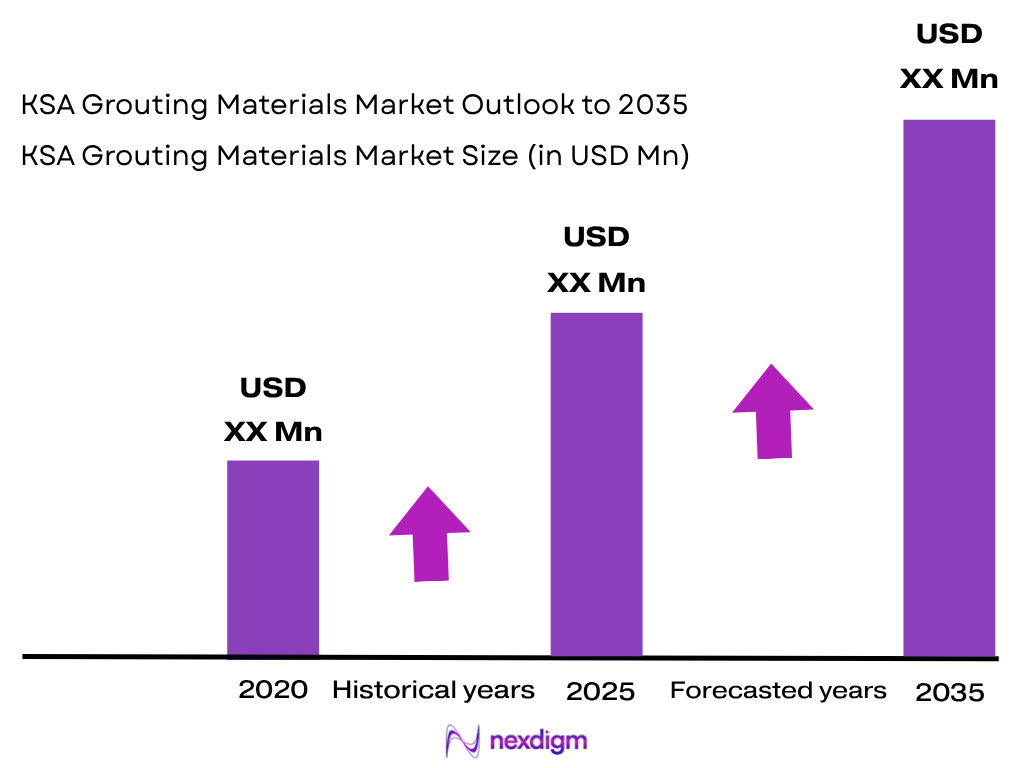
The KSA Grouting Materials Market is valued at approximately ~USD XX million, supported by industrial localization, infrastructure construction and precision equipment installation. Saudi Arabia had 11,549 industrial facilities in the preceding period, increasing to more than 12,000 operating factories in the latest period. Continued expansion of manufacturing, transport and utility assets increases requirements for non-shrink cementitious grouts, precision epoxy systems, anchoring materials, injection grouts and structural connection solutions.
Riyadh, the Eastern Province, Jeddah and the wider Makkah region represent key KSA Grouting Materials demand centres because of dense construction, industrial and infrastructure activity. Riyadh recorded 24,304 building permits in the preceding period and subsequently contained 6,763 licensed commercial warehouses covering 10.7 million square metres. The Eastern Province combines petrochemical, refinery and industrial assets, while Jeddah and Makkah support logistics, hospitality and large-scale urban infrastructure requiring foundation and structural grouting.
Market Segmentation
By Product Type
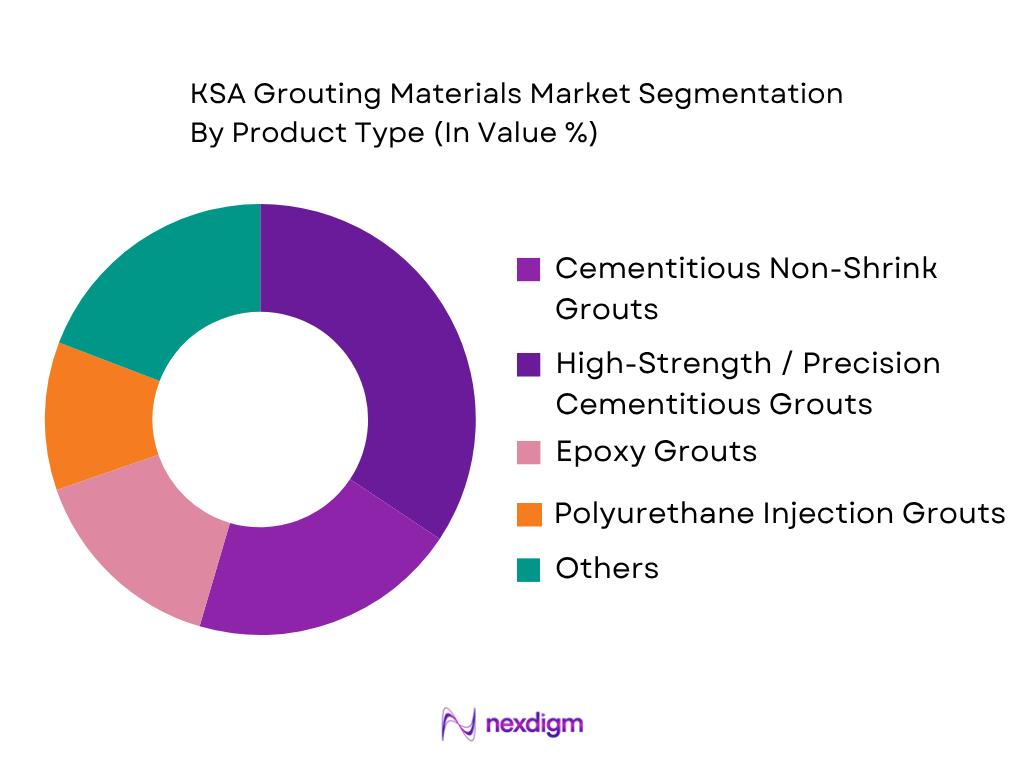
The KSA Grouting Materials Market is segmented into general-purpose non-shrink cementitious grouts, high-strength precision cementitious grouts, epoxy grouts, injection grouts, anchoring grouts, precast connection grouts and specialty infrastructure systems. Non-shrink cementitious grouts hold the dominant share because they serve the broadest application base, including steel column bases, machine foundations, bridge bearings, precast columns, anchors and equipment skids. Saudi Arabia’s industrial base exceeded 12,000 operating factories, while the country continues to expand logistics, manufacturing, mining and infrastructure capacity under Vision 2030. These applications favour factory-formulated grouts with controlled expansion, high flow and predictable compressive strength over conventional site-mixed materials. High-strength precision products are particularly important in machinery installation, while epoxy grouts serve dynamic-load and chemical-exposure applications in refining, petrochemicals and heavy industry. Injection grouts address underground works, water ingress, void filling and ground stabilization.
By Application
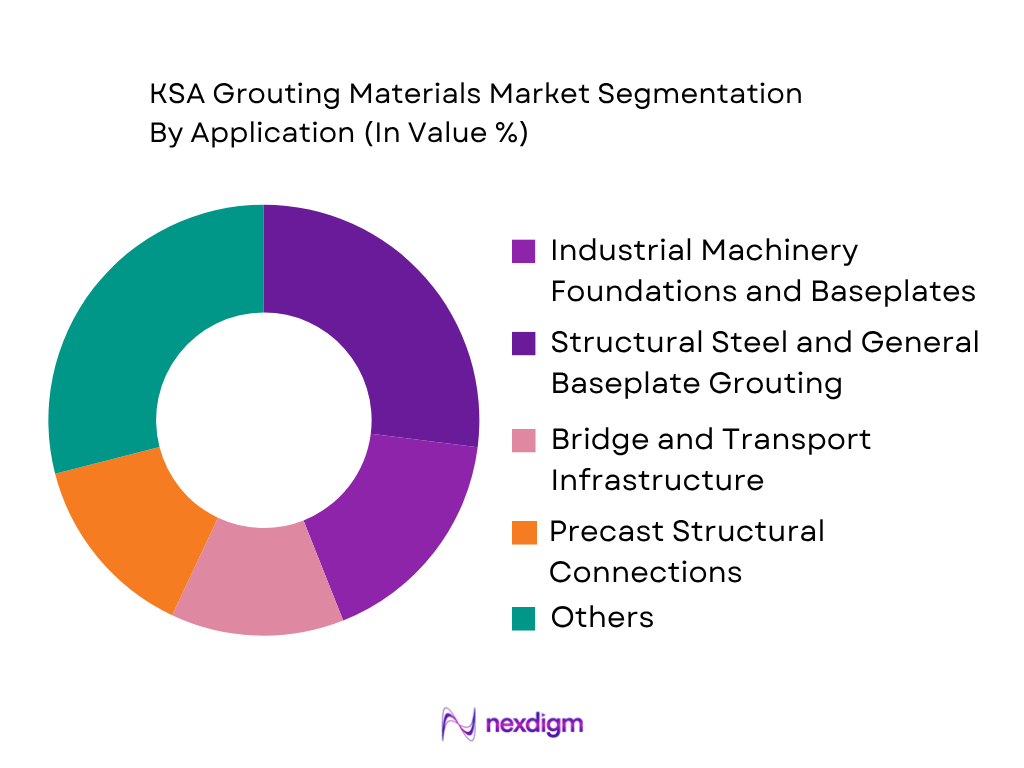
The KSA Grouting Materials Market is segmented into industrial machinery foundations, structural and steel baseplates, precast connections, bridge and transport infrastructure, oil and gas facilities, injection and underground works, renewable-energy foundations and other specialized applications. Industrial machinery and equipment foundations represent the dominant application because Saudi Arabia’s manufacturing ecosystem expanded from 11,549 industrial facilities to more than 12,000 operating factories, while 152 new industrial licences were issued in January alone and 79 factories commenced production during that month. Precision machinery requires uniform bearing contact, dimensional stability and controlled load transfer beneath compressors, pumps, generators and production equipment. Refining and petrochemical facilities further increase demand for chemical-resistant epoxy grouts where vibration and dynamic loading are important. Precast and transport infrastructure contribute additional consumption through column connections, bridge bearings, anchor bolts and rail-support systems, while underground projects support injection and water-cutoff materials.
Competitive Landscape
The KSA Grouting Materials Market combines global construction-chemical manufacturers with regionally established suppliers and Saudi-based producers. Competition is determined by ASTM C1107-compliant non-shrink grout breadth, high-flow and high-strength performance, precision epoxy capability, injection technologies, hot-climate workability, local manufacturing and project-level technical support. Suppliers with direct exposure to petrochemical plants, mining projects, rail infrastructure and giga-project construction are particularly well positioned.
| Major Player | Establishment Year | Headquarters | Non-Shrink / Precision Grouts | Epoxy Machinery Grouts | Injection Capability | Industrial & Oil/Gas Exposure | KSA Manufacturing / Supply | Technical Support |
| Sika | 1910 | Baar, Switzerland | ||||||
| Fosroc | 1972 | Dubai regional base | ||||||
| MAPEI | 1937 | Milan, Italy | ||||||
| Master Builders Solutions | 1909 | Mannheim, Germany | ||||||
| DCP | 1927 | Amman, Jordan / international operations |
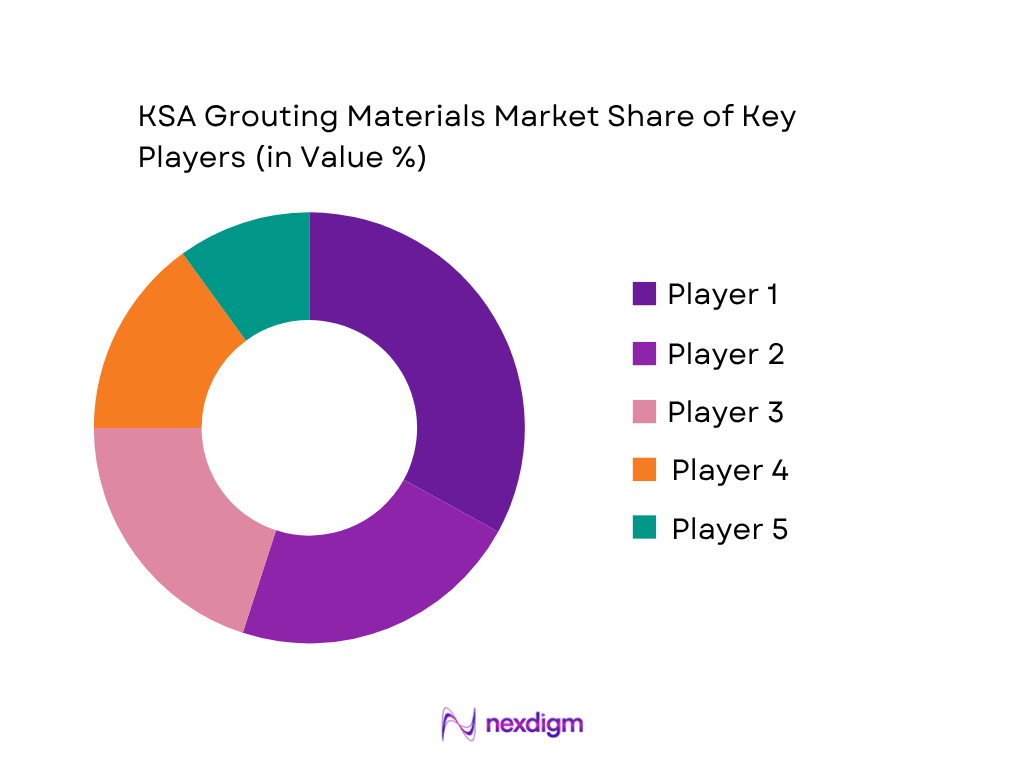
KSA Grouting Materials Market Analysis
Growth Drivers
Industrial Localization and Manufacturing Expansion Are Increasing Precision Grouting Demand
The KSA Grouting Materials Market is being supported by the rapid expansion of Saudi Arabia’s manufacturing and industrial asset base, which creates direct requirements for non-shrink cementitious grouts, precision epoxy grouts, anchor systems and equipment-foundation materials. Ministry of Industry and Mineral Resources data show that Saudi Arabia had 11,672 factories operating or under construction in January 2024, supported by industrial investments of approximately SAR1.539 trillion. During that month alone, the Ministry issued 152 new industrial licences, while 79 factories commenced production with approximately SAR1.3 billion of investment. The new licences included 20 non-metallic mineral-product facilities, 19 fabricated-metal facilities, 18 rubber and plastics facilities and 14 chemical-product facilities, illustrating the breadth of equipment-intensive industrial development. Each production facility creates requirements for machinery baseplates, pumps, compressors, production lines, structural steel columns and utility equipment requiring reliable load transfer. World Bank data record Saudi Arabia’s nominal GDP at USD1.2398 trillion in 2024 and GDP per capita at USD35,121.7. This industrial expansion supports increasing specification of engineered high-flow, shrinkage-compensated and dynamic-load grouting systems.
Renewable Energy, Logistics and Large Infrastructure Programs Are Broadening Grout Applications
Large-scale infrastructure and energy development represents another major growth driver for the KSA Grouting Materials Market because structural foundations, equipment interfaces and transport assets require high-strength grouts across diverse operating environments. Saudi Vision 2030’s National Industrial Development and Logistics Program reported that renewable projects totaling 3.6 GW entered commercial operation in 2024, bringing operating renewable capacity to 6.6 GW. The same government program reported 20 GW of renewable-energy capacity offered through Waves 5 and 6, while 1,200 solar and wind monitoring stations were deployed across the Kingdom. Logistics infrastructure is equally extensive: General Authority for Statistics data record 12,234 licensed commercial warehouses covering 22 million square metres, plus 1,189 construction warehouses covering 7.5 million square metres and 23 activated logistics centres in 2024. These assets require steel-column baseplate grouting, automated-equipment foundations, substations, transformers and heavy machinery installations. World Bank data place Saudi Arabia’s nominal GDP at USD1.2398 trillion in 2024 and GDP per capita at USD35,121.7. Current infrastructure volumes therefore provide a broad platform for cementitious, epoxy and specialized foundation grouts.
Market Challenges
Extreme Heat Creates Shorter Working Windows and More Demanding Grout Placement Conditions
Extreme temperatures are a market-specific challenge for grouting contractors because cementitious and epoxy products are sensitive to mixing-water temperature, flow retention, setting time, evaporation and resin pot life. The Saudi Ministry of Human Resources and Social Development prohibited outdoor work under direct sunlight between 12:00 PM and 3:00 PM from June 15 to September 15, 2024, creating a 3-hour daily restriction over approximately three months of peak summer conditions. The Ministry reported 94.6 on its compliance measure for establishments during the 2024 enforcement period, demonstrating the significance of heat-management requirements across Saudi worksites. The restriction continued during 2025 and 2026, and the Ministry conducted 29,945 inspection visits during the 2026 enforcement period. For grouting activities, elevated temperatures can accelerate cement hydration, reduce flow duration and shorten epoxy working time before complete baseplate filling is achieved. This challenge affects a large construction and industrial base containing 11,672 factories operating or under construction at the start of 2024. World Bank data record Saudi nominal GDP at USD1.2398 trillion in 2024 and GDP per capita at USD35,121.7, underscoring the economic importance of reliable hot-weather application practices.
Specialty Raw-Material Supply and Specification Compliance Increase Execution Complexity
The KSA Grouting Materials Market also faces supply and technical-compliance challenges because advanced epoxy grouts, polyurethane injection systems, microfine cement products and high-performance admixtures depend on controlled raw-material quality and precise site execution. General Authority for Statistics data show that Saudi merchandise imports increased during 2024, while machinery, electrical equipment and parts represented the largest imported product category. King Abdulaziz Port in Dammam alone handled 29.2 on the government’s share measure for national imports, highlighting the importance of international supply channels for industrial projects. The Ministry of Industry and Mineral Resources simultaneously recorded 152 new industrial licences in January 2024 and 11,672 factories operating or under construction, meaning specification consistency must be maintained across an expanding project base. High-performance grouts require controlled water addition, continuous mixing, sealed formwork and complete baseplate filling; errors can create bleeding, segregation or unfilled bearing areas. Epoxy systems add sensitivity to component ratio and temperature. World Bank data place Saudi Arabia’s nominal GDP at USD1.2398 trillion in 2024 and GDP per capita at USD35,121.7. Consequently, localization, quality assurance, approved-product systems and contractor training remain critical competitive requirements.
Market Opportunities
High-Strength and Precision Grouts Can Capture Industrial, Mining and Heavy-Equipment Expansion
High-strength non-shrink and precision epoxy grouts have significant future potential in the KSA Grouting Materials Market because Saudi Arabia is expanding manufacturing and mineral-development activity that requires heavy machinery and precisely aligned equipment. Ministry of Industry and Mineral Resources data show 11,672 factories operating or under construction in January 2024, with approximately SAR1.539 trillion invested across the industrial base. The Ministry issued 152 industrial licences during that month and recorded 79 factories commencing production, providing immediate applications for pumps, compressors, presses, processing lines and steel equipment bases. Mining activity is also creating a future foundation-grouting opportunity. The National Industrial Development and Logistics Program reported 19 new mining sites offered for competition in 2024 and approximately 1,000 square kilometres targeted for tender during that period. In 2025, the Ministry offered three mineralized belts covering 24,423 square kilometres, within a plan involving more than 50,000 square kilometres of exploration areas. World Bank data record Saudi Arabia’s nominal GDP at USD1.2398 trillion in 2024 and GDP per capita at USD35,121.7. These existing activities support future demand for low-creep epoxy grouts and high-strength machinery foundation systems.
Renewable Energy Foundations and Transport Assets Create Scope for Specialized Grouting Systems
Renewable-energy and infrastructure construction provides a strong future opportunity for high-flow cementitious grouts, rapid-setting systems, anchor grouts and large-foundation solutions. Saudi government data show that renewable projects with 3.6 GW of combined capacity entered commercial operation during 2024, raising operating renewable capacity to 6.6 GW. The National Renewable Energy Program also offered 20 GW of capacity through Waves 5 and 6 and deployed 1,200 monitoring stations for solar and wind resources. Wind, solar and grid infrastructure create applications for tower bases, anchor systems, substations, transformers and other equipment interfaces where complete load transfer and dimensional stability are required. Transport and logistics development adds another demand base: General Authority for Statistics data recorded 12,234 licensed commercial warehouses covering 22 million square metres, 1,189 construction warehouses covering 7.5 million square metres, and 16.2 million electronic transport documents issued for road-moved goods during 2024. These assets support automated logistics equipment and structural-base applications. World Bank data record Saudi Arabia’s nominal GDP at USD1.2398 trillion in 2024 and GDP per capita at USD35,121.7, supporting future adoption of engineered grouting technologies.
Future Outlook
The KSA Grouting Materials Market is expected to expand at approximately ~X.X% CAGR during 2026–2035, supported by industrial localization, infrastructure investment, manufacturing capacity additions and continued demand from major urban-development projects. Product demand is expected to move progressively toward high-flow, higher-strength, rapid-setting and application-specific systems rather than conventional site-batched grouting. Industrial development will remain central. Saudi Arabia had 11,549 industrial facilities at the end of the earlier reporting period and surpassed 12,000 operating factories in the subsequent period. The Ministry of Industry and Mineral Resources also recorded 11,672 existing and under-construction factories at the beginning of that expansion cycle, supported by approximately SAR1.539 trillion of industrial investment.
Major Players
- Sika Saudi Arabia
- Fosroc Saudi Arabia
- MAPEI Saudi Arabia
- Master Builders Solutions Saudi Arabia
- DCP Saudi Co.
- Saudi Vetonit Co. Ltd. / SAVETO
- Saudi Readymix Construction Chemicals / Related Solutions
- CMCI – Construction Material Chemical Industries
- Henkel Saudi Arabia
- Hilti Saudi Arabia
- LATICRETE Middle East / Saudi Arabia
- MC-Bauchemie Middle East / Saudi Arabia
- Penetron Saudi Arabia / Regional Solutions
- Kryton International / Saudi Distribution
- Polywed Construction Chemicals
Key Target Audience
- Grouting Material and Construction Chemical Manufacturers
- Oil, Gas, Petrochemical and Industrial Facility Owners
- EPC and Industrial Equipment Installation Contractors
- Precast, Bridge, Rail and Infrastructure Contractors
- Mining and Renewable Energy Project Developers
- Investments and Venture Capitalist Firms
- Government and Regulatory Bodies (Ministry of Industry and Mineral Resources, Ministry of Transport and Logistics Services, Saudi Standards, Metrology and Quality Organization, Royal Commission for Jubail and Yanbu, Saudi Authority for Industrial Cities and Technology Zones)
- Construction Chemical Distributors and Industrial Supply Companies
Research Methodology
Step 1: Identification of Key Variables
The initial phase involves constructing an ecosystem map covering grout manufacturers, cement and resin suppliers, industrial distributors, EPC contractors, precast manufacturers, equipment installers and infrastructure contractors. Secondary and proprietary research identifies product chemistry, application methods and performance requirements. Critical variables include grout gap, compressive strength, flowability, expansion, equipment loading, project type and hot-climate application conditions.
Step 2: Market Analysis and Construction
Historical demand is assessed using construction activity, industrial-factory development, logistics infrastructure, petrochemical investment and transport projects. Top-down analysis estimates the addressable grouting requirement across end-use sectors, while bottom-up analysis evaluates supplier sales, distributor movement and project-level grout consumption. Results are reconciled across non-shrink cementitious, precision, epoxy, injection, anchoring and specialty infrastructure grouts.
Step 3: Hypothesis Validation and Expert Consultation
Market hypotheses are validated through computer-assisted telephone interviews with grout manufacturers, EPC contractors, structural engineers, industrial installers, precast companies and distributors. Interviews assess strength specifications, baseplate dimensions, machinery loads, hot-weather placement requirements, ASTM compliance and purchasing preferences. These consultations are used to refine category shares, application intensity and competitive positioning.
Step 4: Research Synthesis and Final Output
The final phase triangulates government industrial statistics, infrastructure indicators, supplier technical literature and primary research findings. Demand is validated across product type, application, end-user and geography. Forecasting incorporates industrial localization, giga-project implementation, petrochemical and mining development, logistics construction, renewable-energy foundations, infrastructure expansion and increased specification of higher-performance engineered grouts.

- Executive Summary
- Research Methodology (Market Definitions and Assumptions, KSA Grouting Materials Market Classification, Cementitious Grout Assessment, Non-Shrink Grout Assessment, High-Strength Precision Grout Assessment, High-Flow Grout Assessment, Rapid-Setting Grout Assessment, Epoxy Foundation Grout Assessment, Chemical-Resistant Epoxy Grout Assessment, Cementitious Injection Grout Assessment, Microfine Cement Grout Assessment, Polyurethane Injection Grout Assessment, Anchoring Grout Assessment, Precast Sleeve Grout Assessment, Bridge Bearing Grout Assessment, Rail and Track Grout Assessment, Machinery Baseplate Grout Assessment, Wind Turbine Foundation Grout Assessment, Void Filling Assessment, Ground Stabilization Assessment, Water Cut-Off Grout Assessment, Post-Tension Cable Grout Assessment, ASTM C1107 Assessment, ASTM C109 Compressive Strength Assessment, ASTM C827 Expansion Assessment, EN 447 Cable Grout Assessment, Flowability Assessment, Bleeding Assessment, Shrinkage Compensation Assessment, Early Strength Assessment, Dynamic Load Assessment, Hot-Climate Workability Assessment, Saudi Building Code Assessment, Saudi Aramco Specification Exposure, Ministry of Transport and Logistics Services Infrastructure Assessment, Top-Down Market Sizing, Bottom-Up Market Sizing, Primary Contractor Interviews, Distributor Mapping, Project Specification Analysis, Data Triangulation, Forecasting Framework)

- Definition and Scope
- KSA Grouting Materials Industry Evolution and Development of Conventional Cement-Sand Grouts, Factory-Formulated Non-Shrink Grouts, High-Strength Precision Grouts, Flowable Baseplate Grouts, Rapid-Hardening Grouts, Epoxy Foundation Grouts, Chemical-Resistant Epoxy Grouts, Cementitious Injection Grouts, Microfine Injection Grouts, Polyurethane Water Cut-Off Grouts, Precast Sleeve Grouts, Bridge Bearing Grouts, Rail-Bed Grouts, Machinery Foundation Grouts, Cable Duct Grouts, Anchor Grouts, Wind Turbine Foundation Grouts, Rock and Soil Injection Grouts and Hot-Climate Grouting Systems
- Grouting Materials Value Chain Analysis
- Grouting Materials Supply Chain Analysis
- Cement Suppliers, Sulfate-Resistant Cement Suppliers, Microfine Cement Suppliers, Graded Aggregate Suppliers, Silica Fume Suppliers, Mineral Filler Suppliers, Expansive Additive Suppliers, Superplasticizer Suppliers, Epoxy Resin Suppliers, Polyurethane Resin Suppliers, Polymer Modifier Suppliers, Grout Manufacturers, Saudi Dry-Mix Producers, Importers, Construction Chemical Distributors, EPC Contractors, Industrial Grouting Contractors, Precast Contractors, Bridge Contractors, Rail Contractors, Oil and Gas Contractors, Renewable Energy Contractors, Geotechnical Contractors, Developers and Government Infrastructure Agencies

- Growth Drivers (Vision 2030 Construction Programs, Riyadh Urban Expansion, Giga-Project Development, Industrial and Manufacturing Localization, Oil and Gas Facility Investment, Mining Expansion, Rail and Metro Development, Bridge and Highway Construction, Airport Infrastructure, Renewable Energy Projects, Precast Construction Adoption, Machinery Installation)
- Market Challenges (Extreme Heat Application Conditions, Cement and Specialty Resin Input Dependence, Incorrect Water Addition, Grout Segregation, Bleeding, High-Temperature Pot-Life Reduction, Inadequate Formwork, Poor Substrate Saturation, Voids Beneath Baseplates, Skilled Applicator Availability, Remote-Site Logistics, Specification Compliance, Product Substitution, Project Approval Requirements)
- Market Opportunities (ASTM C1107 High-Strength Grouts, High-Flow Non-Shrink Grouts, Precision Epoxy Grouts, Rapid-Setting Grouts, Precast Sleeve Grouts, Bridge Bearing Grouts, Rail and Metro Grouts, Microfine Injection Grouts, PU Water Cut-Off Grouts, Oil and Gas Machinery Grouts, Mining Equipment Grouts, Wind Turbine Foundation Grouts, Low-Carbon Cementitious Grouts)
- Market Trends (Factory-Prepacked Grouts, Shrinkage Compensation, High Early Strength, High-Flow Pumpable Grouts, Extended Hot-Climate Working Time, Precision Epoxy Systems, Precast Sleeve Grouting, ASTM C1107 Specification, Cable Duct Grouting, Microfine Cement Injection, Mechanized Pump Placement, Project-Specific Grout Design, Local Manufacturing, Low-Carbon Binder Systems)
- Government Regulations and Standards (Saudi Building Code, ASTM C1107 Non-Shrink Grout Requirements, ASTM C109 Compressive Strength, ASTM C827 Early Volume Change, EN 447 Cable Grouting Requirements, Saudi Standards Metrology and Quality Organization Requirements, Saudi Aramco Material Specifications, Ministry of Transport and Logistics Services Infrastructure Specifications, Royal Commission Industrial Project Requirements, Occupational Safety Requirements, Local Content Requirements)
- SWOT Analysis
- Porter’s Five Forces Analysis
- PESTLE Analysis

- By Market Value (2020-2025)
- By Grouting Material Consumption Volume (2020-2025)
- By Cementitious Grout Consumption (2020-2025)
- By Non-Shrink Grout Consumption (2020-2025)
- By Precision Grout Consumption (2020-2025)
- By High-Strength Grout Consumption (2020-2025)
- By Epoxy Grout Consumption (2020-2025)

- By Material Chemistry (In Value %)
Cementitious Grouts
Polymer-Modified Cementitious Grouts
Epoxy Resin Grouts
Polyurethane Injection Grouts
Microfine Cement Grouts
Acrylic and Specialty Chemical Injection Grouts
Hybrid Specialty Grouting Systems - By Product Type (In Value %)
General-Purpose Non-Shrink Grouts
High-Strength Non-Shrink Grouts
Precision Grouts
High-Flow Cementitious Grouts
Epoxy Foundation Grouts
Chemical-Resistant Epoxy Grouts
Anchor Grouts
Bridge Bearing Grouts
Rail and Track Grouts
Cable Duct Grouts
Injection Grouts
Void-Filling Grouts
Ground Stabilization Grouts - By Application (In Value %)
Machine Foundations
Equipment Baseplates
Steel Column Baseplates
Anchor Bolts
Precast Column Connections
Precast Wall and Beam Connections
Bridge Bearings
Bridge Pier and Abutment Grouting
Rail Track and Plinth Grouting
Post-Tension Cable Duct Grouting
Wind Turbine Foundation Grouting
Structural Voids and Cavities
Tunnel Injection
Rock Fissure Grouting
Soil Consolidation Grouting
Water Cut-Off Grouting - By Performance Requirement (In Value %)
Shrinkage Compensation
High Early Strength
High Ultimate Strength
High Flowability
Low Bleeding
Zero Segregation
High Dynamic Load Resistance
Low Creep
Chemical Resistance
Sulfate Resistance
High-Temperature Workability
Rapid Return to Service
Microfine Penetration
High Bond Strength
Seismic Load Transfer Capability - By End-Use Sector (In Value %)
Residential and Mixed-Use Developments
Commercial Buildings
Giga-Projects
Industrial Plants
Oil and Gas Facilities
Petrochemical Facilities
Power Plants
Warehouses and Logistics Facilities
Highways and Bridges
Rail and Metro Infrastructure
Airports
Ports and Marine Infrastructure
Water and Desalination Facilities - By Installation Method (In Value %)
Gravity Pouring
Pump Grouting
Dry-Packing
Flowable Placement
Pressure Injection
Low-Pressure Injection
High-Pressure Injection
Tremie Grouting
Preplaced Aggregate Grouting
Sleeve Grouting
Cable Duct Injection

- Market Share of Major Players (By KSA Revenue, Cementitious Grout Volume, Non-Shrink Grout Portfolio, Precision Grout Portfolio, Epoxy Grout Portfolio, Injection Grout Portfolio, Anchoring Portfolio, Precast Exposure, Oil and Gas Exposure, Mining Exposure, Transport Infrastructure Exposure, Renewable Energy Exposure, Saudi Manufacturing Capacity, Distributor Network, Technical Specification Support)
- Cross Comparison Parameters (ASTM C1107 Non-Shrink High-Strength and High-Flow Cementitious Grout Portfolio Breadth, Precision Epoxy Low-Creep and Dynamic-Load Machinery Grouting Capability, Microfine Cement PU and Water Cut-Off Injection Technology Capability, Precast Sleeve Anchor Bolt Bridge Bearing and Cable Duct Grouting Capability, Oil and Gas Mining Rail Giga-Project and Heavy-Equipment Reference Base, Saudi Manufacturing Warehousing Localization and Construction Distribution Network Reach, Extreme-Heat Workability Flow Retention Early-Strength and Shrinkage-Control Performance, Structural Engineer EPC Contractor Training Field Testing and Technical Site-Support Capability)
SWOT Analysis of Major Players - Major Companies
Sika Saudi Arabia
Fosroc Saudi Arabia
MAPEI Saudi Arabia
Master Builders Solutions Saudi Arabia
DCP Saudi Co.
Saudi Vetonit Co. Ltd. / SAVETO
Saudi Readymix Construction Chemicals / Related Solutions
CMCI – Construction Material Chemical Industries
Henkel Saudi Arabia
Hilti Saudi Arabia
LATICRETE Middle East / Saudi Arabia
MC-Bauchemie Middle East / Saudi Arabia
Penetron Saudi Arabia / Regional Solutions
Kryton International / Saudi Distribution
Polywed Construction Chemicals

- Industrial Grouting Contractor Requirement Assessment
- Oil and Gas Contractor Requirement Assessment
- Mining Contractor Requirement Assessment
- Precast Contractor Requirement Assessment
- Bridge Contractor Requirement Assessment
- Rail and Metro Contractor Requirement Assessment
- Renewable Energy Contractor Requirement Assessment

- By Market Value (2026-2035)
- By Grouting Material Consumption Volume (2026-2035)
- By Cementitious Grout Consumption (2026-2035)
- By Non-Shrink Grout Consumption (2026-2035)
- By Precision Grout Consumption (2026-2035)
- By High-Strength Grout Consumption (2026-2035)
- By Epoxy Grout Consumption (2026-2035)


 Request a Sample
 Ask for Customization
 Get a Quote
 Enquire Now
