

 Download PDF
Market Overview
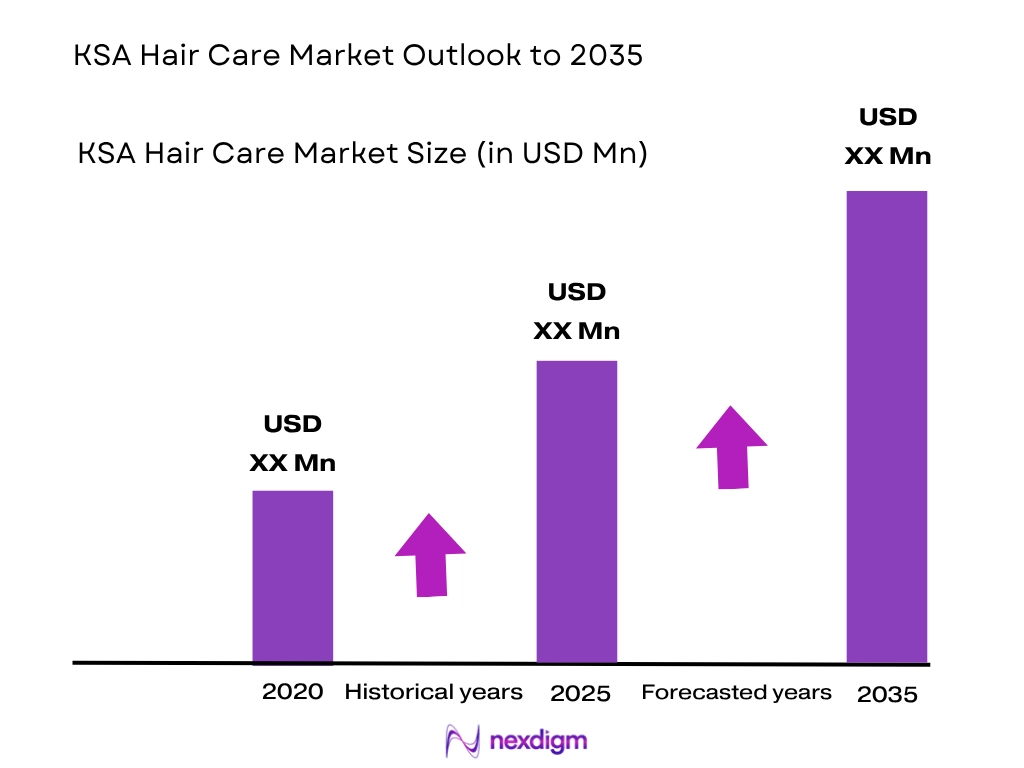
The KSA Hair Care market is valued at USD ~ million, with Nexdigm forecasting the market to reach USD ~ million at a 5.20% CAGR across its published forecast window; for the requested 2026-2035 period, this report applies the same forward CAGR as the closest published hair-care forecast benchmark. Growth is driven by premium hair care, natural formulations, anti-dandruff products, hair fall solutions, e-commerce, and higher grooming expenditure; men’s grooming sales exceeded SAR ~ million in 2023.
Riyadh, Jeddah, and Dammam dominate the KSA Hair Care market because they are the Kingdom’s largest commercial, retail, expatriate, salon, and premium-consumption hubs. Saudi Arabia’s population increased from 33.7 million to 35.3 million, while internet users reached 36.84 million, supporting online beauty discovery and replenishment. Riyadh leads through income concentration and premium retail, Jeddah through beauty retail and pilgrimage-linked demand, and Dammam through affluent urban households and modern trade density.
Market Segmentation
By Product Type
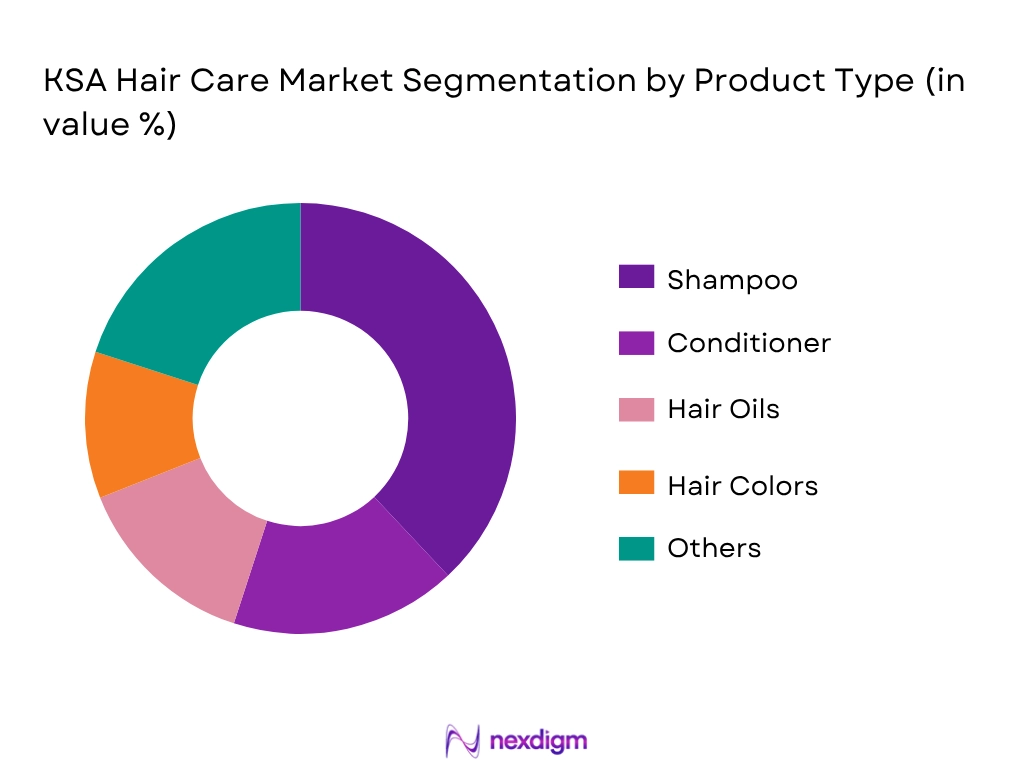
The KSA Hair Care market is segmented by product type into shampoo, conditioner, hair oils, hair colors, hair styling products, and hair treatments, masks and serums. Shampoo has the dominant market share in KSA hair care because it is the core replenishment product used across male, female, family, and salon-influenced routines. Its dominance is supported by high-frequency usage, wide availability across hypermarkets and pharmacies, and stronger brand loyalty in anti-dandruff, hair fall control, scalp care, and natural ingredient claims. Ken Research identifies shampoos as the leading product type due to their ingrained role in daily grooming routines, while premium and organic shampoo variants are gaining traction as consumers become more attentive to scalp health and harsh-chemical concerns.
By Distribution Channel
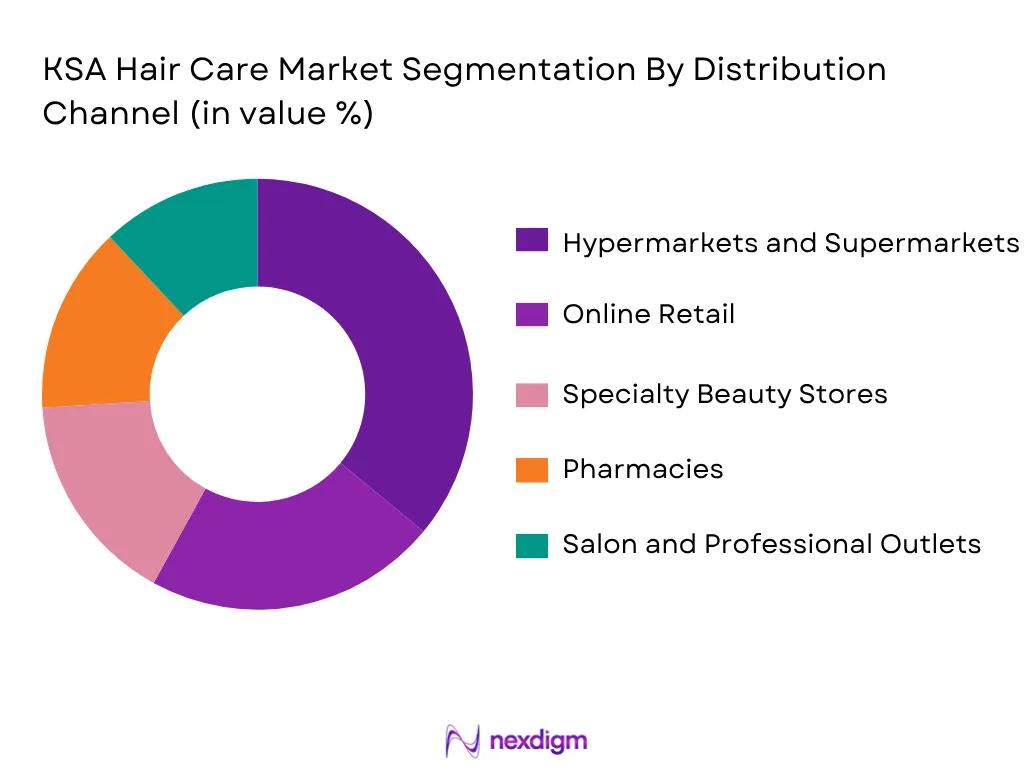
The KSA Hair Care market is segmented by distribution channel into hypermarkets and supermarkets, online retail, specialty beauty stores, pharmacies, and salon/professional outlets. Hypermarkets and supermarkets hold the dominant market share because they combine one-stop household shopping, broad SKU assortment, high visibility of mass and masstige brands, bundle promotions, and immediate product availability. Ken Research states that hypermarkets and supermarkets lead with over 35% share, supported by extensive brand availability and competitive pricing. Online retail is the fastest-moving challenger because Amazon.sa, Noon, Nice One, and Golden Scent allow consumers to compare price, claims, ingredients, ratings, imported brands, and exclusive bundles.
Competitive Landscape
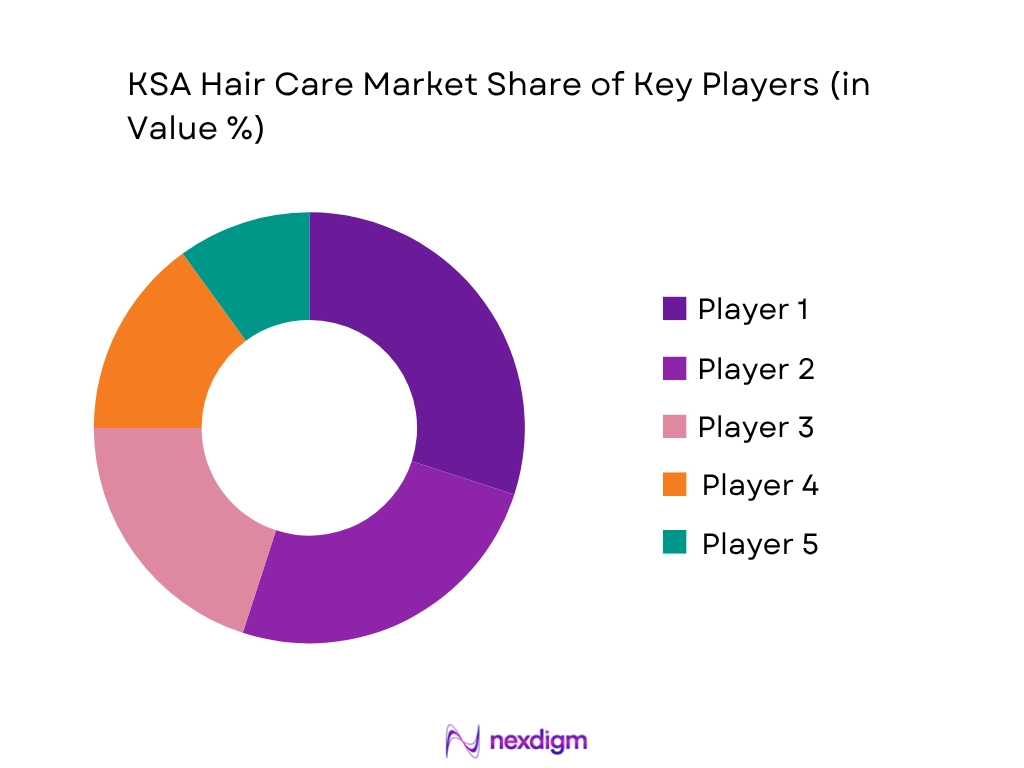
The KSA Hair Care market is led by global FMCG, beauty, dermocosmetic, herbal, and salon-professional companies. L’Oréal, Unilever, Procter & Gamble, Dabur, and Beiersdorf benefit from high brand recall, established import and distributor networks, broad product portfolios, and strong shelf presence across modern trade, pharmacy, e-commerce, and specialty beauty retail. The market is competitive but not fragmented at the top, because major players control high-frequency categories such as shampoo, conditioner, anti-dandruff, oils, styling, and treatment products.
| Company | Establishment Year | Headquarters | Key Hair Care Brands / Lines | KSA Channel Strength | Core Category Strength | Price Positioning | Product Claim Focus | Competitive Advantage |
| L’Oréal Groupe | 1909 | Paris, France | ~ | ~ | ~ | ~ | ~ | ~ |
| Procter & Gamble | 1837 | Cincinnati, USA | ~ | ~ | ~ | ~ | ~ | ~ |
| Unilever | 1929 | London, UK | ~ | ~ | ~ | ~ | ~ | ~ |
| Dabur International | 1884 | Dubai, UAE | ~ | ~ | ~ | ~ | ~ | ~ |
| Beiersdorf AG | 1882 | Hamburg, Germany | ~ | ~ | ~ | ~ | ~ | ~ |
KSA Hair Care Market Analysis
Growth Drivers
Urban Grooming Routines
Urban grooming routines are a strong driver for the KSA Hair Care Market because the consumer base is concentrated in city-led retail, salon, pharmacy, and e-commerce ecosystems. Saudi Arabia’s total population reached 35.3 million in 2024, increasing from 33.7 million in 2023, while the World Bank reported Saudi Arabia’s urban population at 30,065,601 people in 2024. This creates a large urban replenishment base for shampoos, conditioners, anti-dandruff products, hair oils, styling products, and professional treatment ranges. Urban consumers are also more exposed to malls, hypermarkets, pharmacies, beauty specialty stores, and salon services, which makes hair care a routine-led and visibility-driven category. Digital behavior further supports this, as Saudi Arabia’s Communications, Space and Technology Commission reported 99% internet penetration, 99.4% mobile-phone usage for browsing, and 48 GB average monthly mobile data consumption per person in 2024. These indicators directly support online beauty discovery, influencer-led grooming education, e-commerce replenishment, and product comparison across ingredient claims such as sulfate-free, paraben-free, anti-dandruff, keratin, argan oil, and scalp repair. For hair care brands, this urban-digital combination strengthens trial, repeat purchase, and premium product migration across Riyadh, Jeddah, Dammam, Makkah, and Madinah.
Female Workforce Participation
Female workforce participation supports the KSA Hair Care Market by increasing demand for regular grooming, scalp care, styling maintenance, heat protection, frizz control, and salon-linked product routines. GASTAT reported that the total number of Saudi females reached 9,807,663 in the Saudi Women’s Statistics Report 2024, with women aged 15 to 34 forming a major consumer cohort and women aged 20 to 24 representing a distinct young adult segment. The same source reported that Saudi female unemployment declined to 13 in 2024 from 19 in 2022, while Q4 2024 female unemployment fell to 11.9 from 13.9 in the corresponding quarter of 2023. Separately, GASTAT’s labor market release reported Saudi female labor force participation at 36.0 in Q4 2024 and the female employment-to-population ratio at 31.8. For hair care, this supports more frequent use of daily and occasion-based products, including anti-humidity styling, leave-in conditioners, dry-hair care, colored-hair protection, and professional shampoos. Working women are also more likely to interact with formal retail, pharmacies, digital beauty platforms, and salon services, creating stronger demand for branded, compliant, and claim-led hair care portfolios.
Market Challenges
Price Sensitivity
Price sensitivity remains a key challenge for the KSA Hair Care Market because hair care competes with other recurring household and personal-care needs, even when consumer spending capacity is high. World Bank data reported Saudi household final consumption expenditure at USD 556,685,333,333 in 2024, indicating a large consumption base, but GASTAT’s annual CPI release shows that household budgets faced pressure from essential categories. The average annual inflation rate reached 1.7 in 2024, with housing, water, electricity, gas, and other fuels rising by 8.8, housing rental prices rising by 10.6, and food and beverages rising by 0.8. In 2025, GASTAT reported annual average CPI inflation at 2.0, with housing, water, electricity, gas, and other fuels up 6.1, actual rentals paid by tenants for main residence up 8.2, and personal care, social protection and miscellaneous goods and services up 5.1. These figures are relevant for hair care because shampoos and conditioners are recurring purchases, while masks, serums, premium oils, salon-professional treatments, and color-care products are more discretionary. When essential spending rises, consumers may downtrade to mass brands, delay premium treatment purchases, buy larger value packs, or wait for promotions on e-commerce and hypermarket channels.
Counterfeit Risk
Counterfeit and non-compliant product risk is a material challenge for the KSA Hair Care Market because hair care products are directly applied to the scalp and hair, making product safety, ingredient compliance, labeling, storage, and expiry integrity central to consumer trust. SFDA reported that in January 2024 it detected 1,808 violations, with financial fines totaling SAR 4,589,500; among establishments visited, 4,961 were licensed and 893 were unlicensed. For a market with imported shampoos, oils, colorants, serums, salon treatments, henna products, and professional-use chemicals, such enforcement data points indicate the operating risk created by unlicensed establishments and weak traceability. SFDA’s cosmetics enforcement pages also show action against facilities manufacturing and marketing cosmetics in residential houses and storing SFDA-controlled products in unlicensed locations. For hair care brands, counterfeit and non-compliant goods can damage brand equity, create health complaints, distort online pricing, and weaken confidence in professional products sold outside authorized salons or distributors. This especially affects premium repair treatments, hair colors, keratin-related products, scalp solutions, and imported niche brands, where consumers may not easily distinguish authorized SKUs from grey-market or unsafe products.
Opportunities
Premium Hair Repair
Premium hair repair is a strong future opportunity in the KSA Hair Care Market because the macroeconomic base supports trade-up from basic cleansing to multi-step routines. World Bank data reported Saudi Arabia’s GDP per capita, PPP, at USD 71,375.4 in 2024, while household final consumption expenditure reached USD 556,685,333,333 in 2024. These figures indicate a sizeable consumer economy capable of supporting premium shampoos, conditioners, masks, serums, leave-in treatments, bond-repair products, heat-protection products, and salon-maintenance packs. The opportunity is also supported by Saudi Arabia’s digital infrastructure: CST reported 99 internet penetration, 93.1 of online shopping occurring on local websites, 21.5 of internet users using AI tools, and 48 GB monthly mobile data consumption per person in 2024. For premium hair repair, this matters because consumers increasingly discover routines through digital education, influencer tutorials, salon aftercare content, and product reviews. Hair damage from heat styling, coloring, bleaching, keratin services, dry climate, and frequent washing creates a clear need for repair-led regimens. Brands with scientifically positioned claims, professional endorsements, Arabic content, SFDA-compliant labeling, and strong online availability are well positioned to convert consumers from basic shampoo use into complete repair systems.
Hijab Hair Care
Hijab hair care represents a market-specific opportunity because Saudi Arabia has a large female consumer base with distinct scalp, ventilation, oiliness, sweat, fragrance, frizz, dryness, and hair-breakage needs linked to covered-hair routines. GASTAT reported 9,807,663 Saudi females in the Saudi Women’s Statistics Report 2024, with women aged 15 to 34 forming a substantial young consumer group and women aged 20 to 24 representing an important early-career and beauty-adoption cohort. Female economic participation further supports product demand: Saudi female unemployment declined to 13 in 2024 from 19 in 2022, while Q4 2024 female unemployment reached 11.9. These data points support rising mobility, workplace participation, and structured grooming routines among women. Hijab-specific hair care can address scalp freshness, anti-dandruff care, oil-control shampoo, lightweight conditioner, anti-frizz serum, leave-in mist, hair fall control, and breathable fragrance formats. The opportunity is not only product-led but also education-led, requiring Arabic-first content around scalp hygiene, drying routines before covering hair, gentle cleansing, non-greasy oils, and salon-supported care. Brands that localize claims for Saudi climate, female routines, and compliant cosmetic positioning can differentiate from generic global hair care offerings.
Future Outlook
The KSA Hair Care market is expected to expand steadily, supported by premiumization, scalp care, male grooming, e-commerce penetration, and salon-professional product adoption.
The forecasted CAGR for the 2026-2035 period is taken at 5.20%, aligned with the closest published Saudi hair care forecast benchmark. Future growth will be strongest in anti-dandruff, hair fall control, sulfate-free, paraben-free, keratin, argan oil, botanical, hijab-related scalp care, and professional repair systems. SFDA cosmetic notification, Arabic labeling, ingredient compliance, and importer responsibility will remain critical for market access. Saudi Arabia’s hair care industry is moving from basic cleansing toward problem-solution routines. The next phase will be shaped by consumers purchasing complete regimens rather than single SKUs: shampoo plus conditioner, mask, serum, oil, scalp tonic, and heat protection. This shift benefits companies with wider portfolios and strong consumer education. E-commerce will continue to accelerate discovery of imported, niche, clean-label, professional, and influencer-led brands, while hypermarkets will remain relevant for replenishment and family-sized products.
Major Players
- L’Oréal Groupe
- Procter & Gamble
- Unilever
- Henkel AG & Co. KGaA
- Dabur International
- Kenvue
- Wella Company
- Coty Inc.
- Kao Corporation
- Shiseido Company
- The Estée Lauder Companies
- Himalaya Wellness
- Beiersdorf AG
- Godrej Consumer Products
- Revlon
Key Target Audience
- Hair care product manufacturers
- Beauty and personal care brand owners
- Salon chains and professional hair care distributors
- Hypermarket, supermarket, pharmacy, and specialty beauty retailers
- E-commerce marketplaces and online beauty platforms
- Importers, wholesalers, and FMCG distribution companies
- Investments and venture capitalist firms
- Government and regulatory bodies: Saudi Food and Drug Authority, Ministry of Commerce, Saudi Standards, Metrology and Quality Organization, Zakat, Tax and Customs Authority
Research Methodology
Step 1: Identification of Key Variables
The initial phase involves constructing an ecosystem map of the KSA Hair Care market, covering global brand principals, local importers, distributors, retailers, pharmacies, salons, e-commerce platforms, SFDA-regulated entities, and end consumers. The objective is to identify critical variables such as product type, claims, pricing, channel split, import dependence, and regulatory compliance.
Step 2: Market Analysis and Construction
Historical market information is compiled through secondary sources, public market reports, retail channel mapping, product portfolio analysis, and SKU-level price benchmarking. The market is constructed using both top-down beauty and personal care allocation and bottom-up product-level mapping across shampoo, conditioner, oils, colorants, styling, and treatment products.
Step 3: Hypothesis Validation and Expert Consultation
Market hypotheses are validated through interviews with distributors, category managers, salon owners, pharmacy buyers, e-commerce sellers, and brand representatives. These discussions help test assumptions on product velocity, channel margins, consumer preferences, promotional dependency, and demand differences across Riyadh, Jeddah, Dammam, and other regions.
Step 4: Research Synthesis and Final Output
The final stage integrates secondary research, expert validation, regulatory review, and bottom-up revenue triangulation. Product segmentation, distribution split, competitive benchmarking, and future opportunity mapping are finalized after cross-checking against publicly available market figures and Saudi-specific cosmetic notification requirements.

- Executive Summary
- Research Methodology (Market Definitions and Assumptions, Hair Care Product Boundary, Abbreviations, Market Sizing Approach, Top-Down Beauty & Personal Care Allocation, Bottom-Up SKU and Channel Build-Up, Retail Audit Approach, Salon and Distributor Interview Framework, Consumer Cohort Validation, Price-Pack Architecture Mapping, Import and Local Distribution Checks, Limitations and Future Conclusions)

- Definition and Scope
- Overview Genesis
- Timeline of Major Hair Care Players
- Business Cycle
- Supply Chain and Value Chain Analysis
- Retail-to-Salon Category Flow
- Import Dependency and Local Distribution Structure
- Premium, Mass, Natural, Dermatological and Professional Hair Care Landscape

- Growth Drivers (Urban Grooming Routines, Female Workforce Participation, Premium Beauty Spending, Hair and Scalp Concern Awareness, Salon Service Expansion, E-Commerce Discovery)
- Market Challenges (Price Sensitivity, Counterfeit Risk, Import Compliance, Climate-Induced Product Claims, Channel Discounting, Product Duplication, Consumer Trust)
- Opportunities (Premium Hair Repair, Hijab Hair Care, Scalp Wellness, Men’s Hair Care, Curly Hair Care, Saudi-Specific Claims, Salon Retailing, Subscription Commerce)
- Trends (Clean Beauty, Ingredient-Led Shopping, Scalpification, Hair Cycling, Bond Repair, Oil Rituals, Professionalization, TikTok Beauty Discovery, Omnichannel Pricing)
- Government Regulation (SFDA Cosmetic Notification, GHAD Listing, GSO Standards, Ingredient Restrictions, Arabic Labeling, Import Licensing, Warehouse Requirements, Product Claims Control)
- Supply Chain and Route-to-Market (Brand Principal, Importer, Local Distributor, Modern Trade, Pharmacy, Beauty Retail, Salon Distributor, Marketplace Fulfilment, Last-Mile Delivery)
- Pricing and SKU Architecture (Price per ml/g, Entry Pack, Family Pack, Premium Pack, Salon Liter Format, Bundle Pricing, Promo Mechanics, Online Discount Spread)
- Consumer Behavior Analysis (Purchase Frequency, Brand Switching, Hair Concern Triggers, Influencer Impact, Salon Recommendation, Pharmacy Trust, Ingredient Awareness, Trial-to-Repeat Rate)
- SWOT Analysis (Premium Demand, Imported Brand Strength, Compliance Risk, Localized Product Gap, Omnichannel Opportunity, Counterfeit Threat)
- Stakeholder Ecosystem (Brand Owners, Importers, Distributors, SFDA, Retail Chains, Pharmacies, Salons, Dermatologists, Influencers, Marketplaces, Consumers)
- Porter’s Five Forces (Supplier Power, Retailer Power, Threat of Substitutes, New Entrant Risk, Competitive Rivalry, Distributor Leverage)
- Competition Ecosystem (Global FMCG Brands, Professional Salon Brands, Natural/Herbal Brands, Dermocosmetic Brands, Local Distributors, E-Commerce Native Beauty Sellers)

- By Value (2020-2025)
- By Volume (2020-2025)
- By Average Selling Price (2020-2025)
- By Retail Pack Size (2020-2025)
- By Channel Revenue Pool (2020-2025)
- By Salon Professional Consumption Pool (2020-2025)

- By Product Type (In Value%)
Shampoo
Conditioner
Hair Oil
Hair Mask
Hair Serum
Hair Colorants
Hair Styling Products
Scalp Treatment Products
Anti-Dandruff Products
Hair Loss / Hair Strengthening Products - By Consumer Need State (In Value%)
Anti-Dandruff and Scalp Care
Hair Fall Control
Damage Repair
Dryness and Frizz Control
Color Protection
Volume and Shine
Curly / Textured Hair Care
Heat Protection
Organic / Natural Ingredient-Based Care - By Price Positioning (In Value%)
Mass
Masstige
Premium
Luxury
Dermocosmetic
Salon Professional - By Gender (In Value%)
Female Hair Care
Male Hair Care
Unisex / Family Hair Care
Kids and Baby Hair Care - By Distribution Channel (In Value%)
Hypermarkets and Supermarkets
Pharmacies and Drugstores
Beauty Specialist Stores
Salon and Professional Distributors
Traditional Grocery and Convenience Stores
E-Commerce Marketplaces
Brand-Owned Online Stores
Social Commerce - By Region (In Value%)
Central Region
Western Region
Eastern Region
Southern Region
Northern Region - By Hair Type (In Value%)
Normal Hair
Dry Hair
Oily Hair
Damaged / Chemically Treated Hair
Curly / Wavy / Textured Hair
Colored Hair
Hijab-Related Scalp and Hair Concerns - By Ingredient / Claim Type (In Value%)
Sulfate-Free
Paraben-Free
Silicone-Free
Natural / Botanical
Halal-Friendly Beauty Positioning
Dermatologist-Tested
Keratin-Based
Argan Oil-Based
Coconut / Herbal Oil-Based
Anti-Pollution / Heat-Protection Claims

- Market Share of Major Players (Value Share, Volume Share, Shampoo Share, Treatment Share, Salon Professional Share, E-Commerce Share)
- Cross Comparison Parameters (Brand Portfolio Breadth, Product Type Coverage, Price Positioning, SFDA/GSO Compliance Readiness, Channel Penetration, Salon Professional Network, E-Commerce Visibility, Ingredient/Claim Strength)
- SWOT Analysis of Major Players (Brand Equity, Local Distribution Strength, Innovation Pipeline, Premiumization Capability, Pricing Power, Channel Dependency, Regulatory Exposure)
- Pricing Analysis Basis SKUs for Major Players (Shampoo ml Pack, Conditioner ml Pack, Hair Oil ml Pack, Mask g Pack, Serum ml Pack, Colorant Pack, Professional Liter Pack, Bundle Discount)
- Brand Portfolio Mapping (Mass Hair Care, Premium Hair Care, Professional Hair Care, Natural Hair Care, Dermatological Hair Care, Men’s Hair Care, Baby Hair Care)
- Distribution Benchmarking (Modern Trade, Pharmacy, Beauty Specialist Retail, Salon Distributor, Marketplace, Quick Commerce, Brand Website, Social Commerce)
- Detailed Profiles of Major Companies
L’Oréal Groupe
Procter & Gamble
Unilever
Henkel
Dabur International
Kenvue
Wella Company
Coty Inc.
Kao Corporation
Shiseido Company
The Estée Lauder Companies
Himalaya Wellness
Beiersdorf AG
Godrej Consumer Products
Revlon

- Market Demand and Utilization (Usage Frequency, Wash Routine, Oil Application, Mask and Serum Adoption, Salon Treatment Follow-Through)
- Purchasing Power and Budget Allocation (Monthly Hair Care Spend, Premium Trade-Up, Promo Sensitivity, Salon Product Spend, Family Pack Economics)
- Needs, Desires and Pain Point Analysis (Hair Fall, Dandruff, Dryness, Frizz, Heat Damage, Color Damage, Scalp Irritation, Hijab Hair Concerns)
- Decision-Making Process (Retail Shelf Visibility, Dermatologist Advice, Salon Recommendation, Influencer Content, Online Reviews, Ingredient Claims, Price Promotions)
- Customer Cohort Mapping (Gen Z Beauty Shoppers, Working Women, Male Grooming Adopters, Mothers, Premium Salon Users, Pharmacy-Led Treatment Buyers)
- Occasion and Routine Mapping (Daily Care, Weekly Treatment, Pre-Event Styling, Post-Color Maintenance, Post-Salon Care, Travel and Umrah/Hajj Grooming Needs)

- By Value (2026-2035)
- By Volume (2026-2035)
- By Average Selling Price (2026-2035)
- By Retail and Professional Channel Revenue (2026-2035)
- By Premium and Mass Contribution (2026-2035)


 Request a Sample
 Ask for Customization
 Get a Quote
 Enquire Now