
 Download PDF
Market Overview
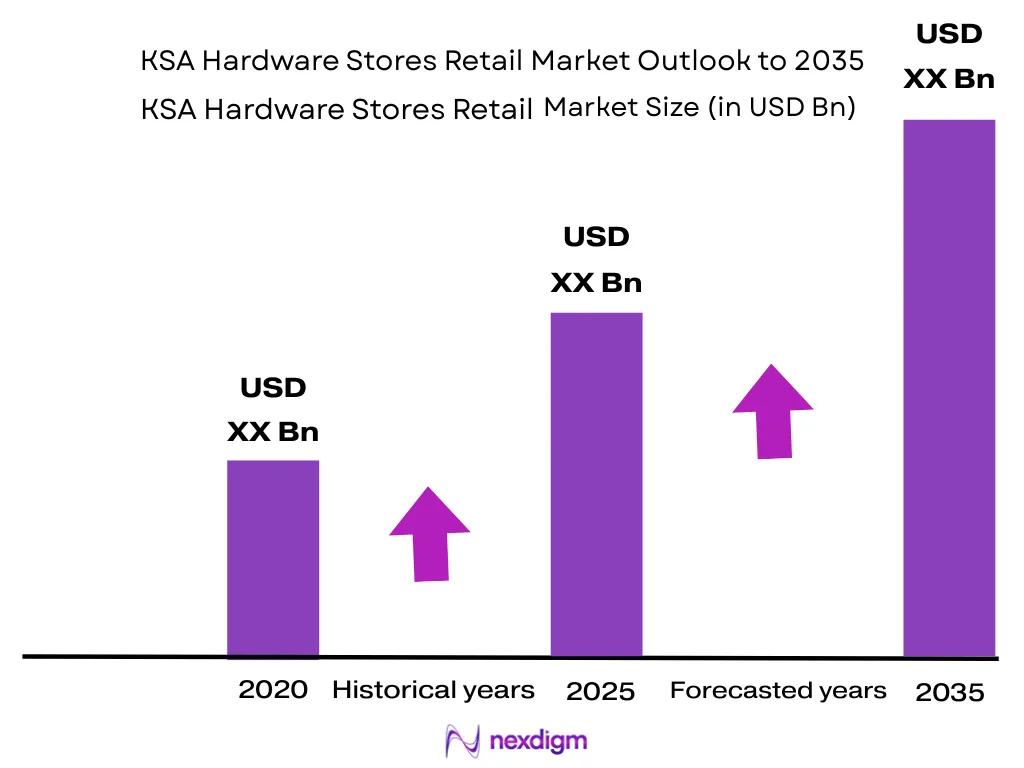
The KSA Hardware Stores Retail Market is valued at USD ~ billion, assessed through the country’s home improvement retail market, which includes building materials, hardware and tools, paints, coatings, electrical supplies, lighting, HVAC, garden and outdoor products. Demand is driven by construction, housing delivery, renovation, contractor procurement and retail modernization. Saudi nominal GDP reached SAR 4,703 billion, compared with SAR 4,135 billion, strengthening the consumer and project base for hardware retail. Riyadh, Jeddah, Dammam and Khobar dominate the KSA Hardware Stores Retail Market because they concentrate residential expansion, project procurement, organized retail stores, port-linked distribution, MEP contractors and facility maintenance demand. Riyadh leads through capital development and giga-project activity, Jeddah through hospitality and western-region distribution, while Dammam and Khobar serve Eastern Province industrial buyers. Data Saudi recorded 79,397 new individual proprietorships in Riyadh, 64,844 in Makkah and 38,424 in Eastern Region.
Market Segmentation
By Product Category
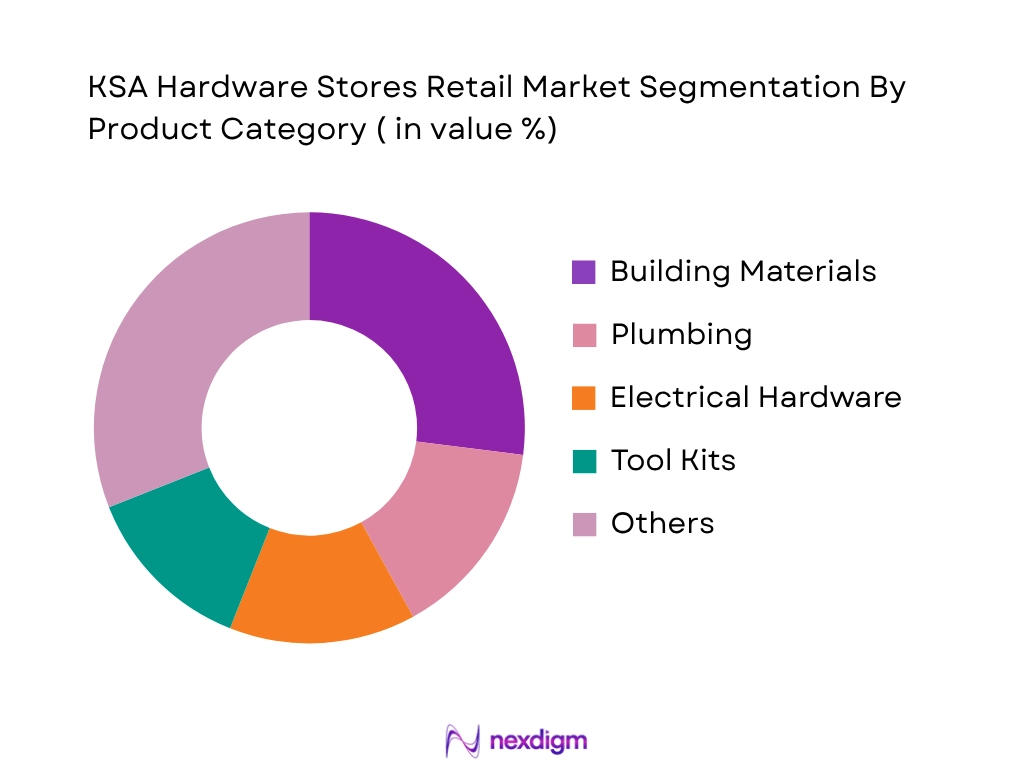
KSA Hardware Stores Retail Market is segmented by product category into building materials, plumbing supplies, electrical hardware, hand tools, power tools, paints, fasteners, safety products and garden hardware. Building materials and construction consumables hold the dominant market share because hardware stores in Saudi Arabia are strongly linked to residential construction, contractor procurement and fit-out activity. Products such as cement-linked inputs, boards, insulation materials, sealants, adhesives, fasteners, pipe fittings and installation consumables are purchased repeatedly across construction stages. The dominance of this segment is reinforced by Vision 2030-related projects, residential compounds, hospitality developments and commercial property upgrades. Unlike discretionary DIY products, building-material-linked hardware is required by contractors, MEP teams and maintenance buyers, giving it a higher purchase frequency and stronger bulk-order contribution.
By Store Format
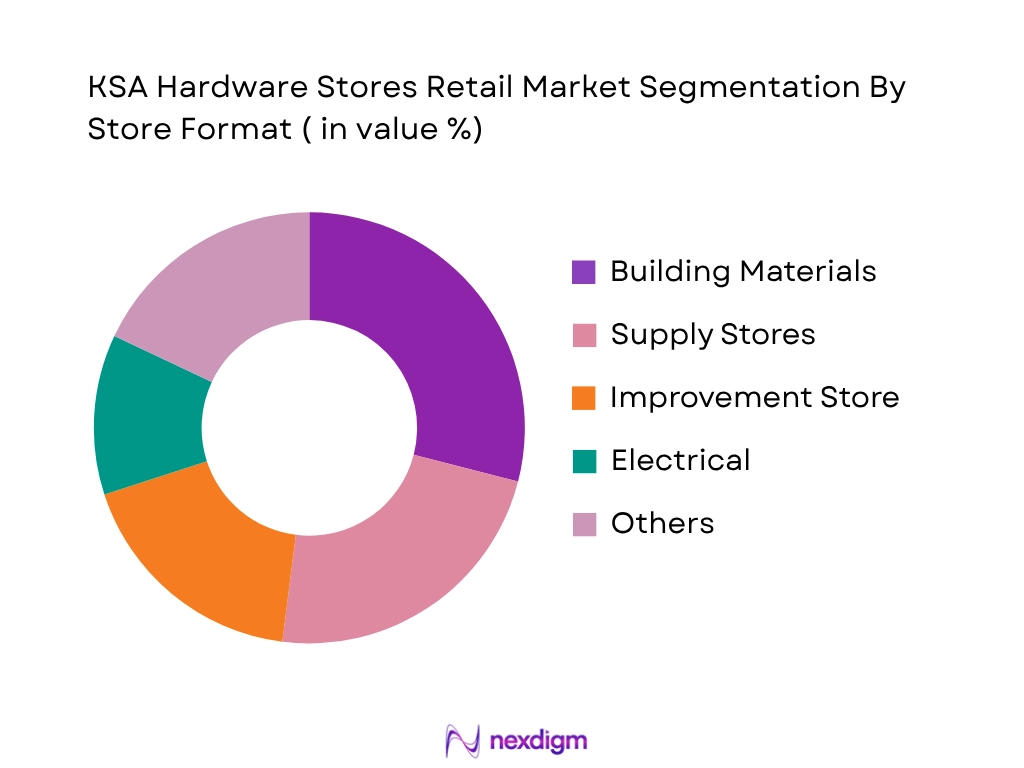
KSA Hardware Stores Retail Market is segmented by store format into building material and hardware chains, traditional stores, big-box home improvement outlets, trade counters, specialist tool retailers, online sellers and B2B procurement suppliers. Building material and hardware retail chains dominate because they combine contractor-oriented product availability with organized retail processes, branded product ranges, delivery capability and larger inventory depth. Saudi buyers often purchase project-related products in bundled baskets covering plumbing, electrical, adhesives, tools, sealants and finishing materials. Chains and structured suppliers also benefit from stronger relationships with contractors, facility managers and developers. Traditional stores remain relevant in local catchments, but organized chains are better placed to serve bulk demand from Riyadh, Jeddah, Eastern Province and giga-project-linked subcontractors.
Competitive Landscape
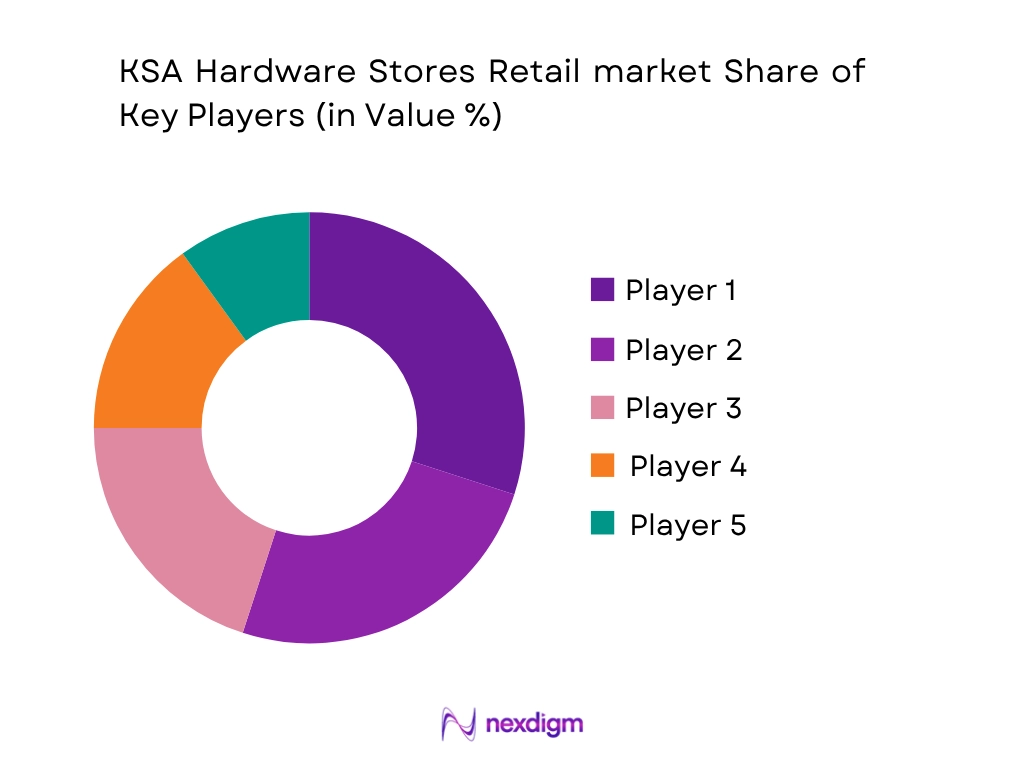
The KSA Hardware Stores Retail Market is moderately fragmented, with competition spread across home improvement superstores, building-material chains, sanitaryware suppliers, electrical distributors, specialist tool retailers and online marketplaces. SACO is one of the largest home improvement retailers in Saudi Arabia and operates 33 stores in 18 cities, offering more than 45,000 products, according to the Saudi Exchange company profile. ABYAT competes through finishing and furnishing materials, while Madar Building Materials, Binex and BMC Gulf serve project, contractor and building-material demand.
| Major Player | Establishment Year | Headquarters | Store / Format Positioning | Core Product Strength | Primary Customer Base | Sales Channel | Delivery / Fulfilment | Market-Specific Differentiator |
| SACO | 1984 | Riyadh, Saudi Arabia | ~ | ~ | ~ | ~ | ~ | ~ |
| ABYAT | 2005 | Kuwait; KSA showrooms in major cities | ~ | ~ | ~ | ~ | ~ | ~ |
| Madar Building Materials | 1969 | Khobar / Al-Fozan Group network | ~ | ~ | ~ | ~ | ~ | ~ |
| Binex | 1981 | Dammam, Saudi Arabia | ~ | ~ | ~ | ~ | ~ | ~ |
| BMC Gulf / BMC Saudi | 1980 | Jeddah / GCC network | ~ | ~ | ~ | ~ | ~ | ~ |
KSA Hardware Stores Retail Market Analysis
Growth Drivers
Vision 2030 Construction Pipeline Supporting Contractor-Led Hardware Demand
KSA Hardware Stores Retail Market is being driven by construction-led procurement across tools, fasteners, plumbing supplies, electrical fittings, sealants, paints, safety products and site consumables. Data Saudi reports that the construction sector recorded SAR 470.6 billion in operating revenues and 273,874 active construction enterprises, showing a large base of contractors, subcontractors and project buyers requiring recurring hardware replenishment. The same source states that construction FDI stock reached SAR 91.4 billion, with net FDI inflow of SAR 11.6 billion, indicating continued institutional participation in project execution. This supports hardware stores because contractor procurement is not limited to one-time tool purchases; it includes repeated orders for screws, anchors, valves, pipes, cables, conduits, adhesives, PPE and replacement accessories. Data Saudi also records construction-sector commercial bank credit at SAR 146.7 billion in April 2026, which supports project liquidity and supplier purchasing. Retailers with trade counters, site delivery and bulk SKU availability are positioned to capture this demand.
Expanding Non-Oil Economy and Urban Consumption Base
KSA Hardware Stores Retail Market benefits from Saudi Arabia’s non-oil economic base, urban household demand and retail-linked consumer activity. The World Bank reports Saudi Arabia’s GDP at USD 1.24 trillion and GDP per capita at USD 35,121.7, reflecting a high-income consumption base for home repair, villa upgrades, garden products, lighting, bathroom fittings and DIY hardware. Data Saudi reports 2,045,964 active enterprises across the Kingdom, including 326,585 active enterprises in wholesale and retail trade and 273,874 active enterprises in construction. These figures support hardware retail because the market serves both household and enterprise buyers: homeowners purchase tools and maintenance products, while contractors and trade professionals buy project inputs repeatedly. World Bank country analysis also notes that Saudi real GDP expanded in the first half of 2025, with services including wholesale and retail trade, restaurants and hotels as main drivers. This strengthens store traffic in Riyadh, Jeddah, Dammam and Khobar, where residential, commercial and facility maintenance demand is concentrated.
Market Challenges
Import Dependence and Supply-Chain Exposure for Tools and Hardware SKUs
KSA Hardware Stores Retail Market faces supply-chain pressure because many hardware categories depend on imported machinery, electrical equipment, hand tools, power tools, fasteners, fittings and accessories. The Ministry of Economy and Planning reports that Saudi imports reached SAR 217.3 billion in Q3 2024, a historical high for that quarter, while the machinery and mechanical appliances category reached around SAR 57 billion in the import category chart. The same government report states that imports from China reached SAR 53.8 billion, with machinery, mechanical devices and electrical equipment worth SAR 24.3 billion as the highest imported products from China. This is directly relevant to hardware retailers because shelves require thousands of imported SKUs across voltage ratings, pipe sizes, drill bits, fastener specifications, locks, switches and branded accessories. Any disruption in customs clearance, shipping lead times or supplier allocation can affect stock availability. Retailers serving contractors face higher risk because project buyers often require exact technical specifications rather than substitutable consumer products.
Compliance Burden and Product Authenticity Risk
KSA Hardware Stores Retail Market is challenged by product compliance requirements and authenticity risks across electrical goods, PPE, tools, plumbing components, adhesives, locks and construction consumables. SASO states that certificates of conformity confirm whether products conform to Saudi standards, and these certifications are relevant for model approval and production-line or batch approval. The U.S. International Trade Administration notes that Saudi Arabia uses the SALEEM/SABER electronic conformity assessment system for imported goods entering the market, which is important for exporters and importers supplying Saudi retail channels. The challenge becomes significant because the hardware sector handles large SKU breadth, including electrical accessories, safety shoes, helmets, switches, sealants, pipes and power-tool accessories. The Saudi Authority for Intellectual Property also launched a counterfeit-goods crackdown in 2024, indicating enforcement attention around fake products. For hardware stores, non-compliant products can lead to blocked imports, warranty disputes, product failure, safety incidents and customer mistrust. Organized retailers must maintain supplier traceability, certificates, invoice records and authorized brand partnerships.
Market Opportunities
Contractor Trade Counters and B2B Hardware Procurement
KSA Hardware Stores Retail Market has a strong opportunity in contractor-focused trade counters, supported by the scale of the construction and enterprise base. Data Saudi records 273,874 active construction enterprises and construction operating revenues of SAR 470.6 billion, indicating a large number of buyers that regularly require tools, plumbing supplies, electrical hardware, fasteners, PPE and building consumables. Construction-sector employee compensation across micro, small and medium enterprises reached SAR 47.6 billion, showing a broad labour ecosystem that uses hardware inputs daily on project sites. Data Saudi also reports construction-sector commercial bank credit of SAR 146.7 billion in April 2026, supporting project execution and supplier procurement capacity. These current indicators point to future growth potential for retailers offering contractor accounts, quotation desks, branch pickup, bulk ordering and delivery scheduling. The opportunity is strongest in Riyadh, Jeddah, Dammam, Khobar and project-linked regions where contractors require immediate SKU availability and documented product compliance. Retailers that combine stock depth with technical staff can increase repeat B2B purchasing.
Omnichannel Hardware Retail and Digital Catalogue Expansion
KSA Hardware Stores Retail Market has an opportunity to expand digital catalogues, click-and-collect, app-based ordering and marketplace-integrated fulfilment because retail and construction customers increasingly need faster SKU discovery. The Ministry of Communications and Information Technology states that Saudi Arabia’s ICT market surpassed SAR 180 billion in 2024, while the digital economy reached approximately SAR 495 billion, creating a strong technology base for online retail, logistics systems and digital procurement. Data Saudi reports construction-sector POS transactions at SAR 1.7 billion in April 2026, showing active card-based purchasing in a sector closely tied to hardware demand. The opportunity is market-specific because hardware purchases involve complex SKU searches across drill sizes, pipe diameters, cable ratings, switches, sealants, fasteners and accessories. Digital catalogues reduce search friction, while physical branches remain critical for inspection, urgent purchases and returns. Retailers can use online stock visibility, Arabic product descriptions, WhatsApp ordering, invoice-based B2B accounts and scheduled delivery to serve contractors, facility managers, electricians, plumbers and DIY households more efficiently.
Future Outlook
The KSA Hardware Stores Retail Market is expected to grow steadily over the next decade, supported by residential development, Riyadh’s urban expansion, Jeddah’s hospitality and commercial demand, Eastern Province industrial maintenance and giga-project-linked procurement. Hardware retailers will benefit from recurring demand across tools, fasteners, electrical products, plumbing supplies, sealants, coatings, safety products and building consumables. The market will shift from fragmented counter-based sales toward organized retail, digital catalogues, click-and-collect, contractor account management and site delivery. B2B procurement will gain relevance as contractors and facility management companies require faster access to exact SKUs, compliant products, warranty support and documented sourcing. Growth will be strongest for retailers that can serve both professional and household customers. Big-box stores will capture DIY and villa-upgrade demand, while trade counters will capture bulk contractor orders. Electrical and plumbing hardware will remain critical because MEP work is central to residential, hospitality, commercial and infrastructure projects. The market will also see rising demand for smart home hardware, water-efficient fixtures, certified PPE, low-VOC paints, energy-efficient lighting and branded professional power tools. Key risks include import dependence, parallel imports, counterfeit products, certification requirements, working-capital pressure from large SKU inventories and price transparency from marketplaces. Retailers with stronger supply-chain control, private label ranges, authorized brand partnerships and regional fulfilment hubs will be better positioned through 2035.
Major Players
- SACO
- ABYAT
- BMC Gulf / BMC Saudi
- Madar Building Materials
- Binex
- Al Rashed Fasteners
- Alfanar
- Sanipex Group Saudi Arabia
- Al Kuhaimi Metal Industries
- Electric House
- Zamil Industrial
- Al Bawardi Tools and Hardware
- Al Hadaf Hardware
- Amazon.sa Hardware Sellers
- Noon Saudi Hardware Sellers
Key Target Audience
- Hardware store chains and home improvement retailers
- Building-material retailers and distributors
- Power tool, hand tool and fastener manufacturers
- Electrical, plumbing and sanitaryware suppliers
- Construction contractors and MEP subcontractors
- Facility management and real estate maintenance companies
- Investments and venture capitalist firms
- Government and regulatory bodies, including General Authority for Statistics, Ministry of Commerce, Saudi Standards, Metrology and Quality Organization, Zakat, Tax and Customs Authority, Ministry of Municipalities and Housing and Saudi Contractors Authority
Research Methodology
Step 1: Identification of Key Variables
The initial phase involves constructing an ecosystem map for the KSA Hardware Stores Retail Market. This includes home improvement stores, building-material chains, traditional hardware shops, trade counters, distributors, importers, contractors, MEP firms, facility managers and e-commerce platforms. Key variables include product category mix, regional demand, customer type, store format, online contribution, contractor account usage and fulfilment model.
Step 2: Market Analysis and Construction
In this phase, historical and current data is compiled from retail, construction, trade, company disclosures and macroeconomic indicators. A top-down approach is used to assess the market from home improvement and construction-linked retail demand, while bottom-up modelling estimates contribution by product category, store format, customer type and region. This enables triangulation of hardware-store revenue pools.
Step 3: Hypothesis Validation and Expert Consultation
Market hypotheses are validated through computer-assisted interviews with hardware retailers, building-material distributors, contractors, MEP buyers, store managers, category suppliers and online sellers. These consultations help refine assumptions related to SKU movement, category margins, contractor credit behaviour, regional demand, delivery requirements, private label potential and online purchasing behaviour. The validation stage improves accuracy across both organized and traditional channels.
Step 4: Research Synthesis and Final Output
The final phase integrates secondary research, public company information, industry interviews and bottom-up modelling into a structured report. The output includes market size, segmentation, competitive benchmarking, future outlook and strategic recommendations. The final report is designed for business decision-makers evaluating expansion, investment, distribution partnerships, product launches and channel strategy in Saudi Arabia’s hardware retail sector.

- Executive Summary
- Research Methodology (Market Definitions and Assumptions, Abbreviations, Hardware Retail Scope, Building Materials Retail Scope, DIY vs Contractor Boundary, Retail vs Wholesale Boundary, Top-Down Market Sizing, Bottom-Up Store Revenue Estimation, SKU-Level Benchmarking, Primary Interviews with Retailers/Contractors/Distributors/Importers, Supplier Channel Checks, Import Flow Review, Limitations and Future Conclusions)

- Definition and Scope
- Market Genesis and Evolution
- Timeline of Major Players
- Business Cycle
- Supply Chain and Value Chain Analysis

- Growth Drivers (Vision 2030 Construction, Housing Development, Giga Projects, Facility Management Growth, DIY Home Improvement, Industrial Maintenance, Hospitality Expansion, E-Commerce Adoption)
- Market Challenges (Import Cost Exposure, SKU Fragmentation, Counterfeit Products, Contractor Credit Risk, Inventory Stockouts, Price Competition, Product Certification, Skilled Sales Staff Shortage)
- Market Opportunities (Private Label Hardware, Trade Loyalty Programs, Smart Home Hardware, Green Building Products, Giga-Project Supply Partnerships, Localized Regional Stores, B2B Procurement Platforms, Certified Product Retailing)
- Market Trends (Retail Modernization, Branded Tool Premiumization, Arabic Digital Catalogues, Click-and-Collect, Same-Day Delivery, Local Sourcing, Product Bundling, Service-Led Retail)
- Government Regulation and Compliance (SASO Standards, SABER Certification, Customs Clearance, VAT, Import Documentation, Product Labelling, Consumer Protection, Electrical Safety Compliance)
- SWOT Analysis
- Porter’s Five Forces Analysis

- By Retail Revenue (2020-2025)
- By Number of Hardware Retail Outlets (2020-2025)
- By Average Revenue per Store (2020-2025)

- By Product Category (In Value %)
Hand Tools
Power Tools
Fasteners and Fixings
Plumbing and Sanitary Hardware - By Store Format (In Value %)
Big-Box Home Improvement Stores
Building Material Retail Chains
Specialist Tool Stores
Electrical and Plumbing Trade Counters
Traditional Hardware Shops - By Customer Type (In Value %)
DIY and Home Improvement Customers
Professional Contractors
MEP Contractors
Giga-Project Subcontractors
Facility Management Companies - By Region (In Value %)
Riyadh
Makkah and Jeddah
Eastern Province
Madinah and Tabuk
Secondary Regions

- Market Share of Major Players (Retail Revenue, Store Count, Regional Footprint, Category Sales, Contractor Account Base, Online Visibility)
- Cross Comparison Parameters (Store Footprint by Region, SKU Depth by Product Category, Contractor Account Penetration, E-Commerce and Delivery Capability, Authorized Brand Partnerships, Private Label Presence, SABER/SASO Compliance Capability, After-Sales and Warranty Support)
- Pricing Analysis Basis Key Hardware SKUs(Cordless Drill, Angle Grinder, Screwdriver Set, PVC Pipe Fitting, Electrical Cable, Silicone Sealant, Door Lock, Safety Shoes, Interior Paint, Anchor Bolt Pack)
- SWOT Analysis of Major Players
- Detailed Profiles of Major Competitors
SACO
Abyat
BMC Gulf
Madar Building Materials
Binex
Al Rashed Fasteners
Alfanar
Sanipex Group Saudi Arabia
Al Kuhaimi Metal Industries
Electric House
Zamil Industrial
Al Bawardi Tools and Hardware
Al Hadaf Hardware
Amazon.sa Hardware Sellers
Noon Saudi Hardware Sellers

- DIY and Household Customer Analysis
- Contractor and Subcontractor Analysis
- MEP Contractor Analysis
- Facility Management Buyer Analysis

- By Retail Revenue (2026-2035)
- By Number of Hardware Retail Outlets (2026-2035)
- By Average Revenue per Store (2026-2035)


 Request a Sample
 Ask for Customization
 Get a Quote
 Enquire Now