
 Download PDF
Market Overview
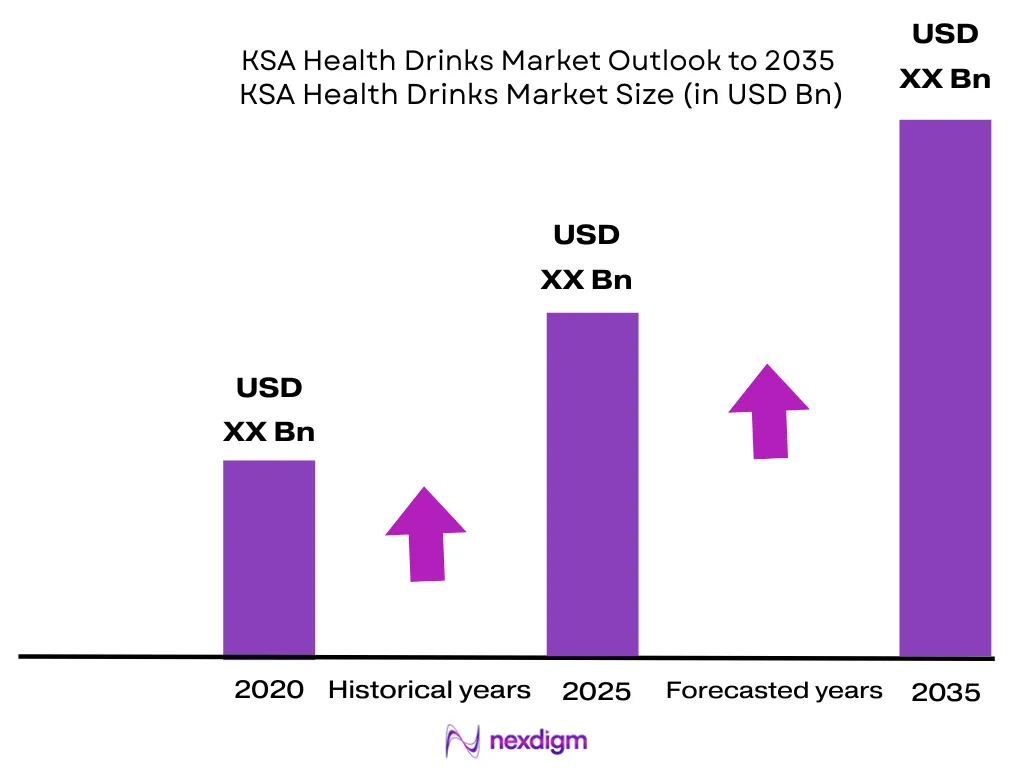
The KSA Health Drinks Market is valued at USD ~ billion, derived from IMARC’s Saudi Arabia functional beverages baseline of USD ~ million and its published growth trajectory. Demand is driven by energy drinks, sports hydration, dairy-based beverages, fortified juices, and functional waters. GASTAT estimates the Kingdom’s population at 35.3 million, rising from 33.7 million, while the World Bank reports GDP per capita of USD 35,121.7, supporting premium and convenience-led beverage demand. Riyadh, Jeddah, Makkah, Madinah, Dammam, and Khobar dominate the KSA Health Drinks Market because they concentrate modern retail, corporate offices, gyms, universities, religious tourism, hotels, and forecourt retail. Riyadh drives premium grocery and q-commerce demand, while Makkah and Madinah benefit from pilgrim hydration needs. Saudi Arabia recorded 116 million domestic and inbound tourists, including 29.7 million inbound tourists and 86.2 million domestic tourists; Hajj alone recorded 1,833,164 pilgrims.
Market Segmentation
Product Type
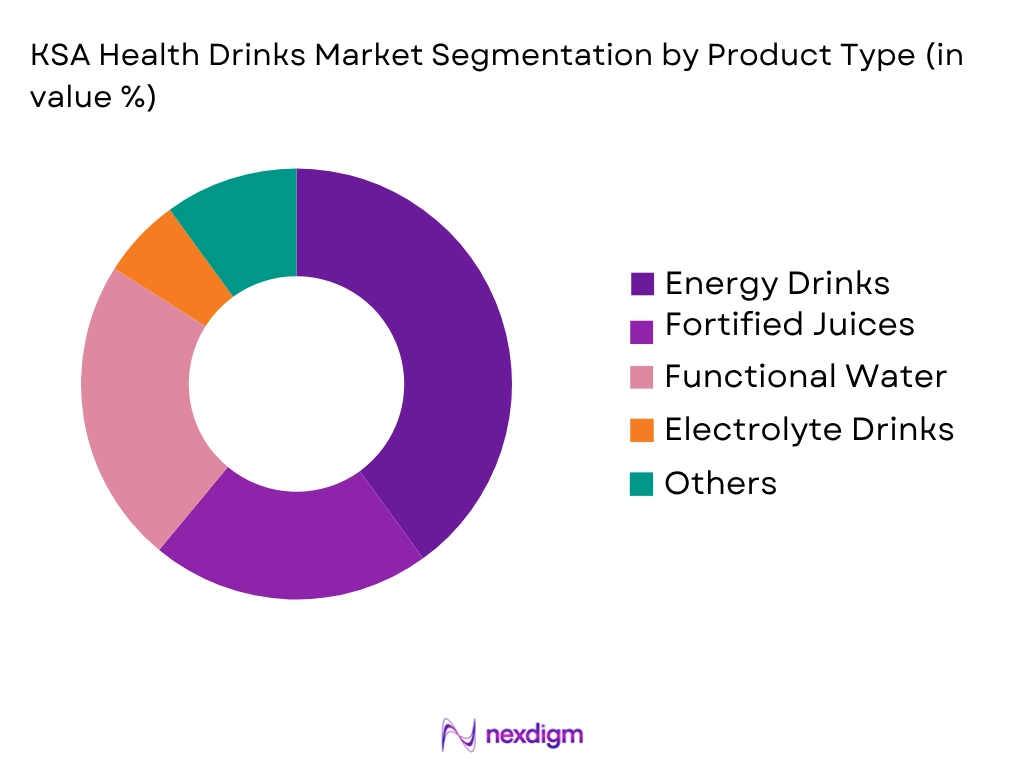
The KSA Health Drinks Market is segmented by product type into energy drinks, sports drinks, dairy-based health drinks, fortified juices, functional water, protein RTD drinks, kombucha and probiotic drinks, and plant-based functional beverages. Energy drinks have a dominant market share in KSA under product type segmentation due to strong youth consumption, single-serve can availability, forecourt visibility, modern grocery penetration, and strong positioning around energy, alertness, and convenience. Brands such as Red Bull, Monster, Power Horse, Bison, and other caffeinated beverage brands benefit from commuter consumption, university demand, late-night retail, gaming culture, and long working-hour occasions. Energy drinks also remain highly visible in petrol stations, convenience stores, hypermarkets, and q-commerce baskets. Sports hydration and dairy-based health drinks are growing, but their purchase occasions are more specific, while energy drinks serve a wider daily-use and impulse-led consumer base.
By Distribution Channel
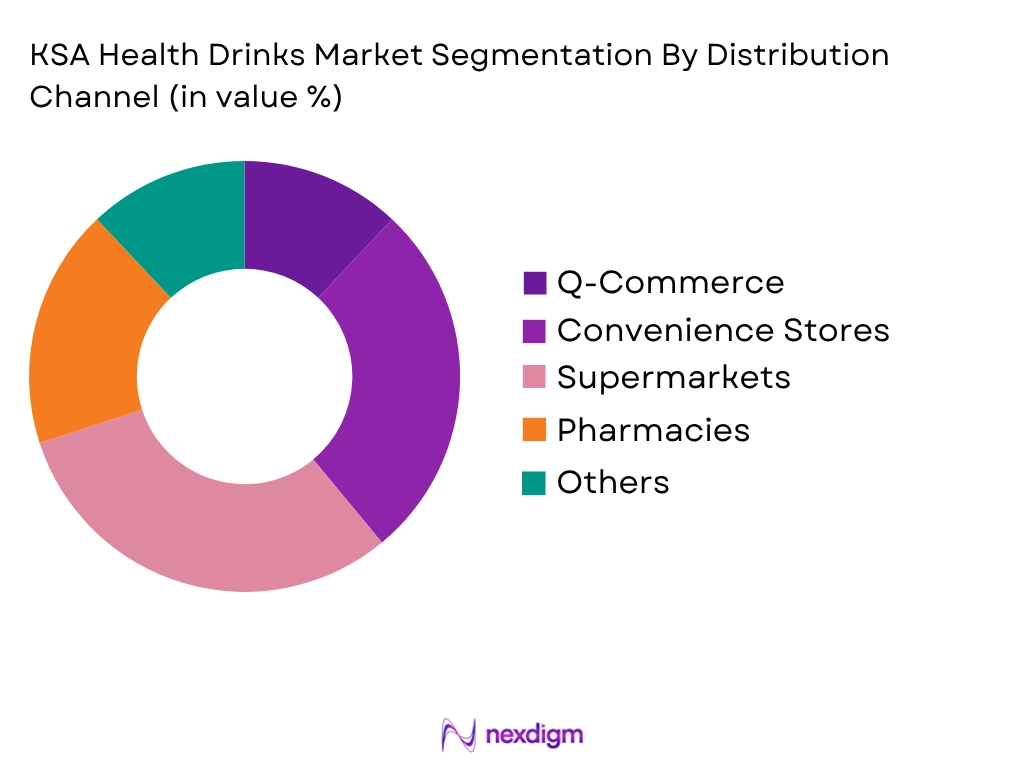
The KSA Health Drinks Market is segmented by distribution channel into supermarkets and hypermarkets, convenience stores and petrol stations, online grocery and q-commerce, pharmacies and health stores, gyms and sports clubs, HoReCa, and Hajj/Umrah travel retail. Supermarkets and hypermarkets hold the dominant market share under distribution channel segmentation because retailers such as Panda, Carrefour, Lulu, Danube, Tamimi, and Farm Superstores provide wide assortment, chilled visibility, multipack promotions, family-pack formats, and imported brand availability. The channel is especially important for fortified juices, dairy-based health drinks, functional waters, sports drinks, and protein RTDs, where shoppers compare brands, pack sizes, sugar claims, and nutrition positioning. Petrol stations remain essential for energy drinks, while q-commerce is becoming important for multipack replenishment. Hajj and Umrah travel retail creates a specialized hydration channel, particularly in Makkah, Madinah, Jeddah, and airport-linked retail.
Competitive Landscape
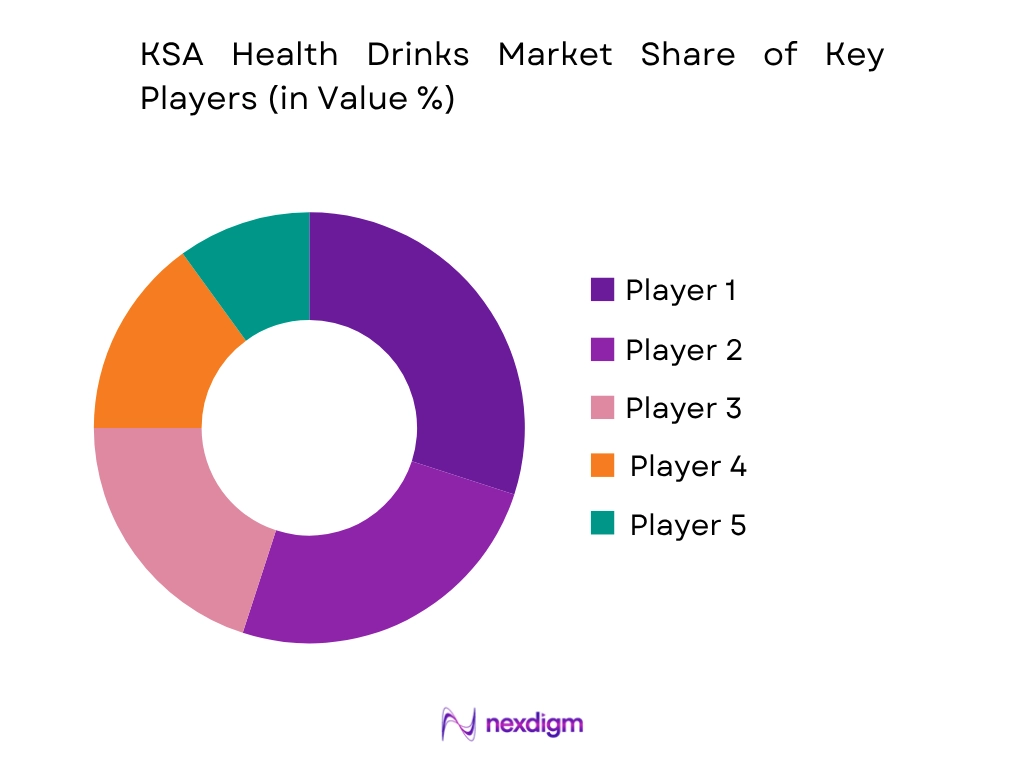
The KSA Health Drinks Market is led by global beverage multinationals, local dairy and juice companies, regional bottlers, and specialist energy and sports hydration brands. Almarai, PepsiCo, Coca-Cola, Red Bull, and Monster are highly influential due to their broad portfolios, chilled distribution, modern trade access, and strong brand recall. Domestic players such as NADEC, SADAFCO, Nada Dairy, and Aujan Coca-Cola are important in juices, dairy-based beverages, and family wellness consumption. Competition is defined by sugar-free innovation, SFDA compliance, excise tax exposure, cold-chain capability, retail shelf visibility, and Hajj/Umrah hydration access.
| Company | Establishment Year | Headquarters | Key KSA Health Drinks Portfolio | Functional Positioning | Core Channel Strength | Sugar-Free / Low-Sugar Strength | Packaging Strength | KSA Competitive Advantage |
| Almarai | 1977 | Riyadh, Saudi Arabia | ~ | ~ | ~ | ~ | ~ | ~ |
| PepsiCo Saudi Arabia | 1965 | Purchase, New York, USA | ~ | ~ | ~ | ~ | ~ | ~ |
| The Coca-Cola Company | 1886 | Atlanta, Georgia, USA | ~ | ~ | ~ | ~ | ~ | ~ |
| Red Bull Saudi Arabia | 1987 | Fuschl am See, Austria | ~ | ~ | ~ | ~ | ~ | ~ |
| Monster Beverage Corporation | 1935 / Monster brand 2002 | Corona, California, USA | ~ | ~ | ~ | ~ | ~ | ~ |
KSA Health Drinks Market Analysis
Growth Drivers
Large resident base and strong income capacity support daily functional beverage consumption
KSA Health Drinks Market demand is supported by a large consumer base and strong macroeconomic capacity for packaged, branded and convenience-led beverages. GASTAT estimates Saudi Arabia’s population at 35.3 million people in its Population Estimates Publication. The World Bank records Saudi Arabia’s GDP at USD 1.24 trillion and GDP per capita at USD 35,121.7, supporting modern grocery, forecourt, gym, pharmacy and q-commerce demand for energy drinks, sports hydration, fortified juices, functional water and dairy-based health drinks. The market is also supported by a sizeable expatriate and commuter base, with Saudi residents estimated at 19.6 million and non-Saudi residents at 15.7 million, strengthening demand across workplace, university, retail and on-the-go beverage occasions.
Tourism, Hajj and Umrah create recurring demand for hydration and fortified ready-to-drink products
KSA Health Drinks Market benefits from religious tourism and wider domestic travel, which create recurring demand for bottled hydration, electrolyte drinks, functional water, fortified juices and single-serve energy beverages in Makkah, Madinah, Jeddah, Riyadh and airport-linked retail. DataSaudi reports 116 million tourists in Saudi Arabia, including 29.7 million inbound tourists and 86.2 million domestic tourists. GASTAT reported 1,833,164 Hajj pilgrims, including 1,611,310 external pilgrims and 221,854 internal pilgrims. DataSaudi’s Hajj dashboard also records 1,707,301 pilgrims in 2026, including 1,546,655 external pilgrims, showing the continuing scale of travel-led hydration occasions. These flows support heat-replenishment beverages, hotel minibar stocking, transport-node retail, and q-commerce delivery around pilgrimage corridors.
Market Challenges
Import dependence and food-supply exposure create sourcing pressure for functional beverage inputs
KSA Health Drinks Market faces sourcing complexity because many functional beverage inputs rely on global supply chains, including vitamins, sweeteners, flavors, whey protein, plant proteins, probiotics, packaging materials, concentrates and specialty ingredients. USDA’s Retail Foods Annual states that Saudi Arabia depends on imports to meet 70 out of every 100 units of food demand, creating exposure for beverage formulators and importers. USDA’s Exporter Guide also reports that Saudi Arabia imports more than USD 20 billion of food and agricultural products annually, while consumer demand is shifting toward healthier foods, particularly beverages and snacks. This creates risk for functional drinks because ingredient documentation, shelf-life management, customs clearance, cold-chain coordination and supplier availability directly affect product launches, especially for protein RTDs, kombucha, fortified juices and plant-based beverages.
Excise and sugar-linked regulation increase reformulation and compliance pressure
KSA Health Drinks Market faces regulatory pressure because energy drinks, sweetened beverages and functional beverages with added sugar must manage tax exposure, label accuracy and ingredient compliance. ZATCA applies excise tax on energy drinks and sweetened beverages, making caffeine-led and sugar-containing health drinks more exposed than plain hydration products. The regulatory challenge is intensified by SFDA requirements around Arabic labeling, ingredient declarations, nutrition panels, caffeine warnings, permitted additives and product registration. Saudi Arabia’s fiscal environment also remains disciplined: the Ministry of Finance Pre-Budget Statement estimates 2026 expenditures at SAR 1,313 billion and revenues at SAR 1,147 billion, indicating continued policy focus on revenue discipline and compliance. For health-drink brands, this raises the need for zero-sugar variants, reduced-sugar fortified juices, compliant claims and accurate SKU-level documentation.
Market Opportunities
Digital grocery and mobile-first retail create stronger access for multipack and premium health drinks
KSA Health Drinks Market has a clear opportunity in online grocery, q-commerce and mobile-led replenishment because Saudi Arabia has a large digitally connected population and strong mobile infrastructure. CST reported 68.2 million mobile telecommunications subscriptions, creating a strong base for app-led ordering, subscription packs, product discovery and rapid delivery of health drinks. ITU data also lists Saudi Arabia’s mobile broadband subscriptions at 181 per 100 people, showing that consumers are heavily connected through mobile channels. This supports future growth for multipack energy drinks, protein RTDs, electrolyte sachets, functional water, sugar-free beverages and imported wellness drinks because digital platforms can display wider flavors, functional claims and pack sizes than physical shelves. The opportunity is especially relevant in Riyadh, Jeddah, Dammam, Khobar, Makkah and Madinah, where working professionals, students, pilgrims and families use delivery-led convenience.
Sports participation and active-lifestyle infrastructure support protein, electrolyte and low-sugar innovation
KSA Health Drinks Market has a growth opportunity in sports hydration, protein RTDs, electrolyte beverages and zero-sugar energy drinks as the Kingdom expands community sports and active-lifestyle infrastructure under Vision 2030. The Ministry of Finance’s Budget Statement notes the League Schools Championship involved more than 2,470 schools and more than 42,600 players, creating a large youth-sports platform relevant for hydration and recovery beverages. Vision 2030 also explicitly targets higher public participation in sports and athletic activities, supporting demand for functional beverages tied to daily exercise, gyms, cycling, football, running and school sports. This supports future product white space in affordable electrolyte bottles, sachets, sports drinks, protein dairy drinks and low-calorie energy beverages. Brands that combine SFDA-compliant claims, halal ingredients, heat-replenishment benefits and strong gym or school-sports activation can scale beyond conventional soft-drink occasions.
Future Outlook
The KSA Health Drinks Market is forecasted to grow at a CAGR of 5.42% during 2026-2035, aligned with the Saudi Arabia functional beverages growth outlook and extended to the market outlook period. Growth will be supported by sugar-free energy drinks, sports hydration, functional dairy, fortified juices, protein RTDs, functional waters, and low-calorie wellness beverages. Saudi Arabia’s young population, rising tourism, Vision 2030 wellness agenda, gym culture, and q-commerce penetration will continue to increase consumption occasions. Over the coming period, the market will be shaped by two parallel demand pools. The first is mass-market consumption, led by energy drinks, dairy-based beverages, fortified juices, and PET-bottle hydration drinks sold through supermarkets, hypermarkets, petrol stations, convenience stores, and q-commerce. The second is premium wellness consumption, led by functional water, protein RTDs, plant-based beverages, kombucha, probiotic beverages, and clean-label products sold through specialty stores, gyms, pharmacies, cafés, and online platforms.
Regulation will remain a key market filter. ZATCA excise tax exposure on energy drinks and sweetened beverages will continue encouraging lower-sugar, no-added-sugar, and zero-sugar product development. SFDA labeling and claim rules will also raise the importance of accurate nutrition panels, Arabic labeling, caffeine warnings, permitted ingredients, shelf-life validation, and functional-benefit substantiation. Pilgrim and tourism-led consumption will provide a differentiated growth channel compared with other GCC markets. Makkah, Madinah, Jeddah, Riyadh, and airport-led travel retail create demand for heat-replenishment beverages, functional water, electrolyte drinks, fortified juices, and convenient single-serve packs. Brands that can combine hydration, portability, temperature resilience, and hotel or travel-retail placement will be better positioned.
Major Players
- Almarai
- PepsiCo Saudi Arabia
- The Coca-Cola Company
- Red Bull Saudi Arabia
- Monster Beverage Corporation
- Aujan Coca-Cola Beverages Company
- Binzagr CO-RO
- National Agricultural Development Company
- Saudi Dairy and Foodstuff Company
- Nada Dairy
- Lacnor / National Food Products Company
- Power Horse Energy Drinks
- Bison Energy Drink
- Pocari Sweat
- Prime Hydration
Key Target Audience
- Health drink manufacturers and brand owners
- Beverage importers and distributors
- Supermarket, hypermarket, and grocery retail chains
- Convenience store and petrol station retail operators
- Online grocery and q-commerce platforms
- Gyms, sports clubs, pharmacies, wellness stores, and HoReCa operators
- Investments and venture capitalist firms
- Government and regulatory bodies (Saudi Food and Drug Authority, Zakat, Tax and Customs Authority, Ministry of Health, Ministry of Sport, Ministry of Tourism, General Authority for Statistics)
Research Methodology
Step 1: Identification of Key Variables
The initial phase involves constructing an ecosystem map covering all major stakeholders within the KSA Health Drinks Market. This includes brand owners, bottlers, co-packers, importers, distributors, retailers, gyms, pharmacies, q-commerce platforms, foodservice operators, travel retail channels, and regulators. The objective is to define key variables such as product type, functionality claim, sugar profile, excise tax exposure, channel mix, region, and consumer cohort.
Step 2: Market Analysis and Construction
In this phase, historical data is compiled for health drinks, functional beverages, energy drinks, sports drinks, dairy-based beverages, fortified juices, and functional water. Top-to-bottom analysis uses published market references and macro indicators, while bottom-to-top validation uses SKU mapping, retail shelf checks, price-pack architecture, channel availability, and distributor-level assumptions. This ensures consistency between reported market value and real channel-level activity.
Step 3: Hypothesis Validation and Expert Consultation
Market hypotheses are validated through computer-assisted telephone interviews with beverage distributors, supermarket category managers, q-commerce operators, gym procurement teams, pharmacy buyers, importers, local dairy companies, and bottled beverage manufacturers. These consultations provide operational inputs on sell-through, seasonality, chilled distribution, sugar-free migration, pilgrim consumption, channel margins, and product trial behavior.
Step 4: Research Synthesis and Final Output
The final phase integrates desk research, primary interviews, regulatory review, competitive benchmarking, and channel-level triangulation. Direct engagement with beverage manufacturers, distributors, and retail buyers supports validation of product segmentation, channel performance, consumer demand, and competitive positioning. The final output provides market size, segmentation, competitive landscape, future outlook, and strategic recommendations for the KSA Health Drinks Market.

- Executive Summary
- Research Methodology (Market Definitions and Assumptions, Health Drinks Inclusion and Exclusion Criteria, Abbreviations, Top-to-Bottom Market Sizing, Bottom-to-Top SKU Build-Up, Retail Shelf Audit, E-Commerce Price Tracking, Distributor and Importer Interviews, Gym and Pharmacy Channel Checks, Hajj and Umrah Consumption Mapping, SFDA and ZATCA Regulatory Review, Primary Research Approach, Limitations and Future Conclusions)

- Definition and Scope
- Overview Genesis
- Health Drinks Category Boundary
- Timeline of Major Players
- Business Cycle

- Growth Drivers (Young Population, Urbanization, Vision 2030 Wellness, Sports Participation, Hot Climate Hydration, Modern Grocery Reach, Q-Commerce Availability)
- Market Challenges (Affordability Constraints, Excise Tax Compliance, Sugar Reformulation Cost, Cold Chain Gaps, Import Cost Exposure, SFDA Claim Approval)
- Opportunities (Zero Sugar Energy, Electrolyte Sachets, Affordable Protein RTD, Pilgrim Hydration, Functional Dairy Innovation, Local Flavor Development, Online Replenishment)
- Market Trends (Sugar-Free Migration, Functional Caffeine, Vitamin Fortification, Electrolyte Hydration, Probiotic Dairy, Multipack Grocery, Wellness Claims, Saudi-Inspired Flavors)
- SWOT Analysis
- PESTLE Analysis
- Porter’s Five Forces Analysis

- By Value (2020-2025)
- By Volume (2020-2025)
- By Average Selling Price (2020-2025)

- By Product Type (In Value %)
Energy Drinks
Sports and Electrolyte Drinks
Functional and Enhanced Water
Fortified Juices and Nectar-Based Health Drinks
Dairy-Based Health Drinks - By Packaging Format (In Value %)
Cans
PET Bottles
Cartons and Tetra Packs
Glass Bottles
Sachets and Powder Sticks - By Distribution Channel (In Value %)
Supermarkets and Hypermarkets
Convenience Stores and Petrol Stations
Pharmacies and Health Stores
Gyms, Sports Clubs and Fitness Studios
Online Grocery and Q-Commerce - By Region (In Value %)
Riyadh
Jeddah
Makkah and Madinah
Dammam and Khobar
Other Regions

- Market Share of Major Players on the Basis of Value and Volume
- Cross Comparison Parameters (Functional Product Portfolio Breadth, Sugar-Free SKU Penetration, Excise Tax Exposure, Local Bottling and Co-Packing Strength, Hajj and Umrah Channel Presence, Chilled Distribution Capability, Gym and Sports Channel Presence, Price-Pack Architecture)
- SWOT Analysis of Major Players
- Detailed Profiles of Major Companies
Almarai
PepsiCo Saudi Arabia
The Coca-Cola Company
Red Bull Saudi Arabia
Monster Beverage Corporation
Aujan Coca-Cola Beverages Company
Binzagr CO-RO
National Agricultural Development Company
Saudi Dairy and Foodstuff Company
Nada Dairy
Lacnor / National Food Products Company
Power Horse Energy Drinks
Bison Energy Drink
Pocari Sweat
Prime Hydration

- Students and Young Adults
- Working Professionals and Commuters
- Fitness Enthusiasts and Athletes
- Families and Household Buyers
- Pilgrims and Religious Tourists

- By Value (2026-2035)
- By Volume (2026-2035)
- By Average Selling Price (2026-2035)


 Request a Sample
 Ask for Customization
 Get a Quote
 Enquire Now