
 Download PDF
 Download PDF
Market Overview
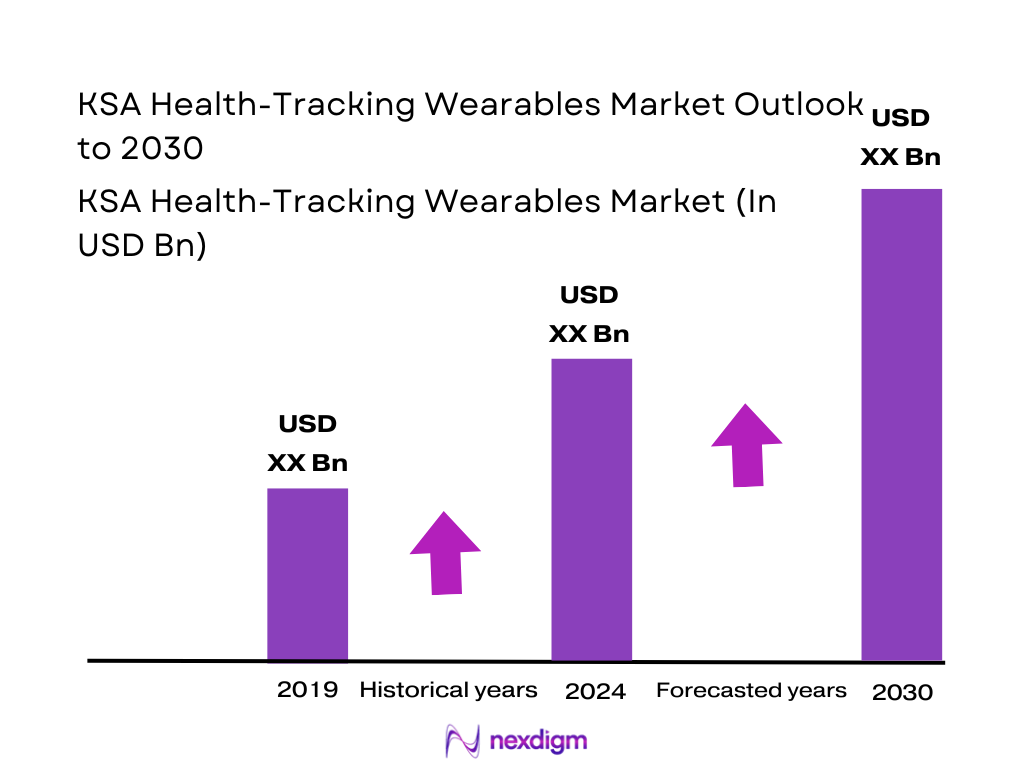
The KSA health-tracking wearables market is valued at USD ~ million in the latest year, supported by a strong base of USD ~ million in the prior year. Demand is being driven by the shift toward preventive health, higher consumer interest in always-on fitness and sleep tracking, and the mainstreaming of smartwatch-led health features. Growth is also reinforced by expanding digital health infrastructure and rising acceptance of connected monitoring in personal wellness routines.
Within Saudi Arabia, Riyadh and Jeddah lead adoption due to dense concentration of premium retail, higher propensity for flagship smartphone ecosystems, and the presence of large hospital groups and corporate employers that normalize wellness programs. Eastern Province hubs (Dammam/Khobar) benefit from high purchasing power and structured employer ecosystems. On the supply side, the market is dominated by brands headquartered in the United States, South Korea, and China, reflecting their control over device OS ecosystems, sensor innovation pace, and distribution scale through Saudi electronics retail and operator channels.
Market Segmentation
By Device Type
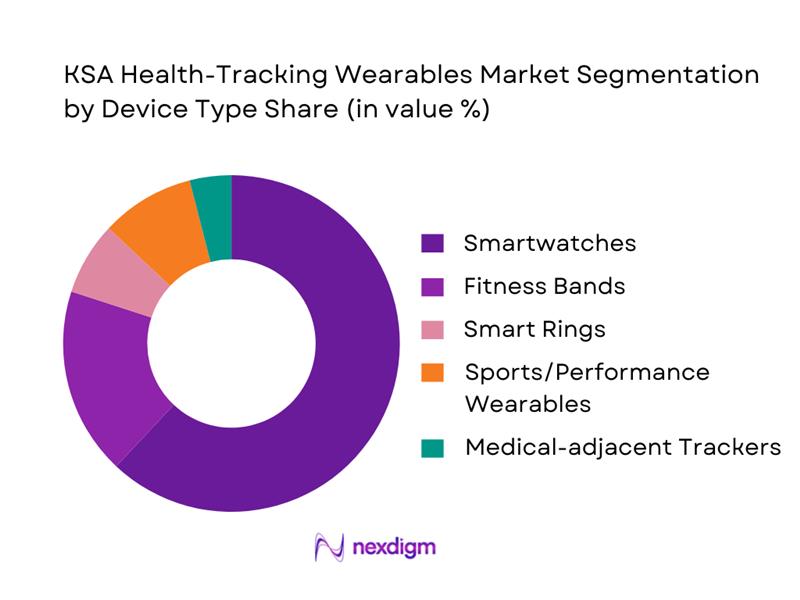
KSA health-tracking wearables are segmented by device type into smartwatches, fitness bands, smart rings, sports/performance wearables, and medical-adjacent trackers. Recently, smartwatches hold the dominant market share under device type because they combine health tracking + notifications + payments + app ecosystems in a single daily-wear format. Their dominance is reinforced by deeper integration with smartphone platforms, broader sensor stacks (multi-metric wellness and cardiovascular monitoring), and stronger retail merchandising and operator bundling compared with bands or niche trackers. Consumers also prefer smartwatches due to perceived premium value, giftability, and compatibility with lifestyle and fitness use cases.
By Distribution Channel
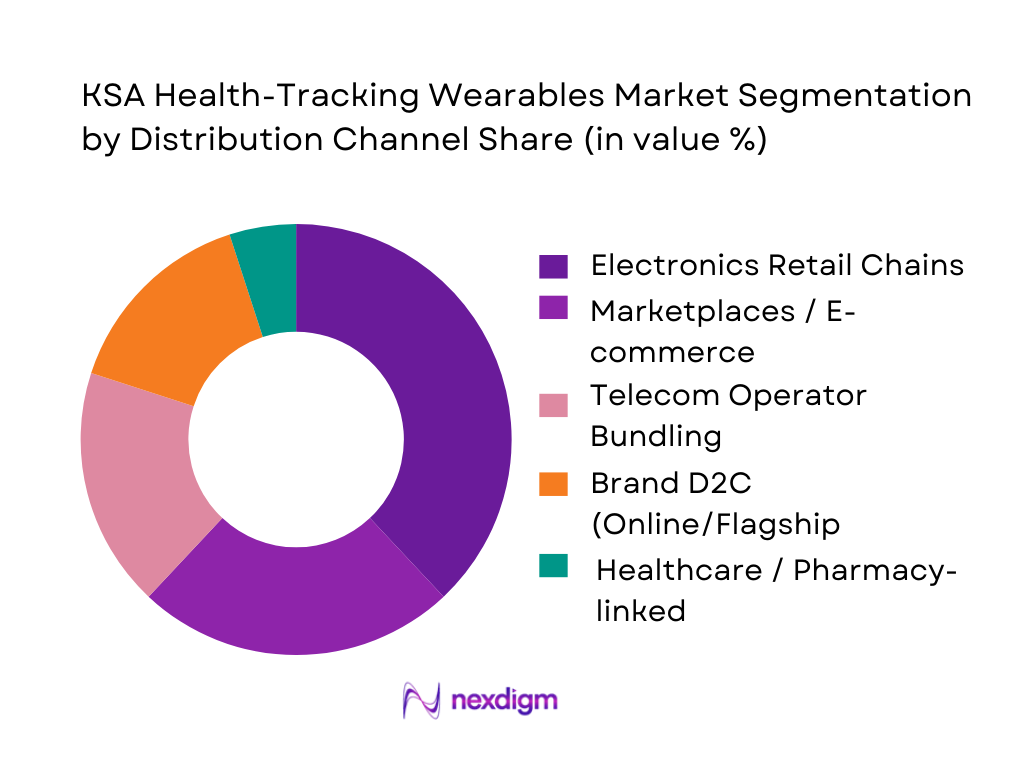
KSA health-tracking wearables are segmented by distribution channel into electronics retail chains, brand D2C (online/flagship), telecom operator bundling, marketplaces/e-commerce platforms, and healthcare/pharmacy-linked channels. Electronics retail chains dominate channel share because they provide the strongest hands-on device trial, accessory attach, installment options (often via cards/financing), and multi-brand comparison that accelerates conversion. Retailers also maintain strong relationships with top OEMs for launch visibility, which shapes consumer choice at the point of purchase. While online is growing quickly, physical retail continues to win for premium devices where buyers seek assurance, warranty clarity, and immediate availability.
Competitive Landscape
The KSA health-tracking wearables market is dominated by a set of global ecosystem players that control device OS platforms, sensors, and companion apps, alongside performance-focused brands that win in sports and training depth. Competitive intensity is shaped by ecosystem lock-in, feature-to-price laddering, retail/channel power, and readiness for Saudi-specific requirements such as data governance expectations and integration pathways with the broader digital health environment.
| Company | Establishment Year | Headquarters | Core Device Focus in KSA | Health-Metric Depth | Ecosystem / App Strength | KSA Channel Strength | Localization Readiness | Enterprise / Program Fit |
| Apple | 1976 | Cupertino, USA | ~ | ~ | ~ | ~ | ~ | ~ |
| Samsung Electronics | 1969 | Suwon, South Korea | ~ | ~ | ~ | ~ | ~ | ~ |
| Huawei | 1987 | Shenzhen, China | ~ | ~ | ~ | ~ | ~ | ~ |
| Xiaomi | 2010 | Beijing, China | Value wearables and bands | ~ | ~ | ~ | ~ | ~ |
| Garmin | 1989 | Olathe, USA | Sports and performance wearables | ~ | ~ | ~ | ~ | ~ |
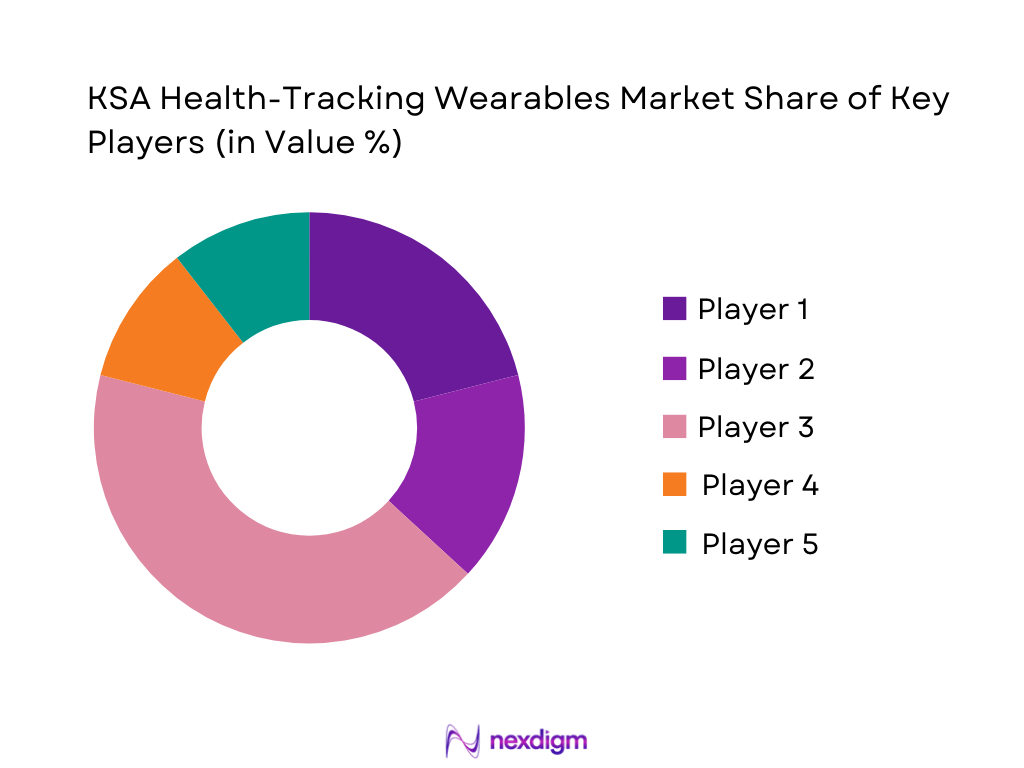
KSA Health-Tracking Wearables Market Analysis
Growth Drivers
Vision-aligned preventive healthcare
Saudi Arabia’s policy push toward prevention and digital-first care is structurally supportive for wearables that quantify sleep, activity, cardiac rhythm, and recovery—especially when these metrics can be used to triage risk and guide earlier interventions. Macro capacity matters: Saudi Arabia’s economy is recorded at USD ~ trillion and GDP per capita at USD ~, enabling sustained public-sector and employer funding for prevention-linked programs. Healthcare digitization scale is visible in payer-provider rails: NPHIES reached ~ insurance transactions, and ~ health service providers plus more than ~ insurers joined early phases—showing that routine healthcare workflows are already being standardized electronically. That foundation de-risks future “wearables-to-clinical workflow” pathways without needing consumers to self-manage data. On the delivery side, telecom and platform readiness supports continuous sync: the sector reported median mobile internet speed of 129 Mbps and ~ million mobile subscriptions, reducing friction for always-connected devices, continuous uploads, and app-based coaching—key for preventive journeys that rely on longitudinal tracking rather than one-time checks.
Lifestyle disease burden
KSA’s wearables demand is strongly linked to the need for continuous, everyday behavior change support that complements clinical care and medication adherence. While this market driver is “health-specific,” it is also anchored in macro and system throughput. Saudi Arabia’s total population is estimated at ~ million, with ~ million Saudi citizens and ~ million non-Saudi residents, creating a large, diverse base of consumers and employer-covered residents who can be targeted with standardized wellness initiatives and device-driven preventive routines. Health-system digitization scale is visible via CHI: NPHIES recorded ~ insurance transactions, demonstrating high healthcare utilization and administrative throughput—conditions where payers and providers often look for tools that reduce avoidable visits and improve monitoring between encounters. Financing capacity to sustain chronic-care infrastructure is reflected in current health expenditure per capita of USD ~, which supports the staffing and service layers that wearables increasingly integrate with. On the connectivity side, CST’s ~ million mobile subscriptions and 129 Mbps median mobile internet speed reduce the practical barriers to continuous monitoring and app-led coaching—critical in markets where long-term conditions are managed over years, not weeks.
Challenges
Clinical validation gaps
A major constraint in KSA is the boundary between “wellness tracking” and “medical-grade claims.” As wearables attempt to move from step counts into arrhythmia detection, sleep-disordered breathing flags, and clinical decision support, they must align with medical device and digital health oversight pathways. Saudi Arabia’s regulator has been formalizing this perimeter: SFDA issued Guidance on Digital Health Products to clarify what falls within regulatory scope, which raises the compliance bar for vendors that want to market medical-grade outcomes rather than lifestyle insights. That regulatory maturity is occurring in a market with the macro scale to demand higher standards: GDP of USD ~ trillion and population of ~ million create a large user base where false positives can translate into avoidable clinical load and reputational risk. System scale is also visible in CHI rails: ~ insurance transactions via NPHIES indicates high-volume healthcare administration, where payers and providers typically require stronger evidence before accepting device outputs into workflows. For vendors, this means more rigorous validation, localized clinical partnerships, and carefully scoped claims—otherwise adoption stays consumer-only and fails to cross into payer/provider-supported pathways that could materially expand usage and retention.
Data privacy concerns
Wearables generate sensitive personal data. In Saudi Arabia, privacy compliance is not optional—PDPL enforcement mechanisms introduce real legal and operational risk, and this affects consumer trust and enterprise procurement. Under the PDPL text published by SDAIA, penalties can include fines up to SAR ~ for certain violations, increasing the burden on vendors to implement privacy-by-design, localized data governance, and secure consent flows. This compliance context sits within a digitally intensive economy: CST reported the digital economy reached SAR ~ billion and ~ million mobile subscriptions, meaning data collection is pervasive and scrutiny is higher. From a macro lens, a USD ~ GDP per capita market tends to have consumers and enterprises that are more demanding about privacy assurances. For wearables, privacy concerns can slow adoption of features that require cloud processing, and can block integration deals with insurers/employers unless vendors can demonstrate robust encryption, access controls, and auditability aligned to Saudi legal expectations.
Opportunities
Medical-grade wearables (regulated pathways + provider-grade use cases)
A high-upside pathway in KSA is the expansion from consumer wellness devices into medical-grade wearables that support regulated monitoring and provider workflows. The enabling conditions are already present in “current stats,” not future promises: CHI’s NPHIES has processed ~ insurance transactions, showing that the ecosystem is already operating at digital scale where standardized documentation and workflow tools can be adopted. SFDA has also published Digital Health Products guidance —a signal that regulatory pathways are being clarified, which is essential for vendors aiming to market clinical-grade claims rather than lifestyle insights. Macro capacity supports procurement and scaling: Saudi Arabia’s economy is recorded at USD ~ trillion, with GDP per capita of USD, enabling hospital groups, integrated networks, and large employers to sponsor devices when ROI is framed as reduced avoidable visits or improved adherence. On the infrastructure side, CST’s 129 Mbps median mobile internet speed supports high-frequency data transmission and remote review workflows without connectivity as the bottleneck. The commercial opportunity is strongest for vendors that can combine: SFDA-aligned claims, PDPL-compliant governance, clinician-friendly dashboards, and integration bridges to national health rails—turning wearables from “consumer gadgets” into scalable care tools.
Insurer-subsidized devices
A scalable growth lever is insurer- and employer-supported subsidization models, where devices are bundled into wellness benefits or chronic-care engagement programs—reducing upfront friction while improving retention through incentives and care pathways. KSA already has the operational backbone for such models: CHI announced NPHIES reached ~ insurance transactions, and early phases included ~ health service providers plus more than ~ insurers, which indicates that digital insurance workflows are mature enough to support programmatic device reimbursement rules, eligibility triggers, and ongoing documentation. The addressable base is large and segmented for targeting: GASTAT estimates ~ million population, including ~ million non-Saudi residents—a meaningful cohort that is often employer-insured and reachable through corporate benefit design. Macro purchasing power supports “value-based” benefit experiments: GDP per capita of USD ~ improves the feasibility of co-pay models where insurers subsidize devices in exchange for engagement and outcomes tracking. Network readiness removes operational barriers: ~ million mobile subscriptions supports app-led nudges, digital coaching, and reminders at scale. The opportunity is strongest for payers that can link incentives to validated behaviors (consistent wear time, verified activity, sustained sleep improvement) while meeting PDPL requirements for consent and data minimization—turning subsidies into measurable engagement rather than one-time giveaways.
Future Outlook
Over the next five to six years, the KSA health-tracking wearables market is expected to expand strongly, driven by deeper consumer focus on preventive health, richer sensor-enabled tracking, and a broader shift toward always-connected lifestyles. OEM competition will increasingly center on accuracy, actionable insights, and AI-enabled coaching, rather than step counts alone. Institutional adoption is also likely to rise as employers, insurers, and providers explore wearables for engagement, wellness enablement, and chronic-condition monitoring pathways.
Major Players
- Apple
- Samsung Electronics
- Huawei
- Xiaomi
- Garmin
- Fitbit
- Amazfit
- Oura
- Withings
- Polar
- Whoop
- Suunto
- OPPO
- OnePlus
- Omron Healthcare
Key Target Audience
- Chief Digital Officer / Head of Digital Transformation
- Chief Medical Information Officer / Head of Health Informatics
- Head of Chronic Disease Programs
- Chief Underwriting Officer / Head of Product
- Head of Employee Wellness & Benefits
- Head of Partnerships / Business Development
- Investments and Venture Capitalist Firms
- Government and Regulatory Bodies
Research Methodology
Step 1: Identification of Key Variables
We construct a KSA-specific ecosystem map covering OEMs, retailers, operators, insurers, providers, and regulators. Desk research is supported by reputable secondary sources and platform intelligence to define variables such as device mix, channel behavior, and integration readiness. The goal is to lock the market scope and data boundaries before sizing.
Step 2: Market Analysis and Construction
Historical market movement is analyzed using demand-side and supply-side indicators. We structure the market into measurable segments and validate assumptions through triangulation. Outputs include market sizing, segmentation logic, and adoption drivers.
Step 3: Hypothesis Validation and Expert Consultation
Hypotheses are validated via expert interviews with OEM/channel stakeholders, enterprise wellness decision-makers, and healthcare/insurance stakeholders. These consultations provide operational insights on adoption barriers, procurement patterns, and platform preferences. Findings are used to refine and verify sizing and segmentation.
Step 4: Research Synthesis and Final Output
We synthesize results into a cohesive model and validate them against benchmark reports and market signals. Final deliverables include segmentation tables, competitive mapping, buyer analysis, and forward outlook. The approach ensures the report is internally consistent, auditable, and decision-ready.

- Executive Summary
- Research Methodology (Market Definitions & Assumptions, Abbreviations, Scope Boundaries, Market Sizing Logic, Demand-Side vs Supply-Side Modelling, Installed Base Assessment, Replacement vs New Adoption Framework, Primary Interview Coverage Across OEMs–Hospitals–Insurers–Retailers, Data Triangulation, Sensitivity Analysis, Limitations & Validation Controls)

- Definition and Scope
- Evolution of Health-Tracking Wearables in Saudi Arabia
- Timeline of Key Market Milestones and Device Penetration
- Business Cycle Analysis
- Value Chain and Ecosystem Mapping

- Growth Drivers
Vision-aligned preventive healthcare
Lifestyle disease burden
Smartphone penetration
Youth demographics
Sports & fitness culture - Challenges
Clinical validation gaps
Data privacy concerns
User retention drop-off
Device accuracy skepticism
Interoperability constraints - Opportunities
Medical-grade wearables
Insurer-subsidized devices
AI-driven early diagnostics
Remote patient monitoring integration
Chronic disease programs - Technology & Innovation Trends
- Regulatory & Compliance Landscape
- Stakeholder Ecosystem Analysis
- Porter’s Five Forces Analysis

- By Value, 2019-2024
- By Volume, 2019-2024
- Installed Base vs Connected Active User Base, 2019-2024
- Replacement, Upgrade and Multi-Device Ownership Dynamics, 2019-2024

- By Device Type (in Value %)
Smartwatches
Fitness Bands
Ring-based Trackers
Chest-worn & Patch-based Trackers
Hybrid Medical-Wellness Devices - By Health Metrics Tracked (in Value %)
Heart Rate, HRV & ECG
Blood Oxygen & Respiratory Metrics
Activity, Sleep & Recovery
Stress, Fatigue & Mental Wellness Indicators
Women’s Health & Metabolic Indicators - By Connectivity & Data Architecture (in Value %)
Standalone Devices
Smartphone-Dependent Devices
Cloud-Connected AI-Enabled Platforms
EHR / Telehealth-Integrated Devices
Insurer-Linked Wellness Platforms - By End User Category (in Value %)
Individual Consumers
Corporate & Employer Wellness Programs
Hospitals & Clinics
Insurance & TPA-led Preventive Health Programs
Government & Public Health Initiatives - By Distribution Channel (in Value %)
Brand Direct-to-Consumer (Online & Flagship Stores)
Electronics Retail Chains
Telecom Operator Bundling
Healthcare & Pharmacy Channels
Corporate & Institutional Procurement - By Region within Saudi Arabia (in Value %)
Central Region
Western Region
Eastern Region
Southern Region
Northern Region

- Competitive Positioning Matrix
- Cross-Comparison Parameters (Device Clinical Validation & Saudi FDA Readiness, Health Metrics Breadth & Accuracy Depth, AI & Predictive Analytics Capability, Cloud, App & Data Localization Compliance, Telehealth / EHR / Insurer Integration, Battery Life & Wearability Optimization, Local Partnerships & Distribution Strength in KSA, Enterprise & Government Program Readiness)
- SWOT Analysis of Key Players
- Pricing & Product Tiering Logic
- Detailed Profiles of Major Companies
Apple
Samsung Electronics
Huawei
Xiaomi
Garmin
Fitbit (Google)
Oura Health
Withings
Amazfit (Zepp Health)
Polar Electro
Whoop
Omron Healthcare
Abbott (wearable biosensing focus)
Dexcom (adjacent continuous monitoring ecosystem)
Local / Regional Digital Health Integrators

- Usage Intensity & Engagement Behaviour
- Purchasing Power & Willingness-to-Adopt Analysis
- Institutional vs Individual Procurement Dynamics
- Pain Points, Drop-off Triggers & Feature Expectations
- Decision-Making Journey: Consumer vs Enterprise Buyers

- By Value, 2025-2030
- By Volume, 2025-2030
- Installed Base vs Connected Active User Base, 2025-2030
- Replacement, Upgrade and Multi-Device Ownership Dynamics, 2025-2030


 Request a Sample
 Ask for Customization
 Get a Quote
 Enquire Now