
 Download PDF
Market Overview
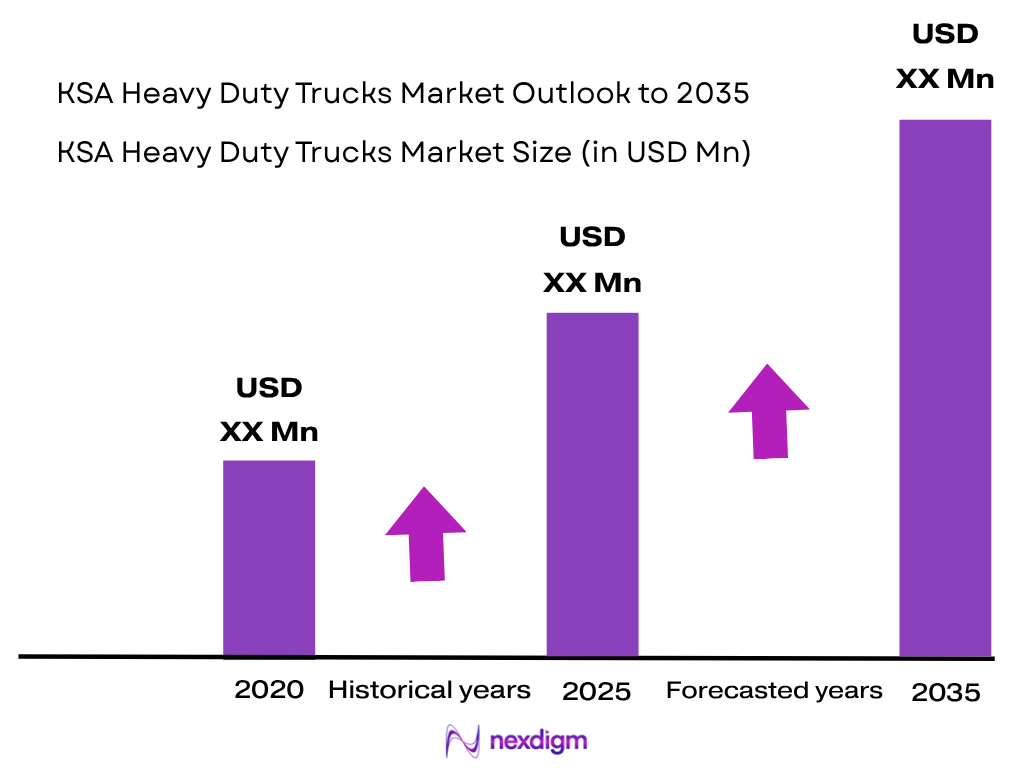
The KSA Heavy Duty Trucks Market is valued at approximately USD ~ billion, based on the latest historical assessment, with the market supported by Saudi Arabia’s expanding logistics, construction, mining, oil and gas, and industrial transportation requirements. The Kingdom recorded ~ million tonnes of road freight activity and approximately ~ million registered commercial vehicles, providing a broad operating base for heavy-duty trucks. Growth is further supported by infrastructure investment, increasing freight movement between industrial centers, port connectivity, and fleet replacement requirements.
The KSA Heavy Duty Trucks Market is concentrated around Riyadh, Jeddah, Dammam, Jubail, Yanbu and major emerging economic-development zones, reflecting their importance as freight, industrial, construction and logistics centers. Riyadh acts as the country’s principal inland distribution and government-services hub, while Jeddah benefits from port-linked freight and western-region distribution. Dammam and Jubail are supported by oil, gas, petrochemical and industrial activity, while Yanbu serves major energy and industrial operations. Emerging developments around NEOM, Qiddiya and the Red Sea region are additionally creating specialized heavy-haul and construction fleet requirements.
Market Segmentation
By Truck Type
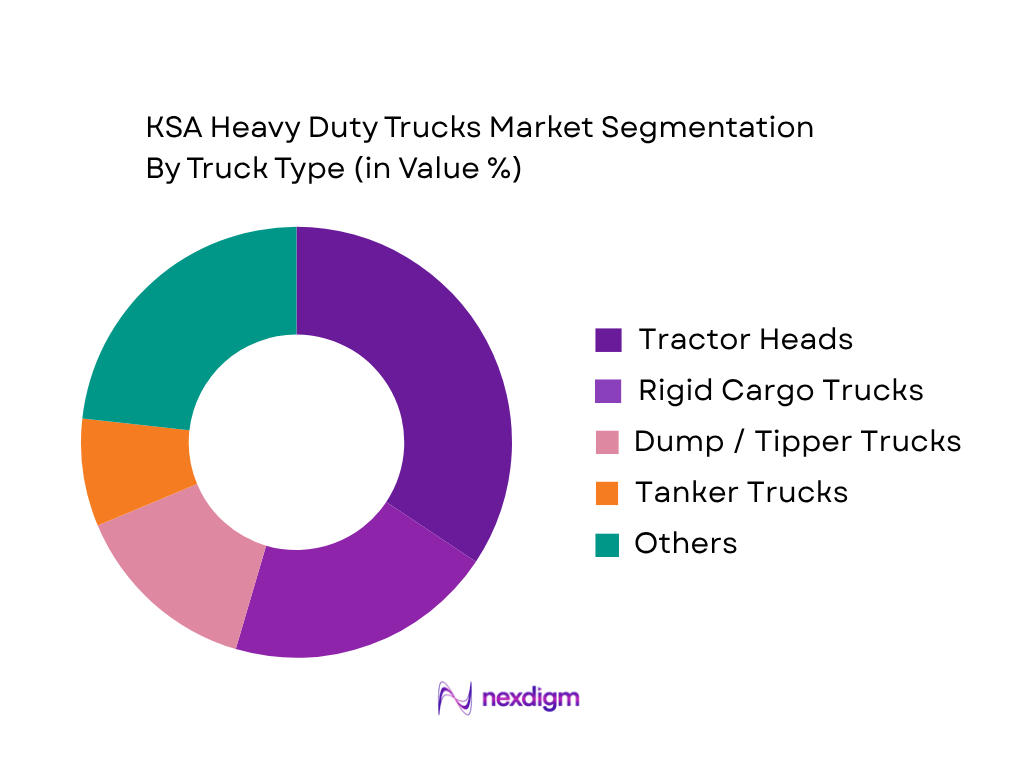
The KSA Heavy Duty Trucks Market is segmented by truck type into tractor heads, rigid cargo trucks, dump/tipper trucks, tankers, concrete mixer trucks, flatbed trucks, refrigerated heavy trucks, container carriers and specialized heavy-haul trucks. Tractor heads are expected to represent the dominant sub-segment, supported by their extensive deployment in long-haul road freight, container transportation, distribution networks and cross-border GCC logistics. Their ability to operate with interchangeable semi-trailers provides fleet operators with greater flexibility across cargo categories and routes. Demand is particularly supported by Saudi Arabia’s strategic position connecting ports with inland consumption centers and industrial zones. Tractor heads are also extensively utilized for container movement from Jeddah Islamic Port, King Abdulaziz Port and other logistics gateways. Their higher utilization across long-distance freight routes makes them particularly important for large logistics fleets seeking asset productivity. The increasing professionalization of Saudi freight operations, fleet renewal and adoption of automated transmissions, telematics and advanced safety systems further strengthens the position of tractor-head configurations within the heavy-duty vehicle market.
By End-Use Industry
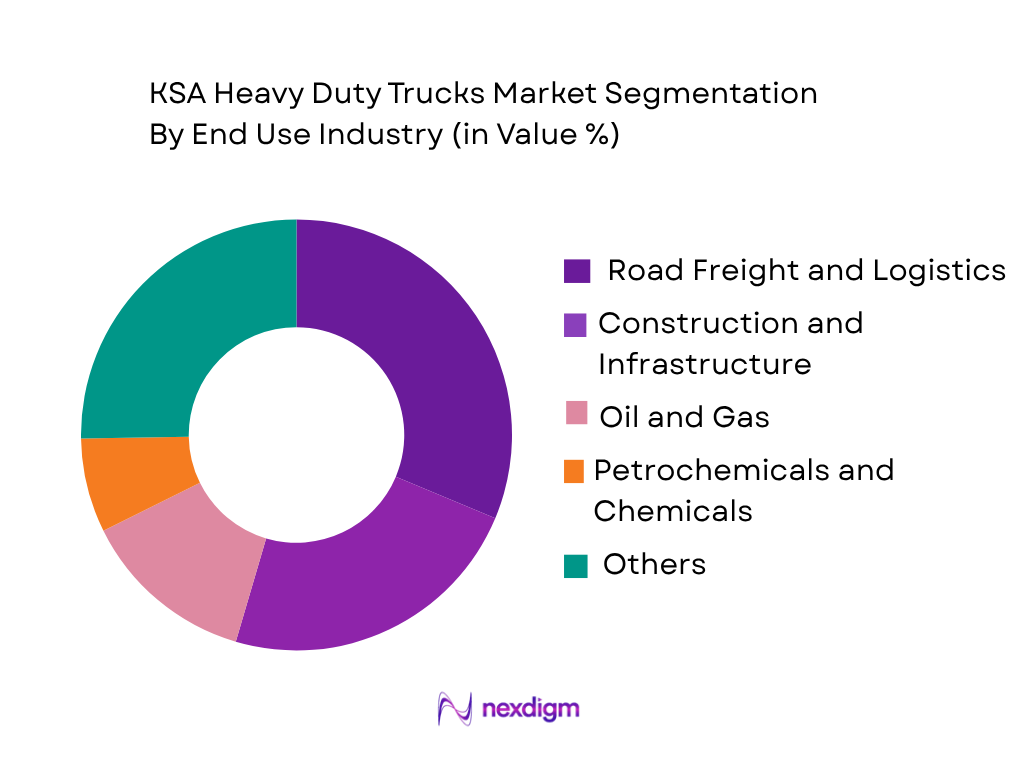
The KSA Heavy Duty Trucks Market is segmented by end-use industry into road freight and logistics, construction and infrastructure, oil and gas, petrochemicals and chemicals, mining and quarrying, cement and building materials, ports and container haulage, manufacturing, retail and e-commerce logistics, food and cold chain, waste management, and energy and utilities. Road freight and logistics represents the dominant application because heavy trucks remain essential for long-distance movement of containers, industrial inputs, consumer goods and finished products between ports, distribution centers and major cities. Saudi Arabia’s role as a regional logistics hub supports continuous demand for high-payload tractor heads and cargo vehicles. Heavy trucks are also required for intercity distribution connecting Riyadh with Jeddah, Dammam, Makkah, Madinah and other major economic centers. The growth of warehouses, distribution centers and fulfillment infrastructure increases the need for reliable line-haul transportation. Fleet operators are increasingly prioritizing fuel efficiency, vehicle uptime, telematics and predictive maintenance because operating economics become particularly important over high-mileage routes. Construction, oil and gas and mining remain significant complementary demand pools.
Competitive Landscape
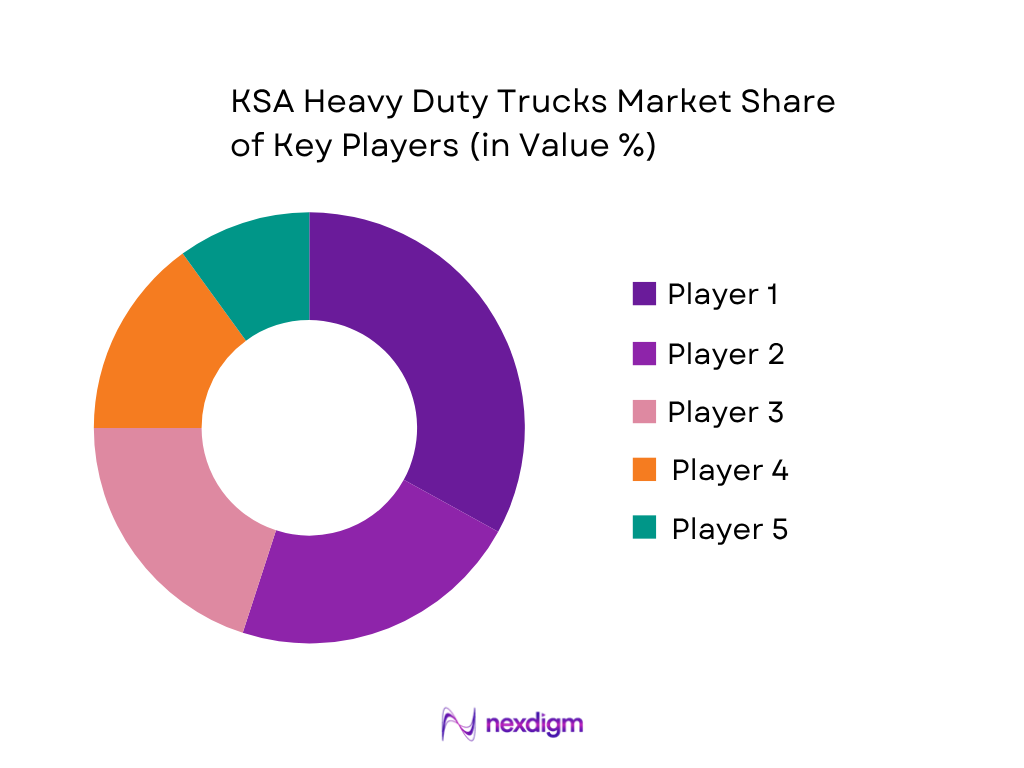
The KSA Heavy Duty Trucks Market is characterized by strong participation from global truck manufacturers supported by established Saudi distributors, dealer networks and aftermarket service organizations. Major brands compete through payload capacity, engine performance, fuel efficiency, extreme-climate durability, fleet uptime, financing support, spare-parts availability and connected-vehicle technologies. European, Japanese, Chinese and Indian manufacturers are increasingly competing across both premium long-haul applications and value-oriented fleet segments, while major fleet buyers place greater emphasis on total cost of ownership and nationwide service coverage.
| Company | Establishment Year | Headquarters | KSA Product Coverage | Engine / Powertrain Strength | Dealer & Service Reach | Fleet Technology | Key End-Use Focus |
| Volvo Trucks | ~ | Sweden | ~ | ~ | ~ | ~ | ~ |
| Scania | ~ | Sweden | ~ | ~ | ~ | ~ | ~ |
| Mercedes-Benz Trucks | ~ | Germany | ~ | ~ | ~ | ~ | ~ |
| MAN Truck & Bus | ~ | Germany | ~ | ~ | ~ | ~ | ~ |
| Isuzu Motors | ~ | Japan | ~ | ~ | ~ | ~ | ~ |
KSA Heavy Duty Trucks Market Analysis
Growth Drivers
Vision 2030 Logistics Transformation and Road Freight Expansion
Saudi Arabia’s logistics transformation is strengthening the structural requirement for heavy-duty trucks across long-haul freight, distribution, industrial transportation and intercity connectivity. The Kingdom’s real GDP grew 1.3% in 2024, while transport, storage and communication activities recorded 4.5% real growth, demonstrating continued expansion in the economic activities most directly associated with freight mobility. The country had 15.8 million registered and roadworthy vehicles at the end of 2024, compared with 14.8 million in 2023, while newly issued vehicle registrations reached 1.0257 million, up from 878.1 thousand. Road freight through land ports comprised 13.4 million tonnes of exports and 12.2 million tonnes of imports, compared with 13.5 million and 11.4 million tonnes respectively in 2023. The logistics infrastructure base is also expanding, with 23 activated logistics centers covering 34.6 million square meters, compared with 22 centers in 2023. Saudi Arabia additionally recorded more than 290 million fulfilled delivery orders and 12,234 licensed commercial warehouses, reinforcing demand for line-haul and distribution fleets. These indicators support sustained requirements for tractor heads, rigid trucks and specialized freight vehicles.
Port, Industrial Infrastructure and Construction Mega-Projects
Expansion of Saudi Arabia’s ports, industrial zones and construction pipeline is generating intensive requirements for heavy-duty transportation equipment. Saudi Arabia’s 2024 GDP reached approximately SAR 4,070 billion, while construction contributed 5.5% of GDP, and real construction activity grew 4.2% during the year. Transport, storage and communication activities also expanded by 4.5%, linking infrastructure investment with demand for construction-material and freight movement. The Kingdom operated 23 activated logistics centers with a combined area of 34.6 million square meters, while licensed commercial warehouses exceeded 12,234, covering more than 22 million square meters. Freight volumes through maritime transportation reached 331.3 million tonnes, while road-port freight reached 25.7 million tonnes and rail freight reached 15.6 million tonnes. These flows require tractor heads, container carriers, tankers and heavy cargo trucks to connect ports, warehouses, industrial cities and project sites. Manufacturing excluding petroleum refining generated 9.1% of GDP, while electricity, gas and water activities grew 4.9%, indicating continued industrial infrastructure requirements. The combination of construction activity, logistics-center development, port connectivity and industrial expansion creates recurring demand for high-payload vehicles, heavy-haul configurations and vocational trucks.
Market Challenges
Extreme Heat Exposure and Long-Haul Operating Conditions
Severe operating conditions create a major durability and fleet-management challenge for the KSA Heavy Duty Trucks Market because vehicles frequently operate over long distances in high-temperature, dusty and demanding environments. Saudi Arabia’s road transport statistics recorded 17,231 serious traffic accidents in 2024, compared with 16,534 in 2023, while 4,282 traffic fatalities and 24,077 injuries were recorded. Although these figures cover all road vehicles rather than heavy trucks alone, they underline the importance of vehicle safety, driver assistance and roadworthiness within the national transportation ecosystem. The Kingdom had 15.8 million registered and roadworthy vehicles at the end of 2024, placing substantial requirements on inspection and maintenance infrastructure. Heavy-duty trucks operating continuously between Riyadh, Jeddah, Dammam, Jubail, ports and remote industrial areas face elevated demands on engines, cooling systems, transmissions, tires, braking systems and air-conditioning systems. High utilization also makes unplanned downtime particularly disruptive to logistics operators. The operating environment therefore increases the importance of preventative maintenance, genuine spare parts, technician availability, thermal-management engineering and telematics-based vehicle-health monitoring. OEMs must demonstrate durability under severe-duty conditions rather than relying solely on conventional laboratory performance specifications.
High Vehicle Acquisition Requirements, Financing Pressure and Alternative-Powertrain Infrastructure Constraints
Heavy-duty fleet operators face significant procurement and financing requirements because tractor heads, multi-axle trucks and specialized vocational vehicles are capital-intensive assets that must generate sufficient utilization to justify acquisition. Saudi Arabia’s nominal GDP was approximately SAR 4,070 billion in 2024, while private-sector and investment activity continued to support substantial logistics and industrial expansion. The IMF reported that Saudi Arabia’s non-oil economy remained resilient, with non-oil activity providing an important source of domestic demand. At the same time, heavy trucks require recurring expenditure on tires, maintenance, lubricants, insurance and downtime management, increasing the importance of total-cost-of-ownership analysis. Alternative-powertrain adoption introduces another constraint because battery-electric and other low-emission heavy trucks require appropriate charging or refueling infrastructure, route planning and operational suitability. The existing logistics ecosystem remains extensive, with 23 activated logistics centers, 12,234 licensed commercial warehouses and more than 290 million fulfilled delivery orders in 2024, creating a large but operationally diverse fleet environment. Financing structures, residual-value expectations, service availability and infrastructure readiness can therefore influence technology adoption as strongly as vehicle specifications.
Market Opportunities
Fleet Modernization, Fuel-Efficient Heavy Trucks and Connected Fleet Management
Fleet modernization represents a significant opportunity as Saudi freight and logistics infrastructure becomes more sophisticated and operators increasingly prioritize uptime, fuel efficiency and asset utilization. The Kingdom recorded 15.8 million registered and roadworthy vehicles in 2024, up from 14.8 million in 2023, while newly issued vehicle registrations exceeded 1.0257 million, demonstrating substantial vehicle turnover within the broader transportation system. Road freight imports through land ports increased from 11.4 million tonnes to 12.2 million tonnes, while logistics infrastructure expanded to 23 activated centers with 34.6 million square meters of total area. Delivery activity exceeded 290 million orders, and the logistics sector employed 140,000 active Saudi drivers and 302,000 non-Saudi drivers, creating a large operating environment for fleet-management technologies. These conditions support demand for trucks equipped with telematics, GPS tracking, remote diagnostics, driver-monitoring systems, predictive maintenance and fuel-efficiency technologies. Heavy-duty OEMs can differentiate through powertrain calibration, automated transmissions, aerodynamic optimization, engine-management systems and connected services that reduce downtime. Fleet operators can also use real-time vehicle data to optimize route selection, maintenance scheduling, driver behavior and asset utilization. The scale of the logistics ecosystem creates a strong application base for technology-enabled fleet modernization.
Zero-Emission Freight Vehicles, Electric Port Trucks and Specialized Heavy-Haul Technologies
The expansion of Saudi logistics, industrial and port infrastructure creates opportunities for lower-emission heavy trucks in applications where operating routes and charging requirements can be controlled. Saudi Arabia recorded 331.3 million tonnes of maritime freight, 25.7 million tonnes through road ports and 15.6 million tonnes through rail transportation in 2024, demonstrating the scale of interconnected freight activity. The Kingdom also operated 23 logistics centers covering 34.6 million square meters, while more than 290 million delivery orders were fulfilled during the year. These concentrated logistics nodes provide potential deployment environments for electric terminal tractors, short-haul heavy trucks, yard vehicles and other specialized zero-emission applications. At the broader economic level, Saudi Arabia’s real GDP increased 1.3% in 2024, with transport, storage and communication activities growing 4.5%, while electricity, gas and water activities expanded 4.9%. These developments strengthen the case for integrating advanced powertrains with digital fleet systems, especially where vehicles operate predictable routes and return regularly to centralized facilities. Opportunities also extend to hydrogen-ready platforms, alternative fuels, autonomous freight technologies and specialized heavy-haul equipment. Current logistics infrastructure provides the operational foundation for testing these technologies without requiring immediate transformation of the entire national truck fleet.
Future Outlook
Over the next decade, the KSA Heavy Duty Trucks Market is expected to benefit from the Kingdom’s logistics transformation, infrastructure development and industrial diversification agenda. Expansion of ports, warehouses, industrial cities and road-freight corridors is expected to sustain demand for high-utilization heavy trucks. Fleet modernization is likely to increasingly prioritize fuel efficiency, uptime, predictive maintenance, automated transmissions, telematics and advanced driver-assistance systems. At the same time, alternative-powertrain adoption is expected to develop gradually around suitable applications such as ports, controlled logistics routes and specialized fleet operations.
Construction, mining, oil and gas, petrochemicals and large-scale development projects are expected to create continued demand for specialized high-payload vehicles. Local manufacturing, assembly and component localization could also become increasingly important as the Kingdom develops its automotive and logistics ecosystem.
Major Players
- Volvo Trucks
- Scania
- Mercedes-Benz Trucks
- MAN Truck & Bus
- Isuzu Motors
- Hino Motors
- UD Trucks
- Ashok Leyland
- Tata Motors
- Foton Motor
- Sinotruk
- Shacman
- FAW Trucks
- Dongfeng Trucks
- Iveco
Key Target Audience
- Heavy-duty truck OEMs and commercial vehicle manufacturers
- Authorized truck distributors, dealers and aftermarket service operators
- Road freight, logistics and fleet management companies
- Construction, infrastructure and mega-project fleet operators
- Oil, gas, petrochemical and energy transportation companies
- Mining, quarrying, cement and industrial-material transportation companies
- Investments and venture capitalist firms
- Government and regulatory bodies (Transport General Authority, Ministry of Transport and Logistics Services, Saudi Standards, Metrology and Quality Organization, Public Transport Authority)
Research Methodology
Step 1: Identification of Key Variables
The research begins by constructing a detailed ecosystem of the KSA Heavy Duty Trucks Market, covering OEMs, distributors, dealers, fleet operators, logistics companies, construction contractors, mining operators, oil and gas companies, ports, financing providers and regulators. Key variables include vehicle registrations, fleet additions, replacement rates, GVW classes, payload, powertrain, configuration, utilization and end-use demand.
Step 2: Market Analysis and Construction
Historical market information is compiled using vehicle registration data, commercial vehicle imports, customs information, OEM disclosures, distributor information and industry-level databases. Bottom-up calculations assess vehicle units by truck configuration, application and end-use industry, while top-down analysis reconciles these findings against freight activity, construction investment, industrial output and fleet demand.
Step 3: Hypothesis Validation and Expert Consultation
Market hypotheses are validated through structured discussions with truck manufacturers, authorized distributors, fleet operators, logistics companies, construction companies, workshops and industry specialists. Interviews focus on vehicle procurement cycles, fleet replacement, utilization, payload requirements, brand selection, financing, fuel efficiency, maintenance requirements and emerging powertrain preferences.
Step 4: Research Synthesis and Final Output
The final stage triangulates demand-side and supply-side findings to develop a validated market structure. OEM and distributor information is reconciled with registration and import patterns, while fleet economics are assessed through fuel consumption, maintenance, uptime, utilization and replacement requirements. The resulting framework supports market sizing, segmentation, competitive benchmarking and future scenario development.

- Executive Summary
- Research Methodology (Market Definition and Scope, Heavy-Duty Truck Classification, GVW and Payload Thresholds, Tractor-Head Inclusion Criteria, New-Vehicle and Replacement-Market Boundaries, Top-Down Market Sizing, Bottom-Up Vehicle-Unit Reconstruction, OEM and Distributor Validation, Fleet-Demand Assessment, Registration Data Reconciliation, Import and Customs Validation, Primary Industry Interviews, Data Triangulation, Forecasting Framework, Scenario Analysis, Assumptions and Limitations)

- Definition and Scope
- KSA Heavy Duty Truck Industry Evolution
- Heavy Duty Truck Ecosystem Mapping
- Heavy Duty Truck Value Chain Analysis
- Heavy Duty Truck Supply Chain Analysis
- KSA Commercial Vehicle Import and Registration Ecosystem
- Heavy Truck Distribution Structure
- KSA Road Freight and Logistics Ecosystem

- Growth Drivers (Vision 2030 Logistics Transformation, Road Freight Expansion, Port and Industrial Infrastructure Development, Construction Mega-Projects, Oil & Gas Logistics, Mining Expansion, E-Commerce Fulfilment, GCC Cross-Border Freight and Fleet Replacement)
- Market Challenges (Extreme Heat Exposure, Long-Haul Operating Conditions, High Vehicle Acquisition Requirements, Driver Availability, Tire and Maintenance Stress, Financing Requirements, Heavy-Vehicle Operating Regulations, Imported Component Dependency and Alternative-Powertrain Infrastructure Constraints)
- Market Opportunities (Fleet Modernization, Fuel-Efficient Heavy Trucks, Zero-Emission Freight Vehicles, Electric Port Trucks, Alternative-Fuel Trucks, Connected Fleet Management, Autonomous Freight Technologies, Specialized Heavy-Haul Vehicles, Local Manufacturing and Logistics Technology Integration)
- Market Trends (Euro-Compliant Powertrains, Fuel-Efficiency Optimization, Automated Manual Transmissions, Fleet Telematics, Predictive Maintenance, ADAS, Connected Trucks, Driver Monitoring, Alternative Powertrains and Zero-Emission Freight)
- Government and Regulatory Framework (Saudi Transport General Authority Requirements, Ministry of Transport and Logistics Services Regulations, Vehicle Type Approval, Heavy Vehicle Registration, Technical Inspection, Axle-Load Regulations, Driver Licensing, Roadworthiness, Emission Standards and GCC Cross-Border Transport Requirements)
- Porter’s Five Forces Analysis
- PESTLE Analysis
- SWOT Analysis

- By Market Value (2020-2025)
- By Vehicle Units Sold (2020-2025)
- By Average Selling Price (2020-2025)
- By GVW / Payload Class (2020-2025)
- By Powertrain (2020-2025)
- By Truck Configuration (2020-2025)
- By Body Type (2020-2025)
- By End-Use Industry (2020-2025)
- By Region (2020-2025)

- By Gross Vehicle Weight / Payload Class (In Volume %)
Medium-Heavy Trucks
Heavy Trucks
Extra-Heavy Trucks
Tractor Heads
Multi-Axle Heavy Trucks
Heavy-Haul Trucks
Special-Purpose Heavy Trucks - By Powertrain (In Volume %)
Diesel Heavy Duty Trucks
Compressed Natural Gas Trucks
Liquefied Natural Gas Trucks
Battery Electric Heavy Trucks
Hybrid Heavy Trucks
Alternative-Fuel Heavy Trucks - By Truck Configuration (In Volume %)
4×2
6×2
6×4
8×4
8×6
10×4 - By Body Type / Vehicle Application (In Volume %)
Tractor Heads
Tipper and Dump Trucks
Cargo Trucks
Flatbed Trucks
Tanker Trucks
Concrete Mixer Trucks
Refrigerated Trucks
Container Carriers
Crane Trucks
Waste Management Trucks
Specialized Heavy Trucks - By End-Use Industry (In Volume %)
Road Freight and Logistics
Construction and Infrastructure
Oil and Gas
Petrochemicals and Chemicals
Mining and Quarrying
Cement and Building Materials
Ports and Container Haulage
Manufacturing and Industrial Distribution
Food and Cold Chain
Retail and E-Commerce Logistics
Waste Management and Municipal Services
Energy and Utilities - By Fleet Ownership (In Volume %)
Large Logistics Fleets
Oil and Gas Fleets
Construction Fleets
Mining Fleets
Port and Container Fleets
Industrial Fleets
Government and Municipal Fleets
SME Fleet Operators
Owner-Operators
Rental and Contract-Hire Fleets

- Market Share of Major Players (By Vehicle Units, Market Value, GVW Class, Tractor Heads, Body Type, Powertrain, End-Use Industry and Region)
- Cross Comparison Parameters (Heavy-Duty Product Portfolio Breadth, Maximum GVW, Payload and Axle Configuration Capability, Engine Power, Torque and Fuel-Efficiency Performance, Extreme-Climate Durability and Operating Reliability)
- SWOT Analysis of Major Players
- Detailed Profiles of Major Companies
Hino Motors Saudi Arabia
Isuzu Motors Saudi Arabia
Aljomaih Automotive Company
Abdul Latif Jameel Machinery
Alissa Truck & Bus
Zahid Tractor
Alissa Automotive
United Motors Company
Petromin Corporation
MAN Truck & Bus Saudi Arabia
Mercedes-Benz Trucks
Volvo Trucks Saudi Arabia
Scania Saudi Arabia
UD Trucks Saudi Arabia
Ashok Leyland Saudi Arabia

- Logistics and Freight Fleet Analysis
- Construction and Mega-Project Fleet Analysis
- Oil and Gas Fleet Analysis
- Mining and Quarrying Fleet Analysis
- Port and Container Fleet Analysis
- Manufacturing and Industrial Fleet Analysis
- Retail and E-Commerce Logistics Fleet Analysis
- Cold-Chain Fleet Analysis

- By Market Value (2026-2035)
- By Vehicle Units Sold (2026-2035)
- By Average Selling Price (2026-2035)
- By GVW / Payload Class (2026-2035)
- By Powertrain (2026-2035)
- By Truck Configuration (2026-2035)
- By Body Type (2026-2035)
- By End-Use Industry (2026-2035)
- By Region (2026-2035)


 Request a Sample
 Ask for Customization
 Get a Quote
 Enquire Now