
 Download PDF
Market Overview
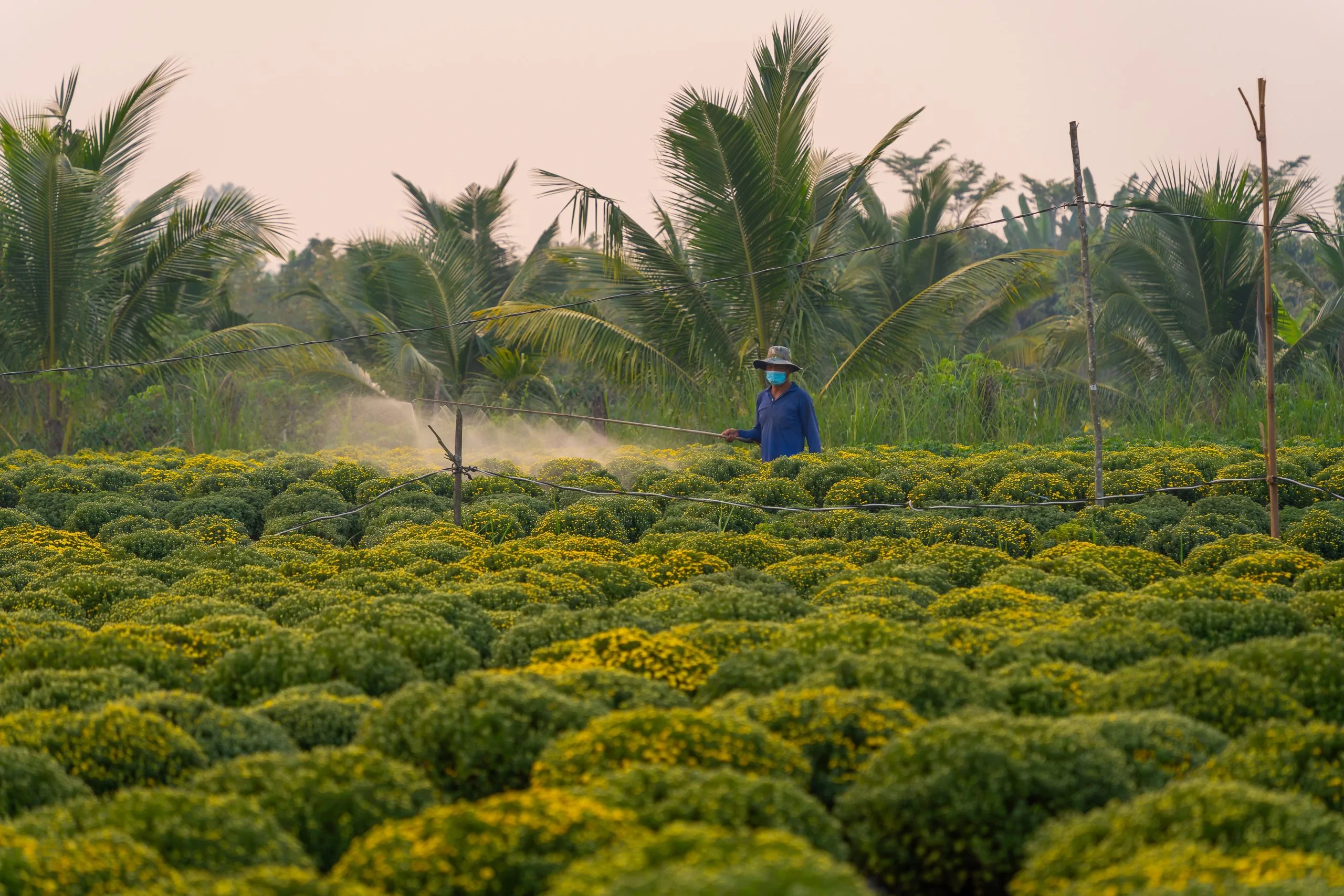
The KSA Herbicide Market is valued at USD ~ million, derived from the published Saudi Arabia herbicides value of USD ~ million and country-level growth benchmark of 5.1%. Demand is driven by date palm farms, protected agriculture, fodder crops, public landscaping and industrial vegetation management. Saudi open-field vegetables reached 89.7 thousand hectares and ~ million tons, while protected vegetables reached 797 thousand tons, supporting recurring weed-control needs. Riyadh, Al Qassim, Madinah, Eastern Province, Tabuk, Al Jouf, Jeddah and Makkah dominate the KSA Herbicide Market because demand is concentrated in date palm farms, greenhouse clusters, fodder farms, public landscaping, religious tourism corridors, industrial estates and road infrastructure. Saudi date production reached 1.923 million tons, while protected vegetable area reached 7.8 thousand hectares and greenhouse structures exceeded 121,000, making these regions key weed-control consumption pockets.
Market Segmentation
By Application Area
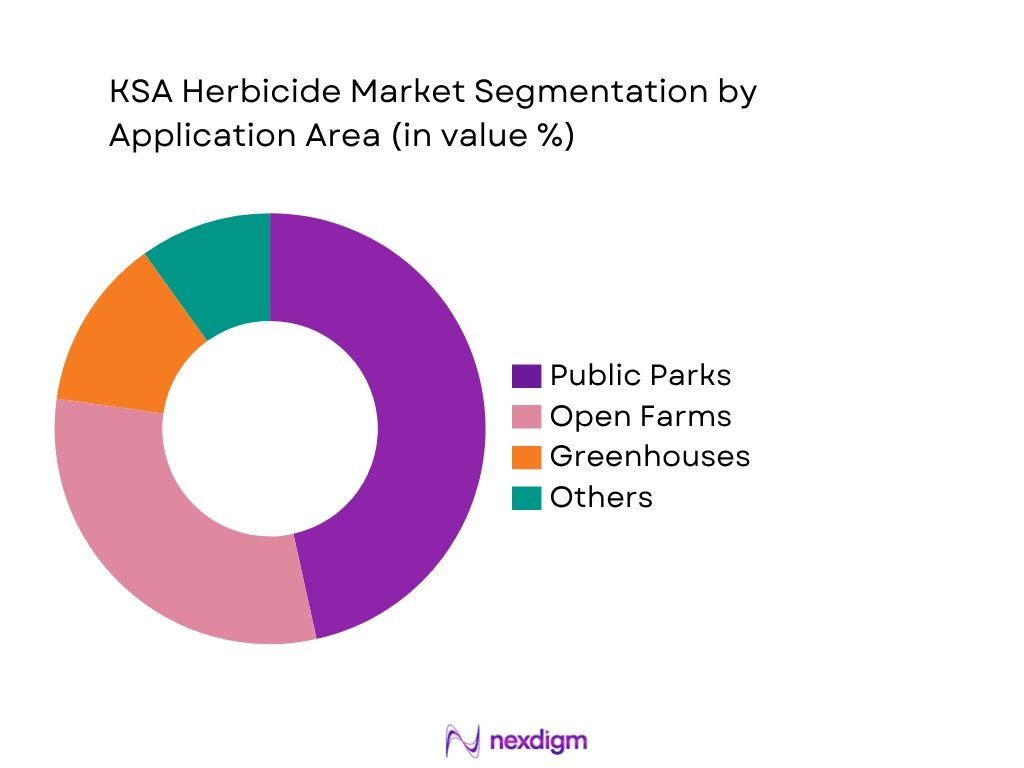
KSA Herbicide Market is segmented by application area into date palm farms, protected agriculture & greenhouses, landscaping & public parks, fodder & open-field farms, roadside, infrastructure & industrial facilities, and golf courses, nurseries & retail garden use. Recently, date palm farms have a dominant market share in KSA under this segmentation due to the Kingdom’s large palm cultivation base and the need for recurring weed control around palm basins, inter-row spaces, irrigation channels and farm boundaries. Date palms are perennial assets, so growers require repeated vegetation management to reduce weed competition for water, improve irrigation efficiency and maintain clean farm access. Herbicides such as glyphosate, glufosinate, oxyfluorfen and residual products are relevant for directed use where crop safety and label compliance are managed carefully.
By Herbicide Type
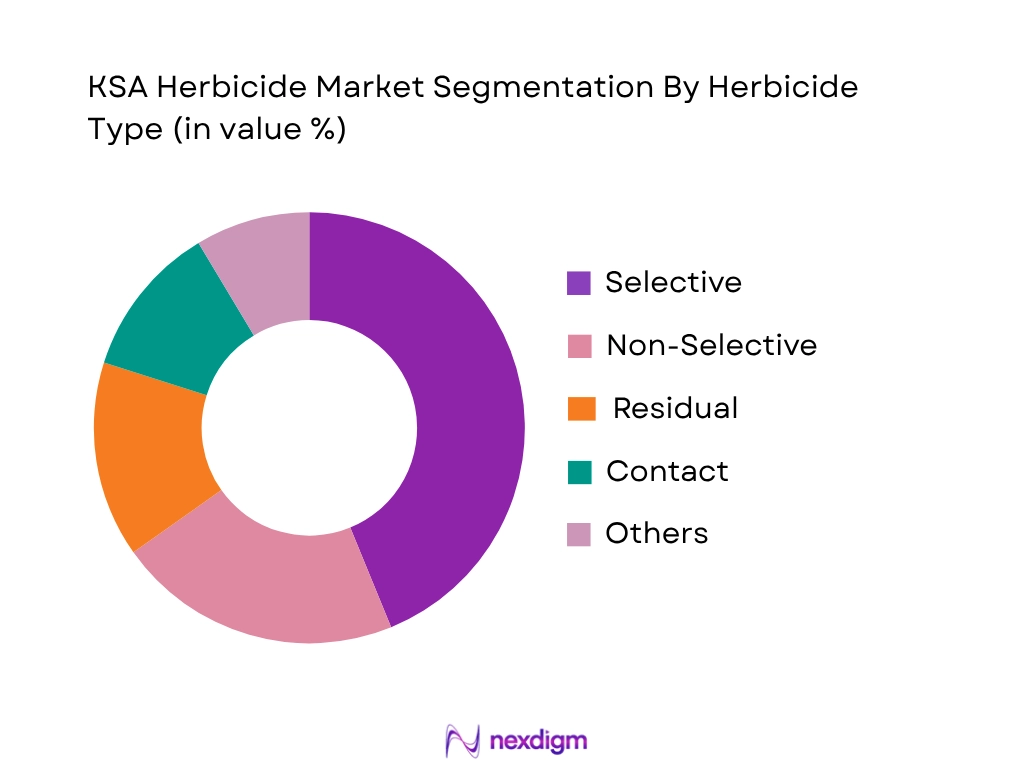
KSA Herbicide Market is segmented by herbicide type into non-selective herbicides, selective herbicides, residual herbicides, contact herbicides, specialty turf & landscape herbicides, and bio-based & low-toxicity herbicides. Recently, non-selective herbicides have a dominant market share in KSA under this segmentation because much of the country’s weed-control demand comes from date palm farm boundaries, pre-plant burn-down, roadsides, industrial facilities, public works, fence lines and landscape-bed maintenance. Glyphosate and glufosinate-type products are widely suited to broad-spectrum vegetation clearance where crop selectivity is not the primary requirement. Non-selective herbicides are also preferred by contractors and large farm operators because they reduce manual labour dependence, provide faster field preparation and support maintenance of farm roads, irrigation edges and hardscape areas in high-temperature conditions.
Competitive Landscape
The KSA Herbicide Market is served by global crop-protection companies, regional agrochemical distributors, local agricultural-input suppliers and large farm operators with direct procurement capability. Competition is shaped by registered product portfolios, compliance with pesticide import and registration requirements, warehouse capability, farm-channel access, municipality tender eligibility and technical support. Saudi pesticide registration requires licensing, documentation and compliance with GCC pesticide rules, creating a barrier for suppliers without local regulatory and distribution infrastructure.
| Company | Establishment Year | Headquarters | Herbicide Portfolio Focus | Key Demand Fit | Distribution Model | Regulatory Strength | Technical Support | Strategic Positioning |
| Bayer CropScience | 1863 | Leverkusen, Germany | ~ | ~ | ~ | ~ | ~ | ~ |
| Syngenta | 2000 | Basel, Switzerland | ~ | ~ | ~ | ~ | ~ | ~ |
| BASF | 1865 | Ludwigshafen, Germany | ~ | ~ | ~ | ~ | ~ | ~ |
| UPL Limited | 1969 | Mumbai, India | ~ | ~ | ~ | ~ | ~ | ~ |
| ADAMA Agricultural Solutions | 1945 | Airport City, Israel | ~ | ~ | ~ | ~ | ~ | ~ |
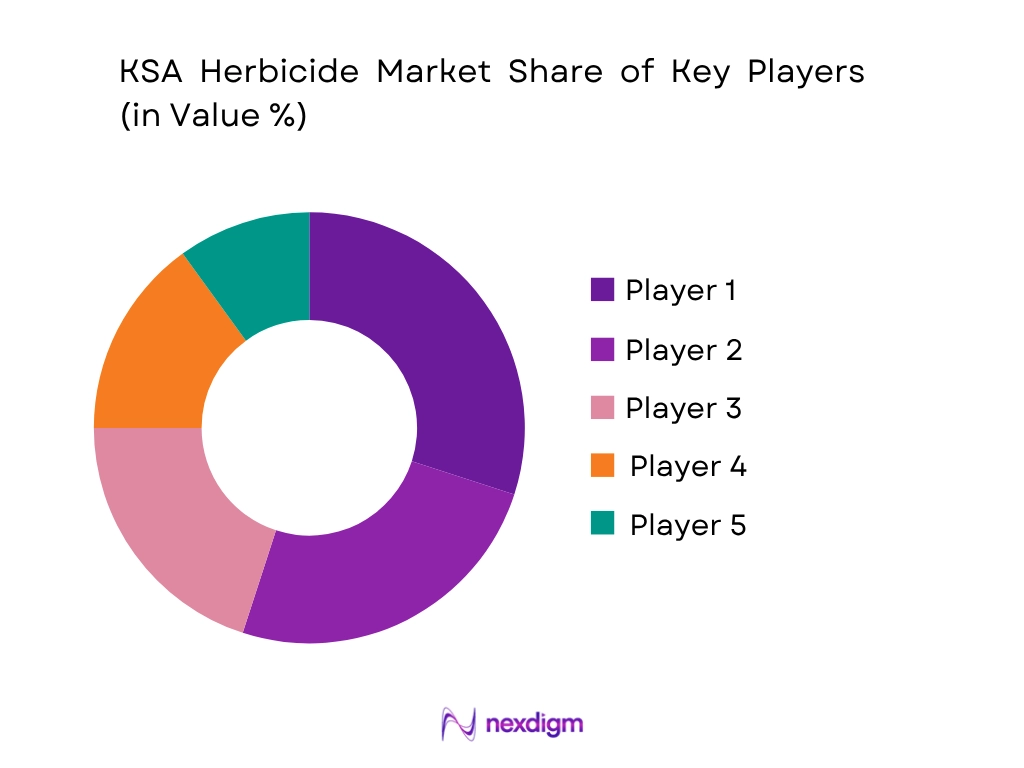
KSA Herbicide Market Analysis
Growth Drivers
Date Palm Cultivation Creates Recurring Demand for Directed Weed Control
KSA Herbicide Market is supported by the Kingdom’s large date palm base, where farms require recurring weed management around palm basins, irrigation channels, inter-row spaces and access roads. GASTAT reported date production of 1,923 thousand tons and more than 37.6 million palm trees, including more than 32 million fruitful trees. The same source notes that date output increased compared with the prior year, reinforcing the recurring nature of orchard-floor maintenance. World Bank data places Saudi Arabia’s GDP at USD 1.24 trillion, GDP per capita at USD 35,121.7, and population at 33.96 million, showing the macroeconomic scale behind commercial agriculture and input procurement. Herbicide demand is market-specific here because palms are perennial assets: growers need directed, crop-safe vegetation control to protect irrigation efficiency in arid conditions, reduce labour-intensive manual cleaning, and maintain farm hygiene around basins, drip lines and harvest pathways.
Protected Agriculture and Vegetable Production Support Professional Weed-Control Use
KSA Herbicide Market is driven by protected agriculture, greenhouse perimeters and vegetable production zones where weed suppression supports sanitation, access and pest-management discipline. GASTAT reported protected vegetable production of 797 thousand tons, cultivated protected-vegetable area of 7.8 thousand hectares, and more than 121,000 greenhouse structures. It also reported open-field vegetables at about 89.7 thousand hectares and 2.7–2.8 million tons, with potatoes, watermelon, tomatoes, cucumbers and onions among leading crops. The macro base is supported by World Bank-reported Saudi GDP of USD 1.24 trillion and GDP growth of 2.0 in the latest reported year. Herbicide demand in this segment is not broad-acre commodity use; it is tied to weed-free greenhouse perimeters, nursery beds, farm roads, drainage lines and open-field vegetable support areas where registered, low-phytotoxicity and label-compliant products are preferred.
Market Challenges
Water Scarcity Limits Broad-Acre Herbicide Expansion
KSA Herbicide Market faces a structural constraint from water scarcity, which limits expansion of water-intensive broad-acre farming and shifts herbicide demand toward managed pockets such as date palms, protected agriculture, landscaping and non-crop vegetation control. World Bank-linked data reports Saudi agricultural land at 383,130 sq. km, agricultural irrigated land at 6.32, and annual freshwater withdrawals for agriculture at 98.17 of total freshwater withdrawals, showing the scale of pressure from farming on water resources. MEWA’s National Water Strategy focuses on demand management, cost-effective water services, safeguarding water resources and reducing current consumption rates in urban and agricultural sectors through 15 water-resource-management initiatives. World Bank places Saudi Arabia’s population at 33.96 million, increasing pressure on water allocation between agriculture, cities and industry. This restricts large-scale field herbicide growth and pushes suppliers toward precision, perimeter and high-value crop applications.
Pesticide Registration and Import Compliance Raises Market Entry Barriers
KSA Herbicide Market faces strict regulatory barriers because pesticides require registration, documentation and controlled circulation before commercial use. The Saudi pesticide law and implementing framework require details such as pesticide registration duration, registration number, purpose of usage and quantity, while SFDA’s public-health pesticide registration service allows manufacturers and importers to register products for trading, marketing or export. The National Company for Agricultural Services also lists agricultural pesticide registration as a formal service category, while pesticide import and distribution must comply with GCC pesticide-law procedures and local licensing requirements. This compliance load matters in a large economy: World Bank data records Saudi GDP at USD 1.24 trillion and GDP per capita at USD 35,121.7. For herbicide suppliers, missing documentation, unregistered active ingredients, non-compliant labels, weak Arabic safety information or inadequate warehousing can delay market access and prevent participation in farm, municipality and contractor procurement channels.
Market Opportunities
Urban Greening and Tourism Infrastructure Create Scope for Low-Odour Public-Space Herbicides
KSA Herbicide Market has an opportunity in professional, low-odour and public-safe herbicides because urban greening, public-space development and tourism infrastructure require managed landscapes. Saudi Arabia’s greening roadmap targets 10 billion trees, while the Green Riyadh programme targets 7.5 million trees and 545 sq. km of green space, creating long-term maintenance needs around parks, streets, public facilities, mosques, schools and road corridors. Tourism demand reinforces this maintenance base: the Ministry of Tourism reported around 116 million domestic and inbound tourists and 538.62 million overnight stays in the tourism dashboard, creating higher footfall across public spaces and hospitality districts. World Bank reports Saudi GDP per capita at USD 35,121.7, supporting spending on premium city services and landscape upkeep. This supports future demand for low-drift, low-odour, QR-labelled and contractor-ready herbicides in parks, roadsides and public-facing landscapes.
Food-Security Farming Creates Scope for Stewardship-Led Herbicide Portfolios
KSA Herbicide Market has an opportunity in stewardship-led herbicide portfolios for food-security farms, protected cultivation and high-value horticulture. Current official agricultural indicators show protected vegetables at 797 thousand tons, open-field vegetables at 2.7–2.8 million tons, protected-vegetable area at 7.8 thousand hectares, open-field vegetable area at 89.7 thousand hectares, and more than 121,000 greenhouse structures. Date production of 1,923 thousand tons and more than 37.6 million palm trees creates another crop-specific base for directed, crop-safe weed-control programs. The macro environment is supported by IMF reporting that Saudi non-oil activity was buoyed by consumption growth of 5.7 and continued Vision 2030 reforms, while World Bank data records GDP of USD 1.24 trillion. The opportunity is to sell more than active ingredients: suppliers can build registered product bundles with Arabic labels, SDS access, farm training, greenhouse perimeter protocols and date-palm directed-spray stewardship.
Future Outlook
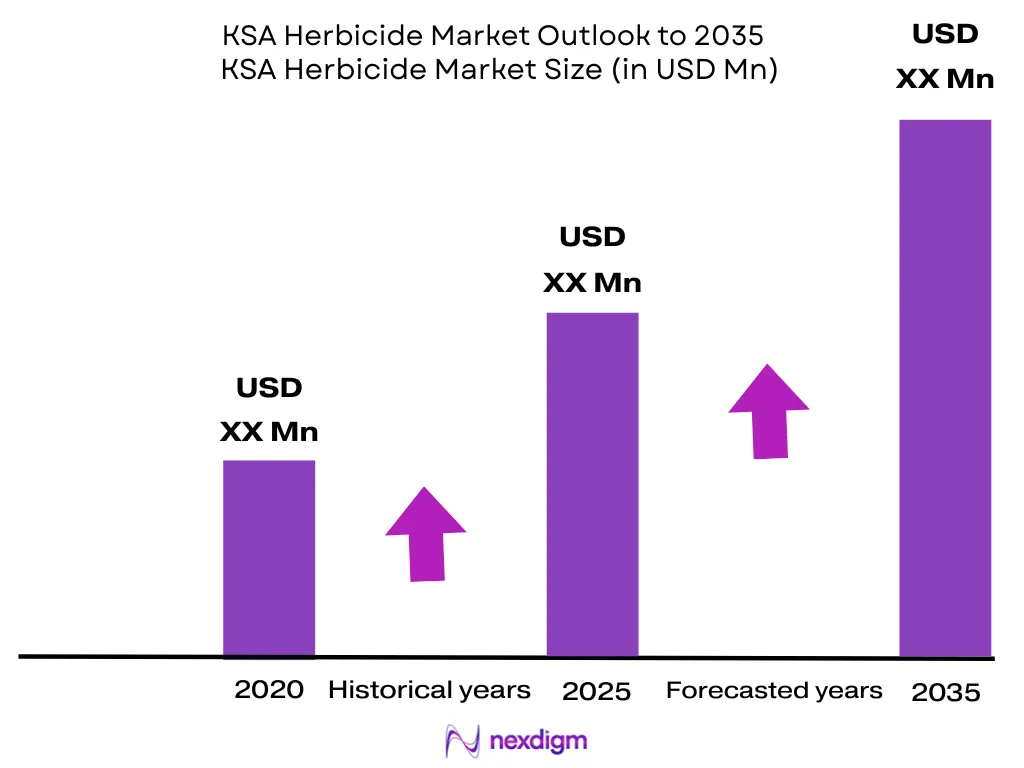
The KSA Herbicide Market is expected to grow at a forecasted CAGR of 5.1% during 2026-2035, supported by protected agriculture, food-security investment, date palm farm stewardship, public landscaping, industrial vegetation management and professional applicator demand. The market will remain import-led, but demand will become increasingly structured around registered products, distributor accountability, municipality procurement and safe-use protocols. Over the next decade, herbicide demand in KSA will be less dependent on broad-acre cereal farming and more concentrated in high-value, water-managed applications. Date palm farms will remain a major anchor because palm basins, irrigation channels and farm access areas require recurring weed control. Greenhouses and protected farms will create demand for perimeter weed suppression, nursery hygiene and low-residue stewardship. Urban and infrastructure applications will gain relevance. Riyadh, Jeddah, Makkah, Madinah and Eastern Province will continue to generate herbicide demand through roadsides, logistics corridors, industrial estates, public spaces, hospitality landscapes and religious tourism infrastructure. These use cases favour non-selective, residual, low-odour and contractor-ready formulations. Regulation will remain a defining factor. KSA pesticide rules require registration, documentation and controls on import, circulation and storage. Companies with compliant labels, Arabic documentation, safety-data sheets, warehouse access and local distributor capability will be better positioned than suppliers relying only on product affordability.
Major Players
- Bayer CropScience
- Syngenta
- BASF
- FMC Corporation
- Corteva Agriscience
- UPL Limited
- ADAMA Agricultural Solutions
- Nufarm
- Sumitomo Chemical
- Arysta LifeScience / UPL Platform
- Saudi Delta Company
- Astra Industrial Group
- Tabuk Agricultural Development Company
- Almarai Agricultural Division
- National Agricultural Development Company
Key Target Audience
- Herbicide manufacturers
- Agrochemical importers and authorised distributors
- Date palm farm operators
- Protected agriculture and greenhouse operators
- Landscape contractors and public-realm maintenance companies
- Investments and venture capitalist firms
- Government and regulatory bodies — Ministry of Environment, Water and Agriculture, Saudi Food and Drug Authority, National Company for Agricultural Services, Saudi municipalities
- Facilities management and industrial vegetation-control companies
Research Methodology
Step 1: Identification of Key Variables
The initial phase involves constructing an ecosystem map of the KSA Herbicide Market, covering global suppliers, local importers, distributors, date palm farms, greenhouse operators, municipalities, landscape contractors and industrial vegetation-control buyers. Key variables include registered product availability, active ingredient mix, application area, formulation type, crop fit, buyer category and regional demand concentration.
Step 2: Market Analysis and Construction
In this phase, historical herbicide-market data, pesticide-market references, Saudi crop statistics, greenhouse data, date production information, pesticide registration rules and company portfolios are compiled. The market is constructed through top-down crop-protection allocation and bottom-up validation across date farms, protected agriculture, landscaping, fodder farms, infrastructure and industrial sites.
Step 3: Hypothesis Validation and Expert Consultation
Market hypotheses are validated through structured interviews with agrochemical distributors, authorised importers, farm input suppliers, greenhouse operators, date farm managers, landscape contractors and facilities-management companies. These consultations help verify herbicide intensity, preferred active ingredients, procurement cycles, regulatory compliance barriers and regional consumption patterns.
Step 4: Research Synthesis and Final Output
The final phase integrates secondary research, regulatory screening and primary validation into a structured market model. Segment shares are refined through triangulation of application area, herbicide type, distributor feedback, farm and contractor usage patterns, public procurement signals and region-wise demand concentration across the Kingdom.

- Executive Summary
- Research Methodology (Market Definitions and Assumptions, Abbreviations, Herbicide Scope, Active Ingredient Mapping, Crop-Wise Treated Area, Non-Crop Treated Area, Import-Distributor Validation, Registered Product Screening, Farm and Contractor Interviews, Bottom-Up SKU Modelling, Top-Down Crop Protection Allocation, Limitations and Future Conclusions)

- Definition and Scope
- Market Genesis
- Evolution of Weed-Control Practices
- Business Cycle
- Supply Chain and Value Chain Analysis

- Growth Drivers (Food Security Initiatives, Date Palm Farm Weed Management, Protected Agriculture Growth, Greenhouse Expansion, Urban Landscaping, Golf and Turf Maintenance, Industrial Vegetation Control, Labour Efficiency Needs)
- Market Challenges (Limited Arable Land, Water Scarcity, Import Dependence, Pesticide Registration Compliance, Heat Stress on Application, Spray Drift Risk, Public Safety Scrutiny, Contractor Training Gaps)
- Opportunities (Sustainable Landscaping Products, Bio-Based Herbicides, Low-Residue Protected Agriculture, Date Palm Stewardship Programs, Specialty Turf Products, Industrial Vegetation Management, Smart Spraying, Municipality Framework Contracts)
- Market Trends (Professional Application, Low-Odour Formulations, Residual Weed-Control Programs, Sustainable Landscaping, QR-Enabled Packaging, Tender-Based Procurement, Integrated Weed Management, Smart Spraying)
- SWOT Analysis
- Porter’s Five Forces

- By Value (2020-2025)
- By Volume (2020-2025
- By Average Realisation (2020-2025)

- By Herbicide Type (In Value %)
Selective Herbicides
Non-Selective Herbicides
Residual Herbicides
Contact Herbicides - By Active Ingredient (In Value %)
Glyphosate
Glufosinate Ammonium
Pendimethalin
Oxyfluorfen and Oxadiazon - By Crop Type (In Value %)
Date Palm
Vegetables
Fodder Crops
Cereals
Fruits and Orchard Crops - By Region (In Value %)
Riyadh Region
Makkah Region
Madinah Region
Eastern Province

- Market Share of Major Players on the Basis of Value and Volume
- Cross Comparison Parameters (Registered Herbicide Portfolio, MEWA/SFDA/NCAS Compliance Strength, Date Palm and Farm Portfolio, Protected Agriculture Fit, Turf and Landscape Product Depth, Municipality Tender Capability, Import and Warehousing Network, Applicator Training and Stewardship Support)
- SWOT Analysis of Major Players
- Detailed Profiles of Major Companies
Bayer Crop Science
Syngenta
BASF
FMC Corporation
Corteva Agriscience
UPL Limited
ADAMA Agricultural Solutions
Nufarm
Sumitomo Chemical
Arysta LifeScience / UPL Platform
Saudi Delta Company
Astra Industrial Group
Tabuk Agricultural Development Company
Almarai Agricultural Division
National Agricultural Development Company

- Market Demand and Utilisation
- Purchasing Power and Budget Allocation
- Regulatory and Compliance Requirements
- Needs, Desires and Pain Point Analysis
- Decision-Making Process

- By Value (2026-2035)
- By Volume (2026-2035)
- By Average Realisation (2026-2035)


 Request a Sample
 Ask for Customization
 Get a Quote
 Enquire Now