
 Download PDF
Market Overview
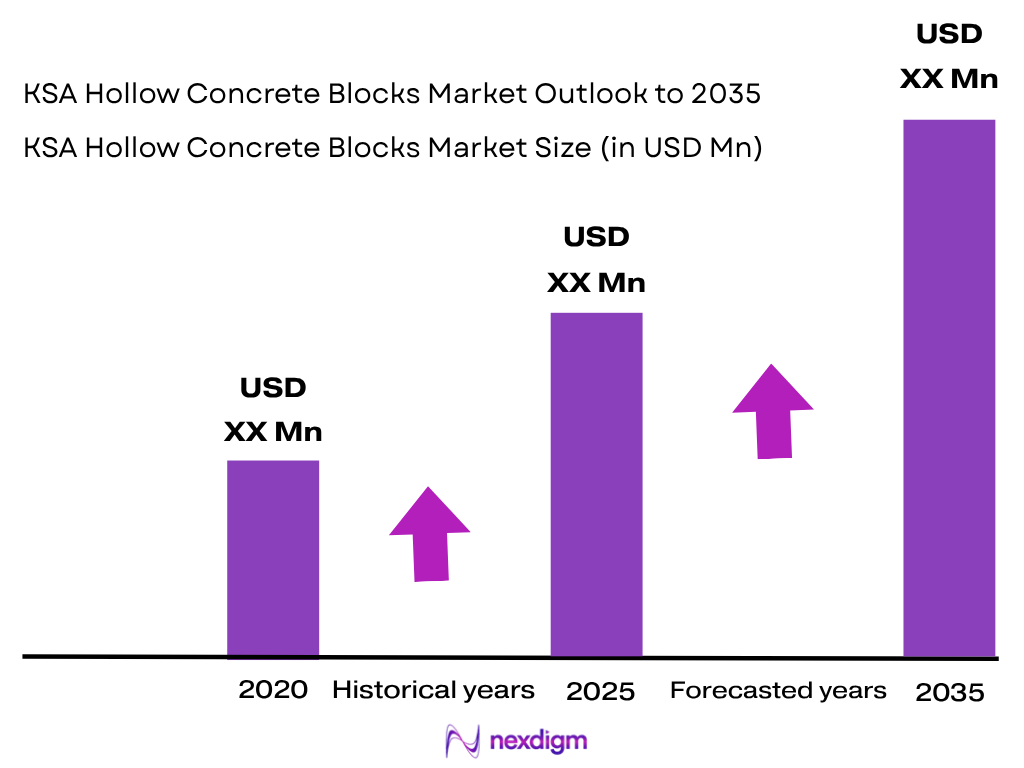
The KSA Hollow Concrete Blocks Market is valued at approximately USD ~ billion, based on historical market assessment, compared with approximately USD ~ billion in the preceding period. Demand is supported by housing construction, commercial buildings, industrial facilities and master-planned communities. Saudi families purchasing homes increased from 747,800 to more than 850,000, while developmental housing delivered more than 19,000 housing units, reinforcing demand for hollow concrete masonry units used in external walls, partitions and building envelopes.
Riyadh, Jeddah and Madinah are important centers of the KSA Hollow Concrete Blocks Market because of their concentrated residential, commercial and infrastructure construction and established block-manufacturing bases. Riyadh benefits from extensive urban and housing development, while Jeddah hosts manufacturers such as Riyadh Block Factory and Nesma Concrete Solutions, whose Asfan facility covers 40,750 m². Madinah also maintains established block manufacturing through companies such as Almansour Concrete Block Company, supporting construction requirements across residential, institutional and commercial projects.
Market Segmentation
By Product Type
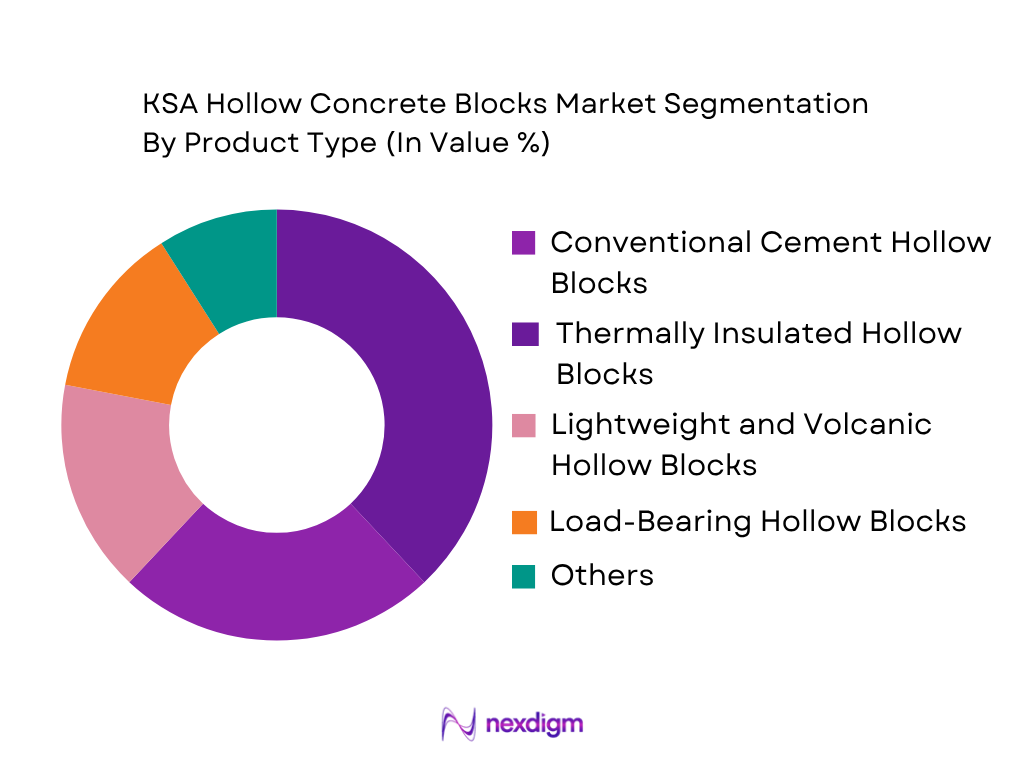
The KSA Hollow Concrete Blocks Market is segmented by product type into conventional cement hollow blocks, thermally insulated hollow blocks, lightweight and volcanic hollow blocks, load-bearing hollow blocks, and specialty hollow blocks. Recently, conventional cement hollow blocks have maintained a dominant market position because they remain widely applicable to external walls, internal partitions, boundary walls and reinforced-concrete-frame infill. Saudi manufacturers offer conventional hollow blocks across multiple standardized dimensions, supporting contractors with established masonry installation practices and broad availability. Riyadh Block Factory manufactures hollow blocks in widths including 100 mm, 150 mm, 200 mm and 250 mm, while Nesma Concrete Solutions manufactures normal-weight and lightweight hollow units. The segment also benefits from the extensive existing manufacturing infrastructure for cement, aggregates, automated molding and curing. However, insulated and lightweight hollow blocks are gaining strategic importance as developers increasingly focus on building-envelope performance, thermal efficiency and lower unit weight.
By Application
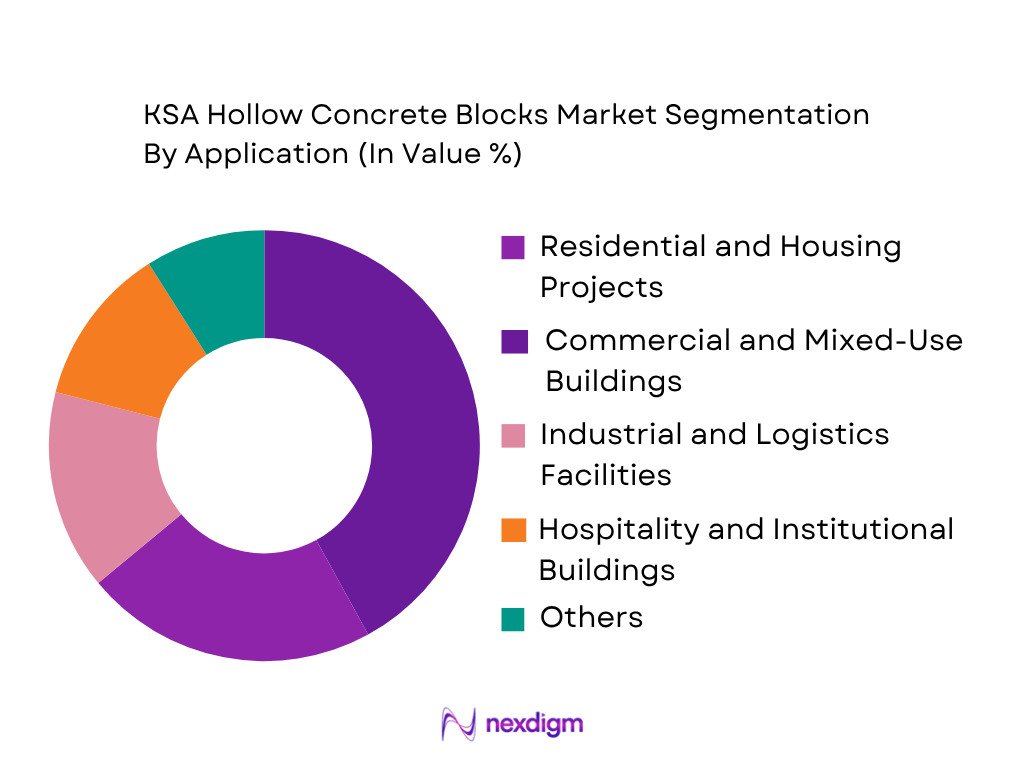
The KSA Hollow Concrete Blocks Market is segmented by application into residential and housing projects, commercial and mixed-use buildings, industrial and logistics facilities, hospitality and institutional buildings, and infrastructure and ancillary construction. Recently, residential and housing projects have maintained a dominant position because hollow blocks are extensively used for villa walls, apartment partitions, external envelopes, service structures and boundary walls. Saudi Arabia’s housing ecosystem continues to expand the underlying construction base, with more than 850,000 Saudi families recorded as purchasing homes in the latest reporting period compared with 747,800 previously. Developmental Housing also provided more than 19,000 housing units in the latest annual period. Large-scale residential construction favors standardized masonry units because manufacturers can supply repeated dimensions and performance classes across extensive community developments. Thermally insulated hollow blocks are additionally relevant for external envelopes, while conventional blocks retain broad applicability to internal partitions and non-load-bearing masonry.
Competitive Landscape
The KSA Hollow Concrete Blocks Market is characterized by regional manufacturing competition because concrete masonry units are heavy products for which factory location and delivery capability materially influence customer service. Established companies compete through product dimensions, insulated and lightweight block portfolios, automated production, compressive performance, contractor relationships and delivery fleets. Riyadh, Jeddah and Madinah contain notable manufacturing operations, while product differentiation increasingly includes volcanic aggregate blocks, factory-insulated blocks and specialized masonry systems.
| Company | Establishment Year | Headquarters / Base | Hollow Block Capability | Insulated Block Capability | Lightweight / Volcanic Blocks | Manufacturing Technology | Delivery Capability | Quality / Product Positioning |
| Riyadh Block Factory | 1988 | Jeddah | ~ | ~ | ~ | ~ | ~ | ~ |
| Saudi Thermo Block Factory | 1993 | Riyadh | ~ | ~ | ~ | ~ | ~ | ~ |
| Nesma Concrete Solutions | 2016 | Jeddah | ~ | ~ | ~ | ~ | ~ | ~ |
| Almansour Concrete Block Company | 2010 | Madinah | ~ | ~ | ~ | ~ | ~ | ~ |
| Saudi Readymix – Block Operations | 1978* | Eastern Province | ~ | ~ | ~ | ~ | ~ | ~ |
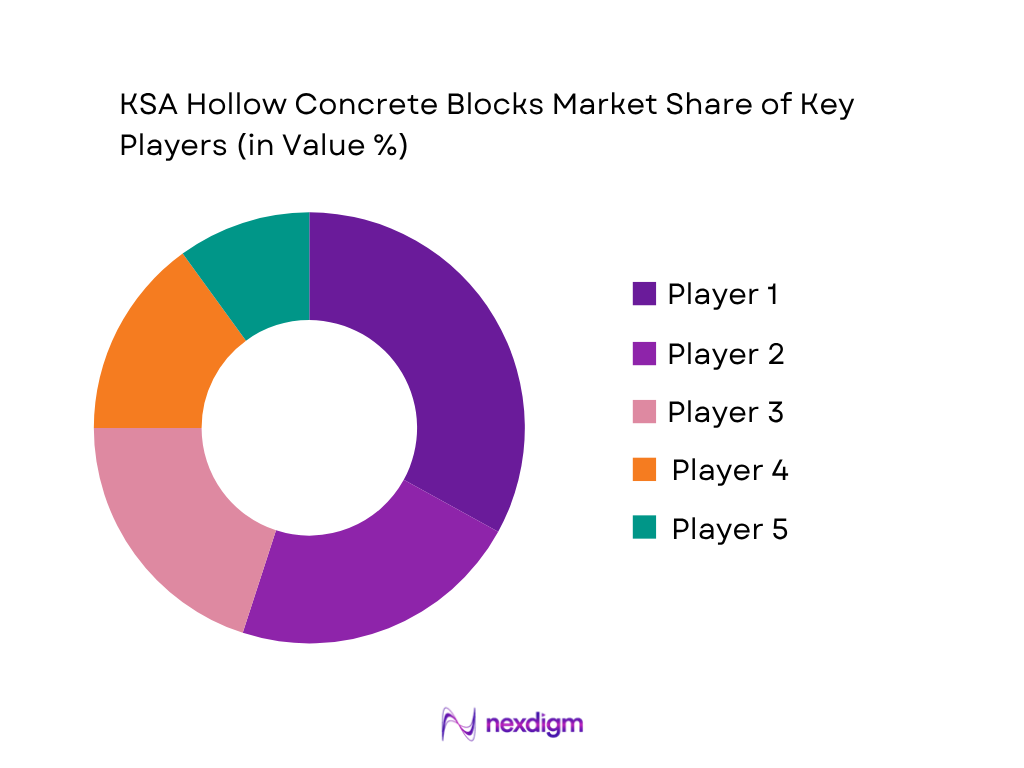
KSA Hollow Concrete Blocks Market Analysis
Growth Drivers
Vision 2030 Construction and Residential Development Driving Hollow Block Consumption
Saudi Arabia’s Vision 2030 construction pipeline is strengthening demand for hollow concrete blocks across residential communities, commercial buildings, schools, mosques, utility structures and mixed-use developments. The Kingdom recorded more than 850,000 Saudi families purchasing homes in 2024, compared with 747,800 families in 2023, while Developmental Housing provided more than 19,000 housing units in 2024. ROSHN’s existing development platform encompasses more than 400,000 homes across Riyadh, Jeddah, Al Ahsa and other regions and covers over 200 million square meters of master-planned neighborhoods. These developments create recurring requirements for conventional hollow blocks, insulated masonry units, internal partition blocks and external wall systems. The macroeconomic environment also supports construction activity: Saudi Arabia generated approximately SAR 4.1 trillion in nominal GDP in 2024, while nominal non-oil GDP reached approximately SAR 2.67 trillion. Large residential programs are particularly favorable for hollow blocks because repeated villa and apartment configurations permit standardized dimensions, predictable production runs and high-volume site deliveries, improving the suitability of automated block manufacturing for Saudi housing developments.
Industrial, Logistics and Non-Oil Development Expanding Masonry Requirements
Industrial diversification is creating an additional structural demand base for the KSA Hollow Concrete Blocks Market as factories, warehouses, workshops, logistics facilities and associated service buildings require external masonry, internal partitions, boundary walls and utility structures. Saudi Arabia had 11,672 factories operating or under construction in January 2024, while 152 new industrial licenses were issued and 79 factories commenced production during that month. This industrial expansion complements the broader non-oil economy, which generated approximately SAR 2.67 trillion in nominal output in 2024. Saudi Arabia’s total nominal GDP stood at approximately SAR 4.1 trillion, demonstrating the economic scale supporting continued fixed investment. Construction remained one of the activities underpinning non-oil expansion, alongside retail and hospitality. Industrial buildings create particularly relevant demand for hollow concrete blocks because these facilities typically contain extensive partition walls, equipment enclosures, service buildings and perimeter structures. Continued development of domestic manufacturing also supports the hollow-block supply chain itself through local demand for cement products, aggregates, machinery and transportation services, reinforcing the role of automated Saudi block plants serving industrial construction corridors.
Market Challenges
Heavy Product Characteristics and Geographic Delivery Constraints
Transportation remains a fundamental challenge for the KSA Hollow Concrete Blocks Market because blocks combine relatively high unit weight with large shipment volumes, making proximity between manufacturing plants and construction projects operationally important. Saudi development is geographically dispersed: ROSHN’s existing portfolio alone encompasses more than 200 million square meters of master-planned communities across Riyadh, Jeddah, Al Ahsa and other regions, with plans covering more than 400,000 homes. Riyadh’s construction footprint is also expanding through projects such as Expo 2030, whose current masterplan covers 6 million square meters across 5 districts. The wider economy generated approximately SAR 4.1 trillion in nominal GDP in 2024, while investment-led development continues to generate substantial construction-material movements. Hollow blocks must be transported on pallets or trucks while limiting breakage, chipping and moisture-related damage, and manufacturers must coordinate loading, unloading and site storage with contractors. Unlike higher-value engineered construction products, standard masonry blocks are required in very large quantities, increasing truck movements. Consequently, distant projects can weaken plant competitiveness and encourage manufacturers to establish regional production facilities, distributor inventories and optimized delivery networks near Saudi construction clusters.
Construction Pipeline Fluctuations Creating Manufacturing Utilization Risk
Hollow concrete block factories depend on sustained construction activity to maintain efficient utilization of batching systems, vibro-press lines, curing facilities, palletizing equipment and finished-goods yards. Saudi construction remains substantial, but recent building-permit data illustrates the short-term volatility manufacturers must manage. The Kingdom issued 5,056 building permits in May 2026, compared with 7,584 permits in May 2025 and 6,803 permits in April 2026. Such changes can translate into uneven ordering patterns for conventional, insulated and lightweight hollow blocks, particularly for manufacturers heavily exposed to specific cities or contractor groups. The challenge occurs within a large macroeconomic environment: nominal GDP stood at approximately SAR 4.1 trillion in 2024, while nominal non-oil GDP reached approximately SAR 2.67 trillion. Vision 2030 investment plans have also undergone project reprioritization, with selected projects accelerated while timelines for others have been extended. For hollow-block manufacturers, changes in project sequencing can affect production planning, mold allocation, aggregate procurement, curing-yard utilization, inventory and truck deployment. Maintaining diversified exposure across housing, industrial, commercial and institutional construction therefore becomes important for stabilizing factory throughput.
Market Opportunities
Thermally Insulated Blocks for Expanding Master-Planned Residential Communities
Thermally insulated hollow concrete blocks represent a significant future opportunity as Saudi Arabia expands large residential communities while placing greater emphasis on building-envelope performance and standardized construction. The opportunity is supported by the existing scale of housing development rather than speculative future demand. More than 850,000 Saudi families had purchased homes in 2024, compared with 747,800 in 2023, while Developmental Housing delivered more than 19,000 housing units during 2024. ROSHN’s current platform covers more than 200 million square meters and encompasses over 400,000 homes across multiple Saudi regions. The Kingdom’s economic capacity also remains substantial, with nominal GDP of approximately SAR 4.1 trillion in 2024 and nominal non-oil GDP of approximately SAR 2.67 trillion. Large community developments provide favorable conditions for insulated hollow blocks because repetitive villa and apartment designs allow manufacturers to standardize block dimensions, insulation inserts and production cycles. Suppliers that expand automated production of thermally efficient masonry units can address external-wall applications while differentiating from conventional blocks through thermal performance, dimensional consistency and integration with Saudi building-envelope requirements.
Giga-Projects and Riyadh Urban Expansion Creating Specialized Block Opportunities
Riyadh’s expanding development pipeline creates future opportunities for manufacturers of conventional, insulated, lightweight, volcanic and higher-performance hollow concrete blocks. Current project scale provides the supporting evidence: the Expo 2030 Riyadh masterplan encompasses 6 million square meters, consists of 5 districts and is designed to accommodate 197 official participants. Alongside event infrastructure, ROSHN is developing a national platform exceeding 400,000 homes across more than 200 million square meters, including substantial development activity in Riyadh. These projects require extensive supporting buildings, residential structures, internal partitions, external walls, service facilities, utility structures and boundary construction where concrete masonry products can be deployed. The opportunity is underpinned by Saudi Arabia’s broader economic diversification, with nominal GDP reaching approximately SAR 4.1 trillion in 2024 and nominal non-oil GDP approximately SAR 2.67 trillion. For hollow-block manufacturers, this construction environment creates scope to expand automated vibro-press capacity, develop lightweight and thermally insulated product ranges and position production closer to Riyadh. Manufacturers capable of providing multiple dimensions, consistent compressive performance, reliable high-volume deliveries and project-specific masonry solutions can address increasingly sophisticated contractor requirements.
Future Outlook
The KSA Hollow Concrete Blocks Market is projected to expand at approximately ~% CAGR during 2026–2035, supported by continued residential, commercial, hospitality, industrial and institutional construction. The market is expected to gradually shift toward higher-performance masonry products as building-envelope efficiency becomes increasingly important. Thermally insulated, lightweight and volcanic hollow blocks are expected to gain strategic relevance alongside conventional concrete blocks. Manufacturers are likely to invest further in automated batching, vibro-press molding, controlled curing, automated handling and product testing to improve dimensional consistency and manufacturing productivity. Regional manufacturing will remain important because the weight-to-value characteristics of concrete blocks favor production close to major construction centers. Riyadh, Jeddah, Madinah and Eastern Province construction corridors therefore provide opportunities for manufacturers capable of combining localized production with reliable project-site delivery.
Major Players
- Saudi Readymix Concrete Company – Block Division
- Saudi Thermo Block Factory
- Nesma Concrete Solutions
- Almansour Concrete Block Company
- Riyadh Block Factory
- Al Armak Cement Product Factory
- Khaleeg Factory for Natural Stone Company – APTC
- Musaed Al-Johani Company – Cement Products Factories
- White Concrete for Cement Products – Golden Block
- Riyadh Kingdom for Concrete Products
- Al Sumou Al Sharqi Factory for Cement Products
- New Century Factory
- Hussein Ahmed Al-Dabash Group of Factories
- Al Saadi Block and Ready-Mix Concrete Factory
- Al Manaratain Block Factory – KSA
Key Target Audience
- Hollow Concrete Block Manufacturers
- Cement and Construction Material Manufacturers
- Real Estate and Housing Developers
- General Contractors and Masonry Contractors
- Building Material Distributors and Dealers
- Giga-Project and Master-Plan Developers
- Investments and Venture Capitalist Firms
- Government and Regulatory Bodies (Ministry of Municipalities and Housing, Ministry of Industry and Mineral Resources, Saudi Standards, Metrology and Quality Organization, Saudi Building Code National Committee)
Research Methodology
Step 1: Identification of Key Variables
The initial phase involves constructing an ecosystem map covering cement and aggregate suppliers, hollow block manufacturers, machinery suppliers, distributors, contractors, developers and regulatory authorities within the KSA Hollow Concrete Blocks Market. Desk research identifies critical variables including production capacity, product dimensions, density, compressive performance, thermal characteristics, manufacturing technology, regional footprint and application demand.
Step 2: Market Analysis and Construction
Historical information is analyzed using top-down and bottom-up approaches to construct the KSA Hollow Concrete Blocks Market framework. Manufacturer capacity, plant locations, production utilization, construction activity, residential development and industrial construction are assessed alongside product-level demand. Supply is evaluated across conventional, insulated, lightweight, volcanic and load-bearing hollow concrete block categories.
Step 3: Hypothesis Validation and Expert Consultation
Market hypotheses are validated through structured discussions and computer-assisted telephone interviews with manufacturers, building material distributors, contractors, masonry specialists, developers and raw-material suppliers. Interviews assess plant utilization, block demand, preferred dimensions, product specifications, distribution radius, procurement practices, contractor requirements and competitive positioning, strengthening the reliability of assumptions developed through secondary research.
Step 4: Research Synthesis and Final Output
The final phase triangulates manufacturer information, primary interviews, construction indicators and demand-side findings. Bottom-up production analysis is reconciled with application demand across housing, commercial buildings, industrial facilities and institutional construction. This process establishes the final market framework, competitive structure, segmentation, demand drivers, challenges and long-term outlook for the KSA Hollow Concrete Blocks Market.

- Executive Summary
- Research Methodology (Market Definitions and Assumptions, Hollow Concrete Masonry Unit Classification, Load-Bearing and Non-Load-Bearing Block Mapping, Insulated Block Mapping, Volcanic Aggregate Block Mapping, Block Dimension Mapping, Cement and Aggregate Input Assessment, Manufacturing Plant Mapping, Installed Block Production Capacity Assessment, Capacity Utilization Assessment, Top-Down Market Sizing, Bottom-Up Manufacturer Assessment, Demand-Side Assessment, Supply-Side Assessment, Contractor and Distributor Interviews, Construction Pipeline Assessment, Housing Development Assessment, Giga-Project Demand Assessment, Data Triangulation, Forecasting Framework)

- Definition and Scope
- KSA Hollow Concrete Blocks Industry Evolution and Development of Conventional Hollow Blocks, Load-Bearing Blocks, Non-Load-Bearing Blocks, Insulated Concrete Blocks, Lightweight Aggregate Blocks, Volcanic Blocks, Hourdi Blocks and Multi-Hollow Concrete Masonry Units
Hollow Concrete Block Industry Value Chain Analysis - Hollow Concrete Block Supply Chain Analysis

- Growth Drivers (Vision 2030 Construction Pipeline, Residential Community Development, Riyadh Urban Expansion, Giga-Project Construction, Tourism and Hospitality Development, Industrial Facility Construction, Warehouse and Logistics Expansion, Demand for Faster Masonry Installation, Local Building Material Manufacturing)
- Market Challenges (Cement Input Exposure, Aggregate Quality Variability, Heavy Low-Value Product Transportation, Restricted Economic Delivery Radius, Block Breakage During Handling, Manufacturing Capacity Utilization Volatility, Contractor Price Sensitivity, Masonry Labor Availability, Product Quality Variability, Competition from Alternative Walling Systems)
- Market Opportunities (Thermally Insulated Hollow Blocks, Lightweight Concrete Blocks, Volcanic Aggregate Blocks, High-Strength Load-Bearing Blocks, Energy-Efficient Building Envelopes, Giga-Project Supply Contracts, Master-Planned Housing Communities, Industrial and Logistics Facilities, Automated Block Manufacturing, Low-Carbon Concrete Masonry Units)
- Market Trends (Machine-Insulated Blocks, Lightweight Aggregate Formulations, Multi-Hollow Block Designs, Higher Thermal Resistance, Automated Vibro-Press Manufacturing, Automated Batching and Palletizing, Controlled Curing Systems, Project-Specific Block Dimensions, Factory Quality Testing, Low-Clinker Cement Mixes)
- Government Regulations and Standards (SASO Concrete Masonry Unit Requirements, SASO Load-Bearing Concrete Masonry Unit Requirements, SASO Lightweight Thermal-Insulation Concrete Masonry Unit Requirements, Saudi Building Code Masonry Requirements, Thermal Insulation Requirements, Compressive Strength Requirements, Dimensional Tolerance Requirements, Water Absorption Requirements, Product Conformity Requirements, Factory Quality Control Requirements) SASO
- SWOT Analysis
- Porter’s Five Forces Analysis
- PESTLE Analysis
- Stakeholder Ecosystem

- By Market Value (2020-2025)
- By Hollow Concrete Block Production Volume (2020-2025)
- By Hollow Concrete Block Consumption Volume (2020-2025)
- By Number of Hollow Concrete Blocks Sold (2020-2025)
- By Installed Block Manufacturing Capacity (2020-2025)
- By Manufacturing Capacity Utilization (2020-2025)

- By Product Type (In Value %)
Conventional Cement Hollow Blocks
Load-Bearing Hollow Concrete Blocks
Non-Load-Bearing Hollow Concrete Blocks
Thermally Insulated Hollow Blocks
Lightweight Aggregate Hollow Blocks
Volcanic Hollow Blocks
Hourdi Hollow Blocks
Multi-Hollow Concrete Blocks - By Block Width and Dimension (In Value %)
100 mm Hollow Blocks
150 mm Hollow Blocks
200 mm Hollow Blocks
250 mm Hollow Blocks
300 mm Hollow Blocks
Special and Project-Specific Dimensions - By Functional Performance (In Value %)
Standard Masonry Hollow Blocks
Load-Bearing Structural Blocks
Thermal Insulation Blocks
Lightweight Blocks
Fire-Resistant Blocks
Acoustic Performance Blocks
High-Compressive-Strength Blocks - By Application (In Value %)
Residential Buildings and Housing Communities
Commercial and Mixed-Use Buildings
Hospitality and Tourism Projects
Industrial Buildings and Factories
Warehouses and Logistics Facilities
Educational and Healthcare Buildings
Government and Institutional Buildings
Giga-Projects and Master-Planned Communities - By Construction Use (In Value %)
External Walls
Internal Partition Walls
Load-Bearing Masonry Walls
Infill Walls for Reinforced Concrete Frames
Thermally Insulated Building Envelopes
Hourdi Roof and Floor Systems
Boundary and Service Walls
Utility and Ancillary Structures - By Customer Type (In Value %)
Real Estate Developers
Housing Developers
Giga-Project Developers
General Building Contractors
Masonry and Blockwork Contractors
Industrial and Logistics Developers
Government Project Contractors
Building Material Distributors and Dealers

- Market Share of Major Players (By Revenue, Block Production Volume, Installed Block Capacity, Number of Manufacturing Plants, Hollow Block Product Range, Insulated Block Capacity, Regional Coverage, Contractor Network, Distributor Network, Project Approvals)
- Cross Comparison Parameters (Annual Hollow Block Production Capacity, Hollow Block Size and SKU Breadth, Load-Bearing and Non-Load-Bearing Product Capability, Thermal and Insulated Block Manufacturing Capability, Compressive Strength and Product Performance Range, Manufacturing Automation and Quality-Control Capability, Regional Distribution and Delivery Coverage, Major Project Approvals and Contractor Supply Portfolio)
- SWOT Analysis of Major Players
- Detailed Profiles of Major Companies
Saudi Readymix Concrete Company – Block Division Saudi Readymix
Saudi Thermo Block Factory Saudi Thermo
Nesma Concrete Solutions Nesma Concrete Solutions
Almansour Concrete Block Company Almansour Concrete Block Co.
Riyadh Block Factory Riyadh Block
Al Armak Cement Product Factory Alarmak
Khaleeg Factory for Natural Stone Company – APTC APTC
Musaed Al-Johani Company – Cement Products Factories White Concrete for Cement Products – Golden Block White Concrete
Riyadh Kingdom for Concrete Products RKCP Group
Al Sumou Al Sharqi Factory for Cement Products EngMaj
New Century Factory New Century Factory
Hussein Ahmed Al-Dabash Group of Factories
Al Saadi Block and Ready-Mix Concrete Factory Al Saadi Sa
Al Manaratain Block Factory – KSA Al Manaratain

- Contractor Procurement Assessment
- Real Estate Developer Requirement Assessment
- Housing Developer Requirement Assessment
- Giga-Project Developer Requirement Assessment
- Industrial and Logistics Developer Assessment
- Masonry Contractor Requirement Assessment

- By Market Value (2026-2035)
- By Hollow Concrete Block Production Volume (2026-2035)
- By Hollow Concrete Block Consumption Volume (2026-2035)
- By Number of Hollow Concrete Blocks Sold (2026-2035)
- By Installed Block Manufacturing Capacity (2026-2035)
- By Manufacturing Capacity Utilization (2026-2035)


 Request a Sample
 Ask for Customization
 Get a Quote
 Enquire Now
