

 Download PDF
Market Overview
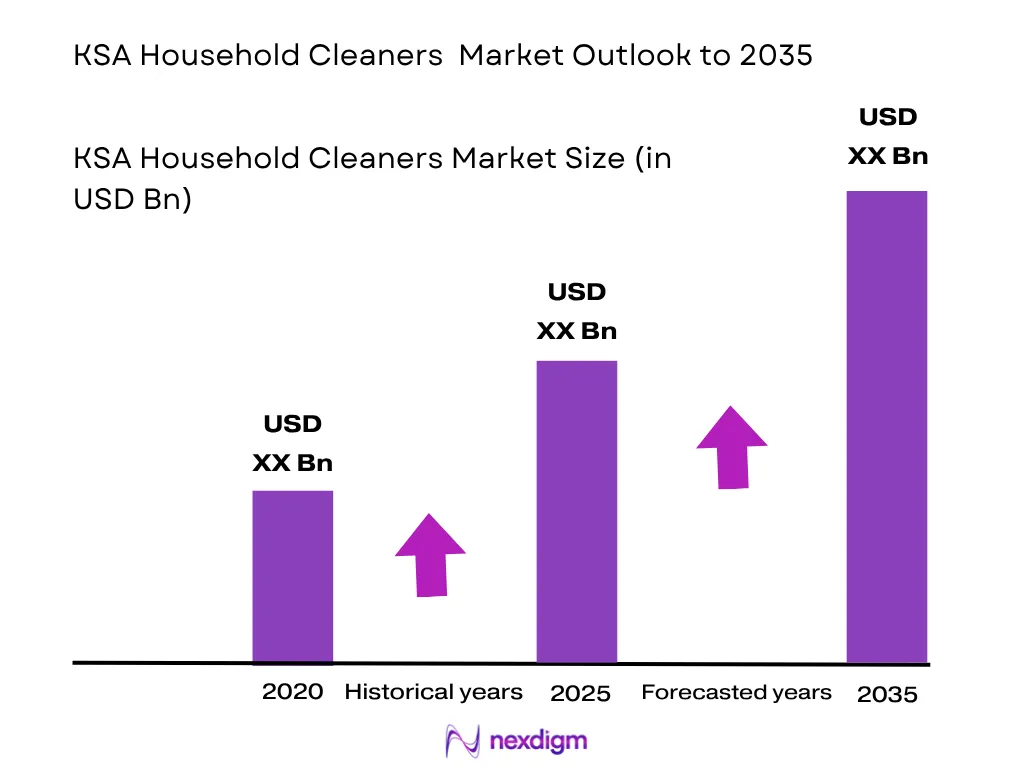
The KSA Household Cleaners market is a rapidly growing segment within the broader consumer goods industry, valued at approximately USD ~ billion in 2025. This growth is driven by several factors, including increasing consumer awareness of hygiene, rising disposable income, and the growing prevalence of dual-income households. The market has also been bolstered by urbanization and retail expansion, particularly in modern trade formats. Additionally, the ongoing trend of premiumization with eco-friendly and antibacterial cleaning products is expected to continue driving market growth, with innovations in product formulations and packaging.
The dominant cities in the KSA Household Cleaners market are Riyadh, Jeddah, and Dammam, due to their large urban populations, high disposable incomes, and the concentration of retail outlets and supermarkets. Riyadh, as the capital, leads in terms of both population size and purchasing power. Jeddah, with its commercial port, plays a critical role in import logistics, facilitating the availability of a wide variety of cleaning products. Dammam, being a key industrial hub, also drives demand, particularly in the commercial and institutional sectors. These cities dominate due to their economic activity, which fuels household cleaning demand across different segments.
Market Segmentation
By Product Type
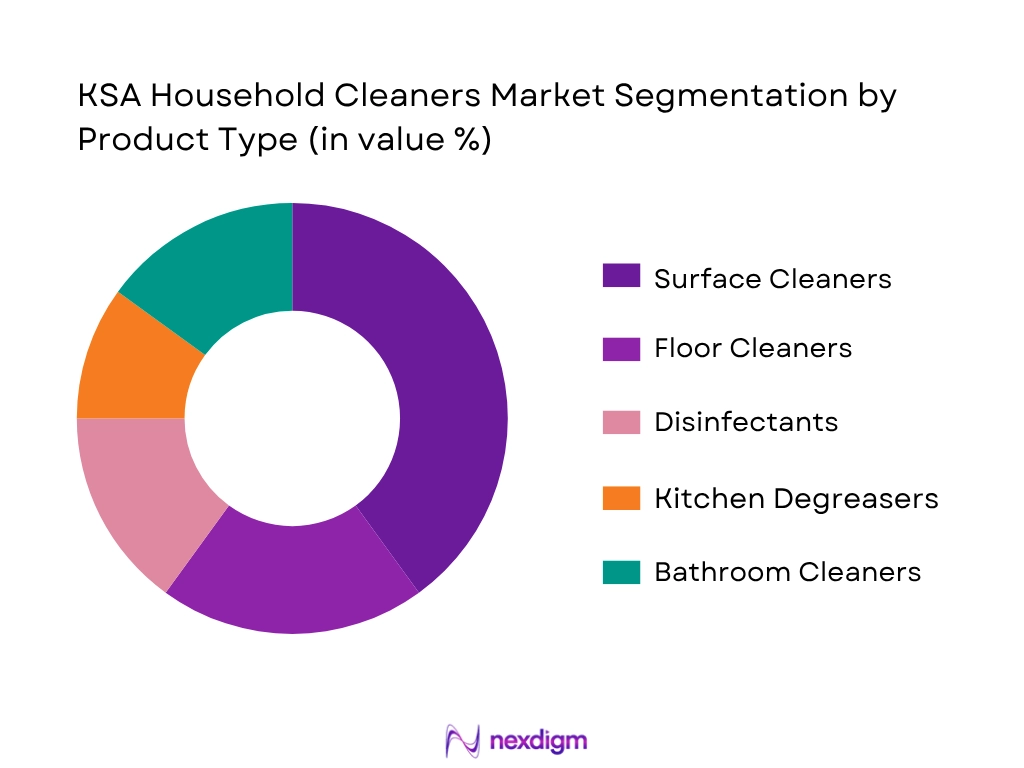
The KSA Household Cleaners market is segmented by product type into surface cleaners, floor cleaners, disinfectants, kitchen degreasers, and bathroom cleaners. Among these, surface cleaners have a dominant market share due to their versatility and frequent use in everyday household cleaning. Brands such as Clorox and Lysol lead the category with well-established products that cater to various consumer preferences, from all-purpose cleaners to specialty surface wipes. This segment benefits from high product penetration, continuous demand in both residential and commercial sectors, and consistent innovation in fragrance and antibacterial properties.
By Active Ingredient Type
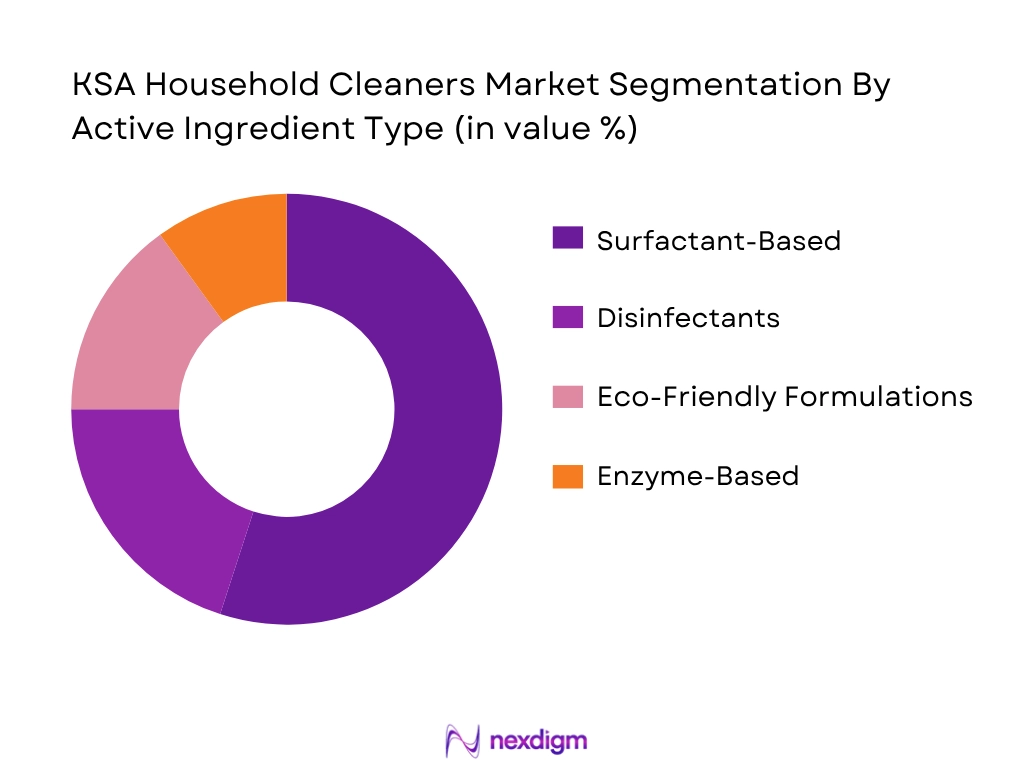
The active ingredients in household cleaning products in KSA are categorized into surfactants, disinfectants, enzymes, and eco-friendly formulations. Surfactant-based products dominate the market as they are effective in breaking down grease, dirt, and oils, making them suitable for various surfaces and environments. Brands like Procter & Gamble and Henkel have established strong market positions with products leveraging surfactants to cater to the high-demand categories of floor and surface cleaners. The rise of eco-friendly cleaning solutions is slowly increasing, but surfactant-based cleaners remain the backbone of the market due to their affordability and effectiveness.
Competitive Landscape
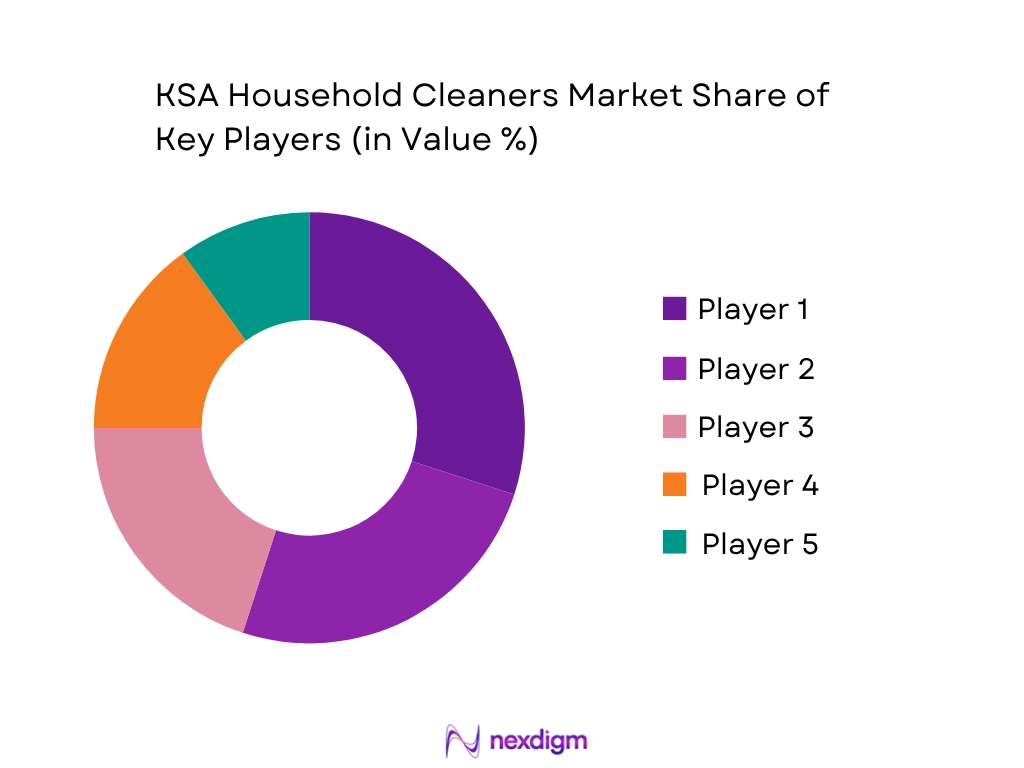
The KSA Household Cleaners market is dominated by a blend of global giants and local players, making it a highly competitive landscape. Global brands such as Unilever, Procter & Gamble, and Reckitt Benckiser have established a significant foothold due to their strong brand recognition, wide distribution networks, and innovative products. Local players like National Detergents Company have a notable presence, catering to specific consumer preferences within the region. These key players are increasingly focusing on sustainability and new product formulations, which are becoming critical drivers in the market.
| Company | Establishment Year | Headquarters | Product Portfolio | Retail Channels | Regional Reach | Pricing Strategy |
| Unilever | 1930 | London, UK | ~ | ~ | ~ | ~ |
| Procter & Gamble (P&G) | 1837 | Cincinnati, US | ~ | ~ | ~ | ~ |
| Reckitt Benckiser | 1823 | Slough, UK | ~ | ~ | ~ | ~ |
| National Detergents Co. | 1972 | Riyadh, KSA | ~ | ~ | ~ | ~ |
| Henkel | 1876 | Düsseldorf, DE | ~ | ~ | ~ | ~ |
KSA Household Cleaners Market Analysis
Growth Drivers
Rising Health & Hygiene Awareness (Post‑Pandemic Persistence)
The expansion of health and hygiene consciousness among Saudi households has become a foundational driver for the demand of household cleaners. The Saudi population reached approximately 35.3 million in 2024, with urban centres such as Riyadh, Jeddah, and Dammam accounting for a significant share of consumer activity. Urban residents typically spend more on hygiene products due to higher awareness of sanitation standards in densely populated areas. Saudi Arabia reported real GDP growth of 1.3% in 2024, driven by non‑oil activities, reflecting improving domestic economic activity that supports consumer spending on non‑essentials including quality cleaning products. As household consumption expenditure increases, investments in home hygiene products have followed suit, especially in post‑pandemic contexts where consumers are more attentive to pathogen control and sanitation routines. Annual GDP figures show resilience in non‑oil sectors, indicating consumer demand that supports premium and functional cleaning product categories. These economic and demographic fundamentals collectively underpin enhanced health and hygiene awareness among Saudi buyers, prompting frequent and diversified purchase behaviour of household cleaning solutions.
Urbanization & Increase in Dual‑Income Families
Urbanisation in Saudi Arabia is a significant structural trend, where 85.17% of the population lives in urban areas in 2024, which typically correlates with higher demand for household maintenance products. Urban households, concentrated in cities such as Riyadh (approx. 7 million residents), Jeddah (approx. 3.75 million), and Dammam (approx. 2.6 million), exhibit greater access to modern retail channels and a propensity for convenience‑oriented purchases. The World Bank reports this high urban share as a result of decades of migration from rural areas to metropolitan centres. Urban living increases exposure to market innovations and promotional touchpoints for household cleaners, boosting category penetration. Furthermore, labour market reforms and socio‑economic transformation have led to an increase in female workforce participation; national estimates show female labour force participation around 33.48% in 2024, which supports a rise in dual‑income families. Dual incomes generally elevate household disposable income, leading to greater expenditure on home care and hygiene products that save time and effort, such as advanced cleaners and disinfectants. These demographic and socio‑economic shifts strengthen the structural demand base for household cleaners and disrupt traditional purchase patterns in favour of diversified and premium product consumption.
Market Challenges
Imported Input Dependency
The KSA Household Cleaners market faces constraints due to heavy reliance on imported raw materials such as surfactants, solvents, and specialty chemicals required for formulation. Saudi Arabia’s merchandise imports have shown resilience, for example total imports reached SAR 81.4 billion in January 2026, driven by machinery, equipment, and intermediate goods, underscoring the kingdom’s dependence on global supply chains for industrial inputs. Household cleaning formulations often rely on chemical components sourced from global producers in East Asia and Europe; fluctuating global supply chain conditions directly impact availability and manufacturing lead times for cleaning product SKU production. The Kingdom’s urban and industrial growth elevates demand for these imported inputs but also exposes manufacturers to foreign exchange fluctuations, shipping costs, and international logistic disruptions. As a result, local producers face input cost variability which can constrain production scalability and affect competitive pricing relative to imported finished goods. Import growth statistics reflect broader industrial dependency on global value chains rather than domestic chemical manufacturing capabilities, creating structural challenges for local supply continuity.
Price Sensitivity in Mass Segments
Household cleaners in Saudi Arabia are susceptible to pricing pressures within the mass consumer segment, driven by broad income distribution and cost‑conscious consumer behaviour. Although GDP indicators show growth in non‑oil sectors, the economic landscape still features segments of the population with limited discretionary spending. The labor force participation rate in 2024 highlights ongoing socio‑economic shifts, but overall consumption patterns in lower income brackets remain sensitive to price escalation in daily‑use goods. Producers face challenges balancing raw material cost pressures with affordable retail pricing, especially when imported inputs are expensive. Retail inflation remains moderate but consumers often trade down to lower‑priced SKUs during periods of price volatility or when promotional activity is weak. The absence of robust domestic chemical inputs further exacerbates cost pressures for mass tier products, intensifying competition among price‑value focused SKUs. As price sensitivity remains a key barrier to demand acceleration at the bottom of the income pyramid, producers must strategically manage cost structures and channel pricing to preserve volume without eroding profit margins. The macroeconomic environment with moderate GDP growth and varied consumer income levels underscores the importance of competitive pricing strategies in mass segments.
Opportunities
Shift Toward Eco‑Friendly/Sustainable Formulations
There is a growing opportunity for eco‑friendly and sustainable household cleaning products as consumer preferences evolve in Saudi Arabia. While specific consumer surveys for the cleaning segment are limited in public datasets, broader environmental and sustainability priorities are rising among urban populations, particularly in Riyadh, Jeddah, and Dammam. Sustainability concerns, driven by higher education levels and global environmental discourse, are influencing purchasing behaviour. Regulatory focus on environmental safety and waste reduction could further incentivise the adoption of biodegradable detergents and eco‑certified cleaners. Saudi Vision 2030’s emphasis on diversification and non‑oil economic sectors supports broader sustainability initiatives that can align with green product portfolios. Urban consumers with higher disposable incomes are more likely to choose sustainable options, potentially reducing dependency on traditional chemical‑heavy products. This shift in preferences presents a structural opportunity for manufacturers to invest in eco‑friendly formulations, certified green labels, and refill systems that reduce environmental footprint. Transitioning to sustainable offerings not only satisfies emerging consumer demand but also aligns with national economic transformation goals, enhancing long‑term competitiveness for brands that lead in eco innovation.
Premiumization
As urban household incomes rise and consumer lifestyles evolve, the premiumization of household cleaning products presents a notable opportunity. Urban households in Saudi Arabia increasingly exhibit willingness to pay for higher‑quality, multifunctional cleaning solutions that offer enhanced performance, superior aesthetics, or specialised features (e.g., antibacterial, long‑lasting fragrance, premium packaging). Premium products often serve dual roles functional efficacy and brand prestige appealing to middle and high‑income segments in cities like Riyadh and Jeddah. The urban consumer base, backed by stable employment and rising female labour force participation, drives demand for these differentiated products that promise convenience and superior results. Brands that invest in R&D to deliver advanced formulations can capture higher margins and foster brand loyalty. Moreover, premium segments often leverage modern retail and digital channels effectively, broadening reach through experiential marketing and value‑added services. As socio‑economic conditions continue to evolve, premiumisation in household cleaning aligns with broader consumption upgrade trends in other FMCG categories, making it a key strategic frontier for market positioning.
Future Outlook
Over the next decade, the KSA Household Cleaners market is poised for steady growth, driven by increasing urbanization, a growing middle-class population, and a continued focus on hygiene and sanitation. As consumers become more health-conscious, demand for disinfectants and eco-friendly products will rise. Additionally, the expansion of e-commerce and modern retail formats will provide greater access to household cleaning products, further driving market growth. Technological innovations in product formulations, along with shifts towards sustainable and green cleaning solutions, are expected to shape the future of the market.
Major Players
- Unilever
- Procter & Gamble
- Reckitt Benckiser
- National Detergents Company
- Henkel
- SC Johnson
- Clorox
- Dabur
- Fine Hygienic Holding
- Ecolab
- S.C. Johnson
- L’Oréal
- Al-Watania
- Al-Jazira Oil & Gas
- Saudi Modern Detergents Co.
Key Target Audience
- Retailers (Hypermarkets and Supermarkets)
- E-commerce Platforms
- Institutional Buyers (Hospitals, Schools, Hotels)
- Manufacturers of Household Products
- Investments and Venture Capitalist Firms
- Government and Regulatory Bodies (SASO, SFDA)
- Importers and Distributors of Household Products
- Private Label Brands (Modern Trade Chains)
Research Methodology
Step 1: Identification of Key Variables
The initial phase involves identifying the major stakeholders within the KSA Household Cleaners market through secondary research. This includes an analysis of retail formats, manufacturers, and regulatory bodies to identify the critical drivers, including consumer behavior trends, product type, and ingredient categories.
Step 2: Market Analysis and Construction
This phase focuses on analyzing historical data to create a baseline for market growth and to understand the penetration rates of key products in various channels such as modern trade, e-commerce, and wholesale. Insights will be gathered through market surveys and secondary data sources.
Step 3: Hypothesis Validation and Expert Consultation
Industry experts will be consulted to validate the hypotheses formed during the initial phases of research. Through interviews with key players in the market, insights on new product launches, future trends, and the impact of sustainability initiatives will be gathered.
Step 4: Research Synthesis and Final Output
The final phase synthesizes data from primary and secondary research sources and consultations with stakeholders to generate comprehensive market projections. This includes forecasting future market dynamics, including shifts in product preferences, pricing trends, and regulatory changes that may affect market performance.

- Executive Summary
- Research Methodology (Market Definitions and Scope (Household Cleaners Product Categories, Active Ingredients, Use Cases), Abbreviations and Industry Nomenclature, Research Framework (Triangulation of Primary, Secondary, and Retail Audit Data, Market Sizing Approach (Bottom‑Up, Channel‑Based Forecasting), Price Benchmarking Methodology , Assumptions & Limitations)

- Definition and Product Taxonomy
- Market Genesis and Evolution
- Household Cleaners Use Behavior in Saudi Consumers
- Household Cleaners Value Chain
- Regulatory Landscape
- Import/Export Dynamics

- Growth Drivers( Rising Health & Hygiene Awareness (Post‑Pandemic Persistence), Urbanization & Increase in Dual‑Income Families, Retail Modernization & E‑commerce Penetration)
- Market Challenges (Imported Input Dependency (Surfactants, Solvents), Price Sensitivity in Mass Segments, Regulatory Compliance Costs)
- Opportunities (Shift Toward Eco‑Friendly/Sustainable Formulations, Premiumization , Private Label Expansion in Modern Trade)
- Key Market Trends (Growing E‑commerce & D2C Brand Adoption, Expansion of Concentrated & Refill Formats, Packaging Innovation)
- Regulatory & Standards Analysis (GCC, SASO, SFDA)
- SWOT Analysis – Market Level
- Porter’s Five Forces (Supplier Power, Retailer Power, Substitution Risk, Entry Barriers, Rivalry Intensity)
- PESTLE Analysis (Regulatory, Economic, Social, Technological, Legal, Environmental Drivers)
- Stakeholder Ecosystem (Manufacturers, SFDA, Retailers, Distributors, E-Commerce Platforms, Raw Material Suppliers)

- By Value (2020-2025)
- By Volume (2020-2025)
- By Average Selling Price (2020-2025)
- By Import vs Local Production (2020-2025)

- By Product Category (In Value %)
All‑Purpose Cleaners (Sprays, Liquids)
Floor & Hard Surface Cleaners
Bathroom & Toilet Cleaners
Kitchen Degreasers
Glass & Multi‑Surface Wipes - By Active Ingredient Type (In Value %)
Surfactant‑Based
Enzyme‑Enhanced
Antibacterial/Disinfectant
Eco/Bio‑Based Formulations
Fragrance/Deodorizer Units - By Distribution Channel (In Value %)
Modern Trade (Hypermarkets & Supermarkets)
Traditional Trade (Grocers, Mini‑Marts)
E‑Commerce (Marketplaces & Brand Sites)
Wholesale/Institutional (Hotels, Facilities) - By Consumer End‑Use (In Value%)
Residential Households
Institutional & Commercial (Hotels, Hospitals)
Eco-Conscious Households
Heavy Cleaning Users
Online-First Households - By Price Tier ( In Value %)
Mass (Economy)
Mid‑Tier
Premium - By Geographic Region (In Value %)
Central (Riyadh)
Western (Jeddah, Makkah Region)
Eastern (Dammam, Khobar)
Southern Region

- Market Share by Value & Volume (Top Players) (Brand/MSA/MSP)
- Cross‑Comparison Parameters (Market Presence, Channel Reach, Product Portfolio Depth, SKU Count by Category, Distribution Footprint, Retail/Online Shelf Presence, Marketing Spend Intensity, Price Band Coverage, Manufacturing Footprint in KSA/GCC, Certifications & Compliance, Customer Retention Metrics, Supply Chain Agility,Innovation & R&D Intensity)
- Competitive Benchmarking Heatmap (Value vs Volume vs Innovation Index)
- Pricing Matrix (Multiuso Bottle, Disinfectant Liter Pack, Bleach Pack, Dishwashing Liquid, Bathroom Spray, Refill Pouch)
- Channel Presence Mapping (Supermarkets, Traditional Trade, Pharmacies, Marketplaces, Quick Commerce)
- Brand Positioning Map (Economy, Mass, Premium, Eco/Natural, Heavy-Duty, Fragrance-Led)
- Recent Developments (Product Launches, Packaging Changes, Retail Partnerships, Sustainability Claims, Capacity Expansion)
- SWOT Analysis of Major Players (Strength, Weakness, Opportunity, Threat by Company)
- Detailed Profiles of Major Players
National Detergents Company (NDC)
OMO (Unilever GCC)
Tide (P&G Saudi Arabia)
Clorox
Henkel Saudi Arabia
SC Johnson
Reckitt Benckiser
S.C. Johnson
Ecolab
Dabur Household Products
Almarai Hygiene Division
Saudi Modern Detergents Co.
Fine Hygienic Holding
Procter & Gamble Middle East
Al-Watania

- Consumer Buying Patterns (Frequency, Channel Preference)
- Category Affinity & Brand Loyalty Metrics
- Price Elasticity & Price Sensitivity Analysis (ASP Bands)
- Needs, Desires, and Pain Points (Efficacy, Price, Fragrance, Surface Safety, Child Safety, Pet Safety, Eco-Claims)
- Consumer Purchase Decision Process (Brand Trust, Price Promotions, Pack Size, Fragrance Testing, Retail Availability)
- Brand Loyalty and Switching Behavior (Promo Sensitivity, Private Label Trial, Regional Brand Adoption, Premium Trade-Up)
- Household Budget Allocation (Monthly Cleaning Spend, Bulk Purchase, Stock-Up Cycles, Small-Pack Dependence)
- Digital Consumer Behavior (Marketplace Reviews, Retailer App Discounts, Subscription Bundles, Search Terms)
- Unmet Needs Analysis (Refill Convenience, Low-Toxicity Products, Mold and Humidity Solutions, Multipurpose Convenience)

- By Value (2026-2035)
- By Volume (2026-2035)
- By ASP(2026-2035)
- By Major Distribution Channel (2026-2035)


 Request a Sample
 Ask for Customization
 Get a Quote
 Enquire Now