
 Download PDF
Market Overview
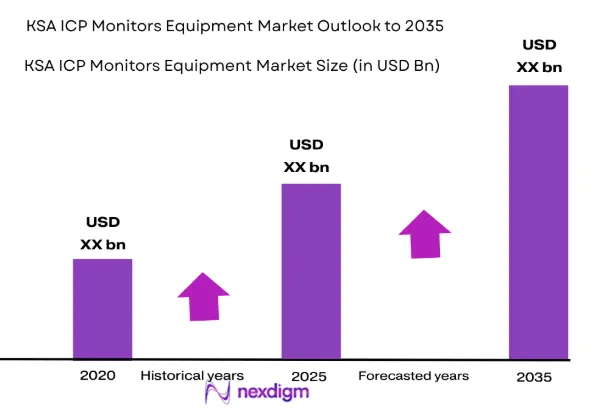
The KSA ICP Monitors Equipment Market demonstrates a specialized yet steadily expanding niche within the broader neuro-monitoring devices sector, driven by increasing neurological disease burden and trauma-related cases. Based on a recent historical assessment, the market size is valued at approximately USD ~ million, supported by hospital investments in critical care infrastructure and adoption of invasive monitoring systems. Growth is further reinforced by advanced ICU setups, rising neurosurgical procedures, and procurement of high-precision monitoring technologies across tertiary healthcare facilities.
Key urban centers such as Riyadh, Jeddah, and Dammam dominate demand due to their concentration of advanced healthcare institutions and specialized neurosurgical units. These cities benefit from higher healthcare spending, better access to trained professionals, and strong government-backed healthcare expansion programs. The presence of leading private hospital networks and medical cities accelerates equipment adoption, while centralized procurement systems and regulatory frameworks ensure consistent technology integration across major healthcare hub.
Market Segmentation
By System Type
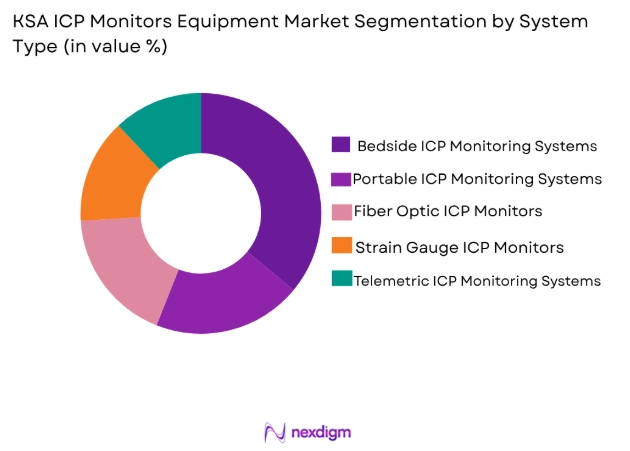
KSA ICP Monitors Equipment Market is segmented by system type into portable ICP monitoring systems, bedside ICP monitoring systems, fiber optic ICP monitors, strain gauge ICP monitors, and telemetric ICP monitoring systems. Recently, bedside ICP monitoring systems has a dominant market share due to factors such as widespread use in intensive care units, continuous monitoring capabilities, higher accuracy in critical conditions, strong integration with hospital infrastructure, and preference among neurosurgeons for real-time intracranial pressure assessment in severe neurological cases.
By End User Type
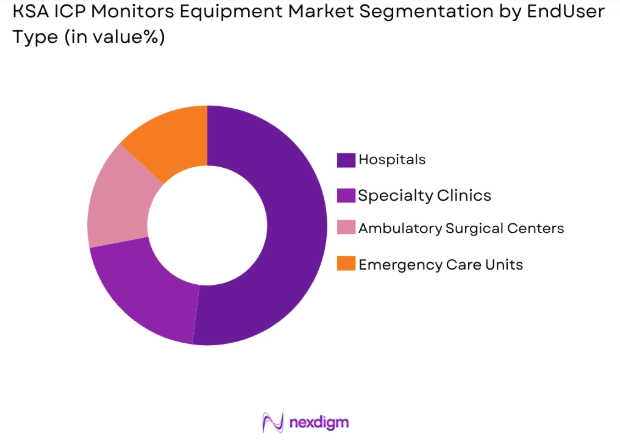
KSA ICP Monitors Equipment Market is segmented by end user into hospitals, specialty clinics, ambulatory surgical centers, and emergency care units. Recently, hospitals has a dominant market share due to factors such as high patient inflow, availability of neurosurgical expertise, advanced ICU facilities, and consistent procurement budgets supporting high-end monitoring equipment adoption.
Competitive Landscape
The competitive landscape is moderately consolidated, with a few global medical device manufacturers controlling a significant portion of the market due to strong product portfolios and technological capabilities. These players leverage partnerships with healthcare providers and distributors to strengthen regional penetration. Market dynamics are influenced by innovation in minimally invasive systems, pricing strategies, and regulatory approvals, while smaller players compete through niche offerings and localized service support.
| Company Name | Establishment Year | Headquarters | Technology Focus | Market Reach | Key Products | Revenue | ICU Integration Capability |
| Medtronic plc | 1949 | Ireland | ~ | ~ | ~ | ~ | ~ |
| Integra LifeSciences | 1989 | USA | ~ | ~ | ~ | ~ | ~ |
| Natus Medical | 1987 | USA | ~ | ~ | ~ | ~ | ~ |
| Raumedic AG | 1948 | Germany | ~ | ~ | ~ | ~ | ~ |
| Sophysa SA | 1976 | France | ~ | ~ | ~ | ~ | ~ |
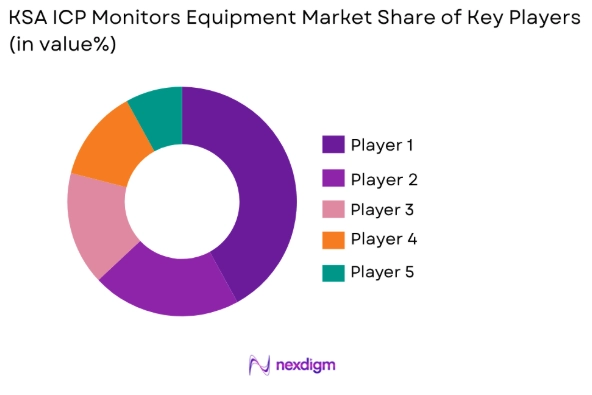
KSA ICP Monitors Equipment Market Analysis
Growth Drivers
Rising Incidence of Traumatic Brain Injuries and Neurological Disorders
The increasing occurrence of traumatic brain injuries and neurological conditions across Saudi Arabia is a significant driver for the ICP monitors equipment market. Road accidents, workplace injuries, and lifestyle-related neurological disorders are contributing to higher hospitalization rates requiring continuous intracranial pressure monitoring. Healthcare providers are prioritizing advanced neuro-monitoring systems to ensure timely diagnosis and intervention, particularly in intensive care units. The growing elderly population further adds to the burden of neurological diseases, increasing demand for monitoring solutions. Hospitals are investing in specialized neurology departments equipped with advanced ICP devices. Additionally, increased awareness among healthcare professionals regarding the importance of ICP monitoring is boosting adoption. The integration of these devices into critical care protocols ensures better patient outcomes and reduced mortality rates. Continuous improvements in device accuracy and reliability are also encouraging wider acceptance. As a result, demand for ICP monitoring equipment is expected to remain strong due to these clinical needs.
Expansion of Healthcare Infrastructure under Vision 2030
Saudi Arabia’s Vision 2030 initiative is significantly transforming the healthcare landscape, creating strong growth momentum for ICP monitoring equipment. Government investments in building new hospitals, upgrading existing facilities, and expanding ICU capacity are driving demand for advanced medical devices. Public-private partnerships are enabling faster deployment of modern healthcare infrastructure across the country. This expansion is particularly evident in major cities and emerging healthcare clusters. Increased funding for specialized medical services such as neurosurgery is further accelerating adoption of ICP monitoring technologies. Healthcare digitization and integration of advanced monitoring systems into hospital networks are enhancing operational efficiency. The push for localization of medical device manufacturing is also influencing procurement patterns. Additionally, international collaborations are introducing cutting-edge technologies into the domestic market. These developments collectively support sustained growth in ICP monitor equipment demand.
Market Challenges
High Cost of ICP Monitoring Equipment and Procedures
The elevated cost associated with ICP monitoring systems and related procedures poses a major challenge to market growth in Saudi Arabia. Advanced ICP devices, especially invasive systems, require significant capital investment, which can strain hospital budgets. Smaller healthcare facilities and clinics often face financial constraints that limit their ability to adopt such technologies. In addition to device costs, maintenance expenses and the need for specialized consumables further increase the overall cost burden. The requirement for trained personnel to operate these systems adds to operational expenses. Insurance coverage limitations for certain procedures may also restrict patient access to ICP monitoring. Procurement processes in public healthcare systems can be lengthy, delaying technology adoption. Furthermore, price sensitivity among healthcare providers may lead to preference for lower-cost alternatives. These financial barriers can slow down market penetration despite increasing clinical demand.
Limited Availability of Skilled Neurosurgical Professionals
The shortage of trained neurosurgeons and critical care specialists in Saudi Arabia presents a significant barrier to the effective utilization of ICP monitoring equipment. Advanced monitoring systems require expertise for accurate placement, calibration, and interpretation of data. Many healthcare facilities, particularly in smaller cities, lack adequately trained professionals to manage these systems. This limitation reduces the adoption rate of sophisticated ICP monitoring technologies. Training programs and skill development initiatives are still evolving, creating a gap between technology availability and its optimal use. Dependence on expatriate medical professionals can also lead to workforce instability. Additionally, continuous training is required to keep up with technological advancements, which may not always be feasible. The lack of standardized training protocols further complicates the situation. Consequently, this challenge affects both operational efficiency and patient outcomes.
Opportunities
Growing Demand for Non-Invasive ICP Monitoring Technologies
The increasing preference for non-invasive ICP monitoring systems presents a significant opportunity in the Saudi Arabian market. These technologies eliminate risks associated with invasive procedures, making them attractive to both patients and healthcare providers. Hospitals are actively exploring alternatives that reduce infection risks and procedural complications. Advancements in sensor technology and imaging techniques are improving the accuracy of non-invasive solutions. This has led to growing confidence among clinicians in adopting such systems. The ability to use these devices in outpatient settings further expands their application scope. Additionally, non-invasive systems can reduce overall healthcare costs by minimizing hospitalization duration. Government initiatives supporting innovation in medical devices are also encouraging development in this segment. As awareness increases, demand for safer and more convenient monitoring solutions is expected to rise significantly.
Integration of Artificial Intelligence in Neuro-Monitoring Systems
The integration of artificial intelligence into ICP monitoring systems offers substantial growth potential for the market. AI-driven analytics can enhance real-time monitoring capabilities and provide predictive insights for patient management. Healthcare providers are increasingly adopting smart monitoring systems that improve diagnostic accuracy and decision-making. These technologies can analyze large volumes of patient data to detect early warning signs of complications. Integration with hospital information systems enables seamless data sharing and improved workflow efficiency. AI-based solutions also reduce the burden on healthcare professionals by automating routine analysis. Continuous innovation in this field is attracting investments from both public and private sectors. Additionally, partnerships between technology firms and healthcare providers are accelerating product development. This trend is expected to redefine neuro-monitoring practices and drive long-term market growth.
Future Outlook
The market is expected to witness steady expansion over the next five years, driven by ongoing healthcare infrastructure development and increasing neurological disease burden. Technological advancements in minimally invasive and non-invasive monitoring systems will play a crucial role in shaping demand. Regulatory support and government-backed healthcare reforms will further enhance adoption. Additionally, growing investments in digital healthcare and AI integration are expected to improve clinical outcomes and operational efficiency across healthcare facilities.
Major Players
- Medtronic plc
- Integra LifeSciences Holdings Corporation
- Natus Medical Incorporated
- Raumedic AG
- Sophysa SA
- Spiegelberg GmbH & Co. KG
- Compumedics Limited
- Ad-Tech Medical Instrument Corporation
- Codman Neuro (Johnson & Johnson MedTech)
- Philips Healthcare
- GE HealthCare Technologies Inc.
- Drägerwerk AG & Co. KGaA
- Abbott Laboratories
- B. Braun Melsungen AG
- NeuroWave Systems Inc.
Key Target Audience
- Hospitals and healthcare providers
- Medical device distributors
- Investments and venture capitalist firms
- Government and regulatory bodies
- Private healthcare groups
- Neurosurgical centers
- Emergency care providers
Research Methodology
Step 1: Identification of Key Variables
Key variables such as market size, demand drivers, pricing trends, and regulatory frameworks are identified. These variables form the foundation for analyzing the ICP monitors equipment market. Data points are gathered from industry databases and validated sources.
Step 2: Market Analysis and Construction
The collected data is structured to build a comprehensive market model. Segmentation, trend analysis, and competitive landscape evaluation are performed. Quantitative and qualitative approaches are used to ensure accuracy.
Step 3: Hypothesis Validation and Expert Consultation
Initial findings are validated through consultations with industry experts and healthcare professionals. Feedback is incorporated to refine assumptions and ensure realistic projections. This step enhances the reliability of insights.
Step 4: Research Synthesis and Final Output
All validated data is synthesized into a structured report format. Insights are aligned with market trends and strategic developments. Final outputs are reviewed for consistency and accuracy before presentation.

- Executive Summary
- Research Methodology (Definitions, Scope, Industry Assumptions, Market Sizing Approach, Primary & Secondary Research Framework, Data Collection & Verification Protocol, Analytic Models & Forecast Methodology, Limitations & Research Validity Checks)

- Market Definition and Scope
- Value Chain & Stakeholder Ecosystem
- Regulatory / Certification Landscape
- Sector Dynamics Affecting Demand
- Strategic Initiatives & Infrastructure Growth

- Growth Drivers
Rising incidence of traumatic brain injuries and neurological disorders in KSA
Expansion of healthcare infrastructure under Vision 2030 initiatives
Increasing adoption of advanced neuro-monitoring technologies in critical care - Market Challenges
High cost of ICP monitoring equipment and procedures
Limited availability of skilled neurosurgeons and trained professionals
Regulatory complexities and approval timelines for advanced devices - Market Opportunities
Growing demand for non-invasive ICP monitoring solutions
Integration of AI and real-time analytics in neuro-monitoring
Expansion of private healthcare sector and medical tourism in KSA - Trends
Shift toward minimally invasive and wireless ICP monitoring systems
Increasing adoption of integrated ICU monitoring platforms - Government Regulations
- SWOT Analysis
- Porter’s Five Forces

- By Market Value, 2020-2025
- By Installed Units, 2020-2025
- By Average System Price, 2020-2025
- By System Complexity Tier, 2020-2025

- By System Type (In Value%)
Portable ICP Monitoring Systems
Bedside ICP Monitoring Systems
Fiber Optic ICP Monitors
Strain Gauge ICP Monitors
Telemetric ICP Monitoring Systems - By Platform Type (In Value%)
Hospital-Based Monitoring Platforms
Ambulatory Monitoring Platforms
Emergency & Trauma Care Platforms
Neurosurgical Integrated Platforms
Remote Monitoring & Telehealth Platforms - By Fitment Type (In Value%)
Invasive ICP Monitoring Systems
Minimally Invasive ICP Monitoring Systems
Non-Invasive ICP Monitoring Systems
Hybrid Monitoring Systems - By End User Segment (In Value%)
Hospitals
Specialty Clinics
Ambulatory surgical centers
Emergency Medical Services

- Market Share Analysis
- Cross Comparison Parameters (Product Innovation, Pricing Strategy, Distribution Network, Regulatory Compliance, Technology Integration, After-Sales Support, Market Presence, Product Portfolio Breadth, Clinical Accuracy, R&D Investment, Strategic Partnerships, Manufacturing Capability, Geographic Expansion, Brand Reputation, Customer Support Services)
- SWOT Analysis of Key Competitors
- Pricing & Procurement Analysis
- Key Players
Medtronic plc
Integra LifeSciences Holdings Corporation
Natus Medical Incorporated
Raumedic AG
Sophysa SA
Spiegelberg GmbH & Co. KG
Compumedics Limited
Ad-Tech Medical Instrument Corporation
Codman Neuro (Johnson & Johnson MedTech)
Philips Healthcare
GE HealthCare Technologies Inc.
Drägerwerk AG & Co. KGaA
Abbott Laboratories
B. Braun Melsungen AG
NeuroWave Systems Inc.

- Hospitals dominating demand due to high volume of neurosurgical procedures
- Specialty clinics focusing on outpatient neurological diagnostics
- Emergency services driving adoption for rapid trauma response
- Growing role of telemedicine in post-operative ICP monitoring

- By Market Value, 2026-2035
- By Installed Units, 2026-2035
- By Average System Price, 2026-2035
- By System Complexity Tier, 2026-2035


 Request a Sample
 Ask for Customization
 Get a Quote
 Enquire Now