
 Download PDF
Market Overview
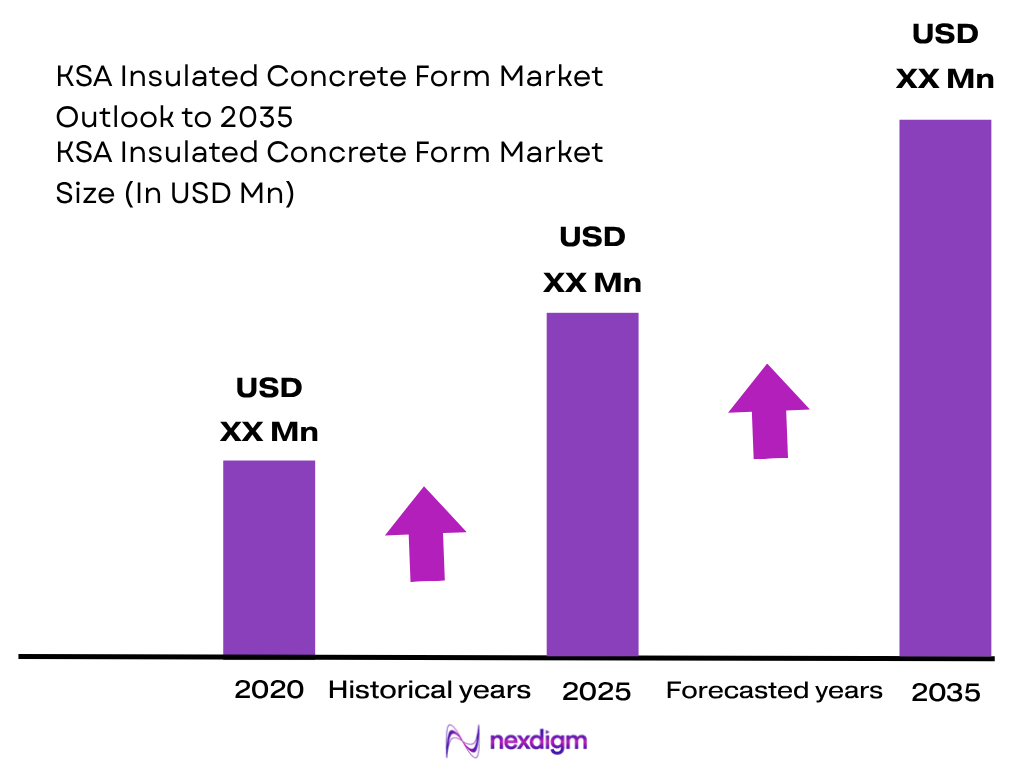
The KSA Insulated Concrete Form Market is valued at approximately USD ~ million, based on historical ICF system adoption and construction activity. Housing demand is supported by NHC, which offered about 70,000 units across 163 projects in the latest period and delivered about 23,000 units, compared with a lower delivery base in the preceding period. Saudi Arabia’s Housing Program additionally recorded more than 61,000 NHC units launched and over 22,000 units delivered, creating an addressable pipeline for insulated structural wall technologies.
Riyadh, Jeddah, Dammam-Al Khobar, Al Ahsa and major development corridors in Makkah and Madinah constitute the principal KSA ICF demand clusters because they combine housing communities, commercial construction, local EPS processing and modern-construction suppliers. Riyadh recorded 24,304 building permits in the preceding construction dataset, while Makkah recorded 18,464 permits. The latest housing cycle also expanded NHC’s portfolio to 17 residential destinations, including newly launched destinations in Makkah and Madinah, reinforcing geographically concentrated demand for industrialised wall construction.
Market Segmentation
By Formwork Architecture
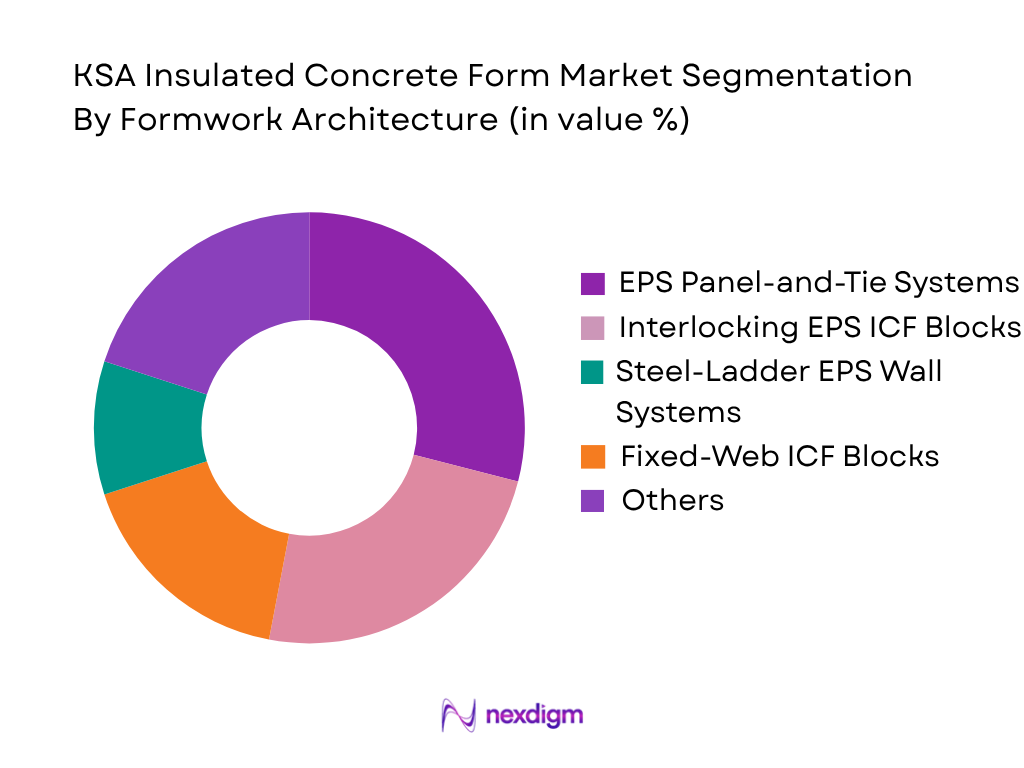
The KSA Insulated Concrete Form Market is segmented into interlocking EPS blocks, EPS panel-and-tie systems, steel-ladder EPS wall systems, fixed-web forms, folding-web forms, variable-width systems and precast ICF. EPS panel-and-tie and steel-connected permanent formwork collectively represent the strongest market position, with EPS panel-and-tie systems allocated the largest individual share. Their suitability is reinforced by Saudi manufacturers already producing panel-based systems designed around reinforced concrete and permanent thermal insulation. Plastbau Arabia’s E-Wall, for example, uses two EPS boards connected by vertical steel ladders, while Al Rayyan manufactures high-density EPS forms using two 60 mm EPS panels surrounding a reinforced-concrete cavity. These systems fit Saudi construction practices because contractors retain familiar reinforced-concrete structural design while eliminating separate masonry and insulation stages. High cooling loads also make continuous external and internal insulation particularly relevant. Interlocking blocks remain important for villas and smaller developments, whereas precast ICF is developing around suppliers such as Al-Maskan targeting repeat residential construction and factory-controlled building systems.
By Building Type
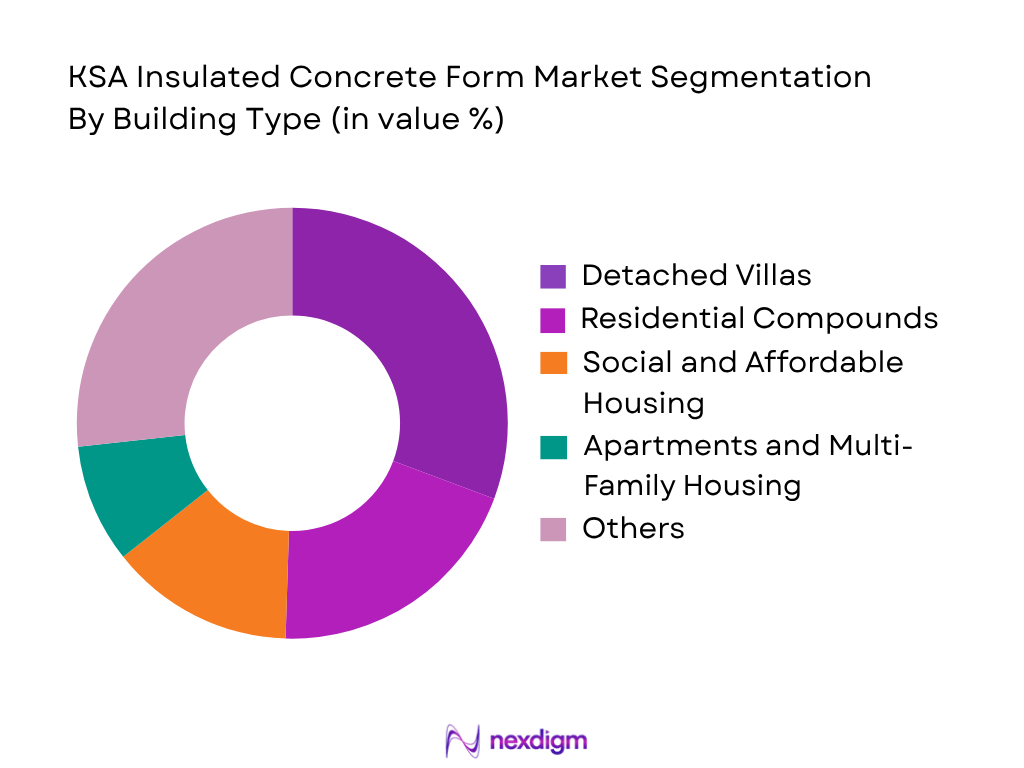
The KSA Insulated Concrete Form Market is segmented into detached villas, residential compounds, apartments, social and affordable housing, hospitality buildings, commercial facilities, educational and healthcare buildings, industrial facilities and government buildings. Detached villas hold the dominant report-model share, supported by Saudi Arabia’s large villa-oriented residential development ecosystem and the suitability of ICF for repetitive low-rise load-bearing walls. Housing Program activity reinforces this application base: NHC launched more than 61,000 housing units, sold more than 27,000 units, offered over 24,000 units and delivered more than 22,000 units during the latest reported cycle. Across the wider housing system, more than 49,000 contracts for ready units, around 16,000 self-construction contracts and over 27,000 off-plan contracts were signed. Villas allow developers to exploit ICF’s thermal continuity, reduced wet trades and combined structural-and-insulation functionality without the engineering complexity associated with high-rise towers. Residential compounds and government-supported communities constitute the next significant opportunity because standardised house designs improve repeat installation economics.
Competitive Landscape
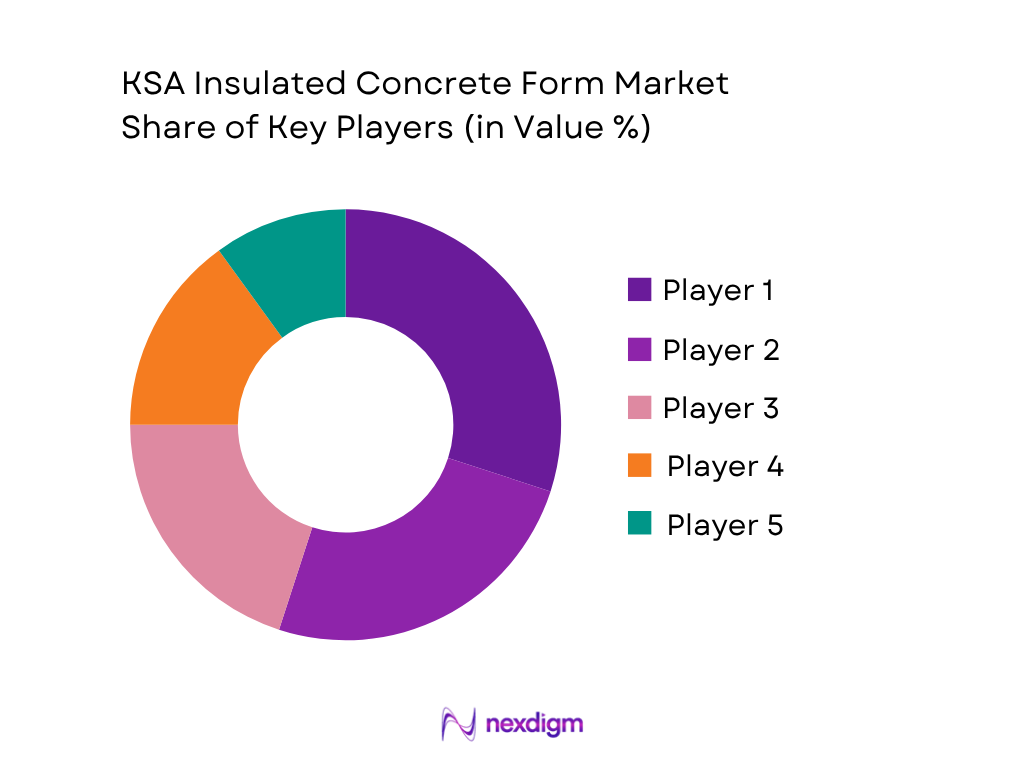
The KSA Insulated Concrete Form Market has a meaningful domestic manufacturing base, differentiating it from markets reliant primarily on imported North American or European ICF systems. Local competition includes Plastbau Arabia, Arabian Expanded Insulation Company, Building Technology Factory, Al-Maskan and Al Rayyan Building Insulation Industry. Competitive strength increasingly depends on local EPS moulding, Saudi-climate adaptation, structural-engineering support, installation capability and compatibility with the Ministry of Municipalities and Housing’s modern-construction framework. The official Modern Construction platform specifically recognizes ICF as a permanent EPS-based formwork technology for walls, floors and ceilings.
| Major Player | Establishment Year | Headquarters / Manufacturing Base | ICF System Architecture | EPS / Insulation Capability | Structural Configuration | Saudi Manufacturing | Application Coverage | Technical / Installation Capability |
| Plastbau Arabia Ltd. Co. | 2005 | Dammam, Eastern Province | ~ | ~ | ~ | ~ | ~ | ~ |
| Building Technology Factory | 2019 | Sudair Industrial and Business City, Riyadh | ~ | ~ | ~ | ~ | ~ | ~ |
| Al-Maskan | 1998 | Saudi Arabia | ~ | ~ | ~ | ~ | ~ | ~ |
| Al Rayyan Building Insulation Industry | Not Publicly Disclosed | Al Ahsa | ~ | ~ | ~ | ~ | ~ | ~ |
| Rawas Al-Diyar Chemicals Factory | 2017 | Saudi Arabia | ~ | ~ | ~ | ~ | ~ | ~ |
KSA Insulated Concrete Form Market Analysis
Growth Drivers
Expansion of Large-Scale Residential and Master-Planned Housing Construction
Saudi Arabia’s expanding residential pipeline is a direct growth driver for the KSA Insulated Concrete Form Market, because ICF systems are suited to repetitive villas, townhouses, and low-rise housing where structural concrete and insulation can be integrated into one permanent wall assembly. NHC launched more than 61,000 housing units in 2024, delivered more than 22,000 units, offered more than 24,000 units, and sold more than 27,000 units across 25 housing destinations. NHC also signed 31 development agreements with 23 developers covering 62,000 housing units during 2024. Al-Fursan destination in Riyadh extends across more than 35 million square metres, incorporates more than 50,000 housing units, and has capacity for more than 250,000 residents, demonstrating the scale at which standardized ICF blocks, reinforcement arrangements, and concrete-placement procedures can be repeated. Such developments support localized EPS moulding, installer specialization, and design standardization. Saudi Arabia’s 2024 macroeconomic base further supports construction technology investment, with GDP recorded at USD 1,239.8 billion and GDP per capita at USD 35,121.7, providing substantial economic capacity for industrialized and higher-performance residential building systems.
Government Recognition of ICF and Development of Thermally Integrated Wall Systems
Formal recognition of insulated concrete forms within Saudi Arabia’s modern-construction ecosystem supports the KSA Insulated Concrete Form Market by reducing specification barriers for developers, engineers, contractors, and housing-program participants. The national Modern Construction platform recognizes permanent EPS formwork in multiple configurations, including blocks, wall panels, floor panels, and hordie elements, allowing ICF technology to address structural walls as well as broader building-envelope applications. Local technology providers have also adapted systems to Saudi climatic requirements. A registered Saudi ICF configuration uses two high-density EPS panels measuring 60 mm each, creating 120 mm of combined EPS layers around a cast-in-place reinforced-concrete cavity. This configuration directly addresses thermal bridging and cooling-load exposure while retaining reinforced-concrete structural principles familiar to Saudi contractors. Housing-sector scale creates a substantial application base: more than 61,000 NHC units were launched across 25 destinations during 2024, with more than 22,000 units delivered. Saudi Arabia’s GDP reached USD 1,239.8 billion in 2024, while GDP per capita stood at USD 35,121.7, supporting continued investment in industrialized construction, energy-efficient envelopes, domestic EPS processing, and specialized ICF installation capabilities.
Market Challenges
Strong Competition from Established Masonry, Conventional Formwork and Insulated Precast Systems
The KSA Insulated Concrete Form Market faces significant substitution pressure from masonry, conventional reinforced-concrete formwork, insulated precast panels, and other established construction methods already embedded in contractor procurement and engineering practices. This challenge becomes more important as project scale increases. NHC launched more than 61,000 housing units and delivered more than 22,000 units across 25 housing destinations during 2024, while 31 development agreements involving 23 developers covered another 62,000 housing units. Developers executing projects at this scale require standardized structural details, dependable material availability, trained crews, repetitive quality control, and predictable construction sequencing before replacing familiar wall technologies. Insulated precast systems create particularly direct competition because Saudi Arabia’s Modern Construction framework recognizes factory-produced sandwich panels incorporating structural concrete and EPS insulation for residential, commercial, governmental, and educational applications. Consequently, ICF must prove advantages not only against concrete blocks but also against industrialized insulated structural alternatives. Saudi Arabia’s economic scale intensifies this competitive environment: 2024 GDP reached USD 1,239.8 billion, while GDP per capita reached USD 35,121.7. The size of the construction economy supports technology investment but also creates procurement inertia around already-qualified systems, contractors, and established building methods.
Specialized Installation, Reinforcement and Concrete-Pour Execution Requirements
Specialized execution requirements remain a major challenge for the KSA Insulated Concrete Form Market, because successful ICF construction depends on alignment, temporary bracing, reinforcement placement, tie integrity, concrete sequencing, openings, MEP penetrations, and finishing interfaces being coordinated within one wall system. Current Saudi ICF configurations demonstrate this technical complexity. One locally registered system uses two 60 mm high-density EPS panels connected by rigid ties around a reinforced-concrete cavity, requiring installers to simultaneously control insulation geometry, structural reinforcement, and concrete placement. Saudi panel-based systems also use steel-connected EPS assemblies, meaning incorrect pour sequencing or alignment can compromise wall geometry before concrete hardening. This requirement becomes more significant when deployment moves from individual villas to standardized housing communities. NHC launched more than 61,000 units across 25 destinations and delivered more than 22,000 units during 2024, indicating the installation consistency required for ICF to penetrate mainstream housing programs. The Al-Asalah project alone covers more than 592,000 square metres and includes 670 residential units. Saudi Arabia’s 2024 GDP of USD 1,239.8 billion and GDP per capita of USD 35,121.7 support construction investment, but large-scale developers correspondingly require rigorous technical documentation, contractor training, structural engineering, and site supervision before adopting specialized wall systems.
Market Opportunities
Standardized ICF Deployment Across Master-Planned Housing Communities
Large master-planned residential developments represent a major future growth opportunity for the KSA Insulated Concrete Form Market, because repeated villa and townhouse designs allow suppliers to standardize moulds, corner blocks, wall dimensions, reinforcement schedules, concrete-placement procedures, and installer training across multiple construction phases. Current activity already provides a substantial commercialization platform without relying on future projections. NHC launched more than 61,000 housing units in 2024, offered more than 24,000 units, sold more than 27,000 units, and delivered more than 22,000 units across 25 housing destinations. During the same period, NHC entered 31 development agreements with 23 developers covering 62,000 housing units. Al-Fursan in Riyadh spans more than 35 million square metres and provides more than 50,000 units, while Al-Asalah covers more than 592,000 square metres and provides 670 units. These large repetitive communities can support dedicated ICF production runs, predictable EPS consumption, specialized installation teams, and standardized engineering documentation. Saudi Arabia’s 2024 GDP reached USD 1,239.8 billion, with GDP per capita at USD 35,121.7, providing the macroeconomic capacity necessary for developers and construction-system manufacturers to invest in scalable industrialized wall technologies and localized production infrastructure.
Localization of EPS Formwork, Components and Integrated ICF Building Systems
Localization represents a strong future opportunity for the KSA Insulated Concrete Form Market, because Saudi Arabia already possesses government-recognized ICF technology, domestic EPS processing capabilities, and locally configured structural wall systems that can be expanded into broader manufacturing ecosystems. The Modern Construction platform recognizes 4 principal ICF product configurations—blocks, wall panels, floor panels, and hordie elements—providing manufacturers with multiple routes beyond conventional wall-only systems. A Saudi technology provider currently manufactures ICF using 2 high-density EPS panels of 60 mm each, creating 120 mm of combined EPS insulation around reinforced concrete. This technical base can support localization of mould tooling, polymer ties, steel connectors, specialty EPS grades, corner forms, floor systems, and installation services. Current housing activity provides the required demand platform: NHC launched more than 61,000 housing units across 25 residential destinations during 2024 and signed 31 agreements with 23 developers covering 62,000 units. Localized manufacturing can consequently be aligned with repeat project schedules rather than isolated imported-system procurement. Saudi Arabia’s 2024 GDP of USD 1,239.8 billion and GDP per capita of USD 35,121.7 further strengthen the investment environment for domestic industrialized construction capacity, manufacturing automation, technical-engineering services, and integrated design-supply-install ICF solutions.
Future Outlook
The KSA Insulated Concrete Form Market is forecast to expand at approximately ~XX% CAGR during 2026–2035, supported by residential development, construction industrialisation, thermal-performance requirements and localisation of modern building technologies. The market is expected to move beyond isolated villa applications toward repeat housing communities, institutional structures, hospitality developments and integrated wall-and-roof systems.
Saudi Arabia already has a comparatively developed local ICF ecosystem. The Ministry of Municipalities and Housing defines ICF within its Modern Construction framework as permanent EPS formwork suitable for walls, floors and ceilings, including block, wall-panel, floor-panel and hordie configurations. The Ministry identifies construction speed, labour productivity, thermal performance and structural durability among the technology’s principal attributes. This formal inclusion lowers the technology-awareness barrier that often restricts ICF adoption in emerging markets. Housing construction provides the largest prospective volume platform. The Housing Program recorded more than 13,000 land-product contracts, around 16,000 self-construction contracts, more than 49,000 ready-unit contracts and over 27,000 off-plan contracts during 2024. NHC simultaneously launched more than 61,000 units and developed 25 housing destinations, creating repeatable project environments where standardised ICF wall systems, mould configurations and installation procedures can be deployed across multiple units.
Major Players
- Al Rayyan Building Insulation Industry / Gulf Walls System
- Plastbau Arabia Ltd. Co.
- Arabian Expanded Insulation Company (AEIDCO)
- Rawas Al-Diyar Chemicals Factory
- Building Technology Factory
- Modern Accomplishment Company / KOTO ICF
- Al-Maskan Factory
- Nudura
- Amvic Building System
- Fox Blocks
- BuildBlock Building Systems
- Quad-Lock Building Systems
- BEWI
- Element ICF
- SuperForm Products
Key Target Audience
- Insulated Concrete Form and EPS Building-System Manufacturers
- Residential Developers and Housebuilders
- Government Housing and Master Community Developers
- Main Contractors and Specialized ICF Installation Contractors
- EPS, Ready-Mix Concrete, Reinforcement and Construction Material Manufacturers
- Architects, Structural Engineering Practices and Building-System Specifiers
- Investments and Venture Capitalist Firms
- Government and Regulatory Bodies (Ministry of Municipalities and Housing, Saudi Building Code National Committee, Saudi Standards, Metrology and Quality Organization, National Housing Company and Saudi Civil Defense)
Research Methodology
Step 1: Identification of Key Variables
The initial phase involves constructing an ecosystem map encompassing all major stakeholders within the KSA Insulated Concrete Form Market, including EPS manufacturers, ICF producers, polymer and steel connector suppliers, concrete companies, reinforcement suppliers, developers, contractors and government housing entities. Extensive desk research is used to identify critical variables such as ICF wall area, form architecture, EPS thickness, concrete-core configuration, domestic manufacturing capability, applications and project delivery models.
Step 2: Market Analysis and Construction
Historical market analysis combines top-down and bottom-up approaches to assess the KSA Insulated Concrete Form Market. The top-down assessment reviews villa construction, residential compounds, housing programs, hospitality assets, institutional buildings and industrial projects to establish the addressable wall-construction base. Bottom-up calculations assess manufacturer activity, EPS form output, installed wall area, concrete-core dimensions, project deployments, domestic supply capability and imported systems to construct and cross-check revenue and volume estimates.
Step 3: Hypothesis Validation and Expert Consultation
Market hypotheses are developed and validated through computer-assisted telephone interviews and direct consultations with ICF manufacturers, EPS processors, structural engineers, developers, main contractors, installers and concrete suppliers. Discussions examine formwork selection, reinforcement requirements, concrete pouring, Saudi climate performance, fire compliance, labour productivity, contractor familiarity and project acceptance. These consultations are used to validate assumptions regarding system penetration, preferred form architecture, domestic manufacturing competitiveness and adoption barriers across residential and non-residential applications.
Step 4: Research Synthesis and Final Output
The final phase integrates primary intelligence with Saudi housing statistics, construction activity, Modern Construction program information, company manufacturing data and technical system specifications. Bottom-up supplier and wall-area analysis is reconciled with top-down construction demand to reduce potential overstatement of ICF penetration. The resulting KSA Insulated Concrete Form Market model evaluates competitive positioning, domestic-versus-imported supply, application demand, thermal-performance requirements, production localisation and anticipated technology adoption to generate the final validated market outlook.

- Executive Summary
- Research Methodology (Market Definition and Scope, KSA Insulated Concrete Form Market Classification, ICF Wall System Demand Assessment, EPS Formwork Consumption Mapping, Reinforced Concrete Core Assessment, Domestic EPS and ICF Manufacturing Capacity Assessment, Import Dependency Analysis, EPS Resin and Polymer Feedstock Assessment, ICF Block and Panel Technology Mapping, Application-Level Demand Assessment, Building Type Demand Mapping, Primary Industry Interviews, Top-Down Market Sizing, Bottom-Up Company Revenue and ICF Wall Area Assessment, Trade Flow Analysis, Data Triangulation, Pricing Assessment, Forecasting Framework)a

- Definition and Scope
- KSA Insulated Concrete Form Industry Evolution and Development of EPS Permanent Formwork, Reinforced Concrete Wall Systems and Modern Construction Technology Ecosystem
- ICF Block, EPS Panel, Polymer Tie, Steel Connector, Reinforcement and Concrete Core Industry Structure
- KSA Insulated Concrete Form Value Chain Analysis
- KSA Insulated Concrete Form Supply Chain Analysis
- EPS Resin Supplier, EPS Moulder, ICF System Manufacturer, Polymer Tie and Steel Connector Supplier, Reinforcement Producer, Ready-Mix Concrete Supplier, Distributor, Structural Engineer, Installer, Contractor, Developer and End-User Ecosystem Analysis
- Insulated Concrete Form Integration Across Villas, Residential Compounds, Apartments, Social Housing, Hospitality, Commercial, Educational, Healthcare, Industrial and Government Buildings

- Growth Drivers (Expansion of Villa and Residential Construction, Housing Program Development, Modern Methods of Construction Adoption, Saudi Building Code Thermal Requirements, High Cooling-Energy Demand, Domestic EPS Manufacturing Capability, Faster Structural Wall Construction, Labour Productivity Requirements, Demand for Airtight and Thermally Insulated Building Envelopes)
- Market Challenges (Entrenched Concrete Block and Conventional Formwork Construction, Limited Specialized ICF Installer Base, Concrete Pour and Form Pressure Management, EPS Fire-Performance Perception, Technology Approval Requirements, Contractor Familiarity, Project-Specific Structural Engineering, Competition from Precast Concrete and AAC, Specialized Bracing Requirements)
- Market Opportunities (Domestic ICF Manufacturing Expansion, Saudi Climate-Optimized ICF Blocks, Large-Scale Housing Programs, Villa and Residential Compound Applications, Government Housing Projects, High-Performance Building Envelopes, Precast ICF Integration, Integrated Wall-and-Deck Systems, Local Polymer Tie Production, Mega-Project Accommodation, Automated EPS Moulding, Imported ICF Technology Localization)
- Market Trends (Localization of Modern Construction Technologies, Flame-Retardant EPS Adoption, Integrated ICF Wall-and-Roof Systems, Precast ICF Development, Higher Thermal Resistance, Reduced Thermal Bridging, Monolithic Reinforced Concrete Construction, Contractor Training, Design-Supply-Install Models, Domestic EPS Processing, Integrated Structural and Thermal Wall Systems)
- Regulatory and Standards Landscape (Saudi Building Code Energy Conservation Requirements, Saudi Building Code Structural Concrete Requirements, Saudi Building Code Fire Protection Requirements, Ministry of Municipalities and Housing Modern Construction Technology Requirements, SASO Thermal Insulation Standards, EPS Product Conformity Requirements, Civil Defense Fire Safety Requirements, Building Permit Compliance, Saudi Green Building Requirements)
- SWOT Analysis
- Porter’s Five Forces Analysis
- PESTLE Analysis
- Stakeholder Ecosystem
- Competition Ecosystem

- By Market Value (2020-2025)
- By ICF Wall Area Installed (2020-2025)
- By ICF Block and Panel Consumption Volume (2020-2025)
- By Domestic ICF Production Value (2020-2025)
- By Domestic ICF Production Volume (2020-2025)
- By ICF System Import Value (2020-2025)
- By ICF System Import Volume (2020-2025)
- By Average Selling Price (2020-2025)

- By Formwork Architecture (In Value %)
Interlocking EPS ICF Blocks
EPS Panel-and-Tie Systems
Steel-Ladder EPS Wall Systems
Fixed-Web ICF Blocks
Folding-Web ICF Systems
Variable-Width ICF Panel Systems
Precast Insulated Concrete Form Systems
Hybrid and Specialty ICF Systems - By Insulation Material (In Value %)
Standard Expanded Polystyrene
High-Density Expanded Polystyrene
Graphite-Enhanced Expanded Polystyrene
Flame-Retardant Expanded Polystyrene
Recycled-Content Expanded Polystyrene
XPS-Integrated Permanent Formwork
Hybrid EPS and High-Performance Insulation Systems
Other Insulated Permanent Formwork Materials - By Application Type (In Value %)
External Structural Walls
Internal Load-Bearing Walls
Foundations
Basement Walls
Retaining Walls
Roof and Deck Systems
Swimming Pool Structures
Boundary and Perimeter Walls
Industrial Building Enclosures
Government and Institutional Structures
Hospitality and Resort Structures
Other Reinforced Concrete Applications - By Building Type (In Value %)
Detached Villas
Residential Compounds
Apartments and Multi-Family Housing
Social and Affordable Housing
Hotels and Resorts
Commercial and Mixed-Use Buildings
Educational Buildings
Healthcare Facilities
Industrial and Logistics Buildings
Government and Institutional Buildings
Mega-Project Residential and Accommodation Assets
Other Building Applications - By Distribution and Project Delivery Model (In Value %)
Direct Manufacturer Supply
Authorized ICF Distributor
Construction Material Distributor
Contractor-Led Procurement
Developer Direct Procurement
Design-Supply-Install Packages
Government and Housing Program Procurement
Main Contractor and EPC Procurement

- Market Share of Major Players (By KSA Revenue, ICF Wall Area, Domestic Production Volume, Formwork Architecture, EPS Configuration, Concrete Core Width, Building Type, KSA Manufacturing and Project Supply Footprint)
- Cross Comparison Parameters (KSA ICF Revenue, Domestic ICF and EPS Manufacturing Capability, ICF Block Panel and Precast Architecture Breadth, EPS Thickness Density and Thermal Performance Capability, Concrete Core Width and Structural Configuration Flexibility, Saudi Building Code and Modern Construction Technology Approval Coverage, KSA Project Supply Manufacturing and Installer Footprint, Structural Design Contractor Training and On-Site Technical Support Capability)
- SWOT Analysis of Major Players
- Competitive Positioning Matrix
- ICF Block, Panel and Precast System Portfolio Benchmarking
- Pricing and ICF System Category Benchmarking
- Domestic Manufacturing, EPS Moulding and Structural System Technology Assessment
- Building Type and Customer Application Exposure Assessment
- Domestic Manufacturing Versus Imported ICF Supply Positioning
- Detailed Profiles of Major Companies
Al Rayyan Building Insulation Industry / Gulf Walls System
Plastbau Arabia Ltd. Co.
Arabian Expanded Insulation Company
Rawas Al-Diyar Chemicals Factory
Building Technology Factory
Modern Accomplishment Company / KOTO ICF
Al-Mskn Factory
Nudura
Amvic Building System
Fox Blocks
BuildBlock Building Systems
Quad-Lock Building Systems
BEWI
Element ICF
SuperForm Products

- Residential Developer ICF Procurement Assessment
- Government and Affordable Housing ICF Requirement Analysis
- Mega-Project Developer Insulated Concrete Form Application Assessment
- Villa Builder and Private Developer ICF Requirement Analysis
- Hospitality and Resort Developer ICF Assessment
- Industrial and Logistics Developer Insulated Wall Requirement Analysis
- Architect and Design Consultant ICF Specification Assessment
- Structural Engineer Concrete Core and Reinforcement Assessment
- Main Contractor ICF Procurement and Installation Analysis
- Specialized ICF Installer Technical Requirement Assessment

- By Market Value (2026-2035)
- By ICF Wall Area Installed (2026-2035)
- By ICF Block and Panel Consumption Volume (2026-2035)
- By Domestic ICF Production Value (2026-2035)
- By Domestic ICF Production Volume (2026-2035)
- By ICF System Import Value (2026-2035)
- By ICF System Import Volume (2026-2035)
- By Average Selling Price (2026-2035)


 Request a Sample
 Ask for Customization
 Get a Quote
 Enquire Now