

 Download PDF
Market Overview
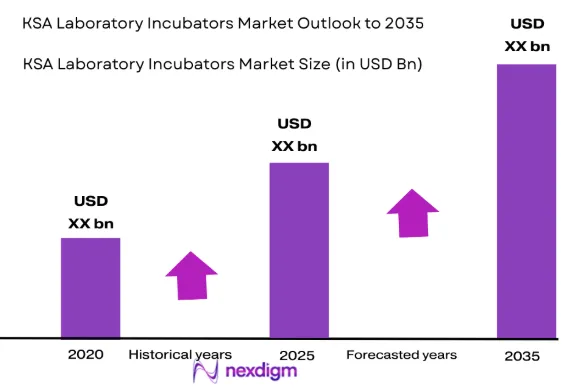
The KSA laboratory incubators market demonstrates a steady valuation supported by increasing healthcare and life sciences investments, with the market size estimated at approximately USD ~ billion based on a recent historical assessment derived from procurement data and industry financial disclosures. Growth is driven by rising demand for controlled laboratory environments in diagnostics, pharmaceuticals, and biotechnology sectors. Expansion of clinical testing infrastructure and government-backed healthcare modernization initiatives further contribute to consistent equipment procurement across both public and private laboratories.
Riyadh, Jeddah, and Dammam represent the most dominant urban centers in the KSA laboratory incubators market due to their concentration of advanced healthcare facilities, research institutions, and pharmaceutical companies. Riyadh leads with strong government-backed medical cities and research hubs, while Jeddah benefits from private healthcare expansion and port-based logistics advantages. Dammam’s industrial ecosystem supports biotech and petrochemical research activities, creating sustained demand for laboratory incubation systems across both academic and commercial applications.
Market Segmentation
By System Type
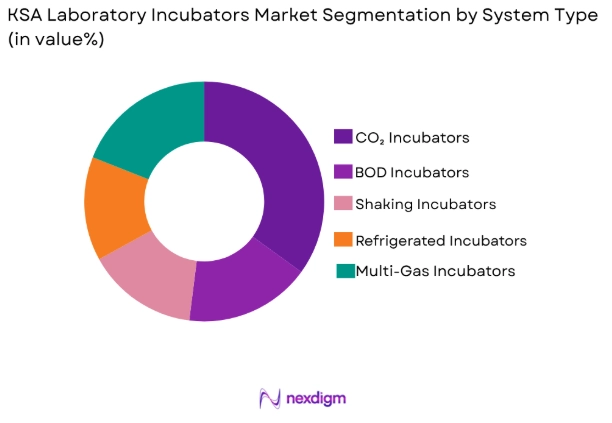
KSA laboratory incubators market is segmented by system type into CO₂ incubators, BOD incubators, shaking incubators, refrigerated incubators, and multi-gas incubators. Recently, CO₂ incubators have a dominant market share due to factors such as increasing demand for advanced cell culture applications, rising investments in biotechnology and pharmaceutical research, and the expansion of clinical laboratories requiring precise environmental control. These systems are widely used in tissue engineering, cancer research, and microbiology studies, making them essential across major healthcare and research facilities in Saudi Arabia where high-performance laboratory infrastructure is continuously expanding.
By End User Type
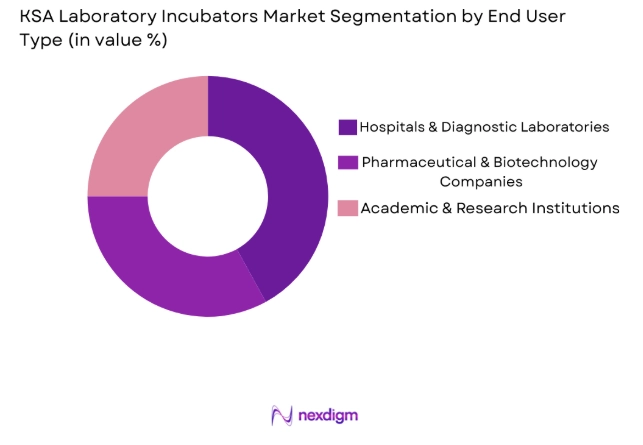
KSA laboratory incubators market is segmented by end user segment into hospitals & diagnostic laboratories, pharmaceutical & biotechnology companies, and academic & research institutions. Recently, hospitals & diagnostic laboratories have a dominant market share due to increased diagnostic testing volumes, expansion of clinical laboratory networks, and government initiatives to enhance healthcare accessibility. These facilities require consistent and reliable incubation systems for microbiological testing and sample analysis, leading to continuous procurement and replacement demand, particularly in urban healthcare clusters with advanced diagnostic capabilities.
Competitive Landscape
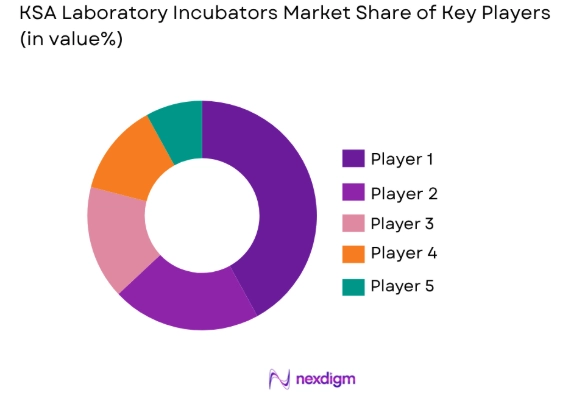
The KSA laboratory incubators market is moderately consolidated, with a mix of global manufacturers and regional distributors shaping competition. Major international players dominate through advanced technology offerings, strong distribution networks, and established brand credibility. Local partnerships and service capabilities influence procurement decisions, particularly in government-funded projects. Companies are increasingly focusing on smart incubator technologies, energy efficiency, and after-sales support to strengthen their market position.
| Company Name | Establishment Year | Headquarters | Technology Focus | Market Reach | Key Products | Revenue | Automation Capability |
| Thermo Fisher Scientific Inc. | 1956 | USA | ~ | ~ | ~ | ~ | ~1 |
| Eppendorf AG | 1945 | Germany | ~ | ~ | ~ | ~ | ~ |
| PHC Holdings Corporation | 1969 | Japan | ~ | ~ | ~ | ~ | ~ |
| Binder GmbH | 1985 | Germany | ~ | ~ | ~ | ~ | ~ |
| Memmert GmbH + Co. KG | 1947 | Germany | ~ | ~ | ~ | ~ | ~ |
KSA Laboratory Incubators Market Analysis
Growth Drivers
Expansion of Biopharmaceutical and Biotechnology Research Infrastructure
The rapid expansion of biopharmaceutical and biotechnology research infrastructure in Saudi Arabia is a primary growth driver for the laboratory incubators market. Government-backed initiatives under national transformation programs are supporting the development of research hubs and innovation centers. This has led to increased procurement of advanced laboratory equipment, including incubators for cell culture and microbiological applications. Pharmaceutical companies are expanding their R&D capabilities to localize drug development and manufacturing. The presence of international collaborations is further accelerating technology adoption. Increased funding for genomic research and vaccine development is also contributing to equipment demand. Hospitals are integrating research capabilities into clinical environments, increasing incubator usage. This growing ecosystem is creating sustained demand for high-performance and automated incubation systems.
Rising Demand for Advanced Diagnostic and Clinical Testing Facilities
The increasing demand for advanced diagnostic and clinical testing facilities is significantly driving the adoption of laboratory incubators across Saudi Arabia. The expansion of private healthcare providers and diagnostic chains has resulted in higher testing volumes. Laboratories require precise incubation systems for microbiological and pathological analysis. Government investments in healthcare infrastructure are improving accessibility and quality of diagnostic services. The growing prevalence of chronic and infectious diseases is further increasing laboratory workloads. Automation in diagnostic labs is enhancing efficiency and driving demand for technologically advanced incubators. Continuous upgrades of laboratory equipment are being prioritized to meet international standards. This trend is expected to sustain long-term market growth.
Market Challenges
High Capital Investment and Operational Costs
The high capital investment required for advanced laboratory incubators presents a significant challenge in the KSA market. Premium incubators equipped with automation and monitoring features are often expensive, limiting adoption among smaller laboratories. Maintenance and calibration costs further add to the total cost of ownership. Budget constraints in certain healthcare facilities can delay procurement decisions. Import dependency increases costs due to logistics and tariffs. Fluctuations in currency exchange rates can also impact pricing structures. Limited availability of cost-effective alternatives restricts market penetration in smaller cities. These financial barriers can slow down overall market expansion despite increasing demand.
Dependence on Imported Technologies and Limited Local Manufacturing
The reliance on imported laboratory incubators and limited domestic manufacturing capabilities pose challenges for the KSA market. Most advanced systems are sourced from international manufacturers, leading to supply chain dependencies. Delays in procurement and installation can occur due to logistical complexities. Local distributors may face challenges in maintaining inventory levels. Lack of local production limits customization options for specific research needs. Technical support and servicing may depend on international expertise, increasing downtime risks. This dependence can also affect pricing competitiveness in the market. Developing local manufacturing capabilities remains a key challenge for long-term sustainability.
Opportunities
Adoption of Smart and IoT-Enabled Laboratory Equipment
The growing adoption of smart and IoT-enabled laboratory equipment presents a significant opportunity in the KSA laboratory incubators market. Advanced incubators with remote monitoring and data analytics capabilities are gaining traction. Laboratories are increasingly prioritizing efficiency and precision in operations. Integration with digital laboratory management systems enhances workflow optimization. These technologies reduce human error and improve reproducibility in experiments. Demand for connected devices is rising across research and clinical environments. Manufacturers focusing on smart solutions can gain a competitive advantage. This trend is expected to drive innovation and premium product adoption in the market.
Expansion of Private Healthcare and Diagnostic Networks
The expansion of private healthcare and diagnostic networks in Saudi Arabia offers substantial growth opportunities for laboratory incubator manufacturers. Private sector investments are increasing the number of diagnostic laboratories and specialized clinics. These facilities require modern laboratory infrastructure, including advanced incubation systems. Rising healthcare expenditure is supporting equipment upgrades and new installations. Partnerships between private providers and international healthcare organizations are enhancing service quality. The growing focus on preventive healthcare is increasing diagnostic testing volumes. This expansion is creating consistent demand for reliable and efficient laboratory incubators.
Future Outlook
The KSA laboratory incubators market is expected to witness steady growth over the next five years, supported by continuous investments in healthcare and life sciences infrastructure. Technological advancements such as smart monitoring systems and energy-efficient designs are likely to shape product innovation. Regulatory support for local manufacturing and research initiatives will further strengthen market development. Increasing demand from diagnostic laboratories and biotechnology sectors will remain a key growth driver.
Major Players
- ThermoFisher Scientific Inc.
- Eppendorf AG
- PHC Holdings Corporation
- Binder GmbH
- Memmert GmbH + Co. KG
- Panasonic Healthcare Co. Ltd.
- NuAire Inc.
- Sheldon Manufacturing Inc.
- Labnet International Inc.
- Carbolite Gero Ltd.
- Genlab Limited
- Jeio Tech Co. Ltd.
- Yamato Scientific Co. Ltd.
- FroilaboSAS
- Sheldon Manufacturing Saudi Arabia
Key Target Audience
- Pharmaceutical companies
- Biotechnology firms
- Private healthcare providers
- Diagnostic laboratory chains |
- Investments and venture capitalist firms
- Government and regulatory bodies
- Medical device distributors
Research Methodology
Step 1: Identification of Key Variables
Key variables such as demand drivers, pricing trends, and technological advancements are identified through secondary research. Industry reports and company disclosures are analyzed to establish baseline parameters. These variables form the foundation for market modeling.
Step 2: Market Analysis and Construction
Market data is structured using both top-down and bottom-up approaches. Historical data is validated and aligned with industry benchmarks. Segmentation analysis is conducted to ensure accurate representation of market dynamics.
Step 3: Hypothesis Validation and Expert Consultation
Findings are validated through consultations with industry experts, including manufacturers and distributors. Feedback is incorporated to refine assumptions and ensure data accuracy. Cross-verification strengthens the reliability of the analysis.
Step 4: Research Synthesis and Final Output
All validated data is synthesized into a comprehensive report. Analytical models are applied to generate insights and forecasts. Final outputs are reviewed for consistency, accuracy, and strategic relevance.

- Executive Summary
- Research Methodology (Definitions, Scope, Industry Assumptions, Market Sizing Approach, Primary & Secondary Research Framework, Data Collection & Verification Protocol, Analytic Models & Forecast Methodology, Limitations & Research Validity Checks)

- Market Definition and Scope
- Value Chain & Stakeholder Ecosystem
- Regulatory / Certification Landscape
- Sector Dynamics Affecting Demand
- Strategic Initiatives & Infrastructure Growth

- Growth Drivers
Rising investment in healthcare and life sciences infrastructure in Saudi Arabia
Expansion of pharmaceutical and biotechnology manufacturing facilities
Increasing demand for advanced cell culture and microbiology research - Market Challenges
High cost of advanced incubator systems and maintenance
Limited availability of skilled laboratory personnel
Dependence on imported laboratory equipment - Market Opportunities
Growth of local biotechnology startups and research hubs
Government initiatives under Vision 2030 for healthcare modernization
Increasing adoption of automation and smart laboratory technologies - Trends
Integration of IoT-enabled monitoring and control systems in incubators
Shift toward energy-efficient and eco-friendly laboratory equipment - Government Regulations
- SWOT Analysis
- Porter’s Five Forces

- By Market Value, 2020-2025
- By Installed Units, 2020-2025
- By Average System Price, 2020-2025
- By System Complexity Tier, 2020-2025

- By System Type (In Value%)
CO₂ Incubators
Refrigerated Incubators
BOD Incubators
Shaking Incubators
Dry Bath Incubators - By Platform Type (In Value%)
Benchtop Incubators
Floor-standing Incubators
Stackable Incubators
Portable Incubators
Modular Incubator Systems - By Fitment Type (In Value%)
Standalone Systems
Integrated Laboratory Systems
Custom-built Configurations
Retrofitted Systems - By End User Segment (In Value%)
Hospitals and Diagnostic Laboratories
Academic and Research Institutes
Pharmaceutical and Biotechnology Companies

- Market Share Analysis
- Cross Comparison Parameters (Product Portfolio Breadth, Technology Innovation, Pricing Strategy, Distribution Network Strength, After-Sales Service Capability, Regional Presence, Strategic Partnerships, Manufacturing Capability, Customization Flexibility, Energy Efficiency Standards, Automation & Smart Integration, Regulatory Compliance Certifications, Supply Chain Efficiency, Installation & Training Support, Warranty & Maintenance Programs)
- SWOT Analysis of Key Competitors
- Pricing & Procurement Analysis
- Key Players
Thermo Fisher Scientific Inc.
Eppendorf AG
Panasonic Healthcare Co., Ltd.
Binder GmbH
Memmert GmbH + Co. KG
PHC Holdings Corporation
NuAire Inc.
Labconco Corporation
Sheldon Manufacturing Inc.
Benchmark Scientific Inc.
Jeio Tech Co., Ltd.
BMT Medical Technology s.r.o.
Esco Lifesciences Group
Amerex Instruments Inc.
Genlab Limited

- Adoption trends in hospital-based diagnostic laboratories
- Usage patterns in academic and university research facilities
- Demand from pharmaceutical manufacturing and R&D units
- Emerging applications in biotechnology startups and clinical research organizations

- Forecast Market Value, 2026-2035
- Forecast Installed Units, 2026-2035
- Price Forecast by System Tier, 2026-2035
- Future Demand by Platform, 2026-2035


 Request a Sample
 Ask for Customization
 Get a Quote
 Enquire Now