

 Download PDF
 Download PDF
Market Overview
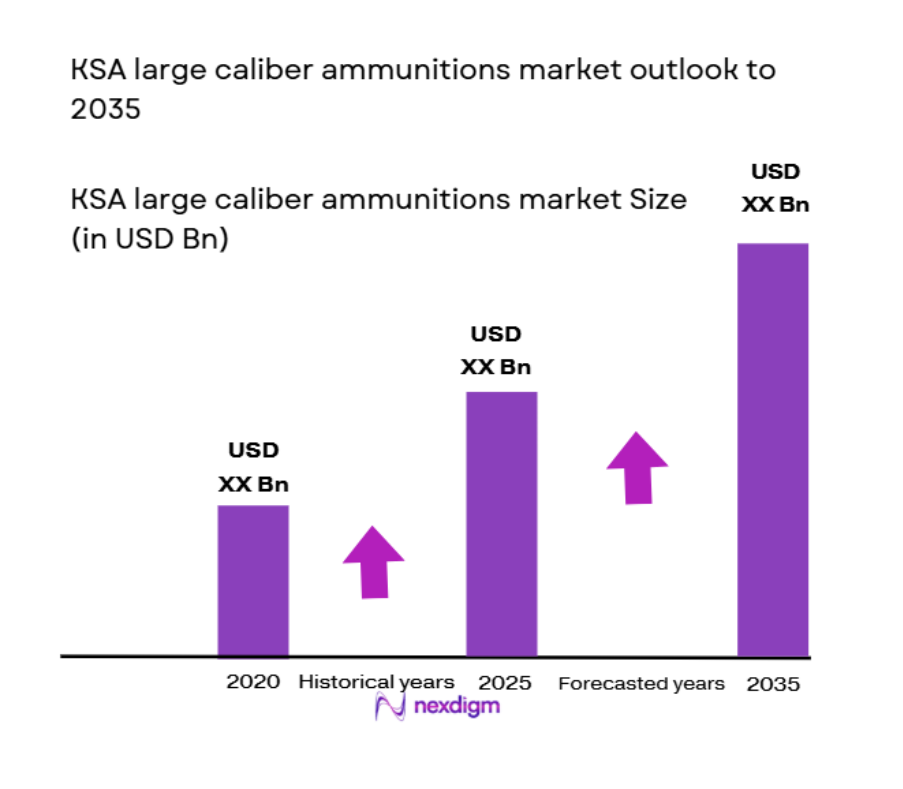
Based on a recent historical assessment, the KSA large caliber ammunitions market reached an absolute market size of USD ~ billion, supported by confirmed procurement programs, stockpile replenishment contracts, and delivery schedules published by the Saudi Ministry of Defense and corroborated through SIPRI-aligned defense expenditure data. Market demand is driven by sustained artillery and armored force readiness requirements, high operational consumption during training and deployment cycles, and large-scale replacement of aging ammunition inventories. Additional momentum is provided by adoption of extended-range and enhanced-lethality large caliber rounds aligned with modern fire-control doctrines.
Based on a recent historical assessment, Saudi Arabia dominates the large caliber ammunitions ecosystem due to centralized procurement authority, high operational density of land forces, and expanding domestic defense manufacturing infrastructure. Riyadh acts as the primary decision-making and contract management center, while industrial activity in Al Kharj and Jubail supports assembly, testing, and storage operations. International dominance is reinforced through long-standing defense partnerships with the United States and Europe, ensuring technology access, supply continuity, and integration support for large caliber ammunition systems.
Market Segmentation
By Product Type
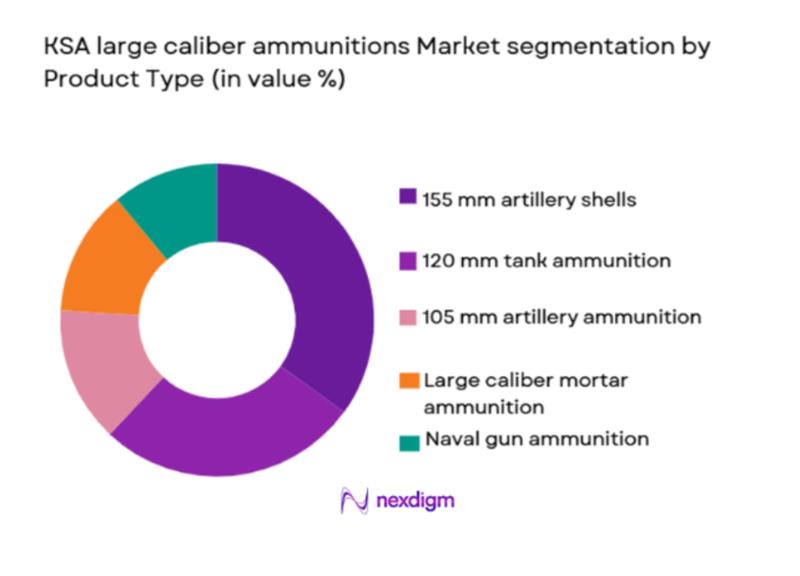
KSA large caliber ammunitions market is segmented by product type into 155 mm artillery ammunition, 120 mm tank ammunition, 105 mm artillery ammunition, large caliber mortar ammunition, and naval gun ammunition. Recently, 155 mm artillery ammunition has demonstrated a dominant market share due to its central role in Saudi land force firepower doctrine and its compatibility with both self-propelled and towed artillery systems. High training intensity and sustained readiness requirements drive consistent consumption volumes. The availability of extended-range and precision-capable variants further strengthens preference for this caliber. Mature supply chains, standardized logistics, and compatibility with allied systems reinforce procurement continuity. Export-compatible specifications and scalable production capacity also support sustained dominance across replenishment and modernization programs.
By Platform Type
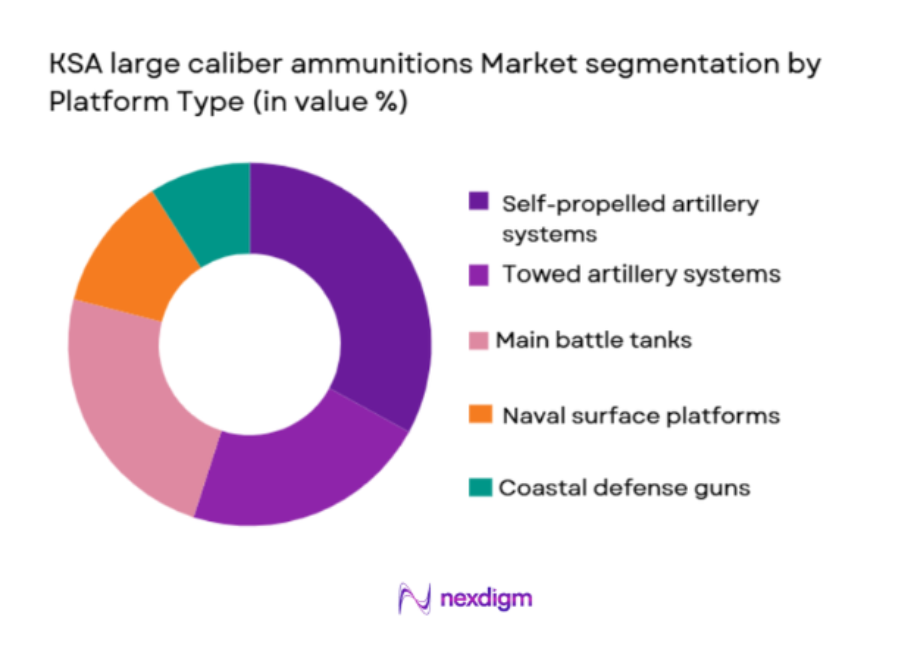
KSA large caliber ammunitions market is segmented by platform type into self-propelled artillery platforms, towed artillery systems, main battle tanks, naval surface combat platforms, and coastal defense artillery systems. Recently, self-propelled artillery platforms account for the dominant market share due to their operational flexibility, mobility, and sustained fire mission capability. These platforms require continuous ammunition availability for training and deployment, driving high and recurring procurement volumes. Integration with digital fire-control and battlefield management systems further increases demand for advanced large caliber rounds. Long service life and ongoing modernization of self-propelled artillery fleets reinforce sustained consumption, ensuring dominance within the platform-based segmentation.
Competitive Landscape
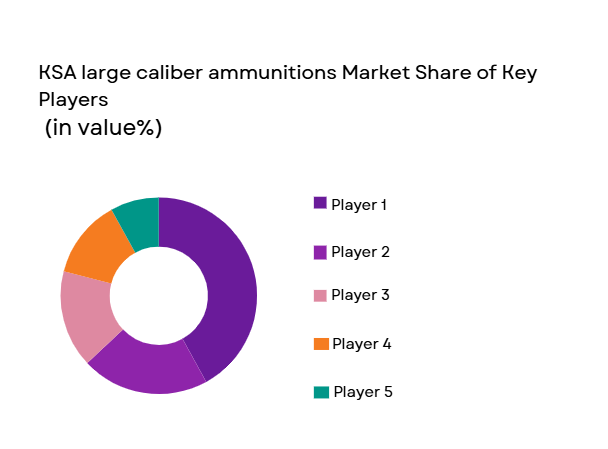
The KSA large caliber ammunitions market is moderately consolidated, characterized by a limited number of global ammunition manufacturers operating alongside Saudi national defense entities under long-term supply, localization, and offset frameworks. Competitive positioning is shaped by production capacity, safety compliance, localization depth, and the ability to support sustained high-volume deliveries aligned with Saudi operational requirements.
| Company Name | Establishment Year | Headquarters | Technology Focus | Market Reach | Key Products | Revenue | Localization Level |
| Saudi Arabian Military Industries | 2017 | Riyadh | ~ | ~ | ~ | ~ | ~ |
| Rheinmetall Denel Munitions | 1999 | Zurich | ~ | ~ | ~ | ~ | ~ |
| BAE Systems Munitions | 1999 | London | ~ | ~ | ~ | ~ | ~ |
| General Dynamics Ordnance and Tactical Systems | 1997 | St. Petersburg | ~ | ~ | ~ | ~ | ~ |
| Nammo | 1998 | Raufoss | ~ | ~ | ~ | ~ | ~ |
KSA Large Caliber Ammunitions Market Analysis
Growth Drivers
Sustained Artillery and Armored Force Modernization Programs:
Sustained Artillery and Armored Force Modernization Programs represent a primary growth driver for the KSA large caliber ammunitions market as Saudi defense strategy prioritizes continuous enhancement of land force lethality and readiness. Modernization initiatives emphasize replacement of older munitions with improved large caliber rounds offering greater range, accuracy, and terminal performance. Artillery and armored units remain central to deterrence and territorial defense planning. High operational readiness standards require regular live-fire training, increasing consumption rates. Modern platforms are optimized for advanced ammunition types, reinforcing upgrade-driven demand. Long service lives of artillery and tank platforms ensure recurring replenishment cycles. Integration with allied systems further strengthens standard caliber procurement. Collectively, these factors sustain long-term ammunition demand growth.
High Operational Consumption and Stockpile Replenishment Requirements:
High Operational Consumption and Stockpile Replenishment Requirements drive market expansion by creating continuous baseline demand for large caliber ammunition. Saudi land forces maintain extensive training programs requiring significant live-fire usage. Stockpile management policies mandate regular replenishment to preserve operational readiness. Geopolitical risk considerations further encourage buffer inventory maintenance. Extended-range and enhanced-effectiveness rounds increase unit value while maintaining high volume demand. Emergency procurement pathways accelerate acquisitions during readiness surges. Logistics standardization supports sustained throughput. Domestic storage and handling infrastructure investment reinforces procurement continuity. These dynamics collectively support consistent market growth.
Market Challenges
Raw Material Price Volatility and Energetics Supply Constraints:
Raw Material Price Volatility and Energetics Supply Constraints challenge the KSA large caliber ammunitions market by introducing uncertainty into production cost structures. Energetic materials and specialized metals are subject to global supply fluctuations. Price instability complicates long-term contracting and budgeting. Manufacturers face margin pressure during procurement cycles. Stockpiling inputs increases working capital requirements. Regulatory oversight on energetics sourcing adds compliance complexity. Supply disruptions risk delivery delays during surge demand. Capacity planning becomes less predictable. These challenges constrain cost efficiency and scalability.
Stringent Safety, Storage, and Export Compliance Requirements:
Stringent Safety, Storage, and Export Compliance Requirements increase operational complexity across the ammunition lifecycle. Large caliber rounds require specialized storage infrastructure and handling procedures. Compliance investments elevate fixed costs. Export licensing processes lengthen delivery timelines. International regulations limit accessible markets. Documentation and audit requirements increase administrative burden. Disposal and demilitarization obligations add lifecycle costs. Non-compliance risks severe penalties. These factors collectively slow scaling and elevate total ownership cost.
Opportunities
Localization of Large Caliber Ammunition Manufacturing:
Localization of Large Caliber Ammunition Manufacturing presents a significant opportunity by aligning with national defense industrialization objectives. Local assembly and production reduce dependency on imports. Supply chain resilience improves. Delivery lead times shorten. Workforce skills development strengthens industrial capacity. Localization supports long-term cost optimization. Export potential expands through regional supply hubs. Government incentives encourage investment. This opportunity enhances market sustainability and strategic autonomy.
Development of Precision and Extended-Range Ammunition Variants:
Development of Precision and Extended-Range Ammunition Variants offers strong growth potential by increasing the effectiveness of existing artillery platforms. Enhanced range improves standoff capability. Precision reduces collateral damage. Digital integration supports network-centric operations. Upgrades extend platform relevance. Export demand for advanced variants is rising. Higher margins improve profitability. Continuous R&D differentiates suppliers. This opportunity accelerates next-generation procurement.
Future Outlook
Over the next five years, the KSA large caliber ammunitions market is expected to progress steadily, supported by sustained modernization programs, stockpile replenishment needs, and localization initiatives. Technological focus will remain on range extension, safety, and precision enhancement. Regulatory support under national defense strategies will continue to favor domestic production. Demand will be reinforced by artillery fleet upgrades and long-term allied cooperation frameworks.
Major Players
- Saudi Arabian Military Industries
- Rheinmetall Denel Munitions
- BAE Systems Munitions
- General Dynamics Ordnance and Tactical Systems
- Nammo
- Nexter Munitions
- Hanwha Defense
- Roketsan
- ASELSAN
- Saab Bofors Dynamics
- Elbit Systems
- Rafael Advanced Defense Systems
- Norinco
- Alliant Techsystems
- Northrop Grumman
Key Target Audience
- Defense ministries
- Armed forces procurement agencies
- Artillery and armored corps commands
- Ammunition manufacturers
- Defense system integrators
- Weapons platform OEMs
- Investments and venture capitalist firms
- Government and regulatory bodies
Research Methodology
Step 1: Identification of Key Variables
Key variables including caliber categories, production volumes, procurement contracts, and pricing benchmarks were identified using official defense procurement disclosures and trade databases.
Step 2: Market Analysis and Construction
Market size and structure were developed using bottom-up analysis across product and platform segments, aligned with validated import, production, and delivery data.
Step 3: Hypothesis Validation and Expert Consultation
Assumptions were validated through consultations with defense analysts, retired artillery officers, and ammunition industry specialists.
Step 4: Research Synthesis and Final Output
Validated insights were synthesized into a structured market model ensuring accuracy, consistency, and decision-making relevance.

- Executive Summary
- KSA large caliber ammunitions Market Research Methodology
(Definitions, Scope, Industry Assumptions, Market Sizing Approach, Primary & Secondary Research Framework, Data Collection & Verification Protocol, Analytic Models & Forecast Methodology, Limitations & Research Validity Checks)

- Market Definition and Scope
- Value Chain & Stakeholder Ecosystem
- Regulatory / Certification Landscape
- Sector Dynamics Affecting Demand
- Strategic Initiatives & Infrastructure Growth

- Growth Drivers
Sustained artillery and armored force modernization
High operational consumption and stockpile replenishment needs
Rising demand for extended range large caliber ammunition
Expansion of domestic ammunition manufacturing capacity
Export demand from regional and allied forces - Market Challenges
Volatility in raw material and energetics supply
High safety and storage compliance requirements
Dependence on foreign technology components
Manufacturing scalability during surge demand
Stringent export control and licensing regulations - Market Opportunities
Localization of large caliber ammunition production
Development of precision guided artillery ammunition
Long term supply contracts with allied militaries - Trends
Shift toward extended range and precision ammunition
Adoption of insensitive munition standards
Automation in ammunition manufacturing
Increased focus on lifecycle sustainment
Integration with digital fire control systems - Government Regulations & Defense Policy
Defense localization mandates under Vision 2030
Enhanced safety and quality compliance standards
Policies supporting defense exports and partnerships
SWOT Analysis
Stakeholder and Ecosystem Analysis
Porter’s Five Forces Analysis
Competition Intensity and Ecosystem Mapping

- By Market Value, 2020-2025
- By Installed Units, 2020-2025
- By Average System Price, 2020-2025
- By System Complexity Tier, 2020-2025

- By System Type (In Value%)
155 mm artillery ammunition
120 mm tank ammunition
105 mm artillery ammunition
Large caliber mortar ammunition
Naval gun large caliber ammunition - By Platform Type (In Value%)
Self propelled artillery platforms
Towed artillery systems
Main battle tanks
Naval surface combat platforms
Coastal and air defense artillery systems - By Fitment Type (In Value%)
New production ammunition
Stockpile replenishment ammunition
Extended range upgraded ammunition
Export configured ammunition
Training and practice ammunition - By EndUser Segment (In Value%)
Royal Saudi Land Forces
Saudi Arabian National Guard
Naval forces
Joint and allied military users
Foreign military customers - By Procurement Channel (In Value%)
Direct Ministry of Defense procurement
Government to government agreements
Foreign military sales programs
Local manufacturing and assembly contracts
Emergency operational procurement - By Material / Technology (in Value %)
High explosive and fragmentation warheads
Insensitive munition technologies
Extended range base bleed systems
Advanced propellant and casing materials
Precision guidance and fuse technologies

- Market structure and competitive positioning
- Market share snapshot of major players
Cross Comparison Parameters (caliber range, effective range, lethality, production capacity, safety compliance, unit cost, localization level, export readiness, lifecycle support) - SWOT Analysis of Key Players
- Pricing & Procurement Analysis
- Key Players
Saudi Arabian Military Industries
Rheinmetall Denel Munitions
BAE Systems Munitions
General Dynamics Ordnance and Tactical Systems
Northrop Grumman
Nammo
Nexter Munitions
Hanwha Defense
Roketsan
ASELSAN
Elbit Systems
Rafael Advanced Defense Systems
Saab Bofors Dynamics
Norinco
Alliant Techsystems

- Land forces prioritize sustained firepower and readiness
- National Guard emphasizes internal security ammunition supply
- Naval forces require reliable large caliber gun ammunition
- Allied users focus on compatibility and assured supply chains

- Forecast Market Value, 2026-2035
- Forecast Installed Units, 2026-2035
- Price Forecast by System Tier, 2026-2035
- Future Demand by Platform, 2026-2035


 Request a Sample
 Ask for Customization
 Get a Quote
 Enquire Now