
 Download PDF
Market Overview
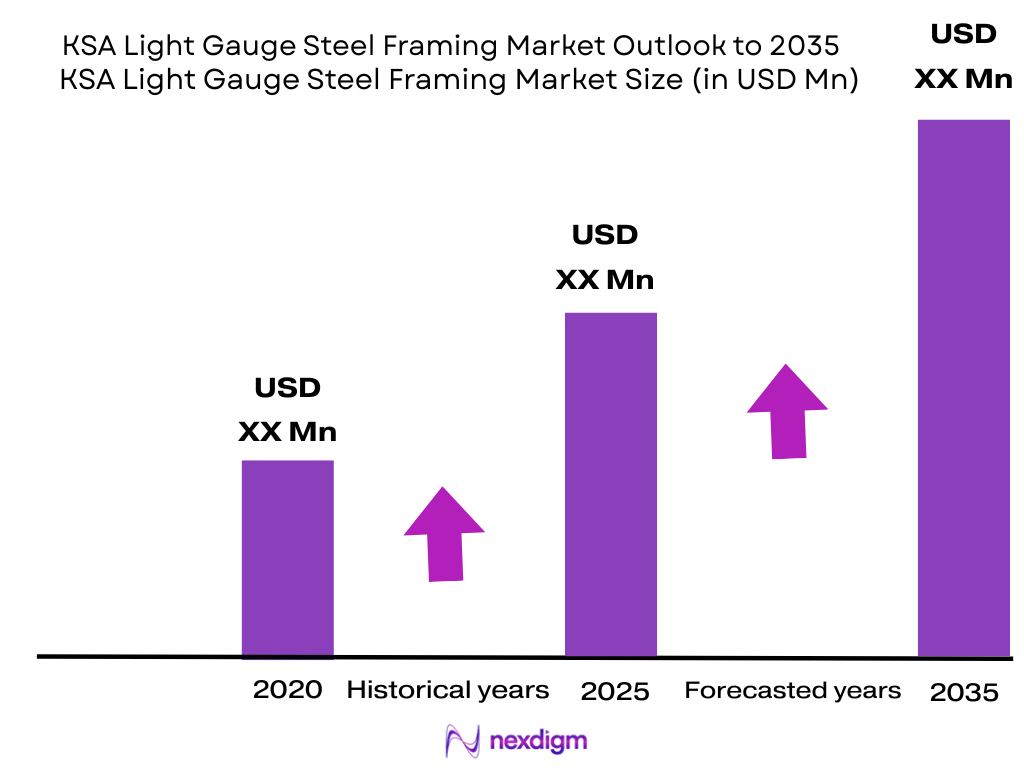
The KSA Light Gauge Steel Framing Market is valued at USD ~ million, supported by expanding residential construction, off-site building adoption and Vision 2030 development. Saudi Arabia’s updated GDP reached SAR 4.57 trillion in the preceding observation and SAR 4.65 trillion in the latest observation. Construction has become an increasingly important non-oil activity, while approximately 70,000 new housing units across 163 projects were offered through NHC, strengthening demand for rapid structural system. Riyadh, Jeddah, Dammam/Khobar and the major western-region development corridors dominate KSA Light Gauge Steel Framing demand because they concentrate residential communities, commercial construction, industrial facilities and Vision 2030 projects. Housing development expanded across 17 NHC residential destinations, while the latest annual cycle recorded approximately 23,000 housing-unit deliveries and more than 276,000 construction licenses nationwide. Riyadh additionally benefits from extensive urban development, while Jeddah and the Eastern Province combine housing, logistics and industrial-building requirements.
Market Segmentation
By Component Type
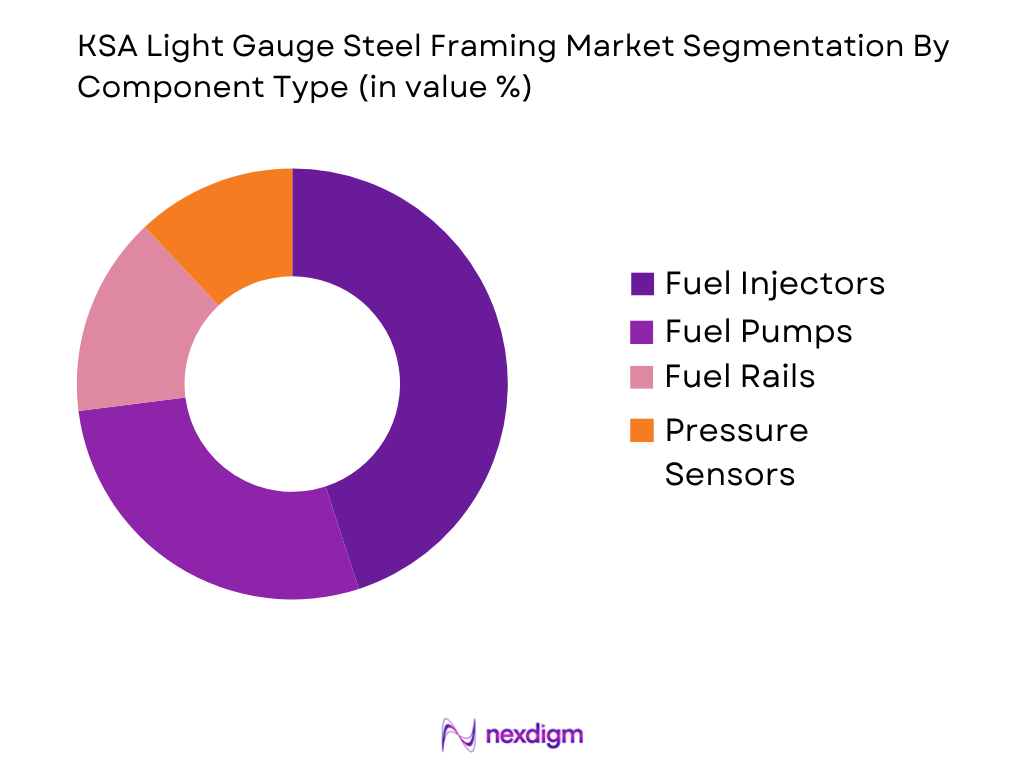
The KSA Light Gauge Steel Framing Market by component type is segmented into wall framing systems, floor framing systems, roof framing systems, structural studs and tracks, and bracing, connectors, and ancillary components. Wall framing systems are a major segment because LGS is widely used for load-bearing and non-load-bearing walls in villas, residential communities, modular buildings, commercial facilities, and workforce accommodation. Studs and tracks form the core structural framework, while floor and roof systems support faster dry construction, dimensional accuracy, and prefabricated assembly across Saudi projects.
By Framing Component
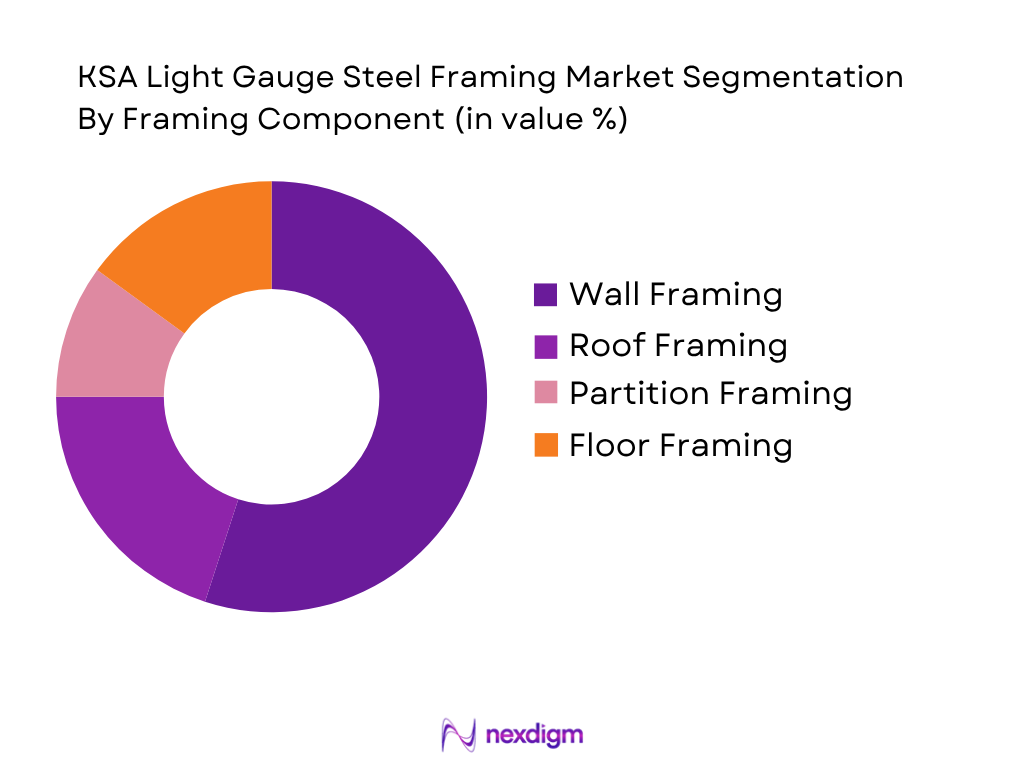
The KSA Light Gauge Steel Framing Market is segmented into wall framing systems, floor framing systems, roof framing systems, structural studs and tracks, and ancillary bracing/connectors. Wall framing systems represent the dominant sub-segment in the report model because external and internal load-bearing wall assemblies constitute a substantial portion of LGS material requirements in villas, modular accommodation, low-rise residential blocks and commercial structures. Cold-formed galvanized steel studs and tracks can be factory cut, punched and assembled into panels before delivery, reducing wet construction activities and supporting dimensional repeatability. Saudi Arabia has also established a dedicated regulatory framework for the technology through SBC 308 for the design of cold-formed steel members and SBC 309 for cold-formed steel light-frame construction. SBC 309 explicitly addresses structural-element design, installation and testing, giving engineered wall framing a formal compliance pathway for adoption in Saudi projects.
Competitive Landscape
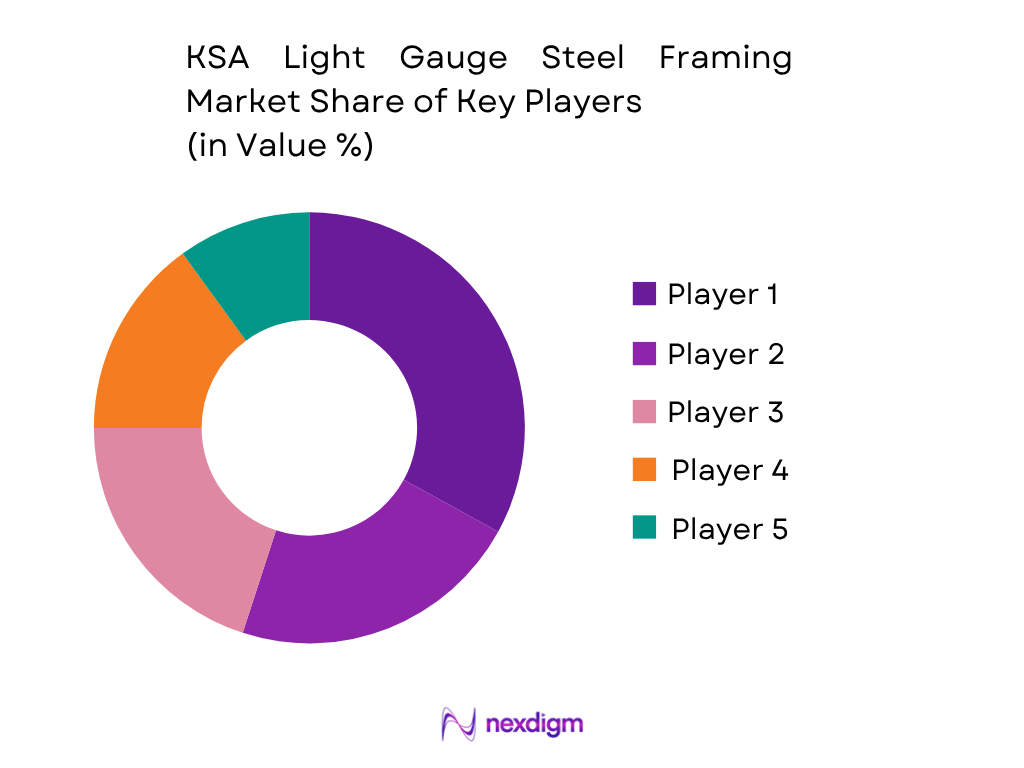
The KSA Light Gauge Steel Framing Market combines domestic steel and building-system companies with regional and international prefabrication specialists. Competition increasingly extends beyond supplying galvanized sections to providing engineering, BIM/design, roll-forming, panelization, modular integration, logistics and site erection. Saudi-specific capabilities are particularly important because systems must align with SBC 308, SBC 309 and applicable SASO building-material requirements. TSSC, for example, operates manufacturing facilities in Saudi Arabia and supplies steel structures and modular housing, while FRAMECAD identifies Saudi-based ISM Prefab as an LGS and modular construction specialist.
| Major Player | Establishment | Headquarters | LGS / Steel System Offering | Design & Engineering Capability | Prefabrication / Modular Capability | Saudi Market Presence | Key End-Use Exposure | Competitive Positioning |
| Zamil Steel | 1977 | Dammam, Saudi Arabia | ~ | ~ | ~ | ~ | ~ | ~ |
| TSSC | 1975 | Dubai, UAE | Cold-rolled steel framing and complete building systems | ~ | ~ | ~ | ~ | ~ |
| FRAMECAD | 1987 | Auckland, New Zealand | LGS design and roll-forming ecosystem | ~ | ~ | ~ | ~ | ~ |
| DORCE Prefabricated | 1982 | Ankara, Türkiye | Lightweight galvanized steel structures | ~ | ~ | ~ | ~ | ~ |
| Karmod | 1986 | Istanbul, Türkiye | Light-steel prefabricated buildings | ~ | ~ | ~ | ~ | ~ |
KSA Light Gauge Steel Framing Market Analysis
Growth Drivers
Large-Scale Housing and Urban Development Pipeline
Saudi Arabia’s expanding residential and mixed-use development pipeline is a major structural driver for light gauge steel framing because large housing programmes require construction systems capable of rapid, repetitive, factory-controlled deployment across villas, townhouses, apartments, worker accommodation and community facilities. GASTAT recorded a national population of 35,300,280 people in 2024, creating a substantial underlying requirement for housing and urban infrastructure. The IMF separately reported Saudi Arabia’s population at approximately 35.3 million people in 2024, while central-government revenue reached approximately SAR 1,172 billion in 2024, with IMF projections of SAR 1,184 billion in 2025 and SAR 1,177 billion in 2026. These fiscal resources support the wider infrastructure and urban-development ecosystem in which prefabricated framing technologies can participate. At the project level, National Housing Company developments demonstrate the construction scale available to suppliers. NHC’s Al-Dar development in Madinah covers more than 106,000 square metres and contains 1,092 residential units, while its Durrat Al-Madina development covers approximately 75,000 square metres and includes 694 units. NHC’s Jana community in Jeddah contains 1,662 residential units across a destination covering approximately 920,000 square metres. The company also operates residential developments across Riyadh, Jeddah, Makkah, Madinah, Dammam, Al Khobar, Al Hofuf, Taif, Tabuk, Buraidah, Unaizah and Khamis Mushait, broadening the geographical base for standardized construction systems. Light gauge steel framing is particularly relevant to this environment because cold-formed steel wall panels, floor systems and roof assemblies can be manufactured in controlled facilities and delivered in repeatable configurations, reducing dependence on entirely site-built structural processes. The technology also aligns with the need for dimensional accuracy when housing communities involve repeated building typologies. Saudi Arabia’s urban development therefore creates demand not only through the number of structures being built but through the industrialized manner in which large residential programmes increasingly need to be delivered, positioning LGS framing as a viable construction method for projects requiring repeatability, modular coordination and compressed erection schedules.
Expansion of Non-Oil Construction and PIF-Led Development Ecosystems
The second major growth driver is Saudi Arabia’s continued expansion of non-oil development programmes, particularly real estate, hospitality, entertainment, manufacturing and large destination projects that create demand for lightweight structural systems, internal framing, modular buildings and prefabricated construction. The Public Investment Fund currently reports more than USD 900 billion in assets under management, more than 220 portfolio companies, and a cumulative non-oil economic contribution exceeding USD 243 billion between 2021 and 2024. Its development ecosystem includes NEOM, Qiddiya, ROSHN, Diriyah and Red Sea Global, all of which create extensive requirements for buildings, support facilities, accommodation, retail structures and construction logistics. Qiddiya City alone extends across more than 360 square kilometres, illustrating the physical scale of development environments being established in the Kingdom. Saudi Arabia’s macroeconomic capacity supports this diversification programme: IMF figures show SAMA net foreign assets of approximately USD 415 billion in 2024, with projected balances of USD 419 billion in 2025 and USD 422 billion in 2026, providing a sizeable external financial buffer alongside public investment activity. PIF’s industrial strategy is also beginning to strengthen domestic manufacturing capability. The fund launched Alat in 2024 to establish more than 30 product categories, including advanced heavy machinery used in construction, building and mining, which illustrates the Kingdom’s broader move toward industrializing project supply chains rather than relying solely on imported finished systems. This environment is relevant to light gauge steel framing because LGS is fundamentally an industrialized construction technology: coils are roll-formed into standardized studs, tracks, joists and trusses, with design information transferred directly into manufacturing and site assembly. Large PIF-linked developments provide potential applications ranging from hospitality back-of-house structures and staff accommodation to schools, retail facilities, villas, modular service buildings and non-load-bearing infill walls. As Saudi development programmes increasingly require consistent quality across geographically dispersed sites, manufacturers able to combine engineering, digital detailing, roll-forming, panelization and installation can position LGS framing as part of a broader transition toward manufactured construction rather than purely conventional site fabrication.
Market Challenges
Volatility in Building-Permit Activity and Project Execution Cycles
A significant challenge for the KSA Light Gauge Steel Framing Market is that the Kingdom’s very large construction pipeline does not translate into a uniform flow of executable building packages. GASTAT reported 5,056 building permits in May 2026, compared with 7,584 permits in May 2025 and 6,803 permits in April 2026, demonstrating that monthly construction authorization volumes can change materially even when the longer-term development pipeline remains substantial. For light gauge steel manufacturers, this matters because roll-forming plants, engineering teams and panel-assembly facilities achieve their best utilization when project releases are predictable. Delayed permits, design revisions, phased development or reprioritization of large projects can create gaps between tender award, detailed engineering, coil procurement, production and erection. The macroeconomic backdrop also demonstrates why project prioritization remains relevant. IMF data show Saudi central-government revenue of approximately SAR 1,172 billion in 2024, projected at SAR 1,184 billion in 2025 and SAR 1,177 billion in 2026, while the current-account position shifted from approximately negative USD 5.7 billion in 2024 to projected deficits of USD 32.5 billion in 2025 and USD 39.0 billion in 2026. These figures do not indicate an absence of development funding, but they reinforce the importance of disciplined capital allocation and sequencing across the Kingdom’s large pipeline. LGS suppliers are particularly exposed when they invest ahead of confirmed volumes because manufacturing requires specialized roll-forming machinery, engineering software, punching and cutting capability, quality-control systems and a trained installation network. A conventional contractor can sometimes shift workers between different concrete or masonry packages, whereas an LGS producer carrying dedicated equipment depends more heavily on a continuing flow of suitable framing projects. The challenge is therefore not insufficient long-term construction ambition; it is converting national project announcements into predictable, technically approved and contractually released LGS packages. Suppliers need diversified exposure across housing, hospitality, commercial buildings, industrial facilities and modular accommodation rather than depending on a single giga-project or residential master development.
Engineering, Certification and Skilled Installation Requirements
Light gauge steel framing also faces a technical adoption challenge because successful projects require more than supplying cold-formed steel sections. Structural design must coordinate wind loads, deflection, fire resistance, thermal movement, acoustic performance, corrosion protection, sheathing, façade interfaces, mechanical penetrations and connection detailing. Saudi Arabia’s rapidly expanding construction ecosystem creates significant demand for these competencies, but the depth of specialized LGS design and installation capability remains more limited than the workforce familiar with conventional reinforced concrete, blockwork and structural steel. The scale of the national labour and development environment makes workforce capability important: GASTAT recorded 35,300,280 residents in 2024, while PIF currently manages a portfolio exceeding 220 companies and development activity across multiple giga-projects and economic sectors. The IMF additionally reports SAMA net foreign assets of USD 415 billion in 2024, with balances projected at USD 419 billion in 2025 and USD 422 billion in 2026, indicating that the Kingdom possesses the macroeconomic resources to support continued construction investment, but technical execution capacity remains a separate constraint. LGS projects require structural engineers capable of designing thin-walled cold-formed sections rather than simply transferring conventional steel assumptions to lighter members. Fabricators must maintain dimensional tolerances across studs, tracks, joists, trusses and punched service openings. Installers require training in screw connections, panel alignment, bracing, sheathing attachment, moisture protection and interface detailing. Saudi climatic conditions also heighten the need for appropriate material specifications because external assemblies can experience strong solar exposure, temperature cycling and coastal corrosion conditions in locations along the Red Sea and Arabian Gulf. Errors during detailing can offset the speed advantages of prefabrication through site modifications and rework. The market therefore faces a capability-building requirement encompassing engineering software, building-information modelling, structural certification, factory quality assurance and installer accreditation. Companies that merely import roll-forming machinery without developing design and project-management expertise may struggle to secure high-specification applications, particularly within PIF, NHC and institutional projects where documented performance and technical compliance are critical to approval.
Market Opportunities
Industrialized, Prefabricated and Digitally Manufactured Construction
The strongest technology-led opportunity for the KSA Light Gauge Steel Framing Market is the transition from conventional site-intensive building methods toward industrialized construction, where structural components are digitally designed, factory-produced and assembled as panels, modules or complete building systems. Saudi Arabia already has a strong policy environment for expanding advanced domestic manufacturing. PIF launched Alat in 2024 with plans covering more than 30 product categories, including robotic systems and advanced heavy machinery used in construction, building and mining. PIF currently has more than 220 portfolio companies and reports over USD 900 billion in assets under management, creating a broad ecosystem in which domestic construction technology suppliers can develop partnerships and local-content programmes. Saudi Arabia’s underlying project pipeline provides substantial physical applications for these technologies. Qiddiya City covers more than 360 square kilometres, while NHC’s portfolio spans major cities including Riyadh, Jeddah, Makkah, Madinah, Dammam, Al Khobar and Tabuk. Individual housing developments already demonstrate repeatable building volumes: Jana in Jeddah includes 1,662 units, Al-Dar in Madinah contains 1,092 units, and Durrat Al-Madina includes 694 units. These characteristics favour LGS because digital structural models can be translated directly into roll-forming instructions, producing pre-punched members that arrive on site labelled for assembly. Manufacturers can extend this process into panelized walls, floor cassettes, roof trusses and volumetric modules, reducing the amount of cutting and dimensional adjustment required on the construction site. The opportunity also extends beyond residential buildings. Hotels, schools, clinics, commercial facilities, temporary structures, worker housing and utility buildings can use light-gauge framing where low structural weight and rapid erection are valuable. Saudi Arabia’s macroeconomic capacity supports continued investment in such systems; the IMF records USD 415 billion of SAMA net foreign assets in 2024, rising to projected levels of USD 419 billion in 2025 and USD 422 billion in 2026. Suppliers that integrate BIM, structural engineering, automated roll-forming and installation rather than selling individual profiles can capture a larger role within this industrialized construction transition.
Localization of Cold-Formed Steel Systems and International Technology Partnerships
A second major opportunity is establishing Saudi-based LGS manufacturing through partnerships between domestic steel processors, developers, construction companies and international cold-formed-steel technology providers. The opportunity is supported by the Kingdom’s push to deepen local industrial supply chains rather than importing complete construction systems. PIF’s private-sector platform explicitly connects suppliers with opportunities across a portfolio of more than 220 companies, while National Housing Company operates procurement and strategic-alliance programmes designed to expand local content within the housing ecosystem. Saudi Arabia is also developing manufacturing capacity in adjacent building-product categories. A PIF-supported industrial example is GROHE’s Saudi facility, which spans more than 26,000 square metres, employs more than 200 people, and has annual capacity for 300,000 units. Although that plant manufactures sanitary products rather than LGS, it demonstrates the Kingdom’s ability to attract global construction-product manufacturing and develop facilities serving both domestic and wider Middle Eastern demand. The same localization logic can be applied to light gauge steel framing through Saudi coil sourcing, domestic roll-forming, engineering centres, panel assembly operations and regional distribution. The macroeconomic foundation remains sizeable: GASTAT places the 2024 population at 35,300,280, while IMF data show central-government revenue of approximately SAR 1,172 billion in 2024, SAR 1,184 billion in 2025 and SAR 1,177 billion in 2026. Localization can support several future growth avenues without relying on speculative construction forecasts. Domestic factories can serve NHC residential communities, PIF destination projects, industrial buildings, hospitality developments, schools and modular accommodation, while proximity to projects shortens the physical supply chain for preassembled wall panels and roof systems. International partnerships can contribute proprietary roll-forming technology, cold-formed structural engineering, fire-rated assembly design, connection systems and automated production software, while Saudi partners contribute local fabrication, construction relationships and code-compliance capability. The most defensible business model is therefore likely to extend beyond profile manufacturing into an integrated system offering covering engineering, detailing, manufacturing, panelization, logistics and erection support. This structure allows Saudi producers to capture more value locally while developing the technical capabilities required to compete for sophisticated modular and industrialized-building packages across the Kingdom.
Future Outlook
The KSA Light Gauge Steel Framing Market is forecast to expand at ~ CAGR during 2026–2035 under the placeholder forecast model. Market development will be supported by Saudi Arabia’s housing pipeline, non-oil construction activity, modern methods of construction, large-scale destination projects and increasing demand for faster project execution. Factory-controlled production, BIM-integrated framing and panelized construction should progressively strengthen the position of LGS in applications where schedule certainty and repetitive building designs are important. Residential construction is expected to remain a core opportunity. Saudi Arabia’s Housing Program reported a 65.4% homeownership rate in its latest annual reporting cycle and more than 106,000 new housing contracts, including approximately 49,000 ready-unit contracts, 27,000 off-plan contracts and 16,000 self-construction contracts. These current indicators establish a sizeable pipeline from which standardized steel-framing solutions can capture demand. Modern methods of construction provide another avenue for market development. LGS framing can shift cutting, punching, assembly and quality control away from the construction site and into controlled manufacturing environments. This becomes particularly valuable for projects involving repeated villas, workforce accommodation, hotels, schools, healthcare buildings and remote-site facilities. The availability of dedicated Saudi codes—SBC 308 and SBC 309—also provides a formal engineering framework for cold-formed steel members and light-frame structures. Saudi Arabia’s wider macroeconomic transformation reinforces this outlook. The World Bank records national GDP at approximately USD 1.24 trillion and GDP per capita at USD 35,121.7 for the latest reported annual period. The IMF reports nominal non-oil GDP at SAR 3.51 trillion, with construction among the activities contributing to the larger measured non-oil economy.
Major Players
- Zamil Steel
- TSSC
- FRAMECAD
- DORCE Prefabricated & Construction
- Karmod
- ISM Prefab
- Kirby Building Systems
- Lindab
- Hadley Group
- Howick Ltd.
- BlueScope
- ArcelorMittal
- voestalpine
- Jindal Shadeed / Jindal Steel
- Emirates Building Systems
Key Target Audience
- Light Gauge Steel Framing Manufacturers and Fabricators
- Cold-Formed Steel Coil, Stud and Track Suppliers
- Real Estate Developers and Housing Project Owners
- EPC Contractors, Modular Construction and Prefabrication Companies
- Building Material Distributors and Construction Supply Companies
- Investments and Venture Capitalist Firms
- Government and Regulatory Bodies (Ministry of Municipalities and Housing, Saudi Building Code National Committee, Saudi Standards, Metrology and Quality Organization, Ministry of Industry and Mineral Resources)
- Industrial, Hospitality, Healthcare and Institutional Project Owners
Research Methodology
Step 1: Identification of Key Variables
The initial phase constructs an ecosystem map of the KSA Light Gauge Steel Framing Market covering steel producers, galvanized-coil suppliers, roll-forming companies, LGS fabricators, modular builders, developers, EPC contractors and building-material distributors. Critical variables include construction activity, housing-unit pipeline, building type, steel tonnage per square meter, framing configuration, project scale, localization and prefabrication penetration. Secondary research incorporates Saudi housing and construction statistics, building codes, steel regulations, company disclosures and project databases. Special attention is given to SBC 308 and SBC 309, which establish the engineering framework for cold-formed steel members and light-frame construction in Saudi Arabia.
Step 2: Market Analysis and Construction
The top-down model begins with Saudi construction activity and addressable residential, commercial, hospitality, institutional and industrial floor area. Projects are screened according to structural suitability for LGS, after which framing intensity and material requirements are applied to derive addressable steel-framing demand. The bottom-up model evaluates LGS manufacturers and fabricators through production capability, roll-forming lines, project volumes, steel consumption, building area and application mix. Domestic production is reconciled with imported framing systems and cold-formed components to avoid duplication and establish a consistent market structure.
Step 3: Hypothesis Validation and Expert Consultation
Market hypotheses are validated through CATIs and structured interviews with LGS fabricators, steel suppliers, developers, EPC contractors, architects, structural engineers and modular-building companies. Interviews examine framing specifications, steel grades, coating requirements, project conversion rates, construction schedules, procurement channels and competitive positioning against reinforced concrete. Expert consultations also test assumptions around factory utilization, panelization, labor productivity, local sourcing and Saudi Building Code compliance. Information from manufacturers and project participants is triangulated with government construction and housing indicators before being incorporated into the market model.
Step 4: Research Synthesis and Final Output
The final phase integrates project-level analysis, housing statistics, construction activity, supplier capacity and primary interviews into the KSA Light Gauge Steel Framing Market model. Top-down demand is reconciled against bottom-up manufacturer and fabricator activity across residential, commercial, hospitality, institutional and industrial applications. Forecast scenarios incorporate housing development, modern-method-of-construction adoption, localization, mega-project activity, steel availability and competition from conventional construction. The resulting model provides base-case, accelerated-MMC and slower-adoption scenarios for assessing long-term LGS demand and investment attractiveness.

- Executive Summary
- Research Methodology (Market Definitions and Assumptions, Light Gauge Steel Framing Scope, Cold-Formed Steel Classification, Abbreviations, Market Sizing Approach, Top-Down Analysis, Bottom-Up Analysis, Demand-Side Assessment, Supply-Side Assessment, Steel Coil Consumption Mapping, Project Pipeline Mapping, Installed Framing Capacity Assessment, Primary Industry Interviews, Contractor Interviews, Developer Interviews, Fabricator Interviews, Data Triangulation, Forecasting Framework, Limitations and Future Conclusions)

- Definition and Scope
- Market Evolution and Industry Genesis
- Evolution from Conventional Masonry to Dry Construction Systems
- Development of Cold-Formed Steel Construction in Saudi Arabia
- Light Gauge Steel Framing Construction Ecosystem

- Growth Drivers (Rapid Housing Delivery, Mega-Project Development, Modular Construction, Construction Productivity, Off-Site Manufacturing, Skilled-Labour Optimization, Digital Construction, Industrialized Building Systems)
- Market Challenges (Steel Price Volatility, Contractor Familiarity, Design Expertise, Fire Compliance, Acoustic Performance, Thermal Bridging, Corrosion Protection, Connection Quality)
- Market Opportunities (Housing Industrialization, Modular Hotels, Remote Construction, Local Manufacturing, Automated Roll Forming, Retrofit, Rooftop Extensions, Export to GCC)
- Market Trends (BIM-to-Machine Integration, Automated Framing, Panelization, Volumetric Modules, Hybrid Construction, High-Strength Steel, Sustainable Construction, Design Standardization)
- SWOT Analysis
- Porter’s Five Forces
- PESTLE Analysis

- By Market Value
- By Framing Volume (2020-2025)
- By Galvanized Steel Consumption (2020-2025)

- By Framing Type (In Value %)
Structural Load-Bearing Framing
Non-Load-Bearing Framing
External Wall Framing
Internal Partition Framing
Floor Joist Systems - By Component Type (In Value %)
C-Studs
U-Tracks
Joists
Rafters
Roof Trusses - By Powertrain Type (In Value %)
Naturally Aspirated GDI
Turbocharged GDI
Twin-Turbo GDI
Mild-Hybrid GDI
Strong-Hybrid GDI - By Building Type (In Value %)
Single-Family Villas
Townhouses
Low-Rise Residential Buildings
Mid-Rise Residential Buildings
Worker Accommodation - By Region (In Value %)
Central Region
Western Region
Eastern Region
Northern Region
Southern Region

- Market Share of Major Players by Value
- Cross Comparison Parameters (Annual LGSF Production Capacity, Roll-Forming Profile and Steel Thickness Range, Structural and Non-Structural Product Portfolio, BIM-to-CNC Design and Manufacturing Capability, Panelized and Volumetric Modular Capability, Saudi Project Execution and Installation Footprint, Galvanized Steel Sourcing and Corrosion Protection Capability, Residential/Commercial/Industrial Project Portfolio)
- SWOT Analysis of Major Players
- Detailed Profiles of Major Companies
MS Metals
ALIF Prefab
Ashour CFS Building System
ILC Saudi Arabia
Al Moawi Porta Cabins
Red Sea International
Zamil Steel
Gulf Specialized Works
United Steel Industries – UNISTEEL
Mabani Steel
Kirby Building Systems
Tiger Steel Engineering
FRAMECAD
Pioner Group
AMANA / DuBox

- Residential Developers
- Hospitality Developers
- Tourism Developers
- Commercial Developers
- Industrial Developers

- By Market Value (2026-2035)
- By Framing Volume (2026-2035)
- By Galvanized Steel Consumption (2026-2035)


 Request a Sample
 Ask for Customization
 Get a Quote
 Enquire Now