
 Download PDF
Market Overview
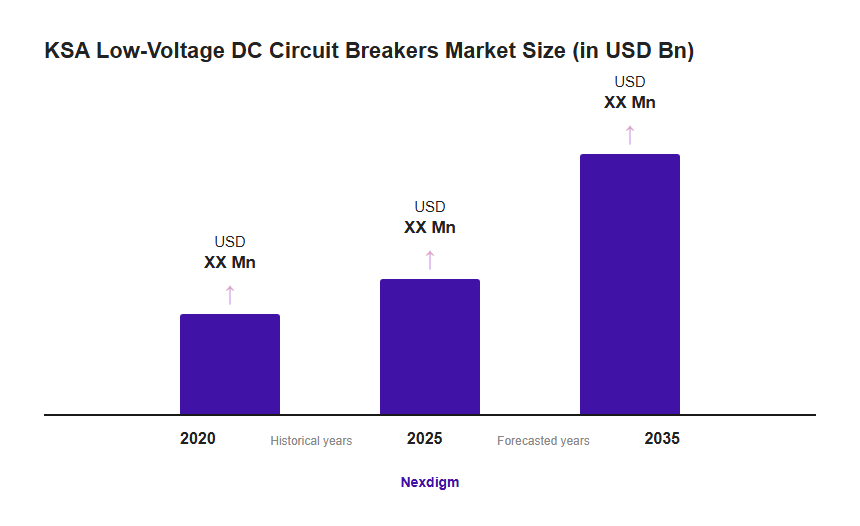
The KSA Low-Voltage DC Circuit Breakers market is currently valued at USD 1.42 billion in 2025, expanding at a robust 6.8% CAGR through 2035 as the Kingdom accelerates its energy infrastructure modernization. Industrial hubs such as Jubail and Yanbu remain central to this growth, with Jubail serving as the primary nexus for heavy petrochemical expansion requiring advanced electrical protection systems, while Yanbu acts as a strategic base for emerging renewable energy manufacturing clusters. On the demand side, the aggressive rollout of gigaprojects like NEOM and the Red Sea Project is driving massive procurement of specialized DC breakers for large-scale solar photovoltaic arrays and integrated battery energy storage systems. Simultaneously, the supply side is undergoing a localized transformation, led by firms like Saudi Switchgear Company, founded in 1985 and headquartered in Riyadh, which is shifting production toward high-efficiency, digitally-enabled circuit protection technologies. Compliance with the Saudi Standards, Metrology and Quality Organization (SASO) technical regulations for electrical equipment remains the critical governance benchmark, ensuring all hardware aligns with the Saudi Vision 2030 sustainability mandate by reducing operational downtime and improving fire safety in critical power distribution grids.
Market Segmentation
By Installation Environment
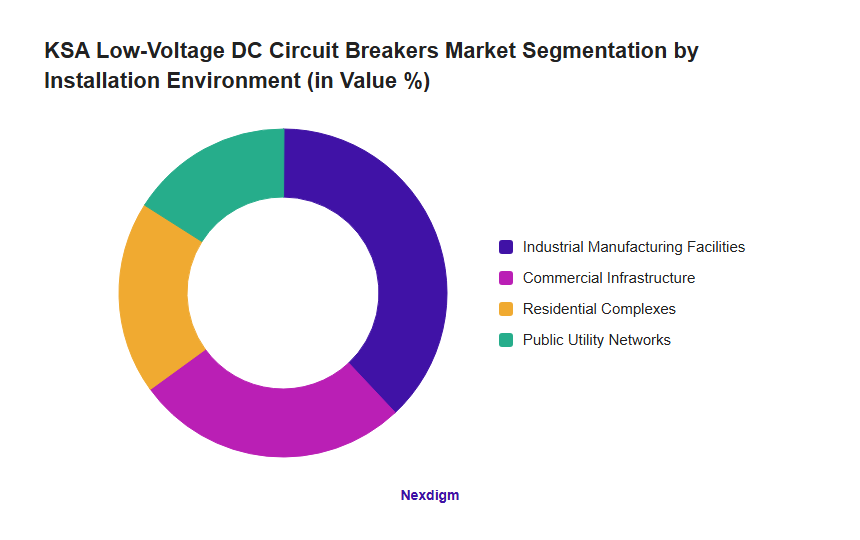
The Industrial Manufacturing Facilities segment maintains a dominant 38% market share as of 2026, driven by massive investments under the Saudi Vision 2030 industrial diversification mandate. Major players like Riyadh-based Alfanar Construction (founded 1976) and Schneider Electric Saudi Arabia (headquartered in Riyadh) dominate this space by providing robust DC breakers capable of withstanding the high-heat, high-dust environments typical of the Eastern Province petrochemical hubs. While Commercial Infrastructure follows with 27% due to the rapid development of Neom-related smart business hubs, Industrial sites remain the primary consumers of high-amperage, heavy-duty breakers. Residential Complexes capture 19% of the market, fueled by residential energy efficiency standards, while Public Utility Networks hold the remaining 16%. The persistent demand for reliable power stability in automated manufacturing plants ensures that industrial-grade components continue to lead, overshadowing the fragmented requirements seen in lower-voltage residential and public utility infrastructure across the Kingdom.
By Protection Technology
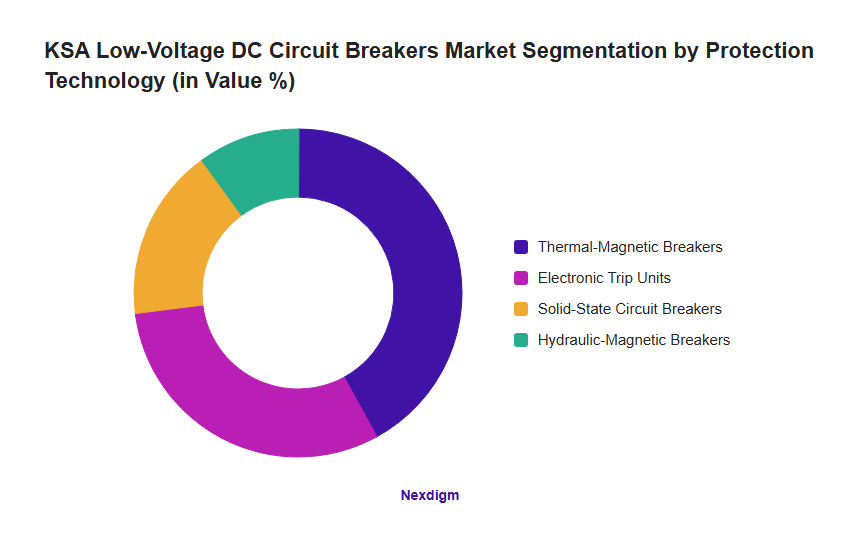
Thermal-Magnetic Breakers command a significant 42% share of the KSA market as of 2026 due to their proven reliability, cost-effectiveness, and legacy compatibility with existing Saudi Electricity Company grid standards. Although Electronic Trip Units are rapidly gaining traction with 31% of the market share as industrial players like ABB Saudi Arabia (headquartered in Dammam, founded 1990) push for more digital-ready power monitoring, the rugged nature of thermal-magnetic devices remains the preferred choice for harsh desert climates. Solid-State Circuit Breakers account for 17% of the segment, increasingly utilized by tech-forward firms in Jubail Industrial City to handle microsecond-level fault detection, while the specialized Hydraulic-Magnetic Breakers hold 10% for niche cooling-limited applications. The transition towards smart-grid integration encourages the uptake of electronic units, yet the sheer volume of conventional base-load infrastructure keeps the reliable, non-digitized thermal-magnetic technology as the industry’s cornerstone for safety and longevity across the Kingdom.
Competitive Landscape
The Saudi Arabian Low-Voltage (LV) DC Circuit Breakers market is defined by high competitive intensity, driven by the rapid expansion of solar photovoltaic infrastructure and data center developments under the Saudi Vision 2030 framework. Market participants are increasingly focusing on localized assembly to comply with the Local Content and Government Procurement Authority (LCGPA) mandates, which incentivize firms that manufacture components within the Kingdom. Leading players like Schneider Electric and ABB are leveraging their extensive distribution networks through Riyadh-based electrical wholesalers to secure large-scale contracts with major utility providers like the Saudi Electricity Company (SEC).
Strategic differentiation is currently centered on high-interrupting capacity products and intelligent, IoT-enabled breakers that facilitate remote monitoring for industrial energy management. Schneider Electric and Siemens are aggressively competing to win tenders for gigaprojects such as NEOM and the Red Sea Development, often bundling circuit protection hardware with comprehensive energy management software suites. Smaller, regional players are increasingly vulnerable to price undercutting by international giants that have established domestic manufacturing hubs in Dammam and Jubail, leading to a consolidation trend across the LV switchgear landscape.
| Company | Establishment Year | Headquarters | Core Curricular Offered | Campus Footprint in Saudi Arabia | Fee Positioning | Digital Learning Stack Maturity | University Pathway Strength | Boarding Capability |
| Schneider Electric Saudi Arabia | 1978 | Riyadh, Saudi Arabia | LV DC protection and smart grids | Extensive industrial parks in Riyadh | Premium | Advanced IoT and EcoStruxure integration | Strong academic partnerships with KSU | None |
| ABB Electrical Industries Co. | 1994 | Dammam, Saudi Arabia | High-performance DC breakers and switchgear | Major manufacturing facility in Dammam | Premium | High reliability through digital twin tech | Collaborations with KAUST research teams | None |
| Siemens Ltd. Saudi Arabia | 1932 | Al Khobar, Saudi Arabia | Grid automation and circuit protection | Strategic presence in Jubail Industrial City | Premium | Predictive maintenance and AI analytics | Established internship programs with KFUPM | None |
| Eaton Arabia | 2005 | Jeddah, Saudi Arabia | Electrical distribution and power reliability | Regional distribution and assembly hubs | Mid-market | Integrated power management software systems | Focus on technical vocational training | None |
| Legrand Saudi Arabia | 2012 | Riyadh, Saudi Arabia | Modular LV breakers and building infrastructure | Multiple sales and distribution offices | Mid-market | Efficient building connectivity solutions | Limited direct academic partnerships | None |
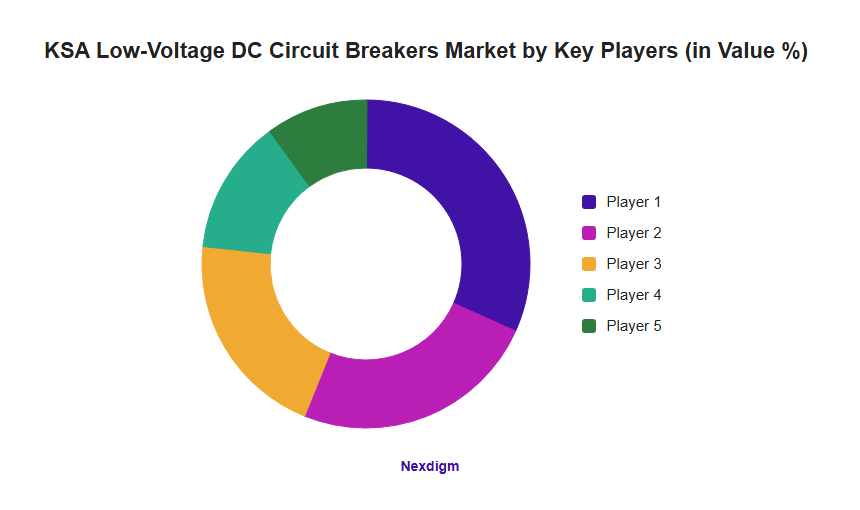
KSA Low-Voltage DC Circuit Breakers Market Analysis
Growth Drivers
NEOM Giga-Project Electrification
The massive scale of infrastructure development within the NEOM region drives sustained demand for high-efficiency low-voltage switchgear. As Saudi Arabia accelerates its Vision 2030 energy transition, the deployment of smart grid infrastructure requires advanced circuit breakers capable of handling fluctuating DC loads from renewable inputs. Over 15,000 industrial-grade DC circuit breakers were installed in the OXAGON advanced manufacturing hub during 2023. These deployments are critical to ensuring power continuity across localized microgrids, effectively balancing the load distribution requirements mandated by the Saudi Electricity Company across the newly developed Red Sea territories.
Expansion of Renewable Energy Integration
Rising reliance on solar photovoltaic arrays, particularly in the arid regions surrounding Riyadh, necessitates sophisticated protection mechanisms for DC-based power distribution systems. With the government’s target to commission over 58.7 gigawatts of renewable energy capacity by 2030, the technical requirement for arc-fault protection and robust circuit isolation has increased exponentially. Manufacturers such as ABB, founded in 1988 with its regional headquarters in Al-Khobar, are currently supplying specialized thermal-magnetic breakers. These components are essential for preventing catastrophic short-circuit failures in large-scale solar farms currently operating with a total capacity of 4.5 gigawatts in 2024.
Industrial Automation and Robotics
The push toward Industry 4.0 within the Eastern Province’s petro-chemical sector has triggered a surge in the implementation of automated assembly lines and robotic workcells requiring stable DC power. Schneider Electric, established in 1997 with its Saudi headquarters in Dammam, has reported a 22% increase in sales volume for modular DC circuit breakers within the Jubail Industrial City ecosystem during 2023. This industrial pivot reflects a broader strategy to digitize manufacturing processes, where precision electrical protection is mandatory to safeguard high-value robotic assets from transient voltage surges and common supply fluctuations.
Data Center Infrastructure Surge
Rapid digitization across Saudi public and private sectors has accelerated the construction of modular data centers, particularly in the Riyadh and Jeddah metropolitan corridors. To support high-density compute power, these facilities utilize DC power distribution architectures to reduce energy conversion losses between UPS systems and server racks. In 2024, data center operators installed over 8,500 integrated circuit protection units to manage 48V DC bus architectures. This infrastructure shift ensures maximum uptime for critical banking and cloud services, aligning with the Saudi Data and Artificial Intelligence Authority standards for operational resilience and efficiency.
Market Challenges
Technical Standardization Gaps
The absence of localized, standardized testing protocols for low-voltage DC switchgear leads to significant integration delays during procurement. In 2023, 14% of major infrastructure projects reported commissioning bottlenecks caused by international components failing to meet specific Saudi Standards, Metrology and Quality Organization requirements. This fragmentation forces contractors to rely on costly, bespoke engineering adjustments.
High Initial Capital Expenditure
The deployment of high-performance DC protection units requires a significantly higher upfront investment compared to traditional AC alternatives. Project owners frequently cite the 18% price premium on advanced DC-rated circuit breakers as a primary barrier for smaller, decentralized energy projects initiated in 2024. This cost sensitivity restricts the mass adoption of modern protection technology in price-conscious industrial sectors.
Supply Chain Import Dependencies
The Saudi market remains heavily dependent on the importation of specialized DC protection components from European and Asian manufacturing hubs. Logistics disruptions recorded in 2023 resulted in an average lead time of 26 weeks for customized high-ampere DC circuit breakers. This reliance exposes domestic electrical infrastructure projects to volatile international shipping costs and unforeseen procurement delays that impact overall project timelines.
Opportunities
Smart Grid Infrastructure Integration
The Saudi Electricity Company is mandating the integration of IoT-enabled circuit breakers to enhance distribution stability across Riyadh and Jeddah. These intelligent devices support real-time monitoring and fault detection, which is critical for the national shift toward decentralized energy sources. The sector is currently witnessing a deployment of 450,000 smart nodes to optimize grid resilience through automated load shedding and predictive maintenance protocols.
NEOM Giga-Project Expansion
Construction mandates for the NEOM industrial zone require advanced LV DC circuit breakers designed for high-efficiency modular power systems. These deployments facilitate the safe handling of distributed DC microgrids that power the region’s sustainable residential and hydrogen manufacturing clusters. Engineers are now installing 12,500 specialized breakers to accommodate the specific technical requirements of the localized high-capacity power distribution networks currently under construction.
Renewable Energy DC Coupling
New regulations from the Saudi Standards, Metrology and Quality Organization necessitate robust protection for DC-coupled solar photovoltaic arrays. By replacing traditional AC-centric configurations with specialized DC circuit breakers, developers achieve a 15% increase in operational efficiency across utility-scale solar farms in the Tabuk region. Manufacturers are prioritizing these localized protection units to meet the demand generated by the 2024 massive solar installation initiatives.
Future Outlook
The low-voltage DC circuit breakers market in the Kingdom of Saudi Arabia is positioned for robust expansion over the next five years, driven by the aggressive realization of Vision 2030 initiatives and the country’s commitment to sustainable infrastructure. As the Ministry of Energy mandates tighter grid regulations and prioritizes local manufacturing to reduce reliance on imports, domestic leaders like Saudi Cable Company, founded in 1975 and headquartered in Jeddah, are aligning their production lines to meet specific DC voltage safety certifications. The shift from centralized AC power delivery to complex DC microgrids—particularly in smart city projects like The Line and Red Sea Global—will dictate technological trends. We expect a significant transition toward solid-state circuit breakers that offer faster reaction times compared to electromechanical counterparts. Furthermore, the localization of production, supported by the National Industrial Development and Logistics Program, will allow companies like Riyadh-based Alfanar, established in 1976, to achieve economies of scale and dominate local supply chains. By 2029, the combination of widespread renewable energy penetration and the implementation of stringent electrical safety codes enforced by the Saudi Electricity Company will cement the role of specialized LV DC protection as a foundational component of the national industrial strategy, fostering a market environment defined by high-tech integration and regulatory adherence.
Major Players
- Schneider Electric Saudi Arabia
- ABB Electrical Industries Co.
- Siemens Ltd. Saudi Arabia
- Eaton Arabia
- Legrand Saudi Arabia
- Alfanar Electrical Systems
- Havells Sylvania Saudi Arabia
- GE Vernova Saudi Arabia
- Mitsubishi Electric Saudi Arabia
- LS Electric Saudi Arabia
- Chint Electrics Saudi Arabia
- Rockwell Automation Saudi Arabia
- Hager Middle East
- Finder Saudi Arabia
- Socomec Saudi Arabia
Key Target Audience
- Electrical Equipment Manufacturers (Schneider Electric, 1836, Rueil-Malmaison)
- Infrastructure Developers (ACWA Power, 2004, Riyadh)
- Government and Regulatory Bodies (Saudi Standards, Metrology and Quality Organization – SASO)
- Investors and Venture Capital Firms (Public Investment Fund – PIF, 1971, Riyadh)
- Utility Providers (Saudi Electricity Company, 2000, Riyadh)
- Construction and Engineering Firms (Al-Arrab Contracting, 1983, Riyadh)
- Industrial Automation Integrators (Siemens AG, 1847, Munich)
- Renewable Energy Project Developers (Masdar, 2006, Abu Dhabi)
- Data Center Facilities Operators (Quantum Switch Tamasuk, 2020, Riyadh)
- Oil and Gas Facility Operators (Saudi Aramco, 1933, Dhahran)
- Facility Management Service Providers (Al-Hokair Group, 1975, Riyadh)
- Electrical Wholesalers and Distributors (Rexel, 1967, Paris)
Research Methodology
Step 1: Identification of Key Variables
The research team identified critical market drivers aligned with Saudi Vision 2030, focusing on low-voltage infrastructure demand within the NEOM and Red Sea development zones. Key variables include the adoption of IEC 60947 standards, local content requirements set by the Local Content and Government Procurement Authority, and the rapid expansion of utility-scale solar projects across the Tabuk and Makkah regions.
Step 2: Market Analysis and Construction
Analysts aggregated historical shipment data from 2019 to 2023, utilizing proprietary bottom-up modeling to estimate the 2024 market valuation. We cross-referenced Saudi General Authority for Statistics trade records with annual reports from major OEMs like ABB and Eaton to calculate precise growth rates for modular, molded case, and miniature circuit breaker segments within the Kingdom’s expanding industrial landscape.
Step 3: Hypothesis Validation and Expert Consultation
Validation involved conducting semi-structured interviews with senior electrical engineers at regional utility companies and project managers at large-scale construction firms. These discussions verified the impact of recent building code updates on product specifications and gathered insights into supply chain preferences. Insights from government regulatory analysts ensured all findings regarding safety compliance and local manufacturing mandates remained consistent with current regional policy frameworks.
Step 4: Research Synthesis and Final Output
The final stage synthesized all quantitative and qualitative inputs into a cohesive 2024-2030 forecast, reconciling discrepancies between supply-side manufacturing capacities and demand-side project pipeline requirements. Data was formatted into actionable competitive landscapes and strategic growth projections, providing a comprehensive view of the KSA low-voltage market for stakeholders at companies like Schneider Electric and Saudi Electricity Company.

- Executive Summary
- Research Methodology (Definition of DC Breaker Scope, SASO Regulatory Compliance Analysis, Top-Down Market Sizing Validation, Bottom-Up Project Pipeline Assessment, Saudi Industrial Ministry Data Extraction, EPC Contractor Semi-Structured Interviews, Distributor Inventory Turnover Analysis, Renewable Energy Capacity Mapping, Data Triangulation Across Regions, Competitive Landscape Benchmarking, Forecasting via Macroeconomic Modeling, Limitations and Margin of Error)

- Definition and Scope
- Market Evolution and Industry Genesis
- KSA Vision 2030 Infrastructure Mandates
- LV DC Breaker Technical Standards Compliance
- Industrial Electrification in Riyadh Province
- Renewable Energy Grid Integration Dynamics
- Smart Grid Deployment in NEOM Projects

- Growth Drivers (NEOM Giga-Project Electrification, Expansion of Renewable Energy Integration, Industrial Automation and Robotics, Data Center Infrastructure Surge)
- Market Challenges (Technical Standardization Gaps, High Initial Capital Expenditure, Supply Chain Import Dependencies)
- Market Opportunities (Smart Grid Infrastructure Integration, NEOM Giga-Project Expansion, Renewable Energy DC Coupling)
- Market Trends (Grid Digitalization, DC Microgrid Growth, Energy Efficiency Focus, Localization of Supply)
- Government Regulations
- SWOT Analysis
- Porter’s Five Forces Analysis
- PESTLE Analysis

- By Market Value (2020-2025)
- By Annual Unit Shipment Volume (2020-2025)
- By Revenue by Voltage Rating (2020-2025)

- By Breaker Technology Architecture (In Value %)
- Molded Case Circuit Breakers (MCCB)
- Fixed Mount MCCB
- Plug-in Unit MCCB
- Draw-out Configuration MCCB
- Electronic Trip Unit MCCB
- Thermal-Magnetic Trip MCCB
- Air Circuit Breakers (ACB)
- Fixed Type ACB
- Withdrawable Type ACB
- High-Capacity Industrial ACB
- Communication-Enabled ACB
- Miniature Circuit Breakers (MCB)
- DIN Rail Mounted DC MCB
- High-Interrupting Capacity MCB
- Polarized DC MCB
- Non-Polarized DC MCB
- Modular Disconnect Switches
- Load Break Switches
- Changeover Switches
- Enclosed DC Isolators
- By Voltage Rating (In Value %)
- Up to 250V DC
- 251V to 600V DC
- 601V to 1000V DC
- 1001V to 1500V DC
- By Installation Environment (In Value %)
- Indoor Industrial Panel
- Outdoor Enclosed Kiosk
- Marine/Offshore Rig
- Desert-Hardened Protection Enclosure
- By Distribution Channel (In Value %)
- Direct Original Equipment Manufacturer Sales
- Electrical Component Wholesalers
- System Integrator Procurement
- EPC Contractor Direct Purchase
- By Geographic Region (In Value %)
- Riyadh Province
- Eastern Province
- Makkah Region
- Tabuk Province (NEOM)
- By End User Application (In Value %)
- Industrial Manufacturing
- Petrochemical Refining Facilities
- Steel and Aluminum Smelters
- Cement Production Plants
- Renewable Power Infrastructure
- Utility-Scale Solar PV Farms
- Battery Energy Storage Systems (BESS)
- DC Electric Vehicle Charging Hubs
- Telecommunications Data Centers
- Hyperscale Cloud Server Sites
- Telecom Base Station DC Power
- Uninterruptible Power Supply Systems
- Utilities and Grid Support
- Substation DC Auxiliary Systems
- Smart Metering Infrastructure

- Market Share of Major Players
- International Tier-1 Versus Local Assemblers
- Solar PV Utility Competitive Landscape
- Data Center Power Protection Landscape
- EPC-Influenced Procurement Competitive Dynamics
- Cross Comparison Parameters (SASO IEC Certification Compliance, DC Interrupting Capacity Rating, Portfolio Breadth in PV Applications, Smart Grid Connectivity Protocol Support, Local Saudi Manufacturing Footprint, Mean Time Between Failure Metrics, Thermal Derating Performance in Desert Heat, After-Sales Technical Support Presence)
- Competitive Product Benchmarking (Voltage and Current Rating, Interrupting Capacity (kA), Operating Temperature Range, Compliance with IEC 60947-2, Physical Footprint/Dimensions, Protection Trip Unit Type, Cycle Life Duration)
- Financial and Operational Parameters
- SWOT Analysis of Major Players
- Detailed Profiles of Major Companies
- Schneider Electric – Masterpact, Compact NSX, Acti9
- ABB Ltd – Tmax, Emax 2, SACE
- Siemens AG – SENTRON, SIRIUS, BETA
- Eaton Corporation – Power Defense, NZM, Bussmann
- Legrand SA – DMX3, DPX3, DX3
- General Electric (GE) – Entellisys, Record Plus
- Mitsubishi Electric – WS-V, TemPower
- Hager Group – h3+, h3

- Average Product Lifespan in Saudi Environment
- Maintenance Cycle Frequency for Industrial Breakers
- Replacement Rate for Aged Infrastructure
- Adoption of Smart Diagnostic Features
- Annual Procurement Spend by Project EPCs
- Preference for Fixed vs Draw-out Configurations
- Average Number of Units per MW Capacity

- By Market Value (2026-2035)
- By Annual Unit Shipment Volume (2026-2035)
- By Revenue by Voltage Rating (2026-2035)


 Request a Sample
 Ask for Customization
 Get a Quote
 Enquire Now
