
 Download PDF
Market Overview
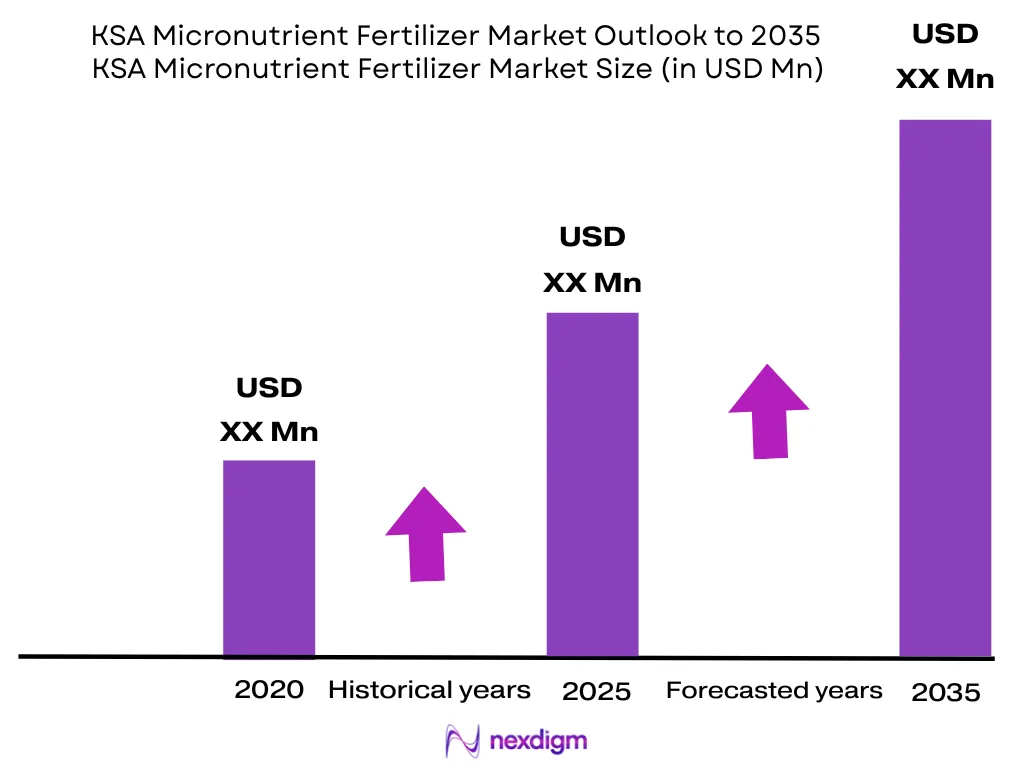
The KSA Micronutrient Fertilizer Market was valued at approximately USD ~ Mn in 2024, compared to USD ~ Mn in 2023. The market is driven by increasing adoption of precision agriculture, expansion of greenhouse farming, and government initiatives focused on food security and sustainable agriculture. Saudi Arabia’s agricultural sector contributes significantly to domestic food production despite limited arable land, encouraging farmers to utilize micronutrient fertilizers to improve crop yields and nutrient efficiency. Growing cultivation of fruits, vegetables, and date palms further supports market demand.
Market Segmentation
By Nutrient Type
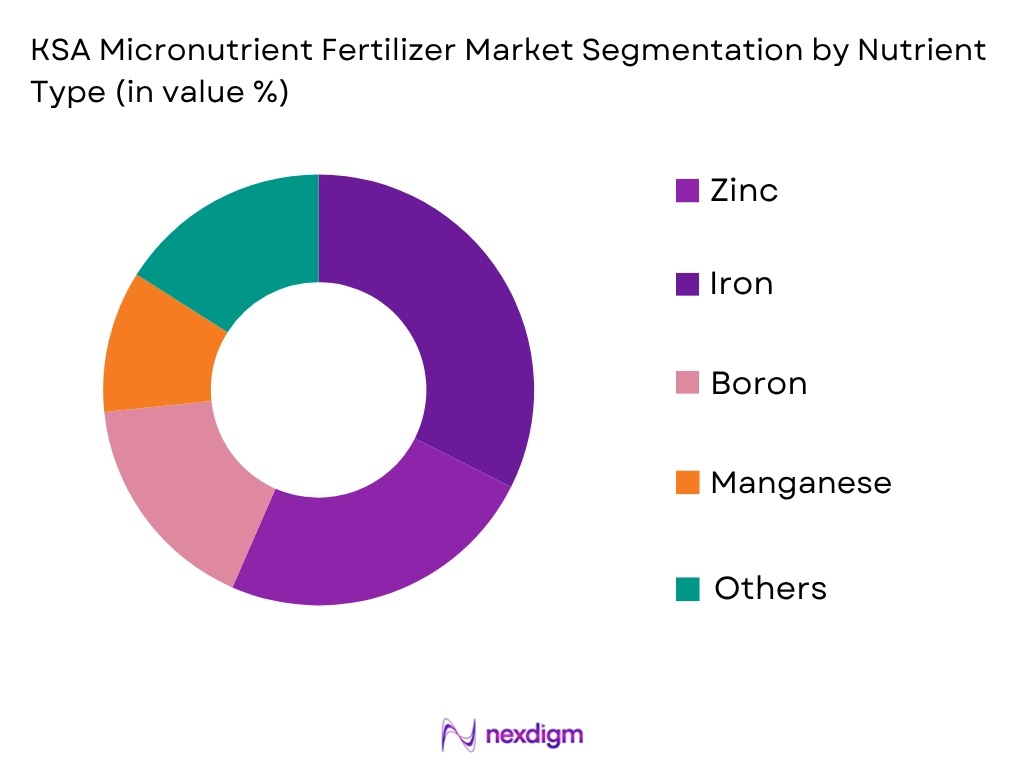
KSA Micronutrient Fertilizer Market is segmented by micronutrient type into zinc fertilizers, iron fertilizers, boron fertilizers, manganese fertilizers, copper fertilizers, and others. Recently, zinc fertilizers hold the dominant market share under this segmentation due to widespread zinc deficiency in alkaline and calcareous soils prevalent across Saudi Arabia. Zinc plays a crucial role in chlorophyll formation, enzyme activation, and crop productivity, making it one of the most frequently applied micronutrients. Farmers cultivating cereals, vegetables, fruits, and fodder crops increasingly rely on zinc-based formulations to improve nutrient uptake and yield quality. The expansion of greenhouse farming and fertigation systems has further accelerated demand for highly soluble zinc products. Additionally, government-supported initiatives promoting efficient fertilizer usage and sustainable agriculture have encouraged the adoption of zinc fertilizers, reinforcing their leadership position within the Saudi micronutrient fertilizer market.
By Crop Type
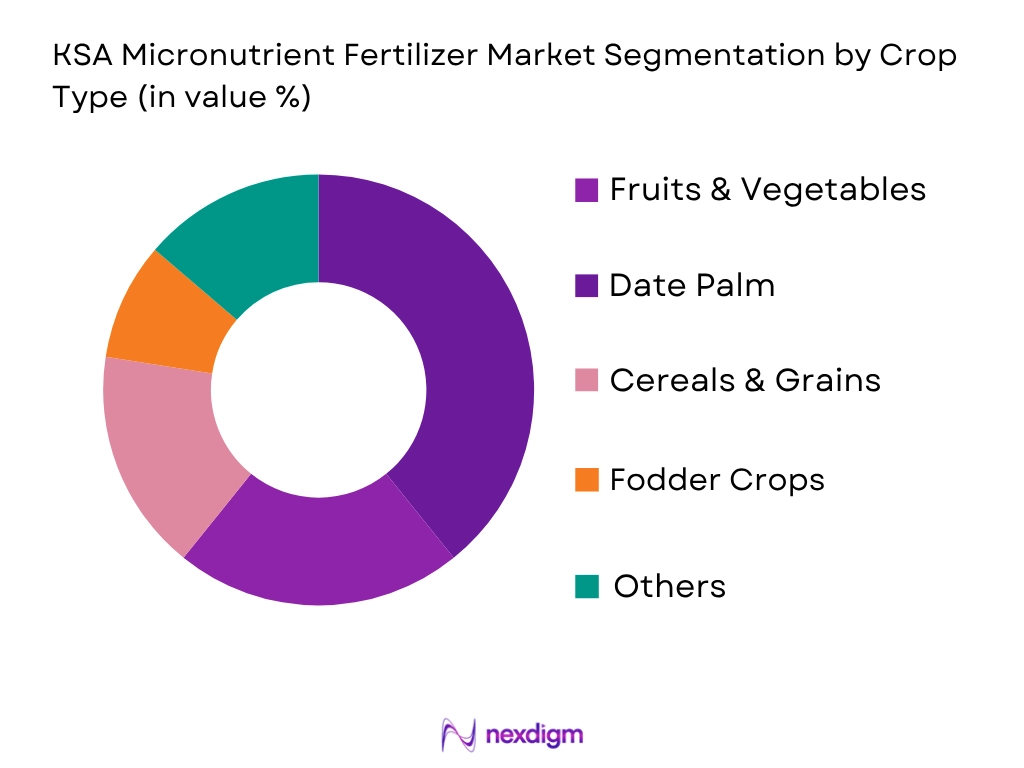
KSA Micronutrient Fertilizer Market is segmented by crop type into fruits and vegetables, date palm, cereals and grains, fodder crops, greenhouse crops, and others. Recently, fruits and vegetables dominate the market share due to their high nutrient requirements, intensive cultivation practices, and strong commercial value. These crops require balanced micronutrient application to enhance quality, appearance, shelf life, and productivity. Saudi Arabia has increasingly focused on domestic horticultural production to reduce reliance on imports and improve food security, resulting in greater adoption of specialty fertilizers. Controlled-environment agriculture, greenhouse cultivation, and drip irrigation systems have also increased micronutrient application rates in fruit and vegetable farming. Farmers prioritize micronutrient formulations to address deficiencies caused by arid soil conditions and improve crop performance, making fruits and vegetables the largest consuming crop segment in the market.
Competitive Landscape
The KSA Micronutrient Fertilizer Market is moderately consolidated, with the presence of both international nutrient solution providers and regional agricultural input companies. Leading companies focus on product innovation, chelated micronutrient formulations, greenhouse agriculture solutions, and extensive distributor networks. Strategic collaborations with agricultural cooperatives and large-scale farms have strengthened market penetration across key farming regions.
| Company | Establishment Year | Headquarters | Micronutrient Focus | Product Portfolio | Distribution Network | Greenhouse Solution | Fertigation Products | Crop-Specific Formulations |
| Yara International | 1905 | ~ | ~ | ~ | ~ | ~ | ~ | ~ |
| COMPO Expert | 1976 | ~ | ~ | ~ | ~ | ~ | ~ | ~ |
| ICL Group | 1968 | ~ | ~ | ~ | ~ | ~ | ~ | ~ |
| SABIC Agri-Nutrients | 1965 | ~ | ~ | ~ | ~ | ~ | ~ | ~ |
| Haifa Group | 1966 | ~ | ~ | ~ | ~ | ~ | ~ | ~ |
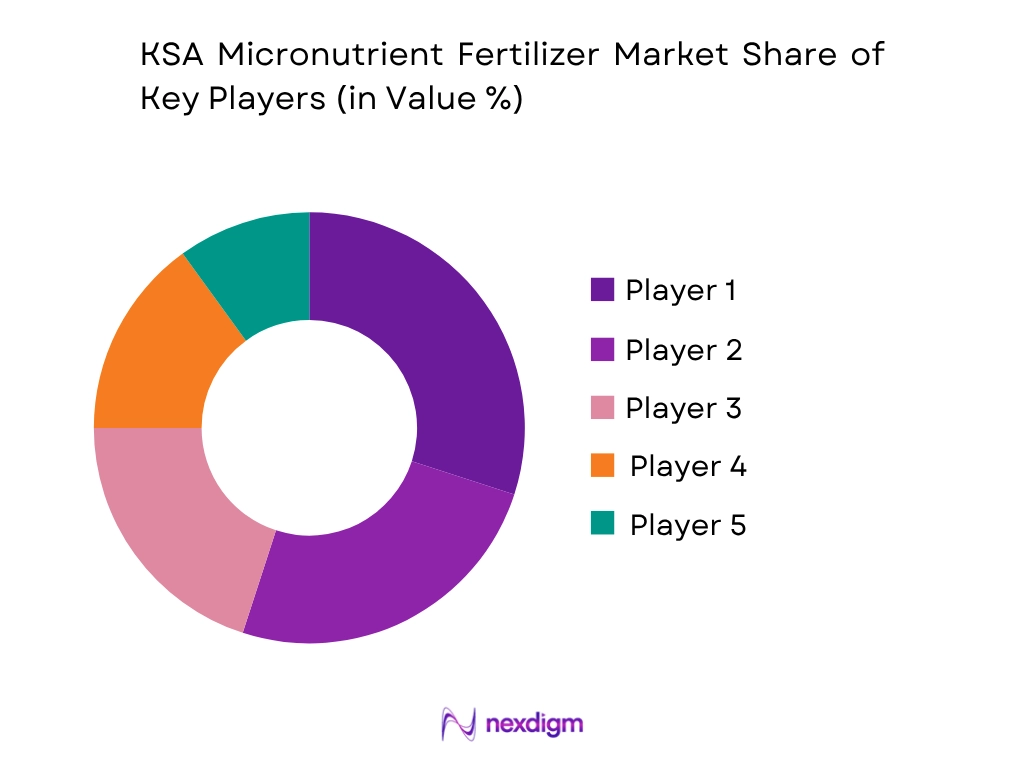
KSA Micronutrient Fertilizer Market
Growth Drivers
Expansion of Food Security and Agricultural Production Programs
Saudi Arabia’s focus on strengthening domestic food production continues to be a major driver for the KSA Micronutrient Fertilizer Market. According to the Ministry of Environment, Water and Agriculture (MEWA), Saudi Arabia recorded agricultural GDP exceeding SAR 114 billion in 2024, reflecting continued investment in crop productivity and sustainable farming systems. The Kingdom’s Vision 2030 strategy prioritizes agricultural efficiency due to limited arable land and water resources, increasing the need for micronutrient fertilizers that improve nutrient uptake and crop yields. The General Authority for Statistics (GASTAT) reported that agricultural activities contributed significantly to non-oil economic diversification, while food self-sufficiency programs continue to support cultivation of vegetables, fruits, and date palms. Saudi Arabia maintains more than 37 million date palm trees, making date cultivation one of the largest agricultural segments requiring micronutrient applications such as zinc, boron, and iron. The World Bank reported Saudi Arabia’s GDP exceeded USD 1.1 trillion in current prices, supporting continued government expenditure on agricultural modernization and irrigation infrastructure. Micronutrient fertilizers are increasingly utilized to address nutrient deficiencies in alkaline soils common across the Kingdom, helping farmers maximize productivity from limited cultivable land.
Growth of Greenhouse Farming and Water-Efficient Agriculture
The rapid expansion of greenhouse cultivation and controlled-environment agriculture is significantly increasing demand for micronutrient fertilizers in Saudi Arabia. MEWA reports that greenhouse farming remains a strategic component of national food security initiatives due to its ability to produce crops using substantially less water than conventional farming methods. Greenhouse operations require precise nutrient management, increasing the use of chelated micronutrients including zinc, iron, manganese, and boron. Saudi Arabia possesses renewable water resources of less than 100 cubic meters per capita annually according to World Bank indicators, placing the country among the most water-scarce nations globally. This scarcity has accelerated adoption of drip irrigation and fertigation systems, both of which rely heavily on water-soluble micronutrient fertilizers. The Kingdom continues to expand protected agriculture facilities across Riyadh, Al-Qassim, Tabuk, and Al-Jouf regions. According to GASTAT agricultural statistics, vegetable production remains one of the largest contributors to domestic crop output, requiring intensive nutrient management to maintain productivity under controlled conditions. The IMF projects continued non-oil sector expansion through 2025 and 2026, supporting investments in agricultural technologies that improve resource efficiency. As greenhouse cultivation expands, demand for specialized micronutrient formulations is expected to strengthen further.
Market Challenges
Limited Arable Land and Soil Nutrient Deficiencies
One of the most significant challenges affecting the KSA Micronutrient Fertilizer Market is the limited availability of arable land combined with widespread soil nutrient deficiencies. According to the World Bank, agricultural land accounts for less than 2 million hectares in Saudi Arabia, representing a small portion of the Kingdom’s total land area. Most agricultural soils are characterized by high alkalinity, low organic matter content, and poor micronutrient availability. These soil conditions reduce the effectiveness of nutrient absorption by crops and increase dependence on specialized micronutrient fertilizers. Iron, zinc, manganese, and boron deficiencies are particularly common in calcareous soils prevalent throughout Saudi Arabia. Farmers often require multiple nutrient applications to maintain crop productivity, increasing operational complexity. The Food and Agriculture Organization (FAO) identifies soil degradation and salinity as persistent agricultural concerns across arid regions of the Middle East. In Saudi Arabia, groundwater-based irrigation can contribute to salinity accumulation, further limiting nutrient availability. Although micronutrient fertilizers help address these deficiencies, the challenge remains substantial because nutrient management must be tailored to specific soil conditions. This creates barriers for smaller farms lacking access to advanced soil testing and agronomic expertise.
Dependence on Imported Specialty Micronutrient Products
Saudi Arabia continues to rely on imported specialty micronutrient formulations, creating supply chain challenges for the market. While the Kingdom has a strong fertilizer manufacturing base through companies such as SABIC Agri-Nutrients, many advanced chelated micronutrients and specialty formulations are sourced from international suppliers. According to data from the General Authority for Statistics and Saudi trade reports, agricultural input imports remain an important component of the domestic farming sector. Global logistics disruptions, geopolitical tensions, and fluctuations in international shipping routes can affect product availability and delivery timelines. The IMF notes that global trade uncertainties continue to influence supply chains across multiple industries, including agricultural inputs. Specialty micronutrients often require advanced manufacturing technologies and proprietary formulations that are concentrated among a limited number of global producers. Saudi Arabia’s agricultural sector increasingly depends on precision farming systems that require consistent access to high-quality micronutrient products. Any disruption in imports can affect nutrient management programs, particularly for greenhouse operators and commercial horticulture farms. This dependence creates operational risks for distributors and growers seeking uninterrupted fertilizer supplies.
Market Opportunities
Increasing Adoption of Precision Agriculture Technologies
The growing implementation of precision agriculture presents a major opportunity for the KSA Micronutrient Fertilizer Market. Saudi Arabia is actively promoting digital agriculture technologies under Vision 2030 to improve productivity while conserving water and land resources. Precision farming systems rely on soil analysis, nutrient mapping, sensors, and automated fertigation systems that require targeted micronutrient applications. According to the World Bank, Saudi Arabia maintains internet penetration exceeding 99 percent of the population, supporting deployment of digital agricultural technologies across commercial farms. The Ministry of Environment, Water and Agriculture continues to support smart farming initiatives aimed at improving resource efficiency and crop performance. Precision agriculture enables farmers to identify specific micronutrient deficiencies and apply nutrients only where needed. This increases demand for specialized formulations including zinc, iron, boron, and manganese fertilizers. Commercial greenhouse operators are among the earliest adopters of these technologies due to their focus on maximizing yields. The IMF highlights continued investment in digital transformation across Saudi Arabia’s non-oil sectors. As agricultural digitization expands, micronutrient fertilizer suppliers have opportunities to develop customized nutrient solutions integrated with precision farming platforms and advanced irrigation systems.
Expansion of High-Value Horticulture and Date Palm Cultivation
The continued expansion of horticulture and date palm cultivation creates substantial opportunities for micronutrient fertilizer suppliers in Saudi Arabia. According to MEWA, the Kingdom maintains more than 37 million date palm trees and remains one of the world’s largest date producers. Date palms require balanced micronutrient nutrition, particularly boron, zinc, and iron, to support fruit quality and productivity. Saudi Arabia also continues to increase domestic production of vegetables and fruits as part of food security initiatives. GASTAT agricultural statistics indicate strong cultivation activity across regions including Riyadh, Al-Qassim, Tabuk, and Al-Jouf. These crops have higher nutrient requirements than many traditional field crops and often require regular micronutrient supplementation. The World Bank reports continued population growth and urban development, supporting long-term demand for fresh produce. Rising consumption of locally produced fruits and vegetables encourages growers to improve crop quality through advanced nutrient management practices. As horticultural production expands under controlled-environment agriculture and greenhouse systems, demand for water-soluble and chelated micronutrient fertilizers is expected to increase. This creates opportunities for manufacturers to introduce crop-specific nutrient solutions tailored to Saudi Arabia’s soil and climatic conditions.
Future Outlook
The KSA Micronutrient Fertilizer Market is expected to witness steady expansion over the forecast period owing to increasing emphasis on food security, sustainable farming practices, and efficient nutrient management. The growing adoption of greenhouse agriculture, hydroponics, and precision farming technologies is expected to accelerate demand for specialty micronutrient products. Government support under agricultural modernization initiatives, combined with increasing awareness regarding soil nutrient deficiencies, is likely to create favorable conditions for market growth. Demand for water-soluble and chelated micronutrients is expected to rise significantly as farmers focus on maximizing crop productivity under challenging climatic conditions.
Major Players
- SABIC Agri-Nutrients
- Yara International
- ICL Group
- Haifa Group
- COMPO Expert
- Nutrien Ltd.
- The Mosaic Company
- Koch Agronomic Services
- K+S Group
- Coromandel International
- Trade Corporation International
- BMS Micro-Nutrients
- SQM
- Valagro (Syngenta Biologicals)
- Arabian Agricultural Services Company (ARASCO)
Key Target Audience
- Micronutrient Fertilizer Manufacturers
- Agricultural Input Distributors
- Greenhouse Farming Operators
- Commercial Farming Enterprises
- Date Palm Growers and Associations
- Horticulture Producers
- Investments and Venture Capitalist Firms
- Government and Regulatory Bodies
Research Methodology
Step 1: Identification of Key Variables
The research process begins with mapping the complete micronutrient fertilizer ecosystem in Saudi Arabia. Extensive secondary research is conducted to identify key demand and supply variables, including crop cultivation patterns, nutrient deficiency trends, fertilizer consumption behavior, and regulatory developments influencing market performance.
Step 2: Market Analysis and Construction
Historical market information is compiled through government publications, trade statistics, company disclosures, agricultural databases, and industry reports. Both volume and value analyses are undertaken to determine market structure, segment performance, and demand distribution across crops and regions.
Step 3: Hypothesis Validation and Expert Consultation
Initial market assumptions are validated through structured interviews with fertilizer manufacturers, distributors, agronomists, agricultural consultants, and commercial farming operators. Insights gathered from these stakeholders help refine market estimates and assess future growth potential.
Step 4: Research Synthesis and Final Output
The final stage involves integrating primary and secondary findings through a bottom-up and top-down analytical framework. Data triangulation techniques are used to ensure consistency, reliability, and accuracy, resulting in a comprehensive assessment of the KSA Micronutrient Fertilizer Market.

- Executive Summary
- Research Methodology (Market Definitions and Assumptions, Abbreviations, Market Sizing Framework, Demand-Side Analysis, Supply-Side Assessment, Primary Research Interviews, Data Triangulation Model, Forecasting Methodology, Limitations and Conclusions)

- Definition and Scope
- Market Evolution and Industry Genesis
- Timeline of Agricultural Nutrient Development in Saudi Arabia
- Agricultural Ecosystem Overview
- Micronutrient Fertilizer Value Chain Analysis

- Growth Drivers (Protected Agriculture Expansion, Water-Efficient Agriculture, Soil Micronutrient Deficiencies, Food Security Programs, High-Value Horticulture Growth)
- Market Challenges (Water Scarcity, Import Dependency, Saline Soil Conditions, Limited Arable Land, Farmer Awareness Gaps)
- Market Opportunities (Hydroponics Expansion, Vision 2030 Agricultural Initiatives, Specialty Crop Cultivation, Precision Fertigation, Sustainable Nutrient Management)
- Market Trends (Chelated Nutrient Adoption, Greenhouse Farming Growth, Customized Crop Nutrition, Smart Irrigation Integration, Water-Soluble Fertilizer Demand)
- Government Regulations (Saudi Ministry of Environment Water and Agriculture Regulations, Fertilizer Registration Framework, SASO Standards, Import Controls, Food Security Programs)
- SWOT Analysis
- Stakeholder Ecosystem
- PESTLE Analysis
- Porter’s Five Forces Analysis
- Competition Ecosystem

- By Market Value (2020-2025)
- By Volume Consumption (2020-2025)
- By Average Realization per Ton (2020-2025)

- By Nutrient Type (In Value %)
Zinc Fertilizers
Iron Fertilizers
Boron Fertilizers
Manganese Fertilizers
Copper Fertilizers
Molybdenum Fertilizers
Chelated Micronutrients
Multi-Micronutrient Blends
Others - By Crop Type (In Value %)
Fruits & Vegetables
Date Palm
Cereals & Grains
Fodder Crops
Greenhouse Crops
Oilseeds & Pulses
Others - By Form Type (In Value %)
Chelated Micronutrients
Non-Chelated Micronutrients
Water-Soluble Micronutrients
Granular Micronutrients
Liquid Micronutrients
Suspension Concentrates - By Application Method (In Value %)
Soil Application
Foliar Spray
Fertigation
Seed Treatment
Hydroponic Application - By Farming System (In Value %)
Open Field Agriculture
Greenhouse Farming
Hydroponics
Vertical Farming
Organic Farming

- Market Share of Major Players (By Value, Volume, Product Portfolio, Crop Coverage, Provincial Presence)
- Cross Comparison Parameters (Production Capacity, Micronutrient Product Portfolio, Chelated Nutrient Offerings, Distribution Network Strength, Greenhouse Agriculture Focus, Import Dependency Level, Crop-Specific Formulations, Fertigation-Compatible Product Range)
- SWOT Analysis of Major Players
- Pricing Analysis Basis SKUs
- Detailed Profiles of Major Companies
SABIC Agri-Nutrients
Saudi United Fertilizer Company (SAMFCO)
Arabian Agricultural Services Company (ARASCO)
Haifa Group
ICL Group
Yara International
Nutrien Ltd.
The Mosaic Company
K+S Group
Koch Agronomic Services
COMPO Expert
Coromandel International
Valagro (Syngenta Biologicals)
Trade Corporation International
BMS Micro-Nutrients
SQM

- Nutrient Consumption Patterns
- Crop-Specific Nutrient Demand Assessment
- Farmer Purchase Behavior
- Adoption of Precision Agriculture Technologies
- Irrigation and Fertigation Utilization Analysis
- Key Pain Points and Unmet Needs
- Decision-Making Framework

- By Market Value (2026-2035)
- By Volume Consumption (2026-2035)
- By Average Realization per Ton (2026-2035)


 Request a Sample
 Ask for Customization
 Get a Quote
 Enquire Now