
 Download PDF
Market Overview
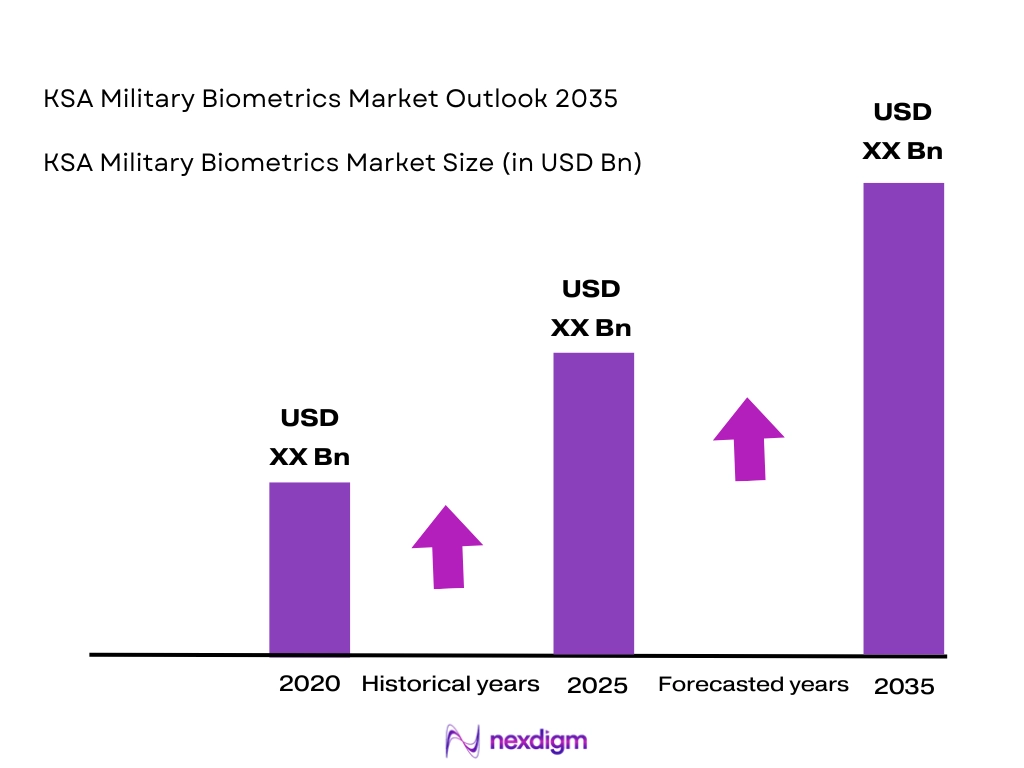
The KSA Military Biometrics Market is expected to witness substantial growth in the coming years, driven by the increasing adoption of advanced biometric solutions within the defense sector. In 2024, the market is projected to reach USD ~ billion, supported by the Kingdom’s ongoing modernization initiatives in the military and security sectors, particularly as part of the Vision 2030 goals. The demand for secure, efficient, and scalable biometric technologies is further fueled by the increasing need for identity verification, border security, and anti-terrorism measures. The market is primarily driven by the integration of multi-modal biometric systems, offering more reliable security measures, such as facial recognition, fingerprint scanning, and iris detection.
The dominant cities and countries driving the market include Riyadh, Jeddah, and Dammam, with Riyadh being the epicenter of military investments and infrastructure development. Saudi Arabia’s Vision 2030 and the expanding defense budgets provide the necessary framework for robust growth in biometric technology adoption. Riyadh’s proximity to military headquarters and strategic investments in national security programs place it at the forefront of biometric deployments. The KSA government’s focus on enhancing security infrastructure and localizing defense technologies further strengthens the market presence of key players in these regions.
Market Segmentation
By Solution Type
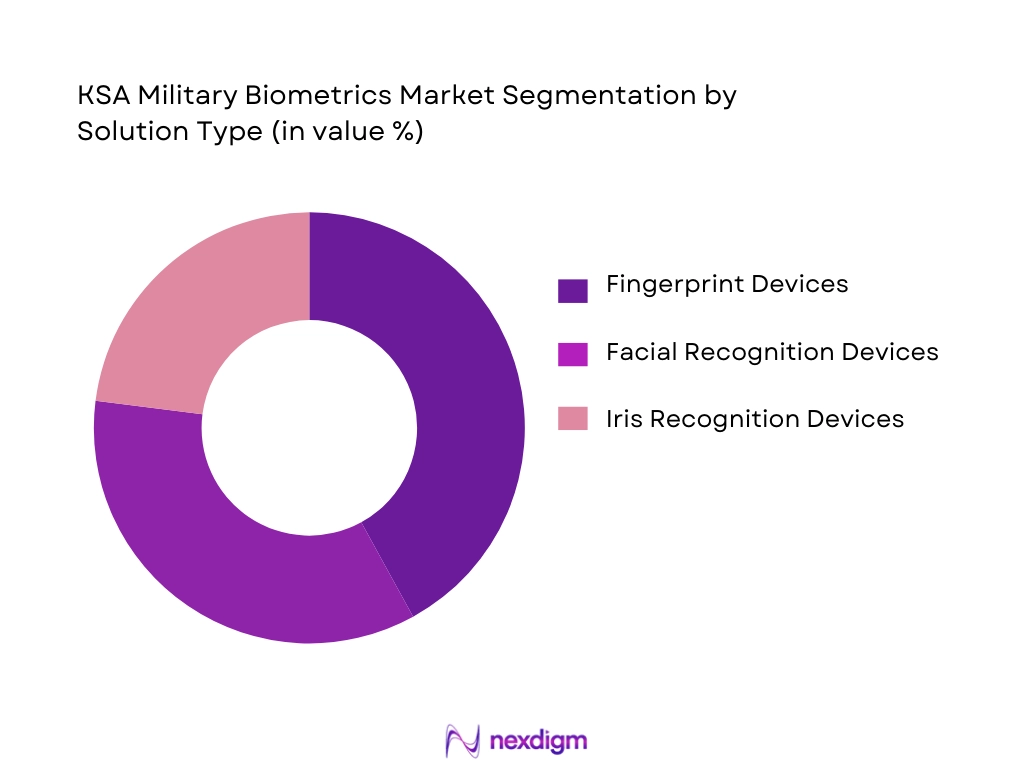
The KSA Military Biometrics Market is segmented into hardware, software, and services. Among these, the hardware segment holds the largest market share due to the growing demand for robust biometric devices like fingerprint scanners, facial recognition cameras, and portable iris recognition systems, which are essential in military operations for secure access control and personnel authentication. These systems are being increasingly deployed in military bases, border control facilities, and military checkpoints, driven by the high security needs of Saudi Arabia’s defense and intelligence sectors.
By Biometric Modality
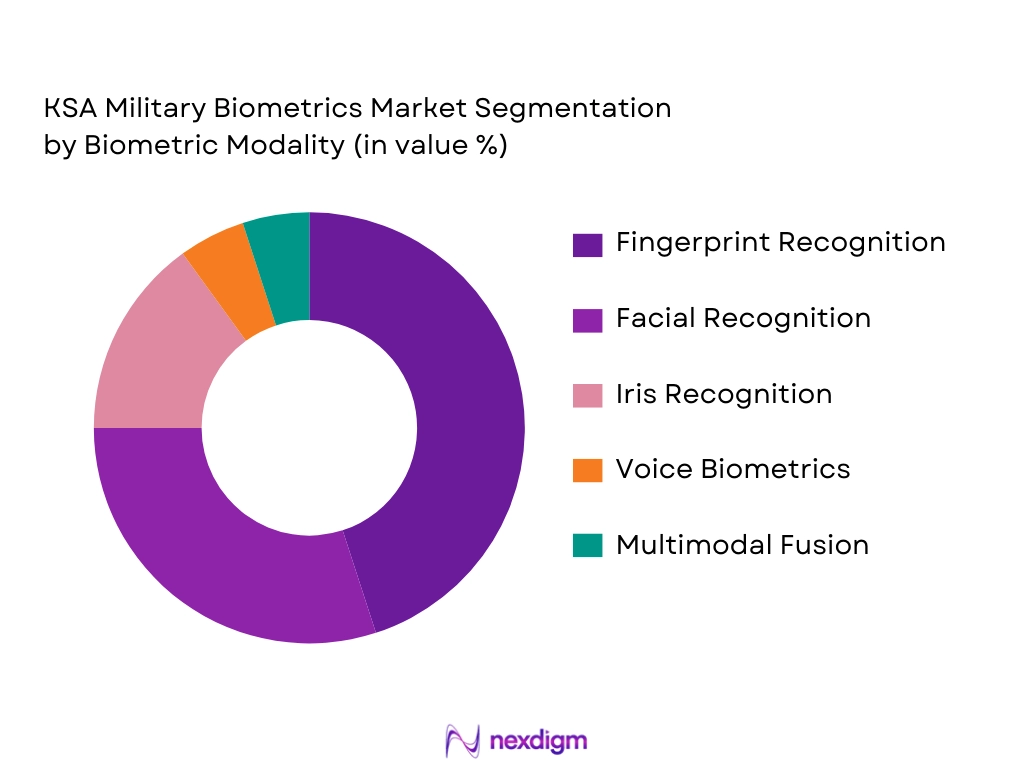
The KSA Military Biometrics Market is also segmented by biometric modality, including fingerprint, facial recognition, iris recognition, voice biometrics, and multimodal fusion. Among these, fingerprint recognition remains the dominant modality due to its cost-effectiveness, ease of deployment, and long-standing use in military operations. Fingerprint biometrics are often integrated into larger military identity management systems, offering reliable and fast identification at access points, bases, and checkpoints, enhancing overall operational efficiency.
Competitive Landscape
The KSA Military Biometrics Market is dominated by a few key players, both global and regional. These companies are pivotal in providing cutting-edge biometric solutions tailored to meet the stringent security requirements of the Kingdom’s defense sector. Companies such as Idemia, Thales, and NEC are at the forefront, offering advanced biometric hardware, software, and integrated solutions. The presence of local players like Saudi Advanced Technologies (SAT) further enhances the competitiveness of the market by focusing on the localization of technology and aligning with Vision 2030’s mandate for domestic production in the defense sector.
| Company | Establishment Year | Headquarters | Solution Type | Technology Focus | Defense Partnerships | Local Manufacturing Presence |
| Idemia | 2007 | France | ~ | ~ | ~ | ~ |
| Thales | 2000 | France | ~ | ~ | ~ | ~ |
| NEC | 1899 | Japan | ~ | ~ | ~ | ~ |
| Saudi Advanced Technologies | 2010 | Saudi Arabia | ~ | ~ | ~ | ~ |
| Aware Inc. | 1986 | USA | ~ | ~ | ~ | ~ |
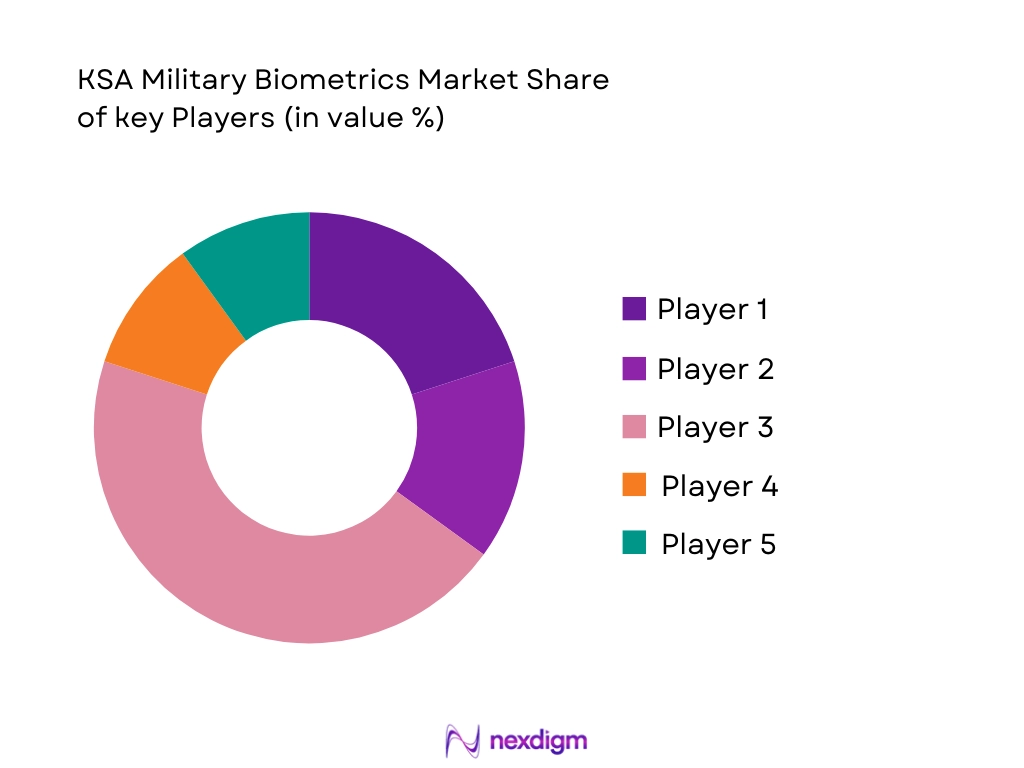
KSA Military Biometrics Market Analysis
Growth Drivers
National Security Imperatives & Border Authentication Needs
The Kingdom of Saudi Arabia faces significant national security threats, including terrorism and border security challenges, which drive the demand for advanced biometric solutions. Biometrics, such as fingerprint, facial recognition, and iris scanning, are crucial for personnel identification, surveillance, and controlling access to sensitive areas. As Saudi Arabia continues to strengthen its borders and military infrastructure, the need for efficient, reliable, and scalable biometric systems becomes even more critical. These systems offer enhanced security by enabling rapid and accurate identification, reducing human error, and preventing unauthorized access. The rising security concerns, especially at high-risk borders and military zones, make biometrics a necessary tool in achieving national security objectives under Vision 2030.
Defense Digitalization & Identity Assurance Priorities
Saudi Arabia is focused on modernizing its defense infrastructure as part of its Vision 2030 agenda, with a particular emphasis on digital transformation in defense operations. The push towards digitizing military services and establishing comprehensive national security frameworks requires a robust biometric solution for identity assurance. Biometric technologies offer secure, tamper-proof identification for military personnel, enabling accurate access control and facilitating real-time data exchange. As the Kingdom moves towards a more tech-integrated military, identity assurance will be central to maintaining security, protecting sensitive information, and ensuring that only authorized individuals can access critical defense systems.
Challenges
Data Privacy & Secure Storage Concerns in Military Context
The use of biometric data, which includes sensitive personal information, raises significant data privacy and security concerns, particularly in the military context. Military operations involve the handling of classified data, making the storage and processing of biometric information a target for cyberattacks. Ensuring that biometric data is stored securely, with high levels of encryption and strict access controls, is a critical challenge. Additionally, the risk of data breaches or misuse of biometric data can compromise national security and the privacy of military personnel. Addressing these concerns requires implementing advanced cybersecurity protocols, clear data handling regulations, and frequent audits to protect this valuable data from unauthorized access and breaches.
Interoperability with Legacy Defense Systems
A major challenge in deploying biometric solutions within Saudi Arabia’s military is ensuring interoperability with legacy defense systems. Many military installations still rely on older technologies for personnel identification, access control, and communication, which may not support modern biometric systems. Integrating new biometric solutions with these older systems without disrupting ongoing operations is a complex task. Additionally, the process may involve high costs, technical difficulties, and time-consuming updates to ensure seamless connectivity. To overcome this challenge, a strategic approach to phased system upgrades and compatibility testing is necessary, ensuring that biometric solutions can work in tandem with existing military infrastructures.
Opportunities
Localization & SAMI-Led Defense Manufacturing Expansion
One of the most significant opportunities in the KSA Military Biometrics Market is the push towards localization of defense technologies. Saudi Arabia has established the Saudi Arabian Military Industries (SAMI) as part of its Vision 2030 to reduce dependency on foreign defense suppliers and promote domestic manufacturing. This initiative presents an opportunity for local defense contractors to develop and manufacture biometric solutions tailored to the specific needs of the Saudi military. By partnering with international biometric technology providers, SAMI can leverage local expertise to produce secure and reliable biometric systems that meet the Kingdom’s national security requirements. This move towards localization will not only strengthen national security but also contribute to the growth of the local economy and defense sector.
Multimodal Biometric Platforms for Integrated Force Authentication
Another key opportunity lies in the adoption of multimodal biometric platforms, which combine multiple biometric modalities (such as fingerprint, facial recognition, and iris scanning) into a single integrated system. This approach offers enhanced accuracy, security, and flexibility, addressing the diverse needs of the Saudi military. Multimodal systems can significantly improve force authentication by providing more reliable identification across various operational environments, including high-risk border areas, military bases, and airfields. By integrating these advanced systems into force-wide identity management programs, Saudi Arabia can bolster its defense capabilities, streamline personnel authentication, and ensure more efficient operations. The growing need for sophisticated, multi-layered security solutions presents a significant market opportunity for biometric solution providers.
Future Outlook
Over the next 5 years, the KSA Military Biometrics Market is expected to exhibit significant growth driven by technological advancements in biometric solutions, increased defense budgets, and a strategic push toward security infrastructure enhancement under Vision 2030. As Saudi Arabia continues to modernize its military and security forces, the demand for biometric systems that provide accurate, fast, and secure identification solutions is anticipated to rise. Additionally, the growing importance of localizing defense technology through domestic manufacturing initiatives is likely to contribute to further market expansion.
Major Players
- Idemia
- Thales
- NEC Corporation
- Safran Identity & Security
- HID Global
- Aware Inc.
- Fulcrum Biometrics
- M2SYS Technology
- Corvus Integration Inc.
- BioEnable Technologies
- Cognitec Systems
- ZKTECO Co., Ltd.
- Smiths Group
- Advanced Electronics Company / SAMI
- Toshiba Corporation
Key Target Audience
- Government and regulatory bodies (e.g., Ministry of Interior, Saudi Ministry of Defense)
- Military and Defense Agencies
- Defense Procurement Committees
- Biometric Technology Integrators
- System Integration and Engineering Firms
- National Security Agencies (e.g., General Intelligence Directorate)
- Law Enforcement Agencies (e.g., Saudi Border Guard)
- Investments and Venture Capitalist Firms
Research Methodology
Step 1: Identification of Key Variables
This phase involves identifying key variables impacting the KSA Military Biometrics Market, including technological innovations, government defense budgets, and geopolitical factors. We conduct comprehensive desk research using secondary databases and publicly available military reports.
Step 2: Market Analysis and Construction
Historical data is analyzed to assess trends in market penetration and growth. We focus on tracking procurement cycles, military infrastructure expansion, and technology adoption rates within the defense sector.
Step 3: Hypothesis Validation and Expert Consultation
To validate the hypotheses formed during the initial research, we conduct expert interviews with defense officials, military contractors, and technology providers, ensuring accuracy and industry insight into market dynamics.
Step 4: Research Synthesis and Final Output
After gathering data and expert opinions, the final report synthesizes insights, offering a comprehensive overview of the KSA Military Biometrics Market, market forecasts, and strategic recommendations for stakeholders.

- Executive Summary
- Research Methodology (Market Sizing Approach (Top‑Down Defense Budget Allocation / Bottom‑Up Installed Base), Primary and Secondary Research Protocols, Defense Supply Chain Mapping, Data Validation and Triangulation Methodology, Limitations and Future Projections)

- Overview of Military Biometrics in Saudi Defense Architecture
- Role within KSA Military Modernization & Security Ecosystem
- Strategic Requirements (Force Protection, Border Control, Identity Assurance)
- Integration of Biometric Solutions with C4ISR and Command Systems

- Growth Drivers
National Security Imperatives & Border Authentication Needs
Defense Digitalization & Identity Assurance Priorities
Biometrics Integration with AI / Machine Learning - Challenges
Data Privacy & Secure Storage Concerns in Military Context
Interoperability with Legacy Defense Systems
Cost & Deployment Complexity for Tactical Operators - Opportunities
Localization & SAMI‑Led Defense Manufacturing Expansion
Multimodal Biometric Platforms for Integrated Force Authentication
Integration with National Digital Identity Programs - Market Trends
Mobile Tactical Biometric Kits
Cloud‑Based ABIS with Edge Analytics
Adoption of Contactless Biometrics in High‑Threat Zones - Regulatory and Compliance Considerations
Defense Data Handling Standards
Certification and Security Accreditation Protocols
Biometric Encryption & Secure Key Management

- Market Value, 2020-2025
- Volume Consumption Across Subsegments, 2020-2025
- Composite Adoption Intensity, 2020-202

- By Solution Type (In Value %)
Hardware (Biometric Devices, Ruggedized Terminals, Field‑Ready Sensors)
Software (Biometric Matching Engines, ABIS, AI‑Assisted Analytics)
Services (Systems Integration, Field Support, Maintenance & Training) - By Biometric Modality (In Value %)
Fingerprint Recognition (Deployment Density, Accuracy Benchmarks)
Facial Recognition (Contactless Identification Parameters)
Iris Recognition (High‑Security Verification Metrics)
Voice Biometrics (Secure Authentication in Communications)
Multimodal Fusion (Combined Modality Performance) - By Deployment Environment (In Value %)
Base Infrastructure (Fixed Access Points, Gates)
Field & Tactical (Handheld & Mobile Kits)
Border Checkpoints & Cross‑Border Identity Control
Airbase & Naval Security Installations - By End User / Defense Entity (In Value %)
Royal Saudi Land Forces
Royal Saudi Air Force
Royal Saudi Navy
National Guard & Special Forces Units
Defense Intelligence & Homeland Security Agencies - By Procurement Type (In Value %)
Government‑Led Procurement Programs (Ministry of Defense Contracts)
Joint Ventures & Localization Projects (Domestic Capability Builds)
Foreign OEM Supply Agreements

- Competitive Structure (Global OEMs & Local Integrators)
- Market Share by Value, Installed Base, and Capability Tier
- Cross‑Comparison Parameters (Company Vision & Strategic Direction, Solution Portfolio Breadth (Full Stack vs Niche), Technology Leadership (Modality Accuracy, AI Integration), Defense Contract Wins & Program Backlog, Localization & In‑Country Value Creation Metrics, System Certification & Security Accreditation, Ruggedization and Field Readiness, Defense Distribution & Integration Partnerships)
- Company Profiles of Key Competitors
Idemia (Global Biometric Defense OEM)
Thales (Biometric & Secure Identity Solutions)
NEC Corporation (AI‑Enabled Biometrics)
Leidos (Defense Biometrics Integrator)
Safran Identity & Security (Multimodal Systems)
HID Global (Secure Identity & Access Control)
Aware Inc. (Biometric Middleware & Matching Engines)
Fulcrum Biometrics (Field‑Ready Biometric Solutions)
M2SYS Technology (Biometric Platform Provider)
Corvus Integration Inc. (Systems Integrator)
ZKTECO Co., Ltd. (Biometric Hardware)
BioEnable Technologies (Authentication Solutions)
Cognitec Systems (Facial Recognition)
Smiths Group (Defense Security Systems)
Advanced Electronics Company / SAMI

- Market Demand and Utilization
- Purchasing Power and Budget Allocations
- Regulatory and Compliance Requirements
- Needs, Desires, and Pain Point Analysis
- Decision-Making Process

- Forecast by Value & Growth Scenarios, 2026-2035
- Forecast by Volume & Composite Penetration, 2026-2035
- Future Demand by Aircraft Segment, 2026-2035


 Request a Sample
 Ask for Customization
 Get a Quote
 Enquire Now