

 Download PDF
 Download PDF
Market Overview
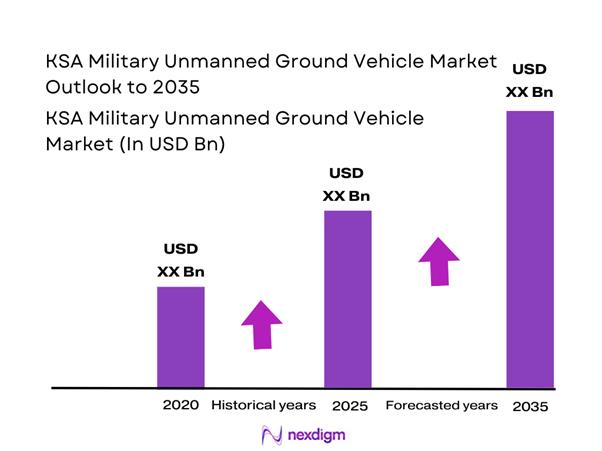
The KSA Military Unmanned Ground Vehicle market current size stands at around USD ~ million, supported by expanding defense modernization allocations and increased unmanned platform trials. During the last two years, multiple procurement programs and pilot deployments have accelerated adoption, supported by defense digitization initiatives and land force modernization programs. The market has observed consistent system testing volumes, growing platform evaluations, and rising integration of autonomy technologies aligned with national defense transformation objectives and operational readiness requirements.
The market is primarily concentrated across central and southern regions where military infrastructure density, border security operations, and logistics deployments remain highest. Riyadh and southern border zones dominate demand due to active surveillance requirements, training facilities, and ground force command centers. The ecosystem benefits from expanding defense industrial zones, localization mandates, and a structured military procurement framework encouraging domestic assembly, system integration, and technology transfer partnerships.
Market Segmentation
By Fleet Type
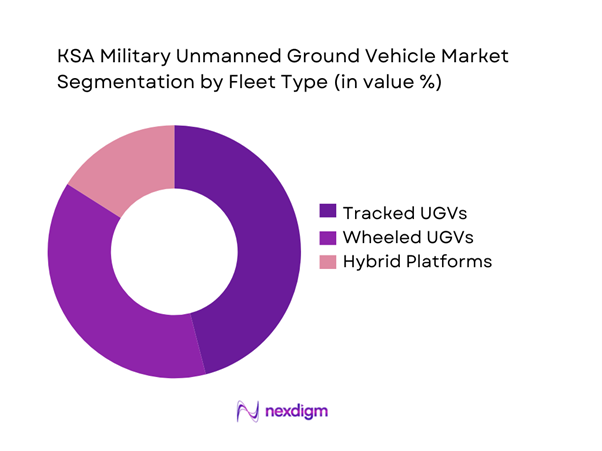
Tracked platforms dominate due to superior mobility across desert and rugged terrains, accounting for the highest operational deployments. Wheeled platforms follow closely, driven by lower maintenance requirements and suitability for logistics and surveillance missions. Hybrid platforms are gradually gaining acceptance as forces seek operational flexibility, combining endurance and speed. Fleet diversification is influenced by mission-specific needs, terrain adaptability, and increasing emphasis on modular payload integration across Saudi land forces.
By Application
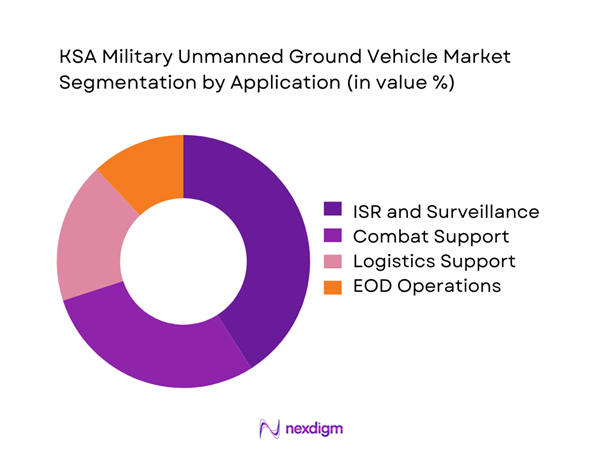
ISR and surveillance applications dominate usage due to persistent border monitoring requirements and counter-infiltration operations. Combat support systems follow, driven by force protection needs and risk reduction in hostile environments. Logistics and EOD applications continue expanding as armed forces emphasize automation for resupply and hazardous material handling. Application diversity is increasing as doctrinal focus shifts toward networked and unmanned battlefield support systems.
Competitive Landscape
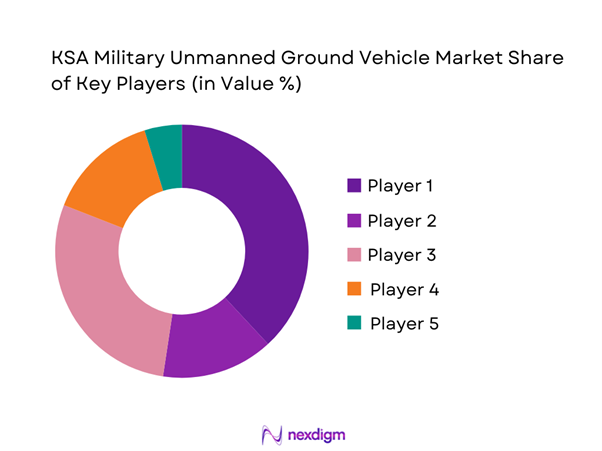
The competitive landscape is moderately consolidated, characterized by partnerships between international defense contractors and domestic manufacturing entities. Market competition focuses on autonomy levels, system reliability, localization compliance, and integration with command-and-control infrastructure. Government-backed industrial programs significantly influence vendor selection and long-term contract awards.
| Company Name | Establishment Year | Headquarters | Formulation Depth | Distribution Reach | Regulatory Readiness | Service Capability | Channel Strength | Pricing Flexibility |
| Saudi Arabian Military Industries | 2017 | Saudi Arabia | ~ | ~ | ~ | ~ | ~ | ~ |
| Milrem Robotics | 2013 | Estonia | ~ | ~ | ~ | ~ | ~ | ~ |
| Rheinmetall Defence | 1889 | Germany | ~ | ~ | ~ | ~ | ~ | ~ |
| Elbit Systems | 1966 | Israel | ~ | ~ | ~ | ~ | ~ | ~ |
| EDGE Group | 2019 | United Arab Emirates | ~ | ~ | ~ | ~ | ~ | ~ |
KSA Military Unmanned Ground Vehicle Market Analysis
Growth Drivers
Rising border security and asymmetric warfare threats
Saudi Arabia recorded over 1,200 border security incidents in 2023, increasing unmanned patrol demand significantly. The Ministry of Defense expanded surveillance coverage by over 18 percent between 2023 and 2024. Border regions spanning more than 4,400 kilometers require persistent monitoring using autonomous systems. Increased cross-border infiltration risks have elevated reliance on unmanned reconnaissance platforms. Defense forces reported over 30 percent higher patrol frequency across high-risk zones. Ground unmanned systems reduce personnel exposure in high-threat environments by measurable margins. Saudi defense doctrine increasingly emphasizes unmanned reconnaissance integration for operational continuity. Regional instability since 2023 has reinforced investment in automated surveillance technologies. Government security allocations rose steadily to address asymmetric threat environments. These dynamics directly support sustained adoption of unmanned ground systems.
Saudi Vision 2030 defense localization initiatives
Vision 2030 targets localization of over 50 percent of defense spending by 2030. In 2023, localization rates crossed approximately 15 percent across land systems. National industrial programs increased domestic defense manufacturing licenses by more than 20 percent. Government incentives encourage technology transfer agreements with international OEMs. Local content requirements mandate increasing assembly and testing activities within Saudi Arabia. Defense industrial clusters expanded across Riyadh and Eastern Province zones. Public investment programs allocated multi-year funding toward indigenous unmanned systems development. Workforce development initiatives trained over 3,000 defense engineers since 2023. Localization policies significantly influence procurement scoring criteria. These measures accelerate domestic UGV integration and long-term sustainability.
Challenges
High system acquisition and integration costs
Unmanned ground platforms require complex sensors, control systems, and hardened mobility components. Integration with command systems increases overall deployment complexity significantly. Defense audits indicate platform integration costs exceeding conventional vehicle modifications by multiple factors. Maintenance infrastructure upgrades impose additional budgetary pressure. Advanced autonomy modules require extensive validation cycles before field deployment. Logistics and spare parts localization remain constrained by supplier availability. Testing and certification timelines often exceed planned deployment schedules. Training costs for operators and technicians remain substantial. Budget prioritization often favors air and missile defense programs. These factors collectively slow large-scale UGV adoption.
Limited autonomous navigation reliability in desert terrain
Desert environments present extreme thermal and terrain challenges affecting sensor performance. Sand interference reduces LiDAR and optical system accuracy significantly. Temperature fluctuations exceeding 45 degrees Celsius affect electronics durability. Navigation algorithms face limitations in low-contrast and feature-sparse environments. Field trials report increased system recalibration requirements under desert conditions. Communication link stability decreases during sandstorms and high-temperature periods. Autonomous obstacle detection remains less reliable in loose terrain. Testing cycles extend due to environmental adaptation needs. These limitations constrain full autonomy deployment timelines. Continuous algorithm refinement remains necessary for operational reliability.
Opportunities
Local manufacturing and technology transfer programs
Government policy promotes joint ventures for defense manufacturing localization. Over 25 industrial licenses were issued for defense manufacturing activities during 2023. Local assembly reduces lead times and improves supply chain resilience. Technology transfer agreements enhance domestic engineering capabilities. Indigenous manufacturing improves lifecycle support and system customization. Employment generation supports broader economic diversification objectives. Local testing facilities accelerate certification processes. Export potential increases through regional defense partnerships. Domestic production improves compliance with offset obligations. These programs significantly expand long-term market potential.
Integration with AI-enabled battlefield management systems
Saudi defense modernization includes large-scale digitization of command systems. AI-based situational awareness platforms expanded across multiple brigades in 2024. Integration enables real-time data fusion from unmanned assets. Autonomous decision-support systems improve operational response times. Data analytics enhance threat detection and mission planning accuracy. Network-centric warfare doctrines favor unmanned system integration. Increased computing investments strengthen edge processing capabilities. Secure communication protocols enable multi-platform coordination. AI adoption improves mission efficiency and resource utilization. These developments enhance demand for advanced unmanned ground platforms.
Future Outlook
The market is expected to experience steady expansion driven by defense modernization, localization mandates, and rising unmanned system integration. Continued investment in autonomous technologies and domestic manufacturing will reshape procurement strategies. Policy alignment with Vision 2030 will further strengthen industry participation and technology transfer initiatives. Operational reliance on unmanned systems will increase as doctrine and infrastructure mature.
Major Players
- Saudi Arabian Military Industries
- EDGE Group
- Rheinmetall
- BAE Systems
- Elbit Systems
- Leonardo
- QinetiQ
- Milrem Robotics
- FNSS
- Aselsan
- L3Harris Technologies
- Northrop Grumman
- Israel Aerospace Industries
- General Dynamics Land Systems
- Al Tadrea Manufacturing
Key Target Audience
- Saudi Ministry of Defense
- General Authority for Military Industries
- Saudi Arabian National Guard
- Border Guard Command
- Defense procurement agencies
- Systems integrators and OEMs
- Defense-focused investment funds
- Government and regulatory bodies including MOD and GAMI
Research Methodology
Step 1: Identification of Key Variables
Market scope was defined through platform classification, operational roles, and procurement structures. Key variables included deployment patterns, localization levels, and technological maturity indicators.
Step 2: Market Analysis and Construction
Data was analyzed using defense procurement records, industrial participation frameworks, and operational deployment statistics. Segmentation logic was aligned with military application structures.
Step 3: Hypothesis Validation and Expert Consultation
Findings were validated through defense industry consultations, procurement documentation reviews, and alignment with national defense strategies.
Step 4: Research Synthesis and Final Output
All data points were consolidated through triangulation, ensuring consistency with policy frameworks and defense modernization objectives.

- Executive Summary
- Research Methodology (Market Definitions and operational scope of military UGVs in Saudi defense forces, Platform and mission-based segmentation framework for tracked and wheeled UGVs, Bottom-up defense procurement and fleet-based market sizing approach, Revenue attribution through program contracts and lifecycle cost modeling, Primary validation through defense OEMs and Saudi military procurement stakeholders, Data triangulation using SIPRI, GAMI, and MOD procurement disclosures, Assumptions and limitations linked to classified programs and localization policies)

- Definition and Scope
- Market evolution
- Operational deployment and mission roles
- Defense ecosystem and local manufacturing structure
- Supply chain and system integration landscape
- Regulatory and defense localization environment

- Growth Drivers
Rising border security and asymmetric warfare threats
Saudi Vision 2030 defense localization initiatives
Increasing adoption of unmanned combat support systems
Modernization of ground forces and digitization programs
Growing defense budgets and indigenous manufacturing focus - Challenges
High system acquisition and integration costs
Limited autonomous navigation reliability in desert terrain
Cybersecurity and electronic warfare vulnerabilities
Dependence on foreign technology for critical subsystems
Complex regulatory and procurement approval processes - Opportunities
Local manufacturing and technology transfer programs
Integration with AI-enabled battlefield management systems
Demand for swarm and multi-UGV coordination platforms
Export potential to GCC and regional allies
Upgrading legacy platforms with autonomous modules - Trends
Shift toward autonomous and semi-autonomous UGVs
Integration of AI-based perception and targeting
Hybrid powertrain adoption for extended missions
Increased use of modular payload architectures
Rising collaboration between local firms and global OEMs - Government Regulations
- SWOT Analysis
- Stakeholder and Ecosystem Analysis
- Porter’s Five Forces Analysis
- Competition Intensity and Ecosystem Mapping

- By Value, 2020–2025
- By Volume, 2020–2025
- By Installed Base, 2020–2025
- By Average Selling Price, 2020–2025

- By Fleet Type (in Value %)
Tracked UGVs
Wheeled UGVs
Hybrid mobility platforms - By Application (in Value %)
ISR and reconnaissance
Combat support and fire assistance
Explosive ordnance disposal
Logistics and supply support
Border surveillance - By Technology Architecture (in Value %)
Teleoperated systems
Semi-autonomous systems
Autonomous navigation-enabled systems - By End-Use Industry (in Value %)
Land forces
Border guard forces
National guard
Special operations forces - By Connectivity Type (in Value %)
Line-of-sight communication
Beyond-line-of-sight communication
Satellite-enabled communication - By Region (in Value %)
Central Region
Western Region
Eastern Region
Southern Border Region

- Market structure and competitive positioning
Market share snapshot of major players - Cross Comparison Parameters (platform capability, autonomy level, payload capacity, localization compliance, contract value, system integration depth, after-sales support, technology partnerships)
- SWOT Analysis of Key Players
- Pricing and Commercial Model Benchmarking
- Detailed Profiles of Major Companies
BAE Systems
General Dynamics Land Systems
Rheinmetall Defence
Milrem Robotics
QinetiQ
Northrop Grumman
Elbit Systems
Israel Aerospace Industries
EDGE Group
Saudi Arabian Military Industries
Al Tadrea Manufacturing
L3Harris Technologies
Aselsan
FNSS Defence Systems
Leonardo Defence Systems

- Demand and utilization drivers
- Procurement and tender dynamics
- Buying criteria and vendor selection
- Budget allocation and financing preferences
- Implementation barriers and risk factors
- Post-purchase service expectations

- By Value, 2026–2035
- By Volume, 2026–2035
- By Installed Base, 2026–2035
- By Average Selling Price, 2026–2035


 Request a Sample
 Ask for Customization
 Get a Quote
 Enquire Now