

 Download PDF
Market Overview
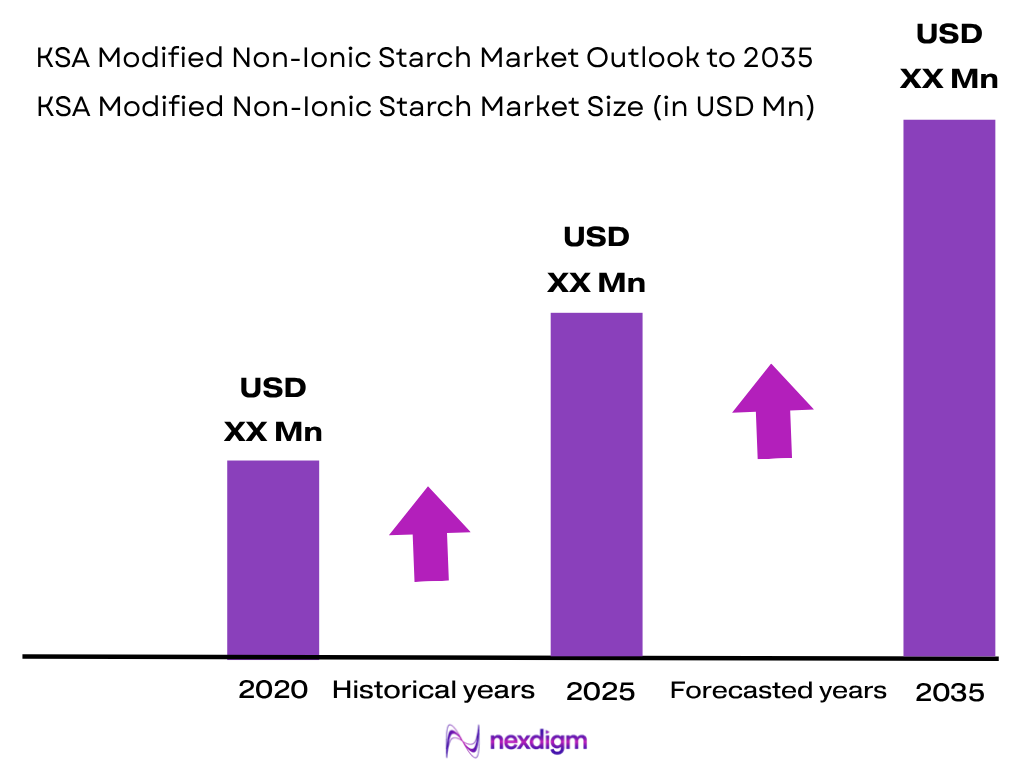
The KSA Modified Non-Ionic Starch market is valued at USD ~ million in 2024 and is projected to grow at a CAGR of ~% during 2026-2035. The market growth is supported by increasing adoption of functional starch ingredients across food processing, bakery, dairy, pharmaceutical, and industrial applications. Modified starches are widely used as stabilizers, thickeners, binders, and texture enhancers due to their improved viscosity control, thermal stability, and processing performance compared with native starch. Saudi Arabia’s expanding food manufacturing ecosystem, supported by food security initiatives and Vision 2030 industrial diversification programs, is increasing demand for imported specialty ingredients. The KSA modified starch market is largely dependent on international suppliers due to limited domestic starch modification capacity.
The KSA Modified Non-Ionic Starch market is primarily concentrated in Riyadh, Jeddah, and Dammam/Eastern Province due to their strong food manufacturing base, logistics infrastructure, and concentration of industrial consumers. Riyadh dominates because of its position as the administrative and commercial center with significant food processing investments. Jeddah benefits from proximity to Jeddah Islamic Port, supporting imports of food ingredients and specialty starch products. The Eastern Province contributes through industrial manufacturing activities and proximity to major industrial zones. Saudi Arabia’s dependence on imported food ingredients creates strong demand for international starch suppliers serving food manufacturers, pharmaceutical companies, and industrial users. Modified starch applications include processed foods, bakery products, dairy formulations, sauces, confectionery, pharmaceutical excipients, and industrial adhesives.
Market Segmentation
By Modification Type
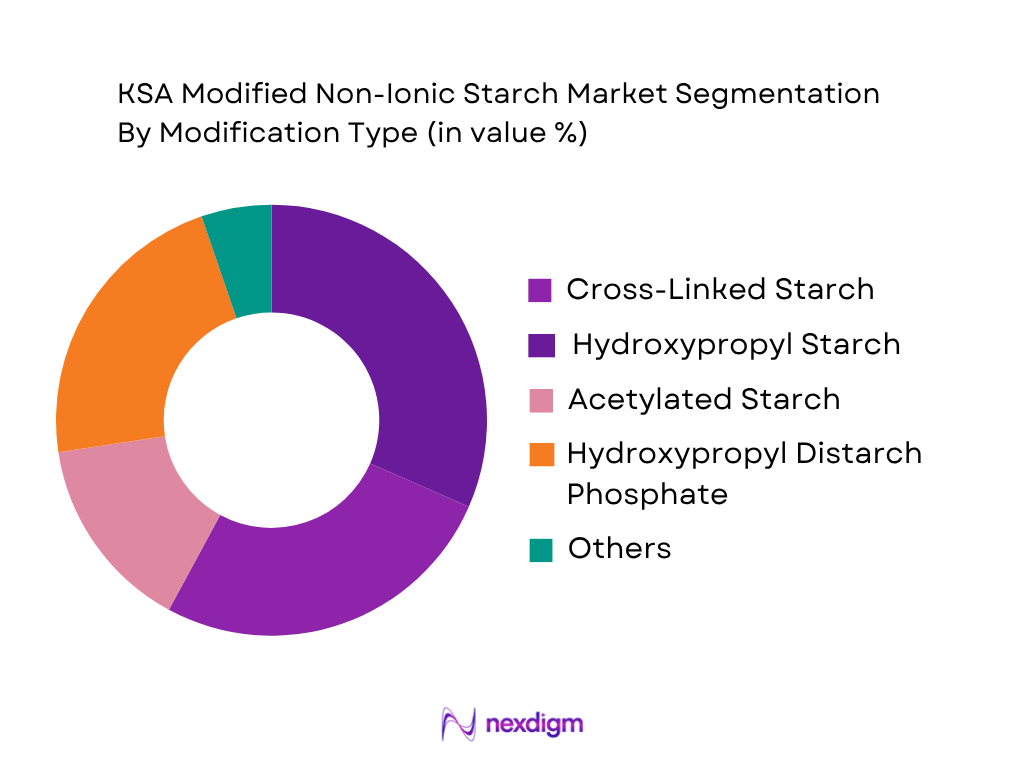
The KSA Modified Non-Ionic Starch market is segmented by modification type into hydroxypropyl starch, acetylated starch, cross-linked starch, hydroxypropyl distarch phosphate, acetylated distarch adipate, pregelatinized starch, and specialty modified starches. Among these, cross-linked starch and hydroxypropyl starch are expected to hold the leading position due to their extensive application in processed foods, bakery products, dairy products, and sauces. Cross-linked starches provide improved resistance against heat, shear, and acidic processing conditions, making them suitable for industrial food production. Hydroxypropyl starches are preferred for applications requiring enhanced freeze-thaw stability and improved texture retention. Food manufacturers in Saudi Arabia increasingly use modified starch solutions to improve consistency and shelf stability of packaged foods.
By Application
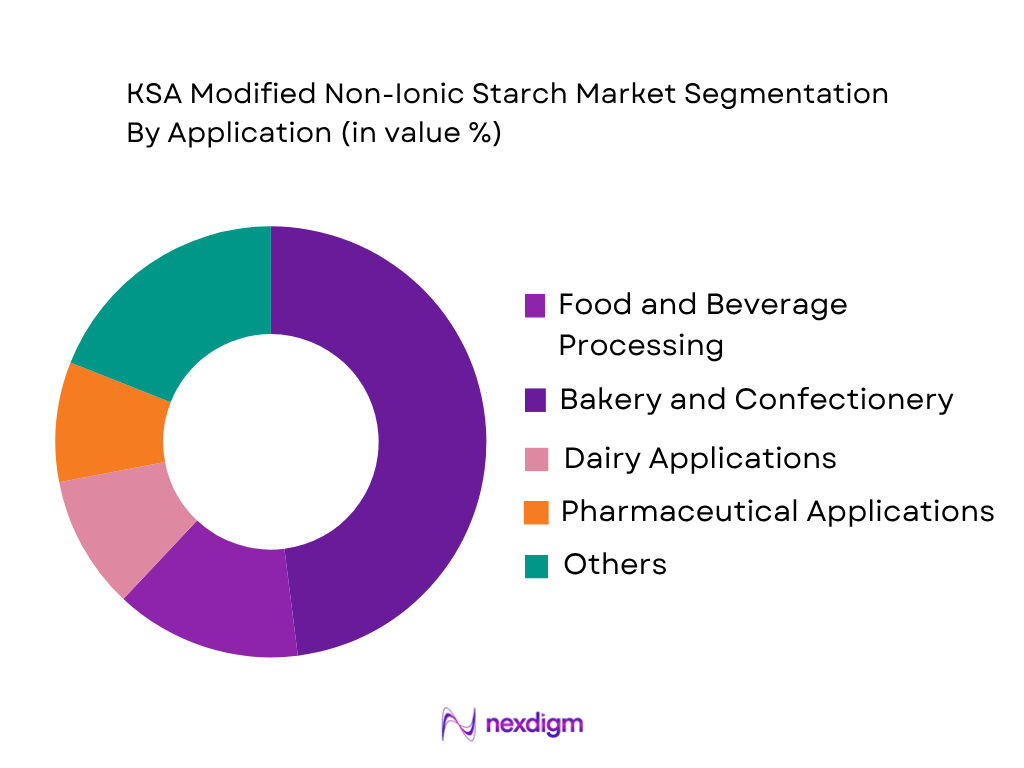
The KSA Modified Non-Ionic Starch market is segmented by application into food and beverages, bakery and confectionery, dairy products, pharmaceuticals, nutraceuticals, industrial adhesives, paper manufacturing, textiles, and other industrial applications. The food and beverage segment dominates the market due to increasing demand for processed food products, convenience foods, frozen products, sauces, and bakery items. Modified starch provides functional advantages such as improved mouthfeel, moisture control, emulsification, and stability during processing. Saudi Arabia’s growing food manufacturing sector and increasing localization of food production support demand for functional ingredients. Pharmaceutical applications are also expanding as modified starches are used as excipients, binders, and fillers in formulations. Industrial applications such as adhesives and paper processing create additional demand due to starch’s binding properties and renewable characteristics.
Competitive Landscape
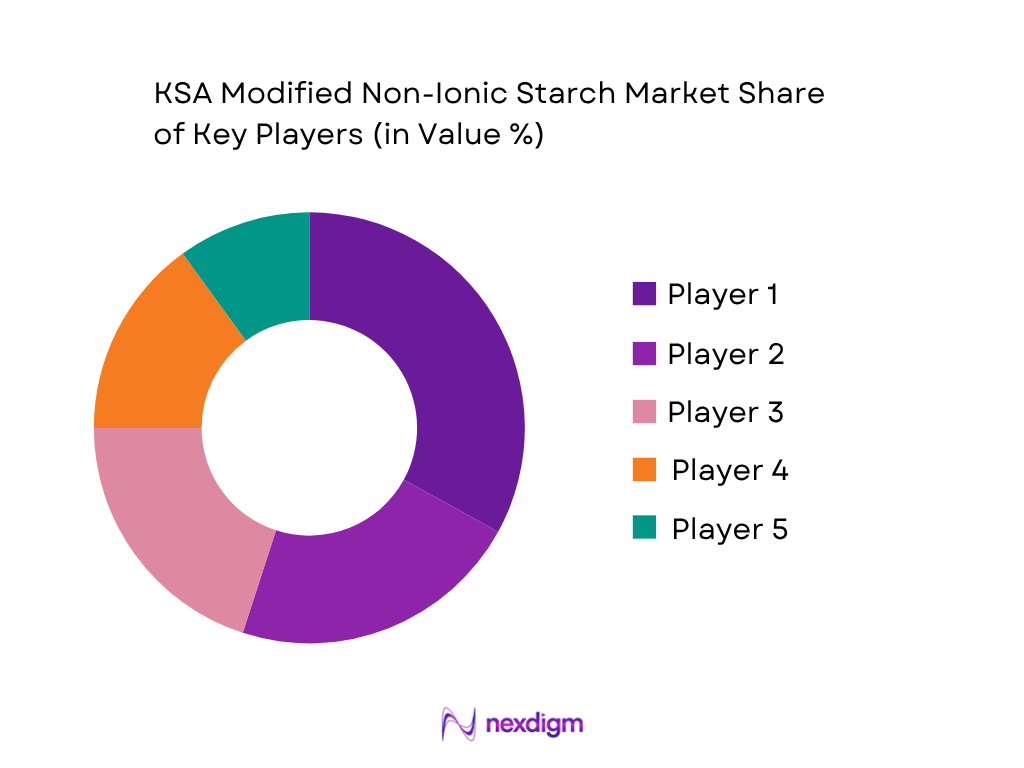
The KSA Modified Non-Ionic Starch market is characterized by strong presence of international starch manufacturers and ingredient suppliers. Domestic production of advanced modified starch remains limited, resulting in dependence on global suppliers with established modification technologies, certification capabilities, and distribution networks. Companies compete through product innovation, food-grade certifications, halal compliance, technical support, and supply reliability.
| Company | Establishment Year | Headquarters | Modified Starch Portfolio | Food Application Capability | Pharmaceutical Grade Capability | Halal Certification Support | GCC Distribution Network |
| Ingredion Incorporated | 1906 | USA | ~ | ~ | ~ | ~ | ~ |
| Cargill Incorporated | 1865 | USA | ~ | ~ | ~ | ~ | ~ |
| Roquette | 1933 | France | ~ | ~ | ~ | ~ | ~ |
| Tate & Lyle PLC | 1921 | UK | ~ | ~ | ~ | ~ | ~ |
| Beneo GmbH | 2007 | Belgium | ~ | ~ | ~ | ~ | ~ |
KSA Modified Non-Ionic Starch Market Analysis
Growth Drivers
Expansion of Food Processing Industry and Increasing Processed Food Manufacturing
The KSA Modified Non-Ionic Starch market is supported by the expansion of Saudi Arabia’s food processing industry and increasing localization of processed food manufacturing. Modified starches are essential functional ingredients used in sauces, bakery products, dairy items, frozen foods, confectionery, and ready-to-eat products due to their ability to improve viscosity, texture, stability, and shelf life. Saudi Arabia’s food manufacturing sector is expanding as part of Vision 2030 initiatives focused on reducing dependence on imported finished food products and strengthening domestic production capabilities. According to the Saudi General Authority for Statistics, Saudi Arabia’s manufacturing sector contributed more than SAR 356 billion to GDP-related economic activities in 2023, reflecting continued industrial development. The country’s population exceeded 36 million people in 2024, according to World Bank demographic indicators, creating sustained demand for processed and packaged food products. Saudi Arabia also recorded food and agricultural imports exceeding USD 25 billion annually, highlighting the importance of imported food ingredients and specialty additives. The growth of modern retail, foodservice chains, and convenience food consumption continues to increase demand for modified starch solutions among local food manufacturers seeking consistent product quality.
Growth of Bakery, Dairy Processing and Functional Food Ingredient Applications
The KSA Modified Non-Ionic Starch market is benefiting from increasing demand across bakery, dairy processing, and functional food applications. Modified starches are widely used in bakery fillings, dairy desserts, yogurt products, sauces, and confectionery because they provide improved moisture retention, freeze-thaw stability, and processing performance. Saudi Arabia has one of the largest food consumption markets in the GCC, supported by population growth, urbanization, and rising demand for packaged food products. According to World Bank data, Saudi Arabia’s urban population exceeded 29 million people in 2023, supporting expansion of supermarkets, restaurants, and convenience food channels. The Kingdom’s dairy industry remains significant, with domestic producers manufacturing milk-based beverages, yogurt, and processed dairy products requiring stabilizers and texture enhancers. The pharmaceutical sector also contributes to demand, as modified starches are used as binding agents and excipients in tablet manufacturing. Saudi Arabia’s pharmaceutical market has attracted investments through industrial development programs, increasing requirements for pharmaceutical-grade functional ingredients. These factors create sustained opportunities for modified starch suppliers serving food and pharmaceutical manufacturers.
Market Challenges
High Dependence on Imported Modified Starch Products and Agricultural Feedstock Supply Dependency
The KSA Modified Non-Ionic Starch market faces challenges due to limited domestic starch modification capacity and dependence on international suppliers for specialty starch ingredients. Saudi Arabia’s climatic conditions restrict large-scale cultivation of major starch crops such as corn, potato, and cassava, resulting in dependence on imported raw materials and finished modified starch products. According to World Bank agricultural indicators, arable land availability in Saudi Arabia remains limited compared with global agricultural economies, increasing reliance on food and agricultural imports. Modified starch manufacturers depend on global supply chains involving agricultural producers, starch processors, and specialty ingredient suppliers across North America, Europe, and Asia. Saudi Arabia imported agricultural and food products valued at billions of dollars annually, reflecting the country’s dependence on international supply networks. Supply disruptions, transportation constraints, and geopolitical events can affect ingredient availability and delivery schedules for food processors. Additionally, fluctuations in agricultural commodity production can influence the availability of starch feedstocks such as corn and cassava. Food manufacturers require consistent ingredient specifications, making supply reliability a critical challenge for companies operating in the Saudi modified starch market.
Regulatory Compliance Requirements and Competition from Alternative Ingredients
The KSA Modified Non-Ionic Starch market experiences challenges from strict regulatory requirements and competition from alternative functional ingredients. Modified starch suppliers must comply with Saudi Food and Drug Authority regulations related to food additives, labeling, safety documentation, and halal certification requirements. Saudi Arabia imported food products from more than 180 countries, requiring extensive regulatory controls to ensure compliance with domestic food safety standards. Food manufacturers increasingly evaluate alternative ingredients such as xanthan gum, guar gum, pectin, and carrageenan based on formulation requirements, clean-label preferences, and product positioning. The challenge is particularly significant for small and medium-sized food manufacturers that may have limited technical resources for optimizing modified starch formulations. Saudi Arabia’s food regulatory environment requires ingredient suppliers to provide detailed technical documentation, including processing methods, allergen information, and quality certifications. Additionally, manufacturers increasingly seek natural and sustainable ingredient solutions, creating pressure on modified starch producers to develop improved formulations with enhanced functionality and consumer acceptance.
Market Opportunities
Clean Label Modified Starch Development and Halal Certified Ingredient Expansion
The KSA Modified Non-Ionic Starch market presents significant opportunities through increasing demand for clean-label ingredients and halal-certified functional food solutions. Saudi Arabia has a predominantly Muslim consumer base, creating strong demand for halal-certified food ingredients across domestic and imported food products. Modified starch suppliers offering certified, traceable, and compliant ingredient solutions can support food manufacturers targeting Saudi consumers and broader GCC markets. Clean-label product development is becoming increasingly important as food manufacturers seek ingredients that maintain performance while meeting consumer expectations regarding transparency and ingredient quality. Saudi Arabia’s food security strategy encourages investment in advanced food production technologies and domestic food manufacturing capabilities. According to government economic development initiatives, food processing is among the targeted sectors for industrial diversification under Vision 2030. The Kingdom’s food import infrastructure and large consumer market create opportunities for suppliers of specialty starch products designed for bakery, dairy, processed foods, and beverage applications. Development of halal-certified modified starches, naturally sourced starch solutions, and application-specific formulations can support future adoption among Saudi food manufacturers.
Plant-Based Food Growth and Pharmaceutical Excipient Applications
The KSA Modified Non-Ionic Starch market has opportunities from increasing plant-based food development, pharmaceutical manufacturing expansion, and specialty ingredient applications. Modified starches are important functional components in plant-based foods because they improve texture, binding, mouthfeel, and stability in products such as meat alternatives, dairy alternatives, and gluten-free foods. Saudi Arabia’s food manufacturing transformation is creating demand for innovative ingredients that support new product categories. The Kingdom’s GDP reached approximately USD 1.1 trillion in 2023 according to World Bank economic indicators, reflecting economic capacity supporting investments in advanced manufacturing sectors. Pharmaceutical applications represent another opportunity because modified starches are used as excipients, binders, and fillers in tablet and capsule formulations. Saudi Arabia has encouraged pharmaceutical localization through industrial strategies aimed at increasing domestic production capabilities. The Kingdom’s pharmaceutical manufacturing sector has attracted international investments, creating demand for pharmaceutical-grade ingredients. Additionally, specialty starch solutions for industrial adhesives, paper processing, and export-oriented food manufacturing can provide additional growth opportunities as Saudi Arabia strengthens its manufacturing ecosystem and expands regional trade connections.
Future Outlook
Over the next decade, the KSA Modified Non-Ionic Starch market is expected to witness continued expansion driven by increasing food manufacturing activities, rising demand for functional ingredients, pharmaceutical production growth, and industrial applications. Saudi Arabia’s focus on strengthening domestic food production under Vision 2030 is expected to encourage adoption of advanced ingredient technologies.
Future market opportunities are expected in clean-label modified starches, halal-certified ingredient solutions, plant-based food applications, pharmaceutical-grade excipients, and sustainable starch processing technologies. Increasing localization of food manufacturing will support demand for specialty starch products with improved functionality.
Major Players
- Ingredion Incorporated
- Cargill Incorporated
- Archer Daniels Midland Company (ADM)
- Roquette Frères
- Tate & Lyle PLC
- Beneo GmbH
- Tereos Group
- Avebe U.A.
- Emsland Group
- AGRANA Beteiligungs-AG
- KMC Ingredients
- Thai Wah Public Company Limited
- Global Bio-Chem Technology Group
- Universal Starch-Chem Allied Limited
- Gujarat Ambuja Exports Limited
Key Target Audience
- Food and Beverage Manufacturers
- Bakery and Confectionery Manufacturers
- Dairy Processing Companies
- Pharmaceutical Manufacturers and Excipient Producers
- Nutraceutical Product Manufacturers
- Industrial Adhesive and Paper Manufacturers
- Investments and Venture Capitalist Firms (Food Technology Investment Funds, Ingredient Manufacturing Investment Funds)
- Government and Regulatory Bodies (Saudi Food and Drug Authority, Saudi Standards Metrology and Quality Organization, Ministry of Environment Water and Agriculture)
Research Methodology
Step 1: Identification of Key Variables
The initial phase involves developing a comprehensive ecosystem map covering starch suppliers, importers, food manufacturers, pharmaceutical companies, industrial users, and regulatory authorities operating within the KSA Modified Non-Ionic Starch market. Secondary research is conducted to identify important variables including application demand, import dependency, modification technologies, regulatory requirements, and supply chain structures.
Step 2: Market Analysis and Construction
This phase involves analyzing historical market trends, application penetration, supplier networks, import patterns, and end-user requirements. The assessment covers food processing demand, pharmaceutical utilization, industrial applications, distribution channels, and procurement behavior of major consumers.
Step 3: Hypothesis Validation and Expert Consultation
Market assumptions are validated through discussions with starch manufacturers, food processing companies, pharmaceutical producers, distributors, and industrial users. These consultations provide insights into product specifications, sourcing strategies, application requirements, and competitive dynamics.
Step 4: Research Synthesis and Final Output
The final stage integrates primary and secondary findings to develop a validated assessment of the KSA Modified Non-Ionic Starch market. Data triangulation is performed through supply-side evaluation, demand-side analysis, and competitive intelligence to ensure accurate market understanding.

- Executive Summary
- Research Methodology (Market Definitions and Assumptions, Modified Non-Ionic Starch Classification, Starch Modification Technology Mapping, Non-Ionic Starch Chemistry Assessment, Hydroxypropyl Starch Evaluation, Acetylated Starch Assessment, Cross-Linked Starch Analysis, Pregelatinized Starch Mapping, Resistant Starch Assessment, Native Starch Feedstock Analysis, Food Application Mapping, Pharmaceutical Application Assessment, Industrial Application Evaluation, Demand-Side Assessment, Supply-Side Assessment, Import Dependency Analysis, Raw Material Supply Analysis, Top-Down Market Sizing, Bottom-Up Market Sizing, Primary Industry Interviews, Data Triangulation, Forecasting Framework, Market Validation, Limitations and Future Conclusions)

- Definition and Scope
- Market Evolution and Development of Modified Starch Processing Technologie
- Modified Non-Ionic Starch Value Chain Analysis
- Modified Non-Ionic Starch Supply Chain Analysis
- Modified Non-Ionic Starch Integration Across Food Processing

- Growth Drivers (Expansion of Food Processing Industry, Increasing Processed Food Manufacturing, Rising Demand for Functional Food Ingredients, Growth of Bakery and Confectionery Sector, Expansion of Dairy Processing Industry, Increasing Pharmaceutical Production, Growth of Convenience Food Consumption, Rising Demand for Texture Enhancement Solutions, Expansion of Industrial Adhesive Applications)
- Market Challenges (High Dependence on Imported Modified Starch Products, Limited Domestic Starch Modification Capacity, Agricultural Feedstock Supply Dependency, Import Logistics Complexity, Regulatory Compliance Requirements, Competition from Hydrocolloids and Alternative Ingredients, Limited Local Modification Technology, Supply Chain Disruptions)
- Market Opportunities (Clean Label Modified Starch Development, Halal Certified Ingredient Expansion, Plant-Based Food Product Growth, Pharmaceutical Excipient Applications, Gluten-Free Product Development, Sustainable Ingredient Solutions, Specialty Bakery Ingredient Demand, Food Export Manufacturing Expansion, Industrial Adhesive Applications)
- Market Trends (Clean Label Ingredient Adoption, Functional Starch Innovation, Halal-Certified Ingredient Demand, Plant-Based Food Formulation Growth, Premium Bakery Product Development, Pharmaceutical Grade Starch Adoption, Sustainable Starch Processing Technologies, Specialty Food Ingredient Import Expansion)
- Government Regulations (Saudi Food and Drug Authority Food Additive Regulations, Saudi Standards Metrology and Quality Organization Standards, Halal Certification Requirements, Food Labeling Regulations, Imported Ingredient Compliance Standards, Pharmaceutical Excipient Regulations, Industrial Chemical Import Requirements)
- SWOT Analysis
- Porter’s Five Forces Analysis
- PESTLE Analysis
- Stakeholder Ecosystem
- Competition Ecosystem

- By Market Value (2020-2025)
- By Market Volume Consumption (2020-2025)
- By Modified Starch Import Volume (2020-2025)
- By Non-Ionic Starch Consumption Volume (2020-2025)
- By Food Grade Modified Starch Consumption (2020-2025)
- By Pharmaceutical Grade Modified Starch Consumption (2020-2025)

- By Modification Technology (In Value %)
Hydroxypropyl Starch
Acetylated Starch
Cross-Linked Starch
Hydroxypropyl Distarch Phosphate
Acetylated Distarch Adipate
Pregelatinized Modified Starch
Oxidized Starch
Specialty Non-Ionic Modified Starch - By Raw Material Source (In Value %)
Corn-Based Modified Starch
Cassava/Tapioca-Based Modified Starch
Potato-Based Modified Starch
Wheat-Based Modified Starch
Rice-Based Modified Starch
Other Agricultural Feedstock-Based Modified Starch - By Application (In Value %)
Food and Beverage Processing
Bakery and Confectionery Products
Dairy and Frozen Food Applications
Sauces, Dressings and Processed Foods
Pharmaceutical Excipients
Nutraceutical Applications
Industrial Adhesives
Paper and Textile Processing
Cosmetic and Personal Care Applications - By End-Use Industry (In Value %)
Food Manufacturing Industry
Bakery Industry
Dairy Processing Industry
Pharmaceutical Manufacturing Industry
Nutraceutical Industry
Industrial Adhesive Manufacturing
Paper Manufacturing Industry
Textile Processing Industry - By Distribution Channel (In Value %)
Direct Import and Bulk Supply
Specialty Ingredient Distributors
Food Ingredient Traders
Industrial Chemical Distributors
Online B2B Ingredient Platforms - By Region (In Value %)
Riyadh
Makkah Region
Eastern Province
Madinah Region
Jazan Region
Other Saudi Regions

- Market Share of Major Players (By Revenue, Modified Starch Sales Volume, Modification Technology Portfolio, Food Application Coverage, Pharmaceutical Application Coverage, Industrial Application Coverage, Import Distribution Network, Regional Presence, Customer Base)
- Cross Comparison Parameters (Modified Starch Product Portfolio Breadth, Non-Ionic Starch Technology Capability, Hydroxypropyl Starch Portfolio Strength, Food Grade Certification Capability, Halal Certification Coverage, Pharmaceutical Grade Starch Capability, GCC Distribution Network Reach, Technical Formulation Support Capability)
- SWOT Analysis of Major Players
- Detailed Profiles of Major Companies
Ingredion Incorporated
Cargill Incorporated
Archer Daniels Midland Company (ADM)
Roquette Frères
Tate & Lyle PLC
Beneo GmbH
Tereos Group
Avebe U.A.
Emsland Group
AGRANA Beteiligungs-AG
KMC Ingredients
Thai Wah Public Company Limited
Galam Group
Universal Starch-Chem Allied Limited
Gujarat Ambuja Exports Limited

- Food Manufacturer Modified Starch Procurement Assessment
- Bakery Manufacturer Ingredient Requirement Analysis
- Dairy Processor Stabilizer Requirement Assessment
- Processed Food Manufacturer Formulation Analysis
- Pharmaceutical Manufacturer Excipient Procurement Assessment
- Nutraceutical Manufacturer Functional Ingredient Analysis
- Industrial Adhesive Manufacturer Starch Requirement Assessment

- By Market Value (2026-2035)
- By Market Volume Consumption (2026-2035)
- By Modified Starch Import Volume (2026-2035)
- By Non-Ionic Starch Consumption Volume (2026-2035)
- By Food Grade Modified Starch Consumption (2026-2035)
- By Pharmaceutical Grade Modified Starch Consumption (2026-2035)


 Request a Sample
 Ask for Customization
 Get a Quote
 Enquire Now