

 Download PDF
Market Overview
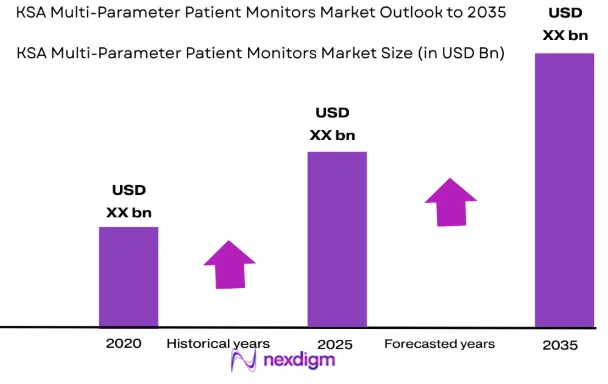
The KSA multi-parameter patient monitors market is valued at approximately USD ~ billion based on a recent historical assessment, driven by rising hospital infrastructure investments and increasing demand for real-time patient monitoring systems. The market expansion is supported by government-backed healthcare transformation programs, growing ICU capacity, and integration of digital health technologies. Demand is further strengthened by higher incidences of cardiovascular and respiratory diseases, necessitating continuous monitoring solutions across critical and non-critical care settings.
Major demand concentration is observed in cities such as Riyadh, Jeddah, and Dammam due to their advanced healthcare infrastructure, high patient inflow, and concentration of tertiary hospitals. These cities benefit from government-funded mega healthcare projects and strong private healthcare participation. Additionally, Saudi Arabia dominates regionally due to centralized healthcare policies, rapid adoption of medical technologies, and Vision 2030 initiatives that prioritize modernization of healthcare facilities and expansion of specialized treatment centers.
Market Segmentation
By System Type
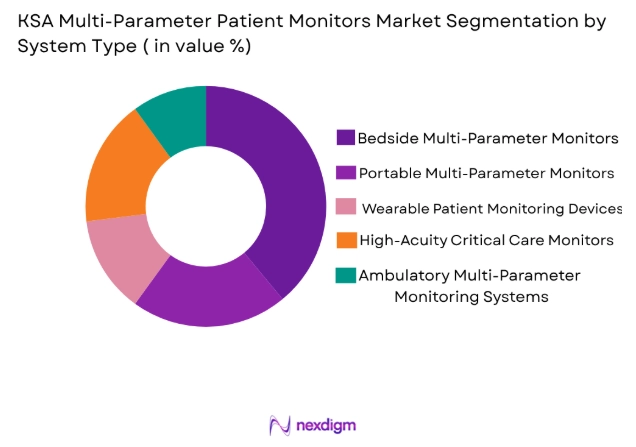
KSA multi-parameter patient monitors market is segmented by system type into bedside monitors, portable monitors, wearable monitors, high-acuity monitors, and ambulatory monitors. Recently, bedside monitors have a dominant market share due to factors such as widespread deployment in intensive care units, high reliability for continuous monitoring, and strong integration with hospital information systems. Their ability to track multiple vital parameters simultaneously makes them essential in critical care environments. Additionally, government investments in hospital infrastructure and ICU expansion further strengthen their demand across major healthcare facilities.
By End User Type
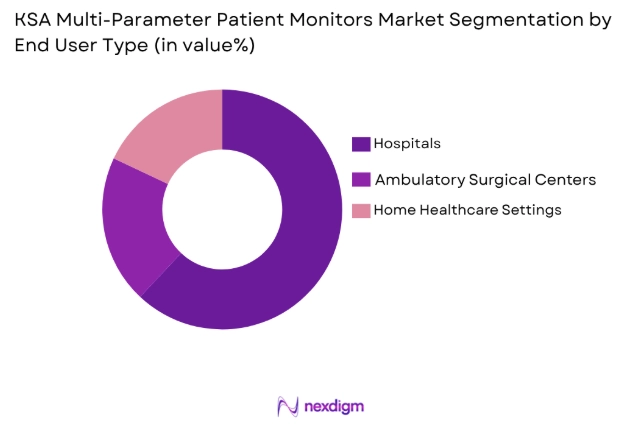
KSA multi-parameter patient monitors market is segmented by end user into hospitals, ambulatory surgical centers, and home healthcare settings. Recently, hospitals have a dominant market share due to factors such as high patient admissions, increasing ICU capacity, and availability of advanced monitoring infrastructure. Hospitals are primary purchasers due to centralized procurement systems and large-scale deployment requirements. The presence of specialized departments such as cardiology and emergency care units further drives demand. Continuous patient monitoring needs and higher budget allocations also contribute to their leading position in the market.
Competitive Landscape
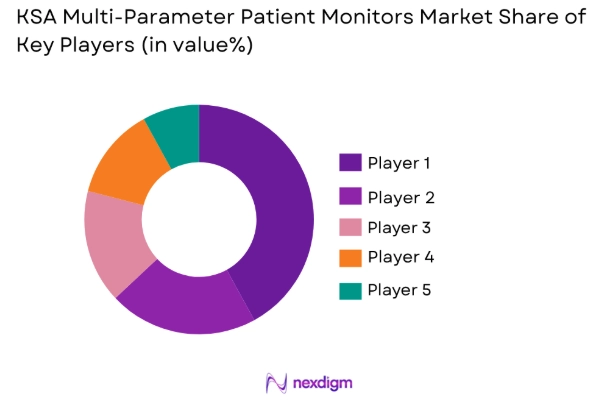
The competitive landscape of the KSA multi-parameter patient monitors market is moderately consolidated, with global players dominating through advanced technology offerings and strong distribution networks. Companies compete on innovation, pricing strategies, and integration capabilities with hospital systems. Strategic partnerships with healthcare providers and government entities enhance market penetration, while local distributors play a key role in supply chain efficiency.
| Company Name | Establishment Year | Headquarters | Technology Focus | Market Reach | Key Products | Revenue | Service Network Strength |
| Philips Healthcare | 1891 | Netherlands | ~ | ~ | ~ | ~ | ~ |
| GE HealthCare | 1892 | USA | ~ | ~ | ~ | ~ | ~ |
| Siemens Healthineers | 1847 | Germany | ~ | ~ | ~ | ~ | ~ |
| Mindray Medical | 1991 | China | ~ | ~ | ~ | ~ | ~ |
| Drägerwerk AG | 1889 | Germany | ~ | ~ | ~ | ~ | ~ |
KSA Multi-Parameter Patient Monitors Market Analysis
Growth Drivers
Expansion of Healthcare Infrastructure Under Vision 2030
The expansion of healthcare infrastructure under Vision 2030 is a primary growth driver for the KSA multi-parameter patient monitors market. The government is investing heavily in hospital construction, modernization, and digital health transformation initiatives. This has resulted in increased demand for advanced monitoring equipment across both public and private healthcare facilities. Large-scale projects such as new medical cities and specialized hospitals are driving procurement volumes. Additionally, partnerships with international healthcare providers are introducing advanced technologies into the market. Increased ICU bed capacity and emergency care expansion further support adoption. The focus on improving healthcare accessibility in rural regions is also contributing to demand. Overall, infrastructure development is creating sustained opportunities for device manufacturers and suppliers.
Rising Prevalence of Chronic Diseases and Aging Population
The rising prevalence of chronic diseases and aging population is significantly driving the adoption of multi-parameter patient monitors in Saudi Arabia. Conditions such as cardiovascular diseases, diabetes, and respiratory disorders require continuous monitoring, increasing demand for advanced systems. The growing elderly population requires long-term care solutions, including remote monitoring devices. Hospitals are increasingly investing in high-acuity monitoring systems to manage critical cases effectively. Preventive healthcare initiatives are also encouraging early diagnosis and continuous monitoring. Technological advancements in wearable and portable devices further support patient-centric care. The integration of AI and predictive analytics enhances clinical decision-making. This combination of demographic and health trends is sustaining long-term market growth.
Market Challenges
High Cost of Advanced Monitoring Systems and Budget Constraints
High cost of advanced monitoring systems and budget constraints remain a significant challenge for the KSA multi-parameter patient monitors market. Premium systems with integrated AI and connectivity features require substantial capital investment, limiting adoption among smaller healthcare facilities. Procurement processes in public hospitals can be lengthy and complex, delaying technology upgrades. Maintenance and training costs further increase the total cost of ownership. Price sensitivity in certain segments leads to preference for lower-cost alternatives, impacting premium product penetration. Currency fluctuations and import dependencies also influence pricing structures. Additionally, budget allocation priorities may shift toward other healthcare needs, affecting procurement cycles. These financial constraints create barriers to widespread adoption.
Shortage of Skilled Healthcare Professionals for Device Utilization
Shortage of skilled healthcare professionals for device utilization poses a critical challenge in the KSA multi-parameter patient monitors market. Advanced monitoring systems require trained personnel for accurate operation and data interpretation. Limited availability of specialized staff in certain regions restricts effective utilization of these devices. Training programs are often insufficient to keep pace with rapid technological advancements. This leads to underutilization of system capabilities and potential inefficiencies in patient care. Hospitals must invest additional resources in training and workforce development. Dependence on expatriate professionals further complicates workforce stability. The complexity of integrating monitoring systems with digital platforms adds to operational challenges. Addressing this skill gap is essential for maximizing system efficiency.
Opportunities
Growth of Remote Patient Monitoring and Telehealth Integration
Growth of remote patient monitoring and telehealth integration presents a significant opportunity for the KSA multi-parameter patient monitors market. Increasing demand for home-based care solutions is driving adoption of portable and wearable monitoring devices. Telehealth platforms enable real-time data transmission and remote diagnosis, enhancing patient convenience. Government initiatives promoting digital health transformation are accelerating adoption. Integration of cloud-based systems allows centralized monitoring and data analytics. This improves patient outcomes and reduces hospital burden. Technological advancements in wireless connectivity further support remote monitoring solutions. Healthcare providers are increasingly investing in telemedicine infrastructure. This trend is expected to expand the market significantly.
Integration of Artificial Intelligence and Predictive Analytics in Monitoring Systems
Integration of artificial intelligence and predictive analytics in monitoring systems is creating new growth opportunities in the KSA multi-parameter patient monitors market. AI-enabled systems enhance early detection of critical conditions and improve clinical decision-making. Predictive analytics help in identifying patient deterioration trends, enabling proactive interventions. Hospitals are increasingly adopting these technologies to improve efficiency and patient outcomes. Integration with electronic health records allows comprehensive data analysis. Continuous innovation in AI algorithms is enhancing system capabilities. Partnerships between technology providers and healthcare institutions are accelerating adoption. Regulatory support for digital health solutions further strengthens market potential. This technological evolution is expected to reshape the monitoring landscape.
Future Outlook
The market is expected to witness steady growth over the next five years, supported by continuous healthcare investments and digital transformation initiatives. Advancements in AI, cloud connectivity, and wearable monitoring technologies will enhance system capabilities and adoption. Regulatory support for healthcare modernization will further strengthen market expansion. Increasing demand for remote monitoring and personalized care solutions will drive innovation. The market is likely to evolve toward integrated, data-driven healthcare ecosystems.
Major Players
- Philips Healthcare
- GE HealthCare
- Siemens Healthineers
- Drägerwerk AG
- Mindray Medical International Limited
- Nihon Kohden Corporation
- Masimo Corporation
- Schiller AG
- Spacelabs Healthcare
- Fukuda Denshi Co., Ltd.
- Edan Instruments, Inc.
- BPL Medical Technologies
- Medtronic plc
- Omron Healthcare
- Hillrom
Key Target Audience
- Hospitals and healthcare providers
- Medical device distributors
- Private healthcare investors
- Investments and venture capitalist firms
- Government and regulatory bodies
- Telehealth service providers
- Healthcare infrastructure developers
Research Methodology
Step 1: Identification of Key Variables
Key variables influencing the KSA multi-parameter patient monitors market were identified through industry databases and healthcare reports. Demand drivers, technological trends, and regulatory factors were analyzed. This step ensured a structured approach to data collection and modeling.
Step 2: Market Analysis and Construction
Market data was collected from secondary sources including financial reports, healthcare statistics, and government publications. The market was constructed using bottom-up and top-down approaches. Cross-validation ensured consistency and accuracy of estimates.
Step 3: Hypothesis Validation and Expert Consultation
Findings were validated through interviews with industry experts, healthcare professionals, and distributors. Assumptions were refined based on expert feedback. This step enhanced reliability and minimized data discrepancies.
Step 4: Research Synthesis and Final Output
All data points were synthesized into a comprehensive framework. Analytical models were applied to derive insights and forecasts. The final output was structured to provide actionable intelligence and strategic clarity.

- Executive Summary
- Research Methodology (Definitions, Scope, Industry Assumptions, Market Sizing Approach, Primary & Secondary Research Framework, Data Collection & Verification Protocol, Analytic Models & Forecast Methodology, Limitations & Research Validity Checks)

- Market Definition and Scope
- Value Chain & Stakeholder Ecosystem
- Regulatory / Certification Landscape
- Sector Dynamics Affecting Demand
- Strategic Initiatives & Infrastructure Growth

- Growth Drivers
Increasing prevalence of chronic diseases requiring continuous monitoring
Expansion of healthcare infrastructure under Vision 2030 initiatives
Rising adoption of advanced digital and connected healthcare technologies - Market Challenges
High initial costs of advanced monitoring systems
Shortage of skilled healthcare professionals for device operation
Data privacy and cybersecurity concerns in connected monitoring systems - Market Opportunities
Growing demand for remote patient monitoring solutions
Integration of AI and predictive analytics in monitoring systems
Expansion of private healthcare sector and medical tourism - Trends
Shift toward wireless and wearable patient monitoring technologies
Adoption of cloud-based data management and real-time analytics - Government Regulations
- SWOT Analysis
- Porter’s Five Forces

- By Market Value, 2020-2025
- By Installed Units, 2020-2025
- By Average System Price, 2020-2025
- By System Complexity Tier, 2020-2025

- By System Type (In Value%)
Bedside Multi-Parameter Monitors
Portable Multi-Parameter Monitors
Wearable Patient Monitoring Devices
High-Acuity Critical Care Monitors
Ambulatory Multi-Parameter Monitoring Systems - By Platform Type (In Value%)
Standalone Monitoring Systems
Integrated Monitoring Platforms
Cloud-Connected Monitoring Systems
Wireless Monitoring Platforms
AI-Enabled Monitoring Systems - By Fitment Type (In Value%)
Fixed Bedside Systems
Mobile Cart-Based Systems
Handheld Monitoring Devices
Wearable Monitoring Solutions - By End User Segment (In Value%)
Hospitals and Clinics
Ambulatory Surgical Centers
Home Healthcare Settings

- Market Share Analysis
- Cross Comparison Parameters (Product Portfolio Breadth, Pricing Strategy, Technological Innovation, Distribution Network Strength, After-Sales Service Support, Regulatory Compliance Capability, Strategic Partnerships, Product Reliability and Accuracy, Integration with Hospital Information Systems, R&D Investment Intensity, Brand Reputation and Market Presence, Customization Capabilities, Training and Technical Support Services, Supply Chain Efficiency, Digital Connectivity and Interoperability)
- SWOT Analysis of Key Competitors
- Pricing & Procurement Analysis
- Key Players
Philips Healthcare
GE HealthCare
Siemens Healthineers
Drägerwerk AG
Mindray Medical International Limited
Nihon Kohden Corporation
Masimo Corporation
Schiller AG
Spacelabs Healthcare
Fukuda Denshi Co., Ltd.
Edan Instruments, Inc.
BPL Medical Technologies
Medtronic plc
Omron Healthcare
Hillrom (Baxter International Inc.)

- Increasing adoption of monitoring systems in tertiary care hospitals
- Rising demand from home healthcare providers for remote monitoring
- Growth in outpatient care centers requiring portable monitoring solutions
- Integration of monitoring systems in specialized care units such as ICUs and NICUs

- Forecast Market Value, 2026-2035
- Forecast Installed Units, 2026-2035
- Forecast Average System Price, 2026-2035
- Future Demand by System Complexity Tier, 2026-2035


 Request a Sample
 Ask for Customization
 Get a Quote
 Enquire Now