
 Download PDF
 Download PDF
Market Overview
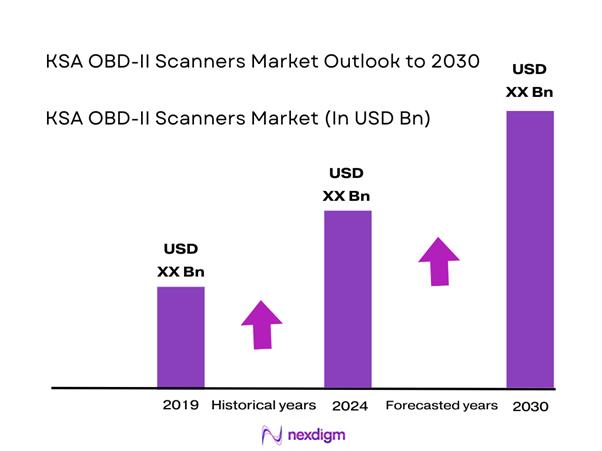
The KSA OBD-II Scanners market is valued at USD ~ million in the prior year and USD ~ million in 2024, based on historical series for Saudi Arabia OBD-II scanners and its stated latest-year value. Demand is being driven by a growing installed base of OBD-II–compliant vehicles, higher electronic content (ECUs, gateways, sensors) that increases diagnostic complexity, and the shift from “symptom-based repair” to code-led fault isolation in workshops, fleets, and used-car pre-purchase inspections.
Demand concentrates in Riyadh, Jeddah, and the Dammam–Khobar–Dhahran cluster because they have the highest density of dealership service centers, independent workshop networks, fleet operators (corporate, logistics, rentals), and multi-brand used-car activity—all of which require faster diagnostics, emissions-readiness checks, and repeatable workflows. In these metros, workshop throughput pressure makes handheld scanners and consumer adapters attractive for quick DTC reads, while larger garages and fleet maintenance hubs adopt multi-system tools to cover broader vehicle makes and reduce rework.
Market Segmentation
By Product Form Factor / Tool Class
KSA OBD-II scanners are segmented by tool class into handheld scanners, Bluetooth/wireless adapters, and professional dealer-grade platforms. Recently, handheld scanners have a dominant share because they offer the best fit for the Saudi aftermarket’s high-volume operating model—quick DTC + readiness checks, faster bay turnover, and broad compatibility for mixed fleets and used vehicles. They also match procurement behavior in independent workshops: tools are purchased as capex items with predictable utility, while subscriptions are minimized unless needed for programming or advanced functions. Handheld scanners are identified as the largest segment in the market.

By End User
The market is segmented by end user into DIY/consumer, independent garages, and OEM/dealership workshops. The DIY/consumer segment is currently dominant because OBD-II adapters and entry handheld tools are widely used for basic fault-code reads, check-engine light resets, and pre-purchase used-car checks—especially in a market where buyers increasingly want quick diagnostic assurance before committing to a vehicle. For fleets and workshops, consumer-led demand also creates a “pull effect” where garages must confirm codes, perform readiness checks, and document issues more transparently. DIY/consumer is identified as the largest end-user category in Saudi Arabia OBD-II scanners.

Competitive Landscape
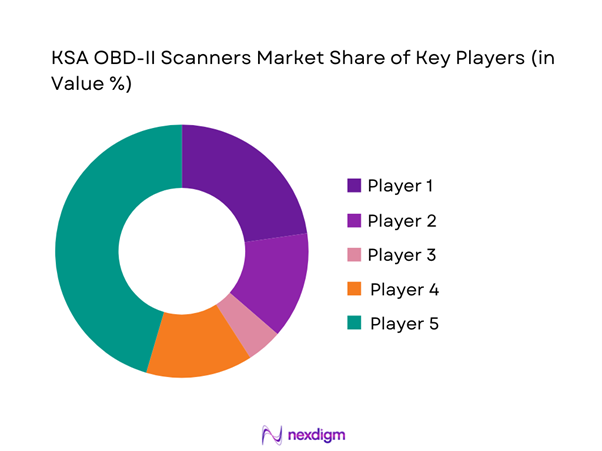
The KSA OBD-II Scanners market is moderately consolidated at the premium end, where professional-grade platforms compete on coverage depth, update cadence, guided diagnostics, and programming support. At the value end, competition is broad with many brands pushing Bluetooth dongles and entry handhelds through e-commerce and accessory retail, while workshop-focused distributors compete on training, warranty handling, and Arabic/field support.
| Company | Est. Year | HQ | Primary Tool Focus | Coverage Depth (Asian/Euro/US makes) | Update/Subscription Model | KSA Channel Strength | Workshop Enablement | Typical Buyer Fit |
| Autel | 2004 | China | ~ | ~ | ~ | ~ | ~ | ~ |
| Launch Tech | 1992 | China | ~ | ~ | ~ | ~ | ~ | ~ |
| Bosch | 1886 | Germany | ~ | ~ | ~ | ~ | ~ | ~ |
| Snap-on | 1920 | USA | ~ | ~ | ~ | ~ | ~ | ~ |
| TOPDON | 2017 | China | ~ | ~ | ~ | ~ | ~ | ~ |
KSA OBD-II Scanners Market Analysis
Growth Drivers
Vehicle Electronics Content Growth
Saudi Arabia’s expanding on-road vehicle base is mechanically “diagnostics-hungry” because more vehicles means more ECUs, sensors, and fault-code events flowing into workshops and fleets. The number of registered and roadworthy vehicles reached ~ million at the end of the latest reported period, up from ~ million in the prior period, while new vehicle registrations reached ~ thousand within the same reporting year—adding large volumes of modern, OBD-dependent platforms into circulation. On the macro side, Saudi Arabia’s GDP was USD ~ trillion and GDP per capita was USD ~, supporting sustained vehicle utilization, aftermarket spend, and professionalization of repair operations that increasingly require scan tools for routine troubleshooting, emissions-related checks, and electronic service resets.
Workshop Digitization
Workshop digitization in Saudi Arabia is accelerating because the economy is processing higher volumes of digital transactions, enabling workshops to standardize workflows (digital estimates, payments, invoices) and invest in connected diagnostics (subscriptions, cloud updates, remote support). National payment rails provide a measurable proxy for this shift: electronic non-cash retail payment transactions reached ~ billion, compared with ~ billion in the prior period, indicating broader normalization of digital tools across SMEs—including garages, service chains, and parts retailers that bundle scan services with maintenance. Meanwhile, the national macro backdrop—population of ~ and a large urban concentration—supports higher workshop density and faster adoption of standardized digital service processes that increasingly rely on OBD data capture, job-card automation, and scan reports as proof-of-work for customers and fleet accounts.
Challenges
Counterfeit and Grey Market Risk
Counterfeit electronics, cloned scan tools, and grey-market subscriptions degrade trust and can cause diagnostic misreads, bricked ECUs, or unsafe repairs—especially when workshops chase lower-cost devices for a highly diverse parc. The enforcement environment signals the scale of the issue: authorities reported ~ suspected customs shipments, and ~ shipments confirmed to contain products violating trademark systems, with ~ million counterfeit products identified in shipments violating IP rights. For a service tool category like OBD scanners—where firmware authenticity and secure update channels matter—this level of counterfeit flow increases risk of non-compliant imports, encourages informal procurement behavior, and forces professional workshops to invest in authentication practices, authorized distribution, and documented tool provenance to protect fleet and insurer relationships.
Tool Compatibility Fragmentation
Compatibility fragmentation is acute in Saudi Arabia because the parc is large, rapidly renewing, and heterogeneous—forcing workshops to handle multiple protocols, brand-specific modules, and model-year variations that low-end scanners can’t cover reliably. The newest wave of vehicles is large enough to constantly refresh the mix: ~ thousand vehicles were registered as a new issue in the latest reporting year, and new driving licenses issued for the first time exceeded ~ thousand, indicating expanding driver base and sustained vehicle circulation. This churn increases demand for scanners that can handle multi-brand coverage, CAN variants, advanced service functions, and consistent DTC libraries. It also increases operational complexity for workshop chains that need standardized tool stacks across branches in high-volume regions like Riyadh and Makkah—where license issuance is concentrated—making procurement and technician standardization harder without enterprise-grade platforms.
Opportunities
Managed Diagnostics-as-a-Service for Fleets
A managed diagnostics-as-a-service model (centralized tooling, standardized scan workflows, remote triage, scheduled health checks, and compliance reporting) is commercially attractive because Saudi fleets operate in a high-utilization road ecosystem with measurable freight and cross-border intensity. The operating backdrop supports service-contract models: road freight imports through land ports reached ~ million tons and exports reached ~ million tons, while registered and roadworthy vehicles reached ~ million—a scale that favors outsourced, standardized diagnostics for fleet operators who want predictable uptime. The broader payments and digitization environment also supports recurring service models: ~ billion non-cash payment transactions indicate mature digital rails for subscription billing and enterprise invoicing. Providers that package scanners, secure updates, technician SOPs, and remote support into SLAs can win fleet accounts by reducing downtime variability and improving auditability of maintenance decisions.
Arabic User Interface and Local Training Bundles
Arabic-first user experience and local training bundles are a high-leverage growth lever because scanner value realization depends on technician comprehension (menus, guided tests, repair flows) and on standardized reporting for customers and fleets. Saudi Arabia’s scale makes localization economically meaningful: population is ~, and the vehicle ecosystem is vast with ~ million registered and roadworthy vehicles, implying high density of end-users across workshops, mobile technicians, and fleet maintenance teams. Meanwhile, the vocational pipeline is large—more than ~ trainees enrolled—creating a sizable audience for structured diagnostic curricula (OBD fundamentals, safe procedures, module coding basics, secure access workflows). Vendors that bundle Arabic UI, Saudi-relevant fault libraries, and localized training and assessment can reduce misdiagnosis risk and accelerate adoption beyond premium workshops into mid-tier garages that currently underutilize scan capabilities.
Future Outlook
Over the next planning cycle, the KSA OBD-II scanners market is expected to expand as vehicles become more software-defined and repair workflows shift toward data-driven diagnostics. Tool differentiation will increasingly move from “reads codes” to multi-system coverage, guided tests, topology mapping, secure gateway access (where applicable), and workflow documentation for fleets and quality assurance. Based on the Saudi market trajectory shown by historical market series, the market’s implied growth from USD ~ million to the level indicated for the later period supports a high-single-digit expansion trend.
Major Players
- Autel
- Launch Tech
- Bosch
- Snap-on
- TOPDON
- Foxwell
- Innova Electronics
- ANCEL
- BlueDriver
- iCarsoft
- Thinkcar
- Actron
- OTOFIX
- OBDLink
Key Target Audience
- Independent workshop chains & multi-branch garages
- Fleet operators
- Car rental & leasing companies
- Dealership service groups & authorized service centers
- Used-car retailers and pre-purchase inspection networks
- Automotive aftermarket distributors & tool importers
- Investments and venture capitalist firms
- Government and regulatory bodies
Research Methodology
Step 1: Identification of Key Variables
We map the KSA diagnostics ecosystem across DIY consumers, garages, dealerships, fleets, and distributors, and define variables such as tool class mix, vehicle parc complexity, and workshop throughput requirements. Desk research is used to align definitions (OBD-II scope, scanner classes) and finalize assumptions for revenue measurement.
Step 2: Market Analysis and Construction
We build the market using a bottom-up structure: tool shipments and sales by class, channel mix (retail, e-commerce, distributor), and average realized pricing by tier. We cross-check with supply-side indicators such as distributor portfolios and service coverage expectations for multi-make tools.
Step 3: Hypothesis Validation and Expert Consultation
Hypotheses on dominant segments (handheld vs adapters vs pro tablets; DIY vs garages) are validated via structured interviews with workshop owners, distributor sales heads, and fleet maintenance leads to confirm purchase triggers, renewal behavior, and feature value.
Step 4: Research Synthesis and Final Output
We synthesize findings into segment sizing, competitive benchmarking, and adoption roadmaps, then triangulate the output against published market series for Saudi Arabia OBD-II scanners to ensure consistency and defendability.

- Executive Summary
- Research Methodology (Market Definitions and Assumptions, Abbreviations, Scope Boundaries, Data Triangulation Framework, Bottom-Up Unit Economics Build, Top-Down Spend Reconciliation, Primary Research Mix, Channel Price Capture, Limitations and Confidence Scoring)

- Definition and Scope
- Market Genesis and Evolution
- Ecosystem Timeline
- Business Cycle Mapping
- Supply Chain and Value Chain

- Growth Drivers
Vehicle Electronics Content Growth
Workshop Digitization
Fleet Uptime Requirements
EV and Hybrid Service Readiness
E-Commerce Tool Accessibility - Challenges
Counterfeit and Grey Market Risk
Tool Compatibility Fragmentation
Secure Gateway and Authorization Barriers
Firmware and Subscription Cost Sensitivity
Limited Advanced Calibration Skills - Opportunities
Managed Diagnostics-as-a-Service for Fleets
Arabic User Interface and Local Training Bundles
EV Battery and BMS Diagnostics Add-ons
Remote Support and Cloud Diagnostics
Ruggedized Field Kits for Mobile Mechanics - Trends
Bidirectional and Topology Mapping Adoption
Secure Gateway Authentication Toolchains
Subscription-Based Software Models
Bluetooth Dongle Ecosystems
Tablet-Based Workshop Workflows - Regulatory & Policy Landscape
- SWOT Analysis
- Stakeholder & Ecosystem Analysis
- Porter’s Five Forces Analysis
- Competitive Intensity & Ecosystem Mapping

- By Value, 2019–2024
- By Units Shipped, 2019–2024
- By Average Selling Price, 2019–2024
- By Customer Tier, 2019–2024
- By Channel Mix, 2019–2024

- By Fleet Type (in Value %)
Passenger Cars
Light Commercial Vehicles
Heavy Commercial Vehicles
Buses and Coaches
Mixed Fleets - By Application (in Value %)
Diagnostic Code Reading
Multi-System Diagnostics
ECU Coding and Programming
Inspection and Emissions Readiness
Preventive and Predictive Maintenance - By Technology Architecture (in Value %)
Basic Code Readers
Enhanced Multi-System Scanners
Professional Diagnostic Tablets
J2534 Pass-Thru Interfaces
Bluetooth and Wi-Fi Dongles - By Connectivity Type (in Value %)
CAN-Based Diagnostics
K-Line and Legacy Protocols
UDS-Based Diagnostics
DoIP-Ready Diagnostics
Wireless Diagnostics - By End-Use Industry (in Value %)
Independent Workshops
Authorized Dealership Service Centers
Fleet Maintenance Operators
Inspection and Testing Centers
Training and Educational Institutes - By Region (in Value %)
Central Region
Western Region
Eastern Region
Northern Region
Southern Region

- Market Share Snapshot
Competitive Positioning Map - Cross Comparison Parameters (Vehicle Coverage Database Depth, Bidirectional Function Breadth, ECU Coding and Programming Readiness, Secure Gateway Handling Capability, Update Cadence and Subscription Structure, Hardware Ruggedness, After-Sales Footprint in KSA, Channel Strength)
- Pricing and Packaging Benchmark
- SWOT Analysis of Key Players
- Channel and Partnership Benchmark
- Detailed Profiles of Major Companies
Autel
LAUNCH
Bosch
Snap-on
TEXA
Jaltest
Hella Gutmann
TOPDON
THINKCAR
Foxwell
OBDLink
Carly
Innova
iCarsoft

- Demand and Utilization Mapping
- Buying Criteria and Decision Tree
- Budgeting and Procurement Mechanics
- Pain Points and Failure Modes
- Channel Preferences

- By Value, 2025–2030
- By Units Shipped, 2025–2030
- By Average Selling Price, 2025–2030
- By Customer Tier, 2025–2030
- By Channel Mix, 2025–2030


 Request a Sample
 Ask for Customization
 Get a Quote
 Enquire Now