
 Download PDF
 Download PDF
Market Overview
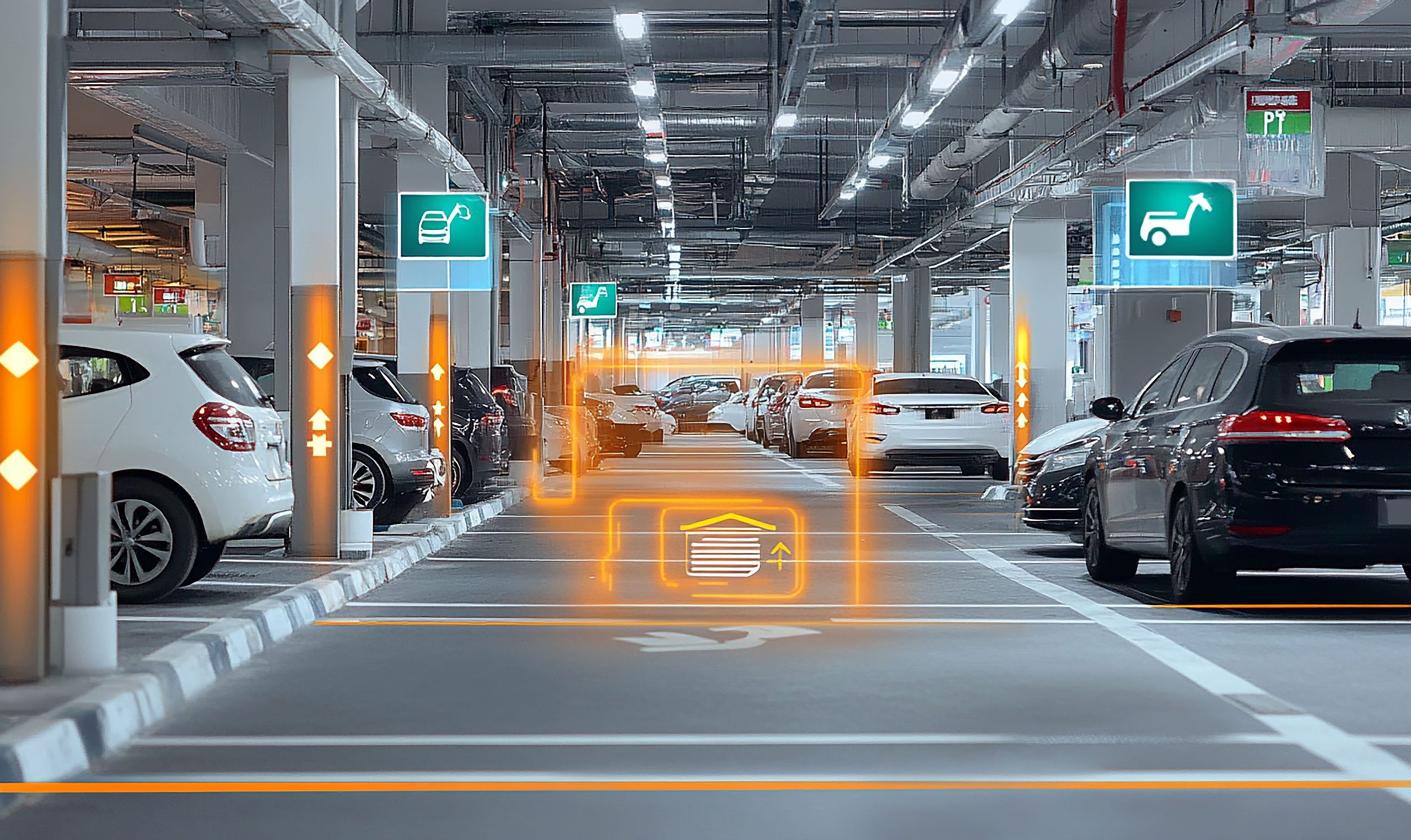
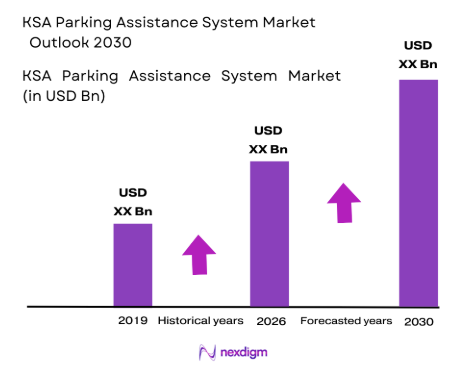
The KSA Parking Assistance System market has witnessed significant growth in recent years, driven by increased vehicle ownership, urbanization, and advancements in automotive technologies. With a growing focus on smart city initiatives and improved traffic management, the market is experiencing accelerated adoption of parking assistance solutions. The market size for KSA parking assistance systems is expected to reach approximately USD ~ billion by 2024. This growth is fuelled by the increasing need for advanced parking technologies in the region’s major cities, where congestion and limited parking space are becoming significant challenges.
The dominant cities in the KSA Parking Assistance System market include Riyadh, Jeddah, and Dammam. Riyadh, as the capital city, leads in terms of both technological integration and demand for smart mobility solutions due to its rapid urbanization and government-driven smart city projects under Vision 2030. Jeddah, a key commercial hub, is following closely with infrastructure development aimed at reducing traffic congestion. Dammam, as an economic centers in the Eastern Province, is also witnessing a rise in the implementation of parking assistance systems due to its growing automotive market and evolving urban planning initiatives.
Market Segmentation
By Product Type
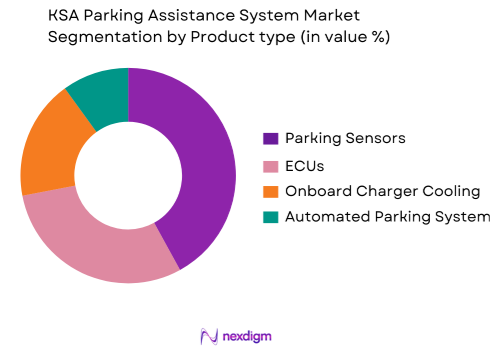
The KSA Parking Assistance System market is primarily segmented by product type, which includes parking sensors, cameras, electronic control units (ECUs), and automated parking systems. Among these, parking sensors hold a dominant share in the market due to their cost-effectiveness and widespread adoption in both OEM and aftermarket segments. These sensors, which include ultrasonic and radar sensors, are integral to many entry-level and mid-range vehicles. Their continued popularity is attributed to their reliability and affordability in providing essential parking assistance functions such as proximity detection and collision avoidance.
By Technology Type
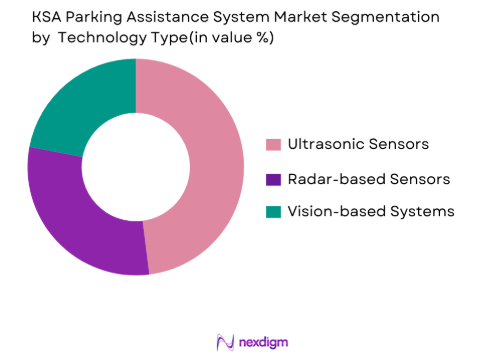
The market is also segmented by technology type, which includes ultrasonic sensors, radar-based sensors, and vision-based systems (cameras). Ultrasonic sensors currently hold the largest market share, driven by their reliability, low cost, and ease of integration into vehicles. These sensors are capable of detecting objects in close proximity, making them ideal for low-speed parking scenarios, which are the most common in Saudi cities due to traffic congestion and limited parking space. Their simple installation and low maintenance costs contribute to their popularity across a wide range of vehicle segments, from economy cars to luxury models.
Competitive Landscape
The KSA Parking Assistance System market is highly competitive, with several global and regional players offering solutions across different product types and technologies. The market is consolidated among a few key global automotive and technology companies, along with regional players who provide tailored solutions for the Saudi market. The competition is centred around providing cost-effective, reliable, and innovative parking solutions that meet the demands of the growing automotive sector in the Kingdom.
| Company | Year Established | Headquarters | Technology Focus | ~ | ~ | ~ | ~ |
| Bosch | 1886 | Germany | Sensors, Cameras, ECUs | ~ | ~ | ~ | ~ |
| Valeo | 1923 | France | Radar, Ultrasonic Sensors | ~ | ~ | ~ | ~ |
| Continental | 1871 | Germany | Parking Sensors, ECUs | ~ | ~ | ~ | ~ |
| Denso | 1949 | Japan | Cameras, ECUs | ~ | ~ | ~ | ~ |
| ZF Friedrichshafen | 1915 | Germany | Radar-based Sensors |
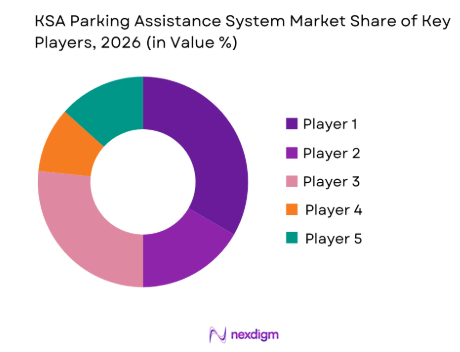
KSA Parking Assistance System Market Analysis
Growth Drivers
Urbanization & Vehicle Ownership Expansion
Saudi Arabia’s rapid urbanization is significantly driving the demand for parking assistance systems. In 2024, Saudi Arabia’s population surpassed ~million people, with around 70% living in urban areas. This increase in urban population is coupled with the surge in vehicle ownership, which in 2024 saw over ~million vehicles on the road. The rising number of vehicles, especially in major cities like Riyadh and Jeddah, directly contributes to the demand for parking assistance solutions. Urban congestion is a key challenge, which leads to an increased need for efficient parking systems to optimize space usage.
Saudi Arabia is aggressively pursuing smart city developments
The Saudi government, through initiatives such as Vision 2030, is driving smart city projects in cities like Neom, Riyadh, and Jeddah. By 2025, Saudi Arabia aims to integrate digital parking solutions in all urban areas as part of its smart mobility objectives. This push is further supported by the government’s plan to implement IoT-based solutions in urban management, which includes real-time parking data, smart parking meters, and cloud-based systems to improve parking efficiency.
Market Challenges
Infrastructure Retrofitting Costs
One of the biggest challenges facing the adoption of parking assistance systems in Saudi Arabia is the high cost of retrofitting existing parking infrastructure. Many parking lots, especially in older urban areas, were not designed to support modern parking technologies. Retrofitting these sites with IoT sensors, automated parking solutions, and real-time payment systems requires significant investment. In 2024, the average cost of upgrading a single parking space in a city centre with smart technology was around USD ~. Despite the high costs, the need for modernization remains a key driver for the market, particularly in urban centres facing severe parking shortages.
Data Standardization & Interoperability
The rapid growth in parking technology systems has resulted in data fragmentation across various service providers, creating challenges in interoperability. Many parking systems in Saudi Arabia operate on proprietary platforms that do not easily integrate with other systems, particularly in multi-functional smart cities. This lack of standardization makes it difficult for smart parking systems to work seamlessly across various regions and providers. As of 2023, 70% of parking facilities in Riyadh faced compatibility issues between parking payment systems and enforcement technologies, which hindered smooth operational integration. The lack of data standardization has created a barrier to the scalability of parking systems across the nation.
Opportunities
PPP Models for Public Parking Deployment
Saudi Arabia is increasingly relying on Public-Private Partnerships (PPP) to finance the development of smart parking infrastructure. The government’s recent push for sustainable development and urban mobility has led to a series of PPP initiatives in cities like Riyadh and Jeddah. These partnerships focus on deploying smart parking systems that integrate sensors, real-time data analytics, and automated payment systems. As of 2024, over 60% of new parking facility projects in Riyadh were being funded through PPPs, which not only alleviate the financial burden on public funds but also attract private investment in technology-driven infrastructure.
EV-Ready Parking Assist Integration
As the adoption of electric vehicles (EVs) grows in Saudi Arabia, there is an increasing need for EV-ready parking systems that provide charging stations integrated with parking assist technologies. In 2024, the number of EVs on the road in Saudi Arabia reached 10,000 vehicles, and the government aims to have over 200,000 EVs on the road by 2025. With this growth, the demand for EV-compatible parking solutions is rapidly increasing. As a result, parking facilities are increasingly investing in integrated charging stations and automated parking systems that cater to the needs of EV owners, creating a significant market opportunity.
Future Outlook
Over the next five years, the KSA Parking Assistance System market is expected to show significant growth driven by ongoing government initiatives supporting smart city developments, increased investments in infrastructure, and rising demand for advanced driver assistance systems (ADAS). With the ongoing efforts to improve urban mobility under Vision 2030, the market is poised for a steady increase in the adoption of automated and semi-automated parking solutions. Additionally, as consumer preference shifts towards eco-friendly technologies and safety features, the demand for smart parking solutions will continue to rise.
Major Players
- Bosch
- Valeo
- Continental
- Denso
- ZF Friedrichshafen
- Aptiv
- Magna International
- Lear Corporation
- Harman International
- NXP Semiconductors
- Delphi Technologies
- Honeywell
- Al-Jazira Oil & Gas
- United Oil Processing and Packaging
- Aujan Group
Key Target Audience
- Investments and Venture Capitalist Firms
- Government and Regulatory Bodies
- OEM Vehicle Manufacturers
- Automotive Tier-1 Suppliers
- Parking Infrastructure Operators
- Smart City Developers
- Fleet Management Companies
- Private Parking Operators
Research Methodology
Step 1: Identification of Key Variables
This phase includes constructing an ecosystem map and identifying key variables affecting the KSA Parking Assistance System market. Desk research combined with secondary data from industry reports and market databases is used to outline market dynamics. The key focus is on segmenting the market based on product type, technology, and regional adoption patterns.
Step 2: Market Analysis and Construction
Data collection from both primary and secondary sources is consolidated, followed by analyzing market penetration rates, product adoption, and revenue generation by segment. The historical data is then examined to project future market growth and trends.
Step 3: Hypothesis Validation and Expert Consultation
Expert opinions are gathered from industry leaders, OEMs, and suppliers via structured interviews and surveys. This step ensures that market assumptions are verified through real-world insights, allowing for accurate forecasting.
Step 4: Research Synthesis and Final Output
The data synthesis phase involves engaging with key stakeholders and reviewing the market findings. Detailed interaction with manufacturers and technology providers ensures the reliability and completeness of the final market analysis.

- Executive Summary
- Research Methodology (Market Scope & Definitions, Assumptions & Limitation Boundaries, Segmentation & Taxonomy Framework, Data Capture Method, Primary/Secondary Research Balance, Forecasting Logic, Industry Interview Matrix, Competitive Benchmarking Method)

Growth Drivers Technologies.
Market Segments.
Competitive Landscape
Regulatory Environment
Challenges
Economic Impact

- Growth Drivers
Urbanization & vehicle ownership expansion
Smart city mandates & parking digitization
Safety compliance & insurance incentive alignment
IoT/AI adoption in parking operations
- Market Challenges
Infrastructure retrofitting costs
Data standardization & interoperability
Regulatory compliance complexity - Opportunities
PPP models for public parking deployment
EV‑ready parking assist integration
AI‑Powered space optimization solution - Trends
Connected parking assist
Predictive space allocation
AI/ML‑aided guidance
Mobile UX + reservation systems

- Total Parking Assistance System Market Value & Volume, 2019-2025
- By Revenue Band, 2019-2025
- By Deployment Type, 2019-2025
- By System Intelligence Level, 2019-2025

- By System Type (In Value %)
Parking Assist Sensors (Ultrasonic/Radar/Camera)
Guidance & Navigation Assist ECUs
Automated Parking & Guided Park Assist
Infrastructure Smart Parking Interface Systems
Fleet & Valet Assist Platforms - By Technology Stack (In Value %)
Ultrasonic
Radar & LiDAR
Vision & AI Imaging
ECU & software fusion
Data analytics & cloud platforms - By End‑User Type (In Value %)
OEM Automotive Manufacturers
Aftermarket Distributors & Service Providers
Parking Infrastructure Operators
Commercial Fleet Operators
Government/Smart City Deployments - By Distribution Channel (In Value %)
OEM
Aftermarket
Direct Integration
System Integrators - By Region (In Value %)
Riyadh
Jeddah
Eastern Province
Makkah/Medina Other Urban Centres

- Market Share & Volume
- Cross‑Comparison Parameters (Company Profile & Local Footprint, Technology, Portfolio Breadth, R&D & Innovation Index, Installed Base & Penetration Rate, Pricing & Value Proposition Matrix, OEM & Infrastructure Partnerships, Channel Reach & Support Ecosystem, Localization & Compliance Certifications)
- SWOT Analysis of Key Players
- Pricing & Yield Analysis by Segment
- Porter’s Five Forces
- Detailed Company Profiles
Bosch
Valeo
Continental
Denso
ZF Friedrichshafen
Mobileye/Intel
Aptiv
Nexparking Systems
Omnitec Group
NParking
Nedap FZE
Cisco saudi
Makani Parking
Smart Parking Co.
Woqoof

- Regional Demand & Utilization Index
- Purchasing Behaviour & Budget Trends
- Compliance & Safety Priorities
- Pain Points & Feature Expectation Mapping
- Decision‑Making Ecosystem

- By System Type, 2026-2030
- By Technology Segment, 2026-2030
- By End‑User Type, 2026-2030
- By Deployment Channel, 2026-2030
- Regional Forecast MAP, 2026-2030


 Request a Sample
 Ask for Customization
 Get a Quote
 Enquire Now