
 Download PDF
Market Overview
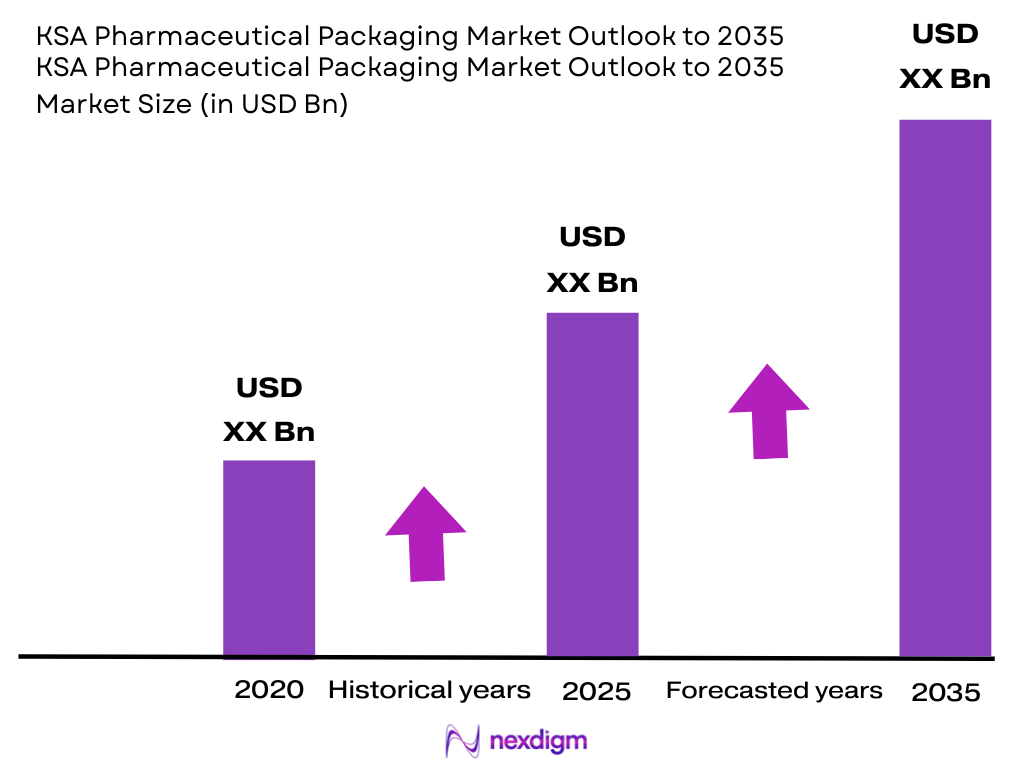
The KSA Pharmaceutical Packaging Market reached USD ~ Billion in 2024 and is projected to reach approximately USD ~ Billion by 2033, reflecting a compound annual growth rate of approximately 8.2% during 2025-2033. The market is being transformed by Vision 2030’s push for localized drug manufacturing, with the Saudi Food and Drug Authority (SFDA) reporting that approximately 68% of newly registered drugs in the first quarter of 2024 were produced domestically. Official industrial data indicate 206 pharmaceutical and medical device factories now operating in the Kingdom, with total investments of approximately SAR 10 billion, as pharmaceuticals and medical devices remain among 12 strategic industrial sectors prioritized for localization under the National Industrial Strategy. The Ministry of Industry and Mineral Resources reported that domestic pharmaceutical production capacity grew by approximately 35% in 2023 alone, requiring substantial new investment in advanced packaging lines to support this rapidly expanding manufacturing base.
Market Segmentation
By Material
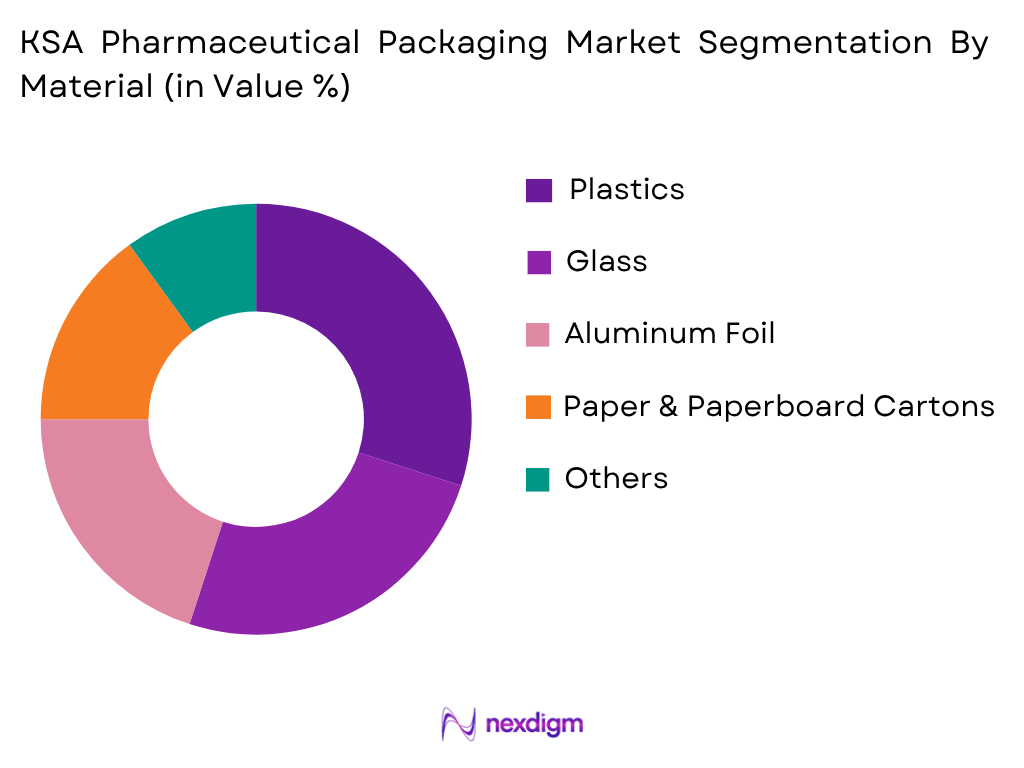
Plastic materials, primarily used in blister films and bottles, hold a substantial share of the KSA Pharmaceutical Packaging Market, supported by their cost-effectiveness and compatibility with the fully automated packaging systems increasingly installed by domestic manufacturers such as Jamjoom Pharma, whose new 120 million unit per year oral solid dosage facility features automated packaging equipment sourced from international suppliers including Uhlmann and Marchesini. Glass packaging, encompassing vials and ampoules, is gaining particular importance as Saudi Arabia’s noncommunicable disease burden continues to grow, with rising rates of chronic conditions strongly associated with parenteral therapies requiring sterile vials, cartridges, and prefilled syringes. Julphar’s 2024 announcement of an $80 million investment to establish a biotechnology and pharmaceutical manufacturing facility in the Kingdom, emphasizing biologics and sterile formulations, further underscores the growing importance of high-specification glass and elastomer primary packaging within the Saudi market. Aluminum foil and paperboard cartons continue to serve essential blister lidding and secondary packaging functions across the Kingdom’s rapidly expanding generics manufacturing base.
By Product Type
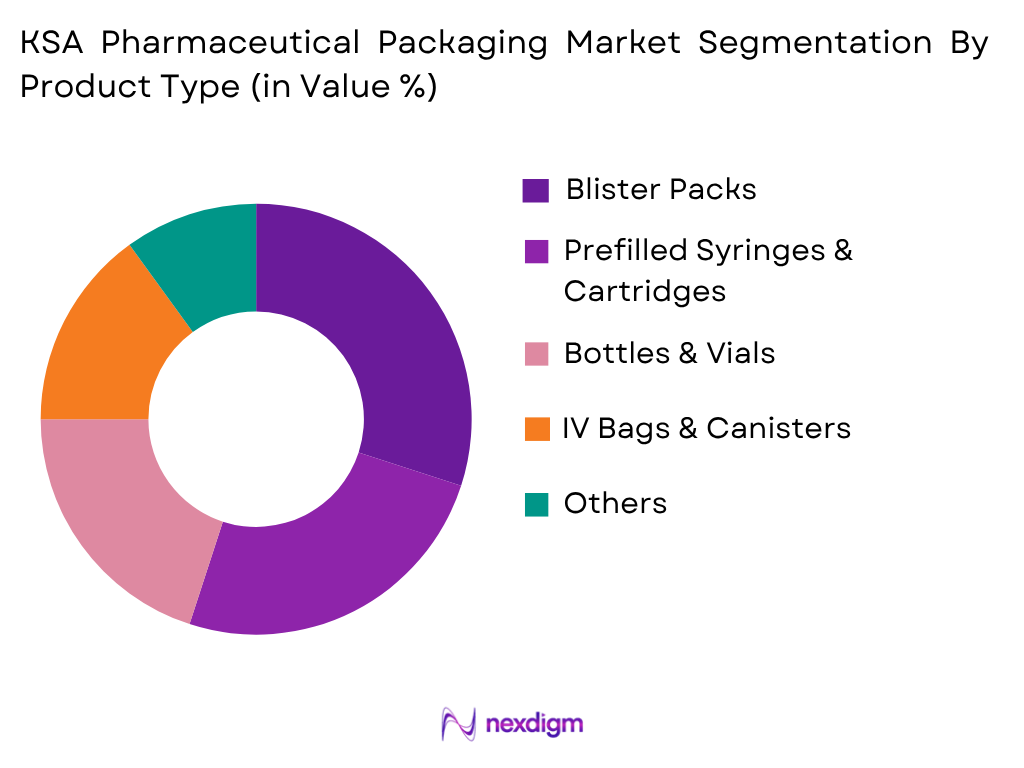
Blister Packs represent the largest product-type segment in the KSA Pharmaceutical Packaging Market, directly reflecting the scale of investment domestic manufacturers have committed to solid oral dosage production. SPIMACO, the largest Saudi-owned pharmaceutical company, invested approximately $150 million to expand its Riyadh facility with state-of-the-art blister packaging lines, while Jamjoom Pharma’s new automated facility adds substantial additional blister packaging capacity to the domestic market. Prefilled Syringes & Cartridges represent an increasingly important growth segment, driven by Saudi Arabia’s rising noncommunicable disease burden and growing domestic investment in sterile and biologic manufacturing capability. Bottles & Vials and IV Bags & Canisters maintain significant shares supporting the Kingdom’s hospital and public healthcare procurement channels, which continue to expand as National Unified Procurement Company (NUPCO) agreements increasingly transition pharmaceutical supply from imports toward domestic production.
Competitive Landscape
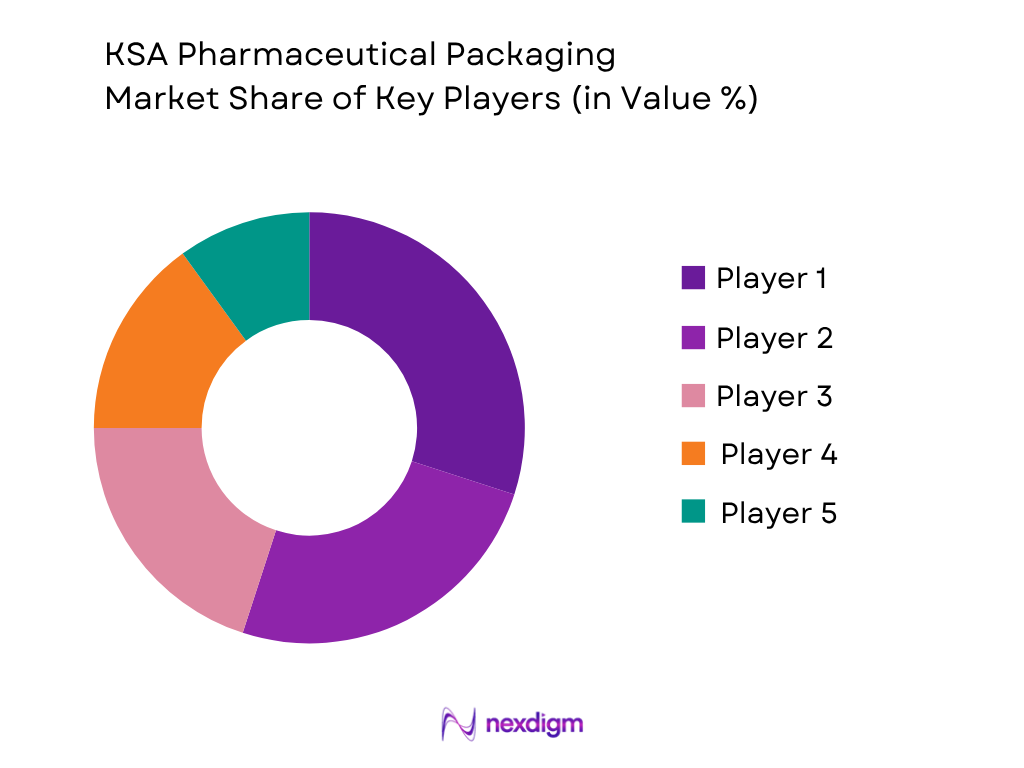
The KSA Pharmaceutical Packaging Market is anchored by SPIMACO, the largest Saudi-owned pharmaceutical company, which operates multiple manufacturing facilities producing tablets, capsules, injectables, and ophthalmic products and has committed approximately $150 million toward expanding its Riyadh blister packaging capacity. Jamjoom Pharma and Tabuk Pharmaceutical Manufacturing Company represent other significant domestic players with established manufacturing operations and growing export portfolios extending to the Gulf, Iraq, and Egypt. Julphar’s 2024 announcement of an $80 million facility investment emphasizing biologics and sterile formulations signals growing competitive intensity in the Kingdom’s higher-value sterile packaging segment, an area where global primary packaging suppliers such as Gerresheimer maintain particular technical strength. Newer entrants such as Cooper Pharma, which acquired a former Sanofi manufacturing site in 2023 and now produces more than 15 million units annually across four Saudi sites, are pursuing differentiated B2B contract manufacturing models, including the October 2024 launch of a dedicated subsidiary focused exclusively on B2B collaborations, reflecting the market’s ongoing structural evolution beyond its traditionally dominant established players.
| Company | Establishment Year | Headquarters | Primary Product Portfolio | Pharmaceutical Packaging Portfolio
|
Manufacturing Presence | Major End-Use Industries | Key Strategic Focus | Certifications & Compliance |
| SPIMACO | 1985 | ~ | ~ | ~ | ~ | ~ | ~ | ~ |
| Jamjoom Pharma | 1975 | ~ | ~ | ~ | ~ | ~ | ~ | ~ |
| Tabuk Pharmaceutical Manufacturing Company | 1994 | ~ | ~ | ~ | ~ | ~ | ~ | ~ |
| Julphar (Gulf Pharmaceutical Industries) | 1980 | ~ | ~ | ~ | ~ | ~ | ~ | ~ |
| Gerresheimer AG | 1864 | ~ | ~ | ~ | ~ | ~ | ~ | ~ |
KSA Pharmaceutical Packaging Market Analysis
Growth Drivers
Vision 2030 Localization Targets and Domestic Capacity Expansion
The KSA pharmaceutical packaging market is experiencing sustained growth due to Vision 2030’s push for localized drug manufacturing, with the government targeting an increase in domestic pharmaceutical production from approximately 20% to 40% of total national pharmaceutical needs, backed by more than USD 65 billion in healthcare infrastructure investments. The SFDA reported that approximately 68% of newly registered drugs in the first quarter of 2024 were produced domestically, while the Ministry of Industry and Mineral Resources reported that domestic pharmaceutical production capacity grew by approximately 35% in 2023 alone. This localization push has already enabled SFDA approval of more than 55 pharmaceutical factories, with the government targeting localization of 70% of essential medicines by 2030. SPIMACO’s approximately $150 million investment to expand its Riyadh facility with state-of-the-art blister packaging lines, alongside Jamjoom Pharma’s new 120 million unit per year oral solid dosage facility featuring fully automated packaging systems from Uhlmann and Marchesini, illustrate the scale of packaging capacity investment this localization drive continues to generate.
NUPCO Procurement Shift and Rising NCD-Driven Parenteral Therapy Demand
Strategic agreements between the National Unified Procurement Company (NUPCO) and domestic manufacturers continue to transition Saudi Arabia’s pharmaceutical supply chain from import-dependent procurement toward local production, with major global players including Pfizer, GSK, and Sanofi establishing regional manufacturing sites to participate in this shift. Noncommunicable diseases have become the dominant health burden in Saudi Arabia and are strongly associated with parenteral therapies requiring sterile vials, cartridges, and prefilled syringes, creating sustained structural demand for advanced primary packaging formats beyond conventional oral solid dosage blister packs. Leading domestic manufacturers such as Jamjoom Pharma reported 268 registered human medicines and 103 registered herbal and health products with the SFDA in a recent reporting year, illustrating the breadth of domestic product registration activity driving packaging demand across multiple therapeutic categories. As NUPCO continues to favor domestically manufactured products in public healthcare procurement, packaging suppliers positioned to serve NUPCO-eligible manufacturers are increasingly well positioned to capture growing public-sector demand.
Market Challenges
Continued Import Dependency Despite Localization Push
Despite substantial Vision 2030-driven investment in domestic pharmaceutical manufacturing, Saudi Arabia’s pharmaceutical market remains fiercely competitive and heavily reliant on imports, with high fragmentation persisting across key pharmaceutical segments. Much of current local production remains concentrated in OTC and general medicine categories, where companies compete intensely to be first to market as patents expire, while more complex sterile and biologic formulations continue to depend heavily on imported products and packaging components. Domestic manufacturers themselves continue to rely on imported advanced packaging machinery, as illustrated by Jamjoom Pharma’s sourcing of automated packaging systems from international suppliers Uhlmann and Marchesini rather than domestic equipment manufacturers, indicating that localization of drug production has not yet been matched by equivalent localization of the packaging technology supply chain. This continued dependency on imported packaging equipment and specialized materials exposes the market to currency fluctuations and global supply chain disruptions even as finished drug production increasingly shifts toward domestic sources.
Market Fragmentation and SFDA Registration Complexity
The KSA Pharmaceutical Packaging Market continues to navigate a highly fragmented competitive landscape, with SPIMACO holding a leading but modest market share of approximately 14.4% in certain segments according to industry estimates, reflecting the absence of a single dominant player capable of setting uniform packaging standards across the industry. This fragmentation requires packaging suppliers to navigate diverse technical specifications and procurement relationships across numerous small and mid-sized domestic manufacturers rather than concentrating sales efforts on a handful of dominant customers. While SFDA has streamlined registration timelines for products manufactured domestically, the registration and validation process for new packaging formats, materials, and serialization technologies continues to require substantial regulatory documentation and testing, extending time-to-market for packaging innovations. Companies serving the Kingdom’s general medicine and OTC categories face additional pricing pressure, as this segment is expected to grow at a comparatively modest pace and remains subject to intense competitive dynamics among numerous fragmented local suppliers.
Market Opportunities
Growth in Sterile and Biologics Packaging Capacity
Julphar’s 2024 announcement of an $80 million investment to establish a pharmaceutical and biotechnology manufacturing facility in the Kingdom, with construction scheduled to begin in early 2025 and an emphasis on biologics, sterile formulations, and general medicines, signals substantial emerging opportunity for packaging suppliers specializing in sterile fill-finish and advanced primary containment formats. As Saudi Arabia’s noncommunicable disease burden continues to grow and domestic manufacturers increasingly pursue higher-value sterile and biologic production to support Vision 2030’s healthcare self-sufficiency objectives, demand for validated glass vials, prefilled syringes, and specialized elastomer closures is expected to expand correspondingly. Global primary packaging specialists such as Gerresheimer, already engaged with sterile pharmaceutical manufacturing operations across the Gulf region, are well positioned to expand their Saudi presence as local biologics production scales. Packaging suppliers capable of providing GCC-GMP compliant sterile packaging solutions alongside technical support for new entrants navigating SFDA’s biologics registration requirements are increasingly well positioned to capture this growing segment.
King Abdullah Economic City and Regional Export Growth
King Abdullah Economic City’s continued success in attracting major healthcare investors is driving Jeddah’s packaging sector to grow approximately 25% faster than the national average through 2025, creating a significant regional growth opportunity for packaging suppliers positioned to serve this expanding industrial cluster. Domestic manufacturers including Jamjoom Pharma are actively pursuing growth in export markets across the Gulf, Iraq, and Egypt, creating demand for packaging solutions capable of meeting the labeling and regulatory requirements of multiple destination markets simultaneously. Newer market entrants such as Cooper Pharma are pursuing differentiated B2B contract manufacturing models specifically designed to serve other pharmaceutical companies’ production needs, reflecting a broader industry shift toward flexible, export-oriented manufacturing capacity. As MODON and the Royal Commission for Jubail and Yanbu continue channeling investment incentives, including subsidized industrial land and utilities, toward pharmaceutical and packaging manufacturers, companies establishing new production capacity in these designated industrial zones are well positioned to benefit from both domestic localization demand and expanding regional export opportunities.
Future Outlook
The KSA Pharmaceutical Packaging Market is expected to witness robust expansion over the forecast period, supported by continued Vision 2030-driven localization of pharmaceutical manufacturing, NUPCO’s ongoing shift of public procurement toward domestic production, and growing investment in sterile and biologics packaging capacity exemplified by Julphar’s 2024 Kingdom investment. Continued expansion of automated blister packaging lines, sterile fill-finish capability, and export-oriented contract manufacturing models will further shape competitive positioning across the industry. The market is also likely to benefit from King Abdullah Economic City’s continued success in attracting healthcare investment and the Kingdom’s growing role as a regional pharmaceutical export base serving Gulf, Iraq, and Egyptian markets.
Major Players
- SPIMACO
- Jamjoom Pharma
- Tabuk Pharmaceutical Manufacturing Company
- Julphar (Gulf Pharmaceutical Industries)
- Gerresheimer AG
- Cooper Pharma
- Riyadh Pharma
- Avalon Pharma
- Sudair Pharmaceutical
- Amcor
- Schott AG
- West Pharmaceutical Services
- Uhlmann Pac-Systeme
- Marchesini Group
- CCL Industries
Key Target Audience
- Pharmaceutical Packaging Manufacturers
- Pharmaceutical & Biotechnology Companies
- Contract Manufacturing Organizations (CMOs)
- Hospitals & Pharmacy Chains
- Export-Oriented Pharmaceutical Manufacturers
- Investment and Venture Capitalist Firms
- Government and Regulatory Bodies (Saudi Food and Drug Authority (SFDA), National Unified Procurement Company (NUPCO), Ministry of Industry and Mineral Resources)
- Raw Material Suppliers and Primary Packaging Component Manufacturers
Research Methodology
Step 1: Identification of Key Variables
The research process begins with identifying the complete ecosystem of the KSA Pharmaceutical Packaging Market, including raw material suppliers, primary and secondary packaging converters, pharmaceutical manufacturers, contract packaging providers, and regulatory authorities. Extensive secondary research is conducted using company annual reports, government publications, trade associations, customs statistics, industry journals, and proprietary databases to determine the variables influencing market demand, pricing, production, consumption, and technological developments.
Step 2: Market Analysis and Construction
Historical market information is collected and analyzed to estimate market size, production volumes, import-export activity, application-wise demand, and pricing trends. A combination of top-down and bottom-up approaches is used to estimate market revenues and validate segment-level performance. Consumption patterns across generics, biologics, injectables, and OTC packaging are evaluated to establish an accurate representation of the industry.
Step 3: Hypothesis Validation and Expert Consultation
The preliminary findings are validated through Computer-Assisted Telephone Interviews (CATIs) and structured discussions with pharmaceutical packaging suppliers, procurement managers, regulatory affairs specialists, packaging engineers, and senior executives operating within the Saudi Arabian pharmaceutical industry. These interviews help verify market assumptions, competitive developments, technology adoption trends, pricing dynamics, and future investment opportunities while refining the overall market estimates.
Step 4: Research Synthesis and Final Output
The final stage integrates insights obtained from primary interviews with quantitative information collected through secondary sources. Data triangulation techniques are applied to reconcile differences between supply-side and demand-side estimates, ensuring robust market forecasting. The report is then reviewed through multiple quality assurance checkpoints to deliver a comprehensive analysis covering market size, segmentation, competitive landscape, future outlook, and strategic recommendations for industry stakeholders.

- Executive Summary
- Research Methodology (Market Definitions and Assumptions, Abbreviations, Market Sizing Approach, Top-Down Analysis, Bottom-Up Analysis, Demand-Side Assessment, Supply-Side Assessment, Primary Industry Interviews, Secondary Research Validation, Data Triangulation, Forecasting Framework, Limitations and Future Conclusions)

- Definition and Scope
- Market Evolution and Industry Genesis
- Timeline of Major Industry Developments
- Pharmaceutical Packaging Industry Value Chain Analysis
- Supply Chain Analysis

- Growth Drivers (Vision 2030 Localization Targets, SPIMACO & Jamjoom Capacity Expansion, NUPCO Procurement Shift to Local Production, Rising NCD-Driven Parenteral Therapy Demand, Growth in Domestic Drug Registration, MODON & Industrial Zone Investment Incentives)
- Market Challenges (Continued Import Dependency Despite Localization Push, Market Fragmentation Among Domestic Players, SFDA Registration Complexity for New Formats, Reliance on Imported Packaging Machinery, Price Competition in OTC Segment, Talent & Technical Skills Gap)
- Market Opportunities (Growth in Sterile & Biologics Packaging Capacity, King Abdullah Economic City & Jeddah Sector Expansion, B2B Contract Manufacturing Growth, Export Growth to Gulf, Iraq & Egypt Markets, Advanced Automated Packaging Line Adoption, Public Healthcare Tender Participation)
- Market Trends (Localization-Driven Capacity Expansion, Automated Blister Line Adoption, Growth in Sterile Fill-Finish Investment, B2B-Focused Manufacturing Models, Regional Export Portfolio Diversification, Smart & Traceable Packaging Development)
- Government Regulations (SFDA Product Registration Requirements, SFDA Streamlined Domestic Manufacturing Approvals, National Industrial Strategy Localization Mandates, NUPCO Local Production Agreements, MODON Industrial Zone Compliance, GCC-GMP Standards)
- Import and Export Analysis (Trade Volume, Major Import Sources, Export Destinations, HS Code Analysis, Trade Balance)
- Raw Material Availability Analysis (Pharma-Grade Glass, Imported Polymer Films, Aluminum Foil Stock, Pharma-Grade Paperboard, Rubber & Elastomer Closures)
- Technology Landscape (Automated Blister Forming & Sealing Lines, Sterile Fill-Finish Technologies, Serialization & Traceability Platforms, Prefilled Syringe Assembly Technologies, Cold Chain Packaging Technologies)
- Sustainability Assessment (Recyclable Packaging Material Adoption, Reduced Carton Material Usage, Energy-Efficient Manufacturing Integration, Glass & Aluminum Circularity, Localized Supply Chain Emission Reduction)
- PESTLE Analysis
- SWOT Analysis
- Porter’s Five Forces Analysis
- Stakeholder Ecosystem
- Competition Ecosystem

- By Market Value (2020-2025)
- By Volume Consumption (2020-2025)
- By Average Selling Price (2020-2025)

- By Material Type (In Value %)
Plastic (Blister Films & Bottles)
Glass (Vials & Ampoules)
Aluminum Foil
Paper & Paperboard Cartons
Rubber & Elastomer Closures - By Product Type (In Value %)
Blister Packs
Bottles & Vials
Ampoules
Prefilled Syringes & Cartridges
Cartons & Labels
IV Bags & Canisters
Closures & Caps - By Drug Type (In Value %)
Generics
Biologics & Sterile Formulations
OTC & Consumer Health Products
Injectables & Parenteral Therapies
Ophthalmic & Specialty Products
Herbal & Health Products - By End User (In Value %)
Pharmaceutical Manufacturers
Contract Manufacturing Organizations (CMOs)
Hospitals & Pharmacy Chains
Export-Oriented Manufacturers
National Unified Procurement Company (NUPCO) Supply Programs
Clinical Research Organizations - By Region (In Value %)
Riyadh Region
Makkah Region
Eastern Province
Madinah Region
Asir Region

- Market Share of Major Players (By Value, Volume, Material Type, Drug Type, Product Category)
- Cross Comparison Parameters (Product Portfolio Breadth, Sterile & Biologics Packaging Capability, Automated Line Capacity, Application Technical Support, Manufacturing Capacity, Regulatory Compliance & Certifications, NUPCO Tender Eligibility, Innovation & New Product Launch Frequency)
- SWOT Analysis of Major Players
- Pricing Analysis by Product Category and Format
- Production Capacity Analysis
- Manufacturing Footprint Analysis
- Distribution Network Analysis
- Innovation Benchmarking
- Detailed Profiles of Major Companies
SPIMACO
Jamjoom Pharma
Tabuk Pharmaceutical Manufacturing Company
Julphar (Gulf Pharmaceutical Industries)
Gerresheimer AG
Cooper Pharma
Riyadh Pharma
Avalon Pharma
Sudair Pharmaceutical
Amcor
Schott AG
West Pharmaceutical Services
Uhlmann Pac-Systeme
Marchesini Group
CCL Industries

- Consumption Pattern Analysis (Industrial Usage, Batch Size, Product Category Penetration, Seasonal Demand, Reformulation Activity)
- Purchasing Criteria (Regulatory Compliance, Localization Credentials, Cost Efficiency, Sterile Packaging Capability, Automation Compatibility, Tamper-Evidence)
- Procurement and Supplier Selection Analysis
- NUPCO Tender Compliance Assessment
- Public vs Private Sector Packaging Demand
- Product Attribute Preference Analysis (Moisture Barrier Performance, Sterile Integrity, Tamper-Evidence, Print & Label Clarity, Automation Line Compatibility, Anti-Counterfeiting Features)
- Localization & Regulatory Compliance Influence on Packaging Investment
- Pain Point Analysis
- Decision-Making Process

- By Market Value (2026-2035)
- By Volume Consumption (2026-2035)
- By Average Selling Price (2026-2035)


 Request a Sample
 Ask for Customization
 Get a Quote
 Enquire Now