
 Download PDF
Market Overview
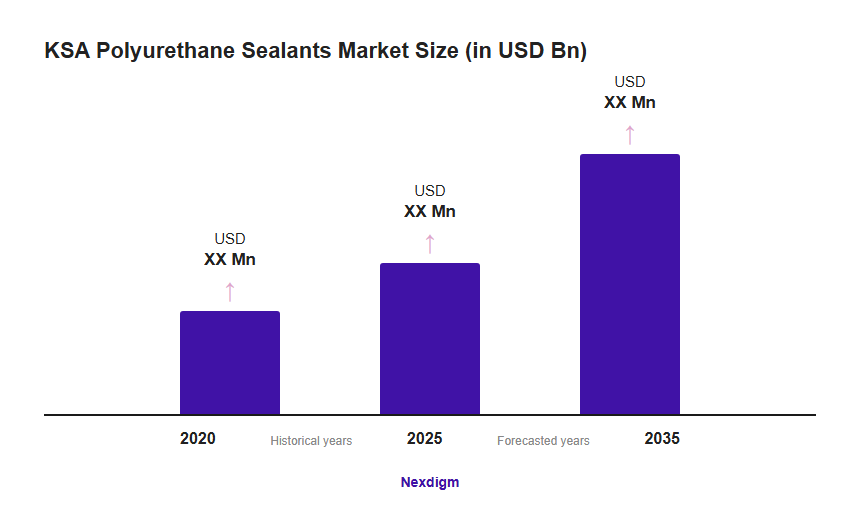
The KSA polyurethane sealants market is valued at USD 1.84 billion in 2025 and is projected to expand at a 5.6% CAGR from 2025 to 2035, driven by the massive infrastructure development under Vision 2030. Industrial hubs such as Jubail and Yanbu serve as critical growth engines, where the concentration of petrochemical processing facilitates localized raw material access and downstream application in heavy construction. A primary demand-side trend is the accelerating adoption of high-performance moisture-curing sealants in mega-projects like NEOM, where thermal resilience and seismic elasticity are non-negotiable requirements for glass-curtain wall installations. Simultaneously, supply-side dynamics are shifting as domestic giants like SABIC, founded in 1976 and headquartered in Riyadh, increase their output of high-purity polyols to reduce reliance on imported chemical inputs. Sustainability efforts are increasingly shaped by the Saudi Standards, Quality and Metrology Organization (SASO), which has implemented stringent VOC emission standards for construction materials. Consequently, market participants are pivoting toward bio-based, solvent-free polyurethane formulations to maintain compliance with these environmental mandates while supporting the Kingdom’s broader initiative to transition toward a more sustainable, high-tech industrial architecture across its rapidly expanding urban landscapes.
Market Segmentation
By Product Formulation
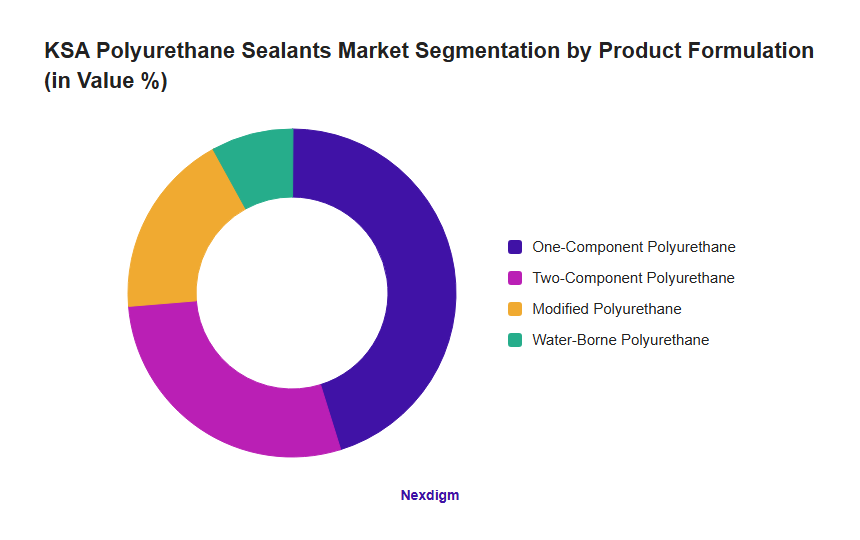
As of 2026, the One-Component Polyurethane segment maintains a dominant 45.2% market share in the KSA due to its operational efficiency and ease of application in high-density residential developments in Riyadh and Jeddah. Industry leaders like Sika AG, founded in 1910 and headquartered in Baar, utilize this formulation for its superior moisture-curing properties which suit the arid climate of the Kingdom. While Two-Component Polyurethane remains essential for high-stress infrastructure projects managed by the Saudi Ministry of Municipal and Rural Affairs, its share is limited by complex mixing requirements. Modified Polyurethane continues to gain traction as developers seek enhanced flexibility for seismic resilience, while Water-Borne Polyurethane, though currently holding a modest 8.0% share, is projected to grow as the Saudi Green Initiative mandates stricter VOC regulations. Companies like BASF SE, founded in 1865 and headquartered in Ludwigshafen, are currently prioritizing the development of low-emission versions of these sealants to align with the Vision 2030 sustainability benchmarks.
By End-User Industry
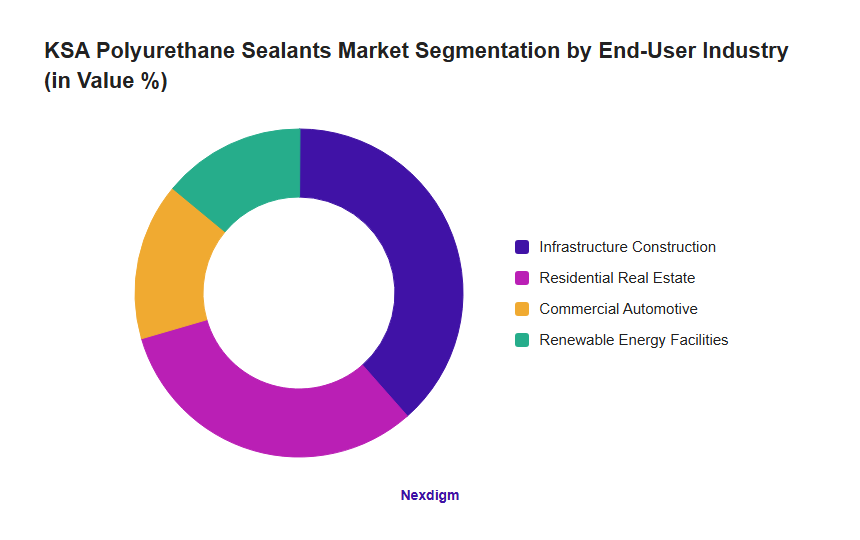
Infrastructure Construction accounts for 38.5% of the KSA market as of 2026, driven by massive state-funded projects such as the NEOM development and the expansion of the Riyadh Metro managed by the Saudi Public Transport Authority. Heavy-duty sealants from Henkel AG, founded in 1876 and based in Düsseldorf, are frequently specified for these structural joints. Residential Real Estate represents the second-largest sector, spurred by the Sakani housing programs, while Commercial Automotive manufacturing initiatives in the Eastern Province drive demand for specialized assembly-line adhesives. Renewable Energy Facilities, particularly in the massive PV solar parks surrounding Al Jouf, rely on specialized polyurethane for photovoltaic module weatherproofing. Firms like 3M, founded in 1902 and headquartered in Maplewood, provide the high-durability products required across the Infrastructure Construction, Residential Real Estate, Commercial Automotive, and Renewable Energy Facilities segments, ensuring operational longevity despite the intense thermal fluctuations and abrasive environmental conditions encountered across the Saudi Arabian landscape.
Competitive Landscape
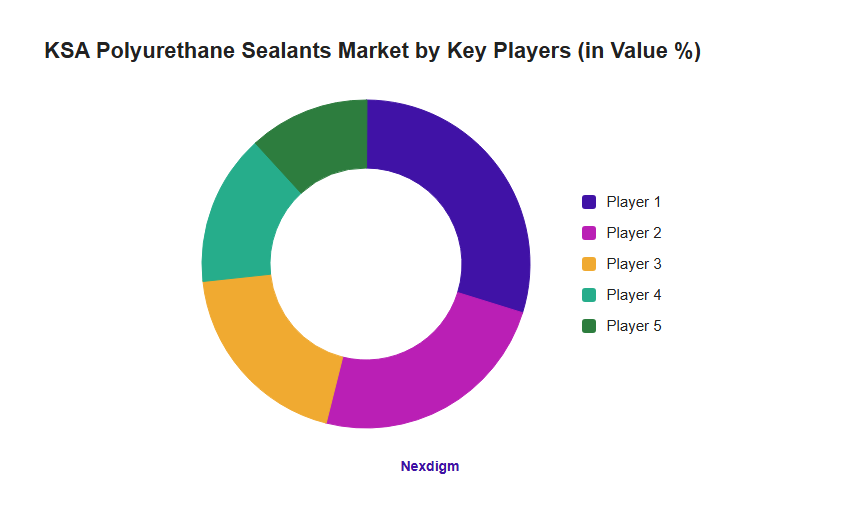
The Saudi Arabian polyurethane sealants market is characterized by high competitive intensity, driven by massive infrastructure investments under the Saudi Vision 2030 framework. Market participants are increasingly focusing on localized manufacturing to align with the Ministry of Industry and Mineral Resources’ In-Kingdom Total Value Add (IKTVA) program. Competition is currently dominated by multinational corporations that leverage extensive R&D facilities to meet the stringent ASTM C920 construction standards, while regional players are gaining traction through aggressive pricing strategies and proximity to major construction projects in Riyadh and Jeddah.
Leading players such as Sika AG and Henkel AG & Co. KGaA have shifted their distribution strategies toward direct supply chain integration with major contractors, bypassing traditional wholesale models to ensure project timelines are met. Recent competitive moves include the formation of strategic joint ventures to produce high-performance, weather-resistant sealants specifically formulated for the arid desert climate of the GCC. As sustainability regulations issued by the Saudi Standards, Metrology and Quality Organization (SASO) become more rigorous, firms are rapidly pivoting to low-VOC and environmentally compliant product portfolios to secure lucrative government contracts.
| Company | Establishment Year | Headquarters | Core Curricular Offered | Campus Footprint in Saudi Arabia | Fee Positioning | Digital Learning Stack Maturity | University Pathway Strength | Boarding Capability |
| Sika AG | 1910 | Baar, Switzerland | High-performance construction and industrial sealants | Extensive manufacturing plant in Dammam | Premium | Advanced integrated supply chain tracking | Strong partnerships with KAUST research | Not applicable |
| Henkel AG & Co. KGaA | 1876 | Düsseldorf, Germany | Polyurethane adhesive and sealant solutions | Regional distribution center in Riyadh | Premium | Highly digitized inventory management | Technical vocational training collaboration | Not applicable |
| BASF SE | 1865 | Ludwigshafen, Germany | Specialty construction chemicals and sealants | Manufacturing base in Jubail | Premium | Automated chemical formulation modeling | Corporate-sponsored chemical engineering programs | Not applicable |
| H.B. Fuller | 1887 | St. Paul, USA | Industrial grade moisture-cure sealants | Regional office in Jeddah | Mid-market | Cloud-based customer support portal | Technical sales training certification | Not applicable |
| RPM International | 1947 | Medina, USA | Specialty coating and sealant systems | Warehouse facilities in Riyadh | Mid-market | Predictive maintenance software integrations | Standardized certification for applicators | Not applicable |
KSA Polyurethane Sealants Market Analysis
Growth Drivers
Expansion of Urban Infrastructure Projects
The rapid acceleration of high-profile infrastructure initiatives in the Kingdom of Saudi Arabia, particularly those falling under the Vision 2030 framework, serves as a primary catalyst for the polyurethane sealant market. Large-scale developments in cities like Riyadh and NEOM necessitate high-performance chemical bonding solutions that withstand extreme arid thermal cycling. The Ministry of Municipal and Rural Affairs and Housing has allocated 450 billion SAR toward housing and urban infrastructure development as of 2024 to facilitate the construction of 300,000 new residential units by 2026. Polyurethane sealants are increasingly favored over traditional silicone variants due to their superior tensile strength and adhesion properties required for modern facade engineering and seismic joint sealing. With 18,500 kilometers of new road networks planned for completion across the Eastern Province and Qassim region by 2027, the demand for joint fillers in concrete structures has spiked significantly. Contractors are transitioning toward advanced polyurethane formulations capable of maintaining flexibility under direct ultraviolet radiation, which remains a critical requirement for maintaining structural integrity in the harsh Arabian climate.
Rise of Industrialization and Manufacturing Facilities
The diversification of the Saudi economy through industrial localization has led to a surge in the construction of specialized manufacturing zones and chemical plants. Companies such as Saudi Basic Industries Corporation, headquartered in Riyadh since 1976, continue to expand their operational footprint, necessitating robust industrial floor coating and sealing solutions. Polyurethane sealants provide the chemical resistance and mechanical durability required for the expansion of 42 new industrial cities currently under development by the Saudi Authority for Industrial Cities and Technology Zones. In 2023, the manufacturing sector contributed 12 percent of the total non-oil GDP, a figure intended to reach 15 percent by the end of 2025. These facility expansions require specialized sealants that comply with international safety standards, including the rigorous fire-resistance protocols established by the Saudi Civil Defense. The local manufacturing capacity for construction chemicals has increased by 2,400 metric tons annually since 2022, ensuring that large-scale industrial projects utilize high-grade domestic materials that meet the demanding environmental stressors characteristic of the Jeddah and Dammam industrial hubs.
Market Challenges
Supply Chain Vulnerability and Raw Material Price Volatility
The Saudi polyurethane sealant market faces significant hurdles due to the heavy reliance on imported diisocyanates and specialized polyols required for high-performance chemical manufacturing. Fluctuations in global feedstock costs, compounded by logistical bottlenecks, directly impact the price stability of final sealant products. During the 2023 fiscal cycle, the cost of imported raw materials increased by 19 percent, creating fiscal strain for local manufacturers and small-to-medium construction contractors. Furthermore, the limited domestic production of specialized additives, such as catalysts and heat stabilizers, requires local firms to maintain excessive inventory levels to mitigate the risk of supply chain disruptions. Inventory management costs in the logistics sector have risen by 14 percent since 2022, reflecting the difficulty of maintaining consistent supply lines in remote construction sites located in the Tabuk region. Smaller regional players struggle to compete against established multinational firms like Sika Saudi Arabia, headquartered in Jeddah, which leverages global procurement networks to stabilize costs, leaving domestic competitors vulnerable to sudden price spikes and inflationary pressures that challenge the viability of fixed-price long-term supply contracts.
Stringent Regulatory Compliance and Technical Certification Hurdles
Navigating the complex regulatory landscape established by the Saudi Standards, Metrology and Quality Organization presents a substantial barrier to entry for many market participants. All construction materials, including polyurethane sealants, must undergo rigorous durability testing to ensure compliance with the Saudi Building Code, which underwent comprehensive updates in 2021 to incorporate modern energy efficiency and safety standards. Obtaining the necessary product certification for specific sealant grades often requires a 12-month lead time for laboratory validation and environmental stress testing. Furthermore, projects in the coastal regions of the Red Sea require specialized formulations with high saline-resistance ratings to prevent premature sealant degradation, a factor that increases the technical burden for manufacturers. As of 2024, 75 percent of building material suppliers operating in the Central Province report that the administrative cost of maintaining current ISO certifications and Saudi Quality Mark accreditations consumes approximately 8 percent of their annual operating budget. The lack of standardized, region-specific environmental product declarations continues to create confusion for architects and developers, often delaying project approvals and slowing the adoption of newer, more sustainable sealant technologies.
Opportunities
Expansion into Sustainable Infrastructure Projects
The Saudi Vision 2030 initiative has catalyzed a surge in green construction standards, specifically under the Saudi Green Building Council framework, creating a robust demand for low-VOC polyurethane sealants. Projects such as the Neom development in Tabuk have set a mandate for 40% of all structural materials to be sourced with high environmental efficiency ratings by 2027. Local manufacturers like Saudi Polyurethane Systems, established in 1994 and headquartered in Dammam, are pivoting toward bio-based polyol technologies to align with these stringent sustainability criteria. The market potential is further bolstered by the 12.5 billion SAR allocation for urban revitalization in Riyadh through 2026, which requires high-performance sealants capable of resisting extreme thermal expansion in desert climates. Contractors are increasingly replacing traditional silicone alternatives with advanced polyurethane formulations that offer 30% greater durability in high-wind environments. This shift ensures that specialized providers who can document long-term chemical resilience are securing contracts for major transport corridors and sustainable housing complexes, effectively shifting the market preference away from cheap imports toward locally engineered, high-durability chemical solutions.
Industrial Retrofitting in the Petrochemical Sector
The aging infrastructure across the Jubail Industrial City presents a lucrative opportunity for high-grade chemical sealant applications designed for hazardous environment protection. As of 2024, approximately 18% of the initial refinery piping structures installed between 1985 and 1995 are nearing critical maintenance cycles, requiring specialized elastomeric sealants that can withstand constant exposure to volatile organic compounds and high-pressure steam. Companies such as National Chemical Carriers, headquartered in Riyadh since 1990, have initiated aggressive maintenance protocols requiring 500 tons of high-tensile polyurethane sealants annually to prevent leakage in cooling towers and expansion joints. Government bodies like the Royal Commission for Jubail and Yanbu have introduced updated safety standards that mandate fire-retardant sealant classifications for all industrial zones, pushing companies to upgrade their inventory to compliant formulations. The integration of robotic sealant application systems in these facilities has increased operational efficiency by 22% while reducing manual labor accidents in confined spaces. This trend toward automated, high-precision maintenance provides a sustainable revenue stream for chemical providers capable of meeting specialized industrial compliance requirements within the Eastern Province.
Future Outlook
The KSA polyurethane sealants market is positioned for significant structural transformation over the next five years, driven by a confluence of massive public infrastructure investments and a move toward localized chemical manufacturing excellence. As the Kingdom transitions toward a post-oil economy, the emphasis on high-performance building materials is expected to displace commodity-grade products currently dominating the lower-tier construction segments. By 2030, the market is projected to reach a state of technical maturity where innovation in UV-resistant and self-healing polyurethane polymers becomes the industry baseline rather than a premium offering. This shift will be heavily influenced by the rigorous compliance requirements enforced by the Saudi Standards, Metrology and Quality Organization, which continues to tighten import regulations for hazardous building components. Furthermore, the operational integration of smart-city technologies in Jeddah and Dammam will necessitate the use of sealants that provide consistent performance under extreme temperature fluctuations, ranging from 15 degrees Celsius at night to over 50 degrees Celsius during peak summer days. As domestic players increase production capacity to meet the demands of giga-projects, the dependency on international supply chains is expected to decrease, fostering a more resilient internal market ecosystem. This long-term evolution ensures that companies prioritizing research-driven product development and localized manufacturing will secure a dominant competitive advantage, effectively insulating the market from external price volatility while fostering sustained growth in the architectural and industrial sealant categories.
Major Players
- Sika AG
- Henkel AG & Co. KGaA
- BASF SE
- H.B. Fuller
- RPM International
- National Paints Factories
- Saudi Specialty Chemicals
- Jotun Group
- Astra Industrial Group
- Arkema S.A.
- Bostik
- 3M Saudi Arabia
- DOW Inc.
- Tremco CPG
- Fosroc International
Key Target Audience
- Polyurethane Sealant Manufacturers (e.g., Sika AG, founded 1910, Baar, Switzerland)
- Chemical Raw Material Suppliers (e.g., BASF SE, founded 1865, Ludwigshafen, Germany)
- Construction and Infrastructure Contractors (e.g., Saudi Binladin Group, founded 1931, Jeddah, Saudi Arabia)
- Government and Regulatory Bodies (Saudi Standards, Metrology and Quality Organization – SASO)
- Real Estate Developers (e.g., ROSHN Group, founded 2020, Riyadh, Saudi Arabia)
- Industrial Adhesive Distributors (e.g., Red Sea Trading, founded 1985, Dammam, Saudi Arabia)
- Facility Management Service Providers (e.g., Al-Hokair Group, founded 1975, Riyadh, Saudi Arabia)
- Investors and Venture Capital Firms
- Specialized Waterproofing Contractors (e.g., Modern Waterproofing Company, founded 1994, Riyadh, Saudi Arabia)
- Public Works Authorities (Ministry of Municipal and Rural Affairs and Housing, Saudi Arabia)
- Architectural and Engineering Firms (e.g., Dar Al-Handasah, founded 1956, Beirut/Riyadh operations)
- Oil and Gas Infrastructure Maintenance Firms (e.g., Saudi Aramco Technical Services, Dhahran, Saudi Arabia)
Research Methodology
Step 1: Identification of Key Variables
The research team begins by defining critical parameters influencing the Saudi Arabian polyurethane sealant market, specifically focusing on the Vision 2030 giga-project pipeline. Primary variables analyzed include consumption volume by application segment, such as civil infrastructure and commercial high-rise construction, as well as the impact of local building codes enforced by the Saudi Standards, Metrology and Quality Organization (SASO). Analysts identify specific demand drivers, including the growth in specialized HVAC installations and high-performance expansion joint sealing requirements across urban centers like Riyadh and NEOM. This stage ensures that macroeconomic indicators, such as non-oil GDP growth and foreign direct investment into the construction sector, are mapped against historical sealant consumption metrics observed between 2018 and 2023.
Step 2: Market Analysis and Construction
Utilizing a robust bottom-up forecasting model, the analysts synthesize data obtained from major manufacturers such as Sika AG and Dow Inc., while adjusting for regional import-export dynamics in the GCC. Market size is constructed by aggregating reported revenue from local manufacturing facilities in Jubail and Dammam with import volumes of finished polyurethane products tracked by the General Authority for Statistics (GASTAT). Competitive landscape mapping involves a rigorous evaluation of pricing strategies, market share distribution, and the technological evolution of solvent-based versus water-based polyurethane systems. This phase concludes with the development of a comprehensive market valuation projection from 2024 through 2035, incorporating tiered growth scenarios based on specific infrastructure project completion timelines.
Step 3: Hypothesis Validation and Expert Consultation
This critical stage involves verifying initial market findings through direct engagement with various industry participants to ensure the accuracy of growth assumptions. Interviews are conducted with senior procurement officers at major civil construction firms, technical directors at chemical blending plants, and regional supply chain logistics leads to validate distribution bottlenecks. Furthermore, project managers overseeing large-scale desert urban development and maintenance engineers responsible for coastal infrastructure provide qualitative insights on the durability performance of sealants under extreme thermal conditions. Regulatory compliance officers are consulted to confirm the evolving mandates for sustainable building materials and energy efficiency standards within the Kingdom. These direct consultations remove reliance on secondary data proxies, allowing for the adjustment of market growth rates based on first-hand operational realities reported by on-the-ground stakeholders.
Step 4: Research Synthesis and Final Output
The final stage involves the consolidation of all quantitative data, expert qualitative feedback, and regulatory analysis into a coherent strategic report, finalized by a senior team lead. Analysts rigorously cross-reference market projections against historical trends and documented industry benchmarks provided by the Ministry of Municipal and Rural Affairs and Housing to ensure internal consistency. The final output is structured to deliver actionable intelligence, providing a granular view of the Saudi Arabian polyurethane sealant landscape through 2035, including detailed profiles of market participants like BASF SE and Henkel AG. This process culminates in a comprehensive peer-reviewed document that provides stakeholders with the requisite foresight regarding investment risks, opportunities in high-growth segments, and the impact of the national industrial strategy on the chemical sector.

- Executive Summary
- Research Methodology (Defining Saudi Polyurethane Market Scope, Top-Down Market Sizing Analysis, Bottom-Up Construction Project Pipeline Mapping, SASO Regulatory Database Integration, Supply-Side Capacity Utilization Assessment, Demand-Side Building Envelope Intensity Metrics, Expert Interviews: Contractors and Consultants, Data Triangulation Across Saudi Regions, Construction Sector Forecasting Framework, Raw Material Price Volatility Modeling, Import Trade Data Validation, Limitations of Secondary Research Sources)

- Definition and Scope
- Market Evolution and Industry Genesis
- Saudi Vision 2030 Construction Infrastructure Impact
- Polyurethane Chemical Synthesis and Polymerization Dynamics
- KSA Building Envelope and Glazing Requirements
- Regulatory Frameworks: SASO and ASTM Compliance
- Strategic Import Dependency versus Local Manufacturing

- Growth Drivers (Expansion of Urban Infrastructure Projects, Rise of Industrialization and Manufacturing Facilities)
- Market Challenges (Supply Chain Vulnerability and Raw Material Price Volatility, Stringent Regulatory Compliance and Technical Certification Hurdles)
- Market Opportunities (Expansion into Sustainable Infrastructure Projects, Industrial Retrofitting in the Petrochemical Sector)
- Market Trends (Sustainability Compliance, Heat-Resistant Formulations, Automated Application, Local Supply Chain)
- Government Regulations
- SWOT Analysis
- Porter’s Five Forces Analysis
- PESTLE Analysis

- By Market Value (2020-2025)
- By Annual Consumption Volume (Metric Tons) (2020-2025)
- By Average Selling Price (SAR/Liter) (2020-2025)

- By Sealant Formulation and Chemical Composition (In Value %)
- One-Component Moisture-Cured Polyurethanes
- High-Modulus Structural Glazing
- Low-Modulus Expansion Joint
- Non-Sag Vertical Application
- Self-Leveling Floor Sealant
- Two-Component Reactive Polyurethanes
- Fast-Curing Infrastructure Repair
- Marine-Grade Industrial Sealing
- High-Temperature HVAC Ducting
- Heavy-Duty Civil Engineering Bonds
- Hybrid Polyurethane-Silane Modified Polymers
- Paintable Exterior Facade Sealants
- Anti-Fungal Sanitary Grade
- UV-Resistant Cladding Adhesives
- Sustainable Low-VOC Formulations
- Specialty Flame-Retardant Sealants
- Intumescent Fire-Rated Expansion Joints
- Smoke-Containment Gasketing
- Industrial Blast-Resistant Seals
- By Application Vertical (In Value %)
- Residential Construction
- Commercial and Office Real Estate
- Industrial and Manufacturing Plants
- Civil Infrastructure and Transportation
- Oil and Gas Facilities
- Renewable Energy Installation
- By Application Method (In Value %)
- Manual Caulking Gun Application
- Pneumatic Pressure Extrusion
- Automated Robotics Glazing Systems
- Spray-Applied Membrane-Sealant Hybrid
- By Distribution Channel (In Value %)
- Direct Project Sales (B2B)
- Industrial Specialized Distributors
- Building Material Superstores
- E-commerce Procurement Platforms
- By Region (In Value %)
- Central Province (Riyadh Metropolitan Area)
- Western Province (Jeddah and NEOM)
- Eastern Province (Dammam and Jubail)
- Southern and Northern Provinces
- By Performance Grade (In Value %)
- High-Modulus Structural
- Medium-Modulus General Purpose
- Low-Modulus Movement Joint

- Market Share of Major Players
- Domestic Manufacturing versus Global Import Brands
- Public Infrastructure Project Competitive Landscape
- Industrial Petrochemical Facility Supplier Dynamics
- Real Estate Giga-Project Specification Competition
- Sustainable Green Building Sealant Market
- Cross Comparison Parameters (KSA Manufacturing Localization Ratio, SASO Certification Compliance Breadth, Technical Support and On-Site Application Training, Supply Chain Logistics Efficiency, R&D Focus on Desert-Climate Weathering, Product Portfolio Depth, Project Specification Approval Status)
- Competitive Product Benchmarking (Joint Movement Capability (%), Shore A Hardness Rating, UV Stability and Weathering Index, VOC Emission Levels (g/L), Tack-Free Curing Time, Tensile Strength (MPa), Shelf Life Under KSA Temperature Extremes)
- Financial and Operational Parameters
- SWOT Analysis of Major Players
- Detailed Profiles of Major Companies
- Sika AG (Switzerland, 1910) – Sikaflex, Sikasil, SikaBond
- BASF Construction Chemicals (Germany, 1865) – MasterSeal, MasterFlex
- Henkel AG & Co. KGaA (Germany, 1876) – Ceresit, Loctite
- 3M Company (USA, 1902) – 3M Polyurethane
- Tremco CPG (USA, 1928) – Tremco, Vulkem
- MAPEI S.p.A. (Italy, 1937) – Mapeflex
- Fosroc International (UK, 1934) – Thioflex, Nitoseal
- Saudi Industrial Resins (KSA, 1978) – SIR Seal

- Sealant Consumption per Square Meter (Facade)
- Frequency of Joint Maintenance Cycles
- Contractor Adoption of Automated Dispensing
- Average Project Sealant Spend (SAR)
- Preference for Fast-Curing Formulations
- Project Specification Rigor by Giga-Projects
- Requirement for High-UV Resistance Certification

- By Market Value (2026-2035)
- By Annual Consumption Volume (Metric Tons) (2026-2035)
- By Average Selling Price (SAR/Liter) (2026-2035)


 Request a Sample
 Ask for Customization
 Get a Quote
 Enquire Now