
 Download PDF
Market Overview
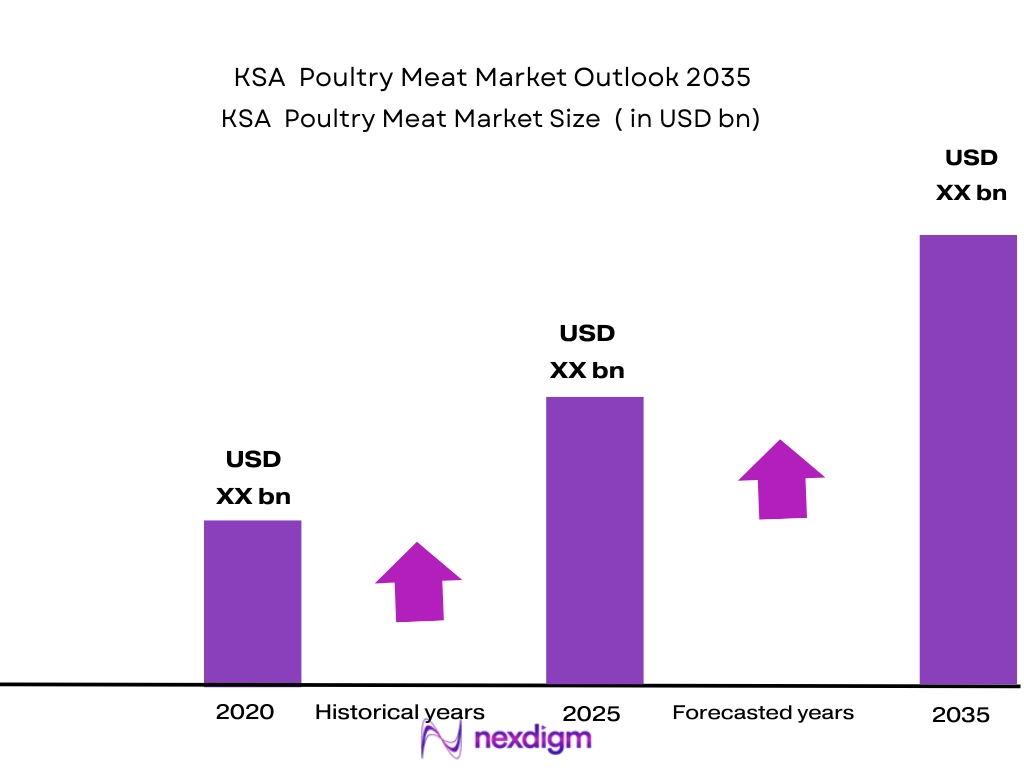
The KSA Poultry Meat Market is valued at USD ~ billion, based on a five-year historical analysis, and is forecast to reach USD 5.62 billion by 2033, expanding at a CAGR of 1.90%. For the requested forecast window, the market is expected to grow at an estimated CAGR of around 1.79% during 2024–2030, supported by food security programs, halal-certified poultry demand, household consumption, and rising foodservice procurement. Poultry output reached around 1.1 million tonnes before rising to nearly 1.2–1.25 million tonnes, showing strong domestic production scaling.
Riyadh, Jeddah, Dammam, Makkah, and Madinah dominate demand because they concentrate large urban populations, organized retail outlets, quick-service restaurants, hotels, logistics networks, and institutional buyers. Riyadh acts as the largest administrative and retail consumption hub, while Jeddah benefits from port-linked imports and food processing investments. Makkah and Madinah generate strong seasonal foodservice demand from religious tourism, and the Eastern Province supports distribution through Dammam’s logistics base and higher-income urban consumers.
Market Segmentation
By Product Form
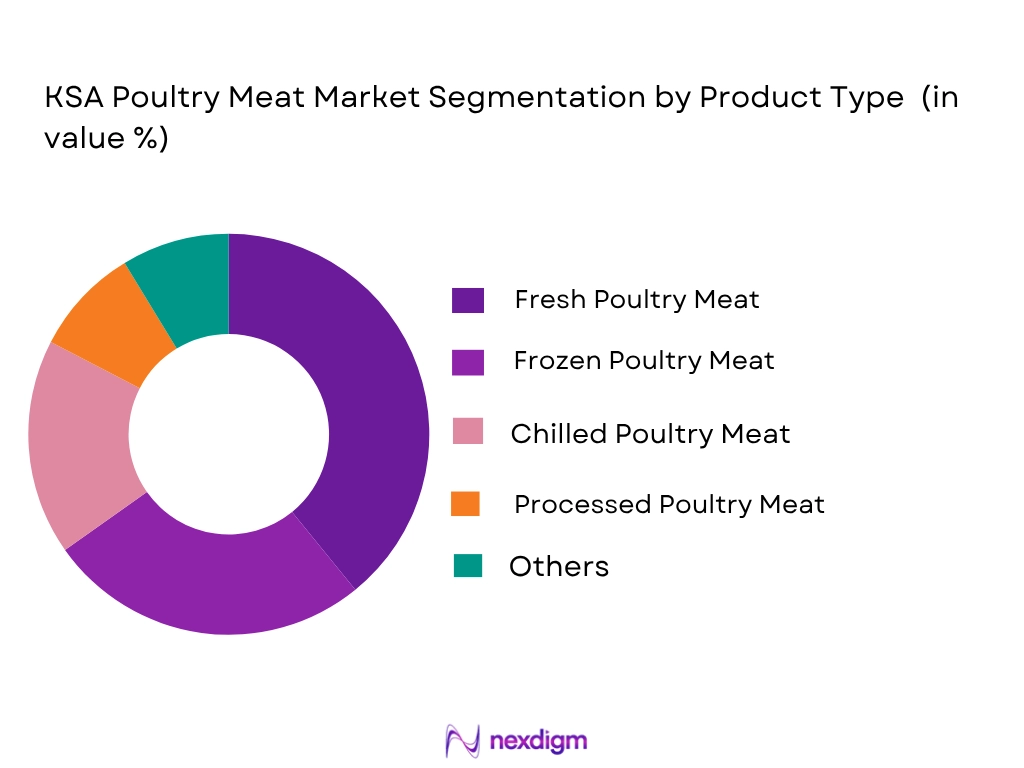
The KSA Poultry Meat Market is segmented by product form into fresh/chilled poultry meat, frozen poultry meat, processed poultry meat, and ready-to-eat poultry products. Recently, fresh and chilled poultry meat has held the dominant market share under this segmentation because Saudi consumers strongly associate freshness with quality, halal assurance, and household cooking suitability. Fresh poultry is widely used in daily meals, family consumption, and restaurant kitchens, especially where buyers prefer whole birds and chicken cuts over heavily processed formats. Domestic poultry expansion has also supported this sub-segment, as local producers are better positioned to supply chilled products through supermarkets, hypermarkets, butcher shops, and foodservice channels. Frozen poultry remains important because of imports and longer shelf life, but fresh/chilled products benefit from consumer trust, faster replenishment cycles, and government-backed domestic production growth.
By Distribution Channel
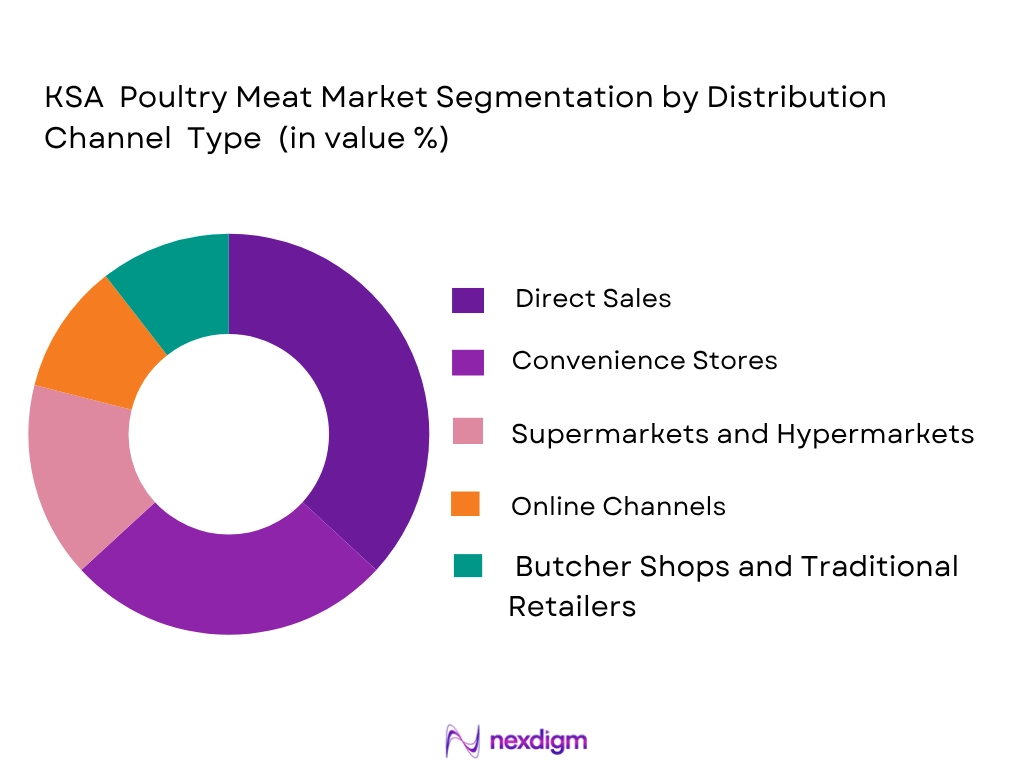
The KSA Poultry Meat Market is segmented by distribution channel into supermarkets and hypermarkets, butcher shops and traditional retailers, foodservice distributors, wholesale and institutional buyers, and online channels. Recently, supermarkets and hypermarkets have maintained the dominant market share under this segmentation due to their strong cold-chain capability, wide geographic presence, and ability to offer branded, halal-certified, packaged poultry products. Retail chains also provide consumers with product variety, including whole chicken, chicken cuts, marinated poultry, frozen packs, and value-added processed products. Urban consumers in Riyadh, Jeddah, Dammam, and Makkah increasingly prefer organized retail because it offers food safety assurance, transparent labelling, promotional pricing, and convenient weekly shopping. Traditional retailers remain relevant for price-sensitive and neighborhood purchasing, while foodservice distributors are growing due to restaurants, catering, hotels, and quick-service chains.
Competitive Landscape
The KSA Poultry Meat Market is moderately consolidated, with domestic producers competing against global poultry companies, frozen meat importers, and value-added food processors. Local companies such as Almarai, Al-Watania Poultry, Fakieh Poultry, Tanmiah Food Company, and Entaj benefit from integrated farming, processing, feed procurement, and distribution networks. International players such as BRF/Sadia and JBS/Seara compete strongly in frozen and processed poultry, while government-backed food security policies are encouraging more local processing capacity.
| Company | Establishment Year | Headquarters | Product Focus | Processing / Farm Presence | Key Channels | Strategic Focus | Brand Positioning | Market Role |
| Almarai Company | 1977 | Riyadh, Saudi Arabia | ~ | ~ | ~ | ~ | ~ | ~ |
| Al-Watania Poultry | 1977 | Qassim, Saudi Arabia | ~ | ~ | ~ | ~ | ~ | ~ |
| Fakieh Poultry Farms | 1960s | Makkah, Saudi Arabia | ~ | ~ | ~ | ~ | ~ | ~ |
| Tanmiah Food Company | 1962 | Riyadh, Saudi Arabia | ~ | ~ | ~ | ~ | ~ | ~ |
| BRF S.A. / Sadia | 1934 | Itajaí, Brazil | ~ | ~ | ~ | ~ | ~ | ~ |
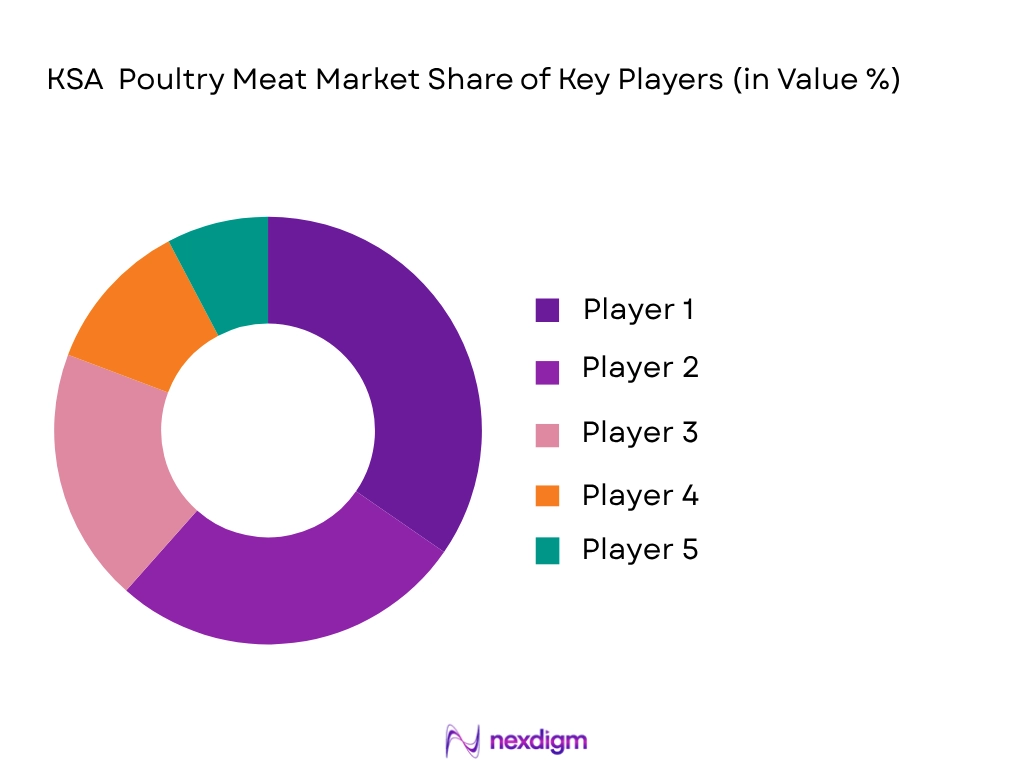
KSA Poultry Meat Market Analysis
Growth Drivers
Rising Consumption of Poultry as a Preferred Protein Source
Poultry meat consumption in Saudi Arabia is increasing due to its affordability, wide availability, and acceptance across different consumer groups. Compared with red meat, poultry is often considered a healthier and more convenient protein option, especially among younger and urban consumers. Chicken is also deeply integrated into local diets, household meals, restaurants, and institutional catering. Rising disposable income and changing food habits are further supporting frequent poultry consumption. In addition, the growing preference for high-protein diets has strengthened demand for fresh, frozen, and processed poultry products. As consumers seek nutritious, easy-to-cook, and cost-effective meat options, poultry remains one of the most preferred protein sources in the Kingdom, supporting steady market growth.
Government Support for Domestic Poultry Production
Government initiatives are playing a major role in expanding Saudi Arabia’s poultry meat market. The Kingdom is focused on improving food security and reducing dependence on imports by encouraging domestic poultry production. Support measures include investment incentives, funding programs, production expansion plans, and regulatory support for local producers. These initiatives help poultry companies modernize farms, improve processing facilities, and increase output capacity. The government’s focus on self-sufficiency also encourages the adoption of advanced farming technologies, biosecurity systems, and efficient supply chains. As local production increases, domestic producers are better positioned to meet rising demand from households, foodservice operators, and retailers. This support strengthens market stability and creates long-term growth opportunities for the poultry industry.
Market Challenges
Dependence on Feed Imports and Price Volatility
One of the key challenges for Saudi Arabia’s poultry meat market is its dependence on imported feed ingredients such as corn and soybean meal. Since feed represents a major portion of poultry production costs, fluctuations in global commodity prices directly affect producer margins. Supply chain disruptions, currency movements, climate-related crop issues, and international trade restrictions can increase feed costs and reduce price stability. Local producers may find it difficult to absorb these cost increases without raising poultry prices. This can affect competitiveness, especially against imported poultry products. Feed price volatility also makes production planning more complex for poultry companies. As a result, managing feed supply risk remains an important challenge for the industry.
Disease Outbreak Risks and Biosecurity Concerns
Disease outbreaks remain a serious concern for the poultry industry in Saudi Arabia. Poultry farms are vulnerable to diseases such as avian influenza and other infections that can affect bird health, production levels, and supply continuity. Outbreaks may lead to production losses, farm closures, higher veterinary costs, and stricter movement controls. Maintaining strong biosecurity standards is therefore essential but can be costly, especially for smaller producers. Farms need proper sanitation, vaccination programs, disease monitoring, controlled access, and trained workers to reduce risks. Any major outbreak can also weaken consumer confidence and disrupt market supply. Therefore, disease prevention and biosecurity investment are critical challenges for sustainable poultry market growth.
Opportunities
Expansion of Domestic Poultry Production Capacity
Saudi Arabia has a strong opportunity to expand domestic poultry production capacity due to rising demand and the national focus on food security. Increasing local production can reduce reliance on imports and improve supply stability. Poultry companies can invest in new farms, hatcheries, processing plants, and integrated production systems to meet growing consumer and foodservice demand. Expansion also allows producers to improve product freshness, reduce transportation dependency, and respond faster to local market needs. With government support and private-sector investment, domestic poultry production can become more competitive and efficient. This opportunity is especially important as the Kingdom aims to strengthen self-sufficiency and build a more resilient food supply chain.
Growing Demand for Processed and Ready-to-Cook Poultry Products
The increasing demand for processed and ready-to-cook poultry products presents a major growth opportunity in Saudi Arabia. Urban consumers are seeking convenient meal solutions due to busy lifestyles, smaller households, and rising participation in modern retail channels. Products such as marinated chicken, nuggets, sausages, burgers, kebabs, and frozen ready-to-cook items are gaining popularity among households and foodservice operators. These products offer convenience, consistent quality, and longer shelf life. Poultry companies can use this opportunity to diversify their product portfolios and capture higher margins compared with raw poultry. Growth in supermarkets, hypermarkets, online grocery platforms, and quick-service restaurants further supports demand for value-added poultry products across the Kingdom.
Future Outlook
Over the next six years, the KSA Poultry Meat Market is expected to grow steadily, driven by domestic production expansion, Vision 2030 food security priorities, higher demand for affordable animal protein, and rising consumption through restaurants, catering, hotels, and quick-service chains. The market outlook will also be shaped by cold-chain investment, stronger halal compliance systems, and greater adoption of processed, marinated, and ready-to-cook poultry formats. Domestic poultry production is expected to remain the central growth pillar. Saudi Arabia is working to reduce reliance on imports and improve poultry self-sufficiency through farm expansion, feed supply support, biosecurity standards, and processing investments. This will support fresh and chilled poultry availability across major urban centers.
Major Players
- Almarai Company
- Al-Watania Poultry
- Fakieh Poultry Farms
- Tanmiah Food Company
- Arabian Agricultural Services Company / Entaj
- BRF S.A. / Sadia
- JBS S.A. / Seara
- Almunajem Foods Company
- Golden Chicken Farms
- Saudi Radwa Food Company
- Herfy Food Services Company
- Americana Foods
- Balady Poultry
- Al Ajban Poultry
- Doux Group
Key Target Audience
- Poultry meat producers and integrated poultry farms
- Frozen and processed meat manufacturers
- Supermarkets, hypermarkets, and organized retail chains
- Foodservice operators, QSR chains, and catering companies
- Poultry feed manufacturers and animal nutrition companies
- Cold-chain logistics and refrigerated warehousing providers
- Investments and venture capitalist firms
- Government and regulatory bodies
Research Methodology
Step 1: Identification of Key Variables
The initial phase involves constructing an ecosystem map covering poultry farms, processors, distributors, retailers, foodservice buyers, importers, regulators, and cold-chain operators in the KSA Poultry Meat Market. This step is based on desk research, company mapping, trade databases, and industry-level information. The objective is to identify the main variables influencing demand, supply, pricing, distribution, and competitive positioning.
Step 2: Market Analysis and Construction
In this phase, historical market information is compiled and assessed for poultry meat consumption, domestic production, import dependency, channel penetration, and product-form preferences. The analysis includes revenue generation across fresh, frozen, processed, and ready-to-eat poultry categories. Service quality, cold-chain reliability, and product availability are reviewed to improve the accuracy of market sizing.
Step 3: Hypothesis Validation and Expert Consultation
Market hypotheses are validated through computer-assisted telephone interviews with poultry processors, distributors, retailers, foodservice procurement teams, cold-chain operators, and regulatory stakeholders. These consultations provide operational and financial insights into pricing, volumes, channel margins, product demand, and capacity expansion. The insights are used to refine assumptions and validate the final market structure.
Step 4: Research Synthesis and Final Output
The final phase involves synthesizing primary inputs, secondary data, company information, and bottom-up market estimates into a structured market report. Direct engagement with producers and distributors helps verify product segments, consumer preferences, regional demand, and sales performance. The final output provides a validated analysis of the KSA Poultry Meat Market, including size, segmentation, competition, outlook, and target audience.

- Executive Summary
- Research Methodology (Market Definitions and Assumptions, Abbreviations, Market Sizing Approach, Consolidated Research Approach, Understanding Market Potential Through In-Depth Industry Interviews, Primary Research Approach, Limitations and Future Conclusions)

- Definition and Scope
- Market Dynamics Overview
- Market Genesis
- Major Players and Market Timeline
- Business Cycle and Trends
- Supply Chain and Value Chain Analysis

- Growth Drivers
Rising Consumption of Poultry as a Preferred Protein Source
Growing Population and Urbanization
Increasing Demand from Foodservice and Quick-Service Restaurants
Government Support for Domestic Poultry Production
Expansion of Modern Retail and Cold Chain Infrastructure
Rising Demand for Halal-Certified Poultry Products - Market Challenges
Dependence on Feed Imports and Price Volatility
Disease Outbreak Risks and Biosecurity Concerns
High Competition from Imported Poultry Products
Cold Chain and Logistics Constraints
Regulatory Compliance and Food Safety Requirements - Opportunities
Expansion of Domestic Poultry Production Capacity
Growing Demand for Processed and Ready-to-Cook Poultry Products
Increasing Adoption of Advanced Farming and Processing Technologies
Rising Demand from HORECA and Institutional Segments
Development of Organic and Antibiotic-Free Poultry Products
Growth of Online Meat Delivery Platforms - Key Trends
Shift Toward Locally Produced Poultry Meat
Rising Preference for Fresh and Chilled Poultry Products
Increasing Demand for Value-Added Poultry Products
Focus on Food Safety, Traceability and Quality Certification
Adoption of Automation in Poultry Farming and Processing
Growth of Private Label Poultry Products in Modern Retail - Government Regulations
- SWOT Analysis
- Porter’s Five Forces

- By Value, 2020–2025
- By Volume, 2020–2025
- By Average Price, 2020–2025

- By Product Type (In Value %)
Fresh Poultry Meat
Frozen Poultry Meat
Processed Poultry Meat
Chilled Poultry Meat
Others - By Poultry Type (In Value %)
Chicken
Turkey
Duck
Others - By Form (In Value %)
Whole Chicken
Chicken Cuts
Boneless Meat
Minced Poultry Meat
Processed Poultry Products - By Processing Type (In Value %)
Raw Poultry Meat
Marinated Poultry Meat
Ready-to-Cook Poultry Meat
Ready-to-Eat Poultry Products - By End User (In Value %)
Households
Hotels, Restaurants and Cafés
Catering Companies
Food Processing Companies
Institutional Buyers - By Distribution Channel (In Value %)
Direct Sales
Supermarkets and Hypermarkets
Convenience Stores
Online Channels
Butcher Shops and Traditional Retailers - By Region (In Value %)
Riyadh Region
Makkah Region
Eastern Province
Madinah Region
Asir Region
Rest of KSA

- Market Share of Major Players by Value/Volume
- Market Share of Major Players by Product Type
- Cross Comparison Parameters (Company Overview, Business Strategies, Recent Developments, Strength, Weakness, Organizational Structure, Revenues, Revenues by Product Type, Number of Touchpoints Distribution Channels, Number of Dealers and Distributors, Margins, Production Plant, Capacity, Unique Value Offering and Others)
- SWOT Analysis of Major Players
- Pricing Analysis Based on Product Categories for Major Players
- Detailed Profiles of Major Companies
Almarai Company
Al-Watania Poultry
Fakieh Poultry Farms
Tanmiah Food Company
Almarai Alyoum
Arabian Agricultural Services Company
BRF S.A.
Savola Group
Herfy Food Services Company
Almunajem Foods Company
Golden Chicken Farms
Doux Group
Al Ajban Poultry
Balady Poultry
Saudi Radwa Food Company

- Market Demand and Utilization
- Purchasing Power and Budget Allocations
- Regulatory and Compliance Requirements
- Needs, Desires and Pain Point Analysis
- Decision-Making Process

- By Value, 2026–2035
- By Volume, 2026–2035
- By Average Price, 2026–2035


 Request a Sample
 Ask for Customization
 Get a Quote
 Enquire Now