
 Download PDF
Market Overview
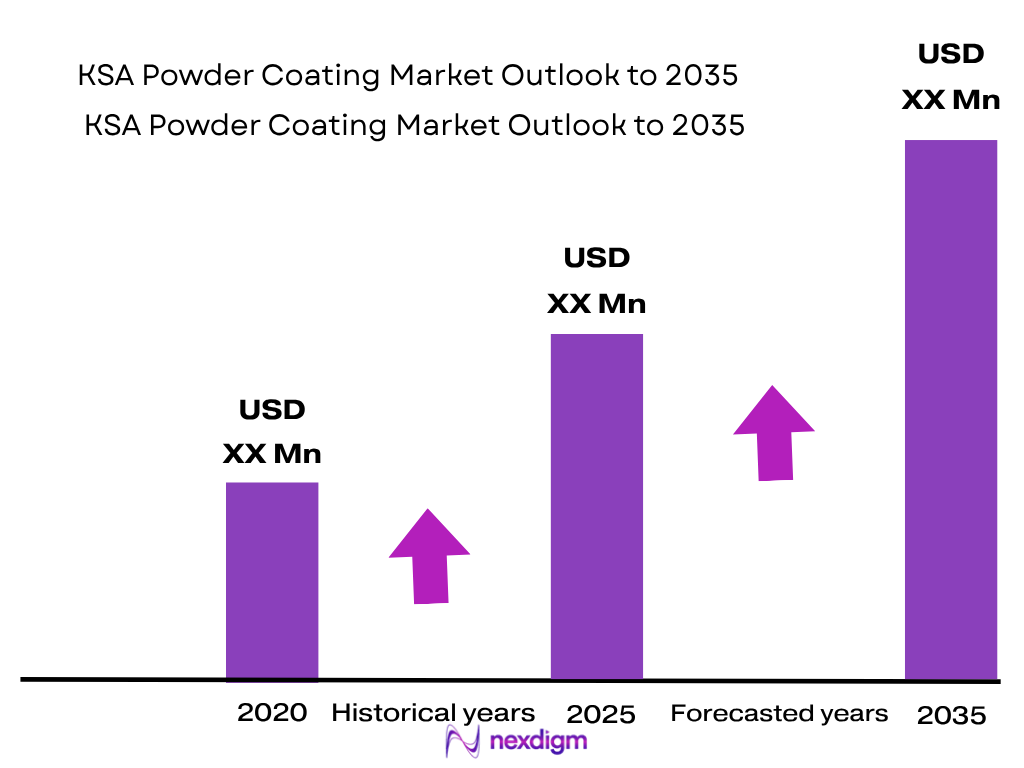
The KSA Powder Coating Market is valued at approximately USD ~XX million, supported by architectural aluminum, metal fabrication, oil and gas equipment, electrical products, HVAC systems and emerging automotive manufacturing. Saudi nominal GDP increased from approximately SAR 4.5 trillion to SAR 4.703 trillion, while the Kingdom had 11,672 operating and under-construction factories with industrial investments of about SAR 1.539 trillion. This expanding manufacturing base increases coated-metal surface requirements across industrial and construction applications.
Riyadh, Dammam, Jubail, Jeddah, Yanbu and the emerging King Abdullah Economic City automotive cluster dominate KSA powder-coating demand because they concentrate metal fabrication, architectural extrusion, petrochemicals, machinery and mobility manufacturing. Riyadh and the Eastern Region host extensive industrial estates, while Jotun operates Saudi powder-coating manufacturing in Dammam Industrial City 2. National nominal GDP moved from around SAR 4.5 trillion to SAR 4.703 trillion, reinforcing industrial investment across these urban and manufacturing corridors.
Market Segmentation
By Resin Chemistry
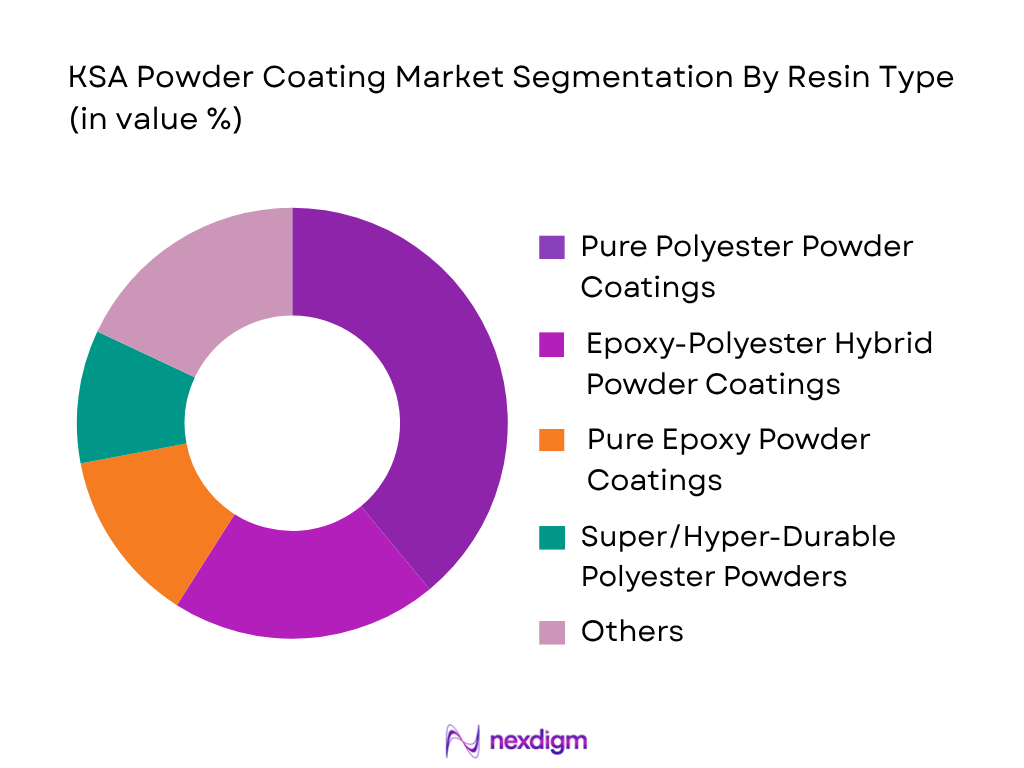
The KSA Powder Coating Market is segmented into polyester, epoxy, epoxy-polyester hybrid, polyurethane, acrylic, fluoropolymer and thermoplastic systems. Pure polyester powder coatings dominate the resin chemistry segment because Saudi Arabia has extensive architectural aluminum, façades, HVAC equipment, outdoor metal furniture, industrial enclosures and infrastructure exposed to severe sunlight and heat. Polyester systems provide stronger outdoor weatherability than epoxy-rich formulations and can be engineered into super-durable and hyper-durable grades. Jotun’s Saudi architectural portfolio includes standard and super-durable powder systems, with its super-durable products carrying QUALICOAT Class 2 and AAMA 2604 positioning. Epoxy and hybrid powders remain important for indoor electrical equipment, machinery and corrosion-resistant primers. Fluoropolymer and higher-durability polyester systems serve premium façade applications where long-term color and gloss retention justify stricter qualification. The expansion of Saudi construction, industrial projects and local manufacturing therefore favors exterior-grade polyester technologies while sustaining epoxy-based functional applications.
By End-Use Industry
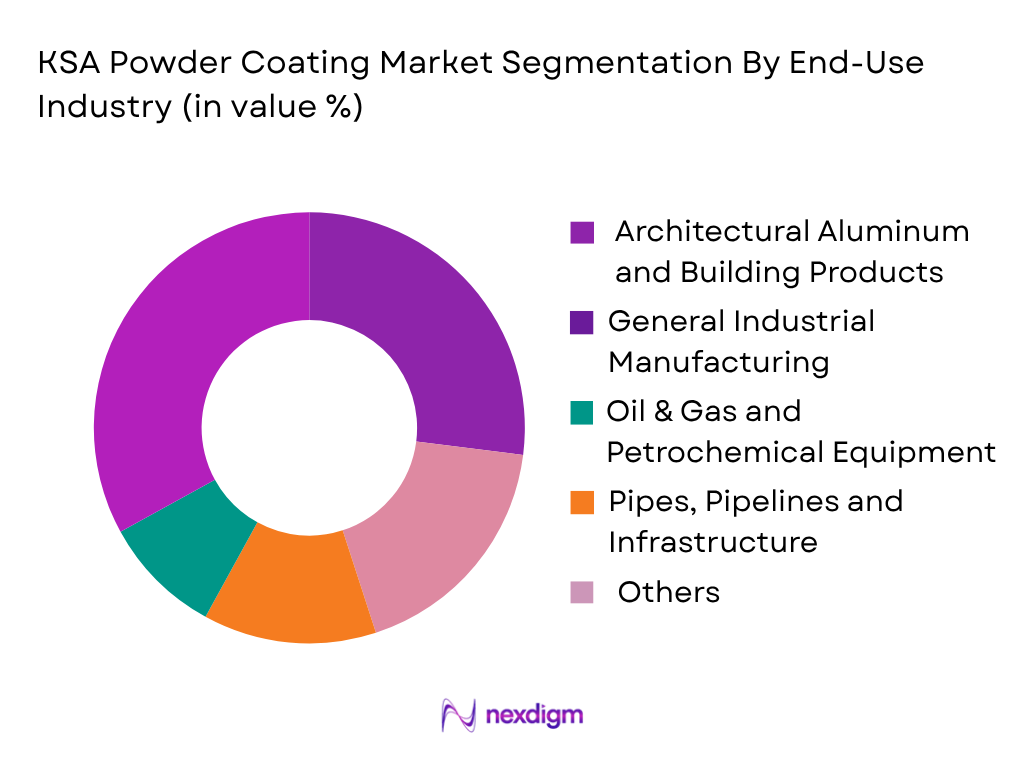
The KSA Powder Coating Market is segmented into architectural aluminum, general industrial manufacturing, oil and gas equipment, pipelines, automotive components, electrical equipment, appliances, HVAC, furniture, transportation and renewable-energy equipment. Architectural aluminum and building products dominate the end-use segmentation because Saudi megaprojects, commercial developments and infrastructure programs require large volumes of coated windows, curtain walls, doors, railings, façade panels and shading systems. Harsh UV exposure and desert conditions make durable powder coatings particularly appropriate for aluminum components. Jotun’s Saudi powder systems target building exteriors and provide architectural formulations engineered for large temperature fluctuations, humidity and sand abrasion. Oil and gas is another strategically important segment because steel structures, pipes, valves and industrial equipment require anti-corrosion powder systems. Automotive demand is smaller currently but is becoming increasingly important as Lucid, Ceer and Hyundai manufacturing projects establish a domestic vehicle and component supply chain.
Competitive Landscape
The KSA Powder Coating Market combines locally established manufacturers, multinational powder specialists and regional industrial coatings suppliers. Jotun, AkzoNobel Interpon, National Paints, ALWAN and Al-Jazeera Paints compete through architectural durability, industrial corrosion protection, local availability and technical qualification support. Local manufacturing presence is particularly valuable because construction and industrial customers often require rapid color matching, approved product documentation and short replenishment cycles.
| Company | Establishment Year | Headquarters | Resin Chemistry Capability | Core Powder Applications | KSA Manufacturing / Supply | Architectural Capability | Functional / Corrosion Capability | Technical Support |
| Jotun | 1926 | Sandefjord, Norway | ~ | ~ | ~ | ~ | ~ | ~ |
| AkzoNobel – Interpon | 1994* | Amsterdam, Netherlands | ~ | ~ | ~ | ~ | ~ | ~ |
| National Paints | 1969 | Sharjah, UAE | ~ | ~ | ~ | ~ | ~ | ~ |
| Gulf Polyester Powder Coating – ALWAN | 1993 | Saudi Arabia | ~ | ~ | ~ | ~ | ~ | ~ |
| Al-Jazeera Paints | 1979 | Khamis Mushait, Saudi Arabia | ~ | ~ | ~ | ~ | ~ | ~ |
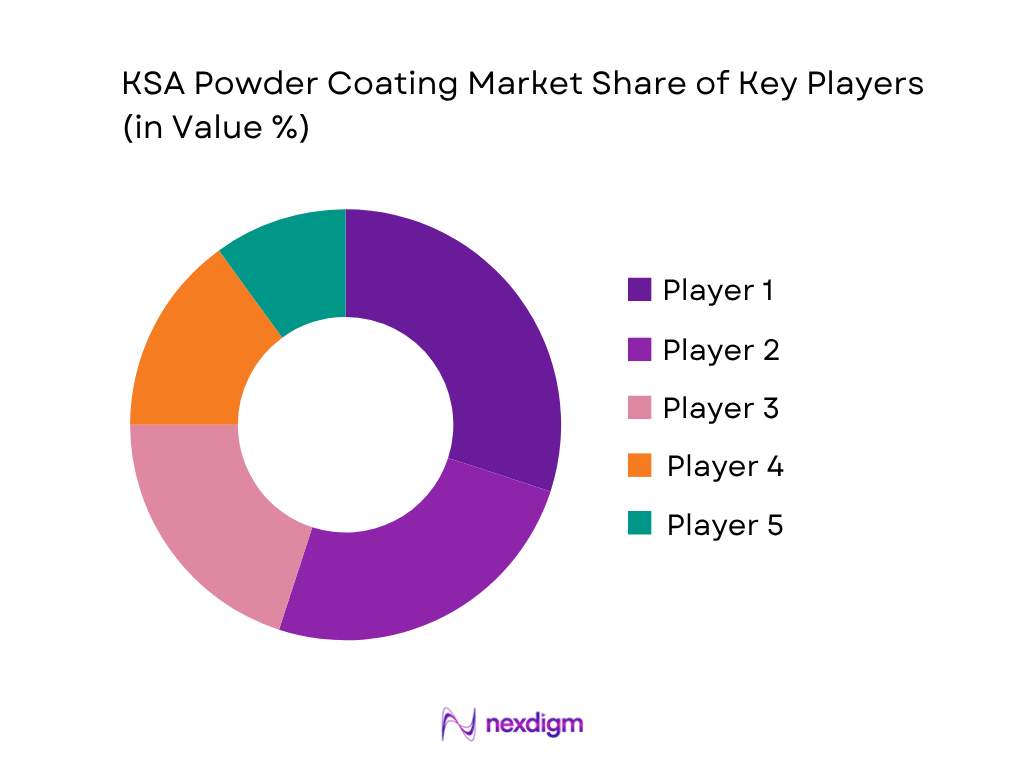
KSA Powder Coating Market Analysis
Growth Drivers
Industrial Localization and Expansion of Metal Manufacturing
Saudi Arabia’s industrial localization agenda is strengthening demand for powder coatings used on fabricated metal products, machinery housings, electrical cabinets, architectural components and industrial equipment. According to the Ministry of Industry and Mineral Resources, the Kingdom had more than 12,000 operating factories in 2024, while the Vision 2030 annual report indicates continued expansion of domestic industrial capacity. Earlier in 2024, 152 new industrial licenses were issued in January alone, including 19 licenses for fabricated metal products, 20 licenses for non-metallic mineral products and 14 licenses for chemicals and chemical products. GASTAT reports nominal GDP of SAR 4.703 trillion in 2024, with other manufacturing industries contributing approximately SAR 343 billion when its reported economic share is applied to total output. Construction activity represented roughly SAR 362 billion, creating an additional powder-coatable substrate base in structural and architectural products. The IMF also recorded robust non-oil economic momentum in 2024, supported by domestic investment and diversification. These industrial developments directly expand demand for polyester, epoxy-polyester hybrid, corrosion-resistant and functional powders across captive OEM lines and independent applicators serving metal fabrication, electrical equipment and construction-related manufacturing.
Architectural Construction and Aluminum Finishing Demand
Saudi Arabia’s construction and architectural development provides a major demand engine for powder coatings used on aluminum extrusions, curtain walls, windows, doors, railings, façade panels, HVAC housings and external metal structures. GASTAT’s updated national accounts place total Saudi nominal GDP at SAR 4.703 trillion in 2024, while construction activities accounted for approximately SAR 362 billion of economic output. Gross capital formation represented approximately SAR 1.49 trillion, indicating the scale of investment flowing through infrastructure, buildings, industrial facilities and associated equipment. The country’s construction pipeline requires durable exterior finishes because architectural components operate under intense UV radiation, high ambient temperatures, sand exposure and, in coastal areas, saline conditions. These environmental demands favor super-durable polyester, hyper-durable polyester and fluoropolymer powder systems over conventional indoor-grade chemistries. The IMF reported that Saudi Arabia’s non-oil economy remained one of the principal drivers of economic activity in 2024, supported by construction, consumption and investment. Powder coating suppliers therefore benefit from both new-build projects and replacement demand for exterior metal products. The opportunity is particularly strong for systems meeting architectural durability requirements while maintaining color and gloss stability under Saudi climatic conditions.
Market Challenges
Imported Resin and Specialty Raw Material Dependence
The KSA Powder Coating Market faces a structural challenge from dependence on imported polyester resins, epoxy resins, crosslinkers, titanium dioxide, organic pigments, specialty additives and effect pigments required for advanced powder formulations. Saudi Arabia’s broader investment cycle is already increasing import requirements: IMF analysis notes that investment-linked imports are rising as Vision 2030 projects progress, while the current account shifted toward deficit conditions in 2024. GASTAT reports that imports represented approximately SAR 1.27 trillion when the published import contribution is applied to nominal GDP of SAR 4.703 trillion in 2024. This large inflow demonstrates the economy’s continuing reliance on international supply chains for machinery, industrial inputs and specialized materials. Powder manufacturers are particularly exposed because relatively small formulation changes can affect cure response, gloss, color matching, UV stability, flow, corrosion resistance and application efficiency. Polyester crosslinkers and high-performance additives cannot always be substituted quickly without reformulation and customer requalification. The challenge is more pronounced for architectural, pipeline and automotive powders where customers require documented performance against strict specifications. Saudi producers must therefore maintain larger safety stocks, multiple qualified suppliers and stronger formulation flexibility while balancing localization objectives with the continued technical dependence on global specialty chemical supply.
Extreme Climate and Performance Qualification Requirements
Saudi Arabia’s climatic and industrial operating environment creates demanding qualification requirements for powder coatings, especially products used on façades, pipelines, electrical equipment and outdoor infrastructure. High temperatures, intense solar radiation, airborne sand and coastal salinity can accelerate gloss loss, fading, chalking, corrosion and adhesion failure when coatings are under-specified. This challenge is significant because GASTAT reports construction activity of approximately SAR 362 billion in 2024, while crude oil and natural gas activities represented about SAR 912 billion of nominal economic output. The IMF reported Saudi oil production at approximately 9 million barrels per day in 2024, illustrating the extensive hydrocarbon infrastructure that requires long-life protective finishes across equipment, pipelines, valves, structural components and electrical systems. Suppliers serving these applications cannot rely solely on decorative performance; powders may need documented salt-spray resistance, UV durability, chemical resistance, impact performance and thermal stability. Qualification cycles can therefore extend beyond color matching to include accelerated weathering, adhesion testing, corrosion testing and operator-specific approvals. These requirements increase technical-service costs and can limit rapid supplier switching. Manufacturers with inadequate laboratory, application-testing or field-support capabilities may struggle to compete in higher-value Saudi architectural and industrial applications.
Market Opportunities
Automotive Localization and EV Component Powder Coatings
Saudi Arabia’s emerging automotive manufacturing ecosystem creates a future opportunity for automotive-grade and functional powder coatings across wheels, suspension parts, seat frames, battery enclosures, electric motors and electrical components. Public Investment Fund initiatives already provide a current manufacturing foundation. Ceer is designed for annual production of 170,000 vehicles, while Lucid’s Saudi manufacturing facility has planned capacity of 155,000 vehicles per year. The PIF-Hyundai joint venture is establishing another Saudi plant designed to manufacture 50,000 vehicles annually, while Ceer is expected to support approximately 30,000 direct and indirect jobs. These current commitments demonstrate that Saudi Arabia is moving from vehicle import dependence toward local assembly and component manufacturing. GASTAT places national nominal GDP at SAR 4.703 trillion in 2024, while gross capital formation is approximately SAR 1.49 trillion, providing a substantial investment backdrop for industrial localization. Powder suppliers can use this manufacturing base to develop automotive polyester systems, anti-corrosion primers, wheel powders, dielectric coatings and heat-resistant products. As domestic supplier networks expand around King Abdullah Economic City and related automotive clusters, local powder production, color matching and OEM qualification capability should become increasingly important for capturing future mobility-sector demand.
Pipeline, Oil & Gas and Functional Corrosion-Protection Powders
Saudi Arabia’s extensive hydrocarbon infrastructure provides a strong future opportunity for fusion-bonded epoxy, high-temperature and severe-corrosion powder systems used on pipelines, valves, fittings, steel components and process equipment. IMF data indicate that Saudi oil production averaged approximately 9 million barrels per day in 2024, while GASTAT places crude oil and natural gas activity at around SAR 912 billion of nominal economic output. Petroleum refining contributes another roughly SAR 245 billion, and petrochemicals approximately SAR 169 billion, based on the economic shares reported in the national accounts. This installed industrial base requires continuous maintenance, refurbishment and expansion, creating demand for powder coatings that provide corrosion resistance, cathodic-disbondment performance, chemical resistance and high-temperature stability. The opportunity extends beyond pipelines to electrical enclosures, busbars, oilfield equipment and coastal infrastructure requiring dielectric or high-edge-build performance. Saudi Arabia’s continuing investment in downstream manufacturing and industrial localization gives local powder producers an opportunity to develop operator-qualified systems rather than relying predominantly on imported finished products. Suppliers able to combine domestic production with technical testing, field application support and rapid supply can capture recurring demand from oilfield manufacturers, pipeline contractors and industrial fabricators serving the Kingdom’s energy sector.
Future Outlook
The KSA Powder Coating Market is forecast to expand at approximately ~X.X% CAGR during 2026–2035, with the figure intentionally retained as a placeholder for the proprietary forecast. Growth will increasingly be linked to Vision 2030 industrial localization, architectural megaprojects, automotive manufacturing, electrical equipment, renewable energy and Saudi Arabia’s continued development of downstream manufacturing. Architectural durability will remain central because Saudi substrates operate under intense UV radiation, temperature fluctuations, sand abrasion and coastal exposure. Suppliers offering super-durable polyester, hyper-durable polyester and fluoropolymer systems should increasingly serve façade, window, door and external architectural applications.
Automotive manufacturing represents a newer growth platform. Lucid has already established vehicle manufacturing in Saudi Arabia, while Ceer is developing its EV manufacturing complex. PIF has also announced the King Salman Automotive Cluster, incorporating Ceer, Lucid, Hyundai and associated automotive suppliers. Powder applications can extend into wheels, suspension components, seat frames, battery enclosures, motors and electrical parts. Energy-efficient curing should become more commercially relevant. AkzoNobel’s low-energy powder technology cures at 150°C, around 30°C lower than traditional systems, and the company states that it can shorten curing time materially. Such technologies are especially relevant to Saudi finishers seeking increased throughput and reduced oven load.
Major Players
- Jotun Saudi Arabia Co. Ltd.
- AkzoNobel Saudi Arabia – Interpon Powder Coatings
- National Paints Factories Co. Ltd.
- Gulf Polyester Powder Coating Company – ALWAN
- Sak Coat Powder Coatings
- Arabian Industrial Metal Coating Co. – AIMCO
- Zamil Industrial Coatings – ZINDCO
- Axalta Coating Systems
- PPG Industries
- The Sherwin-Williams Company
- Al-Jazeera Paints Company
- Kansai Paint
- Protech Group / Oxyplast
- United Coatings Industries
- Saudi Industrial Paint Company – SIPCO
Key Target Audience
- Powder Coating Manufacturers
- Polyester Resin, Epoxy Resin, Pigment and Additive Suppliers
- Architectural Aluminum Extruders and Powder Applicators
- Oil & Gas, Pipeline and Industrial Equipment Manufacturers
- Automotive, Electrical Equipment and Industrial OEMs
- Powder Application Equipment and Finishing-Line Manufacturers
- Investments and Venture Capitalist Firms
- Government and Regulatory Bodies (Ministry of Industry and Mineral Resources, Saudi Standards Metrology and Quality Organization, National Center for Environmental Compliance, Saudi Authority for Industrial Cities and Technology Zones, Royal Commission for Jubail and Yanbu)
Research Methodology
Step 1: Identification of Key Variables
The first research stage develops an ecosystem map covering Saudi powder manufacturers, resin and pigment suppliers, architectural applicators, custom coaters, distributors, metal fabricators and OEM finishers. Key variables include resin chemistry, powder volume, film thickness, curing conditions, transfer efficiency, production footprint, imported raw-material dependence and application-specific performance requirements.
Step 2: Market Analysis and Construction
Historical demand is modeled through top-down and bottom-up approaches. Top-down assessment analyzes architectural aluminum, construction, oil and gas equipment, pipelines, electrical products and manufacturing activity. Bottom-up analysis evaluates producer sales, distribution throughput, applicator consumption, coated surface area and captive OEM coating-line usage to construct a detailed market estimate.
Step 3: Hypothesis Validation and Expert Consultation
Market hypotheses are validated through CATI and structured discussions with manufacturers, distributors, aluminum extruders, powder applicators, fabricators and OEM procurement teams. Interviews evaluate product consumption, resin preference, cure schedules, reclaim practices, project approvals, specification requirements and supplier switching barriers. Primary information is then used to reconcile supply-side and demand-side estimates.
Step 4: Research Synthesis and Final Output
The final stage triangulates Saudi government statistics, trade data, manufacturer information, industrial project activity and primary interviews. Powder consumption is cross-checked against coated surface area, average film build and application intensity. Forecast scenarios incorporate Vision 2030 localization, architectural development, automotive manufacturing, industrial investment, energy-efficient curing and high-durability powder adoption.

- Executive Summary
- Research Methodology (Market Definition and Scope, KSA Powder Coating Taxonomy, Thermoset and Thermoplastic Powder Classification, Resin Chemistry Mapping, Functional and Decorative Powder Classification, Substrate Mapping, Surface Pretreatment Assessment, Electrostatic Application Technology Assessment, Cure Technology Assessment, Film Thickness Assessment, Powder Recovery and Reclaim Assessment, Market Sizing Framework)

- Definition and Scope
- KSA Powder Coating Industry Evolution and Technology Development
- Powder Coating Manufacturing and Formulation Process
- Powder Coating Value Chain Analysis
- KSA Powder Coating Supply Chain Analysis
- Resin, Pigment, Additive and Filler Ecosystem Analysis
- KSA Powder Coating Import Dependency and Localization Assessment
- OEM Powder Coating Application Architecture and Custom Coater Solution Framework

- Growth Drivers (Vision 2030 Industrial Localization, Megaproject and Architectural Aluminum Demand, Oil and Gas Equipment Manufacturing, Pipeline and Infrastructure Development, Automotive and Mobility Manufacturing Expansion, Electrical Equipment and HVAC Demand, Liquid-to-Powder Conversion, High Powder Recovery and Material Utilization)
- Market Challenges (Polyester and Epoxy Resin Supply Exposure, Energy-Intensive Cure Requirements, Extreme UV and Heat Exposure, Pretreatment Quality Variation, Color Change Downtime, Specialty Powder Qualification Requirements, Skilled Applicator Constraints, Imported Raw Material Dependence)
- Market Opportunities (Super-Durable Architectural Powders, Hyper-Durable Desert Climate Powders, Pipeline FBE Systems, Low-Bake and Fast-Cure Powders, EV Battery and Electrical Insulation Powders, Heat-Reflective Powder Coatings, Localized Specialty Powder Manufacturing, Automated Powder Application Systems)
- Market Trends (TGIC-Free Polyester Adoption, Super-Durable Architectural Systems, QUALICOAT-Compliant Powders, Low-Bake Fast-Cure Systems, Bonded Metallic Finishes, Functional Powder Coatings, Robotic Application, Saudi Localization of Powder Manufacturing)
- Regulatory and Standards Landscape (Saudi Standards Metrology and Quality Organization Requirements, Saudi Product Safety Law Requirements, SABER Product Conformity Requirements, Saudi Building Code Requirements, Royal Commission Industrial Environmental Requirements, National Center for Environmental Compliance Requirements, QUALICOAT Architectural Performance Requirements, ASTM and ISO Powder Coating Test Standards)
- SWOT Analysis
- Porter’s Five Forces Analysis
- PESTLE Analysis
- Stakeholder Ecosystem
- Competition Ecosystem

- By Market Value (2020-2025)
- By Powder Coating Consumption Volume (2020-2025)
- By Coated Surface Area (2020-2025)
- By Domestic Production Volume (2020-2025)
- By Import Volume (2020-2025)
- By Export Volume (2020-2025)
- By Average Selling Price (2020-2025)
- By Thermoset Powder Consumption (2020-2025)
- By Thermoplastic Powder Consumption (2020-2025)

- By Resin Chemistry (In Value %)
Pure Polyester Powder Coatings
TGIC Polyester Powder Coatings
TGIC-Free Polyester Powder Coatings
Super-Durable Polyester Powder Coatings
Hyper-Durable Polyester Powder Coatings
Epoxy Powder Coatings
Epoxy-Polyester Hybrid Powder Coatings
Polyurethane Powder Coatings
Acrylic Powder Coatings
Fluoropolymer Powder Coatings
Silicone Polyester Powder Coatings
Nylon Powder Coatings
Polyethylene Powder Coatings - By Coating Technology (In Value %)
Thermosetting Powder Coatings
Thermoplastic Powder Coatings
Low-Temperature Cure Powder Coatings
Low-Bake Fast-Cure Powder Coatings
Ultra-Low-Bake Powder Coatings
UV-Curable Powder Coatings
Thin-Film Powder Coatings
High-Temperature Resistant Powder Coatings - By Functional Performance (In Value %)
Decorative Powder Coatings
Corrosion-Resistant Powder Coatings
Super-Durable Architectural Powders
Hyper-Durable Architectural Powders
High-Temperature Powder Coatings
Heat-Reflective Powder Coatings
Electrical Insulation and Dielectric Powders
Antimicrobial Powder Coatings
Anti-Graffiti Powder Coatings
Scratch-Resistant Powder Coatings
Chemical-Resistant Powder Coatings
Fire-Retardant Powder Coatings
Fusion-Bonded Epoxy Powders
Pipeline Powder Coatings
Rebar Powder Coatings - By End-Use Industry (In Value %)
Architectural Aluminum and Building Products
General Industrial Manufacturing
Oil and Gas Equipment
Petrochemicals
Pipes and Pipelines
Construction Steel and Rebar
Automotive and Auto Components
Commercial Vehicles
Rail and Transportation
Appliances and White Goods
HVAC and Refrigeration Equipment
Electrical Equipment
Switchgear and Control Panels
Furniture and Office Equipment
Agricultural and Construction Equipment
Metal Fabrication
Solar and Renewable Energy Equipment
Marine and Coastal Infrastructure - By Distribution Channel (In Value %)
Direct Powder Manufacturer-to-OEM Sales
Direct Manufacturer-to-Applicator Sales
Authorized Powder Coating Distributors
Industrial Coatings Distributors
Regional Stocking Warehouses
Dealer and Reseller Networks
Equipment and Powder Bundled Distribution
Project-Specific Supply Contracts
Online B2B Industrial Platforms
Custom Color and Small-Batch Channels - By Region (In Value %)
Central Region
Riyadh
Al Kharj
Eastern Region
Dammam
Al Khobar
Jubail
Dhahran
Al Ahsa
Western Region
Jeddah
Makkah
Medina
Yanbu
Northern Region
Tabuk
NEOM Industrial Development Zone
Southern Region
Jazan
Khamis Mushait
Abha

- Market Share of Major Players (By Revenue, Volume, Resin Chemistry, Powder Technology, End-Use Industry, Application Type, Market Type, Distribution Channel)
- Cross Comparison Parameters (Resin Chemistry and Powder Technology Breadth, Saudi Powder Manufacturing and Extrusion Capacity, Super-Durable and Hyper-Durable Architectural Powder Capability, Pipeline FBE and Corrosion-Protection Technology Strength, Low-Bake and Fast-Cure Technology Capability, Custom Color Matching and Project-Specific Formulation Flexibility, KSA Distribution and Technical Application Support, Sustainable and TGIC-Free Low-Energy Powder Portfolio)
- SWOT Analysis of Major Players
- Competitive Positioning Matrix
- Product and Technology Portfolio Benchmarking
- Pricing and Distribution Network Benchmarking
- Market Entry Strategy Assessment
- Detailed Profiles of Major Companies
Jotun Saudi Arabia Co. Ltd.
AkzoNobel Saudi Arabia – Interpon Powder Coatings
National Paints Factories Co. Ltd.
Gulf Polyester Powder Coating Company – ALWAN
Sak Coat Powder Coatings
Arabian Industrial Metal Coating Co. – AIMCO
Zamil Industrial Coatings – ZINDCO
Axalta Coating Systems
PPG Industries
The Sherwin-Williams Company
Al-Jazeera Paints Company
Kansai Paint
Protech Group / Oxyplast
United Coatings Industries
Saudi Industrial Paint Company – SIPCO

- Buyer Segmentation
- OEM Procurement Behaviour
- Supplier Selection Criteria
- Buyer Pain Points
- Technology Adoption Assessment
- Replacement and Repurchase Behaviour

- By Market Value (2026-2035)
- By Powder Coating Consumption Volume (2026-2035)
- By Coated Surface Area (2026-2035)
- By Domestic Production Volume (2026-2035)
- By Import Volume (2026-2035)
- By Export Volume (2026-2035)
- By Average Selling Price (2026-2035)
- By Thermoset Powder Consumption (2026-2035)
- By Thermoplastic Powder Consumption (2026-2035)


 Request a Sample
 Ask for Customization
 Get a Quote
 Enquire Now