
 Download PDF
Market Overview
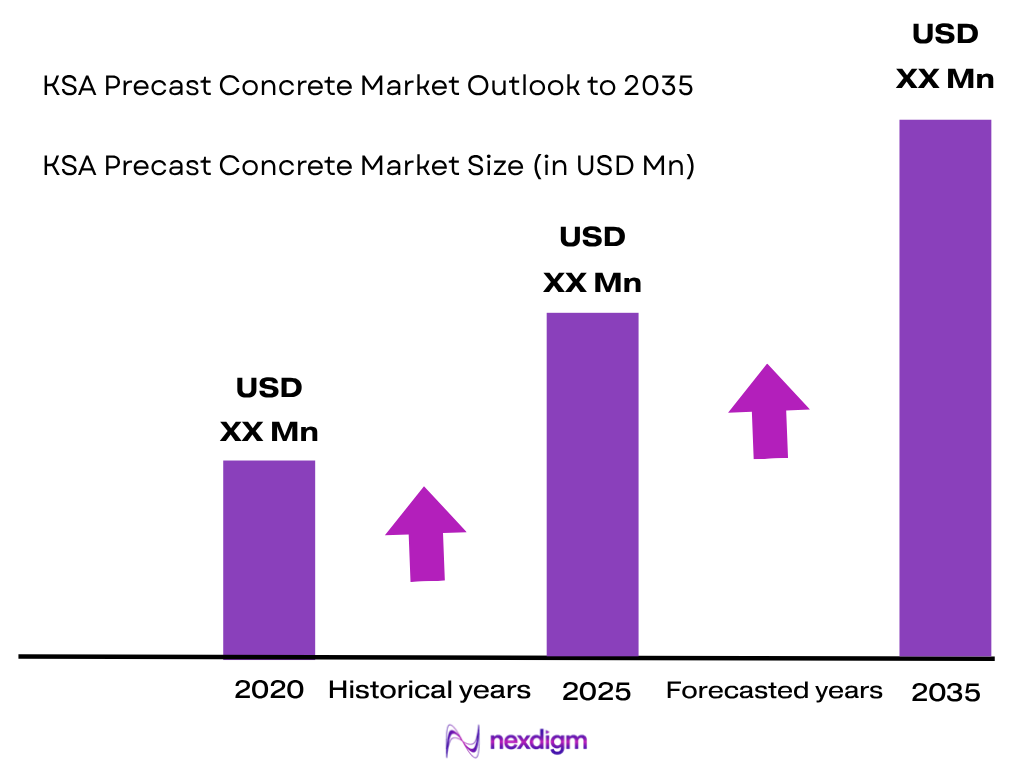
The KSA Precast Concrete Market is valued at approximately USD ~ billion, based on historical market assessment, compared with approximately USD ~ billion in the preceding period. Demand is supported by large-scale housing, infrastructure and giga-project construction. Saudi Arabia’s Housing Program reported that more than 1.3 million Saudi families had benefited from Sakani through the latest reporting period, including more than 122,000 families receiving housing support in the latest annual cycle. Large construction programs favor factory-produced structural frames, hollow-core slabs, wall panels, double tees and architectural precast systems.
Riyadh and the Central Region represent a major center of the KSA Precast Concrete Market because of extensive residential, commercial, entertainment and mixed-use construction and the concentration of manufacturing facilities. Al Rashid Abetong alone operates 5 factories in Riyadh, while Qiddiya covers more than 360 square kilometers west of the capital. Western Saudi Arabia benefits from Red Sea tourism and urban development, while the Eastern Region benefits from industrial, energy and logistics projects and a strong Dammam-based precast manufacturing cluster.
Market Segmentation
By Product Type
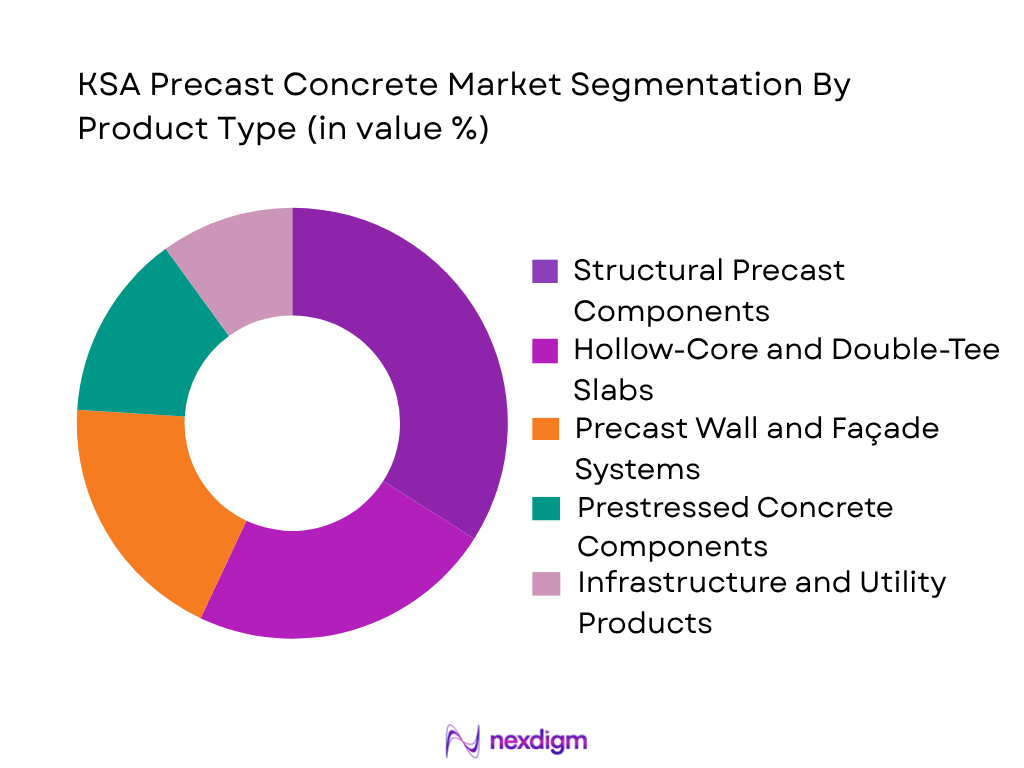
The KSA Precast Concrete Market is segmented by product type into structural precast components, hollow-core and double-tee slabs, precast wall and façade systems, prestressed concrete components, and infrastructure and utility products. Recently, structural precast components have maintained a dominant position because Saudi Arabia’s large residential communities, commercial buildings, parking structures, industrial facilities and giga-projects require repetitive columns, beams, slabs and complete structural systems. Precast structural solutions provide controlled factory production and enable construction activities to proceed through coordinated manufacturing, transportation and erection. The importance of integrated structural systems is reinforced by established domestic manufacturing capability. Al Rashid Abetong operates 5 factories in Riyadh, while KPC Precast reports annual production exceeding 600,000 m³. RDB EL SEIF states that its facilities can manufacture approximately 2,000 m³ per day, illustrating the industrial scale available to serve large Saudi construction programs.
By Application
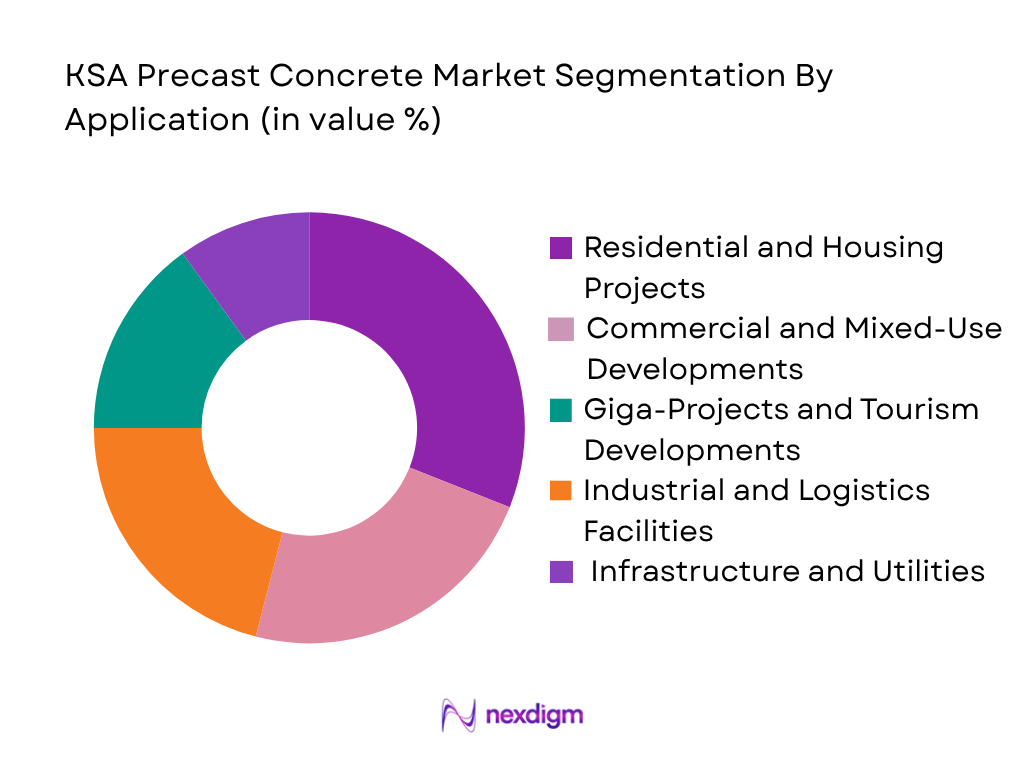
The KSA Precast Concrete Market is segmented by application into residential and housing projects, commercial and mixed-use developments, giga-projects and tourism developments, industrial and logistics facilities, and infrastructure and utilities. Recently, residential and housing projects have represented a major demand category because Saudi Arabia continues to expand master-planned communities and housing availability under Vision 2030. More than 1.3 million Saudi families had benefited from the Sakani initiative through the latest reported period, while more than 122,000 families received housing support during the latest annual cycle. ROSHN is developing integrated communities and has a portfolio encompassing more than 400,000 homes across Riyadh, Jeddah, Al Ahsa and other regions, covering over 200 million m² of master-planned neighborhoods. Repetitive residential development supports precast wall panels, structural frames, stairs, slabs and façade systems because standardized designs can be manufactured in volume and coordinated with accelerated construction programs.
Competitive Landscape
The KSA Precast Concrete Market has an established domestic manufacturing base comprising long-standing Saudi precast producers and companies with integrated design, manufacturing, transportation and erection capabilities. Competition increasingly centers on production capacity, hollow-core and prestressing capability, automation, geographic reach, project mobilization and the ability to meet demanding schedules associated with Vision 2030 developments. Al Rashid Abetong, RDB EL SEIF, KPC Precast, Bina Precast and INCO Precast are among the companies with significant operating histories or specialized capabilities in the Kingdom.
| Company | Establishment Year | Headquarters | Structural Precast | Hollow-Core / Prestressed Capability | Design & Engineering | Transportation & Erection | Geographic Reach | Major Project Capability |
| Al Rashid Abetong | 1977 | Riyadh | ~ | ~ | ~ | ~ | ~ | ~ |
| RDB EL SEIF | 2008 | Riyadh | ~ | ~ | ~ | ~ | ~ | ~ |
| KPC Precast | 2010* | Dammam | ~ | ~ | ~ | ~ | ~ | ~ |
| Bina Precast | 2006/2007* | Dammam | ~ | ~ | ~ | ~ | ~ | ~ |
| INCO Precast | 1967** | Dammam | ~ | ~ | ~ | ~ | ~ | ~ |
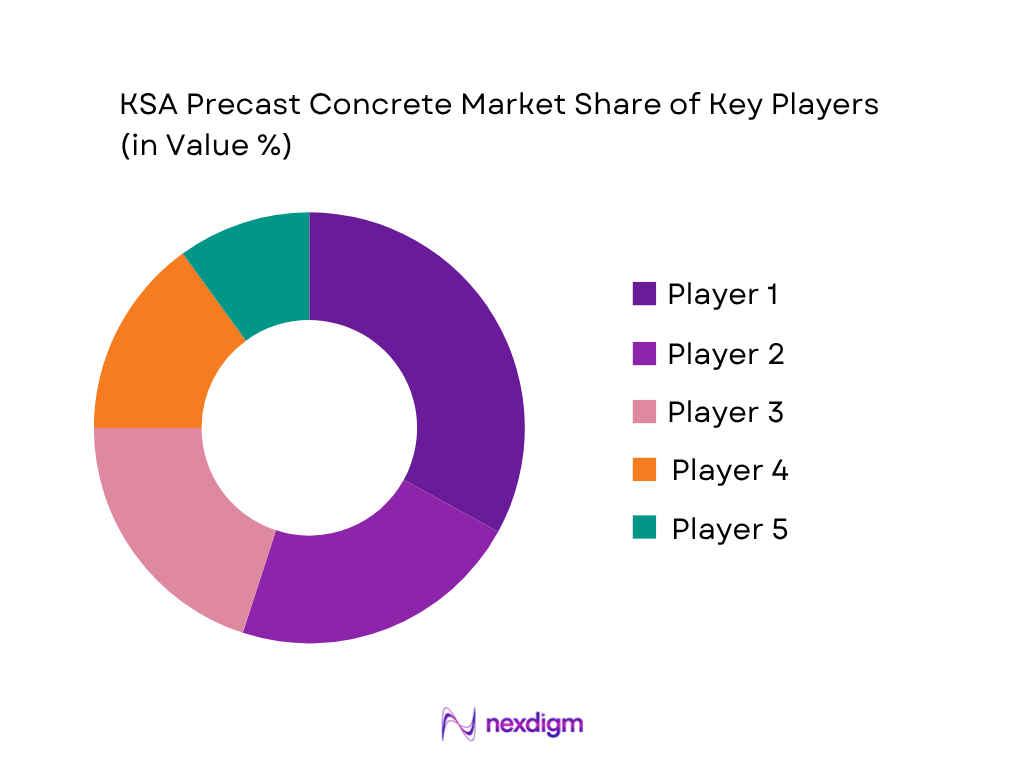
KSA Precast Concrete Market Analysis
Growth Drivers
Vision 2030 Giga-Projects and Urban Construction Accelerating Precast Concrete Demand
Saudi Arabia’s giga-project and urban construction pipeline is a major growth driver for the KSA Precast Concrete Market because large, repetitive developments require structural columns, beams, hollow-core slabs, double tees, wall panels, façades, stairs and infrastructure components manufactured at industrial scale. The country’s economic base supports this construction cycle, with GDP reaching USD 1,239.8 billion in 2024 and GDP per capita reaching USD 35,121.7 in 2024. Physical development is substantial, with NEOM encompassing 26,500 square kilometers, creating requirements across buildings, utilities and infrastructure. In Riyadh, the Expo 2030 masterplan covers 6 million square meters and is designed around 5 districts accommodating 197 official participants, providing another significant future construction ecosystem. ROSHN’s national development portfolio exceeds 400,000 homes across more than 200 million square meters, while its SEDRA development alone includes 30,000 homes across 20 million square meters. These project scales favor precast systems because standardized components can be produced simultaneously with site preparation and installed through sequenced erection programs, strengthening demand for Saudi manufacturers with high-volume production, engineering and installation capabilities.
Expanding Housing Communities and Industrial Development Supporting High-Volume Precast Production
Saudi Arabia’s expanding residential and industrial construction base is supporting demand for structural precast frames, wall systems, slabs, foundations, warehouses and utility components. ROSHN’s development platform includes more than 400,000 homes across over 200 million square meters of master-planned communities, creating a large addressable pipeline for standardized concrete construction. Its ALMANAR, MARAFY and ALDANAH communities introduced more than 6,500 homes across 4.2 million square meters, while the fourth phase of SEDRA added nearly 5,000 homes. Industrial expansion provides another demand channel. Saudi Arabia recorded 11,672 factories operating or under construction at the end of January 2024, with associated investment of approximately SAR 1.539 trillion. During that month alone, 152 new industrial licenses were issued and 79 factories commenced production. These indicators operate against a national economy generating USD 1,239.8 billion in GDP during 2024. Residential communities and industrial facilities frequently use repetitive structural layouts, making them particularly suitable for factory-manufactured columns, beams, hollow-core slabs, boundary walls, sandwich panels and other precast components.
Market Challenges
Large Project Geography Creating Heavy Transportation and Erection Complexity
Transportation and erection represent significant challenges for the KSA Precast Concrete Market because structural columns, long-span beams, double tees, hollow-core slabs and façade panels must move from fixed manufacturing plants to geographically dispersed construction sites. The scale of Saudi development highlights this logistical requirement. NEOM extends across approximately 26,500 square kilometers, while ROSHN’s national development platform encompasses more than 200 million square meters across Riyadh, Jeddah, Al Ahsa and other regions. In Riyadh, the Expo 2030 site alone will occupy 6 million square meters, while the ROSHN Stadium development covers 450,000 square meters and incorporates a venue designed for 45,000 seats. Saudi Arabia’s 2024 GDP of USD 1,239.8 billion demonstrates the macroeconomic scale supporting these investment programs, but large national construction volumes do not eliminate precast logistics constraints. Heavy elements require specialized trailers, route planning, lifting equipment, temporary storage and synchronized erection crews. Consequently, manufacturers located far from project sites can face operational disadvantages, encouraging regional plants, satellite casting facilities and project-specific production strategies to shorten delivery distances and maintain construction schedules.
Project Reprioritization and Volatile Construction Pipelines Complicate Plant Capacity Planning
Precast concrete manufacturing requires substantial fixed production infrastructure, including casting beds, molds, reinforcement facilities, prestressing systems, batching plants, curing equipment and storage yards, making predictable project sequencing important for efficient utilization. Saudi Arabia’s construction pipeline is large, but project schedules can change as national investment priorities are recalibrated. Vision 2030 investment requirements have undergone spending reprioritization, involving acceleration of selected projects and extension of timelines for others. The scale of the domestic industrial economy compounds the planning requirement, with 11,672 factories operating or under construction in January 2024 and 152 new industrial licenses during the same month, while 79 factories entered production. Construction activity can also fluctuate at the permitting level, with Saudi Arabia recording 5,056 building permits in May 2026, compared with 7,584 permits in May 2025 and 6,803 permits in April 2026. Against a 2024 GDP base of USD 1,239.8 billion, these fluctuations illustrate why precast suppliers must carefully coordinate mold allocation, inventories, workforce deployment and production scheduling rather than assuming every announced project immediately translates into factory orders.
Market Opportunities
Expo, Sports and Entertainment Infrastructure Opening New Precast Construction Opportunities
Saudi Arabia’s emerging international-event infrastructure creates a substantial future opportunity for suppliers of structural precast, architectural façades, stadium components, utility products, parking structures and large-span prestressed systems. Current projects provide a measurable foundation for this opportunity. Expo 2030 Riyadh is planned across 6 million square meters, divided into 5 districts, with participation from 197 official participants. The development is intended to accommodate approximately 42 million visits, requiring extensive permanent and temporary buildings, public spaces, transport interfaces and supporting infrastructure. Separately, ROSHN Stadium in southwest Riyadh encompasses 450,000 square meters and is designed with 45,000 seats for international sporting events. These developments sit within an economy that generated USD 1,239.8 billion of GDP in 2024, demonstrating the economic platform supporting Saudi Arabia’s diversification programs. For the KSA Precast Concrete Market, such projects create opportunities for manufacturers capable of engineering high-load structural components, seating elements, façade panels, stairs, utility structures, barriers and parking systems. Suppliers with BIM-enabled engineering, automated production and integrated heavy-haul erection capabilities can increasingly position themselves for complex event-driven construction packages.
Residential Communities and Local Manufacturing Creating Opportunities for Integrated Precast Systems
Saudi Arabia’s master-planned housing pipeline creates future opportunities for precast manufacturers to move beyond individual structural components toward complete building systems incorporating walls, columns, beams, slabs, stairs, façades and boundary elements. ROSHN’s current development platform covers more than 200 million square meters and includes more than 400,000 homes across major Saudi regions. SEDRA alone covers 20 million square meters, incorporates 30,000 homes, includes 400 integrated amenities and is being developed through 8 phases, providing the type of repetitive construction environment suited to industrialized precast production. Recent ROSHN expansion also introduced more than 6,500 homes across 4.2 million square meters through ALMANAR, MARAFY and ALDANAH, while another SEDRA phase added nearly 5,000 homes. Saudi Arabia’s macroeconomic base remains substantial, with USD 1,239.8 billion of GDP and USD 35,121.7 GDP per capita in 2024. This combination of economic capacity and standardized community construction creates opportunities for Saudi precast producers to expand automated manufacturing, develop integrated housing systems and establish regional production capacity closer to major residential development corridors.
Future Outlook
The KSA Precast Concrete Market is expected to expand at a forecast CAGR of approximately ~% during 2026–2035, supported by continued execution of Vision 2030 construction programs. Demand will increasingly originate from residential communities, entertainment districts, tourism destinations, industrial developments, logistics facilities, sports infrastructure and major urban projects. Precast suppliers are expected to place greater emphasis on automated manufacturing, high-performance concrete, BIM-linked production, large-span prestressed systems and integrated design-to-erection services.
Giga-project construction will remain an important demand channel. PIF’s portfolio includes NEOM, Qiddiya, ROSHN, Red Sea Global and Diriyah, each creating different requirements for structural, architectural and infrastructure precast products. NEOM spans approximately 26,500 km², while Qiddiya covers more than 360 km². Riyadh will also remain strategically important as new urban and event infrastructure progresses. Suppliers capable of combining scalable production with project-specific engineering, transportation and erection are positioned to address these increasingly complex requirements.
Major Players
- Al Rashid Abetong
- RDB EL SEIF Company
- KPC Precast – Al Kifah Holding
- Bina Precast
- alfanar Building Systems
- Eastern Precast Concrete
- INCO Precast
- Qanbar Dywidag Precast Concrete
- SAJCO Precast Concrete Factory
- Sany Alameriah Precast Concrete Factory
- Saudi Concrete Products Company
- Al Fahd Company for Precast Industry
- Rabiah-Nassar & Zamil Concrete Industries
- Al-Bilad Concrete Pipe Company
- Saudi Concrete Products Industries Company
Key Target Audience
- Precast Concrete Manufacturers
- Giga-Project and Master-Plan Developers
- EPC and General Construction Contractors
- Real Estate and Housing Developers
- Industrial, Logistics and Infrastructure Developers
- Investments and Venture Capitalist Firms
- Government and Regulatory Bodies (Ministry of Municipalities and Housing, Ministry of Industry and Mineral Resources, Saudi Standards, Metrology and Quality Organization, Local Content and Government Procurement Authority)
- Cement, Reinforcing Steel and Construction Material Manufacturers
Research Methodology
Step 1: Identification of Key Variables
The initial phase involves constructing the complete ecosystem of the KSA Precast Concrete Market, covering raw-material suppliers, precast manufacturers, developers, EPC contractors, government authorities, engineering companies and erection contractors. Secondary research is used to identify critical variables including installed production capacity, product mix, construction pipeline, regional manufacturing footprint, project type and precast adoption.
Step 2: Market Analysis and Construction
Historical market information is compiled through top-down and bottom-up approaches. The analysis evaluates manufacturer production capability, plant utilization, structural and architectural product output, construction activity and demand across residential, commercial, giga-project, industrial and infrastructure applications. Company-level capacity and project activity are reconciled to construct the market framework and segment-level demand structure.
Step 3: Hypothesis Validation and Expert Consultation
Market hypotheses are validated through structured interviews with precast manufacturers, EPC contractors, developers, engineering professionals, raw-material suppliers and industry stakeholders. These discussions assess production utilization, procurement criteria, project delivery requirements, transportation constraints, competitive positioning and customer preferences. The findings are used to validate assumptions developed during secondary research and bottom-up market construction.
Step 4: Research Synthesis and Final Output
The final stage triangulates manufacturer-level analysis, construction pipeline information, primary interviews and secondary data. Market estimates are reconciled across production capacity, project demand, regional construction activity and product categories. The resulting framework provides a consolidated assessment of market structure, segmentation, competition, growth drivers, constraints and the long-term direction of the KSA Precast Concrete Market.

- Executive Summary
- Research Methodology (Market Definitions and Assumptions, KSA Precast Concrete Market Classification, Precast and Prestressed Concrete Scope, Product Mapping, Structural Component Mapping, Infrastructure Precast Mapping, Architectural Precast Assessment, Hollow-Core System Assessment, Prestressed Component Assessment, Precast Building System Assessment, Manufacturing Plant Mapping, Installed Production Capacity Assessment, Capacity Utilization Assessment, Cement and Reinforcing Steel Supply Assessment, Top-Down Market Sizing, Bottom-Up Manufacturer Assessment, Demand-Side Assessment, Supply-Side Assessment, Primary Interviews with Precast Manufacturers, EPC Contractors and Developers, Vision 2030 Project Pipeline Assessment, Giga-Project Construction Assessment, Data Triangulation, Forecasting Framework)

- Definition and Scope
- KSA Precast Concrete Industry Evolution and Development of Structural Precast Systems, Prestressed Concrete Systems, Hollow-Core Slabs, Double-Tee Slabs, Wall Panels, Columns, Beams, Architectural Cladding, Boundary Walls, Precast Foundations, Infrastructure Components, Modular Precast Systems and Total Precast Buildings
- Precast Concrete Industry Value Chain Analysis
- Precast Concrete Supply Chain Analysis
- Cement Producers, Aggregate Suppliers, Reinforcing Steel Suppliers, Prestressing Strand Suppliers, Admixture Suppliers, Formwork and Mold Providers, Precast Manufacturing Plants, Prestressing Facilities, Engineering and Design Companies, Heavy-Haul Transport Providers, Crane and Erection Contractors, EPC Contractors, Real Estate Developers, Giga-Project Developers, Government Infrastructure Authorities, Industrial Project Developers

- Growth Drivers (Vision 2030 Construction Pipeline, Riyadh Urban Expansion, Giga-Project Development, Residential Housing Construction, Tourism and Hospitality Infrastructure, Industrial and Logistics Development, Sports Infrastructure, Transport Infrastructure, Construction Schedule Compression, Off-Site Construction Adoption)
- Market Challenges (Heavy Component Transportation, Long-Distance Delivery Constraints, Crane and Erection Requirements, Cement and Reinforcing Steel Supply Exposure, Skilled Precast Workforce Requirements, Project-Specific Mold Requirements, High Manufacturing Plant Investment, Capacity Utilization Volatility, Complex Connection Engineering, Extreme-Temperature Production Requirements)
- Market Opportunities (Riyadh Giga-Projects, Expo Infrastructure, Sports and Stadium Construction, Tourism Destination Development, Residential Communities, Data Centers, Industrial Cities, Logistics Warehouses, Modular Concrete Buildings, Utility Infrastructure, Low-Carbon Precast Systems, Automated Precast Manufacturing)
- Market Trends (Total Precast Buildings, Prestressed Hollow-Core Systems, Insulated Sandwich Panels, Large-Span Double-Tee Systems, BIM-to-Fabrication Integration, Design-for-Manufacture-and-Assembly, Automated Concrete Distribution, Robotic Reinforcement Processing, Architectural Precast Finishes, High-Performance Concrete, Low-Carbon Concrete Mixes, Factory-Based Quality Control)
- Government Regulations and Standards (Saudi Building Code SBC 307 for Precast Concrete, Saudi Building Code Structural Requirements, SASO Precast Concrete Standards, Concrete Material Requirements, Seismic Design Requirements, Wind and Rain Load Requirements, Precast Construction Requirements, Product Conformity Requirements)
- SWOT Analysis
- Porter’s Five Forces Analysis
PESTLE Analysis - Stakeholder Ecosystem
- Precast Concrete Production and Construction Ecosystem

- By Market Value (2020-2025)
- By Precast Concrete Production Volume (2020-2025)
- By Precast and Prestressed Concrete Production Volume (2020-2025)
- By Structural Precast Production Volume (2020-2025)
- By Architectural Precast Production Volume (2020-2025)
- By Infrastructure Precast Production Volume (2020-2025)
- By Hollow-Core Slab Production Volume (2020-2025)
- By Wall Panel Production Volume (2020-2025)
- By Columns and Beam Production Volume (2020-2025)
- By Installed Precast Concrete Volume (2020-2025)
- By Installed Manufacturing Capacity (2020-2025)
- By Production Capacity Utilization (2020-2025)

- By Product Type (In Value %)
Hollow-Core Slabs
Double-Tee Slabs
Precast Columns and Beams
Solid and Form Slabs
Load-Bearing Wall Panels
Non-Load-Bearing Wall Panels
Insulated Sandwich Panels
Architectural Cladding Panels
Boundary Walls
Precast Staircases
Precast Foundations and Piles
Infrastructure and Utility Precast Components
Special and Customized Precast Elements - By Construction System (In Value %)
Structural Precast Systems
Prestressed Concrete Systems
Total Precast Building Systems
Precast Frame Systems
Precast Wall-Bearing Systems
Precast Building Envelope Systems
Hybrid Precast and Cast-in-Place Systems
Hybrid Precast and Steel Systems
Modular Precast Concrete Systems - By Application (In Value %)
Residential and Housing Projects
Commercial Buildings
Hospitality and Tourism Projects
Industrial and Manufacturing Facilities
Warehouses and Logistics Facilities
Healthcare Facilities
Educational Facilities
Parking Structures
Sports and Entertainment Facilities
Transport Infrastructure
Energy and Utility Infrastructure
Giga-Projects and Mixed-Use Developments - By Customer Type (In Value %)
Giga-Project Developers
Real Estate Developers
EPC and General Contractors
Government Infrastructure Authorities
Housing Developers
Industrial and Logistics Developers
Hospitality Developers
Energy and Utility Project Developers - By Manufacturing Technology (In Value %)
Conventional Wet-Cast Precast
Prestressed Precast Concrete
Extruded Hollow-Core Production
Automated Circulation-Line Production
Battery-Mold Production
Tilting-Table Production
Self-Consolidating Concrete Precast
High-Performance Concrete Precast
Automated Reinforcement and Casting Systems - By Region (In Value %)
Central Region
Western Region
Eastern Region
Southern Region
Northern Region

- Market Share of Major Players (By KSA Revenue, Precast Production Capacity, Number of Manufacturing Plants, Hollow-Core Production Capacity, Structural Precast Capacity, Prestressed Concrete Capacity, Architectural Precast Capability, Geographic Coverage, Giga-Project Exposure, Housing Project Exposure, Engineering Capability, Transportation Capability, Erection Capability)
- Cross Comparison Parameters (Annual Precast Production Capacity, Manufacturing Plant Network and Regional Coverage, Structural and Prestressed Product Breadth, Hollow-Core and Large-Span Production Capability, Engineering and Design-to-Fabrication Capability, Heavy-Haul Transportation and Erection Capability, Saudi Building Code and Client Prequalification Compliance, Giga-Project and Vision 2030 Project Execution Portfolio)
- SWOT Analysis of Major Players
- Competitive Positioning Matrix
- Detailed Profiles of Major Companies
Al Rashid Abetong
RDB-El Seif Company
First Construction Contracting Company – FCCSA
KPC Precast – Al Kifah Holding
Bina Precast
alfanar Building Systems
Eastern Precast Concrete
INCO Precast
Qanbar Dywidag Precast Concrete
SAJCO Precast Concrete Factory
Sany Alameriah Precast Concrete Factory
Saudi Concrete Products Company
Al Fahd Company for Precast Industry
Rabiah-Nassar & Zamil Concrete Industries
Al-Bilad Concrete Pipe Company

- Giga-Project Developer Requirement Assessment
- EPC Contractor Procurement Assessment
- Real Estate Developer Requirement Assessment
- Housing Developer Requirement Assessment
- Industrial and Logistics Developer Assessment
- Hospitality and Tourism Developer Assessment
- Infrastructure Contractor Assessment
- Precast Performance Requirement Assessment

- By Market Value (2026-2035)
- By Precast Concrete Production Volume (2026-2035)
- By Precast and Prestressed Concrete Production Volume (2026-2035)
- By Structural Precast Production Volume (2026-2035)
- By Architectural Precast Production Volume (2026-2035)
- By Infrastructure Precast Production Volume (2026-2035)
- By Hollow-Core Slab Production Volume (2026-2035)
- By Wall Panel Production Volume (2026-2035)
- By Columns and Beam Production Volume (2026-2035)
- By Installed Precast Concrete Volume (2026-2035)
- By Installed Manufacturing Capacity (2026-2035)
- By Production Capacity Utilization (2026-2035)


 Request a Sample
 Ask for Customization
 Get a Quote
 Enquire Now
