
 Download PDF
Market Overview
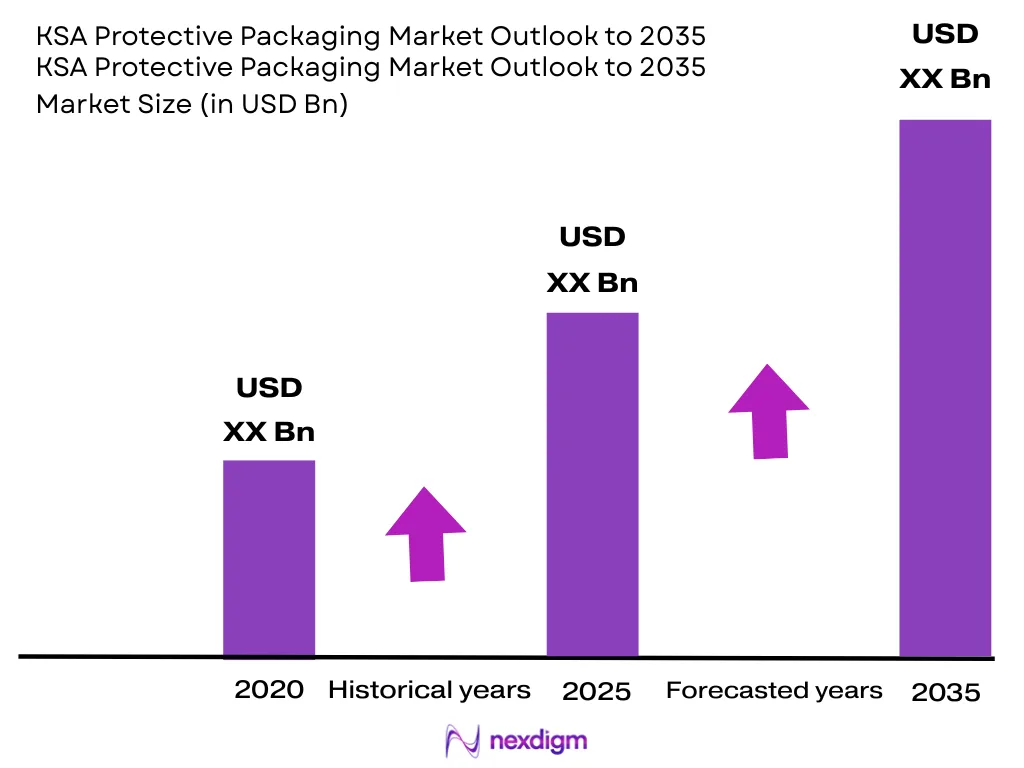
The KSA Protective Packaging Market was valued at USD ~ Billion in 2024 and is anticipated to expand at a CAGR of ~% during 2026-2035. The market is primarily driven by explosive growth in e-commerce, Vision 2030-backed industrial localization, and expanding manufacturing and logistics infrastructure across the Kingdom. According to industry estimates, Saudi Arabia’s broader packaging market reached approximately USD 11.7 billion in 2025 and is projected to reach approximately USD 16.6 billion by 2034, growing at a CAGR of approximately 3.98%, driven by the growing need to protect fragile electronic components, safe storage and transportation of industrial materials, and the Kingdom’s thriving e-commerce industry. Saudi Arabia’s e-commerce packaging market alone generated revenue of approximately USD 4.16 billion in 2024 and is projected to reach approximately USD 15.95 billion by 2033, growing at a CAGR of approximately 16.21%, with Protective Packaging accounting for the highest product share in 2024, reflecting the Kingdom’s position as the largest and fastest-growing protective packaging market within the broader Middle East and Africa region.
Market Segmentation
By Type
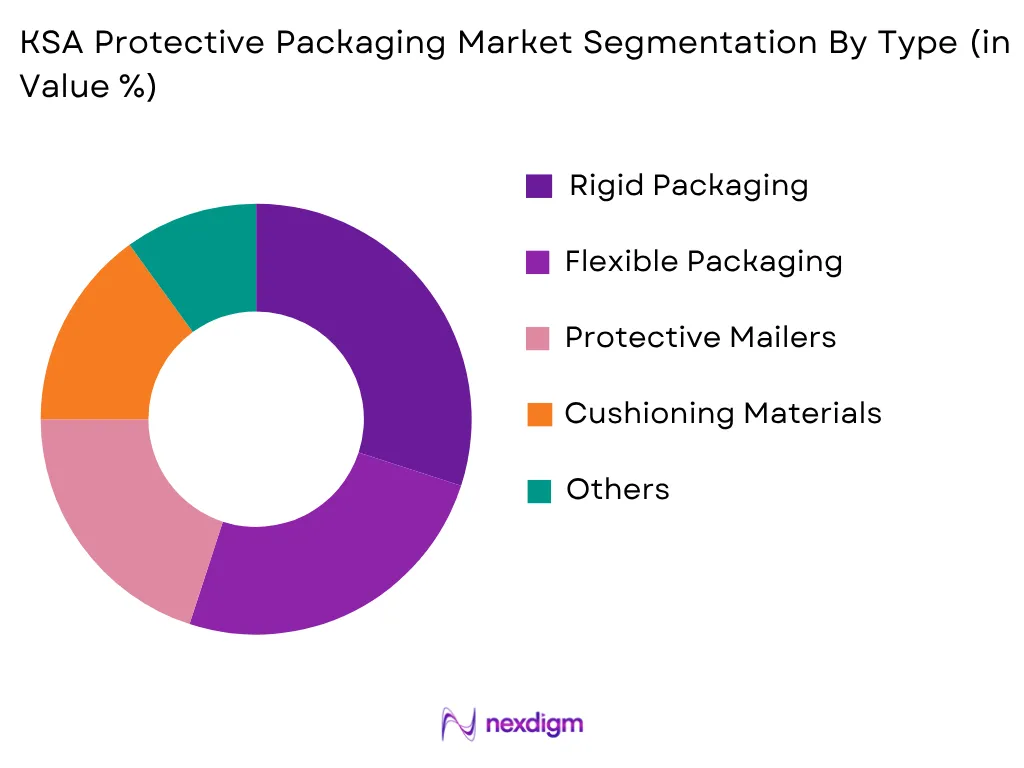
Among these, Rigid Packaging holds the largest revenue share of the KSA Protective Packaging Market, anchored by PET water bottles and HDPE jerrycans that satisfy stringent SASO drop-test criteria, generating approximately 52.12% of 2025 plastic packaging revenue. Flexible Packaging, however, is tracking a faster CAGR of approximately 4.25%, supported by better cube efficiency and lower last-mile damage rates for e-commerce shipments, with converter orders for 11-layer blown-film lines surging approximately 18% in 2024 as local firms increasingly supply high-oxygen-barrier pouches previously imported. Protective Mailers and Cushioning Materials continue to expand rapidly alongside Saudi Arabia’s booming online retail sector, which witnessed a 25% jump in national online sales during 2024, directly driving demand for protective corrugated boxes, mailers, and transit packaging solutions. Corrugated boxes retain a dominant position within the Kingdom’s paper and paperboard packaging market, commanding approximately 45.52% share and serving as the structural backbone for logistics and shipping across the country’s rapidly expanding e-commerce sector.
By End User
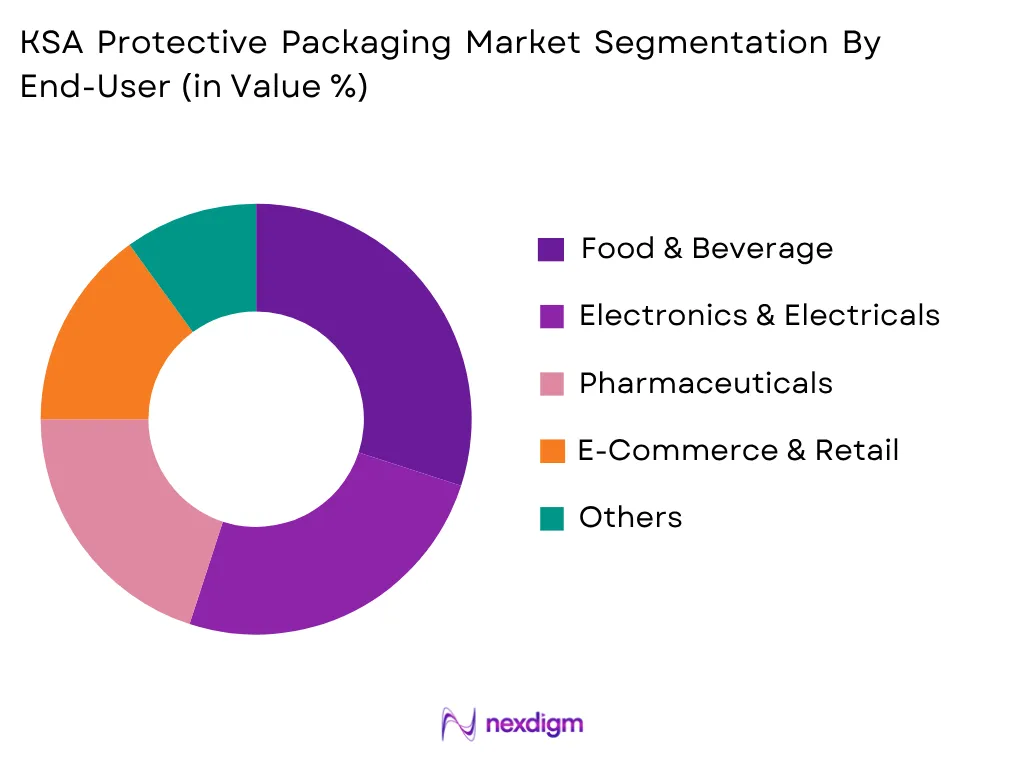
The Food & Beverage segment holds the largest end-user share, representing approximately 57.31% of total paper and paperboard packaging usage, supported by the Kingdom’s large population and thriving food processing industry. E-Commerce & Retail represents the fastest-growing end-user vertical, expanding at nearly 6% annually through 2030 within paper packaging and driven by Saudi Arabia’s internet user base in e-commerce increasing by an estimated 33.6 million, a 42% increase compared to 2019. Pharmaceuticals and Electronics & Electricals continue to require specialized protective packaging solutions, including cushioning materials and anti-static films, to protect fragile and sensitive products during transit across the Kingdom’s expanding logistics networks. Industrial clusters supporting Vision 2030 localization targets, including NEOM and Ras Al Khair, continue to draw global converters into specialized manufacturing zones, further reinforcing demand for high-barrier, protective packaging formats across export-oriented industrial and manufacturing sectors.
Competitive Landscape
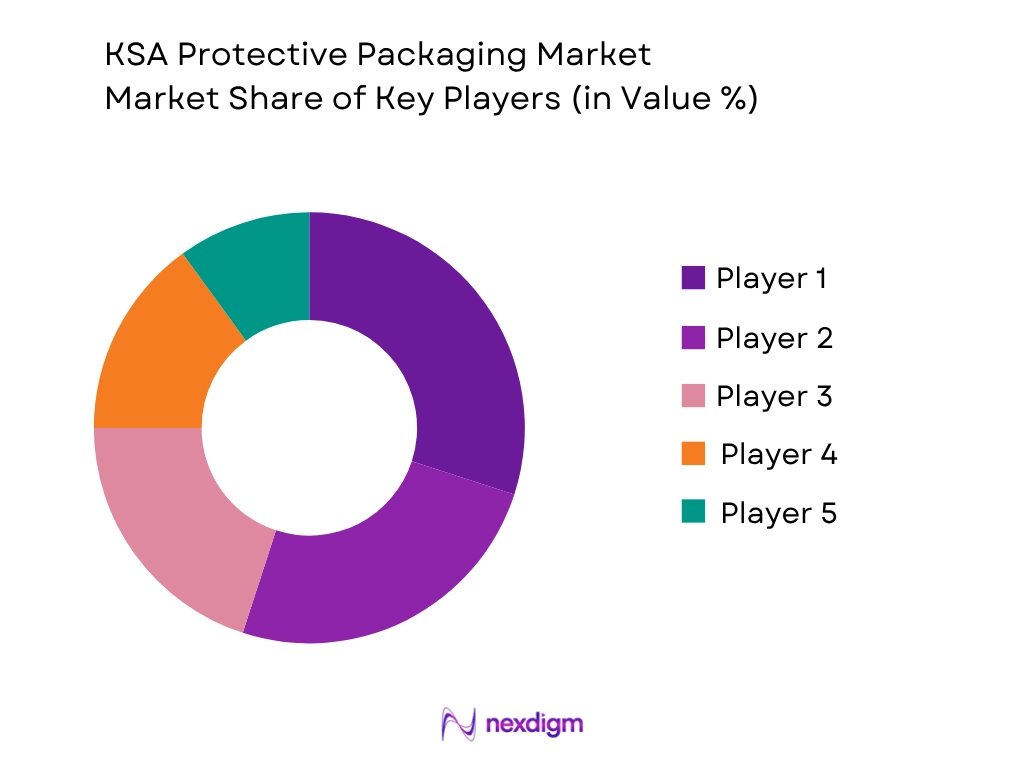
The KSA Protective Packaging Market is moderately consolidated, led by large domestic conglomerates with integrated manufacturing capabilities alongside multinational packaging manufacturers expanding local presence to meet Vision 2030 localization incentives. Competition is primarily based on drop-test and SASO compliance, cost efficiency, localization credentials, application-specific technical support, and sustainability performance. Domestic players such as Obeikan Investment Group and Middle East Paper Company (MEPCO) maintain strong positions across paper, plastic, and corrugated packaging categories, while Saudi Basic Industries Corporation (SABIC), the Kingdom’s petrochemical giant, continues to supply the polymer feedstocks underpinning the country’s plastic packaging industry. Global players including Sealed Air, Storopack, Sonoco, and Intertape Polymer Group continue to expand distribution and manufacturing partnerships to serve the Kingdom’s growing e-commerce and industrial sectors. Vision 2030’s localization incentives continue to draw global converters into specialized industrial clusters such as NEOM and Ras Al Khair, while smaller film companies face increasing pressure to secure long-term off-take agreements with domestic petrochemical crackers to hedge against raw material cost volatility.
| Company | Established | Headquarters | Primary Product Portfolio | Sustainable/Recyclable Portfolio | Manufacturing Presence | Major End-Use Industries | Key Strategic Focus | Certifications & Compliance |
| Obeikan Investment Group | 1985 | ~ | ~ | ~ | ~ | ~ | ~ | ~ |
| Middle East Paper Company (MEPCO) | 1985 | ~ | ~ | ~ | ~ | ~ | ~ | ~ |
| Saudi Basic Industries Corporation (SABIC) | 1976 | ~ | ~ | ~ | ~ | ~ | ~ | ~ |
| Sealed Air Corporation | 1960 | ~ | ~ | ~ | ~ | ~ | ~ | ~ |
| Storopack Hans Reichenecker GmbH | 1874 | ~ | ~ | ~ | ~ | ~ | ~ | ~ |
KSA Protective Packaging Market Analysis
Growth Drivers
Explosive E-Commerce Growth and Vision 2030 Industrial Localization
The KSA Protective Packaging Market is experiencing sustained growth driven by explosive e-commerce expansion and Vision 2030-backed industrial localization initiatives. According to industry estimates, Saudi Arabia’s e-commerce packaging market generated revenue of approximately USD 4.16 billion in 2024 and is projected to reach approximately USD 15.95 billion by 2033, growing at a CAGR of approximately 16.21%, among the fastest growth rates in the Middle East and Africa region, with Saudi Arabia accounting for approximately 3.74% of the global e-commerce packaging market by 2024. The Kingdom’s booming online retail sector witnessed a 25% jump in national online sales during 2024, directly driving unprecedented demand for protective corrugated boxes, mailers, and transit packaging solutions. Manufacturing sector value addition has climbed from approximately 13.21% of GDP in 2021 to 14.79% in 2023, reflecting sustained industrial expansion that continues to reinforce demand for robust protective packaging across the Kingdom’s diversifying economy.
Expansion of Manufacturing and Logistics Infrastructure Under NIDLP
Saudi Arabia’s National Industrial Development and Logistics Program (NIDLP), a core pillar of Vision 2030, continues to drive substantial investment in manufacturing and logistics infrastructure that directly supports protective packaging demand. Vision 2030’s localization incentives are drawing global converters into specialized industrial clusters such as NEOM and Ras Al Khair, supporting rising non-oil exports, a vibrant food-and-beverage sector, and sustained population growth that collectively underpin demand for lightweight, high-barrier protective packaging formats. Brand owners are increasingly shifting toward multilayer pouches and recyclable mono-material films to curb logistics costs and comply with SASO requirements, with converter orders for 11-layer blown-film lines surging approximately 18% in 2024, enabling local firms to supply high-oxygen-barrier packaging previously imported. This growing domestic manufacturing capability, combined with the Kingdom’s strategic geographic position connecting Asia, Europe, and Africa, continues to strengthen Saudi Arabia’s role as a regional protective packaging manufacturing and export hub.
Market Challenges
Regulatory Compliance Under SASO EPR and Oxo-Biodegradable Mandates
The KSA Protective Packaging Market faces significant regulatory compliance challenges under the Saudi Arabian Standards, Metrology and Quality Organization’s (SASO) Technical Regulations for Packaging and Packaging Waste Management, issued in 2021, which mandates Extended Producer Responsibility (EPR) schemes for packaging materials across multiple sectors including food and beverage. Under SASO regulations, plastic products, including packaging made with polypropylene or polyethylene, must comply with oxo-biodegradable material requirements, with the customs authority working alongside accredited laboratories to cross-verify imported products for compliance. These regulatory requirements demand substantial investment in material reformulation, testing, and certification processes, creating operational complexity particularly for smaller converters and importers navigating evolving compliance requirements. Companies must maintain robust documentation and testing protocols to demonstrate compliance with SASO’s drop-test criteria and oxo-biodegradable standards, adding both cost and administrative burden across the protective packaging value chain.
Raw Material Price Volatility and Import Dependency for Specialty Films
Despite the Kingdom’s substantial domestic petrochemical production capacity, the KSA Protective Packaging Market remains exposed to raw material price volatility and import dependency for certain specialty films and high-performance materials. Smaller film companies struggle to hedge input costs effectively, prompting accelerated interest in securing long-term off-take agreements with domestic crackers to stabilize supply and pricing. While virgin fiber remains the predominant material source for paper and paperboard packaging, capturing approximately 70.86% market share, recycled content incorporation is accelerating due to sustainability mandates, requiring converters to invest in new sourcing relationships and processing capabilities. Companies producing high-oxygen-barrier films and specialty protective materials for pharmaceutical and electronics applications continue to rely on imported raw materials and equipment, creating currency exposure and supply chain complexity that smaller domestic converters find particularly challenging to manage amid fluctuating global commodity markets.
Market Opportunities
Growth in Sustainable and Recyclable Protective Packaging Materials
Saudi Arabia’s regulatory environment and Vision 2030 sustainability commitments present substantial opportunities for companies investing in sustainable and recyclable protective packaging innovation. Regulatory shifts emphasizing recyclability, Extended Producer Responsibility, and reduced plastic usage continue to reshape how packaging is designed and sourced across the Kingdom. Brand owners are increasingly shifting toward multilayer pouches and recyclable mono-material films to comply with SASO requirements while curbing logistics costs, while local producers are increasingly adopting digital printing for personalization and high-speed automated manufacturing to enhance efficiency. Companies developing oxo-biodegradable compliant films, recycled-content corrugated packaging, and molded pulp cushioning materials are well positioned to capture growing demand from both domestic brand owners and Vision 2030-aligned industrial manufacturers seeking to meet the Kingdom’s evolving sustainability and localization requirements.
Expansion of NEOM and Ras Al Khair Industrial Cluster Manufacturing
Vision 2030’s localization incentives continue to draw global packaging converters into specialized industrial clusters such as NEOM and Ras Al Khair, creating significant opportunities for companies establishing domestic protective packaging manufacturing capacity. These clusters benefit from proximity to domestic petrochemical feedstock production, supporting cost-competitive manufacturing for both flexible and rigid protective packaging formats. Rising non-oil exports, a vibrant food-and-beverage sector, and sustained population growth continue to underpin demand for lightweight, high-barrier protective packaging formats manufactured within these industrial zones. As Saudi Arabia continues to strengthen its position as a regional manufacturing and logistics hub connecting Asia, Europe, and Africa, companies with integrated manufacturing capabilities and strong localization credentials are well positioned to capture both growing domestic demand and export opportunities across the broader Middle East and North Africa region.
Future Outlook
The KSA Protective Packaging Market is expected to witness robust expansion over the forecast period, supported by continued e-commerce growth, Vision 2030-backed industrial localization, and expanding manufacturing and logistics infrastructure across the Kingdom. Continued investment in domestic petrochemical-backed manufacturing, recyclable and oxo-biodegradable materials, and industrial cluster capacity is expected to further strengthen the market’s competitive landscape. Growing regulatory emphasis on sustainability under SASO’s EPR framework will continue to accelerate the shift toward recyclable, mono-material, and paper-based protective packaging formats through 2035.
Major Players
- Obeikan Investment Group
- Middle East Paper Company (MEPCO)
- Saudi Basic Industries Corporation (SABIC)
- Sealed Air Corporation
- Storopack Hans Reichenecker GmbH
- Sonoco Products Company
- Intertape Polymer Group Inc.
- Smurfit WestRock plc
- DS Smith plc (International Paper)
- Napco National
- Al Yamama Packing Company
- Ranpak Holdings Corp.
- Huhtamaki Oyj
- Mondi Group plc
- Amcor plc
Key Target Audience
- Protective Packaging Manufacturers
- E-Commerce and Retail Companies
- Electronics and Industrial Manufacturers
- Pharmaceutical and Healthcare Companies
- Third-Party Logistics (3PL) Providers
- Investment and Venture Capitalist Firms
- Government and Regulatory Bodies (Saudi Standards, Metrology and Quality Organization (SASO), Saudi Food and Drug Authority (SFDA), Ministry of Industry and Mineral Resources)
- Industrial Cluster and Free Zone Authorities (NEOM, Ras Al Khair)
Research Methodology
Step 1: Identification of Key Variables
The research process begins with identifying the complete ecosystem of the KSA Protective Packaging Market, including raw material suppliers, packaging manufacturers, converters, e-commerce and logistics companies, and regulatory authorities. Extensive secondary research is conducted using company annual reports, government publications, trade associations, customs statistics, industry journals, and proprietary databases to determine the variables influencing market demand, pricing, production, consumption, and technological developments.
Step 2: Market Analysis and Construction
Historical market information is collected and analyzed to estimate market size, import-export activity, application-wise demand, and pricing trends. A combination of top-down and bottom-up approaches is used to estimate market revenues and validate segment-level performance. Consumption patterns across e-commerce, food and beverage, pharmaceuticals, electronics, and industrial applications are evaluated to establish an accurate representation of the industry.
Step 3: Hypothesis Validation and Expert Consultation
The preliminary findings are validated through Computer-Assisted Telephone Interviews (CATIs) and structured discussions with packaging manufacturers, procurement managers, e-commerce and logistics executives, regulatory experts, and senior executives operating within Saudi Arabia’s protective packaging industry. These interviews help verify market assumptions, competitive developments, technology adoption trends, pricing dynamics, and future investment opportunities while refining the overall market estimates.
Step 4: Research Synthesis and Final Output
The final stage integrates insights obtained from primary interviews with quantitative information collected through secondary sources. Data triangulation techniques are applied to reconcile differences between supply-side and demand-side estimates, ensuring robust market forecasting. The report is then reviewed through multiple quality assurance checkpoints to deliver a comprehensive analysis covering market size, segmentation, competitive landscape, future outlook, and strategic recommendations for industry stakeholders.

- Executive Summary
- Research Methodology (Market Definitions and Assumptions, Protective Packaging Taxonomy, Abbreviations, Market Sizing Approach, Top-Down Personal Care Product Consumption Analysis, Bottom-Up Packaging Supplier Aggregation, Packaging Units per Finished Product, Demand-Side Assessment, Supply-Side Capacity Mapping, Import–Export Reconciliation, Retail Channel Analysis, Primary Industry Interviews, Data Triangulation, Forecasting Framework, Scenario Analysis, Limitations and Future Conclusions)

- Definition and Scope
- Market Evolution and Industry Genesis
- Timeline of Major Industry Developments
- Protective Packaging Industry Value Chain Analysis
- Supply Chain Analysis

- Growth Drivers (Explosive E-Commerce Growth, Vision 2030 Industrial Localization, Expansion of Manufacturing and Logistics Infrastructure, Growth in Organized Retail, Rising Non-Oil Exports, Expansion of Pharmaceutical and Electronics Manufacturing)
- Market Challenges (Regulatory Compliance Under SASO EPR Requirements, Oxo-Biodegradable Material Mandates, Raw Material Price Volatility, Import Dependency for Specialty Films, Limited Domestic Recycling Infrastructure, Price-Sensitive Domestic Market)
- Market Opportunities (Growth in Sustainable and Recyclable Packaging Materials, Expansion of NEOM and Ras Al Khair Industrial Clusters, Investment in Domestic Petrochemical-Backed Manufacturing, Cold Chain and Pharmaceutical Packaging Growth, Molded Fiber and Paper-Based Cushioning Innovation, Export-Oriented Manufacturing Expansion)
- Market Trends (Shift Toward Mono-Material Recyclable Films, Growth in Multilayer High-Barrier Pouches, Rise of Corrugated Box Demand, Adoption of Oxo-Biodegradable Plastics, Lightweighting and Dimensional Optimization, Digital Printing for Personalized Packaging)
- Government Regulations (SASO Technical Regulations for Packaging and Packaging Waste Management, Extended Producer Responsibility (EPR) Requirements, Oxo-Biodegradable Material Standards, Saudi Food and Drug Authority (SFDA) Food-Contact Requirements, National Industrial Development and Logistics Program (NIDLP), Vision 2030 Localization Targets)
- Import and Export Analysis (Trade Volume, Major Import Sources, Export Destinations, HS Code Analysis, Trade Balance)
- Raw Material Availability Analysis (Domestic Petrochemical-Derived Polymers, Kraft Paper and Corrugated Board, Molded Pulp Feedstocks, Specialty Films and Foams, Recycled Content Feedstocks)
- Technology Landscape (Multilayer Blown-Film Technologies, Automated Air Cushioning Systems, Molded Pulp Processing, High-Barrier Coating Technologies, Digital Printing and Personalization Systems)
- Sustainability Assessment (Recycled Content Utilization, Oxo-Biodegradable Material Adoption, Carbon Footprint Reduction, Circular Economy Integration, Right-Sizing and Material Reduction)
- PESTLE Analysis
- SWOT Analysis
- Porter’s Five Forces Analysis
- Stakeholder Ecosystem
- Competition Ecosystem

- By Market Value (2020-2025)
- By Volume Consumption (2020-2025)
- By Average Selling Price (2020-2025)

- By Material (In Value %)
Plastic
Paper & Paperboard
Metal
Glass
Others - By Type (In Value %)
Flexible Packaging
Rigid Packaging
Protective Mailers
Cushioning Materials
Others - By Application (In Value %)
Shipping & Logistics
Retail Packaging
Industrial Packaging
Export Packaging - By End User (In Value %)
Food & Beverage
Pharmaceuticals
Electronics & Electricals
E-Commerce & Retail
Others - By Region (In Value %)
Riyadh
Makkah (Jeddah)
Eastern Province
Other Regions

- Market Share of Major Players (By Value, Volume, Material Type, End-User Industry, Packaging Type)
- Cross Comparison Parameters (Recyclable Portfolio Breadth, Localization and Vision 2030 Compliance, Manufacturing Capacity, Application Technical Support Capability, Regulatory Compliance & Certifications, E-Commerce and Industrial Customer Base, Innovation & New Product Launch Frequency, Regional Distribution Network)
- SWOT Analysis of Major Players
- Pricing Analysis by Material Category and Format
- Production Capacity Analysis
- Manufacturing Footprint Analysis
- Distribution Network Analysis
- Innovation Benchmarking
- Detailed Profiles of Major Companies
Obeikan Investment Group
Middle East Paper Company (MEPCO)
Saudi Basic Industries Corporation (SABIC)
Sealed Air Corporation
Storopack Hans Reichenecker GmbH
Sonoco Products Company
Intertape Polymer Group Inc.
Smurfit WestRock plc
DS Smith plc (International Paper)
Napco National
Al Yamama Packing Company
Ranpak Holdings Corp.
Huhtamaki Oyj
Mondi Group plc
Amcor plc

- Consumption Pattern Analysis (Order Volume, Fulfillment Center Throughput, Product Category Penetration, Seasonal Demand, Return Rate Impact)
- Purchasing Criteria (Damage Protection Performance, Cost Efficiency, Regulatory Compliance, Sustainability Credentials, Supply Reliability, Localization Compliance)
- Procurement and Supplier Selection Analysis
- Sustainable Packaging Adoption Assessment
- Premium vs Conventional Packaging Demand
- Product Attribute Preference Analysis (Recycled Content Percentage, Cushioning Performance, Weight Efficiency, Drop-Test Compliance, Material Origin, Recyclability Compliance)
- Consumer Damage-Free Delivery Expectations
- Pain Point Analysis
- Decision-Making Process

- By Market Value (2026-2035)
- By Volume Consumption (2026-2035)
- By Average Selling Price (2026-2035)


 Request a Sample
 Ask for Customization
 Get a Quote
 Enquire Now