
 Download PDF
Market Overview
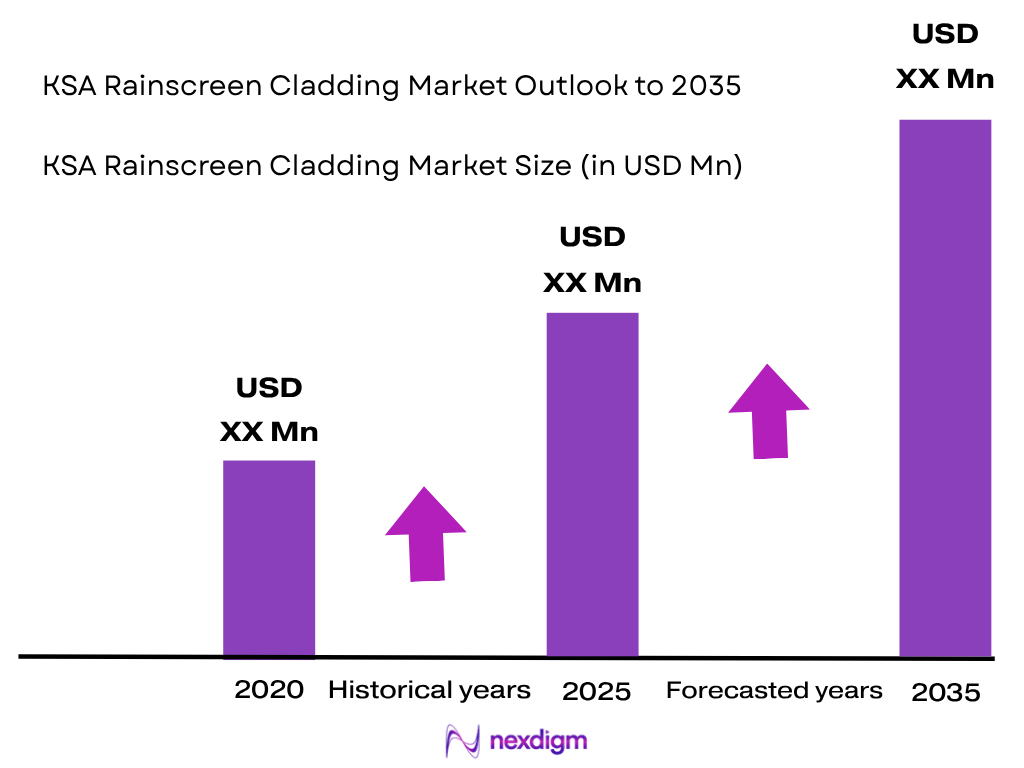
The KSA Rainscreen Cladding Market is valued at approximately ~USD 2.3 billion in 2024, with demand supported by large-scale building construction, Vision 2030 development programs, hospitality projects, commercial developments and increasing requirements for thermally efficient and fire-conscious facade assemblies. A published Saudi Arabia rainscreen-cladding dataset reports USD 2,486.7 million in 2023 and projects USD 4,189.9 million by 2030, with a 7.8% CAGR across its forecast period. Saudi Arabia’s construction activity is reinforced by construction contributing 5.5% of GDP and real estate activities contributing 6.5% of GDP. Grand View Research
Riyadh, Jeddah and Dammam/Eastern Province represent the principal demand centres for the KSA Rainscreen Cladding Market because of their concentration of commercial buildings, residential developments, hospitality assets, infrastructure programs and large-scale urban expansion. Riyadh benefits from government, commercial and giga-project activity, while Jeddah’s coastal environment increases the relevance of weather-resistant facade assemblies. The Eastern Province benefits from industrial, energy and logistics development. Saudi Arabia’s real GDP reached SAR 4,070 billion, while construction activity grew 4.2%, supporting continued demand for building-envelope materials.
Market Segmentation
By Material Type
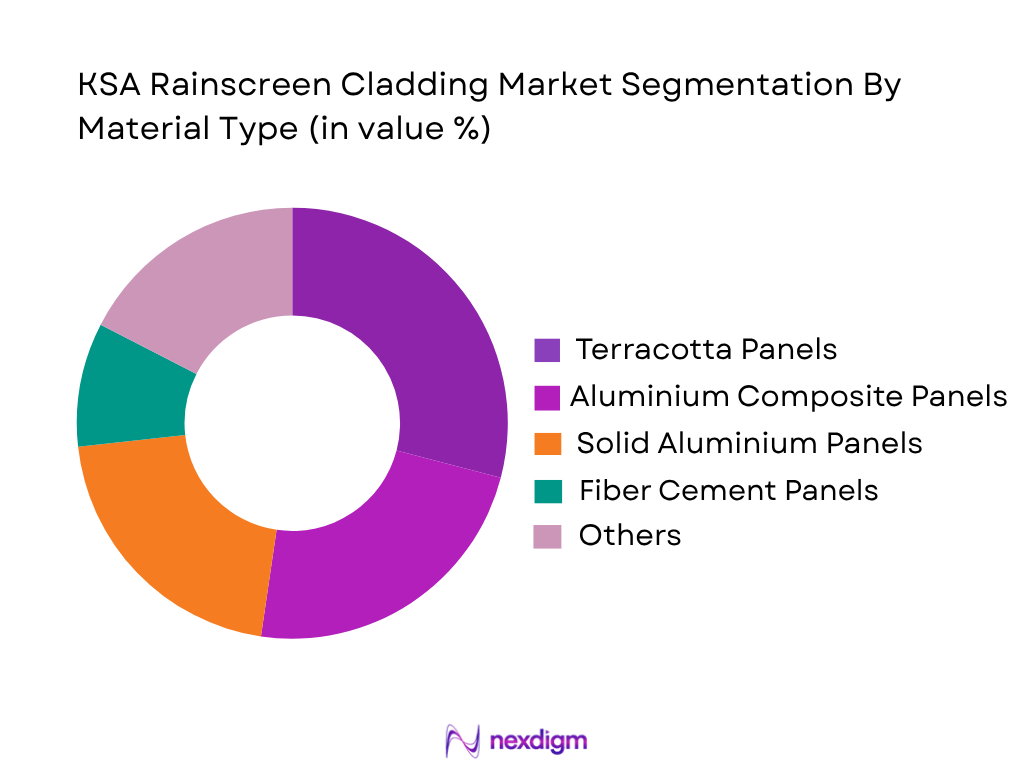
The KSA Rainscreen Cladding Market is segmented by material type into aluminum composite panels, solid aluminum panels, fiber cement panels, terracotta panels, ceramic and porcelain panels, high-pressure laminate panels, GRC and GRP panels, natural stone panels and other rainscreen materials. Terracotta represents the leading material category in the published Saudi market framework because it combines architectural differentiation with durability and suitability for premium developments. Metal is identified as the fastest-growing raw-material category. Aluminum-based systems remain important because of their lightweight construction, fabrication flexibility, corrosion resistance and compatibility with large facade surfaces. Fiber cement, HPL and ceramic systems provide additional options for projects requiring different combinations of fire performance, texture, durability and design flexibility. The growing emphasis on high-performance envelopes also supports materials that can integrate with insulation, ventilated cavities and thermally improved substructures.
By Application
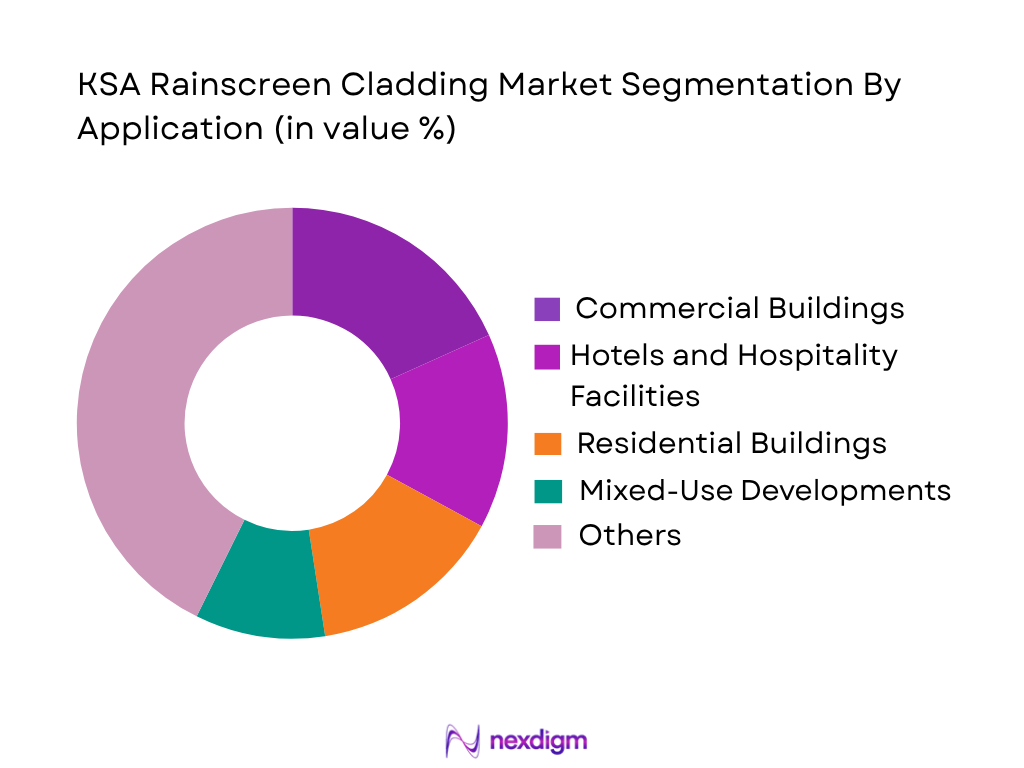
The KSA Rainscreen Cladding Market is segmented by application into residential buildings, commercial buildings, hotels and hospitality facilities, retail and shopping centres, office buildings, institutional buildings, healthcare facilities, educational buildings, industrial and warehouse buildings, data centres, mixed-use developments, government and public buildings, sports and entertainment facilities, transport infrastructure and tourism developments. Commercial buildings represent the leading application because large office, retail, mixed-use and institutional developments require durable and visually differentiated facade systems. Hospitality and tourism developments are also important because premium projects place greater emphasis on architectural appearance, thermal performance and facade durability. Residential construction provides a broad volume base through apartment towers and mixed-use developments. The strong construction ecosystem is supported by non-oil economic activity, which grew 4.3%, while wholesale, retail, restaurants and hotels grew 6.4%, reinforcing the underlying development environment for commercial and hospitality assets.
Competitive Landscape
The KSA Rainscreen Cladding Market includes international building-envelope and facade-material suppliers alongside regional manufacturers, panel converters and specialist facade contractors. Global participants such as Kingspan, Saint-Gobain, ROCKWOOL, Fundermax and Nucor bring established technologies covering insulation, facade panels, building-envelope systems and architectural materials. The competitive environment is increasingly influenced by fire performance, thermal efficiency, material certification, architectural specification, fabrication capability and project execution rather than panel supply alone. The published Saudi market framework identifies Kingspan, Saint-Gobain, ROCKWOOL, Fundermax and Nucor among the key companies active in the broader rainscreen ecosystem.
| Company | Establishment | Headquarters | Core Capability | Rainscreen Product Focus | Fire / Thermal Capability | KSA Project Relevance | Engineering / Specification |
| Kingspan | 1965 | Kingscourt, Ireland | ~ | ~ | ~ | ~ | ~ |
| Saint-Gobain | 1665 | Paris, France | ~ | ~ | ~ | ~ | ~ |
| ROCKWOOL | 1937 | Hedehusene, Denmark | ~ | ~ | ~ | ~ | ~ |
| Fundermax | 1890 | St. Veit an der Glan, Austria | ~ | ~ | ~ | ~ | ~ |
| Nucor | 1905 | Charlotte, USA | ~ | ~ | ~ | ~ | ~ |
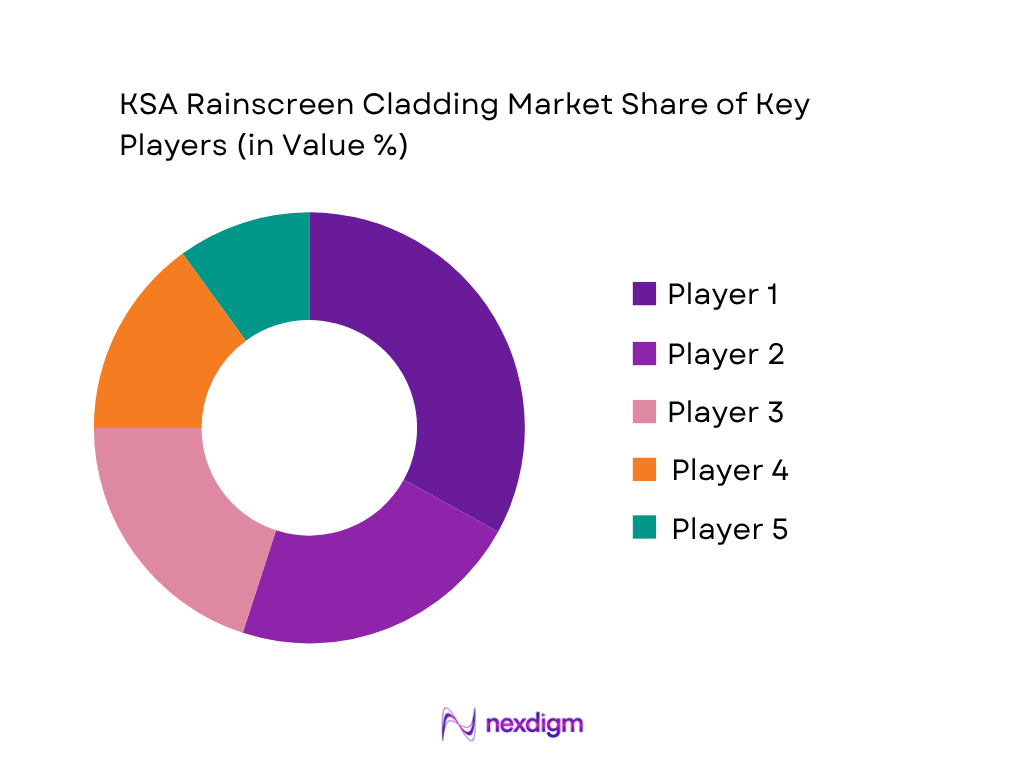
KSA Rainscreen Cladding Market Analysis
Growth Drivers
Expansion of Construction and Urban Development
The KSA Rainscreen Cladding Market is supported by sustained construction activity, urban redevelopment and non-oil economic diversification. Construction activity recorded 4.2% real growth, while non-oil activities expanded 4.3%. Real estate activities also grew 2.5%, supporting continued development across residential, commercial and mixed-use projects. More than 276,000 building permits were issued through the Baladi platform, alongside more than 130,000 commercial permits. These indicators support demand for external building-envelope materials across residential towers, offices, retail developments, hotels and mixed-use projects. Rainscreen systems are particularly relevant where projects require durable facades, moisture management, thermal insulation and architectural flexibility. The continued expansion of construction and real estate activity provides a broad project pipeline for facade-material suppliers, fabricators and installation contractors. Large urban developments also require facade solutions capable of accommodating complex architectural designs and demanding environmental conditions. High-rise construction increases the importance of lightweight facade assemblies that can be transported and installed efficiently. The combination of residential expansion, commercial development and hospitality construction therefore creates recurring opportunities for rainscreen systems. Increasing attention to building-envelope performance further strengthens the relevance of engineered facade solutions.
Government-Led Investment and Building Activity
Government-led investment and private-sector expansion are strengthening the project base for the KSA Rainscreen Cladding Market. Gross fixed capital formation reached SAR 1,653 billion, while construction activities represented 11.4% of gross fixed capital formation. Information and communication activities accounted for 4.8%, supporting demand from technology-intensive developments such as data centres and digitally enabled commercial facilities. Transport, storage and communication activities recorded 4.5% growth, while electricity, gas and water activities expanded 4.9%. These indicators demonstrate continued development across infrastructure-linked sectors requiring new buildings and technical facilities. The non-oil economy expanded 4.2%, with construction among the leading contributors. This investment environment supports rainscreen facade applications across commercial, hospitality, institutional, residential and infrastructure-related buildings. Growing emphasis on building performance also increases the relevance of systems offering moisture management, insulation integration, fire performance and long-term facade durability. Large government-backed developments can generate demand for standardized facade specifications across multiple building types. Developers and contractors are increasingly required to coordinate facade performance with broader building-efficiency and safety requirements. This creates opportunities for suppliers offering integrated systems, technical documentation and project-specific engineering support.
Market Challenges
High Material, Logistics and Installation Complexity
The KSA Rainscreen Cladding Market faces challenges associated with transporting, fabricating and installing facade systems across geographically dispersed construction sites. Transport, storage and communication activities grew 4.5%, reflecting strong logistics activity and the substantial movement required within the construction ecosystem. Construction activity expanded 4.2%, while gross fixed capital formation reached SAR 1,653 billion, creating substantial demand for construction inputs and installation services. Rainscreen systems require coordinated components including external panels, support rails, brackets, insulation, membranes and fixings, increasing procurement and installation complexity. Large commercial and high-rise developments also require precise engineering coordination with structural systems, openings and mechanical services. Strong investment activity can increase demand for imported facade components and specialized materials, creating challenges related to lead times, inventory planning, technical approvals and contractor capability. Customized facade geometry and accelerated project schedules can further increase engineering and installation requirements. Long-distance movement of bulky facade materials can also complicate scheduling between manufacturing facilities and construction sites. Project delays can arise when panels, subframes, insulation or fixing systems are not delivered according to the required installation sequence. These factors make supply-chain coordination and local technical capability important considerations for project execution.
Technical Compliance and Performance Requirements
Technical compliance represents a significant challenge for the KSA Rainscreen Cladding Market because facade systems must address requirements related to fire safety, thermal performance, moisture control, structural stability and long-term durability. More than 276,000 building permits were issued through the Baladi platform, indicating a large and diverse construction pipeline requiring compliance across multiple project categories. Construction activity expanded 4.2%, while real estate activity grew 2.5%, reinforcing the need for technically suitable external-envelope solutions. Inflation remained at 1.9%, creating a relatively stable economic environment while developers continue to focus on construction productivity and project execution. Rainscreen systems must balance architectural requirements with engineering performance, certification and installation quality. Contractors also require technical expertise to maintain cavity ventilation, drainage paths, insulation continuity and fixing performance. Variations between project specifications can increase engineering and approval requirements, while improper installation can undermine the intended thermal, moisture and fire-performance characteristics of the complete facade assembly. High-performance projects can require detailed testing, documentation and approval before materials are accepted for installation. Differences in substrate conditions and building geometry can also require project-specific detailing and engineering. Consequently, suppliers with strong technical documentation and installation support can be better positioned to address compliance-intensive projects.
Market Opportunities
High-Performance Facades for Large-Scale Urban Projects
The KSA Rainscreen Cladding Market presents an opportunity in high-performance facade systems designed for residential, hospitality, commercial and mixed-use developments. Non-oil activities expanded 4.3%, while construction activity grew 4.2% and wholesale, retail, restaurants and hotels expanded 6.4%. These sectors are directly relevant to buildings requiring durable and architecturally adaptable external envelopes. More than 130,000 commercial permits were issued during the period, indicating substantial commercial-development activity. Housing activity also provides an important project base, with 33,380 cumulative housing products in Riyadh and 24,792 in Makkah. Rainscreen systems can capture this opportunity by providing ventilated facade assemblies that combine architectural flexibility with moisture management, insulation integration and long-term weather resistance. The opportunity is particularly relevant for suppliers able to provide complete facade assemblies including subframes, insulation, membranes, fixings and technical support. Large developments can also favour suppliers capable of standardized manufacturing, BIM-compatible detailing, rapid fabrication and project-specific engineering. High-rise residential and mixed-use projects can benefit from lightweight facade systems that simplify transportation and installation at elevated levels. Hospitality and commercial developments can additionally use rainscreen systems to achieve distinctive architectural appearances while maintaining functional envelope performance. This creates opportunities for manufacturers that can combine aesthetic customization with standardized and technically validated facade assemblies.
Expansion into Data Centres, Hospitality and Advanced Building Envelopes
The KSA Rainscreen Cladding Market has an opportunity to expand into technically demanding facilities where facade performance is closely connected with building resilience and operational requirements. Information and communication activities recorded 4.8% growth, while transport, storage and communication activities expanded 4.5%. Wholesale, retail, restaurants and hotels recorded 6.4% growth, creating an additional project base for hospitality and commercial facades. The non-oil economy expanded 4.2%, with construction, retail and hospitality contributing to economic activity. These conditions create opportunities for rainscreen systems designed around thermal insulation, fire performance, moisture drainage, durability and controlled facade detailing. Suppliers can differentiate through lightweight panel systems, prefabricated subframes, low-maintenance finishes and digitally coordinated facade engineering. Refurbishment of existing commercial, institutional and hospitality buildings can also create demand for improved thermal envelopes and updated facade aesthetics. Companies capable of combining design assistance, system engineering, fabrication and installation support are positioned to address increasingly complex Saudi building-envelope requirements. Data-centre projects can require tightly controlled environmental performance and robust external envelopes, creating demand for technically engineered facade assemblies. Hospitality projects provide another opportunity because facade materials must combine durability with architectural appearance and resistance to demanding climatic conditions. These requirements can support higher-value applications for advanced rainscreen systems across new construction and selected building-renovation projects.
Future Outlook
Over the next decade, the KSA Rainscreen Cladding Market is expected to benefit from continued building-envelope investment, major urban-development programs and increasing emphasis on facade performance. Demand is expected to move toward fire-rated, thermally efficient and architecturally differentiated systems rather than commodity panel products alone.
Riyadh is expected to remain a major specification and project-development centre, while Jeddah and the Eastern Province provide additional commercial, residential, hospitality and industrial demand. The market’s future development will also depend on local fabrication, certification, facade engineering expertise and the ability of suppliers to meet project-specific performance requirements.
The Saudi construction environment provides a strong underlying demand base. Real GDP reached SAR 4,070 billion, construction activity grew 4.2%, and real estate activities grew 2.5%. Wholesale, retail, restaurants and hotels expanded 6.4%, creating additional activity across commercial and hospitality assets. The regulatory environment is also becoming increasingly important for facade suppliers. Saudi building-code documentation incorporates requirements covering fire protection, combustible materials and insulation, while the Saudi Fire Code establishes design and safety requirements for protection from fire and explosion hazards.
Major Players
- Kingspan
- Saint-Gobain
- ROCKWOOL
- Fundermax
- Nucor
- CAREA
- CGL Systems
- EcoEarth Solutions
- OmniMax International
- Middle East Insulation
- Al-Dhahayan Aluminum Panels Factory
- Saudi Panel Co.
- Alucobond
- Trespa
- Sika
Key Target Audience
- Real estate developers and giga-project development companies
- Main contractors and facade contractors
- Architectural and facade specification firms
- Building-envelope manufacturers and panel fabricators
- Investments and venture capitalist firms
- Government and regulatory bodies (Saudi Building Code National Committee, Saudi Civil Defense, Ministry of Municipalities and Housing)
- Building-material distributors and specialist facade suppliers
- Infrastructure, hospitality and tourism asset owners
Research Methodology
Step 1: Identification of Key Variables
The initial phase involves constructing a KSA Rainscreen Cladding Market ecosystem map covering material manufacturers, panel fabricators, facade contractors, architects, facade consultants, developers and project owners. The assessment identifies the principal variables affecting rainscreen demand, including facade area, material selection, fire performance, thermal requirements, project type, installation systems and local fabrication capability.
Step 2: Market Analysis and Construction
In this phase, historical and current information is compiled across rainscreen material categories, applications, construction types and geographic demand centres. The analysis considers project pipelines, facade specifications, construction activity, material usage, installed area, manufacturing capacity and the relationship between new-build and retrofit demand to construct the market database.
Step 3: Hypothesis Validation and Expert Consultation
Market hypotheses are validated through consultations with facade contractors, panel manufacturers, architects, developers, building-envelope specialists and project procurement professionals. These discussions are used to test assumptions relating to material adoption, fire-rated systems, fabrication capacity, project specifications, installation practices and competitive positioning across major Saudi construction centres.
Step 4: Research Synthesis and Final Output
The final phase integrates supply-side and demand-side findings with project-level evidence, construction indicators and company-level information. Data is triangulated across material suppliers, manufacturers, contractors and project stakeholders to establish the final market framework, segmentation structure, competitive assessment and future-growth assumptions for the KSA Rainscreen Cladding Market.

- Executive Summary
- Research Methodology (Market Definitions and Assumptions, KSA Rainscreen Cladding Market Classification, Rainscreen System Scope, Ventilated Facade and Cavity Wall Scope, Cladding Material Mapping, Substructure and Support-System Mapping, Thermal and Moisture Management Assessment, Fire-Performance Assessment, Weather-Resistance Assessment, Facade Engineering Assessment, Panel Manufacturing Assessment, Local Fabrication Capacity Assessment, Installation and Erection Capability Assessment, Project Pipeline Assessment, Supply-Side Assessment, Demand-Side Assessment, Top-Down Market Sizing, Bottom-Up Market Sizing, Primary Industry Interviews, Construction Project Pipeline Assessment, Data Triangulation, Forecasting Framework)

- Definition and Scope
- KSA Rainscreen Cladding Industry Evolution and Development of Ventilated Facade Systems, Rainscreen Assemblies, Aluminum Composite Panel Facades, Solid Aluminum Cladding, Fiber Cement Panels, Terracotta Rainscreens, Ceramic and Porcelain Panels, High-Pressure Laminate Facades, GRC and GRP Cladding, Stone Rainscreens, Insulated Rainscreen Systems, Fire-Rated Facade Assemblies, Thermally Enhanced Facade Systems, Low-Carbon Cladding Solutions
- Rainscreen Cladding Value Chain Analysis
- Rainscreen Cladding Supply Chain Analysis
- Aluminum Coil Suppliers, Mineral Core Suppliers, FR and A2 Core Suppliers, Fiber Cement Manufacturers, Terracotta and Ceramic Suppliers, HPL Manufacturers, Stone Suppliers, Insulation Suppliers, Membrane Suppliers, Bracket and Rail Manufacturers, Fastener Suppliers, Panel Fabricators, Facade Contractors, Specialist Installers, Architects, Facade Consultants, Main Contractors, Real Estate Developers, Government Developers, Infrastructure Authorities, Testing and Certification Organizations

- Growth Drivers (Vision 2030 Construction Pipeline, Giga-Project Development, Riyadh Urban Expansion, Jeddah Waterfront Development, Tourism and Hospitality Construction, Commercial Building Development, Demand for Energy-Efficient Building Envelopes, High Solar Exposure, Thermal Performance Requirements, Fire-Safety Requirements, Architectural Premiumization, Domestic Facade Manufacturing Expansion)
- Market Challenges (High Specification Requirements, Imported Raw Material Dependence, Aluminum and Mineral Core Supply Volatility, Fire-Performance Certification Requirements, Facade Engineering Complexity, Thermal Bridge Management, Skilled Installation Requirements, Long Project Qualification Cycles, Heavy Panel Transportation, Project-Specific Fabrication Requirements, Contractor Coordination Complexity, Extreme Heat and UV Exposure)
- Market Opportunities (Riyadh Mega-Projects, NEOM and Regional Giga-Projects, Hospitality and Tourism Facades, Premium Aluminum Rainscreens, FR and A2-Rated ACP Systems, Low-Carbon Facade Materials, Energy-Efficient Building Envelopes, Data Centre Facades, Healthcare and Institutional Buildings, High-Rise Residential Facades, Commercial Retrofit, Facade Replacement, Local Panel Manufacturing, Digital Facade Engineering, Design-for-Manufacturing and Assembly)
- Market Trends (Fire-Rated ACP Adoption, Premium Metal Facades, Large-Format Panels, Terracotta Rainscreens, Porcelain Rainscreens, High-Performance Insulation, Thermal-Break Substructures, BIM-Based Facade Design, Digital Fabrication, Automated Panel Processing, Prefabricated Facade Modules, Low-Carbon Materials, Recycled Aluminum Content, Circular Facade Systems, Smart Facade Monitoring)
- Government Regulations and Standards (Saudi Building Code Requirements, SBC 201 Fire and Life Safety Requirements, SBC 601 Energy Conservation Requirements, SBC 602 Energy Efficiency Requirements, Civil Defense Fire-Safety Requirements, Facade Fire-Performance Testing, Thermal Transmittance Requirements, Moisture and Weatherproofing Requirements)
SWOT Analysis - Porter’s Five Forces Analysis
- PESTLE Analysis
- Stakeholder Ecosystem
- Rainscreen Cladding Manufacturing, Specification and Installation Ecosystem

- By Market Value (2020-2025)
- By Rainscreen Cladding Volume (2020-2025)
- By Installed Facade Area (2020-2025)
- By Aluminum Composite Panel Volume (2020-2025)
- By Solid Aluminum Cladding Volume (2020-2025)
- By Fiber Cement Cladding Volume (2020-2025)
- By Terracotta Cladding Volume (2020-2025)
- By Ceramic and Porcelain Cladding Volume (2020-2025)
- By High-Pressure Laminate Cladding Volume (2020-2025)
- By GRC and GRP Cladding Volume (2020-2025)
- By Stone Rainscreen Volume (2020-2025)
- By Fire-Rated Rainscreen Volume (2020-2025)
- By Premium Architectural Rainscreen Volume (2020-2025)
- By Retrofit and Renovation Rainscreen Volume (2020-2025)
- By New Construction Rainscreen Volume (2020-2025)

- By Material Type (In Value %)
Aluminum Composite Panels
Solid Aluminum Panels
Fiber Cement Panels
Terracotta Panels
Ceramic and Porcelain Panels
High-Pressure Laminate Panels
GRC and GRP Panels
Natural Stone Panels
Metal Composite Panels
Other Rainscreen Materials - By System Type (In Value %)
Open-Joint Rainscreen Systems
Closed-Joint Rainscreen Systems
Ventilated Facade Systems
Pressure-Equalized Rainscreen Systems
Insulated Rainscreen Systems
Fire-Rated Rainscreen Systems
Thermally Broken Rainscreen Systems
Unitized Rainscreen Systems
Stick-Built Rainscreen Systems
Hybrid Rainscreen Systems - By Application (In Value %)
Residential Buildings
Commercial Buildings
Hotels and Hospitality Facilities
Retail and Shopping Centres
Office Buildings
Institutional Buildings
Healthcare Facilities
Educational Buildings
Industrial and Warehouse Buildings
Data Centres
Mixed-Use Developments
Government and Public Buildings
Sports and Entertainment Facilities
Transport Infrastructure
Tourism and Destination Developments - By Construction Stage (In Value %)
New Construction
Renovation and Retrofit
Facade Replacement
Building Expansion
Major Refurbishment
Energy-Efficiency Upgrades
Fire-Safety Upgrades - By Region (In Value %)
Riyadh Region
Makkah Region
Eastern Province
Madinah Region
Asir Region
Tabuk Region
Other Regions

- Market Share of Major Players (By KSA Revenue, Rainscreen Cladding Production Capacity, Panel Conversion Capacity, Manufacturing Facilities, Aluminum Panel Capacity, FR/A2 Product Capability, Material Portfolio, Fire-Test Certification, Geographic Coverage, Facade Engineering Capability, Design-Assist Capability, Fabrication Capability, Installation Capability, Major Project Portfolio)
- Cross Comparison Parameters (Annual Rainscreen Production Capacity, Manufacturing and Fabrication Footprint, Material Portfolio Breadth, FR and A2 Product Capability, Facade Engineering and Design-Assist Capability, Fire and Performance Certification, Geographic Project Coverage, Installation and Project Execution Capability)
- SWOT Analysis of Major Players
- Competitive Positioning Matrix
- Major Companies
Alucobond
Kingspan
Trespa
Rockwool
Carea
Saint-Gobain
FunderMax
Sika
Nucor
ArcelorMittal
Saudi Panel Co. Ltd.
Al-Dhahayan Aluminum Panels Factory
Arabian Masa Factory
Techno Bond Saudi Arabia
Modern Industrial Co. (Unibond)

- Real Estate Developer Rainscreen Requirement Assessment
- Main Contractor Procurement Assessment
- Facade Contractor Procurement Assessment
- Architectural Specification Assessment
- Facade Consultant Specification Assessment
- Government and Institutional Project Requirement Assessment
- Commercial Building Rainscreen Requirement Assessment
- Hospitality and Tourism Facade Requirement Assessment
- High-Rise Residential Facade Assessment

- By Market Value (2026-2035)
- By Rainscreen Cladding Volume (2026-2035)
- By Installed Facade Area (2026-2035)
- By Aluminum Composite Panel Demand (2026-2035)
- By Solid Aluminum Cladding Demand (2026-2035)
- By Fiber Cement Cladding Demand (2026-2035)
- By Terracotta Cladding Demand (2026-2035)
- By Ceramic and Porcelain Cladding Demand (2026-2035)
- By High-Pressure Laminate Cladding Demand (2026-2035)
- By GRC and GRP Cladding Demand (2026-2035)
- By Fire-Rated Rainscreen Demand (2026-2035)
- By Premium Architectural Rainscreen Demand (2026-2035)
- By New Construction Rainscreen Demand (2026-2035)
- By Retrofit and Facade Replacement Demand (2026-2035)


 Request a Sample
 Ask for Customization
 Get a Quote
 Enquire Now