
 Download PDF
Market Overview
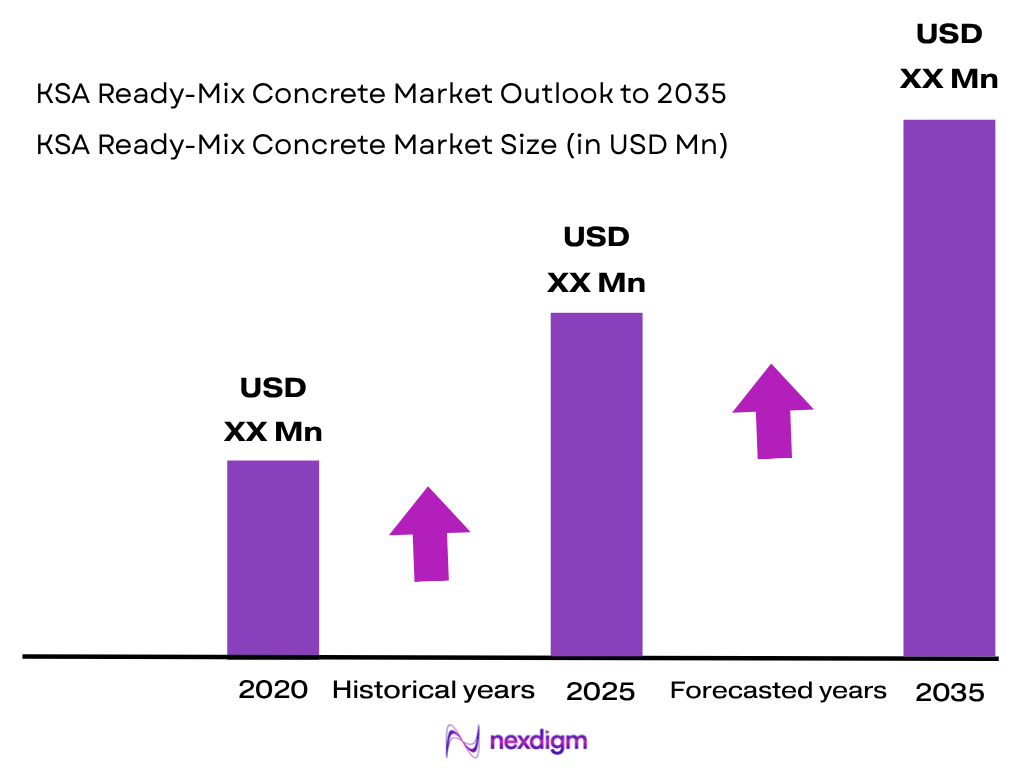
The KSA Ready-Mix Concrete Market is valued at ~USD XX billion in 2024 and is driven by large-scale infrastructure development, residential construction, industrial expansion, and government-backed Vision 2030 projects. Demand is supported by mega developments such as NEOM, Qiddiya, Red Sea Global, Riyadh urban expansion, and transportation infrastructure projects. The market is characterized by extensive batching plant networks supplying concrete through transit mixers to time-sensitive construction sites. The sector benefits from increasing demand for controlled-quality concrete solutions compared with traditional site-mixed concrete.
Riyadh, Jeddah, Makkah, and Dammam represent the major ready-mix concrete consumption centers due to concentrated construction activity, population growth, industrial development, and infrastructure investment. Riyadh is a primary demand hub because of urban expansion, housing programs, and large government projects linked with Vision 2030. The Western region benefits from religious tourism infrastructure and hospitality developments, while the Eastern Province is supported by industrial facilities, energy projects, and logistics infrastructure. The concentration of mega projects creates demand for high-volume concrete supply, advanced batching systems, and specialized concrete grades.
Market Segmentation
By Concrete Type
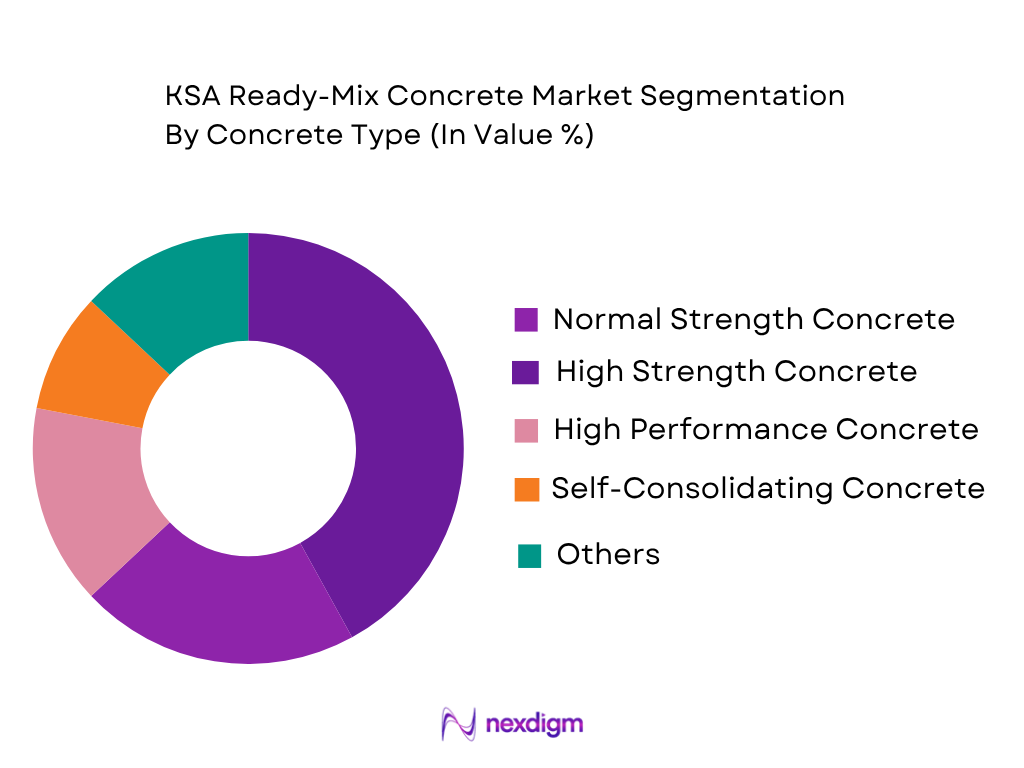
The KSA Ready-Mix Concrete Market is segmented by concrete type into normal strength concrete, high strength concrete, high performance concrete, self-consolidating concrete, fiber reinforced concrete, and sustainable concrete. Normal strength concrete dominates the market due to its extensive application across residential buildings, commercial structures, roads, utilities, and general infrastructure projects. Large-scale housing developments and standard construction activities require concrete grades that provide adequate structural performance while maintaining operational flexibility. However, demand for high-performance and specialized concrete is increasing because mega projects such as NEOM and high-rise developments require enhanced durability, improved strength characteristics, and resistance to harsh environmental conditions. Sustainable concrete solutions are also gaining importance due to Saudi Arabia’s focus on reducing construction emissions and improving resource efficiency under Vision 2030 sustainability initiatives.
By Application
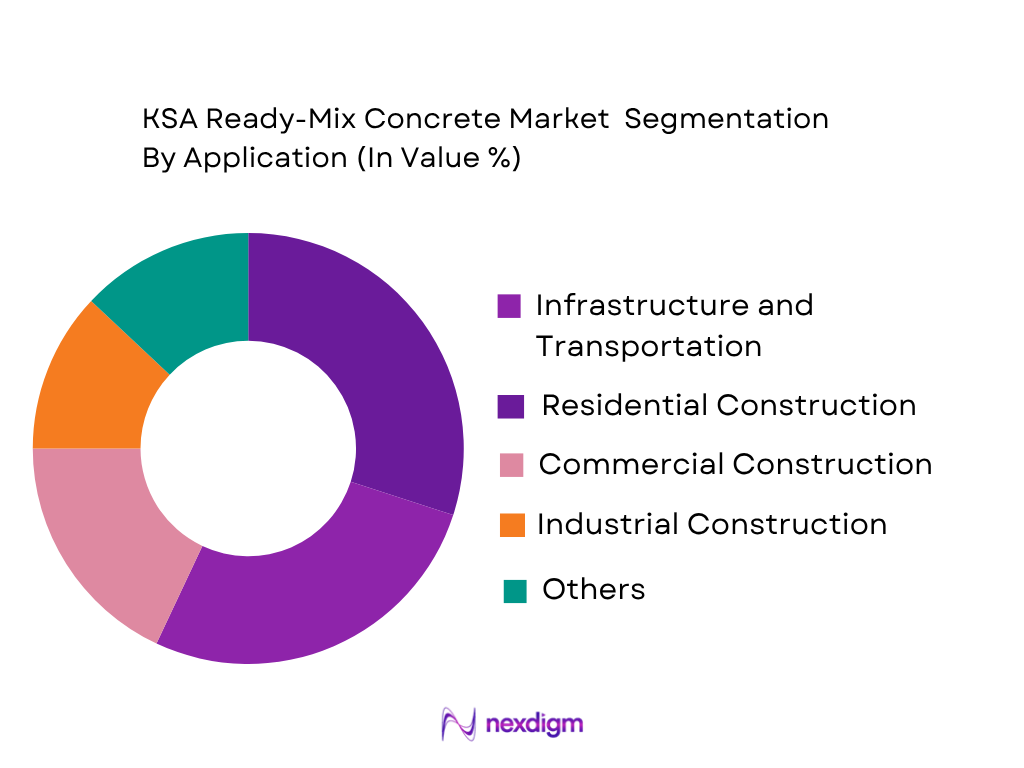
The KSA Ready-Mix Concrete Market is segmented by application into residential construction, infrastructure development, commercial construction, industrial construction, hospitality projects, and energy-related construction. Residential construction represents the leading application segment due to government housing programs, population growth, and urban expansion across Riyadh, Jeddah, and other major cities. Infrastructure development remains a significant demand contributor because Saudi Arabia continues investment in highways, airports, metro systems, utilities, and giga-project infrastructure. Commercial and hospitality construction demand is supported by tourism expansion, business districts, and entertainment developments. Industrial applications are growing due to economic diversification programs supporting manufacturing zones, logistics hubs, and industrial cities. The increasing scale and complexity of these projects require ready-mix suppliers with large production capacity, multiple batching locations, and the ability to deliver customized concrete specifications.
Competitive Landscape
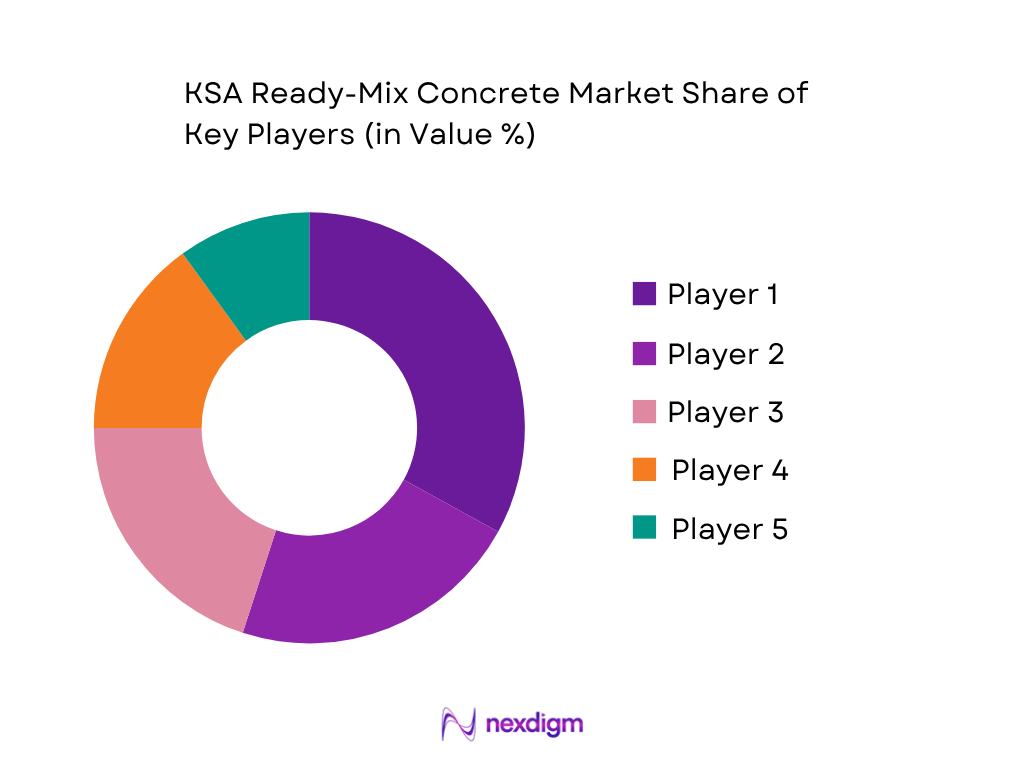
The KSA Ready-Mix Concrete Market is highly competitive, with established domestic producers and construction-material companies supplying major infrastructure, residential, and commercial projects. Competition is influenced by batching plant capacity, geographic coverage, fleet availability, technical capabilities, quality certification, and ability to serve mega projects. Major suppliers compete through expansion of plant networks, adoption of automated batching systems, sustainable concrete solutions, and long-term supply agreements with contractors and developers.
| Company | Establishment Year | Headquarters | Ready-Mix Production Capability | Geographic Presence | Key Project Capability | Concrete Portfolio | Quality & Testing Infrastructure |
| Saudi Readymix Concrete Company | 1978 | Dammam, Saudi Arabia | ~ | ~ | ~ | ~ | ~ |
| Al Kifah Readymix & Blocks | 1975 | Dammam, Saudi Arabia | ~ | ~ | ~ | ~ | ~ |
| Unibeton Ready Mix | 1980 | Abu Dhabi, UAE | ~ | ~ | ~ | ~ | ~ |
| Qanbar Ready Mix | 1970s | Saudi Arabia | ~ | ~ | ~ | ~ | ~ |
| Arabian Cement Company | 1956 | Jeddah, Saudi Arabia | ~ | ~ | ~ | ~ | ~ |
KSA Ready-Mix Concrete Market Analysis
Growth Drivers
NEOM and Giga-Project Construction Demand
The development of Saudi Arabia’s giga-project ecosystem is a major driver for ready-mix concrete demand due to the requirement for large volumes of structural concrete, foundations, tunnels, infrastructure elements, and architectural structures. NEOM, one of the largest regional development programs, includes projects such as The Line, Oxagon, Trojena, and Sindalah, requiring extensive concrete supply networks, strategically located batching plants, and advanced concrete formulations. The Saudi government allocated SAR 1.18 trillion in public expenditure in the approved national budget, supporting infrastructure, transportation, housing, and development programs. The Public Investment Fund has also continued financing large-scale economic diversification projects, creating demand for construction materials. Riyadh’s urban transformation is another major contributor, with the city population exceeding 7.9 million according to Saudi government demographic statistics, increasing requirements for housing, commercial facilities, and public infrastructure. These projects require ready-mix suppliers capable of providing high-strength concrete, self-compacting concrete, and durable mixes suitable for demanding environmental conditions. The increasing scale of construction projects is encouraging contractors to shift from site-mixed concrete toward quality-controlled ready-mix solutions with consistent specifications, automated batching, and reliable delivery scheduling.
Vision 2030 Infrastructure Investment and Urban Development Expansion
Saudi Arabia’s Vision 2030 infrastructure transformation program continues supporting ready-mix concrete demand through transportation networks, housing developments, industrial cities, tourism projects, and urban modernization initiatives. The government’s National Transformation Program and infrastructure strategies are accelerating development across Riyadh, Jeddah, Makkah, and economic zones. According to the General Authority for Statistics, Saudi Arabia’s construction activity remains an important contributor to non-oil economic development, supported by real estate, infrastructure, and industrial projects. The country recorded non-oil economic expansion supported by construction-related activities, reflecting continued investment diversification beyond hydrocarbons. Housing development is a significant demand driver, with Saudi Arabia’s Sakani housing program supporting residential construction requirements across multiple regions. Transportation infrastructure expansion, including metro systems, roads, airports, and logistics facilities, requires large volumes of ready-mix concrete for foundations, pavements, bridges, and structural components. Industrial city development under organizations such as MODON is also increasing demand for warehouses, factories, and utility infrastructure. Ready-mix concrete producers benefit from these developments by supplying customized concrete grades, maintaining regional batching facilities, and supporting large contractors with scheduled delivery capabilities.
Market Challenges
Cement Supply Dependency and Aggregate Availability Constraints
The KSA ready-mix concrete industry faces challenges related to raw material supply, particularly cement and aggregates required for continuous concrete production. Concrete manufacturing depends heavily on consistent availability of cement, crushed stone, sand, and water resources. Saudi Arabia has a large cement manufacturing base, with multiple domestic cement producers operating across regions; however, regional demand concentration around major construction zones can create supply balancing challenges. According to the Ministry of Industry and Mineral Resources, Saudi Arabia has more than 550 million tons of mineral resources identified, highlighting the importance of efficient resource utilization and mining operations. Aggregate availability remains a challenge because construction projects require specific quality grades suitable for structural applications. Transportation of aggregates from quarry locations to batching plants can increase logistics complexity, especially for projects located in remote development areas such as NEOM and Red Sea destinations. The geographical distance between raw material sources and construction sites requires efficient supply-chain planning. Ready-mix suppliers must maintain adequate inventory, optimize plant locations, and develop reliable supplier networks to prevent disruptions. Increasing construction activity across multiple regions also requires stronger coordination between cement producers, aggregate suppliers, and concrete manufacturers.
Desert Climate Concrete Cooling Requirements and Transportation Limitations
Saudi Arabia’s extreme climatic conditions create technical and operational challenges for ready-mix concrete production, particularly during high-temperature periods. Summer temperatures in several regions frequently exceed 40°C, affecting concrete workability, setting time, and transportation efficiency. The National Center for Meteorology records extreme heat conditions across central and western Saudi Arabia, requiring construction companies and concrete suppliers to implement cooling practices, including chilled water systems, ice addition, temperature monitoring, and optimized delivery schedules. Concrete transportation is another challenge because ready-mix materials have limited working time after batching. Large construction projects located far from urban centers require strategically positioned batching plants and extensive mixer truck fleets to maintain quality. Remote mega-project locations increase dependency on logistics planning, fuel availability, and fleet management systems. Water scarcity also affects production processes because concrete manufacturing requires water for mixing, cooling, and equipment cleaning. Saudi Arabia remains among the world’s most water-stressed countries, increasing pressure on industries to adopt water-efficient practices. These operational challenges require ready-mix companies to invest in advanced batching technology, efficient logistics systems, and specialized concrete formulations suitable for harsh environmental conditions.
Market Opportunities
Green Concrete Adoption and Low-Carbon Cement Integration
Sustainability initiatives in Saudi Arabia are creating opportunities for ready-mix concrete producers to develop low-carbon concrete solutions, environmentally optimized mixes, and alternative material applications. The country’s Saudi Green Initiative and Net Zero 2060 commitment are encouraging industries to reduce emissions and improve resource efficiency. Cement production is a major source of industrial carbon emissions globally, increasing demand for supplementary cementitious materials, optimized concrete mixtures, and carbon-reduction technologies. Saudi Arabia has expanded renewable energy development through projects such as the Sakaka Solar Power Plant and large-scale renewable energy programs, supporting broader sustainability objectives. Green building requirements are becoming increasingly relevant for commercial developments, government projects, and giga-projects. Ready-mix suppliers can capture opportunities by offering concrete incorporating recycled aggregates, lower-emission cement alternatives, and durability-enhancing admixtures. NEOM and other sustainable developments require construction materials aligned with environmental performance objectives, creating demand for advanced concrete solutions. The adoption of green concrete also supports contractors seeking compliance with sustainability standards while maintaining structural performance. Suppliers with technical capabilities in environmentally optimized concrete formulations are positioned to support future infrastructure development.
Smart City Development and Digital Ready-Mix Operations
Saudi Arabia’s smart city initiatives and digital transformation programs are creating opportunities for ready-mix concrete companies to adopt automated production, digital ordering systems, and intelligent logistics management. Projects such as NEOM, Riyadh urban transformation programs, and technology-focused developments require efficient construction supply chains capable of managing complex project schedules. Saudi Arabia’s digital economy continues expanding, supported by government technology initiatives and increased adoption of artificial intelligence and automation across industries. Ready-mix suppliers can implement digital platforms for concrete ordering, real-time delivery tracking, automated dispatch management, and fleet optimization. These technologies help reduce delivery delays, improve plant utilization, and enhance coordination between contractors and suppliers. Data center construction represents an emerging opportunity because Saudi Arabia is expanding digital infrastructure to support cloud services and technology investments. Data centers require specialized concrete solutions for heavy structural loads, foundations, and high-performance requirements. High-performance concrete demand is also increasing across infrastructure projects requiring improved durability and resistance to environmental conditions. Companies integrating digital systems with advanced concrete technologies can strengthen their position in Saudi Arabia’s evolving construction ecosystem.
Future Outlook
The KSA Ready-Mix Concrete Market is expected to demonstrate sustained expansion driven by infrastructure modernization, Vision 2030 developments, residential construction programs, and giga-project execution. Demand will increasingly shift toward specialized concrete solutions including high-performance concrete, low-carbon concrete, and digitally managed supply systems. Large-scale projects will require suppliers with advanced production capabilities, efficient logistics networks, and the ability to provide customized concrete formulations.
Major Players
- Saudi Readymix Concrete Company
- Al Kifah Readymix & Blocks
- Unibeton Ready Mix
- Qanbar Ready Mix
- Al Arabia Ready Mix
- Haji Abdullah Alireza Ready Mix
- Eastern Province Cement Company
- Arabian Cement Company
- Yanbu Cement Company
- Southern Province Cement Company
- Najran Cement Company
- Qassim Cement Company
- Riyadh Cement Company
- Al Safwa Cement Company
- Yamama Cement Company
Key Target Audience
- Ready-Mix Concrete Manufacturers
- Cement Manufacturing Companies
- Aggregate Mining and Processing Companies
- Construction and EPC Contractors
- Real Estate Development Companies
- Infrastructure Development Companies
- Investments and Venture Capitalist Firms
- Government and Regulatory Bodies (Saudi Ministry of Municipalities and Housing, Ministry of Transport and Logistics Services, Saudi Standards, Metrology and Quality Organization)
Research Methodology
Step 1: Identification of Key Variables
The research process begins with ecosystem mapping of the KSA ready-mix concrete industry, covering concrete producers, cement suppliers, aggregate suppliers, contractors, developers, and government infrastructure stakeholders. Secondary research is conducted to identify construction activity indicators, project pipelines, production capacity, and demand variables influencing market performance.
Step 2: Market Analysis and Construction
Historical market information is analyzed through demand-side and supply-side assessment. The analysis evaluates ready-mix consumption patterns, batching plant distribution, concrete application demand, infrastructure project requirements, and regional construction activity to establish market sizing assumptions.
Step 3: Hypothesis Validation and Expert Consultation
Market assumptions are validated through discussions with industry participants including ready-mix producers, contractors, material suppliers, and project developers. These interactions provide operational insights regarding capacity utilization, procurement behavior, concrete specifications, and competitive dynamics.
Step 4: Research Synthesis and Final Output
The final stage integrates primary and secondary findings into a comprehensive market assessment. Data triangulation is performed by comparing production indicators, construction activity, company-level information, and industry developments to ensure reliability of market estimates.

- Executive Summary
- Research Methodology (Market Definitions and Assumptions, Ready-Mix Concrete Market Ecosystem Mapping, Concrete Supply Chain Assessment, Market Sizing Approach, Top-Down Analysis, Bottom-Up Analysis, Demand-Side Assessment, Supply-Side Assessment, Primary Industry Interviews, Ready-Mix Producer Validation, Data Triangulation, Forecasting Framework, Market Limitations and Future Conclusions)

- Definition and Scope
- Ready-Mix Concrete Industry Evolution and Development Timeline
- KSA Construction Ecosystem Analysis
- Ready-Mix Concrete Value Chain Analysis
- Ready-Mix Concrete Supply Chain Analysis
- KSA Construction and Infrastructure Development Landscape

- Growth Drivers (NEOM and Giga-Project Construction Demand, Riyadh Urban Development Expansion, Vision 2030 Infrastructure Investment, Housing Construction Growth, Transportation Infrastructure Development, Industrial City Expansion, Tourism Infrastructure Development, Government Construction Spending, Quality-Controlled Concrete Preference, Sustainable Construction Adoption)
- Market Opportunities (Green Concrete Adoption, Low-Carbon Cement Integration, Carbon Reduction Technologies, NEOM Construction Requirements, Smart City Development, Data Center Construction, High-Performance Concrete Demand, Digital Concrete Ordering Platforms, Automated Dispatch Systems, Recycled Aggregate Concrete)
- Market Trends (Sustainable Concrete Solutions, Carbon-Neutral Construction Materials, Digitalization of Ready-Mix Operations, Automated Fleet Management, High-Durability Concrete Adoption, Modular Construction Growth, Advanced Concrete Admixtures, Smart Construction Technologies)
- Government Regulations and Industry Standards (Saudi Vision 2030 Construction Initiatives, Saudi Building Code Requirements, Environmental Sustainability Regulations, Quality Standards for Concrete Production, Construction Material Compliance Standards, Green Building Regulations)
- SWOT Analysis
- Porter’s Five Forces Analysis
- PESTLE Analysis
- Stakeholder Ecosystem
- Construction Competition Ecosystem

- By Market Value (2020-2025)
- By Concrete Production Volume (2020-2025)
- By Ready-Mix Concrete Consumption Volume (2020-2025)
- By Average Selling Price (2020-2025)
- By Project Type Consumption (2020-2025)
- By Regional Demand Distribution (2020-2025)

- By Concrete Grade Type (In Value %)
Normal Strength Concrete
High Strength Concrete
High Performance Concrete
Self-Consolidating Concrete
Fiber Reinforced Concrete
Lightweight Concrete
Sustainable and Low-Carbon Concrete - By Application Type (In Value %)
Residential Construction
Commercial Construction
Industrial Construction
Infrastructure Development
Transportation Infrastructure
Oil & Gas Construction
Power and Utility Projects
Hospitality and Tourism Infrastructure - By End-User Industry (In Value %)
Real Estate Developers
Government Infrastructure Projects
EPC Contractors
Industrial Developers
Oil & Gas Companies
Utility Companies
Mining and Manufacturing Companies - By Delivery Mode (In Value %)
Central Mixed Concrete
Transit Mixed Concrete
Shrink Mixed Concrete
On-Site Batching Solutions
Mobile Concrete Batching Plants - By Region (In Value %)
Riyadh Region
Makkah Region
Eastern Province
Madinah Region
Asir Region
Tabuk Region
Other Provinces - By Project Scale (In Value %)
Mega Infrastructure Projects
Large Commercial Projects
Medium Construction Projects
Small Residential Projects

- Market Share of Major Players (By Revenue, Concrete Production Capacity, Geographic Presence, Project Portfolio, Customer Segments)
- Cross Comparison Parameters (Ready-Mix Production Capacity, Number of Batching Plants, Geographic Coverage, Mixer Truck Fleet Size, Concrete Grade Portfolio, Mega-Project Supply Capability, Quality Testing Infrastructure, Sustainable Concrete Capability)
- SWOT Analysis
- Detailed Profiles of Major Companies
Saudi Readymix
Concrete Company
Al Kifah Contracting Company
Unibeton Ready Mix
HACO Ready Mix
Eastern Province Cement Company
Arabian Cement Company
Yanbu Cement Company
Southern Province Cement Company
Najran Cement Company
Qassim Cement Company
Riyadh Cement Company
Al Safwa Cement Company
Al Arabia Cement Company
Gulf Ready Mix
Fujairah National Industries


 Request a Sample
 Ask for Customization
 Get a Quote
 Enquire Now