
 Download PDF
Market Overview
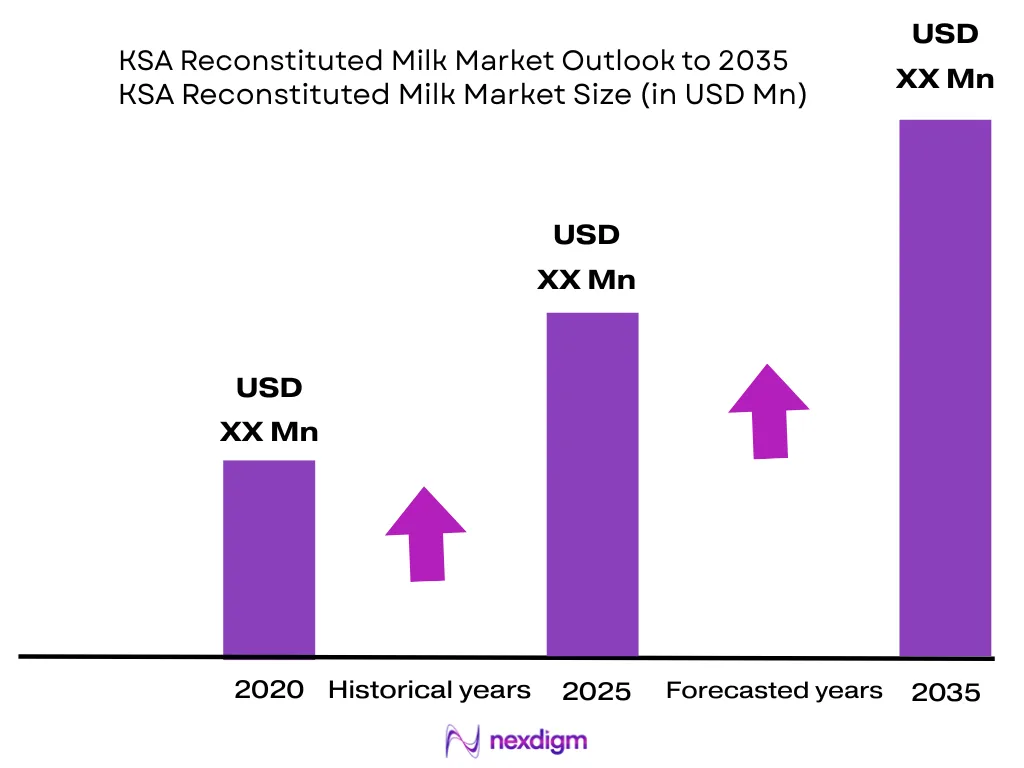
The KSA Reconstituted Milk Market is valued at approximately USD ~ million, based on UHT milk demand used as the closest formal proxy for shelf-stable reconstituted and recombined milk. The broader dairy products market is valued at USD ~ billion, indicating strong liquid dairy and value-added dairy consumption. Demand is driven by ambient storage suitability, foodservice use, household long-life milk adoption, and milk powder recombination in processing.
Riyadh, Jeddah, Makkah, Eastern Province, Madinah and Qassim dominate the KSA Reconstituted Milk Market due to dense population, modern retail penetration, foodservice activity and pilgrimage-linked institutional demand. GASTAT estimates the Kingdom’s population at 35.3 million, compared with 33.7 million previously, creating a larger packaged dairy demand base. Riyadh and Makkah benefit from urban grocery density, while Eastern Province and Qassim support dairy processing and logistics connectivity.
Market Segmentation
By Source
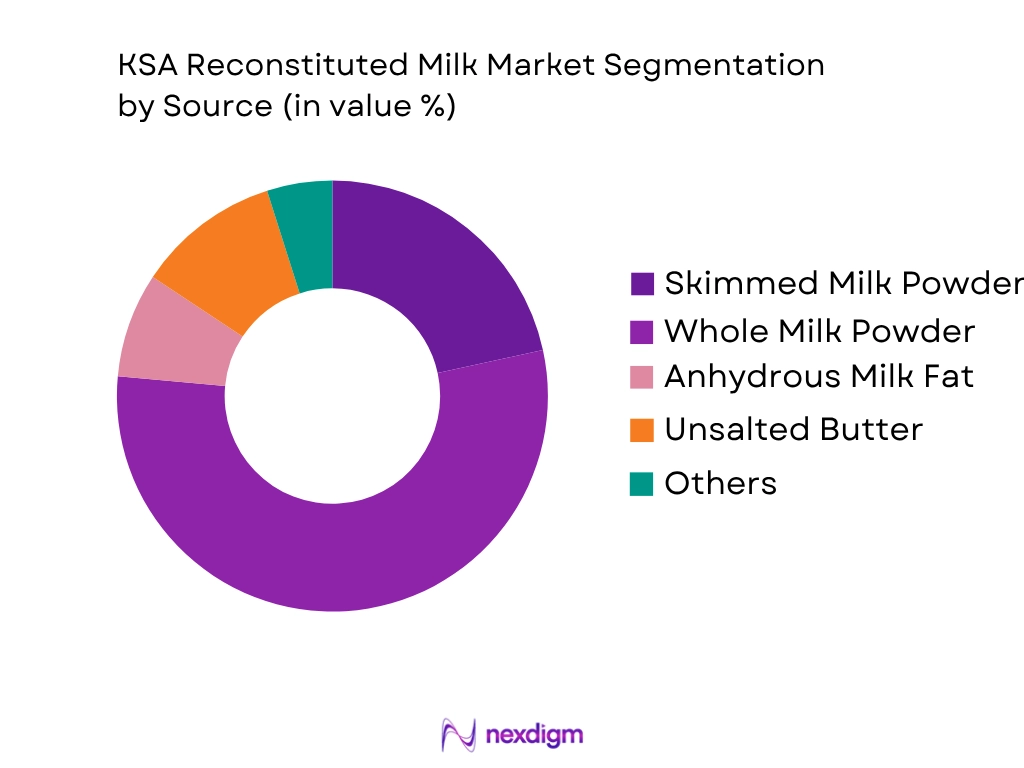
KSA Reconstituted Milk Market is segmented by source into skimmed milk powder, whole milk powder, anhydrous milk fat, unsalted butter/butter oil, and blended dairy solids. Recently, skimmed milk powder has a dominant market share under the source segmentation because it is the most flexible input for standardized recombination. Saudi processors use SMP with water, milk fat or AMF to control fat percentage, protein level, taste profile and cost-in-use across UHT milk, flavoured milk, bakery mixes, desserts and foodservice dairy bases. Saudi Arabia’s food processing sector remains import-dependent for key dairy ingredients, and USDA FAS identifies skimmed milk powder, full cream milk powder, whey powder, milk protein concentrate and AMF among best-prospect food processing inputs. This supports SMP’s role as the largest functional base for reconstituted milk formulations.
By Application
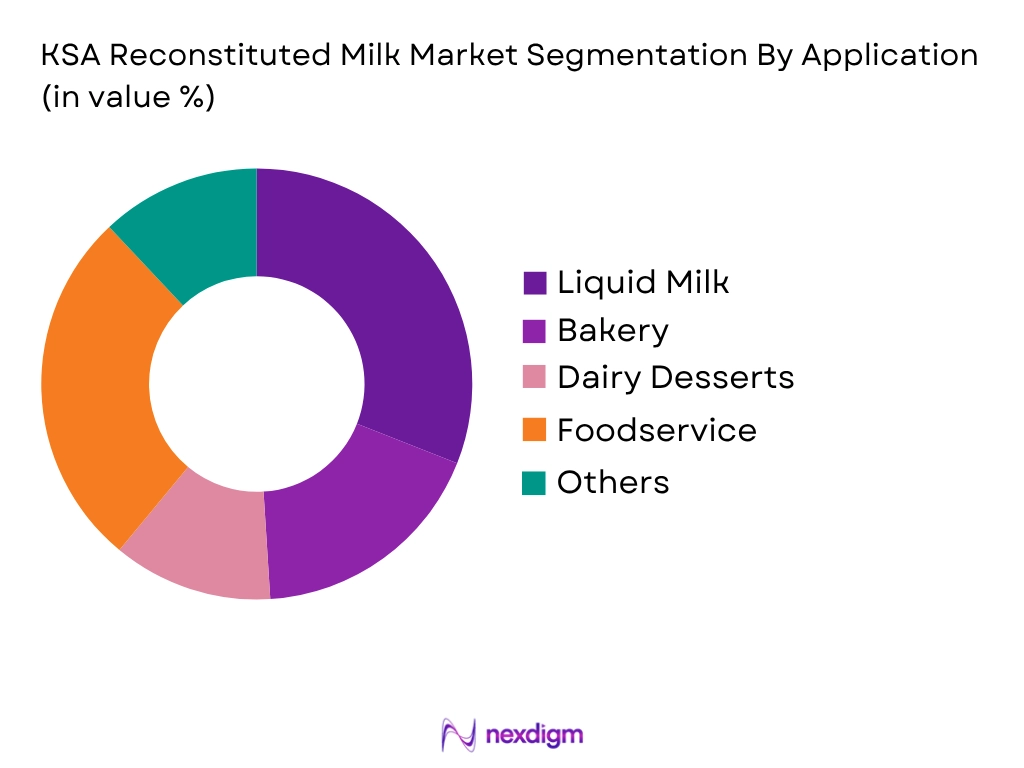
KSA Reconstituted Milk Market is segmented by application into liquid milk, foodservice dairy base, bakery and confectionery, dairy desserts and ice cream, and institutional/public catering. Recently, liquid milk has a dominant market share under the application segmentation because reconstituted and recombined milk is most commercially relevant as shelf-stable UHT milk for household consumption, baqalas, supermarkets, hypermarkets and convenience-led pantry stocking. Saudi Arabia’s hot climate, large urban base, and high reliance on ambient grocery formats make UHT liquid milk more practical than chilled fresh milk in many consumption occasions. The foodservice segment is also expanding due to hotels, cafés, QSR chains, labour camps, airline catering and pilgrimage-related catering, but liquid milk remains the largest application because it is purchased regularly by households and distributed through both modern and traditional grocery channels.
Competitive Landscape
The KSA Reconstituted Milk Market is dominated by large integrated dairy processors and multinational dairy ingredient companies with UHT processing capability, powder sourcing networks, retail relationships and foodservice reach. Almarai, SADAFCO, NADEC, Al Safi Danone and Nada Dairy are central to the domestic liquid dairy ecosystem, while ingredient-linked players such as Arla, Fonterra, Friesland Campina, Nestlé and Lactalis influence recombination through powder, AMF, whey, nutrition and industrial dairy inputs. Competition is shaped by ambient distribution, brand trust, food safety compliance, private-label supply capability and procurement of milk powders.
| Company | Establishment Year | Headquarters | UHT/Reconstituted Milk Presence | Key Brands/Business Lines | Processing Footprint | Distribution Strength | Ingredient Linkage | Market-Specific Position |
| Almarai Company | 1977 | Riyadh, Saudi Arabia | ~ | ~ | ~ | ~ | ~ | ~ |
| SADAFCO | 1976 | Jeddah, Saudi Arabia | ~ | ~ | ~ | ~ | ~ | ~ |
| NADEC | 1981 | Riyadh, Saudi Arabia | ~ | ~ | ~ | ~ | ~ | ~ |
| Al Safi Danone | 1981 | Riyadh, Saudi Arabia | ~ | ~ | ~ | ~ | ~ | ~ |
| Nada Dairy | 1982 | Al Ahsa, Saudi Arabia | ~ | ~ | ~ | ~ | ~ | ~ |
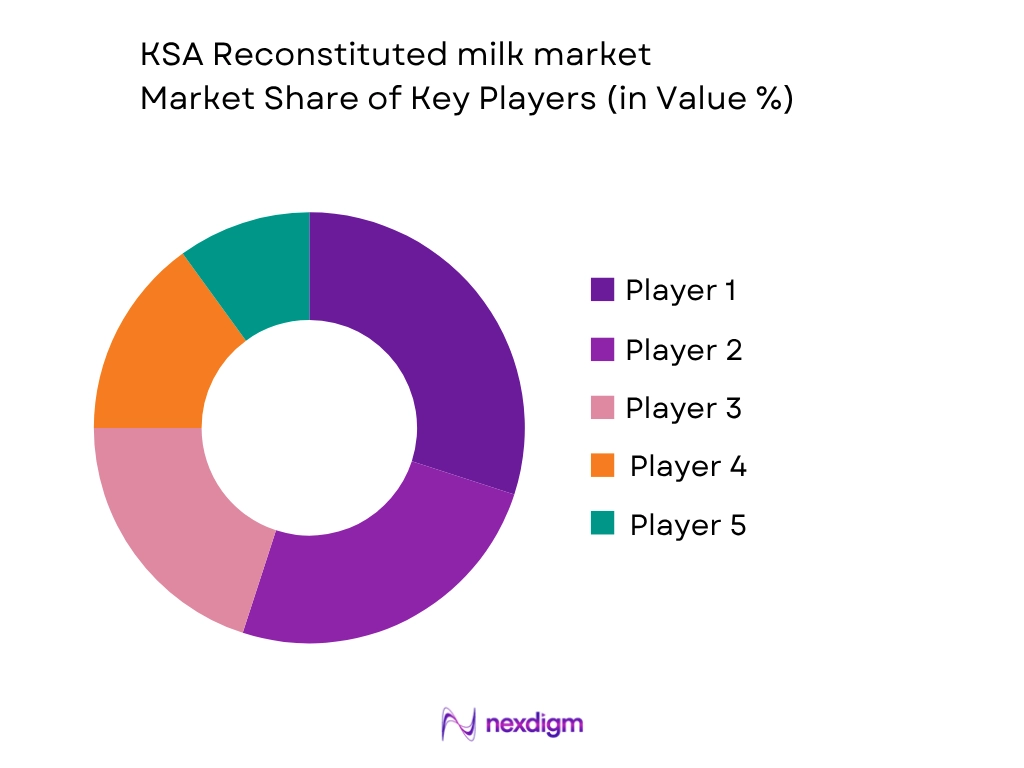
KSA Reconstituted Milk Market Analysis
Growth Drivers
Expansion of Long-Life Dairy Consumption Through Large Urban Demand Base
KSA Reconstituted Milk Market is supported by a large packaged-food consumption base, where shelf-stable milk formats fit household pantry stocking, baqala retailing, hypermarket sales and foodservice procurement. Saudi Arabia’s total population is estimated at 35.3 million people in mid-2024, increasing by 1.6 million people compared with the previous population base, according to GASTAT. World Bank records Saudi Arabia’s GDP at USD 1.24 trillion and GDP per capita at USD 35,121.7 in 2024, supporting formal retail and branded dairy consumption. Reconstituted milk benefits because SMP/WMP-based products can be distributed through ambient channels in Riyadh, Jeddah, Makkah and Eastern Province without continuous chilled storage before opening.
Foodservice, Hospitality and Pilgrimage Demand Supporting Bulk Dairy Use
KSA Reconstituted Milk Market is driven by foodservice and institutional demand because reconstituted and recombined milk can be standardized for cafeterias, hotels, bakeries, labour accommodation, catering kitchens and pilgrimage meal supply. GASTAT reported 1,833,164 Hajj pilgrims in the 1445H season, including 1,611,310 international pilgrims and 221,854 domestic pilgrims, creating recurring demand for shelf-stable beverages and dairy ingredients in Makkah and Madinah. IMF also notes that Saudi non-oil activity in 2024 was driven by retail, hospitality and construction, with oil output at 9 million barrels per day and the Saudi Central Bank’s net foreign assets at USD 415 billion by end-2024. These macro buffers support organized catering and food-distribution infrastructure relevant to long-life milk.
Market Challenges
High Dependence on Imported Dairy Inputs for Reconstitution
KSA Reconstituted Milk Market faces input-security risk because reconstituted milk production depends on imported dairy ingredients such as skimmed milk powder, whole milk powder, whey powder and milk fats. USDA FAS reports Saudi dairy product imports at USD 1.50 billion in 2024 and identifies New Zealand as the dominant exporter of cheese and milk powder to Saudi Arabia. The same table lists dairy suppliers from New Zealand, UAE, France, Netherlands and the United States, indicating a multi-country supply chain for dairy processors. This creates procurement exposure for companies producing recombined milk, UHT milk bases, bakery dairy mixes and foodservice formulations. World Bank records Saudi Arabia’s merchandise-importing economy against a USD 1.24 trillion GDP base in 2024, making ingredient sourcing a strategic issue rather than a purely operational one.
Water and Local Dairy Production Constraints in Desert Conditions
KSA Reconstituted Milk Market faces structural production challenges because local dairy farming is exposed to water scarcity, heat stress, feed imports and cooling requirements. World Bank’s Saudi Arabia profile records annual freshwater withdrawals at 974 of internal resources in 2022, the latest available indicator shown on its country page, highlighting pressure on water-intensive agriculture and livestock operations. Saudi Arabia’s reconstituted milk segment therefore depends on balancing local raw milk with imported powder and milk-fat ingredients. IMF reports Saudi Arabia’s overall real growth at 2.0 in 2024 and oil GDP contraction linked to oil output of 9 million barrels per day, while non-oil expansion was led by domestic activity. For dairy processors, these conditions increase the need for efficient powder reconstitution, aseptic processing, ambient logistics and consistent quality control.
Market Opportunities
Fortified and Functional Reconstituted Milk for Household Nutrition
KSA Reconstituted Milk Market has an opportunity in fortified and functional milk because reconstituted formulations can be adjusted for vitamin D, calcium, protein, low-fat content and children’s nutrition. The opportunity is supported by Saudi Arabia’s large consumer base of 35.3 million people in 2024 and high digital retail readiness, with World Bank reporting internet use at 100 in 2024. This supports online grocery discovery, subscription baskets and targeted promotion of ambient dairy SKUs. IMF reports Saudi non-oil real GDP expansion was driven by private consumption and non-oil private investment in 2024, with retail and hospitality leading growth. Reconstituted milk processors can use SMP, WMP and AMF blending to develop standardized fortified UHT products for families, schools, hospitals and institutional buyers.
Regional and Institutional Supply Through Shelf-Stable Dairy Formats
KSA Reconstituted Milk Market has an opportunity in regional and institutional supply because shelf-stable dairy is suitable for hot-climate logistics, wholesale distribution and public-sector procurement. USDA FAS reports Saudi dairy imports of USD 1.50 billion in 2024, confirming the scale of ingredient and finished-dairy trade feeding local processing and distribution. GASTAT also reported 1,673,230 Hajj pilgrims for the 1446H season, including 1,506,576 international pilgrims and 166,654 domestic pilgrims, showing continued mass-catering relevance. IMF states Saudi Arabia’s central bank net foreign assets were USD 415 billion by end-2024, equivalent to 15 months of imports, indicating capacity to sustain food-import and processing supply chains. Reconstituted milk suppliers can use this base to serve Hajj/Umrah catering, institutional kitchens, foodservice distributors and GCC-facing ambient dairy routes.
Future Outlook
Over the long-range forecast period, the KSA Reconstituted Milk Market is expected to grow steadily as shelf-stable dairy products remain relevant to household consumption, foodservice procurement and institutional supply. Growth will be supported by UHT milk adoption, hot-climate suitability, expanding modern retail, e-grocery, Hajj and Umrah catering, and the use of SMP, WMP and AMF in standardized recombined dairy production. The market’s forward trajectory will also be influenced by Saudi Arabia’s broader food security agenda and its dependence on imported food ingredients. USDA FAS notes that the Kingdom relies on imports for a large share of food consumption needs, while dairy processors continue to use imported milk powders, whey ingredients and milk fats for local manufacturing. This creates opportunities for ingredient optimization, private label UHT milk, fortified milk, functional dairy and foodservice bulk packs. At the same time, the market will remain exposed to milk powder costs, international dairy ingredient supply, freight movement, water scarcity, local feed costs and consumer perception of reconstituted versus fresh milk. Companies with stronger procurement networks, aseptic filling capacity, national distribution fleets and regulatory compliance systems will be better positioned. The forecasted CAGR benchmark for the reconstituted milk outlook is 3.7% for 2026-2035, based on the global reconstituted milk forecast where Middle East and Africa is identified as a growing region and Saudi Arabia is cited for reconstituted milk use in hotels, catering and households.
Major Players
- Almarai Company
- Saudia Dairy and Foodstuff Company
- National Agricultural Development Company
- Al Safi Danone Company
- Nada Dairy
- Al Watania Dairy
- Baladna Food Industries
- Arla Foods Saudi Arabia
- Fonterra Saudi Arabia
- FrieslandCampina Middle East
- Nestlé Saudi Arabia
- Lactalis Saudi Arabia
- Kerry Group Saudi Arabia
- United National Dairy Company
- Farm Dairy
Key Target Audience
- Dairy processors and UHT milk manufacturers
- Milk powder, AMF and dairy ingredient importers
- Supermarket, hypermarket and baqala retail chains
- Foodservice distributors and HoReCa procurement teams
- Institutional catering and Hajj/Umrah food supply companies
- Investments and venture capitalist firms
- Government and regulatory bodies (Saudi Food and Drug Authority; Ministry of Environment, Water and Agriculture; General Authority for Statistics; Zakat, Tax and Customs Authority; Saudi Standards, Metrology and Quality Organization)
- Aseptic packaging, dairy processing and cold/ambient logistics companies
Research Methodology
Step 1: Identification of Key Variables
The initial phase involves constructing an ecosystem map covering dairy farms, milk powder importers, UHT processors, recombined milk manufacturers, retailers, baqalas, foodservice distributors and institutional buyers. Key variables include SMP/WMP availability, AMF sourcing, UHT capacity, pack-size mix, retail channel penetration, foodservice demand and regulatory compliance.
Step 2: Market Analysis and Construction
In this phase, historical data is compiled across UHT milk demand, broader dairy products revenue, food retail sales, foodservice demand, dairy ingredient imports and processor portfolios. The market is constructed through a top-down approach using shelf-stable liquid dairy demand and a bottom-up approach based on company SKUs, applications and channel participation.
Step 3: Hypothesis Validation and Expert Consultation
Market hypotheses are validated through interviews with dairy processors, ingredient importers, packaging suppliers, retail category managers, foodservice distributors and institutional procurement stakeholders. These consultations help verify assumptions around reconstituted milk usage, UHT adoption, powder sourcing, private-label production, foodservice demand and regional distribution.
Step 4: Research Synthesis and Final Output
The final phase integrates secondary research, trade indicators, company benchmarking and primary validation into a structured market model. The output captures market size, forecast outlook, segmentation, competitive positioning and strategic recommendations for stakeholders operating in KSA’s reconstituted, recombined and shelf-stable dairy ecosystem.

- Executive Summary
- Research Methodology (Market Definitions and Assumptions, Reconstituted Milk and Recombined Milk Scope, SMP/WMP Conversion Ratios, Milk Solids-Not-Fat Assumptions, Fat Standardization Approach, UHT and Sterilized Milk Inclusion Criteria, Retail SKU Mapping, Import-Export Triangulation, Processor-Level Bottom-Up Validation, Top-Down Dairy Utilization Assessment, Primary Interviews with Dairy Processors and Distributors, Limitations and Forecast Sensitivities)

- Definition and Scope
- Market Genesis and Evolution
- Role of Reconstituted Milk in KSA Dairy Consumption
- Timeline of Major Dairy Processors
- Business Cycle and Demand Seasonality

- Growth Drivers (Shelf-Stable Dairy Demand, Urban Household Consumption, High Ambient Temperature Suitability, UHT Acceptance, Modern Retail Expansion, Foodservice Demand, Institutional Catering, Dairy Ingredient Utilization)
- Market Challenges (Milk Powder Import Exposure, Feed and Water Constraints, Extreme Climate Production Cost, Regulatory Compliance, Shelf-Life Quality Control, Price Competition, Private Label Pressure)
- Market Opportunities (Fortified Milk, Affordable Family Packs, Foodservice Bulk Packs, Hajj and Umrah Catering, Private Label Manufacturing, Low-Lactose Formulations, Export-Oriented Shelf-Stable Dairy)
- Market Trends (Ambient Dairy Premiumization, Clean Label Positioning, Low-Fat and Fortified UHT, Aseptic Packaging Innovation, Digital Grocery Penetration, Private Label Expansion, Sustainable Packaging, Dairy Traceability)
- SWOT Analysis
- Porter’s Five Forces
- PESTLE Analysis

- By Value (2020-2025)
- By Volume (2020-2025)
- By Average Realization per Litre (2020-2025)

- By Product Type (In Value %)
Full Cream Reconstituted Milk
Low-Fat Reconstituted Milk
Skim/Fat-Free Reconstituted Milk
Recombined Milk
Fortified Reconstituted Milk - By Application (In Value %)
Household Retail Consumption
HoReCa and Foodservice
Bakery and Confectionery
Beverage Manufacturing - By Distribution Channel (In Value %)
Supermarkets and Hypermarkets
Baqalas and Independent Grocers
Convenience Stores and Forecourts
Cash-and-Carry and Wholesale
Online Grocery Platforms - By Region (In Value %)
Riyadh
Makkah
Jeddah
Eastern Province
Madinah

- Market Share of Major Players (Value Share, Volume Share, Long-Life Milk Share, Reconstituted Milk Share, Retail Shelf Presence, Regional Distribution Strength)
- Cross Comparison Parameters (UHT/Aseptic Processing Capacity, SMP/WMP and AMF Sourcing Model, Reconstitution and Recombination Capability, Retail and Baqala Distribution Reach, Private Label Manufacturing Capability, Foodservice and Institutional Contract Exposure, Product Shelf-Life and Pack-Size Portfolio, GCC Export and Regional Route-to-Market Strength)
- Pricing Analysis by SKU
- SWOT Analysis of Major Players
- Detailed Profiles of Major Companies
Almarai Company
Saudia Dairy and Foodstuff Company
National Agricultural Development Company
Al Safi Danone Company
Nada Dairy
Al Watania Dairy
Baladna Food Industries
Arla Foods Saudi Arabia
Fonterra Saudi Arabia
FrieslandCampina Middle East
Nestlé Saudi Arabia
Lactalis Saudi Arabia
Kerry Group Saudi Arabia
Saudia Dairy and Foodstuff Company Ice Cream and Milk Division
United National Dairy Company

- Household Consumers
- Foodservice Buyers
- Bakery and Confectionery Manufacturers
- Beverage and Dessert Manufacturers
- Institutional and Public Procurement Buyers

- By Value (2026-2035)
- By Volume (2026-2035)
- By Average Realization per Litre (2026-2035)


 Request a Sample
 Ask for Customization
 Get a Quote
 Enquire Now