

 Download PDF
Market Overview
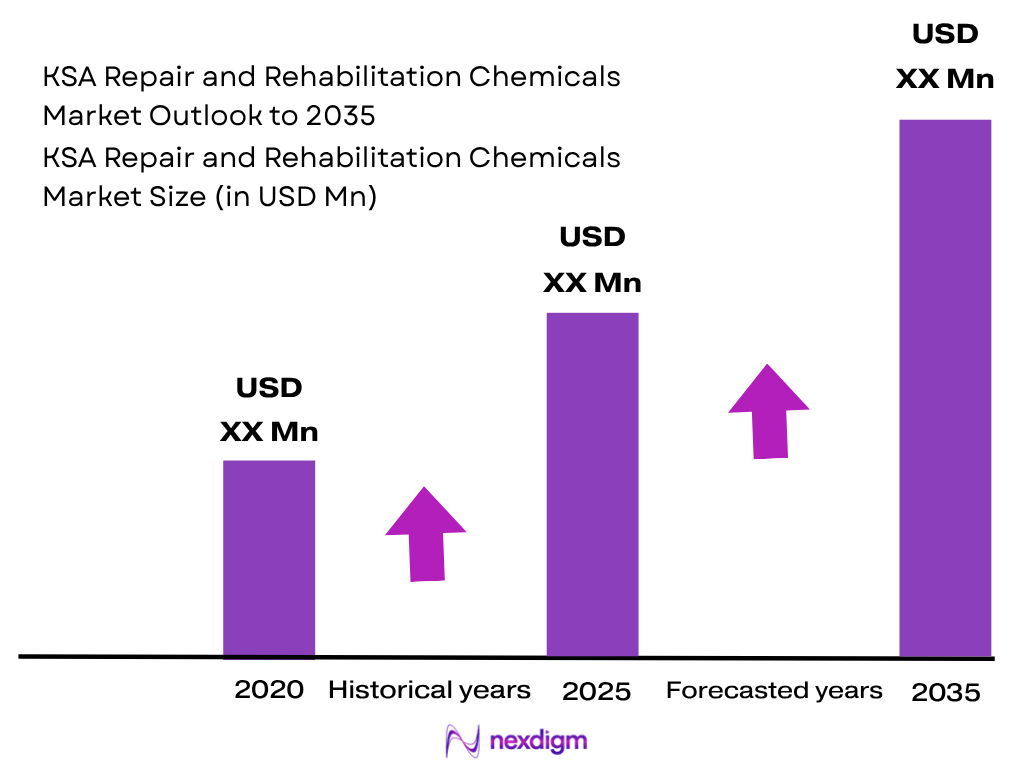
The KSA Repair and Rehabilitation Chemicals Market is valued at approximately USD ~XX million, with demand supported by the Kingdom’s expanding concrete asset base and increasing requirements for structural restoration, corrosion protection and infrastructure maintenance. Saudi construction nominal GDP increased from SAR 338.3 billion to SAR 362.6 billion across the latest two annual observations, strengthening the installed base requiring future maintenance. Demand is concentrated in repair mortars, protective coatings, injection resins, grouts and structural strengthening systems.
Riyadh, Jeddah and the Dammam-Jubail corridor represent the dominant demand centres in the KSA Repair and Rehabilitation Chemicals Market because they combine dense urban assets, transport infrastructure, marine structures, industrial plants and large construction programs. Construction-sector foreign-direct-investment stock increased from SAR 79.8 billion to SAR 91.4 billion across the latest two annual observations. Riyadh benefits from extensive urban development, Jeddah from marine and coastal infrastructure, while Dammam-Jubail has substantial petrochemical and industrial concrete assets requiring specialist rehabilitation.
Market Segmentation
By Product Type
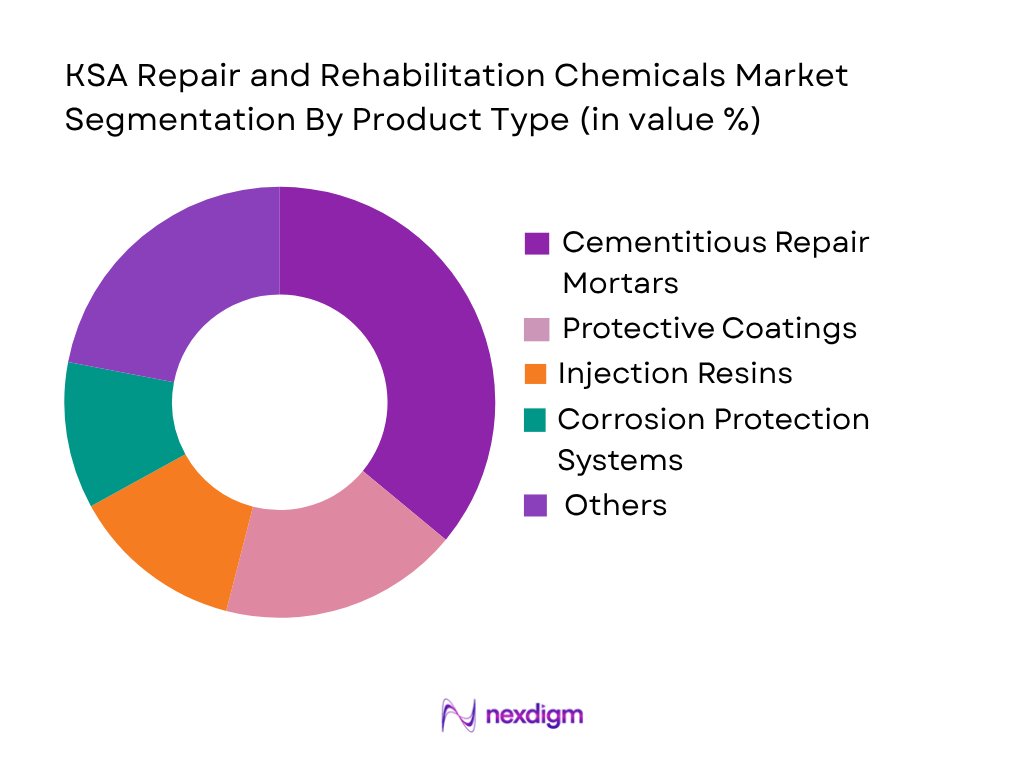
The KSA Repair and Rehabilitation Chemicals Market is segmented into cementitious repair mortars, protective coatings, injection resins, corrosion-protection systems, structural grouts, bonding agents and structural-strengthening materials. Cementitious repair mortars dominate this segmentation because they are extensively used for restoring spalled, cracked and deteriorated concrete across buildings, bridges, industrial facilities, ports and utility structures. Their compatibility with conventional concrete substrates and suitability for hand application, spray application and larger-volume reinstatement make them central to rehabilitation programs. Saudi Arabia’s exposure to high temperatures, chloride-laden marine environments and aggressive industrial conditions increases requirements for polymer-modified and fibre-reinforced mortar systems. Fosroc specifically identifies repair mortars, protective coatings and corrosion-control solutions for concrete rehabilitation and has documented their use at Jeddah Islamic Port. Sika similarly positions cementitious, polymer-modified and epoxy-based mortars for structural restoration, helping explain the segment’s broad adoption across Saudi repair applications.
By End-Use Sector
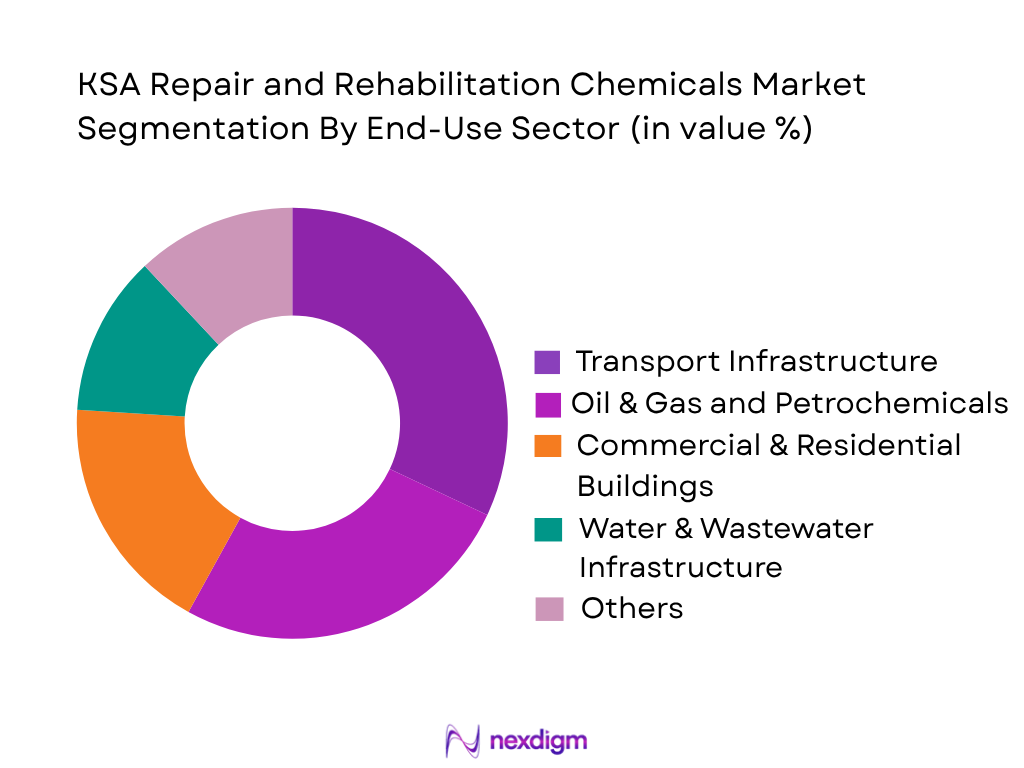
The KSA Repair and Rehabilitation Chemicals Market is segmented into transport infrastructure, oil and gas and petrochemicals, commercial and residential buildings, water and wastewater infrastructure, marine and ports, and government and institutional facilities. Transport infrastructure represents the leading end-use segment because Saudi Arabia maintains an extensive stock of roads, bridges, tunnels and associated reinforced-concrete assets exposed to thermal movement, abrasion, traffic loading and environmental deterioration. The Ministry of Transport and Logistic Services states that more than 60,000 kilometres of paved roads are covered by regular and preventive maintenance programs, demonstrating the scale of the underlying maintenance ecosystem. Repair chemicals are required for bridge decks, piers, expansion interfaces, concrete patching, crack injection and protective treatments. Continued urban mobility investment, airport infrastructure and large transport projects further expand the addressable rehabilitation base for cementitious repair mortars, injection technologies and corrosion-protection systems.
Competitive Landscape
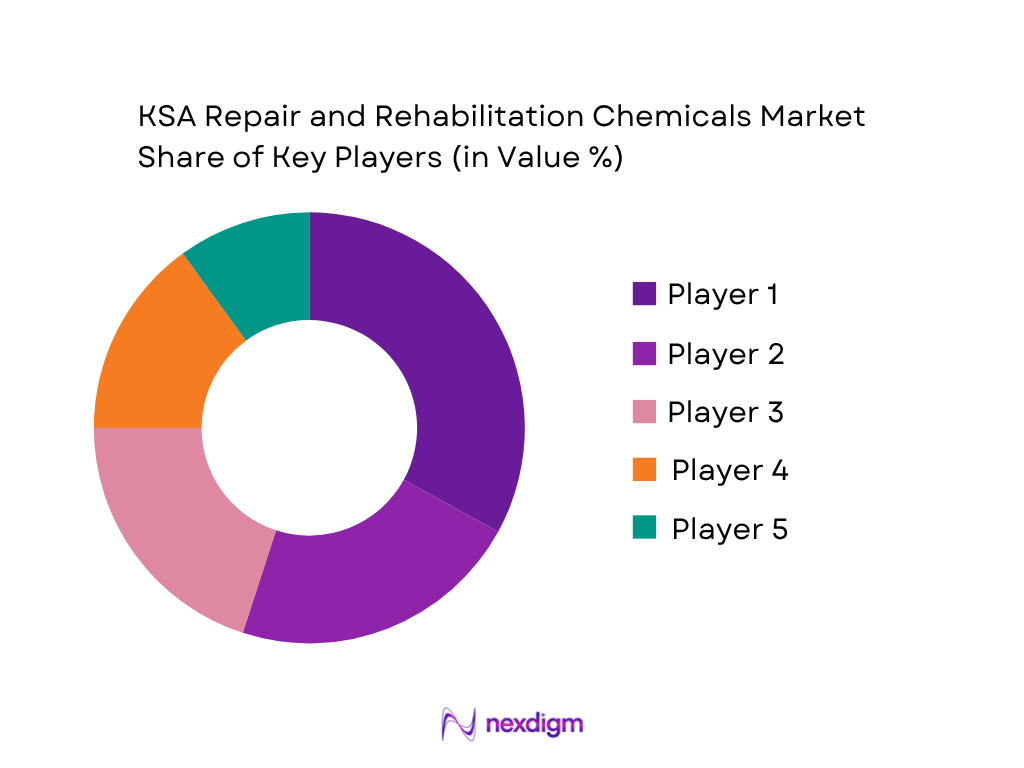
The KSA Repair and Rehabilitation Chemicals Market combines international construction-chemical specialists with established Saudi manufacturers. Sika and Fosroc compete through comprehensive concrete-repair, injection, corrosion-protection and strengthening systems; MAPEI has direct Saudi operations and concrete-restoration expertise; Saveto benefits from domestic manufacturing and a broad Saudi distribution footprint; and Saint-Gobain participates through its wider construction-chemicals platform. Competition is influenced by approved product specifications, technical support, local stock availability, contractor relationships, project references and the ability to supply integrated rehabilitation systems rather than individual repair products.
| Company | Established | Headquarters | Core Repair Systems | Crack Injection Capability | Corrosion Protection Capability | Structural Strengthening Capability | KSA Market Presence | Priority Applications |
| Sika AG | 1910 | Baar, Switzerland | ~ | ~ | ~ | ~ | ~ | ~ |
| Fosroc International | 1972 | Tamworth, United Kingdom | ~ | ~ | ~ | ~ | ~ | ~ |
| MAPEI Group | 1937 | Milan, Italy | ~ | ~ | ~ | ~ | ~ | ~ |
| Saveto Group | 1981 | Riyadh, Saudi Arabia | ~ | ~ | ~ | ~ | ~ | ~ |
| Saint-Gobain | 1665 | Courbevoie, France | ~ | ~ | ~ | ~ | ~ | ~ |
KSA Repair and Rehabilitation Chemicals Market Analysis
Growth Drivers
Expanding Infrastructure Maintenance and Rehabilitation Activity
Saudi Arabia’s expanding infrastructure maintenance workload is directly increasing requirements for cementitious repair mortars, injection resins, corrosion-control systems, protective coatings and structural-strengthening materials. In the Eastern Province alone, the government reported more than 6,700 km of roads under maintenance, including 551 km of highways, 2,306 km of dual carriageways and 3,878 km of single roads in 2025. The same program included 31 major rehabilitation projects covering more than 1,813 km of roads and 39 bridges, demonstrating the scale of concrete assets requiring restoration and preventive treatment. Nationally, the Roads General Authority commissioned 15 road projects covering 1,392 km during 2025. These activities increase recurring demand for concrete patch repair, bridge-deck rehabilitation, crack treatment, reinforcement protection and waterproofing chemicals. The macroeconomic environment provides additional support: World Bank data place Saudi Arabia’s 2024 GDP at US$1,239.8 billion and GDP per capita at US$35,121.7. The IMF subsequently recorded nominal non-oil GDP at SAR 3,511 billion for 2024, providing a substantial non-oil economic base supporting infrastructure construction, maintenance and asset-life-extension activity.
Growth of the Built Environment Expanding the Future Repair Base
Continuous expansion of Saudi Arabia’s urban built environment is enlarging the installed stock of structures that will require repair, protection and rehabilitation chemicals throughout their operating lives. The Ministry of Municipalities and Housing reported that 276,000 construction permits were issued through Baladi during 2024, alongside approximately 100,000 building-compliance certificates. This large flow of residential, commercial and institutional developments expands future demand for crack repair, concrete restoration, joint rehabilitation, waterproofing, corrosion protection and protective coatings as structures age and undergo periodic maintenance. Riyadh is especially relevant: the Royal Commission for Riyadh City launched a second group of 8 major road-development projects in 2025, while the Riyadh Infrastructure Projects Center coordinated more than 8,000 infrastructure projects across the region during the same year. These projects create both immediate defect-rectification requirements and a substantially larger future maintenance base. Macroeconomic conditions reinforce this trajectory. The IMF recorded Saudi nominal GDP at SAR 4,649 billion in 2024 and nominal non-oil GDP at SAR 3,511 billion, while the World Bank reported national GDP of US$1,239.8 billion. This scale of investment-intensive non-oil activity supports long-term demand for specialized rehabilitation chemistry.
Market Challenges
Increasing Technical Compliance and Repair Execution Requirements
The KSA Repair and Rehabilitation Chemicals Market faces growing execution complexity as infrastructure authorities strengthen technical controls covering planning, construction, inspection, quality assurance and maintenance. Riyadh’s Infrastructure Projects Code became mandatory in 2025 across an area of approximately 400,000 square kilometres, covering the capital and 22 surrounding governorates. The framework regulates 8 stages of the infrastructure lifecycle, extending from strategic definition through design, execution, operation and maintenance. For repair-chemical suppliers, this increases the importance of demonstrating correct substrate preparation, product compatibility, application methodology, curing procedures and long-term system performance rather than merely supplying standalone materials. This is particularly important for epoxy injection, corrosion inhibitors, repair mortars, CFRP strengthening and protective coatings where poor execution can compromise the complete rehabilitation system. The expanding scale of construction compounds this technical challenge: the Ministry of Municipalities and Housing recorded 276,000 construction permits in 2024, while more than 8,000 infrastructure projects were coordinated in Riyadh during 2025. Saudi Arabia simultaneously operated within a US$1,239.8 billion economy in 2024 according to the World Bank, increasing expectations for technically compliant, lifecycle-oriented infrastructure delivery and placing greater responsibility on manufacturers, approved applicators and specialist contractors.
Large and Geographically Dispersed Asset Base Raises Rehabilitation Complexity
Saudi Arabia’s extensive and geographically dispersed infrastructure creates a significant operational challenge for suppliers and specialist applicators of repair and rehabilitation chemicals. The Roads General Authority’s intercity network extends approximately 73,600 km, meaning inspection, material mobilization, specialist labour and maintenance scheduling must cover assets spread across very different operating environments. The Eastern Province alone contains a road network exceeding 7,000 km, 6 land border crossings and 5 seaports, while active maintenance programs cover more than 6,700 km and include repairs to 39 bridges. This distribution increases the logistical complexity of supplying temperature-sensitive resins, rapid-setting repair systems, injection materials and corrosion-control products to project sites while maintaining correct storage and application conditions. Rehabilitation specifications also differ between inland road assets, coastal bridges, marine structures, industrial facilities and urban concrete infrastructure. The challenge occurs within a large national economy: the World Bank recorded Saudi GDP of US$1,239.8 billion and GDP per capita of US$35,121.7 in 2024, while the IMF recorded nominal non-oil GDP of SAR 3,511 billion. The scale of economic activity therefore expands the asset base while simultaneously increasing the technical and logistical demands placed on repair-system suppliers. Saudi Press Agency
Market Opportunities
Water and Wastewater Infrastructure Creates a Long-Term Rehabilitation Opportunity
Saudi Arabia’s expanding water infrastructure creates a substantial future opportunity for repair mortars, waterproofing systems, injection resins, protective coatings and chemical-resistant rehabilitation materials. Saudi Water Partnership Company reported 15 projects under contract management, 4 projects under execution, 9 projects under tendering and 22 projects under planning in its 2024 sustainability reporting. Water-sector infrastructure is particularly demanding because reservoirs, treatment plants, pumping facilities and concrete water-retaining structures operate under permanent moisture exposure and require protection against leakage, cracking, chemical attack and reinforcement deterioration. SWPC’s project framework also included desalination developments with a combined listed capacity of 4.3 million cubic metres per day, demonstrating the physical scale of assets entering or progressing through the national water system. These assets will create recurring inspection and lifecycle-maintenance requirements beyond initial construction. Government fiscal support reinforces the opportunity: Saudi Arabia’s 2025 budget allocated SAR 87 billion to the economic-resources sector, which includes water, desalination and sewage infrastructure. The wider macroeconomic platform remains substantial, with World Bank data showing Saudi GDP of US$1,239.8 billion in 2024. For rehabilitation-chemical suppliers, the opportunity therefore lies in building approved systems for wet concrete, potable-water structures, wastewater exposure, crack injection and corrosion mitigation. Saudi Sports for World Cup
Transport and Urban Infrastructure Pipeline Expands Future Asset-Life-Extension Demand
Saudi Arabia’s continuing transport and urban infrastructure development creates a future pool of concrete assets that will require preventive protection and eventual rehabilitation. In Riyadh, the second group of the Main and Ring Road Axes Development Program commenced in 2025 with 8 projects, while the third group added 6 projects and the fourth group comprised 4 projects extending approximately 40 km, including 14 major interchanges, 33 bridges, 5 tunnels and 6 pedestrian bridges. Nationally, 15 road projects covering 1,392 km entered service during 2025. These structures significantly broaden the addressable base for future bridge-joint restoration, structural crack injection, concrete patch repair, anti-carbonation protection, reinforcement corrosion treatment and CFRP strengthening. The opportunity is supported by government expenditure capacity: Saudi Arabia’s 2025 budget provided SAR 42 billion for infrastructure and transportation and SAR 65 billion for municipal services. At the macro level, the World Bank reported 2024 GDP of US$1,239.8 billion, while the IMF recorded nominal non-oil GDP at SAR 3,511 billion. Repair-chemical suppliers that secure specifications during construction and establish approved-applicator networks can therefore position themselves for recurring lifecycle maintenance as this expanding infrastructure stock moves from construction into operation.
Future Outlook
The KSA Repair and Rehabilitation Chemicals Market is expected to expand at approximately ~X.X% CAGR during 2026–2035, supported by the increasing requirement to extend the operating life of Saudi Arabia’s concrete infrastructure. Demand is expected to shift toward integrated repair systems combining corrosion protection, repair mortar, protective coating and structural strengthening technologies. Marine infrastructure, transport assets, industrial plants, water facilities and ageing buildings are likely to create recurring rehabilitation requirements. Localization and stronger technical-service capabilities are also expected to become increasingly important competitive differentiators.
Saudi Arabia’s infrastructure base supports a long-duration maintenance opportunity because repair demand continues after initial project completion. The Ministry of Municipalities and Housing reported more than 276,000 construction permits issued through Baladi in 2024, while the construction sector generated SAR 470.6 billion in operating revenue. This expanding built environment increases the future stock of assets requiring inspection, preventive maintenance, concrete restoration and protection.
Major Players
- Sika Saudi Arabia
- Fosroc Saudi Arabia
- Saint-Gobain Construction Chemicals
- MAPEI Saudi Arabia / Bitumat
- Master Builders Solutions
- Saveto Group
- Saudi Vetonit Company
- Tremco CPG / RPM International
- Henkel
- H.B. Fuller
- Jotun
- Dow
- Pidilite Industries
- LATICRETE International
- CHRYSO / GCP Applied Technologies
Key Target Audience
- Repair and Rehabilitation Chemical Manufacturers
- Construction Chemical Importers and Distributors
- Specialist Concrete Repair and Structural Strengthening Contractors
- EPC Contractors and Infrastructure Developers
- Real Estate Developers and Industrial Asset Owners
- Oil, Gas, Petrochemical, Marine and Utility Operators
- Investments and Venture Capitalist Firms
- Government and Regulatory Bodies (Ministry of Municipalities and Housing, Ministry of Transport and Logistic Services, Saudi Standards, Metrology and Quality Organization, Saudi Building Code National Committee, Saudi Ports Authority)
Research Methodology
Step 1: Identification of Key Variables
The initial phase involves constructing an ecosystem map covering manufacturers, local formulators, importers, distributors, repair contractors, EPC firms, consultants and asset owners operating in the KSA Repair and Rehabilitation Chemicals Market. Secondary research identifies critical variables including chemical technology, repair application, structure type, end-user sector, distribution model and regional rehabilitation intensity.
Step 2: Market Analysis and Construction
Historical demand for cementitious repair mortars, injection systems, corrosion-protection products, grouts, protective coatings and strengthening systems is assessed using top-down and bottom-up methods. Infrastructure maintenance activity, construction output, existing concrete asset stock, product consumption intensity and supplier revenues are evaluated to develop the KSA Repair and Rehabilitation Chemicals Market model.
Step 3: Hypothesis Validation and Expert Consultation
Market hypotheses are validated through computer-assisted telephone interviews and direct discussions with repair-chemical manufacturers, distributors, structural repair contractors, applicators, engineers and procurement professionals. These consultations evaluate application patterns, product preference, competitive positioning, technical approval processes and regional demand, helping refine the assumptions used for the KSA Repair and Rehabilitation Chemicals Market.
Step 4: Research Synthesis and Final Output
Primary findings are triangulated with government construction statistics, infrastructure-maintenance information, manufacturer portfolios and project references. Top-down estimates are reconciled with product-level bottom-up calculations to establish a consistent market framework. The final output provides validated segmentation, competitive assessment and forecast direction for the KSA Repair and Rehabilitation Chemicals Market.

- Executive Summary
- Research Methodology (Market Definitions and Assumptions, KSA Repair and Rehabilitation Chemicals Market Classification, Cementitious Repair Mortar Scope, Epoxy Repair Compound Assessment, Polyurethane Repair System Assessment, Crack Injection Resin Assessment, Corrosion Protection System Assessment, Bonding Agent Assessment, Structural Grout Assessment, Protective Coating Assessment, Structural Strengthening Material Assessment, Surface Reprofiling Compound Assessment, Joint Repair System Assessment, Structural Concrete Restoration Assessment, Crack Repair Assessment, Reinforcement Corrosion Assessment, Waterproof Rehabilitation Assessment, Grouting and Anchoring Assessment, EN 1504 Concrete Repair Assessment, ASTM Concrete Repair Assessment, ACI Repair Guideline Assessment, SASO Product Compliance Assessment, SABER Conformity Assessment, Saudi Building Code Assessment, Product Approval Assessment, Substrate Compatibility Assessment, Marine Exposure Assessment, Industrial Chemical Exposure Assessment, Infrastructure Rehabilitation Assessment, Preventive Maintenance Assessment, Corrective Rehabilitation Assessment)

- Definition and Scope
- KSA Repair and Rehabilitation Chemicals Industry Evolution and Development of Cementitious Repair Mortars, Polymer-Modified Repair Mortars, Fibre-Reinforced Repair Mortars, Micro-Concrete, Rapid-Setting Repair Mortars, Epoxy Repair Compounds, Epoxy Injection Resins, Polyurethane Injection Resins, Acrylic Injection Resins, Reinforcement Primers, Migrating Corrosion Inhibitors, Galvanic Anodes, Cementitious Grouts, Epoxy Grouts, Anti-Carbonation Coatings, Epoxy Protective Coatings, Polyurethane Protective Coatings, Silane and Siloxane Impregnation, Carbon Fibre-Reinforced Polymer Systems, Structural Epoxy Adhesives, Surface Reprofiling Compounds and Flexible Joint Rehabilitation Systems
- Repair and Rehabilitation Chemicals Value Chain Analysis
- Repair and Rehabilitation Chemicals Supply Chain Analysis
- Cement Suppliers, Polymer Modifier Suppliers, Epoxy Resin Suppliers, Polyurethane Raw Material Suppliers, Acrylic Polymer Suppliers, Corrosion Inhibitor Suppliers, Fibre Reinforcement Suppliers, Mineral Filler Suppliers, Additive Suppliers, Packaging Suppliers, Repair Chemical Manufacturers, Local Blenders, Importers, Construction Chemical Distributors, Specialist Repair Contractors, Injection Contractors, Structural Strengthening Contractors, Marine Repair Contractors, Industrial Maintenance Contractors, EPC Contractors, General Contractors, Consultants, Infrastructure Authorities and Asset Owners

- Growth Drivers (Aging Concrete Infrastructure, Transport Infrastructure Rehabilitation, Marine and Chloride Exposure, Industrial and Petrochemical Maintenance, Water Infrastructure Rehabilitation, Building Refurbishment, Asset Life-Extension Requirements, Giga Project Maintenance Requirements, Structural Strengthening Demand, Government Infrastructure Maintenance Programs, Concrete Durability Requirements, Increasing Preventive Maintenance Adoption)
- Market Challenges (Shortage of Specialized Repair Applicators, Improper Surface Preparation, Product Compatibility Risks, Extreme Heat During Application, Rapid Moisture Loss, Chloride-Heavy Exposure Conditions, Imported Specialty Resin Dependence, Lengthy Product Approval Cycles, Price-Led Tendering, Inconsistent Preventive Maintenance, Application Failure Risk, Contractor Skill Gaps)
- Market Opportunities (Marine Rehabilitation Systems, Corrosion Mitigation Technologies, Structural Strengthening Systems, Crack Injection Systems, Industrial Shutdown Maintenance, Water Infrastructure Rehabilitation, Tunnel and Underground Repair, Local Repair Mortar Manufacturing, Specialty Epoxy Formulation, Polyurethane Injection Systems, Rapid-Cure Repair Materials, Low-Carbon Repair Mortars, Galvanic Corrosion Protection, Approved Applicator Network Expansion)
- Market Trends (Integrated Repair System Adoption, Polymer-Modified Repair Mortar Growth, Epoxy and Polyurethane Injection Adoption, CFRP Structural Strengthening, Galvanic Corrosion Protection, Hydrophobic Impregnation Systems, Rapid-Reinstatement Repair Materials)
- Government Regulations and Standards (Saudi Standards Metrology and Quality Organization Requirements, SABER Product Conformity Requirements, Saudi Building Code Requirements, Construction Material Product Certification, EN 1504 Concrete Repair Standards, ASTM Repair Material Standards, ACI Concrete Repair Guidelines)
- SWOT Analysis
- Porter’s Five Forces Analysis
- PESTLE Analysis
- Stakeholder Ecosystem
- Repair and Rehabilitation Chemicals Manufacturing, Distribution and Specialist Applicator Ecosystem

- By Market Value (2020-2025)
- By Repair Chemical Consumption Volume (2020-2025)
- By Cementitious Repair Mortar Consumption (2020-2025)
- By Epoxy Repair Compound Consumption (2020-2025)
- By Crack Injection Resin Consumption (2020-2025)
- By Corrosion Protection Chemical Consumption (2020-2025)
- By Structural Grout Consumption (2020-2025)
- By Protective Coating Consumption (2020-2025)
- By Structural Strengthening Material Consumption (2020-2025)
- By Concrete Restoration Chemical Consumption (2020-2025)
- By Waterproof Rehabilitation Chemical Consumption (2020-2025)
- By Marine Repair Chemical Consumption (2020-2025)
- By Industrial Rehabilitation Chemical Consumption (2020-2025)
- By Infrastructure Repair Chemical Consumption (2020-2025)

- By Product Type (In Value %)
Cementitious Repair Mortars
Polymer-Modified Repair Mortars
Fibre-Reinforced Repair Mortars
Micro-Concrete
Epoxy Repair Compounds
Crack Injection Resins
Corrosion Protection Systems
Bonding Agents
Structural Grouts
Protective Coatings
Structural Strengthening Materials
Surface Reprofiling Compounds
Joint Repair Systems
Waterproof Rehabilitation Systems
Other Specialty Repair Chemicals - By Chemical Technology (In Value %)
Cement-Based Systems
Epoxy-Based Systems
Polyurethane-Based Systems
Acrylic-Based Systems
Polymer-Modified Systems
Silane and Siloxane-Based Systems
Hybrid Repair Systems
Fibre-Reinforced Composite Systems
Other Specialty Chemical Systems - By Application (In Value %)
Structural Concrete Restoration
Crack Repair and Injection
Reinforcement Corrosion Control
Surface Reprofiling
Concrete Protection
Waterproof Rehabilitation
Structural Strengthening
Grouting and Anchoring
Joint Rehabilitation
Chemical-Resistance Restoration
Marine Concrete Repair
Tunnel and Underground Structure Repair
Bridge and Flyover Rehabilitation
Industrial Concrete Rehabilitation
Building Refurbishment - By End-Use Sector (In Value %)
Transport Infrastructure
Oil and Gas
Petrochemicals
Power and Utilities
Water and Wastewater
Residential Buildings
Commercial Buildings
Industrial and Manufacturing Facilities
Hospitality and Tourism
Marine and Ports
Government and Institutional Buildings
Airports
Tunnels and Underground Structures
Religious and Pilgrimage Infrastructure
Mega and Giga Projects - By Failure Mechanism (In Value %)
Reinforcement Corrosion
Chloride Attack
Sulphate and Chemical Attack
Carbonation
Water Ingress
Concrete Cracking
Honeycombing and Voids
Abrasion and Erosion
Impact Damage
Structural Overloading
Thermal Movement and Shrinkage
Marine Exposure Deterioration
Industrial Chemical Exposure - By Region (In Value %)
Riyadh and Central Region
Jeddah and Western Region
Makkah Region
Madinah Region
Dammam and Eastern Province
Jubail and Industrial Eastern Corridor
Northern Region
Southern Region
Red Sea Development Corridor
NEOM and Northwest Development Corridor

- Market Share of Major Players (By KSA Revenue, Repair Chemical Consumption Volume, Cementitious Repair Mortar Portfolio, Epoxy Repair Portfolio, Injection Resin Portfolio, Corrosion Protection Portfolio, Protective Coating Portfolio, Structural Strengthening Portfolio, Marine Rehabilitation Exposure, Infrastructure Rehabilitation Exposure, Industrial Maintenance Exposure, Local Manufacturing Capacity, Distribution Coverage, Approved Applicator Network, Technical Support Capability)
- Cross Comparison Parameters (Concrete Repair and Rehabilitation Product Portfolio Breadth, Local Manufacturing and Blending Capability in KSA, Government EPC and Consultant Product Approvals, Specialist Repair Contractor and Approved Applicator Network, Marine Transport and Industrial Rehabilitation Project References, Crack Injection and Water-Stopping Technology Capability, Reinforcement Corrosion Protection and Concrete Protection Portfolio, CFRP and Structural Strengthening System Capability)
- SWOT Analysis of Major Players
- Competitive Positioning Matrix
- Major Companies
Sika Saudi Arabia
Fosroc Saudi Arabia
Saint-Gobain Construction Chemicals
MAPEI Saudi Arabia / Bitumat
Master Builders Solutions
Saveto Group
Saudi Vetonit Company
Tremco CPG / RPM International
Henkel
H.B. Fuller
Jotun
Dow
Pidilite Industries
LATICRETE International
CHRYSO / GCP Applied Technologies

- Government Infrastructure Authority Requirement Assessment
- Oil and Gas Operator Requirement Assessment
- Petrochemical Facility Requirement Assessment
- Marine and Port Operator Requirement Assessment
- Water and Wastewater Utility Requirement Assessment
- EPC Contractor Procurement Assessment
- Specialist Repair Contractor Requirement Assessment
- Structural Strengthening Contractor Requirement Assessment
- Consultant and Structural Engineer Specification Assessment
- Real Estate Developer Requirement Assessment
- Industrial Maintenance Contractor Requirement Assessment
- Technical Service and Application Training Requirement Assessment

- By Market Value (2026-2035)
- By Repair Chemical Consumption Volume (2026-2035)
- By Cementitious Repair Mortar Consumption (2026-2035)
- By Epoxy Repair Compound Consumption (2026-2035)
- By Crack Injection Resin Consumption (2026-2035)
- By Corrosion Protection Chemical Consumption (2026-2035)
- By Structural Grout Consumption (2026-2035)
- By Protective Coating Consumption (2026-2035)
- By Structural Strengthening Material Consumption (2026-2035)
- By Concrete Restoration Chemical Consumption (2026-2035)
- By Waterproof Rehabilitation Chemical Consumption (2026-2035)
- By Marine Repair Chemical Consumption (2026-2035)
- By Industrial Rehabilitation Chemical Consumption (2026-2035)
- By Infrastructure Repair Chemical Consumption (2026-2035)


 Request a Sample
 Ask for Customization
 Get a Quote
 Enquire Now
