
 Download PDF
Market Overview
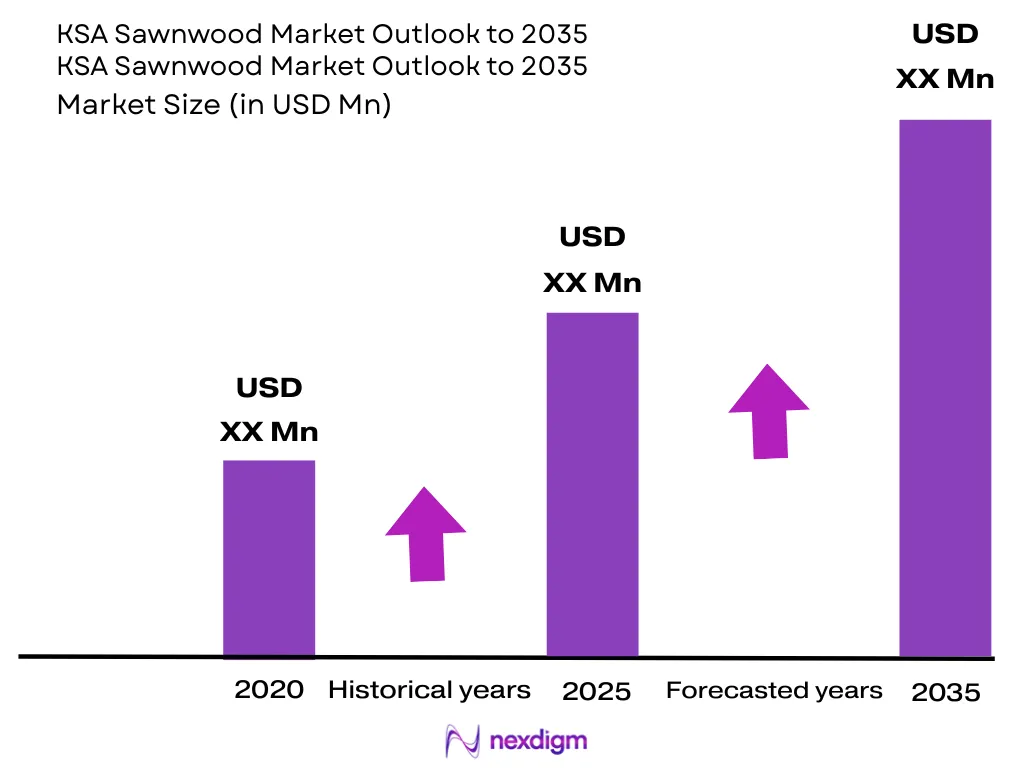
The KSA Sawnwood Market was valued at approximately USD ~ Million in 2024, reflecting the Kingdom of Saudi Arabia’s position as the largest single timber-consuming market in the GCC and Arab world, driven by one of the most ambitious national transformation programmes ever undertaken by a sovereign government. According to data published by the Food and Agriculture Organization, the Saudi General Authority for Statistics, and the Saudi Customs Authority, the Kingdom is entirely dependent on sawnwood imports to satisfy domestic demand, sourcing structural and appearance-grade timber from Scandinavia, the Baltic states, Brazil, Chile, New Zealand, Canada, and Southeast Asia. Saudi Arabia possesses no commercially harvestable forestland, with the country’s arid desert climate and limited rainfall precluding viable commercial timber cultivation at meaningful scale. The sawnwood market is fundamentally shaped by the Kingdom’s Vision 2030 economic transformation programme, which has unleashed an unprecedented wave of construction and development activity through giga-projects including NEOM, the Red Sea Project, Qiddiya, Diriyah Gate, Amaala, and the expansion of the Grand Mosque in Makkah and the Prophet’s Mosque in Madinah. These projects, combined with the National Housing Programme targeting delivery of millions of new residential units, rapid urbanisation, tourism and hospitality infrastructure investment, and a growing domestic fit-out and interior design sector, collectively position Saudi Arabia as one of the world’s most significant and fastest-growing timber-consuming markets over the forecast period.
Market Segmentation
By Wood Species Type
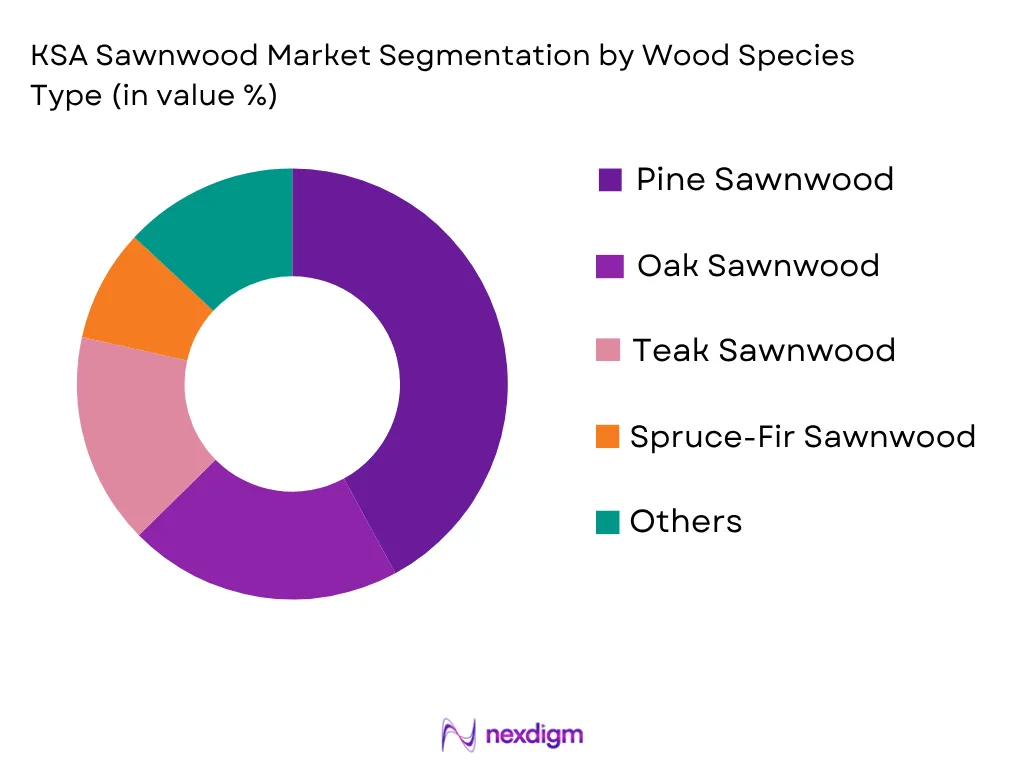
KSA Sawnwood Market is segmented by wood species type into Pine Sawnwood, Oak Sawnwood, Teak Sawnwood, Spruce-Fir Sawnwood, Tropical Hardwood Sawnwood, and Other Commercial Species. Pine Sawnwood holds the dominant market share by volume, driven by its versatility, cost-effectiveness, and availability from established supply origins including Scandinavia, the Baltic states, Brazil, Chile, and New Zealand. Construction-grade pine lumber is the foundational structural and temporary works timber across Saudi Arabia’s enormous residential, commercial, and infrastructure construction sector, consumed in formwork, hoarding, scaffolding decking, roof structure, interior framing, and pallet manufacturing applications at massive volumes corresponding to the scale of the Kingdom’s construction pipeline. Saudi Arabia’s housing programme, delivering hundreds of thousands of new residential units annually under the National Housing Company and Sakani programme platforms, generates particularly large and consistent demand for affordable structural pine suitable for roof trusses, door and window frames, and interior woodwork. Kiln-dried and pressure-treated pine products are increasingly specified for applications requiring dimensional stability in the Kingdom’s extreme desert climate, where ambient temperature fluctuations and very low humidity levels can cause rapid moisture loss and dimensional movement in improperly seasoned timber. Oak Sawnwood commands the highest unit value in the KSA market, driven by strong and growing demand from luxury residential villa developments in Riyadh’s premium districts, high-end hospitality projects along the Red Sea and in major cities, giga-project interior specification programmes, and an increasingly sophisticated domestic design and fit-out market that favours European hardwood species for custom joinery, wall panelling, flooring, and bespoke furniture applications.
By End-Use Industry
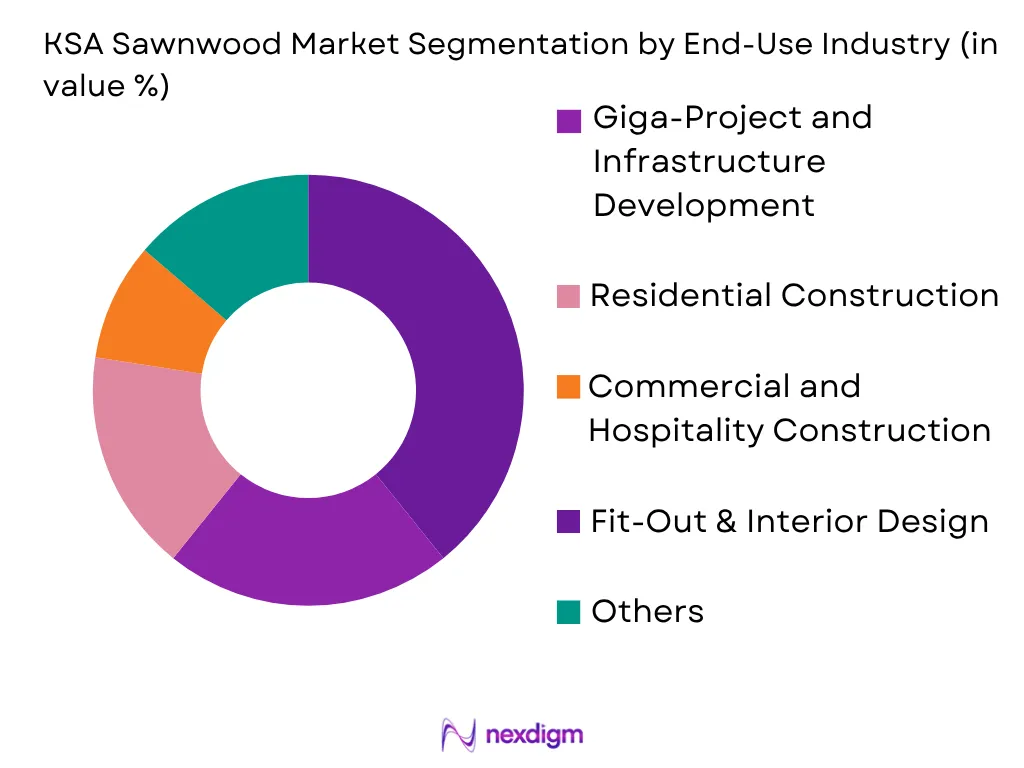
KSA Sawnwood Market is segmented by end-use industry into Residential Construction, Commercial and Hospitality Construction, Giga-Project and Infrastructure Development, Fit-Out and Interior Design, Furniture Manufacturing, and Packaging & Pallets. Giga-Project and Infrastructure Development represents the most strategically significant and value-intensive segment, reflecting the unparalleled scale of Saudi Arabia’s Vision 2030 mega-project pipeline, which collectively represents trillions of riyals of committed capital investment and generates demand for enormous volumes of structural, formwork, finishing, and specification-grade sawnwood over extended multi-year construction programmes. NEOM alone, envisioned as a futuristic smart city development spanning 26,500 square kilometres in northwest Saudi Arabia, encompasses THE LINE linear city, SINDALAH island resort, OXAGON floating industrial city, and TROJENA mountain resort, each requiring substantial timber inputs across formwork, temporary works, interior fit-out, and permanent structural and finishing applications. The Red Sea Project’s luxury eco-resort island developments, Diriyah Gate’s heritage district restoration and new-build programme, Qiddiya’s entertainment city, and Amaala’s ultra-luxury wellness resort collectively generate high-specification timber demand for premium interior applications, bespoke joinery, and outdoor decking and landscaping structures. Residential Construction is the largest segment by volume, driven by the Sakani National Housing Programme’s ambitious unit delivery targets, private residential villa and apartment development across Riyadh, Jeddah, Dammam, and secondary cities, and strong underlying demand from Saudi Arabia’s young and growing population structure, with a median age below 30 years generating sustained household formation and homeownership demand.
Competitive Landscape
The KSA Sawnwood Market is characterised by a fully import-dependent, trading-oriented competitive structure with no domestic timber production, operating at a substantially larger scale than other GCC markets owing to the Kingdom’s population size, economic scale, and transformational Vision 2030 construction activity. Market participants consist of specialist timber importers and distributors, large conglomerate building materials divisions, giga-project supply chain contractors, economic zone-based wood processing operators, and a substantial retail timber merchant sector serving small contractors and individual buyers across the Kingdom’s major cities. Riyadh, Jeddah, and Dammam function as the primary commercial centres for timber trading, with large warehouse and distribution operations supplying regional networks of builders’ merchants, hardware retailers, and direct industrial customers. Companies with pre-qualified supplier status for major Vision 2030 giga-projects, established relationships with the National Housing Company and Sakani programme developers, and compliance with Saudi Building Code and SASO timber quality standards hold strong competitive positioning in the Kingdom’s most strategically important procurement channels. FSC and PEFC certification credentials are growing in importance as Saudi Arabia’s Saudi Green Initiative and alignment with COP28 sustainability commitments drive greater specification of responsibly sourced timber in government-funded and premium private construction programmes.
| Company | Establishment Year | Headquarters | Plantation Assets | Sawmill Capacity | FSC/PEFC Certification | Export Presence | Product Portfolio | End-Use Focus |
| Saudi Wooden Industries Co. | 1978 | ~ | ~ | ~ | ~ | ~ | ~ | ~ |
| Al-Yamamah Steel Industries (Timber Div.) | 1975 | ~ | ~ | ~ | ~ | ~ | ~ | ~ |
| Alsorayai Group (Timber Division) | 1978 | ~ | ~ | ~ | ~ | ~ | ~ | ~ |
| National Timber & Building Materials Co. | 1980 | ~ | ~ | ~ | ~ | ~ | ~ | ~ |
| Arabian Wood & Timber Trading Co. | 1985 | ~ | ~ | ~ | ~ | ~ | ~ | ~ |
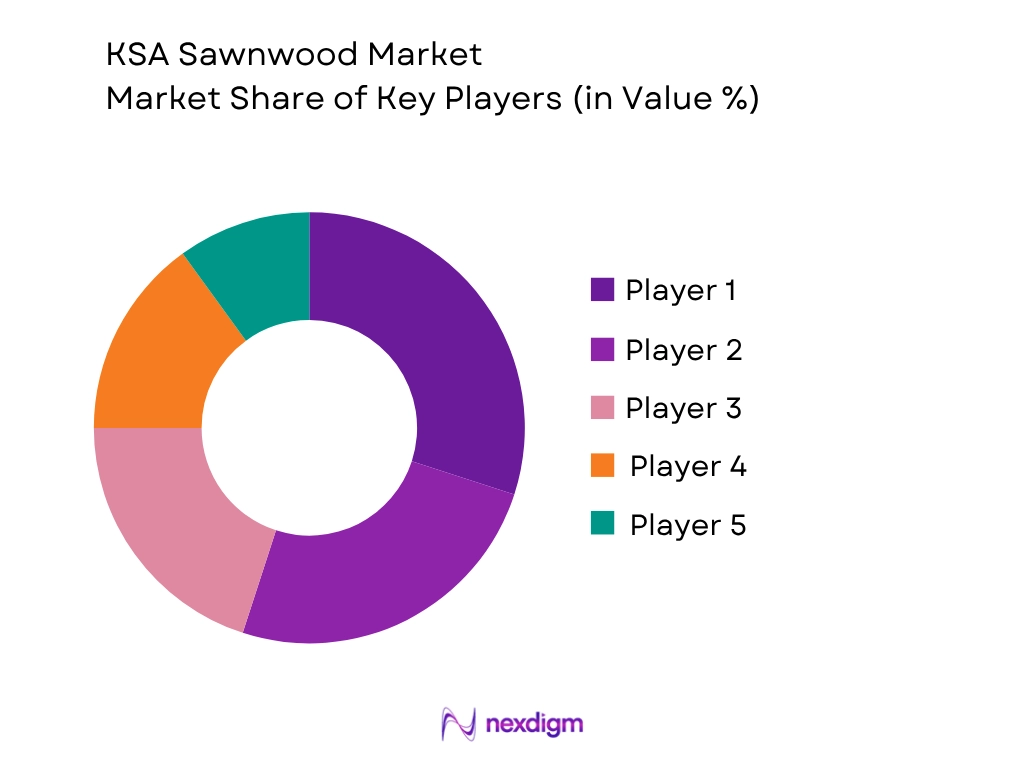
KSA Sawnwood Market Analysis
Growth Drivers
Vision 2030 Giga-Project Pipeline and Unprecedented Construction Activity
Saudi Arabia’s Vision 2030 national transformation programme represents the single most powerful structural driver of sawnwood market growth in the Kingdom, unleashing an unprecedented wave of construction investment across tourism, entertainment, residential, commercial, cultural, and infrastructure development that collectively positions the KSA as one of the world’s most significant timber-consuming growth markets over the forecast period. The Public Investment Fund (PIF) has committed multi-trillion riyal investment packages to giga-projects spanning the entire country, each generating sustained and large-scale demand for structural, formwork, appearance-grade, and specialist sawnwood products throughout their multi-year construction and fit-out phases. NEOM’s THE LINE alone, designed to house nine million residents in a 170-kilometre linear mirrored city, requires enormous quantities of construction timber across formwork, temporary works infrastructure, and permanent structural and interior applications over its extended development timeline. The Red Sea Project’s 50 luxury island and inland resort developments, targeting ultra-high-net-worth international tourists and specifying premium timber finishes in bungalow, villa, and resort facility construction, generate disproportionately high-value sawnwood procurement requirements relative to development area. Diriyah Gate’s restoration and new-build of 20 districts across a 14-square-kilometre heritage zone incorporates extensive timber specification in traditional Najdi architectural elements, interior fit-out, and landscaping. Qiddiya’s entertainment city, designed to become the world’s largest entertainment destination, and Amaala’s Triple Bay luxury wellness resort collectively add further timber demand through theme park structures, hospitality construction, and high-specification interior programmes. The aggregate construction timber demand generated by Vision 2030 giga-projects is expected to represent a transformational uplift to KSA sawnwood import volumes and market value through the forecast period, establishing Saudi Arabia as a priority market for international timber suppliers, trading companies, and port logistics operators.
National Housing Programme and Residential Construction Demand
Saudi Arabia’s National Housing Programme, operating through the Sakani platform and the National Housing Company (NHC), represents a second major structural pillar of sawnwood market demand, targeting the delivery of hundreds of thousands of new residential units annually to address the Kingdom’s housing needs arising from a young, rapidly growing population and rising homeownership aspirations among Saudi citizens. The Saudi government has committed to raising the national homeownership rate to 70% under Vision 2030 targets, up from historical levels in the low-to-mid 60% range, requiring sustained acceleration in residential unit delivery across Riyadh, Jeddah, Makkah, Madinah, Dammam, and secondary cities. Housing programme developments consume substantial volumes of structural pine for roof systems, door and window frames, interior woodwork, and formwork, while the growing penetration of prefabricated construction methods and modular building systems is increasing the specification of precision-cut, kiln-dried, and engineered timber products. Private residential development in Riyadh’s expanding premium districts including Al Qiddiya, Diriyah suburbs, and King Salman District, Jeddah’s Red Sea waterfront developments, and the Eastern Province’s villa communities generates additional demand for appearance-grade and high-specification timber in custom joinery, flooring, and interior fit-out applications. Saudi Arabia’s demographic profile, with approximately 60% of the population under 35 years of age and strong household formation dynamics, ensures that residential construction will remain a robust and sustained sawnwood demand driver across the forecast horizon regardless of short-term economic fluctuations.
Market Challenges
Complete Import Dependency and Supply Chain Vulnerability
The KSA sawnwood market faces a fundamental structural challenge arising from the Kingdom’s complete absence of domestic timber production, making it entirely reliant on international supply chains for every cubic metre of sawnwood required to support one of the world’s most ambitious construction programmes. Saudi Arabia’s arid desert environment, characterised by extremely low annual rainfall averaging below 100 millimetres across most of the country, high summer temperatures exceeding 50 degrees Celsius in some regions, and alkaline desert soils, precludes the development of commercially viable plantation forestry at meaningful scale. This total import dependency exposes the sawnwood market to a broad spectrum of external risk factors that are entirely beyond domestic control, including international freight rate cycles, vessel availability constraints, port congestion at origin terminals in Scandinavia, the Baltic states, Brazil, and New Zealand, geopolitical disruptions affecting key supply corridors, and trade policy changes by exporting nations. The extraordinary freight rate escalations of 2021 and 2022, when global container shipping rates reached multiples of historical averages, imposed severe cost pressures on Saudi timber importers, many of whom operate on relatively thin trading margins and face price-sensitive buyers in a competitive domestic market. Supply chain disruptions arising from the Red Sea shipping security situation, with Houthi attacks on commercial vessels forcing rerouting of container ships around the Cape of Good Hope and adding substantially to shipping times and costs for imports transiting the Suez Canal route, directly impact the cost and lead time of timber shipments to Jeddah Islamic Port and King Abdulaziz Port in Dammam. Systematic supply chain diversification, strategic inventory management, and procurement partnership development across multiple origins are essential risk management imperatives for KSA timber market participants.
Harsh Climate Conditions and Timber Storage and Handling Challenges
Saudi Arabia’s extreme desert climate creates distinctive and demanding conditions for sawnwood storage, handling, and performance in construction and interior applications that require careful material specification, acclimatisation management, and supply chain design to mitigate. The Kingdom’s very low relative humidity levels, particularly in inland regions including Riyadh and the Northern Borders, combined with intense solar radiation and wide diurnal temperature ranges, create conditions that cause rapid moisture loss, dimensional movement, surface checking, and degradation in improperly seasoned or protected sawnwood. Kiln-dried timber specified to appropriate equilibrium moisture content levels for Saudi interior environments, typically in the range of 6% to 9%, is essential for avoiding post-installation movement, joint opening, and finish cracking in high-specification fit-out and joinery applications. Open-air storage of sawnwood at construction sites and timber yards without adequate shading, covering, and stacking practices results in rapid solar degradation, end-checking, and surface bleaching that reduces product quality and customer satisfaction. Treated timber products, particularly those intended for outdoor, landscape, and ground-contact applications in the Kingdom’s harsh UV and heat environment, require appropriate preservative treatment specifications that differ from those used in temperate climates. Humidity-controlled warehouse storage, rapid transit from port to covered stockyard, and comprehensive product acclimatisation guidance for contractors and end users represent operational requirements that add cost and complexity to KSA sawnwood supply chain management relative to more temperate market environments. These climate-specific challenges elevate the importance of experienced and technically capable timber importers and distributors who understand the Kingdom’s unique material specification and handling requirements.
Market Opportunities
Saudi Green Initiative and Certified Sustainable Timber Specification Growth
Saudi Arabia’s Saudi Green Initiative, launched by Crown Prince Mohammed bin Salman in 2021, and the Kingdom’s hosting of COP16 biodiversity talks alongside its active participation in international climate frameworks, are progressively elevating the profile of sustainable construction materials and certified timber products in government and premium private construction procurement across the Kingdom. The Saudi Green Initiative’s targets, including planting 10 billion trees within Saudi Arabia and 40 billion trees regionally under the Middle East Green Initiative, reflect a broader governmental commitment to environmental sustainability that is translating into growing specification preference for certified, responsibly sourced timber in Vision 2030 projects and government infrastructure programmes. The Saudi Green Building Forum’s promotion of LEED, BREEAM, and Mostadam green building rating systems across the Kingdom’s construction sector creates specific procurement incentives for FSC and PEFC certified sawnwood with documented chain-of-custody verification, particularly in commercial, hospitality, and institutional construction projects targeting sustainability certification. Giga-project developers including NEOM, Red Sea Global, and Diriyah Gate Development Authority have each made high-profile sustainability commitments incorporating responsible material sourcing requirements that extend to timber supply chains. As Saudi Arabia’s construction sector continues to professionalise and align with international ESG and sustainability standards driven by foreign investor requirements, sovereign wealth fund governance frameworks, and Vision 2030 reputational objectives, demand for certified and sustainably documented sawnwood is expected to grow substantially, creating premium market positioning opportunities for certified European, North American, and Australasian timber suppliers serving the Kingdom.
Giga-Project Supply Chain Integration and Value-Added Processing in Economic Zones
Saudi Arabia’s network of Special Economic Zones (SEZs) and industrial cities, developed under the National Industrial Development and Logistics Programme (NIDLP) and managed by the Saudi Authority for Industrial Cities and Technology Zones (MODON), presents a significant opportunity for establishing value-added timber processing operations within the Kingdom that can supply giga-project, construction, and furniture manufacturing customers from locally processed inventories. King Abdullah Economic City (KAEC) near Jeddah, NEOM’s industrial zones, the Ras Al Khair Industrial City, and Jazan Economic City each offer industrial land, utility infrastructure, logistics connectivity, and fiscal incentives that could support the establishment of timber treatment, kiln-drying, precision sawing, finger-jointing, and engineered wood manufacturing operations. Localising value-added timber processing within Saudi Arabia’s economic zone framework would reduce finished product import lead times, enable rapid response to construction project requirements, create Saudisation-compliant employment, and satisfy IKTVA localisation content targets increasingly required in government and giga-project procurement contracts. The scale of Vision 2030 construction demand provides a viable volume foundation for investment in dedicated sawmill and wood processing facilities serving the Kingdom’s timber supply chain, particularly for dimension-specific structural products, treated timber, and specialty construction timber items that currently require lengthy import lead times from overseas producers. Development of Saudi-based timber processing capabilities aligned with giga-project supply chain integration requirements and government localisation policies represents a strategically significant opportunity for both domestic investors and international timber industry participants seeking long-term market positioning in the Kingdom.
Future Outlook
The KSA Sawnwood Market is expected to witness strong and sustained growth over the forecast period, driven by the continued execution of Vision 2030 giga-projects generating transformational construction timber demand, the National Housing Programme’s residential unit delivery targets, rapid urbanisation and population growth sustaining private construction activity, and the progressive development of the Kingdom’s tourism and hospitality infrastructure sector. Saudi Arabia’s commitment to the Saudi Green Initiative and international sustainability frameworks is expected to drive growing specification of certified, FSC and PEFC verified timber products in government, giga-project, and premium private construction procurement channels. The development of value-added timber processing operations within Saudi Arabia’s Special Economic Zones, supported by government localisation incentives and Vision 2030 industrial development objectives, is anticipated to progressively reduce dependence on finished product imports and improve supply chain responsiveness to the Kingdom’s enormous construction demand base. Diversification of import sourcing origins, strategic inventory management improvements, and digital timber procurement platform development are expected to strengthen supply chain resilience and procurement efficiency for KSA market participants. Saudi Arabia’s emergence as the Arab world’s most significant timber-consuming growth market is anticipated to attract increased investment from international timber suppliers, logistics operators, and wood processing investors seeking long-term commercial positioning in one of the global construction industry’s most dynamic and well-funded development environments through 2035.
Major Players
- Saudi Wooden Industries Co.
- Al-Yamamah Steel Industries (Timber Division)
- Alsorayai Group (Timber Division)
- National Timber & Building Materials Co.
- Arabian Wood & Timber Trading Co.
- Al Tamimi Group (Building Materials Division)
- Saudi Building Materials Company (SBMC)
- Al Rajhi Building Materials
- Haji Hussein Alireza & Co. (Timber Division)
- Bin Laden Group (Construction Materials)
- Al Fozan Group (Building Materials)
- Almabani General Contractors (Timber Supply)
- Gulf Timber Trading Co.
- Jeddah Wood & Timber Co.
- Riyadh Timber & Lumber Co.
Key Target Audience
- Timber Importers, Distributors and Trading Companies
- Wood Processing and Treatment Enterprises (Economic Zone-Based)
- Furniture Manufacturing Companies
- Residential, Commercial, Hospitality and Giga-Project Construction Companies
- Fit-Out Contractors and Interior Design Firms
- Investments and Venture Capitalist Firms
- Government and Regulatory Bodies (Ministry of Municipal and Rural Affairs, Saudi Authority for Industrial Cities and Technology Zones (MODON), National Housing Company, Saudi Customs Authority, Saudi Standards, Metrology and Quality Organisation (SASO), Public Investment Fund (PIF))
- Giga-Project Procurement Teams and Vision 2030 Supply Chain Partners
Research Methodology
Step 1: Identification of Key Variables
The initial phase involves constructing an ecosystem map covering timber importers, economic zone-based processors, building material distributors, construction contractors, fit-out firms, giga-project procurement functions, furniture manufacturers, and government regulatory bodies operating within the KSA Sawnwood Market. Extensive secondary research is conducted using industry associations, trade databases, customs data, and government publications including data from the Saudi General Authority for Statistics, Saudi Customs Authority, Ministry of Municipal and Rural Affairs, National Housing Company, Saudi Authority for Industrial Cities and Technology Zones (MODON), and the Food and Agriculture Organization to identify variables influencing market demand, import trade flows, and giga-project procurement dynamics within the Kingdom’s fully import-dependent timber economy.
Step 2: Market Analysis and Construction
This phase focuses on gathering historical information relating to sawnwood import volumes and values by origin country and species, domestic consumption patterns across construction and industrial end uses, pricing trends by species and grade, and demand projections linked to Vision 2030 project execution timelines and national housing programme delivery schedules. Market revenues are estimated using a combination of customs import data, average landed prices, distribution margins, and end-use consumption assessments while validating relationships between construction activity indicators, government project pipelines, and timber import volume trends.
Step 3: Hypothesis Validation and Expert Consultation
Market assumptions are validated through structured interviews with timber import traders, construction material distributors, fit-out contractors, giga-project supply chain managers, economic zone operators, logistics specialists, and Saudi timber industry association representatives. These consultations provide operational insights regarding import sourcing strategies, pricing dynamics, species demand evolution, certification requirements, Vision 2030 project timber procurement volumes, Saudisation and IKTVA compliance approaches, and supply chain investment opportunities, ensuring greater accuracy of market estimates within the KSA’s unique and rapidly evolving timber market context.
Step 4: Research Synthesis and Final Output
The final stage integrates findings from primary and secondary research to develop market forecasts, segmentation analysis, competitive benchmarking, and strategic recommendations. Data triangulation techniques are applied to validate market estimates and generate a comprehensive assessment of the KSA Sawnwood Market while ensuring consistency across all segments, regions, and stakeholder perspectives within this strategically critical and high-growth Middle East timber consuming economy.

- Executive Summary
- Research Methodology (Market Definitions and Assumptions, Abbreviations, Market Sizing Approach, Top-Down Analysis, Bottom-Up Analysis, Demand-Side Assessment, Supply-Side Assessment, Primary Industry Interviews, Forestry Sector Validation Framework, Trade Flow Assessment, Data Triangulation, Forecasting Framework, Limitations and Future Conclusions)

- Definition and Scope
- Market Evolution and Industry Genesis
- Timeline of Major Industry Developments
- Timber Trade and Wood Processing Industry Ecosystem
- Sawnwood Value Chain Analysis

- Growth Drivers (Vision 2030 Giga-Project Pipeline, Residential Construction and Housing Programme Demand, Fit-Out and Interior Design Sector Growth, Tourism and Hospitality Infrastructure Investment, Population Growth and Urbanisation)
- Market Challenges (Complete Import Dependency, Freight and Logistics Cost Volatility, Harsh Climate Storage and Handling Requirements, Price-Sensitive Procurement Culture, Competition from Engineered Wood and Composite Alternatives)
- Market Opportunities (Green Building Certification and Sustainable Timber Specification, Giga-Project Supply Chain Integration, Value-Added Wood Processing in Economic Zones, Digital Timber Procurement Platforms, GCC Regional Supply Hub Development)
- Market Trends (FSC-Certified Timber Specification Growth, Kiln-Dried and Treated Lumber Preference, Prefabricated Construction Timber Demand, Luxury Hospitality Wood Specification, Saudi Green Initiative Material Alignment)
- Government Regulations (Saudi Building Code, Saudisation and IKTVA Localisation Requirements, Saudi Standards, Metrology and Quality Organisation (SASO) Timber Standards, Ministry of Municipal and Rural Affairs Construction Regulations, Saudi Green Building Forum Guidelines)
- SWOT Analysis
- Porter’s Five Forces Analysis
- PESTLE Analysis
- Stakeholder Ecosystem
- Competition Ecosystem

- By Market Value (2020-2025)
- By Volume (2020-2025)
- By Average Realized Price (2020-2025)

- By Wood Species Type (In Value %)
Pine Sawnwood
Oak Sawnwood
Teak Sawnwood
Spruce-Fir Sawnwood
Tropical Hardwood Sawnwood
Other Commercial Wood Species - By Product Form (In Value %)
Rough Sawn Lumber
Planed Sawnwood
Kiln-Dried Sawnwood
Treated Sawnwood
Structural Sawn Timber
Appearance Grade Lumber - By End-Use Industry (In Value %)
Residential Construction
Commercial and Hospitality Construction
Giga-Project and Infrastructure Development
Fit-Out and Interior Design
Furniture Manufacturing
Packaging and Pallets - By Distribution Channel (In Value %)
Direct Sales to Construction and Fit-Out Contractors
Timber Traders and Wholesalers
Building Material Distributors
Retail Timber Merchants and Hardware Stores
Government and Giga-Project Procurement - By Region (In Value %)
Riyadh Region
Makkah Region (Jeddah and Mecca)
Eastern Province (Dammam, Al Khobar, Dhahran)
Madinah Region
Remaining Regions

- Market Share of Major Players (By Value, Import Volume, Distribution Reach, Processing Capacity)
- Cross Comparison Parameters (Annual Sawnwood Import Volume, Warehouse and Processing Capacity, Kiln Drying Capability, FSC/PEFC Certified Timber Share, Giga-Project Supply Revenue Share, Number of Distribution Facilities, Product Grade Portfolio, Economic Zone Presence)
- SWOT Analysis of Major Players
- Benchmarking Analysis of Major Players
- Pricing Analysis (By Species, Grade, Moisture Content, Thickness, Import Origin and Domestic Distribution Margins)
- Detailed Profiles of Major Companies
Saudi Wooden Industries Co.
Al-Yamamah Steel Industries (Timber Division)
Alsorayai Group (Timber Division)
National Timber & Building Materials Co.
Arabian Wood & Timber Trading Co.
Al Tamimi Group (Building Materials Division)
Saudi Building Materials Company (SBMC)
Al Rajhi Building Materials
Haji Hussein Alireza & Co. (Timber Division)
Bin Laden Group (Construction Materials)
Al Fozan Group (Building Materials)
Almabani General Contractors (Timber Supply)
Gulf Timber Trading Co.
Jeddah Wood & Timber Co.
Riyadh Timber & Lumber Co.

- Consumption Pattern Assessment (Consumption Frequency, Product Mix, Industry Demand Share, Volume Utilisation, Seasonal Demand)
- Sawnwood Utilisation by Industry (Construction Usage, Giga-Project Procurement Share, Fit-Out and Interior Sector Consumption, Furniture Manufacturing Demand, Packaging Applications)
- Procurement and Sourcing Analysis (Contract Duration, Supplier Preference, Import Sourcing Origins, Procurement Volume, Lead Time Requirements)
- Buyer Preference Analysis (Species Preference, Grade Preference, Moisture Requirements, Certification Requirements, Delivery Expectations)
- Price Sensitivity Analysis (Price Elasticity, Grade-Based Pricing, Regional Price Variations, Volume Discounts, Giga-Project Contract Pricing Trends)

- By Market Value (2026-2035)
- By Volume (2026-2035)
- By Average Realized Price (2026-2035)


 Request a Sample
 Ask for Customization
 Get a Quote
 Enquire Now