
 Download PDF
Market Overview
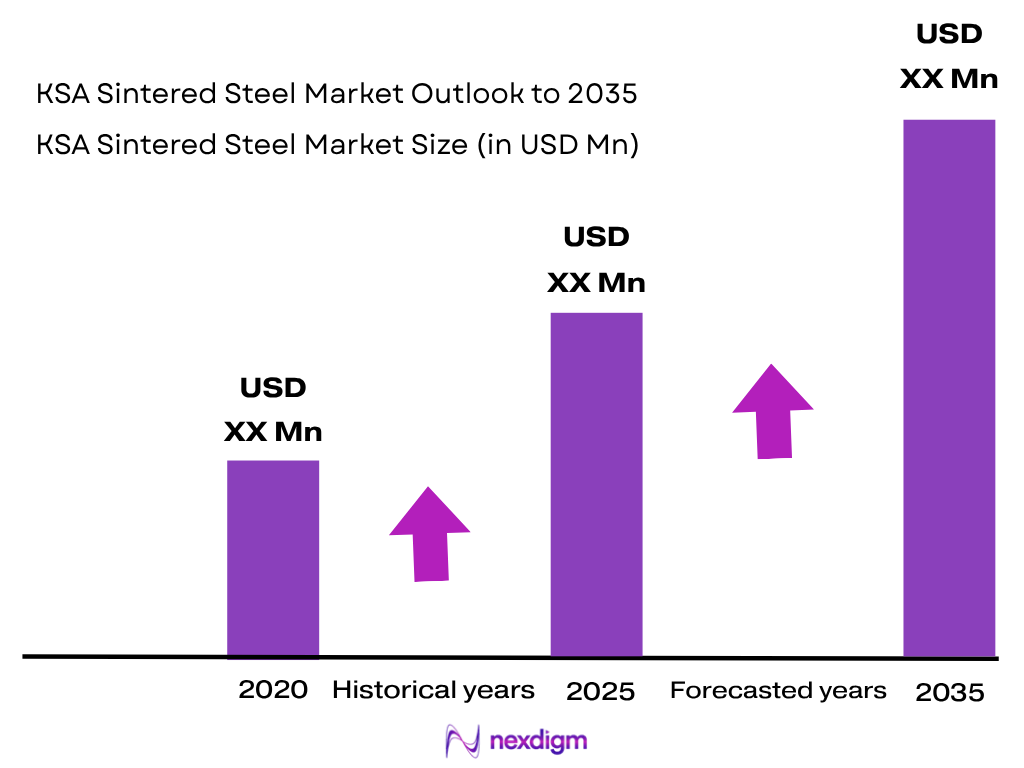
The KSA Sintered Steel Market is valued at USD ~XX million in 2024, with the market supported by Saudi Arabia’s expanding industrial manufacturing base, localization programs, automotive development, oil and gas equipment requirements, and demand for precision-engineered components. Saudi Aramco reported 12.4 million barrels of oil-equivalent hydrocarbon production per day and 4.1 million barrels per day of net refining capacity in 2024, creating a substantial industrial ecosystem for pumps, compressors, gears, bearings and other engineered components. Saudi Arabia’s Vision 2030 agenda also continues to prioritize domestic manufacturing and higher-value industrial capabilities.
The KSA Sintered Steel Market is concentrated around major industrial and manufacturing centers including Riyadh, Dammam, Jubail, Jeddah and Yanbu, reflecting their proximity to automotive, oil and gas, petrochemical, machinery, logistics and industrial clusters. The Eastern Province is particularly important because of its concentration of hydrocarbon production, petrochemicals and industrial facilities, while Riyadh provides access to government-led industrial development and emerging automotive manufacturing. Saudi Arabia’s industrial localization strategy specifically emphasizes domestic production capabilities and supply-chain development across strategic sectors.
Market Segmentation
By Product Type
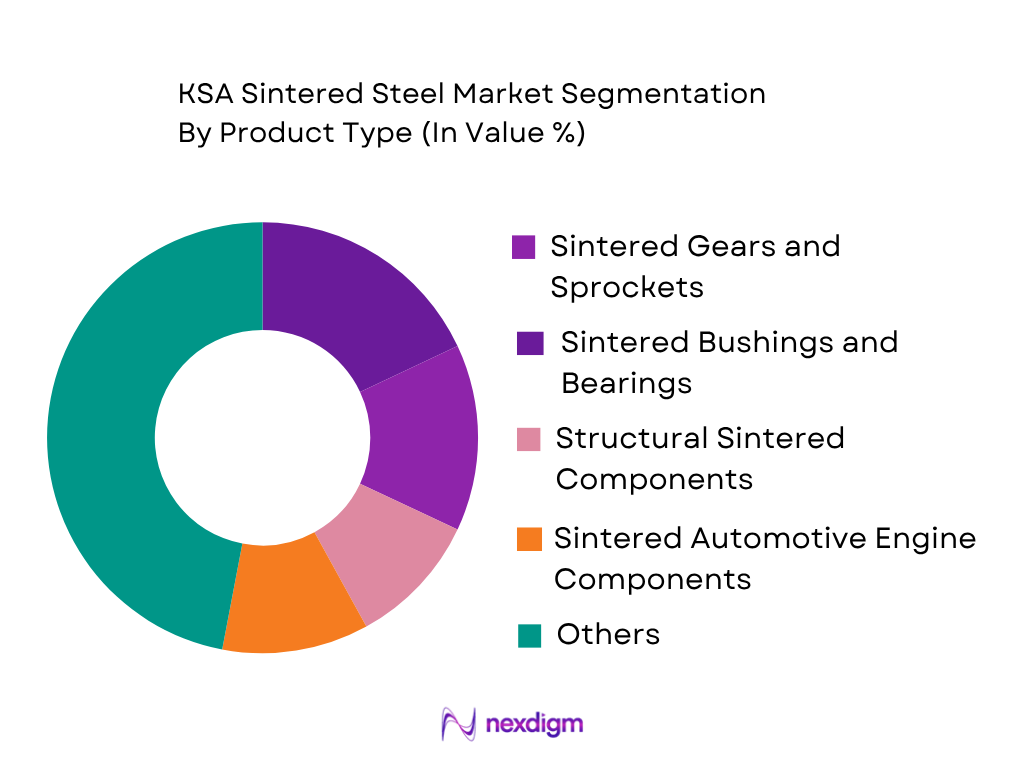
The KSA Sintered Steel Market is segmented by product type into structural sintered steel components, sintered gears and sprockets, sintered bushings and bearings, engine components, transmission components, pump components, compressor components, electrical and magnetic components, rotors and motor components, filters and porous components, and other precision components. Sintered gears and sprockets represent a major application category because powder metallurgy can produce repeatable geometries and controlled-density components for rotating and power-transmission systems. Their relevance extends across automotive, industrial machinery, pumps, compressors and other equipment. Saudi Arabia’s industrial diversification program is encouraging the development of domestic manufacturing capabilities, while its large oil, gas, petrochemical and industrial infrastructure creates requirements for engineered mechanical components. Aramco’s 2024 operational base included 12.4 million barrels of oil-equivalent daily hydrocarbon production, 4.1 million barrels per day of refining capacity and 57.6 million tonnes per year of net chemicals production capacity, supporting a broad downstream equipment ecosystem.
By End-Use Industry
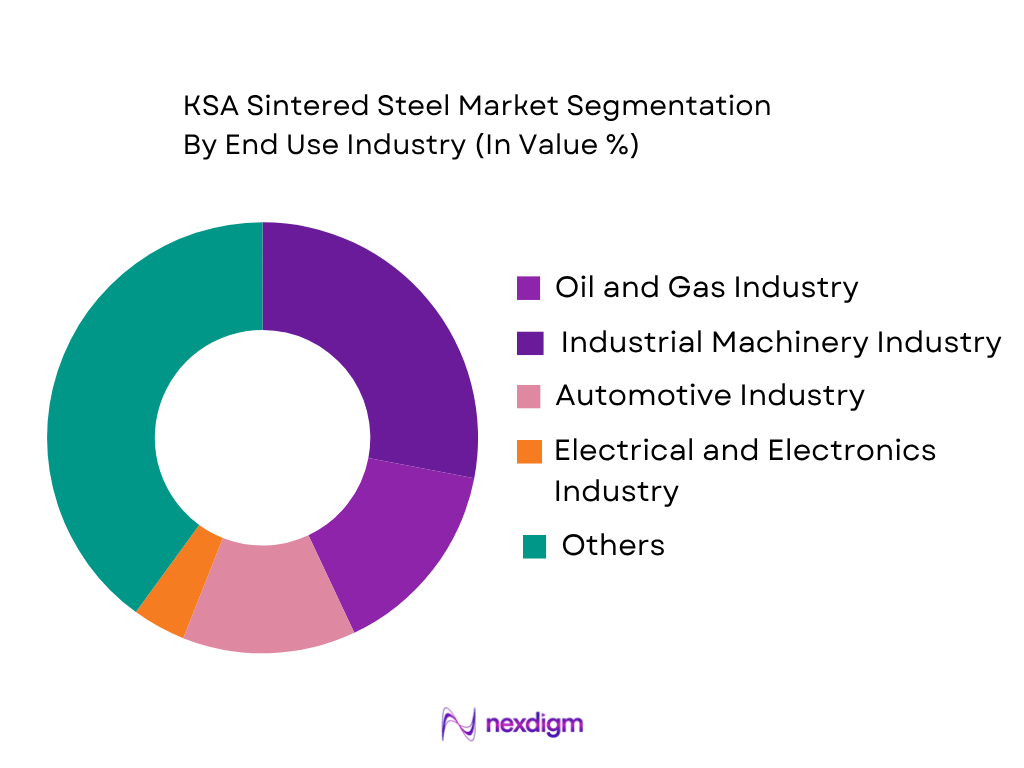
The KSA Sintered Steel Market is segmented by end-use industry into oil and gas, automotive, electric vehicle and hybrid vehicle, industrial machinery, aerospace, power generation, construction equipment, electrical and electronics, HVAC and refrigeration, marine and offshore, and medical and precision engineering. Oil and gas represents a major demand segment because Saudi Arabia operates one of the world’s largest integrated hydrocarbon production and processing ecosystems, requiring extensive mechanical equipment and replacement components. Aramco reported 12.4 million barrels of oil-equivalent daily hydrocarbon production, 10.3 million barrels per day of total liquids production, 10.8 billion standard cubic feet per day of gas production, and 57.6 million tonnes per year of net chemicals production capacity in 2024. These operations create applications for pumps, compressors, valves, bearings, gears and wear-resistant components.
Competitive Landscape
The KSA Sintered Steel Market includes international powder-metallurgy specialists and diversified engineering companies supplying materials, components and advanced manufacturing technologies. Competition is shaped by technical capability, component qualification, production scale, material expertise, application coverage and the ability to support localization. Saudi Arabia’s industrial strategy emphasizes development of domestic manufacturing and strategic supply chains, creating opportunities for international manufacturers to establish partnerships, production capabilities and technology-transfer arrangements within the Kingdom.
| Company | Established | Headquarters | Product Portfolio | PM Technology | Key Applications | KSA Relevance | Manufacturing Capability | Technology Focus |
| Höganäs AB | 1797 | Höganäs, Sweden | ~ | ~ | ~ | ~ | ~ | ~ |
| GKN Powder Metallurgy | 1759 | Birmingham, UK | ~ | ~ | ~ | ~ | ~ | ~ |
| Miba AG | 1927 | Laakirchen, Austria | ~ | ~ | ~ | ~ | ~ | ~ |
| Sumitomo Electric Industries | 1897 | Osaka, Japan | ~ | ~ | ~ | ~ | ~ | ~ |
| Ames Group | 1951 | Barcelona, Spain | ~ | ~ | ~ | ~ | ~ | ~ |
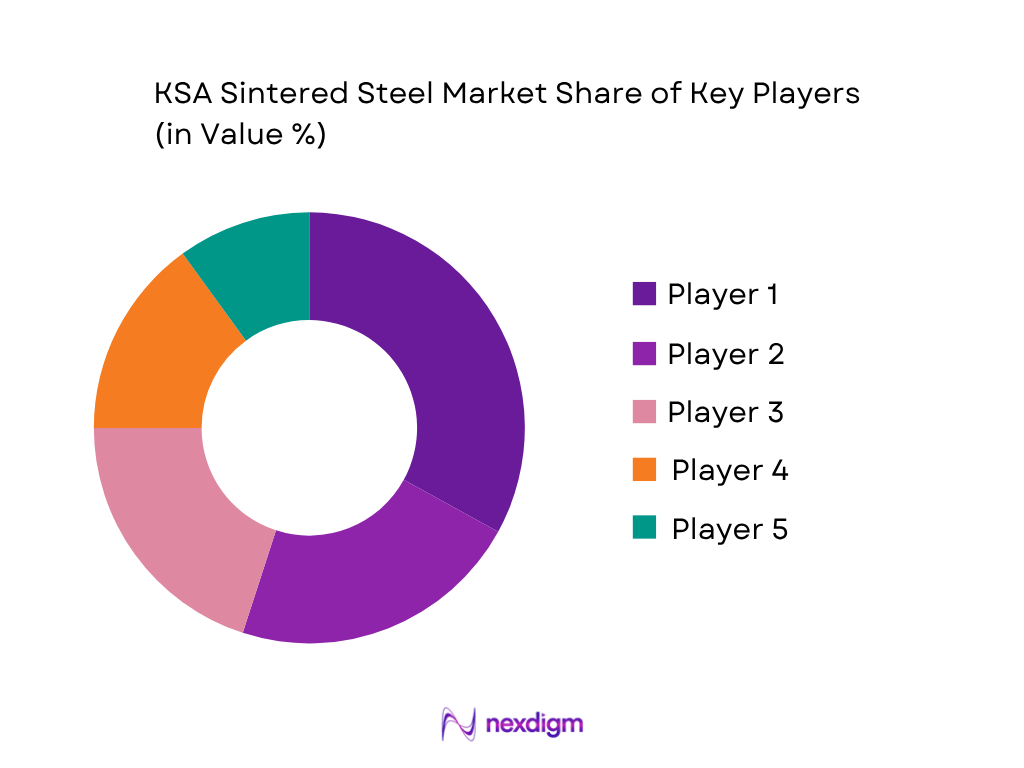
KSA Sintered Steel Market Analysis
Growth Drivers
Industrial Manufacturing Expansion
Industrial manufacturing expansion is strengthening the underlying demand environment for the KSA Sintered Steel Market because powder-metallurgy components are used in machinery, pumps, compressors, power transmission systems and precision industrial equipment. Saudi Arabia’s General Authority for Statistics reported that the manufacturing activity index increased by 4.7% in 2024, while non-oil industrial activities increased by 5.3%, indicating continued expansion beyond hydrocarbons. The World Bank recorded Saudi Arabia’s 2024 GDP at approximately USD 1.25 trillion, providing a substantial economic base for industrial investment and equipment demand. The IMF estimated 2024 non-oil GDP growth at 4.5%, reflecting continued expansion in domestic economic activity. The Ministry of Industry and Mineral Resources also reported 152 new industrial licenses in January 2024, including 19 licenses for fabricated metal products, directly relevant to the broader engineered-metal ecosystem. These conditions support demand for sintered gears, bushings, bearings, structural parts, pump components and other precision components. The National Industrial Strategy identifies machinery and equipment, metals, automotive and aerospace among strategic industrial subsectors, creating additional pathways for localization of advanced components and increasing the relevance of sintered steel technologies within Saudi Arabia’s manufacturing diversification agenda.
Automotive Localization
Automotive localization is creating an important downstream opportunity for the KSA Sintered Steel Market because locally produced vehicles and components require compact, repeatable and precision-engineered metal parts such as gears, bushings, bearings, rotors, transmission components and structural elements. Saudi Arabia’s National Industrial Strategy identifies automotive as one of its strategic industrial subsectors, alongside machinery and equipment, metals and aerospace. The IMF reported that Saudi Arabia’s non-oil GDP grew 4.5% in 2024, indicating continued expansion of the broader economic sectors that support automotive manufacturing and industrial supply chains. The Saudi automotive ecosystem is also being developed through industrial localization initiatives and investment programs designed to increase domestic production capabilities. The World Bank recorded Saudi Arabia’s 2024 GDP at approximately USD 1.25 trillion, demonstrating the scale of the domestic economy supporting vehicle-related industrial investment. The National Industrial Strategy specifically emphasizes leveraging domestic demand to develop manufacturing capabilities and integrate Saudi producers into regional value chains. For sintered-steel suppliers, this environment supports opportunities in high-volume automotive components where near-net-shape production can reduce machining requirements and provide consistent dimensional performance. The localization of automotive supply chains can therefore encourage domestic sourcing of powder-metal components and associated tooling, materials and engineering services.
Market Challenges
Dependence on Imported Metal Powders
Dependence on imported metal powders remains a structural challenge for the KSA Sintered Steel Market because advanced powder-metallurgy production requires consistent supplies of iron powders, alloy powders, stainless-steel powders, graphite and specialized additives. Saudi Arabia’s industrial base is expanding, but domestic production of specialized powder-metallurgy feedstocks remains less developed than downstream industrial demand. The World Bank recorded 2024 imports of goods and services at around 35.7% of GDP, demonstrating the importance of imported inputs across the wider Saudi economy. The IMF reported that Saudi Arabia’s 2024 imports of goods and services were equivalent to 30.1% of GDP under its 2025 Article IV dataset, reflecting significant external sourcing requirements. The General Authority for Statistics also recorded continued manufacturing expansion, with the manufacturing activity index increasing 4.7% in 2024, potentially increasing demand for specialized industrial inputs faster than domestic material capabilities develop. For sintered-steel producers, imported powder exposure can affect procurement continuity, material qualification and production planning. Specialized powders may require approval of specific grades and chemistry before they can be used in qualified components. This becomes particularly relevant for oil and gas, aerospace and safety-critical applications where material traceability and consistency are essential. Building domestic powder-processing capabilities and diversified international supply arrangements is therefore important for reducing supply-chain vulnerability.
High Tooling and Specialized Equipment Requirements
High tooling and specialized equipment requirements present a significant entry and scaling challenge for the KSA Sintered Steel Market because commercial powder metallurgy requires dedicated compaction presses, precision dies, controlled-atmosphere sintering furnaces, sizing equipment, heat-treatment systems and inspection technologies. These requirements become more demanding when manufacturers target high-density components, tight tolerances or safety-critical applications. Saudi Arabia’s IMF data show that credit to the private sector increased 13.4% in 2024, demonstrating strong financing activity but also highlighting the capital-intensive environment in which manufacturers must fund specialized industrial assets. The General Authority for Statistics reported that the annual manufacturing activity index increased 4.7% in 2024, creating a growing industrial base but also increasing competition for advanced production equipment and skilled technical resources. The Ministry of Industry and Mineral Resources reported 11,672 existing and under-construction factories by January 2024, illustrating the scale of the wider manufacturing ecosystem. Sintered-steel manufacturers must compete for engineering personnel, equipment suppliers and industrial infrastructure while establishing production processes that maintain consistent density, dimensional accuracy and mechanical properties. Tooling is also component-specific, meaning manufacturers may need dedicated dies for different geometries and production programs. These factors can lengthen qualification cycles and make small-volume applications less economical compared with established machining or forging routes.
Market Opportunities
Oil & Gas Sintered Components
Oil and gas equipment represents a significant opportunity for the KSA Sintered Steel Market because Saudi Arabia has an exceptionally large installed hydrocarbon-production, refining and processing ecosystem that requires pumps, compressors, bearings, gears, valves, wear components and other engineered parts. Aramco reported 12.4 million barrels of oil-equivalent per day of total hydrocarbon production in 2024, alongside 10.3 million barrels per day of total liquids production and 10.8 billion standard cubic feet per day of gas production. Its 2024 annual report also recorded 4.1 million barrels per day of net refining capacity and 57.6 million tonnes per year of net chemicals production capacity. This extensive operating base creates recurring requirements for industrial components capable of maintaining dimensional stability, wear resistance and reliability under demanding operating conditions. The opportunity for sintered steel lies particularly in components where controlled porosity, near-net-shape manufacturing, material efficiency and repeatable production can provide technical advantages. Saudi Arabia’s National Industrial Strategy also prioritizes machinery and equipment and seeks to strengthen domestic manufacturing and supply-chain resilience. Local production of selected oil and gas components could therefore support supplier localization while reducing dependence on imported finished components. Sintered-steel manufacturers can address this opportunity through qualified component production, application-specific alloys, secondary machining and surface treatments aligned with oil and gas equipment requirements.
Advanced Sintering Technologies and Powder-Based Manufacturing
Advanced sintering technologies and powder-based manufacturing provide an opportunity to broaden the KSA Sintered Steel Market beyond conventional press-and-sinter components into higher-value applications requiring complex geometries, high density and specialized material performance. Saudi Arabia’s industrial transformation is increasingly incorporating advanced manufacturing technologies. The Vision 2030 program identifies 12 strategic industrial subsectors, including aerospace, automotive, machinery and equipment, metals and renewables, creating multiple potential application pathways for powder-based production. Saudi Arabia’s General Authority for Statistics reported a 4.7% increase in manufacturing activity in 2024, while the IMF recorded 4.5% non-oil GDP growth in 2024, indicating continued expansion of the economic base supporting advanced manufacturing investment. Advanced powder processing can serve applications in automotive powertrains, industrial automation, aerospace equipment, electric motors, pumps and precision machinery. The opportunity is particularly relevant where conventional subtractive manufacturing generates substantial material waste or requires multiple machining operations. Technologies such as high-density compaction, sinter hardening, metal injection molding and powder-based additive manufacturing can expand component-design possibilities and improve manufacturing flexibility. Saudi Arabia’s localization agenda provides an additional pathway for technology transfer, domestic production and development of specialized engineering capabilities. These conditions can support gradual movement toward higher-value powder metallurgy applications rather than limiting the market to conventional commodity components.
Future Outlook
Over the coming decade, the KSA Sintered Steel Market is expected to develop alongside Saudi Arabia’s industrial localization agenda, automotive manufacturing ambitions, oil and gas equipment ecosystem and advanced manufacturing initiatives. Demand is expected to increasingly move toward precision components, high-density materials, wear-resistant parts and application-specific powder metallurgy solutions. Vision 2030 continues to emphasize localization, industrial diversification and higher-value manufacturing, creating a framework for greater domestic participation in engineered-component supply chains.
Major Players
- Höganäs AB
- GKN Powder Metallurgy
- Miba AG
- Sumitomo Electric Industries Ltd.
- Ames Group
- Fine Sinter Co., Ltd.
- Hitachi Astemo Ltd.
- Porite Corporation
- Schunk Group
- Sandvik AB
- Carpenter Technology Corporation
- SSI Sintered Specialties
- Burgess-Norton
- Sumitomo Electric Sintered Alloy Ltd.
- Sintercom India Pvt. Ltd.
Key Target Audience
- Automotive and Automotive Component Manufacturers
- Oil and Gas Equipment Manufacturers
- Industrial Machinery and Equipment Manufacturers
- Aerospace and Defense Component Manufacturers
- Investments and Venture Capitalist Firms
- Government and Regulatory Bodies (Ministry of Industry and Mineral Resources, National Industrial Development and Logistics Program, Local Content and Government Procurement Authority)
- Power Generation and Energy Equipment Manufacturers
- Metal Powder, Tooling and Advanced Manufacturing Equipment Suppliers
Research Methodology
Step 1: Identification of Key Variables
The initial phase involves constructing a KSA Sintered Steel Market ecosystem covering metal-powder suppliers, component manufacturers, tooling companies, equipment providers, distributors and end-use industries. The assessment identifies variables including component demand, material grades, manufacturing technologies, production capacity, import dependency and localization requirements.
Step 2: Market Analysis and Construction
Historical market information is compiled through supply-side and demand-side assessment of sintered components used across automotive, oil and gas, industrial machinery, power generation and aerospace applications. Production activity, component consumption, manufacturing capabilities, imports and industrial development indicators are evaluated to construct the market baseline.
Step 3: Hypothesis Validation and Expert Consultation
Market hypotheses are validated through consultations with manufacturers, distributors, engineering companies, procurement specialists and industrial equipment suppliers. Interviews focus on component specifications, qualification requirements, purchasing criteria, manufacturing technologies, supplier selection and expected adoption of advanced powder-metallurgy processes.
Step 4: Research Synthesis and Final Output
The final stage integrates primary findings with official industrial statistics, company disclosures, trade information and sector-level indicators. Bottom-up component assessments are reconciled with top-down industrial demand analysis to establish the market structure, competitive landscape, segmentation framework and future outlook.

- Executive Summary
- Research Methodology (Market Definition and Scope, Sintered Steel Classification, Powder Metallurgy Mapping, Market Sizing Framework, Top-Down Assessment, Bottom-Up Assessment, Demand-Side Analysis, Supply-Side Analysis, Primary Industry Interviews, Manufacturer and Supplier Mapping, Capacity Assessment, Import-Export Validation, Data Triangulation, Forecasting Framework, Assumptions and Limitations)

- Definition and Scope
- Sintered Steel and Powder Metallurgy Industry Structure
- Evolution of Powder Metallurgy and Sintered Component Manufacturing in Saudi
- Development of Local Industrial Manufacturing and Component Localization
- Integration of Sintered Steel Components into Saudi Industrial Value Chains
- Sintered Steel Value Chain Analysis
- Raw Material and Input Ecosystem
- Manufacturing Technology Ecosystem

- Growth Drivers (Industrial Manufacturing Expansion, Automotive Localization, Oil & Gas Equipment Manufacturing, Machinery and Equipment Localization, Aerospace Manufacturing Development, Vision 2030 Industrial Diversification, IKTVA Localization Requirements, Increasing Demand for Precision Components, Expansion of Advanced Manufacturing)
- Market Challenges (Dependence on Imported Metal Powders, Limited Domestic Sintered Component Capacity, High Tooling Requirements, Specialized Sintering Equipment Requirements, Powder Qualification Constraints, Limited Local Alloy Powder Availability, Technical Expertise Requirements, Energy-Intensive Processing, Manufacturing Yield Management, Competition from Machining and Forging, Qualification Barriers for Critical Components)
- Market Opportunities (Oil & Gas Sintered Components, Automotive Sintered Components, EV Motor Components, Industrial Machinery Components, Aerospace Powder Metal Components, Pump and Compressor Components, Soft Magnetic Components, High-Density Sintered Components, Advanced Sintering Technologies, Powder-Based Additive Manufacturing)
- Market Trends (Manufacturing Localization, Powder Metallurgy Automation, Sinter-Hardening Adoption, High-Density Component Development, Advanced Alloy Powder Utilization, EV Powertrain Miniaturization, Industrial Robotics Integration, Digital Process Monitoring, Sustainable Material Utilization, Additive Powder Manufacturing)
- Government Policies and Industrial Regulations (Saudi Vision 2030, National Industrial Strategy, NIDLP, Local Content and Government Procurement Authority Requirements, IKTVA Requirements, Saudi Standards and Metrology Requirements, Industrial Licensing Requirements, Environmental Compliance, Product Certification Requirements, Import Regulations)
- SWOT Analysis
- Porter’s Five Forces Analysis
- PESTLE Analysis
- Stakeholder Ecosystem
- Competition Ecosystem

- By Market Value (2020-2025)
- By Production Volume (2020-2025)
- By Consumption Volume (2020-2025)
- By Domestic Production Volume (2020-2025)
- By Import Volume (2020-2025)
- By Export Volume (2020-2025)

- By Product Type (In Value %)
Structural Sintered Steel Components
Sintered Gears and Sprockets
Sintered Bushings and Bearings
Sintered Engine Components
Sintered Transmission Components
Sintered Pump Components
Sintered Compressor Components
Sintered Filters and Porous Components
Sintered Electrical and Magnetic Components
Sintered Rotors and Motor Components
Other Precision Sintered Steel Components - By Material Type (In Value %)
Iron-Based Sintered Steel
Low-Alloy Sintered Steel
Stainless Steel
Nickel-Alloy Sintered Steel
Copper-Iron Sintered Materials
High-Performance Alloy Powders
Soft Magnetic Sintered Materials - By Manufacturing Technology (In Value %)
Conventional Press-and-Sinter
Warm Compaction
High-Temperature Sintering
Sinter Hardening
Metal Injection Molding
Powder Forging
Hot Isostatic Pressing
Powder-Based Additive Manufacturing
Hybrid Powder Metallurgy Processes - By Component Function (In Value %)
Structural Components
Rotating Components
Transmission Components
Wear Components
Fluid-Control Components
Magnetic Components
Porous and Filtration Components
Pump and Compressor Components
Precision Mechanical Components - By End-Use Industry (In Value %)
Oil & Gas Industry
Automotive Industry
Electric Vehicle and Hybrid Vehicle Industry
Industrial Machinery Industry
Aerospace Industry
Construction Equipment Industry
Electrical and Electronics Industry
HVAC and Refrigeration Industry
Marine and Offshore Industry
Medical and Precision Engineering Industry

- Market Share of Major Players (By KSA Revenue, Product Category, End-Use Industry, Component Type, Manufacturing Technology, Customer Industry)
- Cross Comparison Parameters (Sintered Steel Product Portfolio Breadth, Metal Powder and Alloy Technology Coverage, Press-and-Sinter Manufacturing Capability, Sinter-Hardening and High-Density Component Capability, Oil & Gas Component Application Capability, Automotive and EV Component Manufacturing Capability, Industrial Machinery and Powertrain Component Capability, Local Manufacturing, Qualification and Supply-Chain Integration Capability)
- SWOT Analysis of Major Players
- Detailed Profiles of Major Companies
Höganäs AB
GKN Powder Metallurgy
Miba AG
Sumitomo Electric Industries Ltd.
Hitachi Astemo Ltd.
Fine Sinter Co., Ltd.
Porite Corporation
AMES Group
Schunk Group
Sintercom India Pvt. Ltd.
SSI Sintered Specialties
Sandvik AB
Carpenter Technology Corporation
H.C. Starck Solutions

- Oil & Gas Equipment Manufacturer Requirement Assessment
- Automotive Component Manufacturer Demand Analysis
- Aerospace Component Procurement Assessment
- Power Generation Equipment Requirement Analysis
- Construction Equipment Component Demand Analysis

- By Market Value (2026-2035)
- By Production Volume (2026-2035)
- By Consumption Volume (2026-2035)
- By Domestic Production Volume (2026-2035)
- By Import Volume (2026-2035)
- By Export Volume (2026-2035)


 Request a Sample
 Ask for Customization
 Get a Quote
 Enquire Now