
 Download PDF
 Download PDF
Market Overview
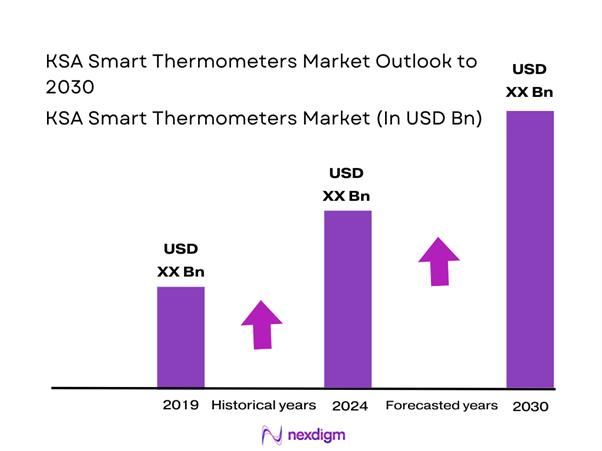
The KSA Smart Thermometers Market sits within the broader Saudi Arabia thermometer market, where the latest-year revenue is USD ~ million and is forecast to reach USD ~ million by the end of the forecast window. This market is driven by higher home-monitoring intensity for fever/respiratory episodes, hospital and outpatient triage throughput needs, and the structural shift away from legacy mercury formats toward mercury-free, digital, infrared, and connected devices—supported by retail pharmacy expansion and e-commerce medical device availability.
On the demand concentration side, Riyadh, Jeddah, and Dammam/Khobar typically dominate thermometer and smart-health device consumption because they concentrate the Kingdom’s largest hospital clusters, specialist networks, and modern pharmacy chains, alongside higher private insurance coverage and employer-provided healthcare access. These metros also lead in consumer electronics penetration (supporting app-linked devices) and host regional decision-makers for national healthcare operators and procurement frameworks, which accelerates adoption of upgraded thermometer categories in institutional and household settings.
Market Segmentation
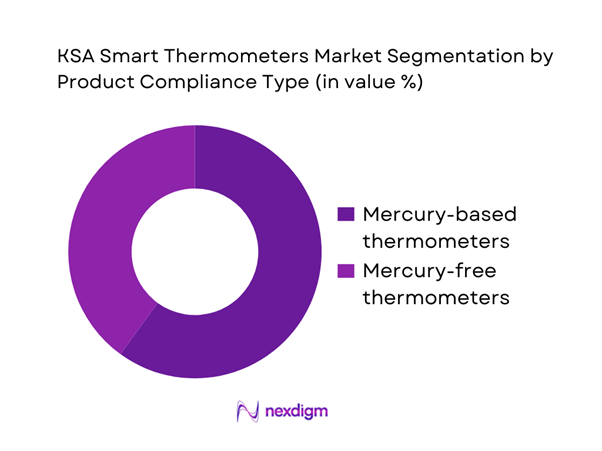
By Product Compliance Type
Mercury-based devices retain a sizeable installed base in institutional and small-clinic settings where procurement cycles are slower, device replacement is conservative, and basic temperature measurement is treated as a commodity. These products often persist through legacy SOPs, staff familiarity, and compatibility with existing workflows, especially in high-volume outpatient use where the perceived switching benefit is not always enough to override standardization and inventory inertia. Meanwhile, the “smart thermometer” opportunity in KSA is primarily captured within mercury-free categories (digital, infrared/contactless, and app-linked), but these tend to scale fastest where homecare monitoring, pediatric convenience, and infection-control preferences are strongest. Over the forecast horizon, mercury-free (including connected models) typically benefits from compliance pressure, consumer preference for faster readings, and retail-channel merchandising, but the current structure still reflects legacy penetration and institutional continuity.
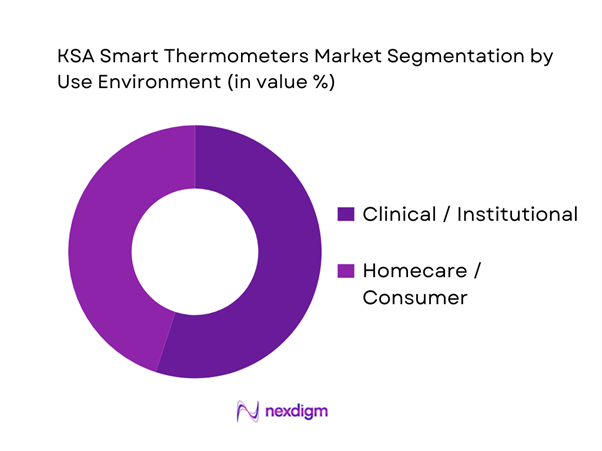
By Use Environment
In KSA, clinical and institutional demand is anchored by hospitals, outpatient facilities, diagnostic points, and emergency/triage workflows—where thermometer procurement is bundled into broader medical consumables/device purchasing and driven by throughput, durability, and protocol adherence. Homecare/consumer demand is increasingly visible through pharmacies and e-commerce, and it is the core adoption pathway for smart/app-linked thermometers, especially for parents, chronic patients, and households managing repeated fever episodes. The home segment’s growth is reinforced by consumer preference for rapid readings, reduced handling complexity, and a broader shift toward self-monitoring behaviors in the Kingdom’s large metros. That said, without a disclosed open-source KSA share split, assigning percentages would require estimation—so the table below is provided as a ready-to-fill structure aligned with how KSA procurement and retail channels actually behave.
Competitive Landscape
The KSA smart thermometer competitive landscape is fragmented at the brand level (consumer device brands) but consolidated through channels—notably large pharmacy chains, medical distributors, and hospital procurement frameworks. Global thermometer brands compete on measurement modality (contact vs infrared), clinical validation positioning, app ecosystem depth, Arabic UI/support availability, warranty/service reliability, and channel coverage. The “smart” layer is increasingly differentiated by Bluetooth/Wi-Fi stability, multi-profile family use, data export, and integration readiness with remote monitoring programs.
| Company | Est. Year | Headquarters | Core Thermometer Modality Strength | “Smart” / App Ecosystem | Channel Strength in KSA (Typical) | Clinical Positioning | Warranty / Service Model (Typical) | Differentiation Lever |
| OMRON | 1933 | Kyoto, Japan | ~ | ~ | ~ | ~ | ~ | ~ |
| Braun | 1921 | Germany | ~ | ~ | ~ | ~ | ~ | ~ |
| Microlife | 1981 | Widnau, Switzerland | ~ | ~ | ~ | ~ | ~ | ~ |
| Exergen | 1980 | Watertown, USA | ~ | ~ | ~ | ~ | ~ | ~ |
| Withings | 2008 | Issy-les-Moulineaux, France | ~ | ~ | ~ | ~ | ~ | ~ |

KSA Smart Thermometers Market Analysis
Growth Drivers
Pediatric care intensity
Saudi Arabia’s scale and demographics keep pediatric fever-triage a constant utilization driver for smart thermometers across homes, primary care, and emergency pathways. The Kingdom’s population is ~ (macro demand base), and GDP is USD ~ trillion (ability to fund healthcare capacity and consumer device purchases). On the supply side, the care network that absorbs pediatric demand is large: ~ hospitals and ~ primary healthcare centers/medical complexes are in operation, with ~ physicians and ~ nurses supporting visit volumes and rapid screening workflows. These structural fundamentals matter because fever is among the highest-frequency “decision” symptoms in pediatrics—triggering repeated temperature checks at home (parents), at triage desks (frontline staff), and within clinics (pediatricians). Smart thermometers benefit when caregivers need faster readings, multi-profile family use, and digital logging that reduces recall errors during consultations. Urban concentration amplifies this effect: Riyadh leads hospital counts (~ hospitals) while Makkah follows (~ hospitals), aligning with the Kingdom’s densest pediatric specialist access points and higher-throughput outpatient settings.
Home healthcare expansion
Home healthcare expansion in Saudi Arabia increases the addressable “routine monitoring” moments where smart thermometers are repeatedly used (care plans, caregiver documentation, escalation thresholds). Macro capacity to fund service expansion remains strong with GDP at USD ~ trillion and a national population of ~, supporting scaled public-private delivery models and household purchasing power for connected devices. Operationally, Saudi care delivery is increasingly “hub-and-spoke” enabled by virtual care. The Ministry of Health’s Seha Virtual Hospital supports ~ hospitals, provides ~ basic specialized services plus ~ sub-specialty services, employs more than ~ doctors, and is designed with capacity of more than ~ patients annually—a national backbone that makes home-based monitoring (including temperature logs during infections or post-procedure recovery) more actionable because escalation can be managed remotely. The physical network also points to expansion of “community-first” access: ~ primary healthcare centers/medical complexes create distributed touchpoints for follow-up and referrals, while ~ private sector pharmacies reinforce consumer access and repeat purchase cycles for thermometry and related home diagnostics. In this context, smart thermometers are not just consumer gadgets; they become workflow tools for caregivers and clinicians to reduce information gaps (when fever started, peak temperature, response to antipyretics) and to support decisions on when to shift from home care to in-person assessment.
Challenges
Accuracy perception for no-contact devices
Accuracy perception is a binding constraint for infrared/no-contact thermometers because KSA’s high ambient temperatures and air-conditioned indoor/outdoor transitions can create user doubt when readings vary. This challenge plays out at scale: Saudi Arabia has ~ residents and a dense clinical footprint with ~ hospitals and ~ primary healthcare centers/medical complexes, meaning even small trust issues cascade into high volumes of “repeat checks,” clinician skepticism, and preference for contact modalities in certain workflows. Professional capacity is large—~ physicians—so clinical guidelines and procurement committees exert meaningful influence on what patients and pharmacies consider “reliable.” This is where “smart” can be a double-edged sword: app features don’t compensate if the core measurement is distrusted, and poor user education (distance, forehead preparation, acclimatization) amplifies dissatisfaction. From a compliance standpoint, oversight posture also raises the bar for claims: in ~, inspections on medical device manufacturers reinforced that documentation, validation and post-market controls matter—especially for products marketed with “clinical-grade” or algorithmic features. Net effect: adoption occurs, but buyers are selective; brands that can demonstrate stable performance in real-world KSA conditions and provide strong Arabic instructions gain disproportionate credibility.
Price competition and commoditization
Price competition is intense because thermometry is often treated as a “must-have, low-involvement” category in pharmacies and marketplaces, where many SKUs appear substitutable. The Kingdom’s scale—~ private sector pharmacies—creates a wide retail surface area, and competition concentrates in the largest regions: Riyadh has ~ private pharmacies and Makkah has ~, enabling frequent promotions and rapid switching across brands when consumers perceive similar performance. Macro conditions also support fast-moving retail: GDP is USD ~ trillion and population is ~, sustaining high category availability and broad consumer access. For smart thermometers, commoditization risk increases when buyers prioritize “works with a phone” as the headline feature and ignore differences in sensor design, algorithms, or clinical validation. This can compress value capture for higher-quality brands and push suppliers into frequent SKU refreshes or bundling strategies (apps, multi-user features, logging, data export). Additionally, institutional channels may standardize on fewer models for protocol consistency, leaving the retail channel as the battleground where listings, promotions, and pharmacist recommendations matter most. As pharmacy workforce scales—~ pharmacists—the ability to train frontline staff to explain differentiation becomes more important; otherwise, the category drifts further toward price-only competition.
Opportunities
Telehealth and RPM bundling
Telehealth and RPM bundling is a high-conviction opportunity because the Kingdom already operates national-scale virtual care infrastructure, which can convert smart thermometer data from “personal tracking” into a reimbursable, clinically actionable input. Macro scale supports continued rollout: population is ~ and GDP is USD ~ trillion, providing the demand base and fiscal headroom for digital pathways. The clearest current proof point is Seha Virtual Hospital: it supports ~ hospitals, provides ~ basic specialized services and ~ sub-specialty services, employs ~ doctors, and has capacity for ~ patients annually. This creates an immediate bundling logic: connected thermometers (plus pulse oximeters, BP devices where appropriate) can be packaged into care pathways for fever management, post-discharge monitoring, pediatric follow-ups, and infection-control triage—without needing “future” volume claims to justify the direction. Additionally, the provider workforce scale—~ physicians—enables protocol standardization when digital logs reduce consult time and improve continuity. Vendors that can integrate exports, Arabic-first instructions, and reliable device identity/traceability (UDI readiness) are better positioned to become preferred devices inside virtual clinics and RPM kits.
Employer wellness and occupational health
Employer wellness and occupational health is a scalable opportunity because KSA has large, geographically distributed workforces (industry, logistics, services) where standardized health screening and “stay-at-work safely” protocols reduce absenteeism and improve duty-of-care governance. The macro base—USD ~ trillion GDP and ~ population—supports a sizable private sector and large public employers that can institutionalize device standards at scale. The retail and access infrastructure makes procurement and replenishment feasible: ~ private sector pharmacies provide dense last-mile availability, while the care system offers clinical escalation points through ~ hospitals and ~ primary healthcare centers/medical complexes. This matters for occupational health programs because thermometer readings often sit at the first step of triage for “fit to work” decisions (fever thresholds triggering remote consults or clinic referral). Smart thermometers strengthen this model when they offer device standardization, user guidance (reducing false alarms), and auditable logs for HR/health units—without needing to claim future adoption levels. Finally, enforcement posture and UDI requirements make corporate buyers more likely to demand authorized channels and traceable devices, which can shift demand toward compliant brands and structured distributor partnerships.
Future Outlook
Over the next planning cycle, the KSA smart thermometers market is expected to expand steadily as mercury-free replacement accelerates, consumer and provider preferences shift toward fast, hygienic measurement, and digital health programs normalize home monitoring alongside clinic-based triage. Product roadmaps will increasingly prioritize clinical-grade validation, lower measurement variance in high-ambient conditions, Arabic app experiences, and multi-profile household tracking. Channel competition is likely to intensify in pharmacy retail and online marketplaces, while institutional demand will favor vendors that can support after-sales reliability, bulk availability, and standardized device protocols for high-throughput care settings.
Major Players
- OMRON
- Braun
- Microlife
- Exergen
- Withings
- iHealth
- Beurer
- Xiaomi
- Philips
- Citizen Systems
- Medisana
- Terumo
- Rossmax
- Welch Allyn
Key Target Audience
- Hospitals & health systems procurement teams
- Large outpatient clinic networks & day-care operators
- Pharmacy chains & retail healthcare operators
- Medical device distributors & authorized importers
- E-commerce health category leaders / marketplaces
- Corporate & employer health program buyers
- Investments and venture capitalist firms
- Government and regulatory bodies
Research Methodology
Step 1: Identification of Key Variables
We build an ecosystem map covering brands, distributors, pharmacy chains, hospital procurement channels, and regulators in the KSA smart thermometers space. Desk research consolidates device modalities, compliance pathways, and go-to-market structures to define variables that shape adoption and pricing power.
Step 2: Market Analysis and Construction
We compile historical market indicators for the thermometer category, then isolate “smart thermometer” drivers using channel mapping (institutional vs retail/online), modality shifts (contact vs infrared), and replacement dynamics (mercury-to-mercury-free). Triangulation is performed across vendor footprints and channel availability.
Step 3: Hypothesis Validation and Expert Consultation
Hypotheses are validated through structured interviews with distributors, pharmacy category managers, hospital biomedical/procurement stakeholders, and brand/channel partners. These inputs refine assumptions around procurement criteria, SKU velocity, warranty/service expectations, and device standardization.
Step 4: Research Synthesis and Final Output
We synthesize findings using a combined top-down category sizing and bottom-up channel build, cross-validating with brand presence and channel checks. Final outputs include segmentation logic, competitive benchmarking, and actionable recommendations aligned to KSA procurement realities.

- Executive Summary
- Research Methodology (Market definition boundary, Definitions & taxonomy, Assumptions: device replacement cycles, household penetration proxies, pediatric vs adult utilization, clinical vs home-use utilization rates, Sizing architecture, Primary research plan, Data integrity & bias controls: duplicate-SKU elimination, grey-market identification, promo-period normalization, outlier treatment)

- Definition and Scope
- Market Genesis and Adoption Pathway
- Demand Context in KSA
- Ecosystem Overview

- Growth Drivers
Pediatric care intensity
Home healthcare expansion
Digital health adoption
Infection-control practices
Pharmacy retail expansion
Travel readiness demand - Challenges
Accuracy perception for no-contact devices
Price competition and commoditization
Grey-market and counterfeit risk
App engagement drop-off
Integration friction
Regulatory complexity - Opportunities
Telehealth and RPM bundling
Employer wellness and occupational health
Pediatric subscription ecosystems
Hospital clinical upgrade cycles
Arabic-first user experience differentiation - Trends
AI-based fever guidance and age-adjusted algorithms
Multi-user family dashboards
Symptom journaling and care pathways
Device-to-provider data sharing
Contactless screening protocol evolution - SWOT Analysis
- Stakeholder & Ecosystem Analysis
- Porter’s Five Forces Analysis
- Competitive Intensity & Ecosystem Mapping

- By Value, 2019–2024
- By Units, 2019–2024
- By Average Selling Price, 2019–2024
- By Channel Split, 2019–2024
- By Smart Feature Mix, 2019–2024

- By Fleet Type (in Value %)
Infrared no-contact
Temporal/forehead
Tympanic/ear
Oral/axillary digital
Continuous/RPM skin temperature sensors - By Application (in Value %)
Fever screening
Pediatric monitoring
Chronic care and home healthcare
Workplace and school screening
Travel and Hajj readiness kits - By Technology Architecture (in Value %)
Standalone digital
Bluetooth app-synced
Wi-Fi cloud-synced
Multi-user family profile enabled
Clinician dashboard capable - By Connectivity Type (in Value %)
Non-connected
Bluetooth
Wi-Fi
Hybrid connectivity - By End-Use Industry (in Value %)
Households
Hospitals
Pediatric clinics
Urgent care centers
Home healthcare providers - By Region (in Value %)
Central
Western
Eastern
Southern
Northern

- Competitive intensity map
- Cross Comparison Parameters (SFDA market-access readiness, modality portfolio breadth, smart stack maturity, clinical validation posture, data privacy and security posture, channel strength in KSA, after-sales and warranty execution, localization and Arabic UX quality)
- Company positioning matrix
- Innovation and product roadmap signals
- Partnership ecosystem
- Competitive SWOT snapshots
- Detailed Profiles of Major Companies
Braun
Omron Healthcare
Withings
iHealth Labs
Kinsa
Exergen
Microlife
Beurer
Citizen Systems
Terumo
Welch Allyn
Berrcom
Xiaomi
Philips

- Household buyer journey
- Hospitals
- Pediatric clinics
- Home healthcare providers
- Occupational health

- By Value, 2025–2030
- By Units, 2025–2030
- By Average Selling Price, 2025–2030
- By Channel Split, 2025–2030
- By Smart Feature Mix, 2025–2030


 Request a Sample
 Ask for Customization
 Get a Quote
 Enquire Now