
 Download PDF
Market Overview
The KSA Sour Milk Drinks Market is valued using the auditable yoghurt and sour milk products retail benchmark of approximately USD ~ billion, derived from reported USD ~ billion retail sales after 8% current-value growth. Demand is driven by laban’s role as a daily meal-pairing drink, hydration beverage and fermented dairy staple. The broader KSA dairy market reached USD ~ billion, supported by health awareness, changing diets, product formulation upgrades and cultural preference for dairy-based nutrition.
Riyadh, Jeddah, Makkah, Madinah, Dammam and Al Khobar dominate consumption due to dense modern grocery networks, higher chilled dairy shelf availability, HORECA concentration and stronger last-mile cold-chain economics. Saudi Arabia’s population reached 35,300,280, while Q3 foreign Umrah performers reached 3,348,512, creating concentrated demand in the Western Region. Riyadh anchors corporate and household consumption, while Makkah and Madinah benefit from pilgrim catering, hotel buffets and institutional meal programs.
Market Segmentation
By Product Type
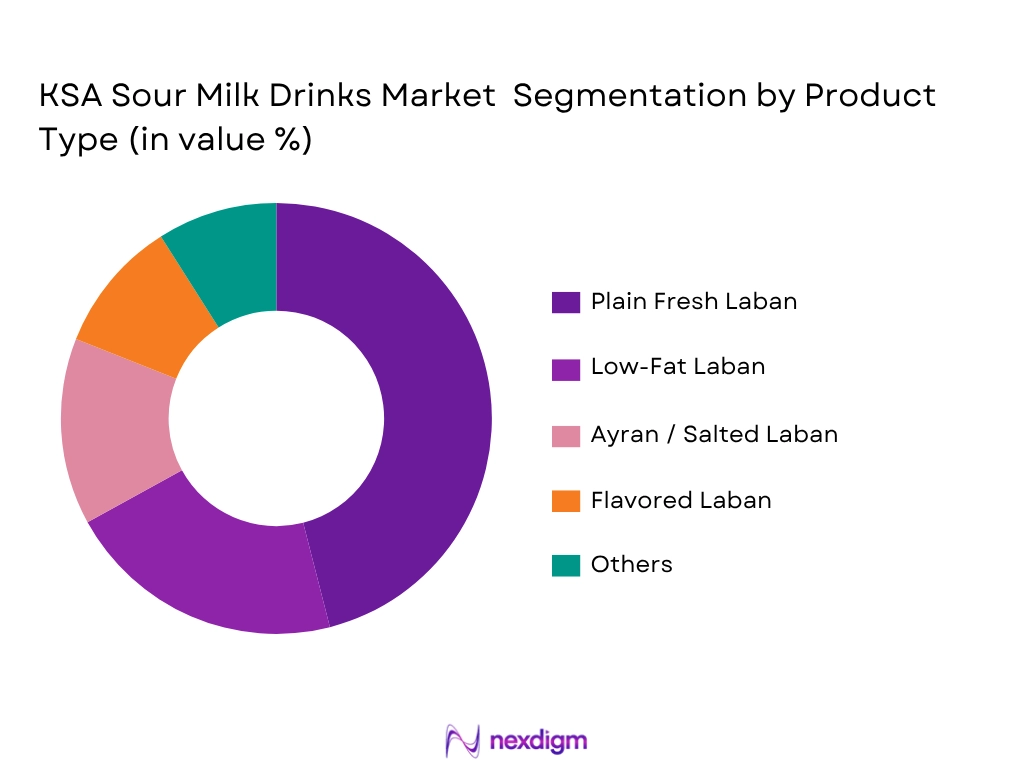
KSA Sour Milk Drinks Market is segmented by product type into plain fresh laban, low-fat laban, ayran/salted laban, flavored laban, probiotic/kefir sour milk drinks and camel milk-based fermented drinks. Plain fresh laban has the dominant market share because it is embedded in Saudi household meals and is consumed with rice, grilled meats, mandi, kabsa, shawarma and breakfast foods. Its dominance is reinforced by large family pack availability, routine replenishment through baqalas and supermarkets, and strong branded portfolios from Almarai, NADEC, Al Safi Danone and Nada. Almarai lists full-fat and low-fat fresh laban lines, while NADEC sells fresh laban and ayran formats fortified with vitamins, supporting wide mass-market coverage.
By Distribution Channel
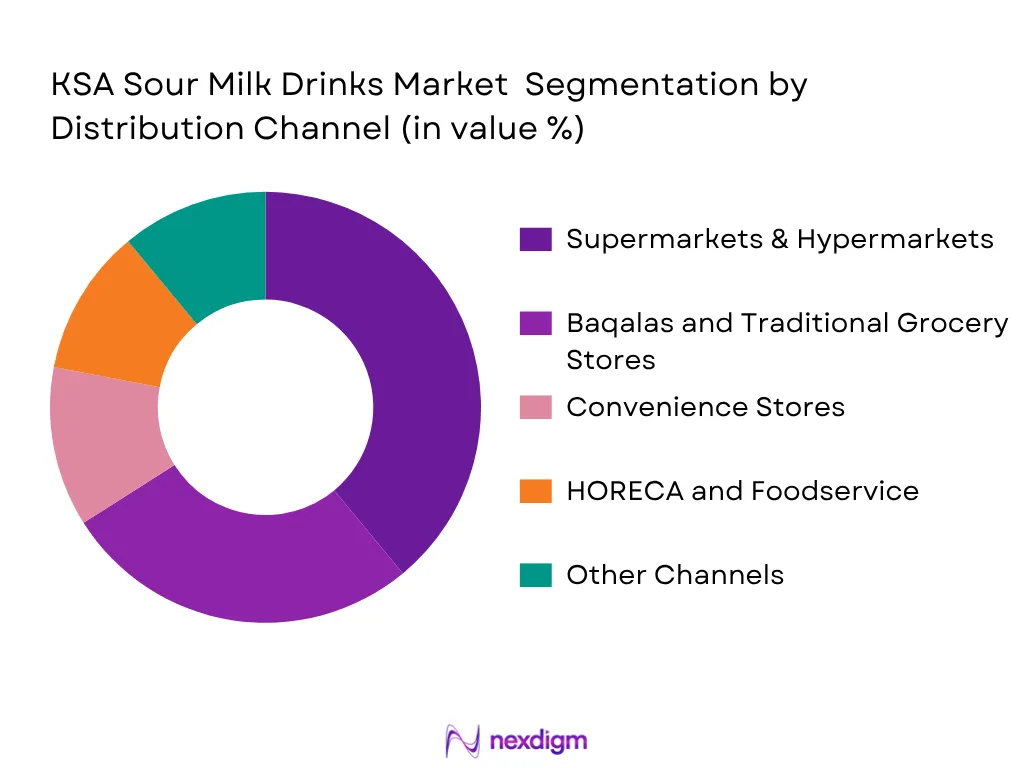
KSA Sour Milk Drinks Market is segmented by distribution channel into hypermarkets and supermarkets, baqalas and traditional grocery stores, convenience stores and petrol stations, HORECA and foodservice, online grocery and quick commerce, and institutional sales. Hypermarkets and supermarkets dominate due to refrigerated shelf capacity, wider SKU depth, multi-pack promotions and trust in expiry-date rotation. Retailers such as Carrefour, Lulu, Danube, Tamimi and Othaim provide visibility for full-fat laban, low-fat laban, ayran, flavored laban and probiotic variants. Baqalas remain critical for neighborhood replenishment, but modern trade controls larger basket purchases and family-pack demand. Online grocery is expanding through cold-chain-enabled replenishment, but chilled dairy still relies heavily on physical-store execution.
Competitive Landscape
The KSA Sour Milk Drinks Market is concentrated around vertically integrated Saudi dairy processors with strong fresh milk sourcing, refrigerated fleet networks and daily distribution capabilities. Almarai remains the most visible national player in fresh laban, while NADEC, Al Safi Danone and Nada compete through fresh dairy portfolios, ayran, low-fat products and fortified options. SADAFCO is more strongly associated with long-life dairy, but its distribution strength keeps it relevant in the wider dairy competitive set.
| Company | Establishment Year | Headquarters | Laban Portfolio | Ayran / Salted Drink Presence | Chilled Distribution Strength | Pack-Size Breadth | Health Positioning | Foodservice Relevance |
| Almarai | 1977 | Riyadh | ~ | ~ | ~ | ~ | ~ | ~ |
| NADEC | 1981 | Riyadh | ~ | ~ | ~ | ~ | ~ | ~ |
| Al Safi Danone | 1981 | Al-Kharj / Riyadh presence | ~ | ~ | ~ | ~ | ~ | ~ |
| Nada Dairy | 1982 | Al Ahsa / Eastern Province | ~ | ~ | ~ | ~ | ~ | ~ |
| SADAFCO | 1976 | Jeddah | ~ | ~ | ~ | ~ | ~ | ~ |
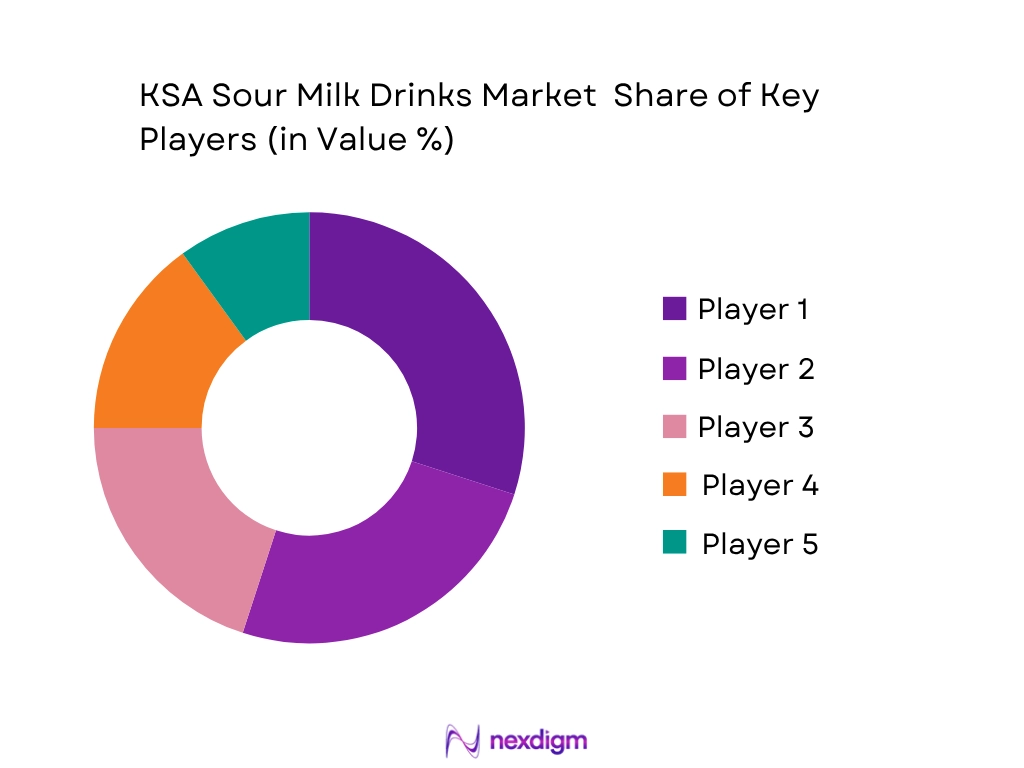
KSA Sour Milk Drinks Market Analysis
Growth Drivers
Chilled Dairy Penetration
Chilled dairy penetration in the KSA Sour Milk Drinks Market is supported by a large urban consumer base, dense grocery networks and recurring household demand for fresh laban and ayran. Saudi Arabia’s population is estimated at 35.3 million people, including 19.6 million Saudi citizens and 15.7 million non-Saudi residents, creating a broad base for daily chilled dairy replenishment. World Bank data places Saudi Arabia’s urban population at 85.17% of total population, which is structurally relevant because chilled laban depends on refrigerated retail shelves, short-distance route density and frequent store restocking. GASTAT also reports 3.0% real GDP growth in the first quarter of 2026 and 1.7% inflation in April 2026, indicating a relatively stable consumption environment for essential fresh dairy items. For laban producers, this supports wider distribution of HDPE family bottles, single-serve ayran and low-fat laban through supermarkets, baqalas, petrol-station stores and online grocery platforms. High urbanization reduces the logistical friction of chilled delivery because Riyadh, Jeddah, Dammam, Makkah and Madinah provide concentrated demand clusters where refrigerated trucks can serve many outlets per route. The same structure favors national dairy processors with integrated farms, depots and cold-chain fleets, as fresh sour milk drinks require daily or near-daily shelf servicing.
High Meal-Pairing Relevance
High meal-pairing relevance is a core driver for the KSA Sour Milk Drinks Market because laban and ayran are consumed with rice meals, grilled meat, shawarma, mandi, kabsa, breakfast plates and institutional catering meals. The consumer base is not limited to resident households: DataSaudi reports 116 million tourists in Saudi Arabia, including 29.7 million inbound tourists and 86.2 million domestic tourists, creating additional foodservice occasions where chilled dairy beverages can be served alongside meals. The same source records 560 million inbound overnight stays and 539 million domestic overnight stays, which expands breakfast buffet, hotel catering, restaurant and pilgrimage-linked foodservice demand. Religious tourism is especially relevant for laban because inbound religious tourists reached 12.3 million, while Q3 Umrah performers reached 6,270,868 according to GASTAT’s Umrah statistics. These figures justify strong Western Region demand around Makkah, Madinah and Jeddah, where hotels, caterers, canteens and restaurants require reliable chilled beverage supply. For market participants, meal-pairing relevance supports volume resilience across plain laban, salted ayran and low-fat laban, because the product is treated as a functional companion to meals rather than an occasional flavored beverage. It also strengthens single-serve formats in foodservice outlets and larger pack formats for household lunch and dinner consumption.
Market Challenges
Cold-Chain Cost
Cold-chain cost is a material challenge in the KSA Sour Milk Drinks Market because laban beverage, ayran and related chilled dairy products require strict refrigerated handling despite Saudi Arabia’s hot climate and geographically dispersed consumption points. SFDA’s transport requirements list laban beverage ayran or doogh at not more than 5°C during chilled dairy transportation, while the Ministry of Environment, Water and Agriculture states that Saudi summer maximum temperatures range from 35°C to 45°C. This gap between required product temperature and ambient summer heat increases the operational intensity of refrigerated trucks, temperature monitoring, insulated loading, outlet-level storage and rapid shelf replenishment. The issue is market-specific because sour milk drinks are typically fresh, high-rotation products sold through supermarkets, baqalas, petrol stations, restaurants and institutional canteens, not only centralized modern trade. Saudi Arabia’s population base of 35.3 million people and DataSaudi’s 116 million tourist trips add demand scale, but they also increase the number of delivery nodes needing chilled reliability. Riyadh and the Western Region require dense refrigerated logistics, while Southern and Northern areas increase route complexity due to lower outlet concentration. The challenge is therefore not simply transportation; it is maintaining laban quality and food-safety compliance across factory, depot, vehicle, receiving bay, retail chiller and final consumer purchase.
Short Shelf Life
Short shelf life is a market-specific constraint for KSA sour milk drinks because fresh laban and ayran depend on live-culture fermentation, cold storage integrity and rapid stock rotation. SFDA’s chilled dairy transport table requires laban beverage, ayran or doogh at not more than 5°C, and GSO-related fermented milk requirements specify cold storage after fermentation at 0°C to 5°C. These limits matter because Saudi Arabia combines high ambient heat, large population centers and heavy foodservice movement: the Kingdom has 35.3 million people, 15.7 million non-Saudi residents, and 116 million tourist trips, all of which expand daily consumption points but also increase expiry-management complexity. Fresh laban cannot be handled like ambient milk powder, juice or shelf-stable beverages; it needs fast dispatch, reliable temperature control, accurate demand forecasting and disciplined first-expiry-first-out practices at outlet level. GASTAT’s Q3 Umrah data shows 6,270,868 performers, creating concentrated short-period demand in Makkah and Madinah, where foodservice buyers may require large volumes within narrow operating windows. When demand spikes in Ramadan, summer travel or pilgrimage periods, processors must balance availability with the risk of unsold expired stock. This makes chilled route planning, production scheduling, return control and retailer execution central to profitability and brand reliability in the sour milk drinks category.
Market Opportunities
Premium Fermented Dairy
Premium fermented dairy is a future growth opportunity in the KSA Sour Milk Drinks Market because current macro and demographic indicators support demand for value-added nutrition, functional positioning and differentiated refrigerated beverages. World Bank reports Saudi Arabia’s GDP per capita at USD 35,121.7, while the IMF lists the country’s population at 35.3 million in its 2024 economic indicators and projects 36.726 million people for 2026. These figures indicate a large, relatively high-income consumer base for premium probiotic laban, kefir-style drinks, high-protein fermented dairy, fortified laban and low-fat functional beverages. The opportunity is market-specific because plain laban is already embedded in daily meals, allowing brands to upgrade familiar consumption occasions rather than create entirely new behavior. DataSaudi’s 116 million tourists, including 29.7 million inbound tourists, also provide premium channels through hotels, airport retail, cafés, supermarkets in major cities and religious-tourism corridors. The strongest product whitespace lies in refrigerated formats that combine familiar sour milk taste with added cultures, vitamin fortification, protein claims, digestive wellness cues and controlled sweetness. GSO’s probiotic-related standards reference lactic acid bacteria and fermented milk products, which reinforces the regulatory relevance of accurate culture-count and functional-ingredient positioning. Premium fermented dairy is therefore best approached through credible health communication, transparent labeling and cold-chain-backed freshness execution.
Camel Milk Sour Drinks
Camel milk sour drinks represent a future growth opportunity in the KSA Sour Milk Drinks Market because the product can combine fermented dairy demand with Saudi heritage, premium positioning and local livestock identity. The Saudi Press Agency, citing the Ministry of Environment, Water and Agriculture, reports that the Kingdom’s camel population reached 2,235,297 camels, with 656,423 camels in Riyadh Region and the Eastern Region following as another major camel base. This gives processors a culturally relevant raw-material story for camel milk laban, camel milk ayran and fermented camel dairy beverages aimed at premium retail, tourism retail, health-conscious consumers and local-origin buyers. The opportunity is supported by Saudi Arabia’s 116 million tourist trips, including 12.3 million inbound religious tourists, because pilgrimage and tourism corridors create demand for products tied to Saudi identity and differentiated food experiences. It is also supported by a large resident base of 35.3 million people, including 19.6 million Saudi citizens, where traditional consumption narratives can be localized more effectively than imported probiotic formats. Camel milk sour drinks would not replace mainstream cow-milk laban; instead, they can create an adjacent premium niche in single-serve bottles, giftable refrigerated formats, specialty grocers, hotel menus and airport or destination retail. The opportunity depends on supply consistency, sensory acceptance, cold-chain compliance and clear labeling around fermentation, fat content and nutritional properties.
Future Outlook
The KSA Sour Milk Drinks Market is expected to expand steadily as chilled dairy consumption grows across urban households, foodservice operators and religious tourism corridors. Growth will be supported by continued demand for laban as a traditional meal beverage, rising interest in probiotic and low-fat dairy, and broader investment in dairy supply chains. Almarai announced an investment plan of more than SAR 18 billion, including supply chain and core product-category expansion, indicating continued confidence in dairy and food security-led growth.
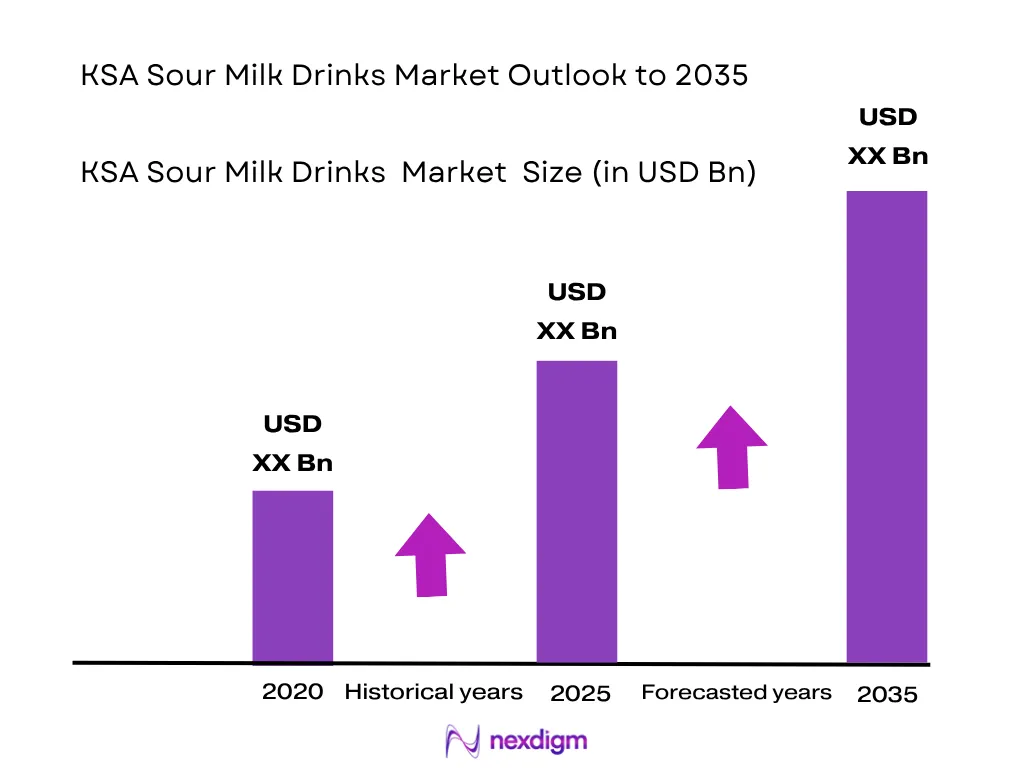
For the forecast period, a practical outlook for KSA sour milk drinks should be benchmarked against the parent KSA dairy CAGR of around 4.0% for 2026-2034 and global sour milk drinks CAGR of 3.6% for 2026-2035. Premium growth will likely come from probiotic laban, ayran, fortified drinks, camel milk fermented drinks and flavored single-serve SKUs, while volume stability will remain anchored in plain fresh laban and family packs.
Major Players
- Almarai Company
- National Agricultural Development Company – NADEC
- Al Safi Danone
- Nada Dairy
- Saudia Dairy & Foodstuff Company – SADAFCO
- United National Dairy Company
- Al Watania Agriculture
- Al Jouf Agricultural Development Company
- Danya Foods / Arla Foods
- Fonterra / Anchor
- Lactalis / Président
- Baladna Food Industries
- Al Ain Farms
- Al Rawabi Dairy
- Marmum Dairy Farm
Key Target Audience
- Dairy processing companies
- Chilled beverage manufacturers
- Supermarket and hypermarket chains
- Baqala and traditional grocery distributors
- HORECA operators and catering companies
- Investments and venture capitalist firms
- Government and regulatory bodies (Saudi Food and Drug Authority, Ministry of Environment, Water and Agriculture, Ministry of Commerce, General Authority for Statistics, Saudi Standards, Metrology and Quality Organization)
- Packaging, cold-chain logistics and refrigerated fleet companies
Research Methodology
Step 1: Identification of Key Variables
The initial phase involves constructing an ecosystem map covering dairy farms, laban processors, packaging suppliers, cold-chain logistics providers, modern trade retailers, baqalas, HORECA buyers and regulators. The objective is to identify critical variables such as raw milk supply, fermented dairy SKU count, chilled shelf availability, regional demand clusters, pricing architecture and product-level positioning.
Step 2: Market Analysis and Construction
Historical data is compiled for the KSA sour milk drinks ecosystem using parent dairy market benchmarks, yoghurt and sour milk product retail sales, company portfolios, online grocery SKU audits and channel-level price checks. The analysis evaluates value, volume, average selling price, pack size, product type, fat content and distribution-channel splits to construct a validated market framework.
Step 3: Hypothesis Validation and Expert Consultation
Market hypotheses are validated through structured interviews with dairy processors, distributors, supermarket category managers, HORECA procurement teams, cold-chain operators and foodservice suppliers. These discussions test assumptions on plain laban dominance, ayran growth, Ramadan seasonality, Hajj and Umrah uplift, product wastage, retail margins and emerging probiotic demand.
Step 4: Research Synthesis and Final Output
The final phase synthesizes secondary research, primary findings, retail SKU checks and bottom-up channel assumptions into a coherent market model. Company-level insights are compared against product availability, distribution reach, pack sizes and pricing. The resulting output provides a decision-useful view of market size, segmentation, competitive positioning, forecast direction and opportunity areas.

- Executive Summary
- Research Methodology (Market definitions and assumptions, sour milk drink inclusion/exclusion criteria, laban/ayran/kefir/flavored laban classification, abbreviation list, top-down market sizing, bottom-up SKU mapping, retail audit approach, chilled dairy value-chain validation, primary interviews with dairy processors/distributors/modern trade buyers/HORECA procurement teams, secondary research consolidation, price basket benchmarking, cold-chain validation, data triangulation, limitations and future conclusions)

- Definition and Scope
- Market Genesis and Evolution
- Timeline of Major Laban and Fermented Dairy Players
- Business Cycle and Seasonal Consumption Pattern
- Supply Chain and Value Chain Analysis
- Chilled Dairy Route-to-Market Structure
- Role of Laban in Saudi Meal Occasions and Hydration Consumption
- Impact of Hajj, Umrah, Ramadan, Summer Heat and Foodservice Demand

- Growth Drivers (Chilled dairy penetration, high meal-pairing relevance, health and gut-wellness demand, expanding modern grocery, foodservice recovery, religious tourism volumes, urbanization, premiumization)
- Market Challenges (Cold-chain cost, short shelf life, raw milk availability, promo pressure, wastage, SKU cannibalization, regulatory compliance, private-label pressure)
- Market Opportunities (Premium fermented dairy, camel milk sour drinks, functional claims, foodservice bulk, digital grocery, private label, localized flavors, sustainable packaging)
- Trends (Product innovation, packaging shift, halal assurance, clean label, proteinization, localization, sustainability, route automation)
- Government Regulation (SFDA compliance, GSO standards, halal requirements, dairy safety, microbiological criteria, nutrition labels, shelf-life declaration, claims substantiation)
- SWOT Analysis (Strengths, weaknesses, opportunities and threats for KSA laban and sour milk drinks)
- Stakeholder Ecosystem (Dairy farms, feed suppliers, processors, packaging suppliers, cold-chain logistics, distributors, retailers, online grocery platforms, HORECA buyers, regulators, consumers)
- Porter’s Five Forces (Supplier power, buyer power, threat of substitutes, threat of new entrants, competitive rivalry)
- Competition Ecosystem (Branded national players, regional dairy processors, private labels, imported probiotic brands, foodservice suppliers)
- Pricing and Promotion Analysis (Price per litre, pack-size ladder, modern trade discounts, baqala pricing, Ramadan promotions, bulk foodservice rates)

- By Value (2020-2025)
- By Volume (2020-2025)
- By Average Selling Price (2020-2025)
- By Retail Realization versus Distributor Realization (2020-2025)
- By Per Capita Consumption (2020-2025)

- By Product Type (In Value%)
Plain Fresh Laban
Low-Fat Laban
Ayran / Salted Laban
Flavored Laban
Kefir and Probiotic Sour Milk Drinks
Camel Milk-Based Sour/Fermented Drinks - By Fat Content (In Value%)
Full Fat
Low Fat
Fat Free / Light
Fortified Laban - By Packaging Size (In Value%)
Single-Serve Cups and Bottles
Small Family Packs
Large Family Packs
Multi-Packs
Foodservice Bulk Packs - By Packaging Format (In Value%)
HDPE Bottles
PET Bottles
Tetra / Carton Packs
Cups
Bulk Containers - By Distribution Channel (In Value%)
Hypermarkets and Supermarkets
Baqalas and Traditional Grocery Stores
Convenience Stores and Petrol Stations
Online Grocery and Quick Commerce
HORECA and Foodservice
Institutional Sales - By End User (In Value%)
Households
Working Professionals and Students
Restaurants and Quick-Service Food Chains
Hotels and Catering Companies
Health-Conscious Consumers
Pilgrims and Religious Tourism Consumers - By Region (In Value%)
Central Region
Western Region
Eastern Region
Southern Region
Northern Region - By Price Tier (In Value%)
Economy
Mass
Premium - By Consumption Occasion (In Value%)
Breakfast Consumption
Lunch and Dinner Meal Pairing
Hydration and Refreshment
Ramadan and Iftar/Suhoor
Travel, Pilgrimage and On-the-Go

- Market Share of Major Players (Value share, volume share, chilled dairy shelf share, laban SKU share, Product Type, Channel, Region)
- Cross Comparison Parameters (Company overview, KSA laban SKU range, ayran/flavored laban portfolio, fat-content variants, pack-size architecture, price per litre, chilled distribution reach, modern trade shelf presence, baqala penetration, HORECA and institutional coverage, production and dairy farm integration, cold-chain depot network, promotion intensity, freshness/shelf-life positioning, halal/SFDA compliance strength, innovation pipeline, online grocery visibility, brand recall, margins and trade schemes, recent developments, strengths, weaknesses)
- Major Player Benchmarking (Portfolio breadth, pricing ladder, channel coverage, freshness proposition, promotional depth, product innovation)
- SWOT Analysis of Major Players (Brand strength, distribution control, cost efficiency, SKU gaps, premiumization readiness)
- Pricing Analysis Basis SKUs for Major Players (180 ml, 225 ml, 340 ml, 360 ml, 800 ml, 1 L, 1.4 L, 1.75 L, 2 L, 3 L, bulk packs)
- Product Shelf Benchmarking (Facing count, chilled shelf placement, expiry rotation, promotion visibility, private-label adjacency)
- Detailed Profiles of Major Companies
Almarai Company
National Agricultural Development Company – NADEC
Al Safi Danone
Nada Dairy
Saudia Dairy & Foodstuff Company – SADAFCO
United National Dairy Company
Al Watania Agriculture
Al Jouf Agricultural Development Company
Danya Foods / Arla Foods
Fonterra / Anchor
Lactalis / Président
Baladna Food Industries
Al Ain Farms
Al Rawabi Dairy
Marmum Dairy Farm

- Market Demand and Utilization (Meal-pairing frequency, hydration occasions, family pack consumption, single-serve impulse)
- Purchasing Power and Budget Allocation (Price per litre, pack-size trade-off, premium versus mass preference)
- Regulatory and Compliance Requirements (Food safety, halal, cold storage, expiry monitoring, catering procurement standards)
- Needs, Desires and Pain Point Analysis (Freshness, consistent taste, low-fat variants, value packs, chilled availability, reduced sourness, convenient packs)
- Decision-Making Process (Brand trust, retailer availability, promotions, expiry date, pack size, nutritional claims)
- HORECA Procurement Analysis (Bulk pack preference, credit terms, delivery frequency, menu pairing, wastage control)
- Institutional Buyer Analysis (Volume contracts, food safety documentation, price stability, supply continuity)

- By Value (2026-2035)
- By Volume (2026-2035)
- By Average Selling Price (2026-2035)
- By Per Capita Consumption (2026-2035)
- By Retail and Foodservice Demand Split (2026-2035)


 Request a Sample
 Ask for Customization
 Get a Quote
 Enquire Now