
 Download PDF
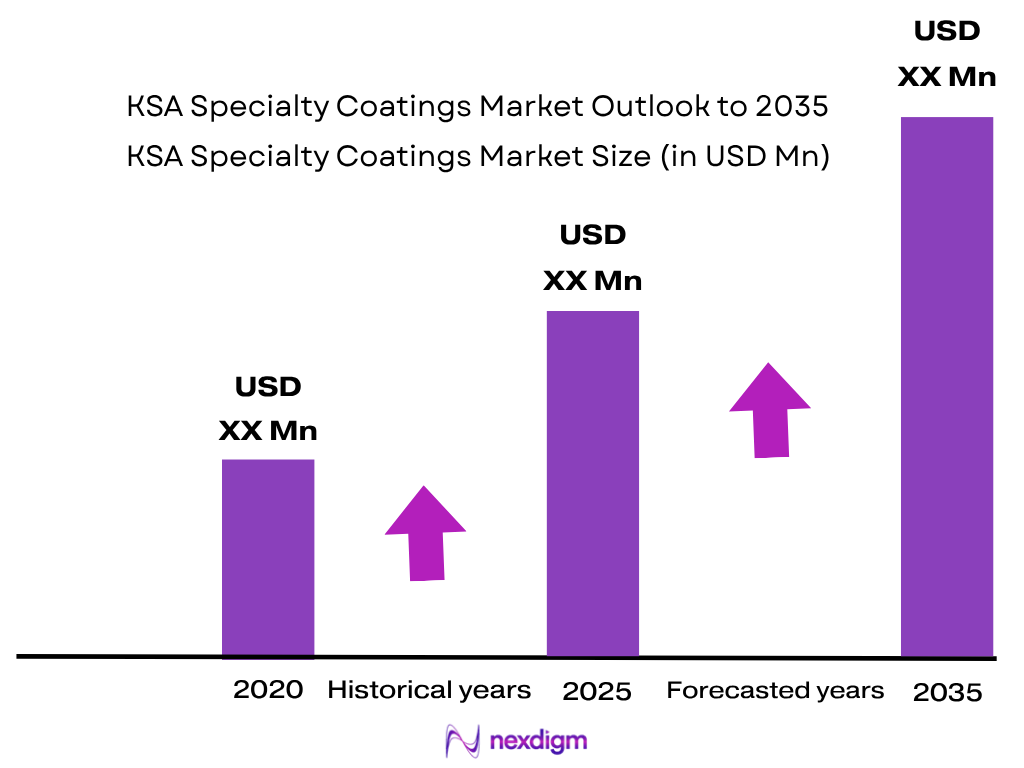
Market Overview
The KSA Specialty Coatings Market is valued at approximately USD ~ million, using Saudi industrial coatings as the closest published market proxy for specialty performance coatings. The preceding comparable market base was approximately USD ~900 million. Demand is supported by corrosion protection, industrial maintenance, oil and gas facilities, pipelines, petrochemicals, power assets and infrastructure. Saudi crude-oil production moved from 3,506.3 million barrels to 3,277.5 million barrels, illustrating the enormous installed hydrocarbon asset base requiring protective maintenance.
Dammam/Eastern Province, Riyadh, Jeddah, Jubail and Yanbu represent the principal demand centres for KSA specialty coatings. Dammam and Jubail benefit from concentrated oil, gas, petrochemical and industrial assets; Riyadh benefits from infrastructure and large development programs; Jeddah is supported by marine, logistics and construction demand; and Yanbu contains major refining and industrial assets. Saudi ports added 34 maritime services across Jeddah, Dammam and Jubail, while Jotun maintains Saudi manufacturing locations in Jeddah, Yanbu and Dammam. The specialty-coatings ecosystem is consequently more industrial and specification-driven than a conventional decorative-paint market. Products are selected according to corrosion category, substrate, chemical exposure, service temperature, dry-film thickness, durability, VOC profile and asset-owner specifications. Epoxies, polyurethane systems, zinc-rich primers, high-solids technologies, polysiloxanes, intumescent systems and specialized marine coatings are particularly relevant to the Kingdom’s operating environment.
Market Segmentation
By Resin Type
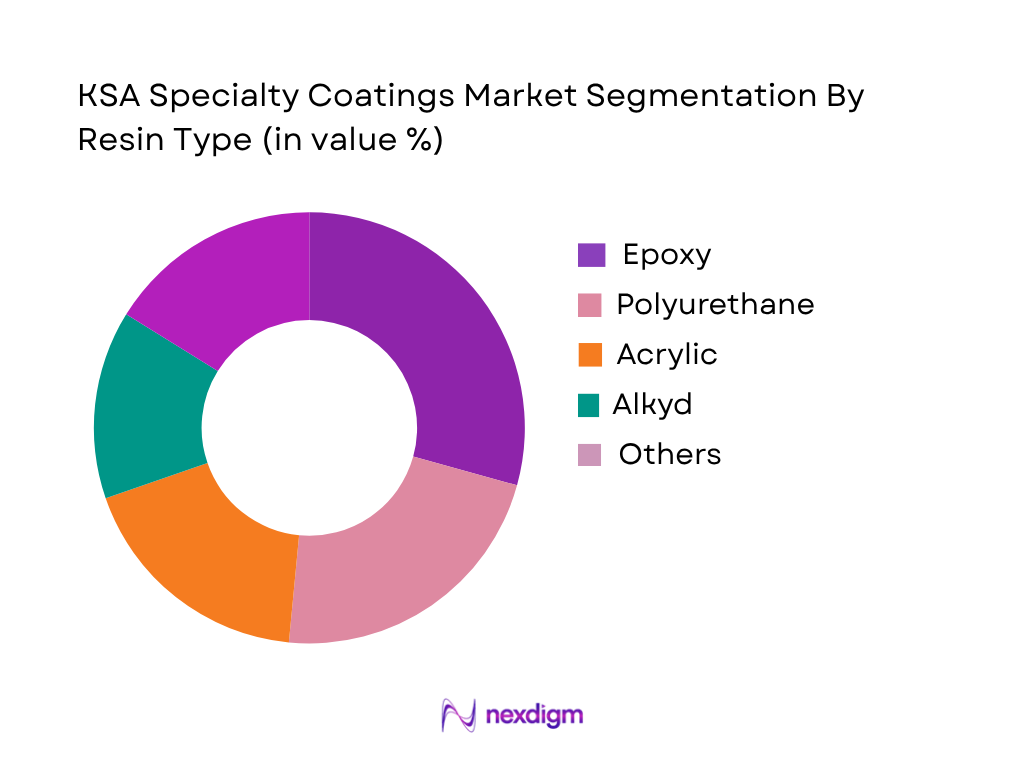
The KSA Specialty Coatings Market is segmented by resin type into epoxy, polyurethane, acrylic, alkyd, polyester and other specialty resin systems. Epoxy holds the dominant position within the specialty/industrial coatings resin mix. Its position is primarily attributable to excellent adhesion to prepared steel, chemical resistance, corrosion protection and compatibility with high-build coating systems. Saudi Arabia has extensive oil and gas infrastructure, refineries, petrochemical complexes, pipelines, storage tanks, marine structures and industrial equipment that require these performance characteristics. Epoxy systems are extensively deployed as primers, intermediate coats, tank linings, floor coatings and heavy-duty protective systems. Published industrial-coatings research places epoxy at approximately 29.26% of the relevant Saudi resin market. Polyurethane is important as a UV- and weather-resistant finish, particularly where colour retention and exterior durability are required.
By End-Use Industry
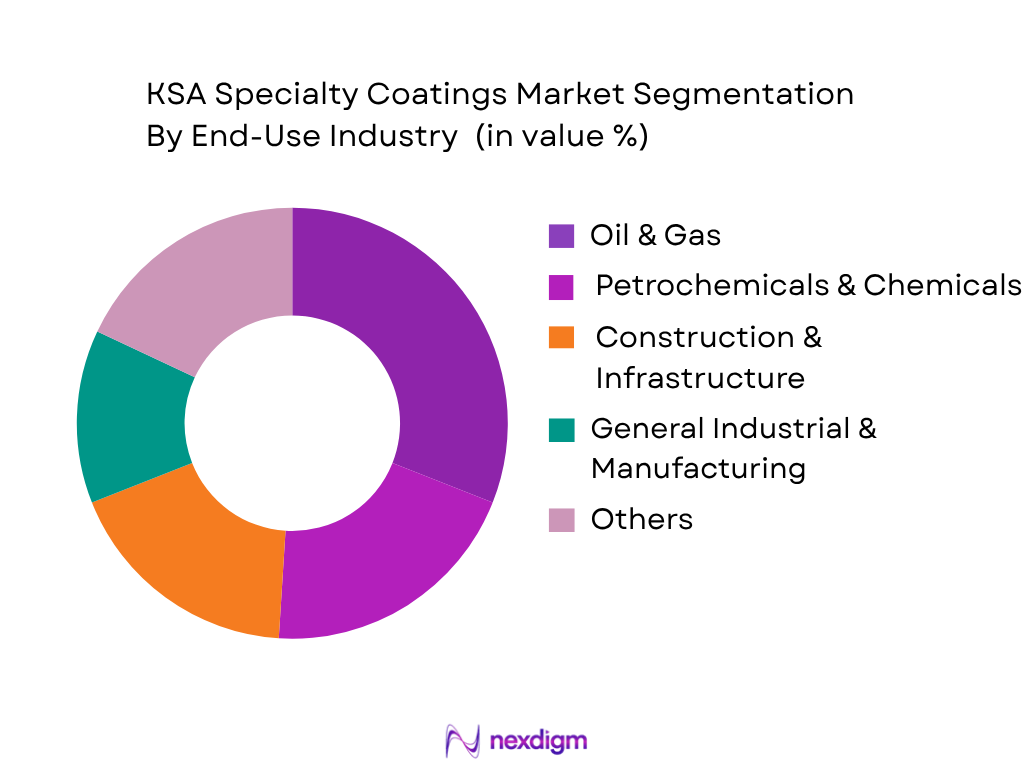
The KSA Specialty Coatings Market is segmented by end-use industry into oil and gas, petrochemicals and chemicals, marine and shipbuilding, construction and infrastructure, power and utilities, and general industrial/manufacturing applications. Oil and gas and associated hydrocarbon infrastructure represent the most strategically important specialty-coatings demand pool. The Kingdom operates an extensive network of production facilities, pipelines, processing plants, storage tanks and downstream installations where corrosion control is critical to asset integrity. Saudi Arabia produced 3,277.5 million barrels of crude oil, compared with 3,506.3 million barrels in the preceding period. These operating assets require recurring inspection, maintenance and recoating independent of greenfield construction. Specialty coatings therefore serve both capital projects and recurring MRO demand, including high-build epoxy, zinc-rich, polyurethane, heat-resistant, tank-lining and pipeline systems.
Competitive Landscape
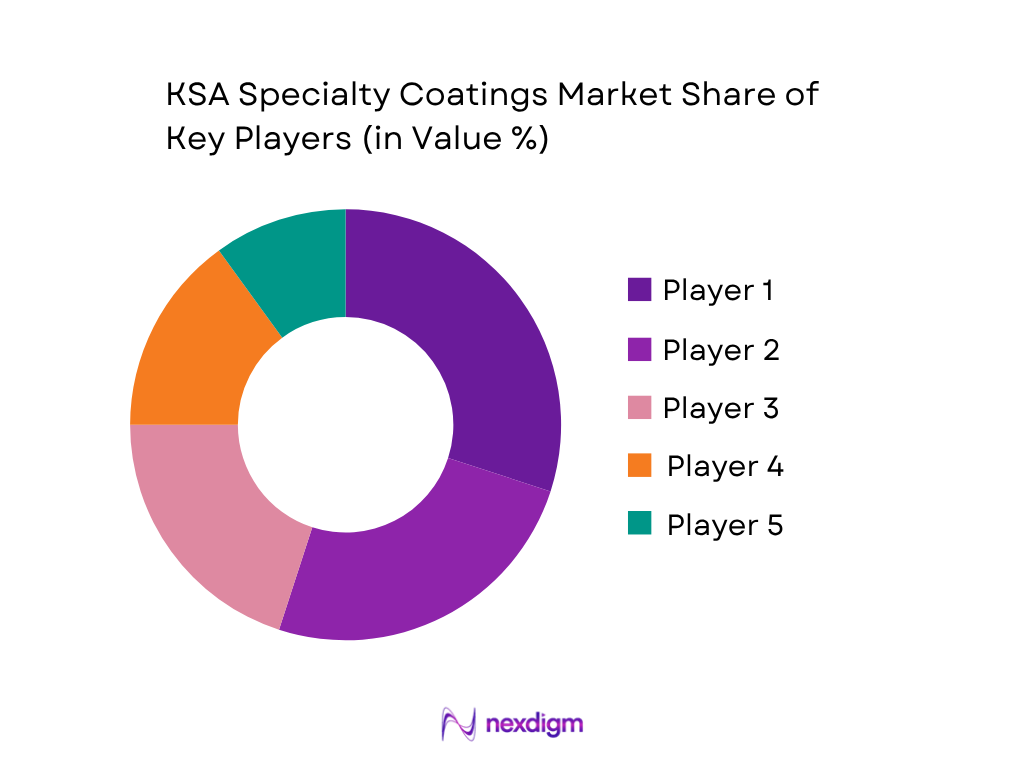
The KSA Specialty Coatings Market has a combination of multinational coatings groups and established Saudi/regional manufacturers. Competition is particularly strong in protective, marine, industrial, flooring and high-performance coatings, where technical approvals, product specifications, local manufacturing, application support and customer relationships are critical. Major international participants include Jotun, AkzoNobel, Hempel, PPG and Sherwin-Williams. Published Saudi industrial-coatings research consistently identifies these companies among prominent suppliers.
| Major Player | Established | Headquarters | Key Specialty-Coating Focus | Protective/Marine Capability | KSA Manufacturing/Local Presence | Key Resin Systems | Major End Uses | Technical Positioning |
| Jotun | 1926 | Sandefjord, Norway | ~ | ~ | ~ | ~ | ~ | ~ |
| AkzoNobel | 1792 | Amsterdam, Netherlands | ~ | ~ | ~ | ~ | ~ | ~ |
| Hempel | 1915 | Lyngby, Denmark | ~ | ~ | ~ | ~ | ~ | ~ |
| PPG | 1883 | Pittsburgh, USA | ~ | ~ | ~ | ~ | ~ | ~ |
| Sherwin-Williams | 1866 | Cleveland, USA | ~ | ~ | ~ |
KSA Specialty Coatings Market Analysis
Growth Drivers
Oil & Gas, Refining and Petrochemical Asset Protection
Saudi Arabia’s hydrocarbon and downstream asset base creates a structurally recurring requirement for anti-corrosion coatings, tank linings, pipeline coatings, high-temperature systems, marine protection and chemical-resistant coatings. Saudi crude-oil production reached 3,277.5 million barrels in 2024, while crude exports totaled 2,214 million barrels and domestic crude consumption stood at 166.5 million barrels, according to the General Authority for Statistics. Domestic production of gas oil/diesel also reached 407.8 million barrels, highlighting the scale of refining and petroleum-processing infrastructure exposed to aggressive operating environments. These installations require periodic surface preparation, maintenance painting and recoating to control corrosion and extend equipment life. The macroeconomic backdrop remains supportive: the World Bank records Saudi Arabia’s nominal GDP at USD 1.254 trillion in 2024, while the IMF reported that oil output was maintained at around 9 million barrels per day during 2024. The combination of large production volumes, pipelines, storage terminals, refineries and petrochemical assets provides a sizeable installed base where specialty coatings function as essential asset-integrity materials rather than discretionary finishes.
Expansion of Industrial, Construction and Logistics Infrastructure
Saudi Arabia’s industrial diversification is materially increasing the number of structures, factories, logistics facilities and transport assets requiring protective, flooring, fire-resistant, powder and concrete-protection coatings. General Authority for Statistics data show that Saudi businesses purchased SAR 1,653 billion of fixed assets in 2024, indicating substantial capital formation across the economy. Manufacturing was the largest operating-revenue activity in the business sector, while construction represented another major contributor to economic activity. The Ministry of Industry and Mineral Resources reported 11,672 factories operating or under construction as early as January 2024, with 152 new industrial licences issued during that month alone and associated investments of SAR 6.2 billion. Logistics infrastructure is expanding simultaneously: the Vision 2030 annual reporting framework records 34 new maritime shipping services introduced across Saudi ports during 2024, including Jeddah Islamic Port, King Abdulaziz Port in Dammam and Jubail Commercial Port. This expanding physical asset base increases coated steel, machinery, flooring, terminals and industrial structures requiring performance coatings throughout construction and subsequent maintenance cycles.
Market Challenges
Dependence on Imported Specialty Inputs and Exposure to External Supply Conditions
The KSA specialty coatings industry remains exposed to international supply chains because several high-performance resin systems, curing agents, functional pigments, specialty additives and advanced chemical intermediates are sourced through global trade channels. This vulnerability is significant in an economy undertaking large investment-linked imports. The IMF reported that Saudi Arabia’s current account shifted into a deficit in 2024 as lower oil receipts coincided with stronger imports associated with investment and diversification activity. Saudi Arabia’s nominal GDP stood at USD 1.254 trillion in 2024 according to the World Bank, showing the scale of economic activity driving raw-material demand, while the IMF recorded central-bank net foreign assets of approximately USD 415 billion in 2024. The coatings challenge is therefore not an absence of financial capacity, but operational exposure to imported chemical feedstocks, international freight, lead times and supplier concentration. Specialty formulations based on advanced epoxy curing agents, fluoropolymers, polysiloxanes and high-performance additives are particularly sensitive because qualifying alternative materials can require reformulation, laboratory validation and customer reapproval before they can be substituted in specification-driven industrial applications.
Product Qualification, Application Control and Project Execution Complexity
Specialty coatings used in Saudi oil and gas, petrochemical, marine and infrastructure projects must satisfy demanding technical specifications covering surface preparation, dry-film thickness, curing, temperature resistance, chemical exposure and corrosion performance. The challenge becomes more significant as industrial activity expands. The Ministry of Industry and Mineral Resources recorded 11,672 factories operating or under construction in January 2024, while 79 factories commenced production during that month, adding more industrial assets requiring technically controlled coating applications. Construction activity also remains substantial: General Authority for Statistics data show total business-sector fixed-asset purchases of SAR 1,653 billion in 2024, with construction accounting for a meaningful portion of gross fixed capital formation. More recently, GASTAT recorded 5,056 building permits in May 2026, compared with 7,584 permits in May 2025, illustrating the scale and volatility of project execution. For specialty-coating suppliers, a large pipeline does not automatically translate into immediate consumption because product qualification, technical submittals, approved applicator selection, inspection requirements and project scheduling can extend commercialization cycles and create irregular order timing.
Market Opportunities
Localization of High-Performance Coatings and Industrial Formulation Capacity
Saudi Arabia’s expanding industrial base creates a clear opportunity for specialty-coating producers to localize formulation, blending, filling, warehousing and technical support closer to end users. The Ministry of Industry and Mineral Resources reported 11,672 factories operating or under construction in January 2024, while the same month saw 152 industrial licences issued and 79 factories begin production. Fourteen of the newly issued licences were for chemicals and chemical products, demonstrating continuing expansion of the domestic chemicals ecosystem that can support coating localization. The wider capital-investment environment is also substantial: General Authority for Statistics data show SAR 1,653 billion in purchases of fixed assets by Saudi businesses during 2024. The World Bank places Saudi Arabia’s nominal GDP at USD 1.254 trillion in 2024, while the IMF recorded strong expansion in non-oil economic activity driven partly by construction and manufacturing. These indicators support future localization because coating suppliers with Saudi formulation capacity, shorter delivery cycles, local inventory, field technical service and project-specific customization can increasingly serve domestic industrial customers without relying exclusively on finished-product imports.
Advanced Protective Systems for Ports, Marine Assets and New Industrial Infrastructure
Saudi Arabia’s expanding logistics and industrial network creates future opportunities for marine, anti-corrosion, immersion-service, flooring, passive-fire-protection and long-life protective coating systems. Official Vision 2030 reporting records 34 additional maritime services introduced during 2024 across major ports including Jeddah Islamic Port, King Abdulaziz Port in Dammam and Jubail Commercial Port. These additions increase vessel calls, terminal activity and supporting infrastructure exposure to saltwater, humidity, abrasion and aggressive atmospheric conditions, all of which require specialized coating protection. Industrial expansion adds another layer of demand: Saudi Arabia had 11,672 factories operating or under construction in January 2024, and 79 additional factories began production during that month. The IMF reported continued strong non-oil activity in 2024, with construction and manufacturing among the principal contributors, while the World Bank recorded nominal GDP of USD 1.254 trillion. These current indicators establish a strong physical-asset base from which future specialty-coating consumption can develop through new construction, commissioning, preventive maintenance and periodic recoating of ports, plants, warehouses, fabricated steel and utility infrastructure.
Future Outlook
The KSA Specialty Coatings Market is expected to expand at a forecast CAGR of approximately ~4.0% during the forecast period, supported by industrial diversification, hydrocarbon asset maintenance, downstream petrochemical investments, transportation infrastructure, marine development, water infrastructure and major construction programs. Published forecasts for adjacent Saudi industrial-coatings categories vary by scope, with one current forecast indicating approximately 3.9% CAGR, demonstrating the importance of maintaining a tightly defined specialty-coatings boundary. Future demand is expected to shift gradually toward coatings that deliver longer service intervals and lower lifecycle costs. High-solids epoxy, solvent-free linings, waterborne systems, advanced polyurethane topcoats, polysiloxanes and specialty powder coatings are positioned to gain importance as asset owners seek improved durability alongside environmental compliance.
Oil and gas will remain a critical demand generator because the existing asset base itself creates recurring MRO requirements. Pipeline networks, tank farms, offshore structures, refineries and petrochemical installations require inspection, surface preparation and periodic recoating throughout their operating lives. Epoxy already represents the leading industrial resin in one Saudi market assessment, reflecting its suitability for these conditions.
Major Players
- Jotun Saudia Co. Ltd.
- Hempel
- AkzoNobel / International
- PPG Industries
- The Sherwin-Williams Company
- Al-Jazeera Paints
- Saudi Industrial Paint Company (SIPCO)
- National Paints Factories
- Sigma Paints Saudi Arabia
- Kansai Paint
- Axalta Coating Systems
- Carboline
- Sika Saudi Arabia
- Fosroc Saudi Arabia
- Asian Paints / Berger Middle East
Key Target Audience
- Specialty Coatings Manufacturers and Formulators
- Oil & Gas, Refining and Petrochemical Asset Owners
- EPC Contractors and Industrial Coating Applicators
- Marine, Shipbuilding and Port Infrastructure Companies
- Construction, Infrastructure and Giga-Project Developers
- Raw Material, Resin, Pigment and Specialty Additive Suppliers
- Investments and Venture Capitalist Firms
- Government and Regulatory Bodies (Saudi Standards, Metrology and Quality Organization [SASO], Ministry of Industry and Mineral Resources, Ministry of Environment, Water and Agriculture, Royal Commission for Jubail and Yanbu)
Research Methodology
Step 1: Identification of Key Variables
The initial phase involves constructing the complete KSA Specialty Coatings Market ecosystem, including coating manufacturers, raw-material suppliers, distributors, EPC contractors, asset owners, applicators and regulators. Secondary research identifies critical variables such as coating consumption, resin mix, end-use demand, imports, local production, project pipeline, maintenance cycles, pricing and specification requirements.
Step 2: Market Analysis and Construction
Historical demand is assessed through top-down and bottom-up approaches. The top-down model evaluates industrial output, oil and gas assets, construction activity, marine infrastructure and manufacturing demand, while the bottom-up model examines coating consumption by application, coated surface area, dry-film thickness, recoating intervals, project activity, manufacturer sales and distributor throughput.
Step 3: Hypothesis Validation and Expert Consultation
Market hypotheses are validated through computer-assisted telephone interviews and structured discussions with coating manufacturers, EPC companies, industrial distributors, applicators, technical specifiers and procurement professionals. Interviews test assumptions regarding resin preferences, product pricing, project specifications, competitive positioning, localization, qualification requirements and maintenance demand.
Step 4: Research Synthesis and Final Output
Primary findings are triangulated against company information, trade statistics, government publications, industry databases and secondary market sources. Market size and segment estimates are reconciled through supply-side and demand-side checks, followed by forecasting based on project pipelines, industrial activity, maintenance requirements, technology shifts and macroeconomic conditions to generate the final validated market model.

- Executive Summary
- Research Methodology (Market Definition and Scope, KSA Specialty Coatings Taxonomy, Coating Chemistry Classification, Functional Performance Mapping, Market Sizing Framework, Top-Down Analysis, Bottom-Up Analysis, Domestic Production Assessment, Import Dependency Assessment, Demand-Side Assessment, Supply-Side Assessment, End-Use Application Mapping, Industrial Consumption Assessment, Primary Industry Interviews, Trade-Flow Validation, Data Triangulation, Forecasting Framework, Scenario Analysis, Assumptions and Limitations)

- Definition and Scope
- KSA Specialty Coatings Industry Evolution and Technology Development
- Specialty Coatings Manufacturing and Formulation Process
- Specialty Coatings Value Chain Analysis
- KSA Specialty Coatings Supply Chain Analysis
- KSA Specialty Coatings Raw Material and Resin Ecosystem
- KSA Specialty Coatings Application and Project Specification Ecosystem

- Growth Drivers (Oil and Gas Capital Expenditure, Petrochemical Capacity Expansion, Giga-Project Construction, Infrastructure Development, Desalination and Water Infrastructure Expansion, Marine and Port Development, Industrial Diversification, Corrosion Protection Requirements)
- Market Challenges (Raw Material Price Volatility, Import Dependency for Specialty Chemicals, Long Product Approval Cycles, Skilled Applicator Availability, Harsh Climatic Conditions, Technical Specification Barriers, Price Competition, Environmental Compliance Costs)
- Market Opportunities (High-Performance Anti-Corrosion Coatings, Passive Fire Protection Coatings, Pipeline Coatings, Tank Linings, Marine and Offshore Coatings, Specialty Industrial Flooring, High-Temperature Coatings, Low-VOC Technologies, Specialty Powder Coatings)
- Market Trends (High-Solids Coating Adoption, Water-Borne Technology Shift, Solvent-Free Systems, Longer-Life Protective Coatings, Polysiloxane Adoption, Low-VOC Formulations, Faster-Curing Systems, Specification-Led Procurement, Local Manufacturing Expansion)
- Regulatory and Standards Landscape (Saudi Standards, Metrology and Quality Organization Requirements, SABER Conformity Requirements, Environmental Performance Requirements, VOC Compliance, Hazardous Chemical Handling Requirements, Product Safety Requirements, Industrial Environmental Regulations)
- SWOT Analysis
- Porter’s Five Forces Analysis
- PESTLE Analysis

- By Market Value (2020-2025)
- By Coating Consumption Volume (2020-2025)
- By Domestic Production Volume (2020-2025)
- By Import Volume (2020-2025)
- By Export Volume (2020-2025)
- By New-Project Coating Demand (2020-2025)
- By Maintenance and Recoating Volume (2020-2025)
- By Average Realized Selling Price (2020-2025)
- By Application Revenue (2020-2025)

- By Coating Type (In Value %)
Protective and Anti-Corrosion Coatings
Marine Coatings
Industrial Floor Coatings
Fire-Resistant and Intumescent Coatings
High-Temperature Coatings
Chemical-Resistant Coatings
Pipeline Coatings
Tank and Vessel Linings
Specialty Powder Coatings
Abrasion-Resistant Coatings
Anti-Fouling Coatings
Specialty Concrete Protection Coatings - By Resin Type (In Value %)
Epoxy
Polyurethane
Acrylic
Alkyd
Polyester
Fluoropolymer
Polysiloxane
Silicone
Vinyl Ester
Zinc-Rich and Inorganic Silicate Systems - By Technology (In Value %)
Solvent-Borne Coatings
Water-Borne Coatings
High-Solids Coatings
Solvent-Free Coatings
Powder Coatings
Fusion-Bonded Epoxy Coatings
UV-Cured Coatings
Moisture-Cured Coatings - By Application (In Value %)
Structural Steel Protection
Pipelines
Storage Tanks and Process Vessels
Marine Vessels and Offshore Structures
Industrial Floors
Machinery and Equipment
Bridges and Infrastructure
Process Piping
Fire-Protected Steel Structures
Concrete Structures - By End-Use Industry (In Value %)
Oil and Gas
Petrochemicals and Chemicals
Marine and Shipbuilding
Construction and Infrastructure
Automotive and Transportation
Power Generation
Renewable Energy
Water and Wastewater Treatment
Mining and Metals
Industrial Manufacturing
Food and Beverage Processing
Warehousing and Logistics - By Demand Type (In Value %)
Greenfield Projects
Brownfield Expansion Projects
Maintenance, Repair and Operations
Shutdown and Turnaround Maintenance
Rehabilitation and Recoating
OEM and Factory-Applied Coatings - By Substrate Type (In Value %)
Carbon Steel
Galvanized Steel
Stainless Steel
Aluminium
Concrete
Masonry
Composite Materials
Other Industrial Substrates - By Sales Channel (In Value %)
Direct Sales to Asset Owners
EPC Contractor Sales
Authorized Distributors and Dealers
Applicator and Contractor Sales
OEM and Fabricator Sales
Project-Based Tender Sales

- Market Share of Major Players (By Revenue, Volume, Coating Type, Resin Type, Application, End-Use Industry, Technology, Distribution Channel)
- Cross Comparison Parameters (Specialty Coating Portfolio Breadth, Protective and Marine Coating Capability, KSA Manufacturing and Formulation Footprint, Asset-Owner and EPC Approval Coverage, Project Specification Penetration, Local Technical-Service and Application Support, Distribution and Inventory Reach, High-Performance and Low-VOC Technology Portfolio)
- SWOT Analysis of Major Players (Product Strength, Technology Capability, Manufacturing Footprint, Distribution Strength, Key Account Access, Competitive Gaps)
- Competitive Positioning Matrix (Product Breadth, Technical Performance, Market Presence, Specification Strength, Pricing Position, End-Use Coverage)
- Pricing Benchmarking of Major Players (Price per Litre, Price per Kilogram, Applied Cost per Square Meter, Product Grade, Coating System, Project Pricing)
- Product and Technology Benchmarking of Major Players (Dry Film Thickness, Solids by Volume, VOC Content, Corrosion Resistance, Chemical Resistance, Temperature Resistance, Cure Time, Expected Service Life)
- Detailed Profiles of Major Companies
Jotun Saudia Co. Ltd.
Hempel Saudi Arabia
AkzoNobel / International Paint
PPG Industries
The Sherwin-Williams Company
Al-Jazeera Paints
Saudi Industrial Paint Company (SIPCO)
National Paints Factories Co. Ltd.
Sigma Paints Saudi Arabia
Kansai Paint
Axalta Coating Systems
Carboline
Sika Saudi Arabia
Fosroc Saudi Arabia
Berger Paints / Asian Paints Middle East

- Buyer Segmentation
- Procurement Behaviour
- Supplier Selection Criteria
- Buyer Pain Points
- Technology Adoption Assessment
- Replacement and Repurchase Behaviour

- By Market Value (2026-2035)
- By Coating Consumption Volume (2026-2035)
- By Domestic Production Volume (2026-2035)
- By Import Volume (2026-2035)
- By Export Volume (2026-2035)
- By New-Project Coating Demand (2026-2035)
- By Maintenance and Recoating Volume (2026-2035)
- By Average Realized Selling Price (2026-2035)
- By Application Revenue (2026-2035)


 Request a Sample
 Ask for Customization
 Get a Quote
 Enquire Now