

 Download PDF
Market Overview
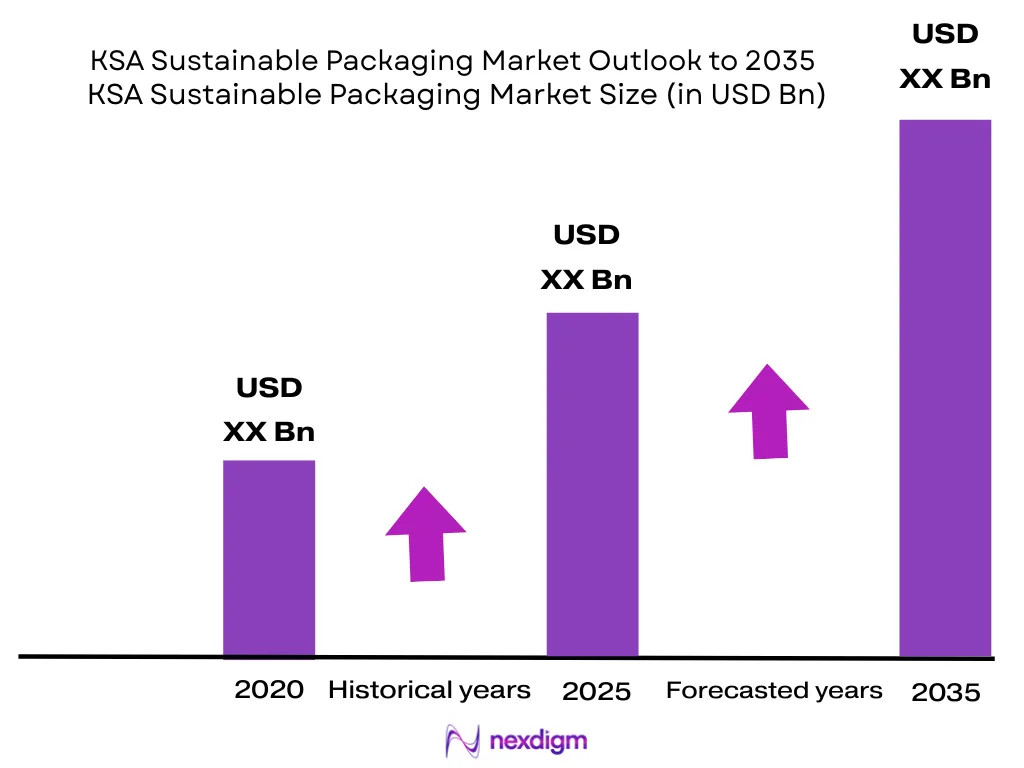
The KSA Sustainable Packaging Market is valued at approximately USD ~ billion and is forecast to expand at a CAGR of % during 2026–2035. Saudi Arabia’s nominal GDP increased from approximately SAR 4.14 trillion to SAR 4.70 trillion, while non-oil manufacturing, wholesale trade, hospitality, food processing, and logistics expanded. Sustainable packaging demand is being driven by industrial localization, food-security investment, e-commerce, tourism, pilgrimage catering, waste-management reforms, and corporate packaging-reduction programs. Riyadh, Jeddah, Dammam, Jubail, Makkah, Madinah, Yanbu, and King Abdullah Economic City dominate the KSA Sustainable Packaging Market. Riyadh concentrates corporate procurement, retail, food manufacturing, and national distribution; Jeddah supports ports, food imports, pilgrimage supply chains, and western-region conversion; while Dammam and Jubail benefit from petrochemical feedstocks, industrial manufacturing, flexible-film production, and Gulf logistics. Makkah and Madinah generate specialized demand through high-volume hospitality, bottled-water, foodservice, and institutional catering requirements.
Market Segmentation
By Material Type
The KSA Sustainable Packaging Market is segmented into paper and paperboard, recycled and recyclable plastics, aluminum and steel, glass, bio-based and biodegradable plastics, molded fiber, wood, and sustainable multi-material structures. Paper and paperboard hold the dominant position because corrugated cases, folding cartons, paper sacks, cups, food boxes, retail bags, and e-commerce mailers serve food, beverages, pharmaceuticals, household goods, electronics, dates, fresh produce, and industrial products. Saudi Arabia has substantial corrugated and board-conversion capacity. United Carton Industries describes itself as the largest corrugated supplier in the MENA region, while Obeikan Paper Industries produces 220,000 tonnes of duplex carton board annually. Paper formats also support plastic substitution and high-quality printing. Plastics remain important where moisture barriers, sealing, low transport weight, transparency, and product durability are required. Gulf Packaging Industries operates BOPP, CPP, and metallizing lines serving flexible-packaging applications.
By End-Use Industry
The KSA Sustainable Packaging Market is segmented into food and beverage, foodservice and hospitality, retail and e-commerce, healthcare and pharmaceuticals, personal and household care, petrochemicals and industrial goods, agriculture, aviation catering, and other applications. Food and beverage hold the dominant position because Saudi consumers and institutions require bottled water, dairy products, juices, bakery goods, confectionery, dates, meat products, ready meals, edible oils, coffee, and packaged staples. These categories use PET bottles, cartons, cans, glass containers, pouches, trays, cups, closures, labels, corrugated cases, and temperature-resistant packaging. Obeikan Liquid Packaging has capacity for 2 billion carton packs annually, demonstrating the scale of domestic liquid-food packaging. Foodservice demand is reinforced by restaurants, hotels, delivery platforms, events, hospitals, workplaces, and pilgrimage catering. Sustainable conversion increasingly focuses on lighter packs, fiber products, recyclable films, reusable transport containers, and compliant biodegradable plastics.
Competitive Landscape
The KSA Sustainable Packaging Market combines large integrated packaging groups, corrugated-box producers, paperboard manufacturers, flexible-film suppliers, rigid-plastic converters, liquid-carton companies, and industrial-packaging businesses. Napco National and Obeikan offer broad portfolios across major packaging categories, while Gulf Packaging Industries supplies high-volume flexible films. United Carton Industries is a leading corrugated producer, and SIG Combibloc Obeikan participates in aseptic liquid-food packaging. Competition is based on manufacturing capacity, local-content credentials, material efficiency, food-contact compliance, print quality, barrier performance, design support, export coverage, and development of recyclable or lower-material structures.
| Company | Establishment Year | Headquarters | Core Sustainable Portfolio | Material Capability | Principal End Uses | KSA Manufacturing Footprint | Circularity Capability | Strategic Differentiation |
| Napco National | 1956 | Dammam, Saudi Arabia | ~ | ~ | ~ | ~ | ~ | ~ |
| Obeikan Investment Group | 1982 | Riyadh, Saudi Arabia | ~ | ~ | ~ | ~ | ~ | ~ |
| Gulf Packaging Industries | 1989 | Jubail, Saudi Arabia | ~ | ~ | ~ | ~ | ~ | ~ |
| United Carton Industries Company | 1989 | Jeddah, Saudi Arabia | ~ | ~ | ~ | ~ | ~ | ~ |
| SIG Combibloc Obeikan | Joint venture platform | Riyadh, Saudi Arabia | ~ | ~ | ~ | ~ | ~ | ~ |
KSA Sustainable Packaging Market Analysis
Growth Drivers
Expansion of Non-Oil Manufacturing and Packaged-Goods Production
Saudi Arabia’s industrial diversification is expanding the customer base for recyclable corrugated cartons, lightweight bottles, mono-material films, folding cartons, aseptic packs, molded-fiber trays, industrial sacks, reusable crates, and lower-material transport packaging. The General Authority for Statistics recorded nominal GDP of SAR 4,703 billion in 2024, while non-oil activities expanded by 4.3 percentage points in real terms. In 2025, current-price GDP increased to SAR 4,789 billion, with manufacturing excluding oil refining accounting for 11.1 parts of every 100 parts of economic output. Wholesale and retail trade, restaurants, and hotels represented another 12.3 parts, directly supporting packaging demand across consumer goods and foodservice channels. These economic activities translate into larger packaging requirements for dairy products, bottled water, juices, dates, bakery products, confectionery, pharmaceuticals, cosmetics, household chemicals, electronics, spare parts, and e-commerce shipments. Localization is particularly relevant because domestic producers require packaging compatible with automated filling, warehousing, palletization, desert transport, refrigerated distribution, and regional exports. Riyadh supports national food, pharmaceutical, retail, and e-commerce operations; Jeddah connects converters with ports, imported food, hospitality, and pilgrimage supply chains; while Dammam and Jubail provide access to petrochemical resins, industrial customers, and Gulf logistics. Packaging suppliers can consequently shorten delivery lead times, conduct production-line trials locally, maintain safety stocks, and tailor structures to Saudi climatic conditions.
Waste-Management Policy and Packaging Conformity Requirements
Saudi government policy is increasing demand for packaging that uses fewer materials, carries verifiable environmental claims, complies with product-conformity rules, and can participate in future collection and recycling systems. The National Industrial Strategy identifies circular-economy activities as an industrial-development priority and includes approximately 540,000 tonnes per year of additional recycling-related capacity within its opportunity framework. This supports investment in material-recovery facilities, recovered paper, recycled polymers, metal and glass processing, industrial-waste utilization, and circular feedstocks for manufacturing. Packaging regulation also affects material selection. The Saudi Standards, Metrology and Quality Organization maintains a technical regulation for degradable plastic products covering environmental requirements, conformity procedures, documentation, and product marking. SASO previously identified 16 plastic product categories within an implementation phase, including mailing bags, deposit bags, parcel bags, and bags used to package bread, nuts, and sweets. Suppliers of covered products must therefore demonstrate conformity rather than use unverified biodegradable terminology. SASO also provides a dedicated certificate and conformity mark for biodegradable plastic products, allowing manufacturers and importers to document compliance and supporting market-surveillance procedures.
Market Challenges
Limited Post-Consumer Feedstock and Uneven Recovery Infrastructure
Saudi Arabia’s sustainable packaging market is constrained by the difficulty of obtaining clean, consistent, traceable post-consumer feedstock at industrial scale. The country has substantial packaging consumption across bottled water, dairy, food delivery, retail, household goods, pharmaceuticals, industrial products, and pilgrimage catering, yet discarded packaging is geographically dispersed across large cities, smaller municipalities, commercial areas, industrial zones, highways, hotels, and holy-site service corridors. Mixed municipal collection reduces the quality of PET bottles, polyethylene films, polypropylene containers, paperboard, glass, cans, and liquid-food cartons before these materials reach a processor. Packaging technically described as recyclable does not automatically become a reliable manufacturing input. PET can contain coloured bottles, PVC contamination, food residue, labels, adhesives, moisture, and incompatible closures. Recycled polyethylene and polypropylene may vary in colour, odour, melt flow, tensile strength, and contamination. Recovered paper can contain food residue, wax, plastic coatings, wet-strength additives, sand, and excessive moisture. Glass requires separation by colour and removal of ceramics, stones, and metals. Flexible laminates containing multiple polymers, aluminum, adhesives, and inks remain especially difficult to recycle through conventional mechanical processes.
Hot-Climate Performance and Specialized Technical Capability
Sustainable packaging materials used in Saudi Arabia must operate under high temperatures, intense sunlight, dry conditions, refrigerated supply chains, long road journeys, and high-volume foodservice environments. These conditions make packaging conversion more technically demanding than replacing a conventional material with a visibly greener alternative. A paper cup may require a liquid-resistant coating; a molded-fiber tray may need grease and moisture protection; a mono-material pouch must retain oxygen and aroma barriers; and a recycled-content bottle must withstand filling pressure, stacking, warehouse heat, and transport vibration. Flexible food packaging presents a particularly difficult design problem. Conventional structures may combine PET, polyethylene, polypropylene, polyamide, aluminum, inks, coatings, and adhesives to protect dairy products, coffee, snacks, meat, sauces, and pharmaceuticals. Simplifying the structure can improve recycling compatibility but may reduce puncture resistance, heat sealing, light protection, or shelf life. Paper-based substitution can reduce plastic use, yet barrier coatings may make the package difficult to repulp. Biodegradable formulations may have storage or mechanical limitations if exposure to heat and ultraviolet light is not properly controlled.
Market Opportunities
Advanced Recycling and Circular Polymer Integration
Saudi Arabia’s petrochemical and industrial infrastructure creates an opportunity to connect packaging production with mechanical recycling, chemical recycling, circular polymers, and digitally traceable material flows. The National Industrial Strategy identifies approximately 540,000 tonnes per year of recycling-related capacity opportunity, providing a current policy and investment base for future packaging circularity. This capacity can support plastics sorting, washing, pelletizing, paper recovery, metal processing, glass beneficiation, industrial-waste treatment, and advanced conversion technologies. Mechanical recycling can expand first in high-value, comparatively identifiable streams such as clear PET bottles, HDPE containers, polypropylene crates, commercial polyethylene film, corrugated cardboard, aluminum cans, and steel packaging. Packaging manufacturers can improve output quality through transparent or lightly coloured resin, removable sleeves, wash-off labels, compatible closures, limited pigments, and fewer incompatible components. Commercial generators such as beverage plants, distribution centres, warehouses, hotels, retailers, and food factories can provide cleaner material than mixed household waste.
Pilgrimage, Tourism, and Regional Recovery Systems
Saudi Arabia’s pilgrimage, tourism, hospitality, and foodservice sectors create a distinctive opportunity for high-volume sustainable packaging systems. Makkah and Madinah require drinking-water bottles, meal trays, cups, lids, cutlery, snack packs, pharmaceutical packaging, corrugated cases, sanitation products, and protective transport packaging for concentrated populations and institutional service networks. These environments generate large quantities of similar packaging within defined geographic areas, making source separation and controlled recovery more practical than in dispersed consumer channels. Packaging suppliers can develop lighter water bottles, recyclable labels, compatible closures, molded-fiber meal trays, paperboard food boxes, mono-material snack pouches, reusable catering crates, and high-strength corrugated distribution cases. Hotels can replace small amenity bottles with refillable dispensers, while caterers can use pooled transport containers and reusable service equipment behind the customer-facing operation. Foodservice formats must still withstand heat, grease, moisture, stacking, and rapid distribution.
Future Outlook
The KSA Sustainable Packaging Market is expected to expand during 2026–2035 as Vision 2030 industrial diversification, food manufacturing, tourism, pilgrimage activity, digital commerce, and national waste-management investment increase packaging demand. Development will increasingly shift from general environmental claims toward measurable material reduction, recyclability, certified biodegradable performance, recycled content, reuse, and verified recovery routes. Saudi Arabia’s nominal GDP reached SAR 4.703 trillion in 2024, while the updated national accounts showed substantial contributions from trade, manufacturing, construction, government services, and non-oil activities. In 2025, nominal GDP increased further to SAR 4.789 trillion, and manufacturing excluding oil refining contributed 11.1% of current-price GDP. These activities support demand for industrial sacks, cartons, films, bottles, trays, closures, labels, pallets, protective packaging, and reusable logistics products.
Major Players
- Napco National
- Obeikan Investment Group
- Gulf Packaging Industries
- Saudi Arabian Packaging Industry
- Saudi Modern Packaging Company
- Al-Sharq Flexible Packaging
- United Carton Industries Company
- Middle East Paper Company
- Waraq Arab Paper Manufacturing Company
- Rowad National Plastic Company
- Takween Advanced Industries
- 3P Gulf Packaging Systems
- Printopack
- Tetra Pak Arabia
- SIG Combibloc Obeikan
Key Target Audience
- Packaging material manufacturers and converters
- Food, beverage, dairy, personal-care, and pharmaceutical brand owners
- Retailers, e-commerce platforms, and food-delivery operators
- Hotels, airlines, pilgrimage caterers, and institutional foodservice companies
- Recycling, waste-management, and circular-polymer companies
- Investments and venture capitalist firms
- Private-equity and strategic packaging investors
- Government and regulatory bodies
Research Methodology
Step 1: Identification of Key Variables
The initial phase constructs an ecosystem map covering resin producers, paper manufacturers, packaging converters, importers, brand owners, retailers, hospitality operators, waste companies, recyclers, and regulators. Key variables include material type, packaging format, unit weight, recycled content, biodegradability status, food-contact requirements, manufacturing capacity, collection access, and end-use demand.
Step 2: Market Analysis and Construction
Historical information is compiled by material, package format, end-use sector, region, sustainability strategy, and recovery route. The bottom-up model assesses converter shipments, packaging units, material tonnage, plant utilization, and customer procurement. The top-down model reviews manufacturing output, food production, retail activity, imports, industrial capacity, company revenues, and waste-management development.
Step 3: Hypothesis Validation and Expert Consultation
Preliminary hypotheses are validated through computer-assisted telephone interviews with packaging engineers, converters, food processors, retailers, petrochemical companies, recyclers, procurement managers, and regulatory professionals. Consultations assess material qualification, barrier performance, SASO and SFDA compliance, feedstock availability, customer switching, local-content requirements, and investment priorities.
Step 4: Research Synthesis and Final Output
Supply-side and demand-side findings are triangulated to reconcile converter output, customer demand, packaging-material supply, imports, and recovery capability. Segment shares and forecasts are tested against unit volumes, package weights, capacity additions, industrial localization, regulatory changes, end-use production, and expert feedback.

- Executive Summary
- Research Methodology (Market Definitions and Assumptions, Sustainable Packaging Inclusion and Exclusion Criteria, Abbreviations, Market Sizing Approach, Top-Down Analysis, Bottom-Up Analysis, Packaging Volume Conversion Model, Material Flow Analysis, Demand-Side Assessment, Supply-Side Assessment, Converter Capacity Assessment, Primary Industry Interviews, Data Triangulation, Regulatory Scenario Modelling, Forecasting Framework, Limitations and Future Conclusions)

- Definition and Scope
- Market Evolution and Industry Genesis
- Transition from Conventional Packaging to Circular Packaging Systems
- Evolution of Packaging Lightweighting and Source Reduction
- Development of Recycled-Content Packaging
- Expansion of Paper, Paperboard and Molded-Fiber Packaging
- Development of Reusable and Refillable Packaging Systems

- Growth Drivers (Vision 2030 Diversification, Circular Economy Investment, Food and Beverage Manufacturing, Tourism and Pilgrimage Demand, E-Commerce Expansion, Retail Modernization, Local Content Development and Corporate Sustainability Commitments)
- Market Challenges (Dependence on Imported Fiber and Specialty Materials, Limited Domestic Recycled Feedstock, Food-Grade PCR Constraints, Flexible Packaging Recovery Gaps, Biodegradable Product Compliance, Hot-Climate Performance, Collection Infrastructure Gaps and Capital-Intensive Conversion)
- Market Opportunities (High-Barrier Recyclable Paper, Mono-Material Flexible Packaging, Food-Grade Recycled PET, Molded Fiber, Reusable Pilgrimage Catering Systems, Smart Waste Collection, Chemical Recycling and Regional Export Packaging)
- Market Trends (Paperization, Lightweighting, High-PCR Packaging, Refill Pouches, Recyclable Laminates, Fiber-Based Foodservice Packaging, Digital Product Traceability, Wash-Off Labels, Mass-Balance Circular Polymers and Packaging Carbon Disclosure)
- SWOT Analysis
- Porter’s Five Forces Analysis
- PESTLE Analysis

- By Market Value (2020-2025)
- By Packaging Volume (2020-2025)
- By Packaging Unit Shipments (2020-2025)

- By Material Type (In Value %)
Paper and Paperboard
Corrugated Board
Molded Fiber
Recycled Plastic
Bio-Based Plastic - By End-Use Industry (In Value %)
Food and Beverage
Personal Care and Cosmetics
Household Care
Healthcare and Pharmaceuticals
E-Commerce - By Distribution Channel (In Value %)
Direct Sales to Brand Owners
Packaging Distributors
Contract Packaging Companies
Digital Packaging Platforms
Industrial Wholesalers
Retail Packaging Suppliers - By Region (In Value %)
Central Region
Western Region
Eastern Region
Southern Region
Northern Region

- Market Share of Major Players (By Value, Packaging Volume, Material Type, Packaging Format, End-Use Industry and Region)
- Cross Comparison Parameters (Sustainable Material Portfolio Breadth, Post-Consumer Recycled and Circular Polymer Capability, Biodegradable Product and SASO Compliance Expertise, KSA Manufacturing and Conversion Footprint, Food-Contact and Product-Conformity Capability, Recycling and Closed-Loop Partnership Capability, End-Use Industry Coverage, Packaging Innovation and Commercialization Speed)
- SWOT Analysis of Major Players
- Detailed Profiles of Major Companies
Napco National
Obeikan Investment Group
Gulf Packaging Industries
Saudi Arabian Packaging Industry
Saudi Modern Packaging Company
Al-Sharq Flexible Packaging
United Carton Industries Company
Middle East Paper Company
Waraq Arab Paper Manufacturing Company
Rowad National Plastic Company
Takween Advanced Industries
3P Gulf Packaging Systems
Printopack
Tetra Pak Arabia
SIG Combibloc Obeikan

- Food and Beverage Brand Analysis
- Bottled Water and Beverage Analysis
- Dairy and Liquid-Food Analysis
- Grocery Retailer Analysis
- E-Commerce and Marketplace Analysis
- Foodservice Operator Analysis

- By Market Value (2026-2035)
- By Packaging Volume (2026-2035)
- By Packaging Unit Shipments (2026-2035)


 Request a Sample
 Ask for Customization
 Get a Quote
 Enquire Now