
 Download PDF
Market Overview
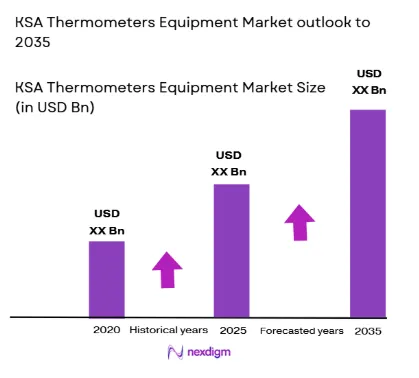
The KSA Thermometers Equipment market is poised for substantial growth, with a market size reaching approximately USD ~ billion based on a recent historical assessment. This market growth is driven by the increasing demand for temperature monitoring across multiple sectors such as healthcare, pharmaceuticals, and industrial applications. Technological advancements, especially the shift towards contactless infrared thermometers, and the growing emphasis on health and safety regulations further propel this market’s expansion. Moreover, the integration of smart technologies in thermometers is expected to enhance market attractiveness, contributing to further growth.
The Kingdom of Saudi Arabia (KSA) remains the dominant player in the market, driven by its robust healthcare infrastructure and significant investments in industrial sectors. Major cities such as Riyadh, Jeddah, and Dammam lead the demand for thermometer equipment due to their advanced healthcare facilities, large industrial bases, and government-driven initiatives to promote public health and safety standards. The demand in these cities is significantly influenced by both the private and public sectors, with rising healthcare concerns, industrial operations, and the increasing need for real-time temperature monitoring across various applications.
Market Segmentation
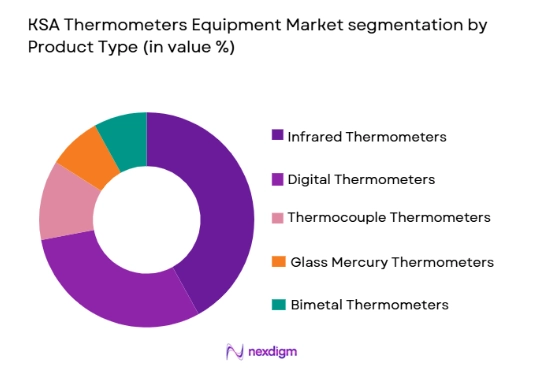
By Product Type:
The KSA Thermometers Equipment market is segmented by product type into infrared thermometers, digital thermometers, thermocouple thermometers, glass mercury thermometers, and bimetal thermometers. Recently, infrared thermometers have a dominant market share due to factors such as heightened demand for non-contact solutions, user-friendliness, and the increasing adoption of these devices in healthcare settings, particularly for fever screenings. This preference is largely driven by the ongoing global focus on health and hygiene, especially post-pandemic, as infrared thermometers offer rapid, accurate, and safe temperature measurements without the need for physical contact, minimizing the spread of infections.
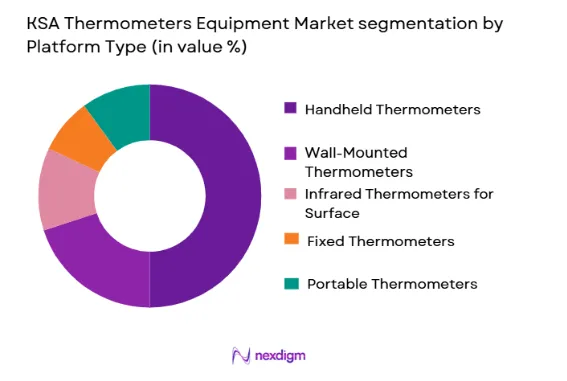
By Platform Type:
The market is segmented by platform type into handheld thermometers, wall-mounted thermometers, infrared thermometers for surface measurement, fixed thermometers, and portable thermometers. Handheld thermometers have emerged as the dominant sub-segment due to their portability, ease of use, and convenience, especially in healthcare and industrial settings. Their compact design allows for quick temperature readings in various environments, making them the preferred choice in high-demand areas, such as hospitals, airports, and retail locations. Additionally, the growing emphasis on personal health monitoring has contributed to their increased adoption in households and healthcare institutions.
Competitive Landscape
The competitive landscape in the KSA Thermometers Equipment market is highly concentrated, with key players driving innovation and market expansion. Major companies dominate the market through strategic acquisitions, investments in R&D, and partnerships with healthcare and industrial sectors. The market is witnessing consolidation as larger companies expand their footprint in the KSA region to capitalize on the growing demand for thermometers across various industries. This is further intensified by regulatory changes, which emphasize the importance of advanced, reliable temperature monitoring systems.
| Company Name | Establishment Year | Headquarters | Technology Focus | Market Reach | Key Products | Revenue (USD Billion) | Regulatory Compliance |
| Thermo Fisher Scientific | 1956 | Waltham, USA | ~ | ~ | ~ | ~ | ~ |
| Fluke Corporation | 1948 | Everett, USA | ~ | ~ | ~ | ~ | ~ |
| Honeywell International | 1906 | Charlotte, USA | ~ | ~ | ~ | ~ | ~ |
| Optris GmbH | 2003 | Berlin, Germany | ~ | ~ | ~ | ~ | ~ |
| Testo SE & Co. KGaA | 1957 | Lenzkirch, Germany | ~ | ~ | ~ | ~ | ~ |
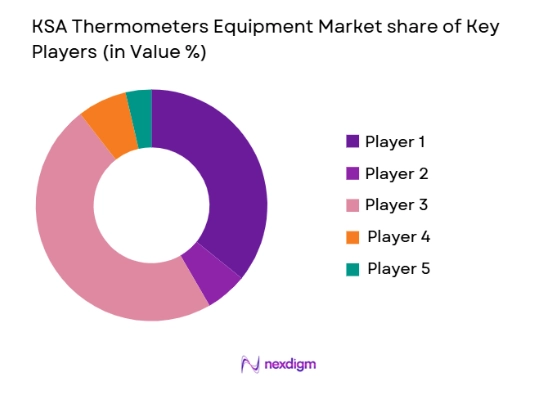
KSA Thermometers Equipment Market Analysis
Growth Drivers
Government Health and Safety Regulations:
Government regulations and public health initiatives are a major growth driver for the KSA Thermometers Equipment market. The Saudi government has continuously placed significant emphasis on improving healthcare infrastructure and ensuring public safety, especially in light of recent global health crises. This focus has led to stricter regulations regarding temperature monitoring in healthcare, industrial, and public settings, driving the demand for thermometers. In particular, healthcare facilities are required to maintain accurate temperature records to prevent the spread of contagious diseases, making advanced thermometers an essential tool. Moreover, the government has supported the adoption of digital and infrared thermometers in various public sectors, including retail, hospitality, and airports, ensuring public health standards are met. These regulations are contributing to a sustained increase in the demand for high-quality, non-contact temperature measurement solutions across all sectors. This legislative focus aligns with global trends towards maintaining health standards, making government regulation a significant catalyst for market growth.
Technological Advancements in Thermometer Design:
The ongoing advancement in thermometer technology has greatly influenced the market dynamics, further fueling growth. The development of smart thermometers that integrate with mobile applications or cloud-based systems is becoming increasingly popular. These devices allow for real-time temperature monitoring, data logging, and automatic alerts, providing added convenience and accuracy for both healthcare providers and industrial users. Furthermore, the introduction of infrared technology has revolutionized temperature measurement by offering non-contact solutions, which is especially valuable in environments where hygiene and safety are a priority, such as hospitals and factories. With the continued improvement of sensor accuracy, user-friendly designs, and enhanced connectivity, thermometers are becoming more versatile and capable of meeting the growing demand for real-time, remote temperature monitoring. The combination of ease of use, cost-effectiveness, and innovative features will continue to push the market forward, as businesses and consumers seek more efficient and accurate solutions.
Market Challenges
High Cost of Advanced Thermometers:
One of the primary challenges facing the KSA Thermometers Equipment market is the high cost of advanced temperature measurement devices. While infrared and smart thermometers offer superior features such as non-contact measurement and real-time data logging, their high price point often limits accessibility, particularly in smaller businesses and rural healthcare settings. Additionally, healthcare institutions with budget constraints may find it difficult to justify the investment in high-end thermometers, despite their long-term benefits. While the market for such devices is expanding, cost remains a significant barrier to mass adoption, especially for non-governmental organizations or smaller private sector players. Despite increasing affordability over time, the initial cost of high-tech thermometers may deter potential buyers from adopting these solutions, potentially slowing market growth in some regions.
Regulatory Barriers and Compliance Challenges:
Regulatory barriers pose another challenge to the growth of the KSA Thermometers Equipment market. As the demand for advanced temperature measurement devices increases, so too does the complexity of regulatory compliance, particularly for thermometers used in medical applications. In order to meet strict standards, companies must invest heavily in quality control and certification processes. The KSA regulatory landscape for medical devices requires manufacturers to meet stringent certifications, such as ISO 13485, CE, and FDA approvals. These compliance requirements can increase the cost of production and delay market entry for new products. Moreover, some products may face regulatory hurdles due to variations in safety and performance standards across different regions. Navigating these regulations can be a time-consuming and expensive process for both new and established companies, hindering the growth of the market in the short term.
Opportunities
Rise in Smart Thermometer Adoption for Home Use:
The increasing trend of home-based health monitoring presents a significant opportunity for the KSA Thermometers Equipment market. With a growing interest in personal health management, consumers are turning to smart thermometers that offer convenience, real-time tracking, and integration with other smart home devices. These thermometers are not only used for fever detection but also for monitoring body temperature over time, enabling users to detect changes and take proactive health measures. As awareness around personal health management continues to rise, the demand for home-use thermometers that are affordable and easy to use is expected to grow. The ability to remotely monitor temperatures through mobile applications will further drive the adoption of these products in households across the country, expanding the market’s reach beyond traditional healthcare and industrial sectors.
Expansion of Thermometer Use in Industrial Applications:
Another promising opportunity for the KSA Thermometers Equipment market lies in the expanding use of thermometers in industrial applications. Industries such as manufacturing, oil and gas, and food processing require precise temperature monitoring to ensure the quality and safety of their operations. As industrial operations grow more complex and require stringent quality control measures, the demand for advanced thermometer solutions is increasing. Moreover, the need for accurate temperature readings in production lines, warehouses, and equipment maintenance has led to the development of specialized thermometers tailored to these environments. By offering precise, reliable, and durable solutions, the market is expected to experience significant growth in this segment. This trend presents an opportunity for manufacturers to expand their product offerings and cater to the growing needs of the industrial sector.
Future Outlook
The KSA Thermometers Equipment market is expected to witness steady growth over the next few years. Key trends such as the increasing adoption of smart, contactless thermometers and the growing demand for real-time monitoring solutions are anticipated to drive the market forward. The advancement of IoT technology, combined with government initiatives focusing on health and safety, will further enhance market prospects. Additionally, the expansion of industrial applications and regulatory support will offer ample opportunities for growth, positioning the market for continued development in the coming years.
Major Players
- Thermo Fisher Scientific
- Fluke Corporation
- Honeywell International
- Optris GmbH
- Testo SE & Co. KGaA
- Omega Engineering
- Yokogawa Electric Corporation
- Amprobe Test Tools
- Kimo Instruments
- Extech Instruments
- Panasonic Corporation
- Raytek Corporation
- Bacharach Inc.
- Cooper-Atkins Corporation
- West Control Solutions
Key Target Audience
- Investments and venture capitalist firms
- Government and regulatory bodies
- Healthcare providers
- Industrial manufacturers
- Retail and e-commerce companies
- Pharmaceutical companies
- Public sector agencies
- Hospitals and healthcare institutions
Research Methodology
Step 1: Identification of Key Variables
The first step involves identifying critical market variables, such as product type, platform type, and end-users, to ensure a comprehensive analysis of the KSA Thermometers Equipment market.
Step 2: Market Analysis and Construction
In this step, we segment the market based on key factors like product types and end-user applications, developing a detailed market structure for more accurate forecasting and analysis.
Step 3: Hypothesis Validation and Expert Consultation
A rigorous validation process follows, utilizing expert consultations, customer feedback, and industry insights to ensure the hypotheses about market trends and drivers hold true across various sectors.
Step 4: Research Synthesis and Final Output
The final output involves synthesizing the collected data and research findings into actionable insights that can guide strategic decisions and market forecasts for stakeholders in the KSA Thermometers Equipment market.

- Executive Summary
- Research Methodology (Definitions, Scope, Industry Assumptions, Market Sizing Approach, Primary & Secondary Research Framework, Data Collection & Verification Protocol, Analytic Models & Forecast Methodology, Limitations & Research Validity Checks)

- Market Definition and Scope
- Value Chain & Stakeholder Ecosystem
- Regulatory / Certification Landscape
- Sector Dynamics Affecting Demand
- Strategic Initiatives & Infrastructure Growth

- Growth Drivers
Rising healthcare and safety concerns
Growing demand for non-contact thermometers
Increased adoption in industrial applications
Government regulations on temperature monitoring
Technological advancements in smart thermometers - Market Challenges
High cost of advanced thermometers
Limited consumer awareness in rural areas
Availability of counterfeit and low-quality products
Strict regulatory requirements and certifications
Complex installation and maintenance processes - Market Opportunities
Development of AI and IoT-integrated thermometers
Expansion of temperature monitoring solutions in emerging markets
Increased demand for thermometers in educational institutions and public spaces - Trends
Growth of touchless technology
Integration with mobile devices for real-time tracking
Enhanced focus on environmental sustainability
Technological integration for improved accuracy
Shift towards disposable and single-use thermometers - Government Regulations & Defense Policy
Increased regulatory focus on healthcare safety standards
Temperature monitoring mandates in public spaces
Policy changes regarding industrial thermometer usage - SWOT Analysis
- Stakeholder and Ecosystem Analysis
- Porter’s Five Forces Analysis
- Competition Intensity and Ecosystem Mapping

- By Market Value, 2020-2025
- By Installed Units, 2020-2025
- By Average System Price, 2020-2025
- By System Complexity Tier, 2020-2025

- By System Type (In Value%)
Infrared Thermometers
Digital Thermometers
Thermocouple Thermometers
Glass Mercury Thermometers
Bimetal Thermometers - By Platform Type (In Value%)
Handheld Thermometers
Wall-Mounted Thermometers
Infrared Thermometers for Surface Measurement
Fixed Thermometers
Portable Thermometers - By Fitment Type (In Value%)
Wall-Mounted Fitment
Handheld Fitment
Fixed Fitment
Tabletop Fitment
Clip-on Fitment - By EndUser Segment (In Value%)
Healthcare Institutions
Pharmaceuticals and Laboratories
Industrial Sectors
Retail and Commercial Usage
Home Care and Personal Use - By Procurement Channel (In Value%)
Direct Sales
Distributors and Resellers
E-Commerce Platforms
B2B Sales
Retail Outlets - By Material / Technology (in Value%)
Plastic Thermometers
Metal Thermometers
Electromagnetic Thermometers
Smart Thermometers
Infrared Technology-based Thermometers

- Market structure and competitive positioning
- Market share snapshot of major players
- CrossComparison Parameters (Market Share, Product Portfolio, R&D Investment, Distribution Network, Geographical Reach, Pricing Strategy, Technological Innovation, Customer Support, Manufacturing Capacity, Brand Reputation)
- SWOT Analysis of Key Players
- Pricing & Procurement Analysis
- Key Players
Thermo Fisher Scientific
Fluke Corporation
Honeywell International
Optris GmbH
Yokogawa Electric Corporation
Panasonic Corporation
Omega Engineering
Testo SE & Co. KGaA
Kimo Instruments
Amprobe Test Tools
Extech Instruments
E+E Elektronik
Sensus
Omega Engineering
TME
Testo SE

- Healthcare providers increasing their reliance on non-contact thermometers
- Pharmaceutical industry investing in precise temperature measurements
- Industrial applications utilizing thermometers for quality control
- Growth of smart home and personal health monitoring devices

- Forecast Market Value, 2026-2035
- Forecast Installed Units, 2026-2035
- Price Forecast by System Tier, 2026-2035
- Future Demand by Platform, 2026-2035


 Request a Sample
 Ask for Customization
 Get a Quote
 Enquire Now