
 Download PDF
Market Overview
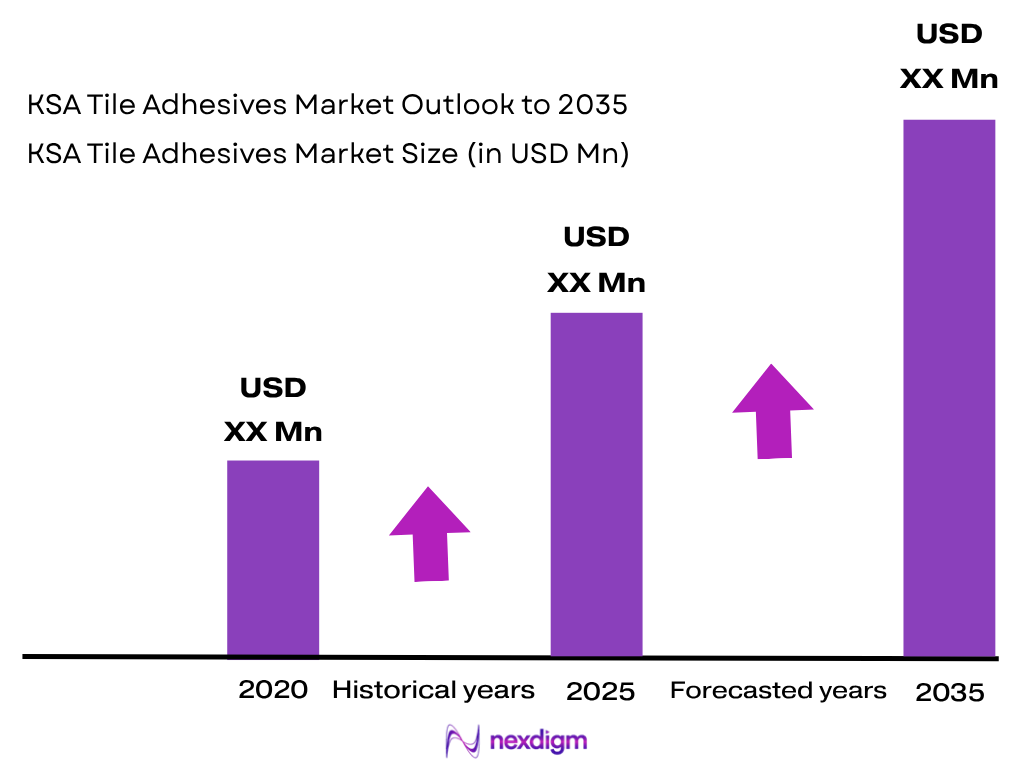
The KSA Tile Adhesives Market is valued at approximately ~USD XX million, supported by housing construction, giga-projects, hospitality development, porcelain installation and conversion from site-mixed mortar. Across the latest two annual observations, ready-built housing contracts increased from more than 42,000 to more than 49,000, while self-construction contracts remained above 16,000 in both periods. These construction volumes support sustained demand for factory-mixed polymer-modified tile and stone fixing systems.
Riyadh, Jeddah, Makkah, Madinah and the northwestern giga-project corridor dominate the KSA Tile Adhesives Market because they concentrate housing, hospitality, religious infrastructure and mixed-use construction. Riyadh recorded 33,380 housing-product solutions, Makkah 24,792, the Eastern region 14,088 and Madinah 4,770 in the latest annual Housing Program data, reinforcing tile installation activity across residential, commercial and hospitality developments without implying numerical market-share concentration.
Market Segmentation
By Adhesive Technology
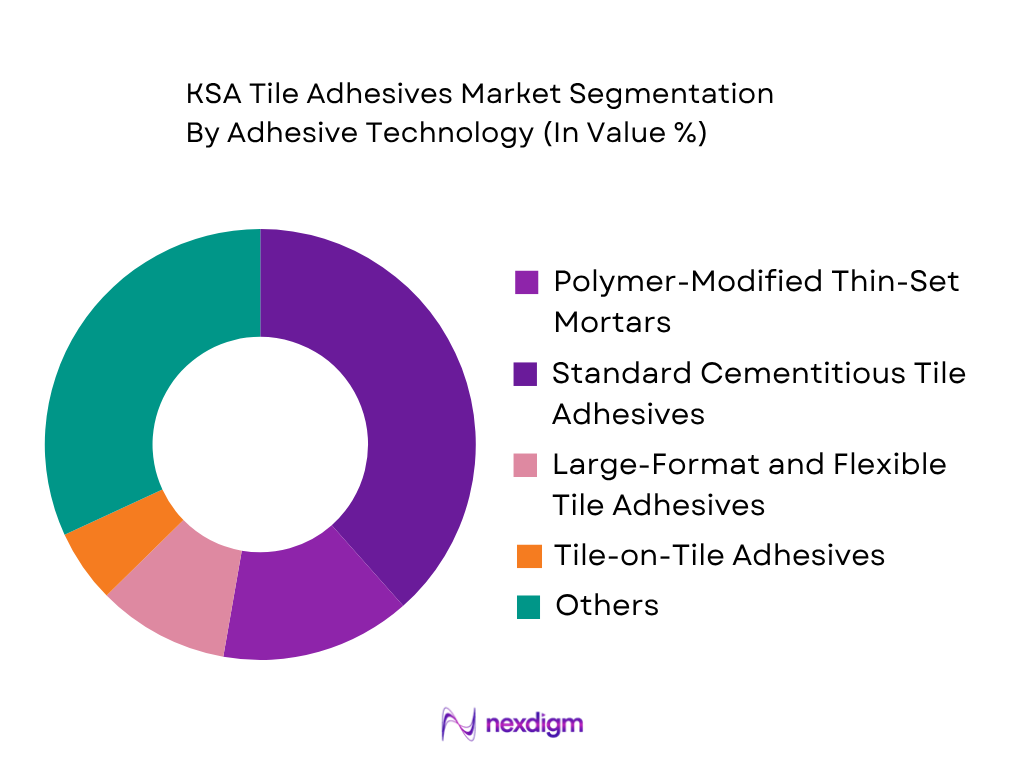
The KSA Tile Adhesives Market is segmented into standard cementitious adhesives, polymer-modified products, C2 high-performance adhesives, C2TE systems, S1 and S2 flexible adhesives, large-format mortars, rapid-setting adhesives, tile-on-tile systems, epoxy products and specialty stone adhesives. Polymer-modified cementitious adhesives hold the dominant modeled market share because they can serve the Kingdom’s broad residential, hospitality and commercial applications while offering better adhesion and workability than traditional cement-sand mortar. Demand is increasingly moving toward higher-performance classifications as porcelain tiles, exterior applications and larger formats become more prominent. Current products supplied in Saudi Arabia already demonstrate this evolution: Weber markets a C2TES1 adhesive for large and thin tiles, difficult substrates, external applications and extended-open-time requirements, while LATICRETE’s locally manufactured 317 Floor & Wall adhesive is classified C2TE under EN 12004 and ISO 13007. Local performance-based product availability supports continued migration from basic mortars to factory-formulated systems.
By Tile and Stone Type
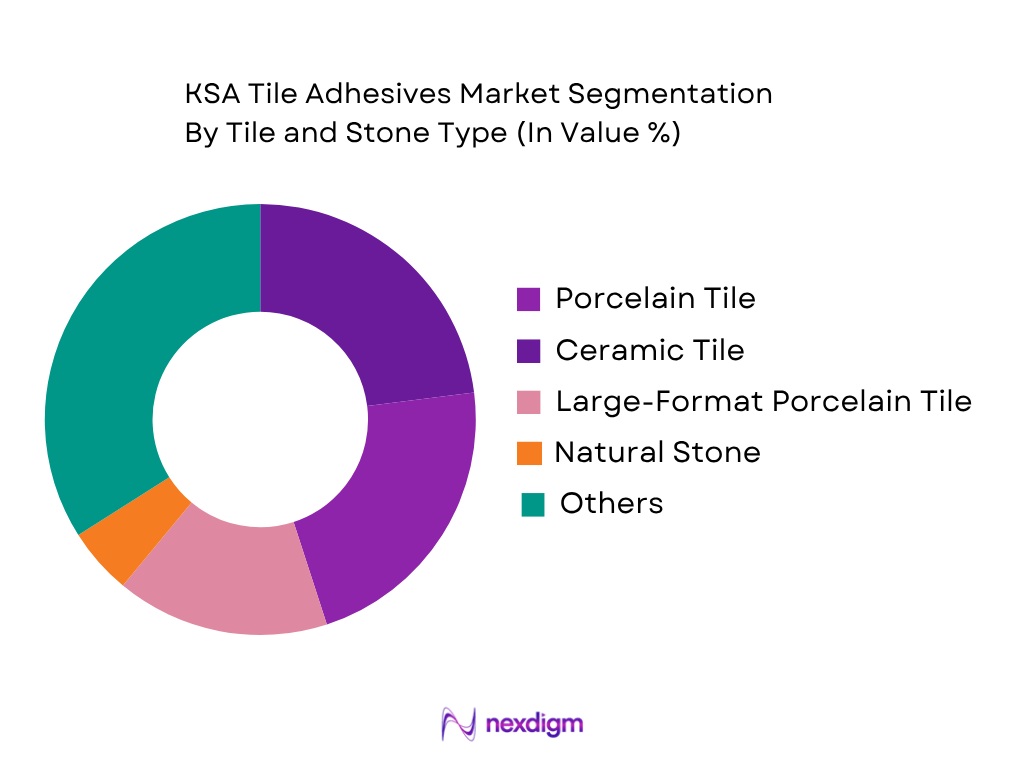
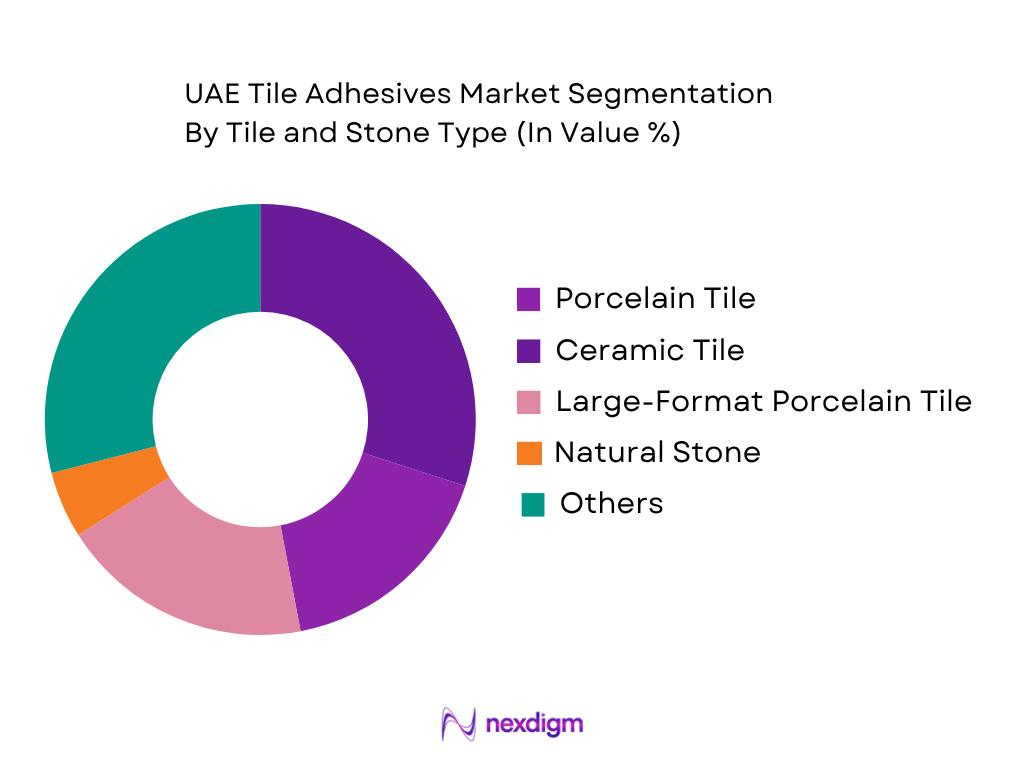
The KSA Tile Adhesives Market is segmented into ceramic tiles, porcelain tiles, large-format porcelain, porcelain slabs, marble, granite, travertine, mosaics and engineered stone. Porcelain and large-format porcelain represent the dominant modeled demand group because premium residential, hotel, retail and public developments increasingly use low-absorption finishes requiring stronger polymer modification and improved adhesive transfer. Larger formats require extended open time, reduced vertical slip, improved deformability and better substrate preparation than conventional small ceramic tiles. Marble and natural stone are also strategically important because Saudi hospitality, religious and luxury developments incorporate premium stone finishes, creating demand for white, rapid-setting and stain-sensitive installation systems. Saveto’s Saudi tile product portfolio includes large-format tile products, marble adhesives, swimming-pool systems and epoxy products, illustrating the breadth of specialized local applications. The combination of premium architecture, heat exposure and large tile dimensions makes application-specific adhesives increasingly important in Saudi Arabia.
Competitive Landscape
The KSA Tile Adhesives Market includes strong domestic dry-mix manufacturers and multinational construction-chemical companies. Saveto, Sika, MAPEI, Fosroc and Saint-Gobain Weber compete through local or regional manufacturing, C2/C2TE technology, large-format capability, marble and stone expertise, distributor coverage and specification support. Competitive advantage is increasingly determined by the ability to supply complete tile-installation systems rather than standard cementitious adhesive alone, particularly on giga-project, hospitality and premium residential developments.
| Major Player | Establishment Year | Headquarters | C2 / C2TE Capability | Large-Format / S1-S2 Capability | KSA Manufacturing / Supply | Stone & Marble Capability | Pool / Exterior Systems | Technical & Project Support |
| Saveto Group / Saudi Vetonit | 1981 | Riyadh, Saudi Arabia | ~ | ~ | ~ | ~ | ~ | ~ |
| Sika | 1910 | Baar, Switzerland | ~ | ~ | ~ | ~ | ~ | ~ |
| MAPEI | 1937 | Milan, Italy | ~ | ~ | ~ | ~ | ~ | ~ |
| Fosroc | 1972 | Dubai, UAE | ~ | ~ | ~ | ~ | ~ | ~ |
| Saint-Gobain Weber | 1900 | Courbevoie, France | ~ | ~ | ~ | ~ | ~ | ~ |
KSA Tile Adhesives Market Analysis
Growth Drivers
Riyadh Housing Expansion and Vision 2030 Residential Development
Residential development is a major growth driver for the KSA Tile Adhesives Market because new apartments, villas and residential compounds create recurring requirements for porcelain, ceramic, bathroom, kitchen and large-format tile installation. Saudi Arabia’s Housing Program recorded 33,380 housing solutions in Riyadh during 2024, including 17,999 ready-built units, 10,094 off-plan units, 3,798 self-construction solutions and 1,489 residential-land solutions. Makkah recorded another 24,792 housing solutions, while the Eastern Region accounted for 14,088 and Madinah 4,770, creating geographically diverse installation demand. The broader economic environment supports this construction cycle: World Bank data place Saudi Arabia’s 2024 GDP at USD1,239.8 billion and GDP per capita at USD35,121.7. The IMF additionally reported Saudi Central Bank net foreign assets of USD415 billion and oil production of approximately 9 million barrels per day in 2024. Large residential developments increasingly favor factory-mixed mortars because controlled polymer content, consistent water retention and repeatable adhesion are easier to manage across thousands of identical bathrooms and tiled floors than conventional site-batched cement-sand mortar.
Giga-Projects, Hospitality and Premium Stone Installation
Saudi giga-project and hospitality construction is accelerating demand for C2-class adhesives, flexible mortars, marble adhesives and large-format porcelain installation systems. PIF states that Diriyah includes 18,000 residential units and more than 40 hotels, while its hotel portfolio alone provides approximately 902,000 square metres of hospitality gross floor area. Red Sea Global adds more than 40 hotels, 12,000 hotel rooms and 2,000 luxury residences across a destination covering 28,000 square kilometres and more than 90 islands. These developments create substantial installation requirements across hotel bathrooms, villas, pools, spas, restaurants, lobbies and high-traffic public areas, where large porcelain formats and natural stone require greater adhesive transfer, deformation tolerance and water resistance. Such projects also strengthen demand for white stone mortars and rapid-setting products suited to premium finishing schedules. The macroeconomic foundation remains significant: World Bank data record 2024 Saudi GDP of USD1,239.8 billion and GDP per capita of USD35,121.7, while the IMF reported non-oil activity was led by construction, hospitality and retail, with central-bank net foreign assets of USD415 billion.
Market Challenges
Extreme Heat, Open-Time Loss and Installation Productivity
Saudi Arabia’s climatic conditions create a direct technical challenge for cementitious tile adhesives because high substrate temperatures accelerate water evaporation, mortar skinning and loss of workable open time. The Ministry of Human Resources and Social Development prohibited private-sector outdoor work under direct sunlight from 12:00 p.m. to 3:00 p.m. between June 15 and September 15, 2024, illustrating the severity of heat exposure during the construction season. The same restriction continued during 2025 and 2026, with the 2026 enforcement period again covering June 15 to September 15; authorities conducted 29,945 inspection visits during the 2026 period. For exterior porcelain, façades and large-format installations, shortened open time can reduce adhesive transfer if material is spread over excessive areas before tile placement. Installers therefore require higher water retention, extended-open-time products, correct trowel coverage and disciplined back-buttering. These challenges operate within a large construction economy: World Bank data put Saudi Arabia’s 2024 GDP at USD1,239.8 billion and GDP per capita at USD35,121.7, while the IMF recorded Saudi oil production at approximately 9 million barrels per day and central-bank net foreign assets at USD415 billion.
SASO Compliance and Specialty Raw-Material Dependence
Product conformity and specialty-input dependence create another challenge for organized tile adhesive suppliers. SASO maintains a dedicated Technical Regulation for Glue and Adhesive Materials, covering prepared adhesives under customs heading 3506 and related adhesive categories, while the SABER platform is used for the updated list of regulated products and customs codes. In 2024, SASO also issued project 2024/407 for adoption of ISO 17889-2:2023, covering sustainability requirements and assessment methods for ceramic tile installation materials including adhesives, grouts and membranes. Manufacturers therefore face a broader compliance burden involving product composition, testing, documentation and sustainability performance while simultaneously sourcing polymer modifiers, cellulose ethers and specialized rheology additives that are not interchangeable with basic cementitious inputs. Saudi trade data reinforce the importance of internationally connected supply chains: merchandise imports increased sharply in December 2024, while machinery and electrical equipment remained the largest Q4 import category. From a macroeconomic perspective, World Bank data place 2024 Saudi GDP at USD1,239.8 billion and GDP per capita at USD35,121.7; the IMF reported USD415 billion in central-bank net foreign assets. Suppliers must therefore balance regulatory conformity, imported specialty chemistry and consistent batch performance across major projects.
Market Opportunities
C2TE, S1/S2 and Large-Format Porcelain Adhesives
Higher-performance C2TE and deformable S1/S2 adhesives offer a strong future opportunity as Saudi developments adopt larger porcelain formats, exterior finishes and premium tiled interiors. Current construction activity already provides a substantial application base: Riyadh recorded 33,380 housing solutions in 2024, including 17,999 ready-built units and 10,094 off-plan units, while Makkah recorded 24,792 housing solutions and the Eastern Region 14,088. Diriyah further contributes 18,000 residential units and more than 40 hotels, creating applications where large porcelain tiles, feature walls and stone finishes require stronger adhesion, lower slip and improved deformation capacity. These projects favor application-specific adhesives over basic cement mortar because larger tiles provide less tolerance for poor substrate flatness and incomplete adhesive transfer. Saudi Arabia’s 2024 macroeconomic base supports continued specification-led construction: World Bank data record GDP of USD1,239.8 billion and GDP per capita of USD35,121.7, while IMF data show central-bank net foreign assets of USD415 billion. Current project and housing volumes therefore provide a measurable foundation for future growth of high-performance large-format, flexible and extended-open-time tile adhesive systems.
Pool, Natural-Stone, Sustainable and Rapid-Renovation Systems
Specialized pool, natural-stone, sustainable and rapid-setting adhesives provide another future growth route as Saudi Arabia expands tourism, luxury hospitality and premium residential infrastructure. Red Sea Global currently encompasses more than 40 hotels, 12,000 hotel rooms and 2,000 luxury residences, while Diriyah includes more than 40 hotels and 18,000 residential units. These developments generate technically demanding installations across swimming pools, spas, bathrooms, marble lobbies, restaurant interiors and exterior leisure areas where submerged-service performance, stain control, rapid curing and compatibility with waterproofing systems become essential. Sustainability is also becoming more formalized: SASO project 2024/407 adopted ISO 17889-2:2023, which specifically addresses sustainability assessment for tile installation materials including adhesives and grouts. This creates a clearer route for low-emission, resource-efficient and durability-focused formulations within major projects. Saudi Arabia’s economic capacity further supports premium construction materials, with World Bank data showing 2024 GDP of USD1,239.8 billion and GDP per capita of USD35,121.7; the IMF reported Saudi Central Bank net foreign assets of USD415 billion. These current assets, projects and standards create a strong platform for future expansion of specialist tile adhesive categories.
Future Outlook
The KSA Tile Adhesives Market is forecast to expand at approximately ~X.X% CAGR during 2026–2035. Growth is expected to be supported by residential development, Vision 2030 giga-project execution, hospitality expansion, religious infrastructure, large-format porcelain installation and growing use of specification-based factory-mixed systems. Housing remains one of the largest structural demand drivers. The Housing Program recorded cumulative residential-product contracts reaching 850,485, including 414,406 ready-built units, 254,623 self-construction contracts, 105,112 off-plan sales contracts and 76,344 residential-land contracts. These programs enlarge the installed base of bathrooms, kitchens, floor surfaces and common areas requiring ceramic, porcelain and stone installation materials.
Major Players
- Save to Group / Saudi Vetonit
- Sika Saudi Arabia
- MAPEI Saudi Arabia
- Fosroc Saudi Arabia / Saint-Gobain
- Saint-Gobain Weber Saudi Arabia
- LATICRETE Arabia
- DCP Saudi Co.
- Jazea for Construction Chemicals
- ARDEX Middle East
- Kerakoll Gulf
- Bostik Middle East / Arkema
- MC-Bauchemie Saudi Arabia
- Terraco Saudi Arabia
- Arkaz
- PAC Technologies
Key Target Audience
- Tile Adhesive and Dry-Mix Mortar Manufacturers
- Ceramic, Porcelain and Natural Stone Manufacturers
- Real Estate and Giga-Project Developers
- Main Contractors and Interior Fit-Out Contractors
- Tile, Marble and Stone Distributors
- Tile, Stone and Swimming Pool Installation Contractors
- Investments and Venture Capitalist Firms
- Government and Regulatory Bodies (Saudi Standards, Metrology and Quality Organization, Ministry of Municipalities and Housing, Saudi Building Code National Committee, Ministry of Tourism)
Research Methodology
Step 1: Identification of Key Variables
The initial phase involves constructing an ecosystem map covering cement and polymer suppliers, dry-mix manufacturers, tile and stone producers, distributors, developers, contractors and applicators. Desk research identifies critical variables such as ISO 13007 classification, tile size, substrate, deformability, construction activity, climate exposure, local manufacturing and project specification requirements.
Step 2: Market Analysis and Construction
Historical information for the KSA Tile Adhesives Market is assessed through top-down and bottom-up methodologies. Top-down analysis considers housing programs, giga-projects, tourism infrastructure and construction activity, while bottom-up analysis estimates adhesive consumption from tile area, coverage, application thickness, tile format, building type and the ratio of packaged adhesive to traditional mortar.
Step 3: Hypothesis Validation and Expert Consultation
Market hypotheses are subsequently validated through computer-assisted telephone interviews with tile adhesive producers, ceramic distributors, building-material dealers, contractors and applicators. These discussions test assumptions around C2/C2TE penetration, large-format tile usage, stone-installation requirements, contractor preferences, regional demand and the importance of local manufacturing and project technical support.
Step 4: Research Synthesis and Final Output
The final phase triangulates Saudi government housing information, SASO standards, PIF project data, manufacturer documentation and primary industry interviews. Bottom-up consumption models are reconciled against residential, hospitality and giga-project activity to generate validated segmentation, competitive positioning, regional assessment and strategic conclusions for the KSA Tile Adhesives Market.

- Executive Summary
- Research Methodology (Market Definitions and Assumptions, KSA Tile Adhesives Market Boundary, Cementitious versus Reactive Adhesive Classification, C1 and C2 Adhesive Assessment, C2T and C2TE Performance Assessment, S1 and S2 Deformability Assessment, Porcelain Tile Adhesive Assessment, Large-Format Tile Adhesive Assessment, Natural Stone and Marble Adhesive Assessment, Exterior Tile Adhesive Assessment, Pool and Submerged Tile Adhesive Assessment, High-Temperature Application Assessment, Tile-on-Tile Adhesive Assessment, SASO Regulatory Mapping, ISO 13007 Alignment, ISO 17889-2 Sustainability Assessment, Local Dry-Mix Manufacturing Mapping, Contractor and Applicator Mapping, Distributor Mapping, Giga-Project Specification Assessment, Supply-Side Assessment, Demand-Side Assessment, Top-Down Market Sizing, Bottom-Up Market Sizing, Primary Industry Interviews, Project Pipeline Assessment, Data Triangulation, Forecasting Framework)

- Definition and Scope
- Evolution of Tile Fixing Practices in Saudi Arabia
- Transition from Conventional Cement-Sand Mortar to Factory-Mixed Tile Adhesives
- Development of Polymer-Modified Cementitious Tile Adhesives
- Evolution of Porcelain and Low-Absorption Tile Installation
- Emergence of Large-Format Porcelain and Slab Adhesives
- Growth of Marble and Natural Stone Installation Systems
- Development of Flexible Exterior Tile Adhesives

- Growth Drivers (Riyadh Residential Development, Vision 2030 Housing Programs, Giga-Project Construction, Hotel and Resort Development, Makkah and Madinah Expansion, Porcelain Tile Adoption, Large-Format Tile Installation, Marble and Natural Stone Usage, Airport and Metro Infrastructure, Factory-Mixed Dry Mortar Adoption, Applicator Productivity Requirements, Specification-Based Construction)
- Market Challenges (Traditional Cement-Sand Mortar Competition, Low-Cost Product Substitution, Extreme Ambient Temperatures, Rapid Moisture Loss, Incorrect Adhesive Selection, Poor Substrate Preparation, Inadequate Adhesive Coverage, Applicator Skill Variation, Large-Format Tile Lippage, Imported Polymer Dependence, SASO Compliance Requirements, Natural Stone Staining Risk)
- Market Opportunities (C2TE Tile Adhesives, S1 and S2 Flexible Adhesives, Large-Format Porcelain Slab Adhesives, High-Temperature Exterior Adhesives, Marble and Natural Stone Adhesives, Tile-on-Tile Renovation Systems, Epoxy Tile and Stone Systems, Swimming Pool Adhesives, Rapid-Setting Adhesives, Low-VOC Adhesives, Antimicrobial Tile Adhesives, Contractor Training and Certification)
- Market Trends (C2-Class Adhesive Adoption, C2TES1 Systems, Flexible Large-Format Mortars, Porcelain Slab Installation, Extended Open-Time Adhesives, High-Temperature Systems, Thick-Bed Adhesives, Tile-on-Tile Systems, White Marble Adhesives, Epoxy Adhesives, Pool Adhesives, Sustainable Installation Materials)
- Government Regulations and Standards (SASO Technical Regulation for Glue and Adhesive Materials, Saudi Product Conformity Requirements, SABER Compliance, ISO 13007 Tile Adhesive Classification, ISO 17889-2 Sustainability Requirements, Ceramic Tile Quality Mark Requirements, Saudi Building Code, Construction Material Conformity, Chemical Labelling and Worker Safety)
- SWOT Analysis
- Porter’s Five Forces Analysis
- PESTLE Analysis

- By Market Value (2020-2025)
- By Tile Adhesive Consumption Volume (2020-2025)
- By Standard Cementitious Tile Adhesive Consumption (2020-2025)
- By Polymer-Modified Tile Adhesive Consumption (2020-2025)
- By C2 High-Performance Adhesive Consumption (2020-2025)
- By C2TE Adhesive Consumption (2020-2025)
- By S1 and S2 Flexible Adhesive Consumption (2020-2025)

- By Adhesive Technology (In Value %)
Standard Cementitious Tile Adhesives
Polymer-Modified Cementitious Tile Adhesives
C2 High-Performance Tile Adhesives
C2T Slip-Resistant Tile Adhesives
C2TE Extended Open-Time Adhesives
S1 Flexible Tile Adhesives
S2 Highly Deformable Tile Adhesives
Large-and-Heavy-Tile Adhesives
Rapid-Setting Tile Adhesives
Thick-Bed Tile Adhesives
Tile-on-Tile Adhesives
Epoxy and Reaction-Resin Adhesives
Polyurethane Tile Adhesives
White Tile and Stone Adhesives
Specialty High-Bond Adhesives - By Tile and Stone Type (In Value %)
Ceramic Tiles
Porcelain Tiles
Large-Format Porcelain Tiles
Porcelain Slabs
Marble
Granite
Travertine
Natural Stone
Glass Mosaic
Ceramic Mosaic
Engineered Stone
Existing Tile Surfaces - By Application (In Value %)
Internal Floor Tile Installation
Internal Wall Tile Installation
Bathroom and Wet-Area Installation
Kitchen Tile Installation
Large-Format Tile Installation
Tile-on-Tile Installation
Exterior Wall Tile Installation
Façade Tile Installation
Swimming Pool Tile Installation
Natural Stone Installation
Mosque and Religious Facility Installation
Hotel and Resort Installation
Commercial Flooring Installation
Airport and Transport Building Installation - By Performance Class (In Value %)
C1 Normal Cementitious Adhesives
C2 Improved Cementitious Adhesives
C2T Slip-Resistant Adhesives
C2E Extended Open-Time Adhesives
C2TE High-Performance Adhesives
S1 Deformable Adhesives
S2 Highly Deformable Adhesives
Fast-Setting Adhesives
High-Temperature Adhesives
Water-Immersion-Resistant Adhesives
Heavy-Tile Adhesives
Weather-Resistant Exterior Adhesives - By Construction Activity (In Value %)
New Residential Construction
Giga-Project Construction
Hospitality Construction
Commercial Construction
Religious Infrastructure Construction
Entertainment and Tourism Construction
Infrastructure Construction
Residential Renovation
Hotel Refurbishment
Retail Refurbishment
Bathroom Renovation
Tile Replacement - By Building Type (In Value %)
Apartments and Residential Compounds
Villas
Luxury Residential Developments
Hotels and Resorts
Commercial Offices
Shopping Malls and Retail Buildings
Mosques and Religious Complexes
Hospitals and Healthcare Facilities
Educational Buildings
Airports
Metro and Rail Stations
Entertainment Destinations
Government Buildings
Mixed-Use Developments

- Market Share of Major Players (By KSA Revenue, Tile Adhesive Volume, Polymer-Modified Adhesive Portfolio, C2 and C2TE Portfolio, S1 and S2 Portfolio, Large-Format Tile Adhesive Portfolio, Porcelain Exposure, Marble and Natural Stone Exposure, Giga-Project Exposure, Hospitality Exposure, Local Manufacturing Footprint, Distributor Network, Applicator Network, Project Specification Presence, Technical Support)
- Cross Comparison Parameters (Tile and Stone Adhesive Portfolio Breadth, ISO 13007 C2 C2TE and C2TES1 Performance Capability, S1 S2 Large-Format Porcelain and Slab Adhesive Capability, Marble Exterior Pool and Tile-on-Tile Application Capability, KSA Dry-Mix Manufacturing Formulation and Supply Footprint, Building Material Distributor Applicator and Giga-Project Network Reach, High-Temperature Sustainable Rapid-Setting and Premium Polymer Technology Capability, SASO SABER Technical Specification Applicator Training and Jobsite Support Capability)
- SWOT Analysis of Major Players (Technology Portfolio, Local Manufacturing, Distribution, Giga-Project Exposure, Contractor Reach)
- Major Companies
Saveto Group / Saudi Vetonit
Sika Saudi Arabia
MAPEI Saudi Arabia
Fosroc Saudi Arabia / Saint-Gobain
Saint-Gobain Weber Saudi Arabia
LATICRETE Saudi Arabia
DCP Saudi Co.
Jazea for Construction Chemicals
ARDEX Middle East
Kerakoll Gulf
Bostik Middle East / Arkema
MC-Bauchemie Saudi Arabia
Terraco Saudi Arabia
Arkaz
PAC Technologies

- Real Estate Developer Requirement Assessment
- Giga-Project Developer Requirement Assessment
- Main Contractor Requirement Assessment
- Stone and Marble Contractor Requirement Assessment
- Interior Fit-Out Contractor Requirement Assessment
- Hospitality Contractor Requirement Assessment
- Religious Infrastructure Contractor Requirement Assessment

- By Market Value (2026-2035)
- By Tile Adhesive Consumption Volume (2026-2035)
- By Standard Cementitious Tile Adhesive Consumption (2026-2035)
- By Polymer-Modified Tile Adhesive Consumption (2026-2035)
- By C2 High-Performance Adhesive Consumption (2026-2035)
- By C2TE Adhesive Consumption (2026-2035)
- By S1 and S2 Flexible Adhesive Consumption (2026-2035)


 Request a Sample
 Ask for Customization
 Get a Quote
 Enquire Now
