

 Download PDF
Market Overview
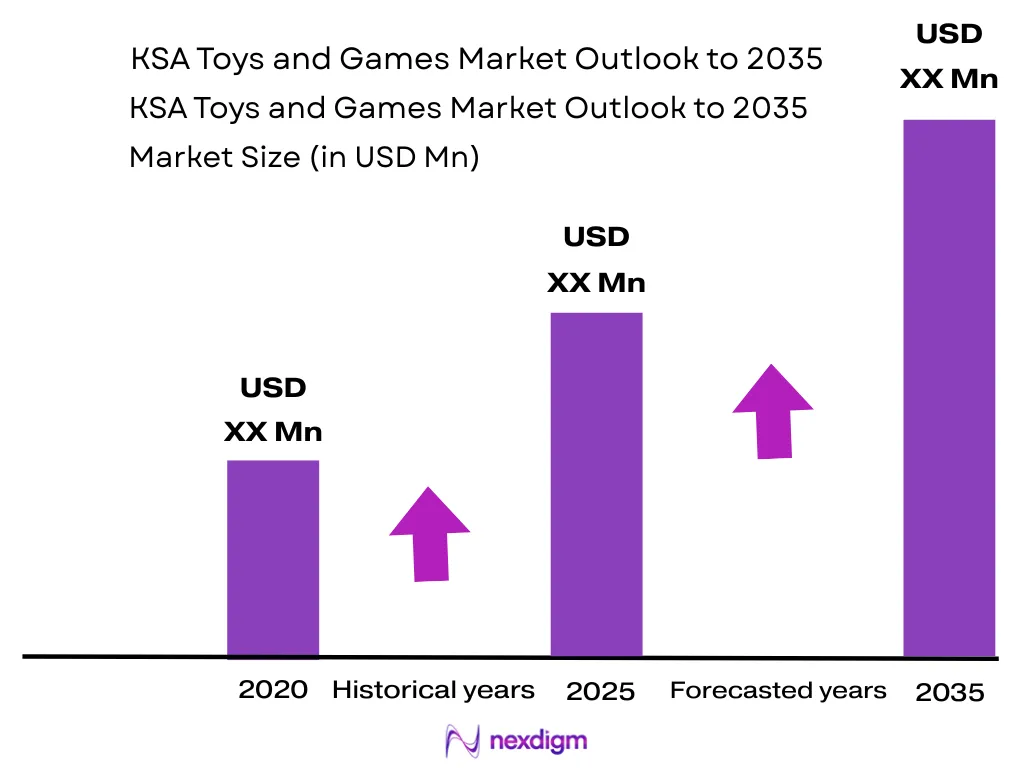
The KSA Toys and Games market reached a revenue of USD ~ million in 2024, supported by household spending and import‑driven supply, according to industry production statistics. Total household consumption accounted for a large share of demand, reflecting strong parental expenditure on children’s leisure and developmental products. Imports constitute roughly 87.5 percent of total market demand in 2024, indicating heavy reliance on foreign toy manufacturers and branded products. Consumer demand is primarily driven by young families and a growing youth population as well as rising discretionary income associated with broader economic diversification and Vision 2030 policies. Riyadh and Jeddah’s expanding retail footprints also facilitate product accessibility, while growing e‑commerce adoption complements traditional specialty retail channels. Within the KSA toys and games industry, Riyadh and Jeddah are the dominant markets based on retail infrastructure scale, consumer purchasing power, and overall population density. Riyadh’s metropolitan span hosts flagship stores from global brands such as LEGO and Hamleys, reinforcing premium toy visibility and accessibility. Jeddah’s diversified consumer base and high footfall malls also support multi‑brand toy retailers and seasonal promotions. These cities attract organized retail formats, specialty outlets, and localized marketing campaigns that resonate with dual‑income families and expatriate communities, positioning them as core demand hubs. Additionally, the Eastern Province (Dammam‑Khobar) shows consistent demand due to urbanization, expatriate spending, and active lifestyle preferences that include outdoor and interactive toys.
Market Segmentation
By Product Type
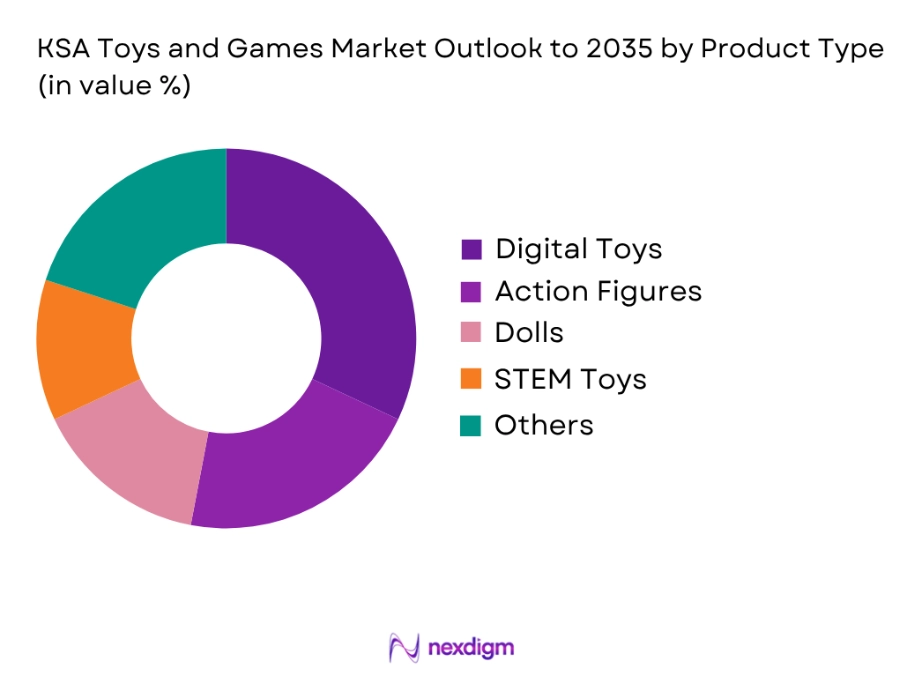
Electronic games and digital toys dominate the KSA market due to increased interest in interactive play experiences and video gaming formats, which integrate with digital platforms and mobile ecosystems. In 2024, this segment captured the largest share of retail value, driven by demand for gaming consoles, handheld devices, and mobile‑compatible game accessories. Saudi households increasingly purchase products that combine entertainment with technology, influenced by rising internet penetration and youth digital engagement. For example, video gaming inclusion in educational curricula reflects broader acceptance of digital play’s developmental value. Licensed action figures follow, bolstered by global franchise tie‑ins that appeal to children and collectors alike. Educational and STEM toys are also significant, as parents prioritise learning outcomes alongside play. Dolls and traditional toys maintain a notable presence among younger age groups, supported by cultural preferences and gifting traditions during holidays and festive seasons.
By Distribution Channel
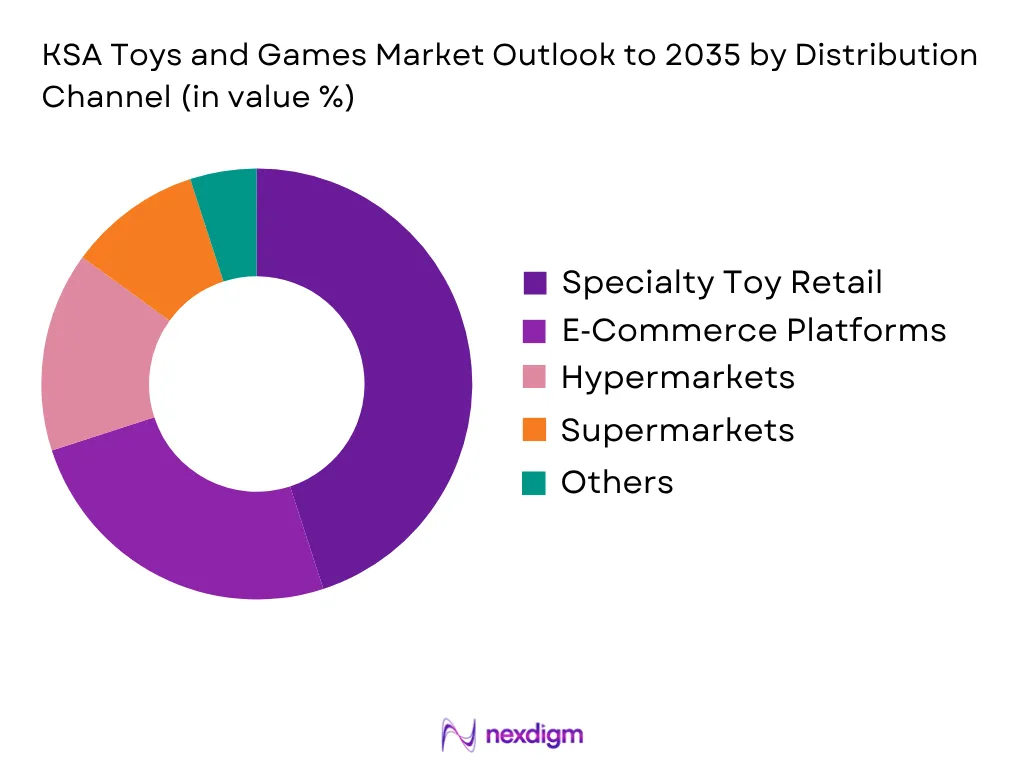
Specialty toy retailers hold the largest share due to their curated assortments, brand partnerships, and experiential retail environments that attract families and children. These stores often feature exclusive product lines from major licensors and international brands, encouraging higher transaction values. E‑commerce platforms follow as online sales expand accessibility across regional segments, enabling consumers outside metropolitan centers to access diverse product assortments with convenience. Leading digital marketplaces enhance visibility for both domestic and international toy brands through targeted promotions and seasonal campaigns. Department and hypermarket channels cater to broader shoppers through toy sections integrated with general merchandise, appealing to value‑oriented families seeking bundled purchases. Supermarket and mass merchandiser toy categories generate additional volume during festive and school vacation periods, while independent retailers focus on niche products and community presence in suburban and peripheral areas.
Competitive Landscape
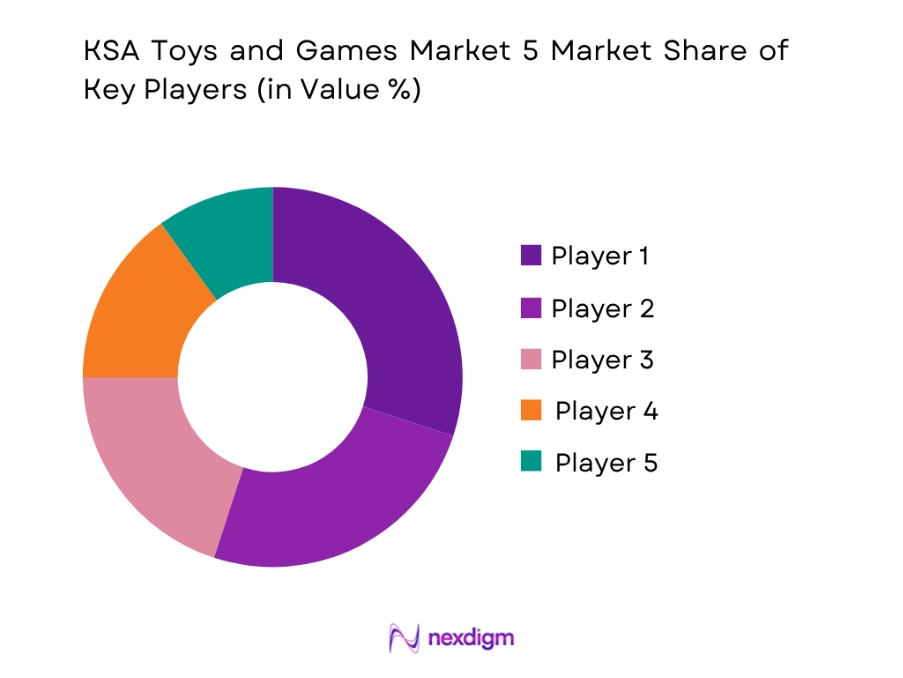
The KSA toys and games market features a mix of global licensors, large retail chains, franchise operators, and local distributors. International brands leverage strong intellectual property and licensed merchandise, while local retailers use retail networks and cultural relevance to expand presence.
| Player Name | Est. Year | Headquarters | Product Portfolio Breadth | Retail Footprint | Brand Licensing Partnerships | E‑Commerce Integration | Distribution Network Scale | Safety Compliance & Quality |
| LEGO Group | 1932 | Denmark | ~ | ~ | ~ | ~ | ~ | ~ |
| Mattel, Inc. | 1945 | United States | ~ | ~ | ~ | ~ | ~ | ~ |
| Hasbro, Inc. | 1923 | United States | ~ | ~ | ~ | ~ | ~ | ~ |
| Toys R Us Saudi Arabia | 1957 (Brand) | Franchise KSA | ~ | ~ | ~ | ~ | ~ | ~ |
| Samaco Toys & Leisure | 1970s | Saudi Arabia | ~ | ~ | ~ | ~ | ~ | ~ |
KSA Toys and Games Market
Growth Drivers
Increasing Household Consumption Expenditure Supporting Consumer Discretionary Purchases
Household consumption in Saudi Arabia remains a major engine driving discretionary categories like toys and games. In 2025, household final consumption expenditure totaled SAR 2,136 billion, a figure reflecting aggregate domestic spending on goods and services such as leisure products, recreation, and play items. This comprehensive household spend underpins retailers’ ability to stock diverse global toy brands and interactive gaming products, as families allocate discretionary budgets toward experiential and educational purchases. The reliance on household expenditure for broad retail categories highlights the role of consumer spending capacity in sustaining demand, particularly across urban centres where retail footfall and family purchasing power are concentrated. Saudi Arabia’s GDP stood at USD 1.24 trillion in 2025, with real economic activity continuing to support retail trades like toys and games through persistent consumer demand even amid moderate national growth, pointing to resilient consumption patterns. Furthermore, the retail landscape, including specialty toy stores and e‑commerce channels, benefits from this robust household spend, enabling expanded product assortments and seasonal promotions that attract family‑oriented purchases and stimulate market momentum.
Near‑Universal Digital Connectivity Enhancing Access to Toys and Games Content
Saudi Arabia’s advanced digital infrastructure significantly supports the toys and games ecosystem, particularly through e‑commerce and digital interactive content. Government‑published data shows internet penetration reached 99 percent of the population, with nearly all consumers connected and digitally active. This near‑universal connectivity facilitates online discovery, purchase, and social sharing of toys, games, and gaming accessories, extending beyond physical store access to broad swaths of the population. Moreover, mobile penetration is extremely high: 99.4 percent of users access the internet via mobile devices, making digital platforms highly effective channels for retail and digital engagement with play and gaming content. With 36.84 million internet users in early 2024, the digital ecosystem underpins key e‑commerce behaviours that retailers leverage to boost toy and game category exposure and sales. These digital trends are complemented by elevated social media engagement and online gaming participation, offering marketing and branding opportunities that drive consumer interest in both physical toys and digital entertainment products. As a result, digital penetration acts as a fundamental enabler of market access, extending reach into non‑traditional retail zones and enhancing convenience‑driven purchases, underpinning growth across both online and omnichannel supply strategies.
Market Opportunities
Young Population Base Driving Long‑Term Play and Gaming Demand
Saudi Arabia’s demographic structure creates a strong foundation for ongoing demand across the toys and games market due to a predominantly youthful population that forms the largest potential consumer cohort. National demographic estimates indicate the Kingdom’s population was 36,196,049 people in 2024, with a large segment of this population in younger age brackets that are the core target for toy and game purchases. Young consumers and children influence family purchasing behaviour not only for traditional toys but also for digital gaming peripherals, interactive playsets, and licensed entertainment products. In addition to children, the broader youth segment supports demand for collectibles, board games, and esports‑related play experiences, augmenting total engagement with the market. Complementing this demographic strength, nearly 99 percent of the Saudi population used the internet in 2024, reinforcing the potential for e‑commerce and digital engagement to extend product access and influence play behaviours across age groups. With high internet penetration, digital content and interactive gaming formats also benefit from broader reach, especially among tech‑savvy youth. This demographic and digital context positions the toys and games market to capture evolving play patterns beyond basic physical toys, supporting sustained demand across multiple product categories and retail formats.
Advanced Digital Connectivity and E‑Commerce Adoption Supporting New Channel
Saudi Arabia’s highly developed digital and online retail environment presents a significant opportunity for expansion of toys and games distribution beyond traditional brick‑and‑mortar stores. Internet penetration reached 99 percent of the population in 2024, with mobile connectivity reaching nearly 99.4 percent, indicating widespread digital access across all socioeconomic segments. This pervasive connectivity supports the growth of e‑commerce platforms as effective channels for discovery, comparison, and purchase of toys, games, and gaming peripherals, expanding beyond major urban retail locations to serve consumers in remote regions. Enhanced digital adoption also enables omnichannel retailing strategies, where consumers seamlessly browse products online and complete purchases via home delivery or in‑store pickup. Furthermore, the surge in mobile and social app usage — with millions of active users engaging with digital content daily — supports targeted digital marketing campaigns, video demos, and influencer partnerships that elevate product visibility and consumer interest. As retailers integrate digital payments and logistics solutions, consumer convenience improves, reducing barriers to purchase and enabling broader product category penetration. Digital platforms also facilitate licensing and niche toy discovery that might otherwise lack shelf space in physical stores. Thus, high levels of connectivity and e‑commerce adoption create channels for market expansion, enhancing retail reach and supporting diversified product offerings that align with evolving consumer purchasing behaviours.
Market Challenges
Slower National Economic Growth Impacting Consumer Discretionary Spend
The broader economy in Saudi Arabia is currently experiencing modest growth dynamics that can constrain discretionary spending on non‑essential categories like toys and games. According to the World Bank, Saudi Arabia’s gross domestic product (GDP) increased by approximately USD 1.24 trillion in 2024, but real economic growth was measured around 2.0 percent, reflecting moderate expansion relative to historic peaks. This slower pace of macroeconomic growth suggests that, while overall output remains substantial, the rate at which households increase disposable spending on discretionary goods — such as premium toys, collectibles, and interactive gaming accessories — may be tempered by cautious consumer behaviour. Even though household final consumption expenditure represents a major component of domestic demand, measured growth outside essential goods can lead to prioritisation of necessities over entertainment categories when economic priorities shift. In this context, consumer budgets may allocate more to food, utilities, and transport rather than higher‑ticket toys and adult collectibles, particularly among middle‑income and value‑oriented households. Additionally, regional economic pressures and global energy market volatility can influence fiscal planning and household expectations, further tightening discretionary discretionary spend. Retailers in the toys and games market must therefore align product pricing, promotions, and value propositions with consumer sensitivity to broader economic conditions, focusing on affordable category entries and omni‑channel promotions that resonate with cautious spending patterns rather than relying solely on premium priced assortments.
Heavy Import Dependence Exposing Supply Chains to Global Disruptions
The KSA toys and games market faces a structural challenge related to its dependence on imports for the vast majority of product supply, which exposes retailers and distributors to volatility in global supply chains, logistics, and foreign trade conditions. International trade data indicate a significant portion of toys and recreational products sold in Saudi Arabia are sourced from global manufacturing hubs, particularly Asia and Europe, with domestic production capacity limited in comparison. This import reliance subjects the market to exchange rate pressures, shipping cost fluctuations, and logistical delays, especially during periods of constrained global maritime traffic or elevated freight costs. For example, when container freight indices rose sharply between 2022–2024, the cost structure for imported toys increased, forcing retailers to adjust pricing or absorb margin pressures. Furthermore, compliance with customs and regulatory import standards adds complexity, as products need to meet stringent safety certifications before entry, leading to additional handling times and potential bottlenecks. These supply chain dependencies can result in periodic shortages of key toy lines, delay seasonal inventory replenishment, and increase lead times for popular licensed products, all of which dampen retail responsiveness to consumer demand. Retailers and distributors must invest in diversified sourcing strategies, pre‑emptive inventory planning, and agile logistics partnerships to mitigate these risks in order to sustain stable market availability and protect revenue streams amidst global trade uncertainties.
Future Outlook
The KSA Toys and Games market is projected to expand over the next decade and beyond, propelled by young demographic trends, digital engagement in play activities, rising household incomes, and increasing preferences for interactive and educational toys. Expansion of e‑commerce and omnichannel retail will broaden market access across varied regions, while brand licensing strategies will continue shaping consumer demand. Stakeholders are expected to innovate through hybrid physical‑digital product offerings and partnerships that align with Saudi Arabia’s Vision 2030, which emphasises family entertainment, education, and digital inclusion.
Major Players
- LEGO Group
- Mattel, Inc.
- Hasbro, Inc.
- Toys R Us Saudi Arabia
- Samaco Toys & Leisure
- Toy Triangle
- Hamleys Saudi Arabia
- Jarir Bookstore (Toys Division)
- Simba Toys
- Toy Town
- Toys Brand Trading Company
- Clementoni
- Melissa & Doug
- Wasit Saudi Corp.
- Guangdong Family of Childhood Industrial Co., Ltd.
Key Target Audience
- Retail Chain Buyers & Category Heads
- Toy Manufacturers & Importers
- Brand Licensing and IP Partners
- Investments & Venture Capitalist Firms
- Toy Distributors & Logistics Providers
- Specialty E‑Commerce Platform Stakeholders
- Government & Regulatory Bodies
- Retail Real Estate Investors
Research Methodology
Step 1: Identification of Key Variables
The initial phase mapped the full ecosystem of producers, licensors, distributors, retailers, and end consumers in the KSA toys and games market using comprehensive secondary data from import statistics, trade data, and retail monitoring.
Step 2: Market Analysis and Construction
This phase compiled historical revenue figures from multiple sources, evaluating retail performance across product types, distribution channels, and regional demand clusters to assess revenue drivers and consumption patterns.
Step 3: Hypothesis Validation and Consultation
Market hypotheses were verified through expert consultations and industry insights, including import volume reviews, retail network analyses, and trend assessments for digital and physical toy categories to refine market assumptions.
Step 4: Research Synthesis and Final Output
The final phase consolidated validated data into a structured market outlook, integrating cross‑segment segmentation, competitive benchmarking, and forecast projections to deliver a robust industry analysis tailored for strategic decision‑making.

- Executive Summary
- Research Methodology (Market Definitions & Assumptions, Abbreviations, Market Sizing & Forecasting Approach, Consolidated Research Framework, Primary Research Protocol, Data Triangulation Method, Limitations & Future Research Directions)

- Definition & Scope
- Market Genesis & Consumer Evolution
- Cultural & Festive Demand Influencers (Seasonal Purchasing Patterns)
- Retail Landscape Overview (Brick‑and‑Mortar vs Online Channels)
- Import‑Dependence & Local Production Dynamics

- Growth Drivers (Youth Population & Family Spending Dynamics, Rising Disposable Income & Consumer Preferences, Digital Media & Interactive Toy Adoption)
- Market Challenges (High Import Reliance, Product Safety & Regulatory Compliance, Price Competition & Market Fragmentation)
- Market Opportunities (Expansion of E‑Commerce & Digital Marketplaces, Demand for Educational / STEM & Smart Toys, Retail Experience & Flagship Store Development)
- Market Trends (Licensed Merchandise Growth, Digital Play & Hybrid Toy Solutions, Seasonal & Cultural Collection Trends)
- Government Regulation Impact (Safety Standards & Toy Certification Regulations, Import Tariffs & Compliance Requirements)
- SWOT Analysis
- Stakeholder Ecosystem
- Porter’s Five Forces Analysis

- Market Revenue by Value (2020-2025)
- Rationale for Growth (2020-2025)
- Household Consumption Drivers (2020-2025)

- By Product Type (In Value %)
Electronic Games & Digital Playsets
Action Figures & Collector Models
Dolls & Plush Toys
Educational & STEM Toys
Games, Puzzles & Board Games - By Age Group (In Value %)
Early Childhood (0‑5)
Children (6‑10)
Pre‑Teens (11‑14)
Teen & Adult Collectibles - By Distribution Channel (In Value %)
Specialty Toy Retailers
Department & Hypermarkets
E‑Commerce Platforms
General Retail Outlets & Gift Shops
Independent Toys & Games Boutiques - By Region (In Value %)
Riyadh Metropolitan Region
Jeddah & Western Province
Eastern Province (Dammam‑Khobar)
Northern & Southern Regions

- Market Share — Value / Volume
- Cross Comparison Parameters(Company Overview, Business Strategy Archetype, Product Portfolio Breadth, Licensing Partnerships & IP Access, Retail Footprint & Channel Distribution Scale, E‑Commerce Integration Score, Supply Chain Resilience & Import Network, Price Tier & SKU Price Band Spread, Safety & Quality Compliance Ratings, Innovation Index & New Product Velocity, Consumer Engagement & Loyalty Index, Marketing & Seasonal Campaign Strength, Revenue Distribution by Category, Geographic Market Coverage)
- Player Positioning Matrix (Premium vs Mass vs Value)
- Product Pricing & SKU Mapping by Competitor
- Strategic Initiatives & Recent Developments
- Detailed Profiles of Major Companies
Mattel, Inc.
Hasbro, Inc.
LEGO Group
Spin Master Corp.
MGA Entertainment
Bin Salman Fty For Plastic & Toys
SAMACO Toys and Leisure
Toy Triangle
Simba Toys
Toys R Us Saudi
Wasit Saudi Corp.
Clementoni
Guangdong Family of Childhood Industrial Co., Ltd.
BlueBird Toys
Local Independent Toy Chain

- Consumer Demand & Purchase Behavior
- Purchasing Power & Budget Allocation Patterns
- Retail Decision Influencers (Brand vs Price)
- Urban vs Regional Consumption Patterns
- Consumer Sentiment & Product Expectations

- By Revenue Outlook & Projections (2026-2035)
- By Volume & Unit Forecast (2026-2035)
- By Retail Channel Evolution Metrics (2026-2035)


 Request a Sample
 Ask for Customization
 Get a Quote
 Enquire Now