
 Download PDF
Market Overview
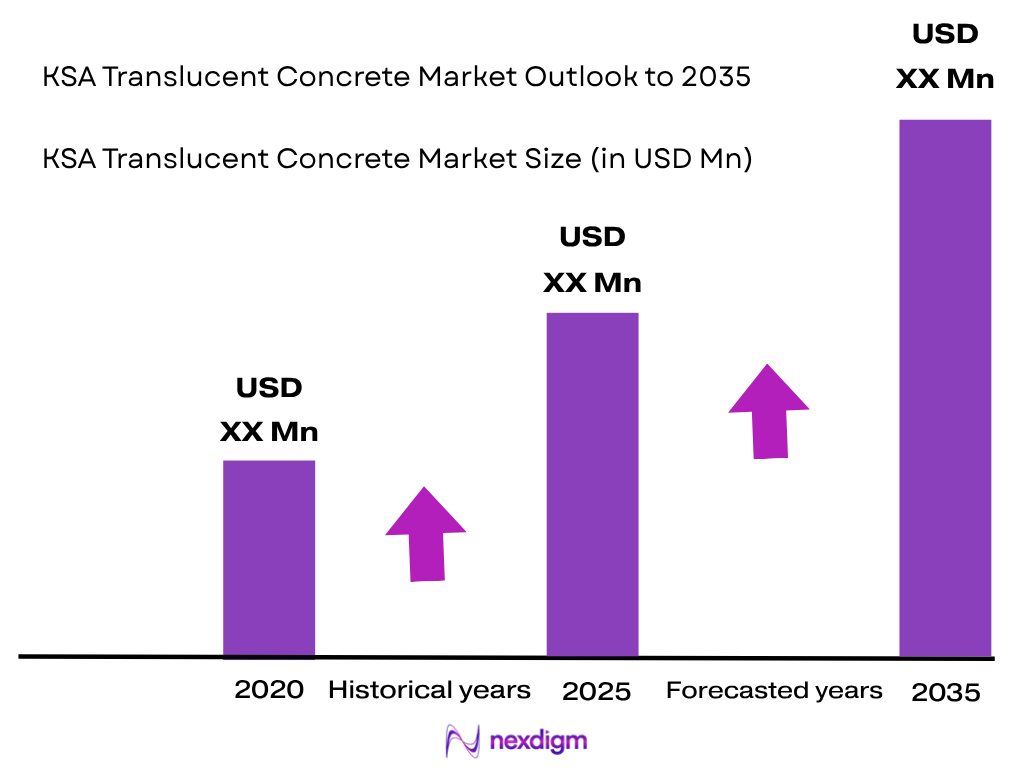
The KSA Translucent Concrete Market is valued at approximately USD 140 million, based on a five-year historical analysis. The preceding period recorded a smaller commercial base as adoption remained concentrated in specialized architectural projects. Market development is being driven by energy-efficient construction, sustainable architecture, premium façades, smart infrastructure and Vision 2030 projects. Translucent concrete’s combination of structural concrete with optical elements enables daylight transmission while supporting visually distinctive walls, façades and interior architectural surfaces.
Riyadh, Jeddah and Dammam represent the principal demand centers for the KSA Translucent Concrete Market because they concentrate commercial development, infrastructure construction, premium residential projects and architectural investment. The preceding period’s construction expansion was complemented by continuing Vision 2030 implementation and giga-project development, including projects designed to create new economic ecosystems. Riyadh’s large-scale urban transformation, Jeddah’s tourism and mixed-use development, and Dammam’s Eastern Province construction ecosystem make these cities particularly relevant for advanced building materials and architectural concrete.
Market Segmentation
By Raw Material
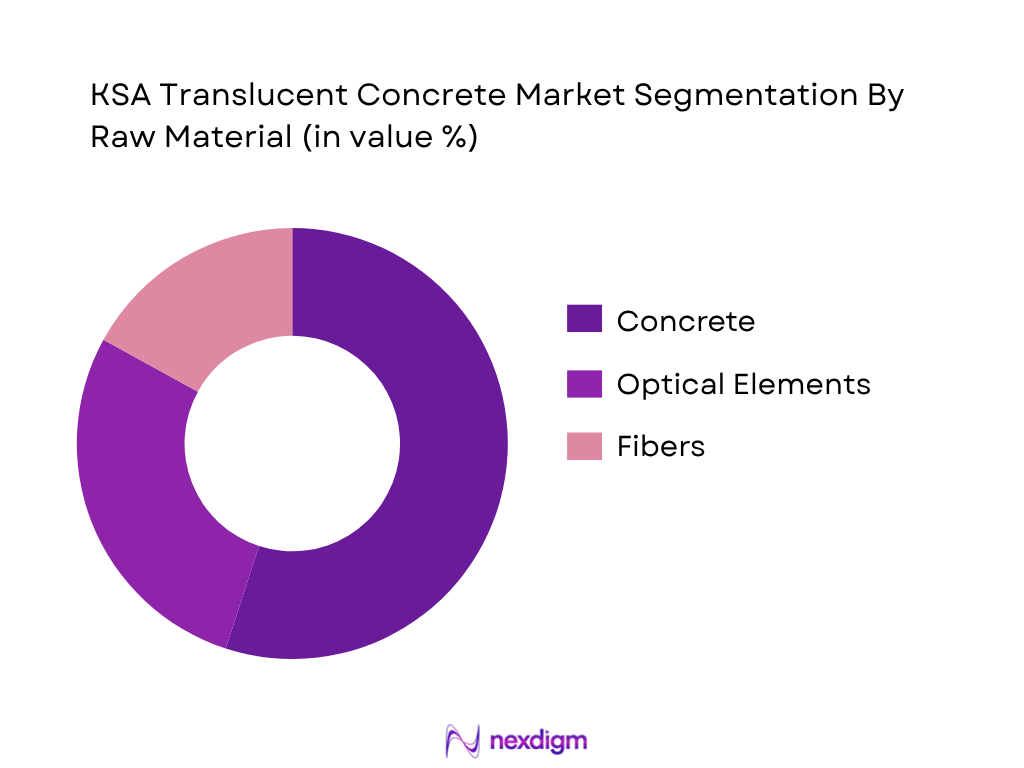
The KSA Translucent Concrete Market is segmented by raw material into Concrete, Optical Elements and Fibers. Concrete holds the dominant position because it constitutes the principal structural and architectural matrix into which optical fibers, glass elements or other light-transmitting components are integrated. Saudi Arabia’s extensive construction and infrastructure activity creates a natural demand environment for concrete-based architectural materials, while translucent systems provide additional aesthetic and daylighting functionality. The segment benefits from the Kingdom’s established cement, ready-mix and precast ecosystem, which creates potential for greater domestic fabrication as adoption develops. Optical elements remain technologically critical because they enable transmission of natural or artificial light through an otherwise solid cementitious surface. Fibers are similarly important in optical-fiber-embedded systems, particularly where architects require detailed light patterns or illuminated façades. Concrete nevertheless remains the leading raw-material category in available Saudi market assessments because every commercial translucent-concrete solution requires a suitable cementitious matrix capable of providing structural integrity, durability and architectural finish.
By End User
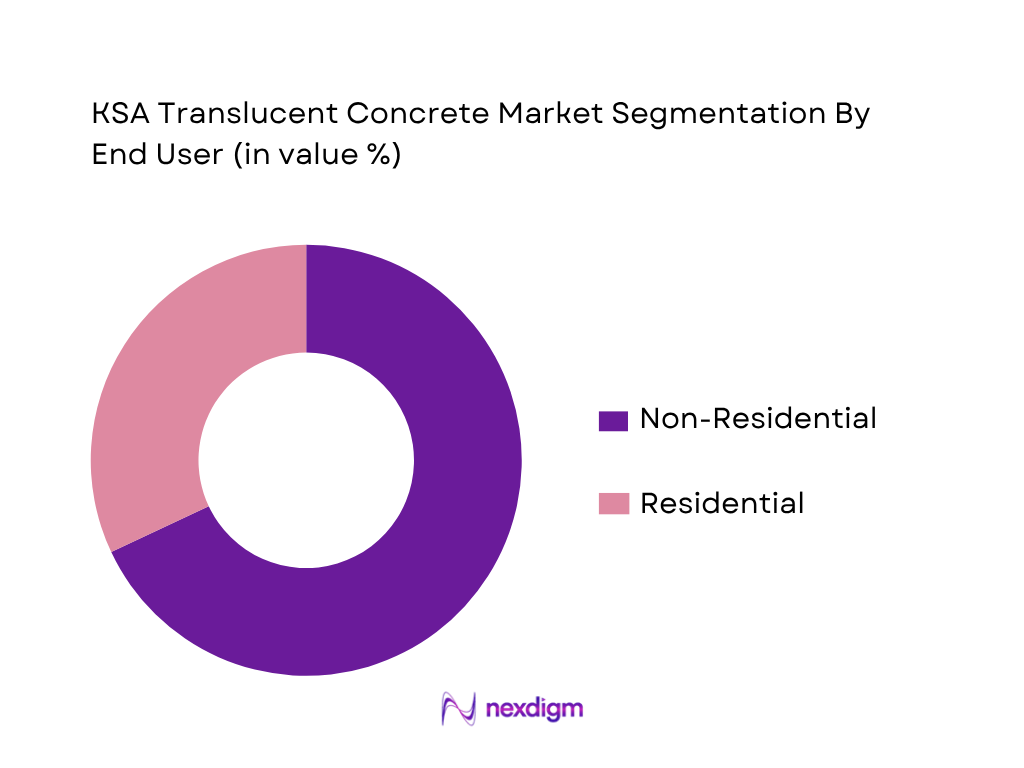
The KSA Translucent Concrete Market is segmented into Residential and Non-Residential applications. Non-residential construction holds the dominant market position because translucent concrete is particularly suited to high-profile commercial buildings, hospitality properties, cultural destinations, transportation infrastructure, public buildings and landmark architecture where aesthetic differentiation can justify specialized material specification. Saudi Arabia’s Vision 2030 transformation is creating precisely this type of construction environment through large-scale destinations and giga-projects designed to establish new tourism, entertainment and urban ecosystems. Optical-fiber concrete can be incorporated into façades, lobby walls, illuminated partitions, reception areas, signage and public-realm installations, giving non-residential developers a broader application range than conventional residential projects. Commercial users can also integrate translucent panels with architectural lighting to create branded or interactive surfaces. Residential demand remains relevant in luxury villas and premium developments, but larger installation areas, public visibility and architectural customization requirements make non-residential buildings the stronger demand center for the Saudi translucent-concrete industry.
Competitive Landscape
The KSA Translucent Concrete Market is characterized by specialist international technology providers, advanced concrete manufacturers and architectural façade companies rather than a large base of dedicated domestic translucent-concrete producers. Companies compete primarily through optical-fiber and light-guide technology, light-transmission performance, architectural customization, panel engineering, façade-system compatibility and project execution. Saudi Arabia’s project-driven market also places importance on GCC accessibility, technical support, customized fabrication and the ability to collaborate with local precast manufacturers, architects and façade contractors.
| Major Player | Establishment Year | Headquarters | Core Technology | Key Product Form | Light-Transmission Capability | Façade Capability | Customization Capability | KSA/GCC Relevance |
| LUCEM GmbH | 2007 | Aachen, Germany | ~ | ~ | ~ | ~ | ~ | ~ |
| LiTraCon / Litracon | 2004 | Csongrád, Hungary | ~ | ~ | ~ | ~ | ~ | ~ |
| Heidelberg Materials / Italcementi | 1873 | Heidelberg, Germany | ~ | ~ | ~ | ~ | ~ | ~ |
| Pan-United Corporation Ltd. | 1958 | Singapore | ~ | ~ | ~ | ~ | ~ | ~ |
| Fapinex LLC | 2016 | Dubai, UAE | ~ | ~ | ~ | ~ | ~ | ~ |
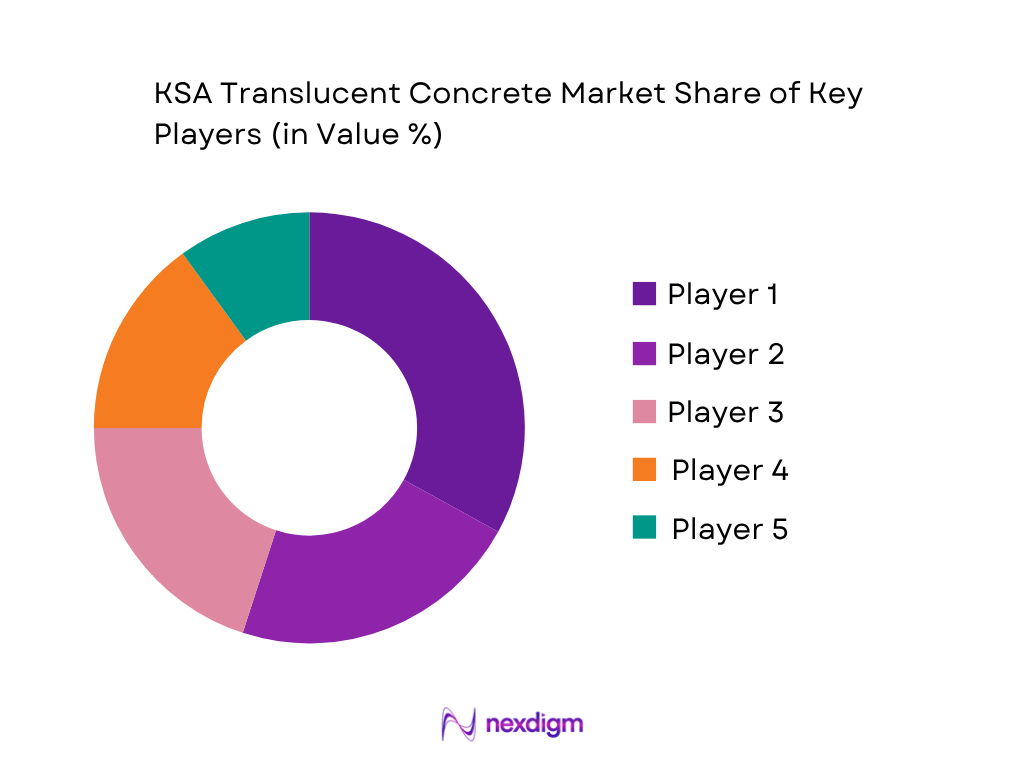
KSA Translucent Concrete Market Analysis
Growth Drivers
Vision 2030 Construction Pipeline and Capital Formation Accelerating Architectural Material Demand
Saudi Arabia’s large construction and fixed-investment base provides a substantial demand foundation for translucent concrete across landmark façades, feature walls, illuminated partitions, public spaces and high-specification architectural projects. GASTAT reported SAR 1,441 billion in gross fixed capital formation during 2024, while structural business statistics recorded SAR 988 billion of gross fixed capital formation across the business sector and SAR 1,653 billion in purchases of fixed assets. Construction activity is particularly relevant for translucent concrete because the Ministry of Municipalities and Housing issued more than 276,000 construction licenses during 2024 and approximately 100,000 building compliance certificates across the Kingdom. These volumes demonstrate a large pipeline through which specialized optical-fiber concrete and light-transmitting cementitious products can gain specification. The macroeconomic environment reinforces this construction base: IMF data place Saudi Arabia’s 2024 nominal GDP at approximately SAR 4,108 billion, equivalent to about USD 1,096 billion, while nominal non-oil GDP reached approximately SAR 2,670 billion. Saudi Arabia also continues to channel investment toward non-oil urban development, tourism, entertainment, commercial property and public infrastructure, sectors where distinctive architectural materials have greater relevance. For translucent concrete manufacturers, the opportunity extends beyond structural construction toward architect-led projects requiring controlled daylight penetration, privacy and visual differentiation. Large mixed-use developments can utilize translucent concrete in entrance structures, pedestrian areas, façades, interior partitions and illuminated public spaces. The substantial level of fixed investment also strengthens the potential business case for domestic precast companies to add specialized panel-manufacturing capabilities. Consequently, Saudi Arabia’s construction transformation provides both an immediate specification environment and a longer-term industrial platform for optical-fiber panels, illuminated concrete surfaces, custom architectural components and other high-performance translucent concrete applications.
Hospitality Expansion Creating Demand for Premium Façades and Illuminated Architectural Surfaces
Saudi Arabia’s rapidly expanding hospitality infrastructure provides a direct market-specific growth driver for translucent concrete because hotels, resorts and tourism destinations require visually differentiated façades, reception areas, entrance structures, illuminated walls, privacy partitions and customized interior surfaces. The Ministry of Tourism reported 426,056 licensed hospitality room keys across Saudi Arabia as of August 2024. The licensed hospitality base subsequently expanded to 544,879 room keys in the first half of 2025, comprising 450,074 hotel room keys and 94,805 apartment and other accommodation keys. Makkah alone recorded 305,764 licensed room keys, while Madinah contained 64,569, Riyadh approximately 47,593, Jeddah 30,900, and the Dammam metropolitan area 20,559. These concentrations create identifiable geographic clusters in which specialist architectural products can be marketed to hotel owners, developers, architects and interior designers. The broader macroeconomic environment provides additional support: IMF data show Saudi nominal GDP of approximately USD 1,096 billion in 2024 and nominal non-oil GDP of approximately SAR 2,670 billion. The expansion of hospitality capacity is particularly relevant because translucent concrete has applications extending from exterior envelopes to interior experience design. Optical-fiber panels can create illuminated reception walls, corridors, spa areas, restaurants and branded spaces without eliminating the visual solidity associated with concrete. Luxury resorts can also deploy translucent concrete in landscape walls, pathways, signage and exterior architectural elements. Growing room inventory consequently expands not only the number of potential projects but also the number of individual interior and exterior locations where specialized light-transmitting concrete can be specified, strengthening the addressable application ecosystem.
Market Challenges
Specialized Material Adoption within a Very Large Conventional Construction Ecosystem
The scale of Saudi construction is simultaneously a growth driver and an adoption challenge because translucent concrete must compete for architectural specification within an established ecosystem dominated by conventional precast concrete, architectural glass, stone, GFRC, UHPC, metal façades and other familiar building systems. The Ministry of Municipalities and Housing recorded more than 276,000 construction licenses during 2024 alongside approximately 100,000 building compliance certificates, demonstrating the enormous number of projects moving through conventional permitting and compliance processes. GASTAT reported SAR 988 billion in business-sector gross fixed capital formation during 2024, with purchases of fixed assets reaching SAR 1,653 billion, while national gross fixed capital formation stood at SAR 1,441 billion. Against this large construction base, translucent concrete requires additional coordination between optical-fiber suppliers, cementitious-material manufacturers, precast companies, architects, lighting designers, façade engineers and specialist installers. The IMF recorded Saudi nominal non-oil GDP at approximately SAR 2,670 billion in 2024, illustrating the economic scale supporting non-oil development but not automatically translating into adoption of specialist materials. Optical-fiber concrete must therefore demonstrate a clear architectural function compared with well-established substitutes. Developers may also require full-scale façade mock-ups before approving unfamiliar translucent systems. Material suppliers need documentation covering compressive performance, flexural behavior, anchorage, fire characteristics, optical consistency and environmental durability. Saudi climatic conditions additionally make UV, heat, dust and thermal-cycling performance important specification considerations. Manufacturers consequently need local technical representation and installation capability alongside the product itself, making commercial market entry considerably more complex than conventional concrete supply.
Construction Pipeline Volatility Can Affect Specification of Specialized Architectural Materials
Translucent concrete is more exposed to construction-cycle and project-stage changes than conventional structural concrete because it is typically specified for architectural differentiation rather than essential structural volume. Current Saudi building-permit data demonstrate the variability that can occur in the flow of projects reaching execution. GASTAT recorded 7,584 building permits in May 2025, compared with 6,803 permits in April 2026 and 5,056 permits in May 2026. For suppliers of optical-fiber concrete panels, variations in projects moving through approval and construction can affect the timing of façade packages, interior fit-outs, physical mock-ups, material approvals and specialist procurement. The challenge exists despite Saudi Arabia’s considerable macroeconomic capacity. IMF data show 2024 nominal GDP at approximately SAR 4,108 billion, nominal non-oil GDP at approximately SAR 2,670 billion, and Saudi Central Bank net foreign assets of approximately USD 415 billion in the IMF’s subsequent assessment. GASTAT also reported SAR 1,441 billion in national gross fixed capital formation during 2024. Specialized architectural products face additional risk because developers can redesign façades or replace non-essential finishes during value engineering. A delayed hospitality, entertainment or commercial development can therefore postpone translucent-concrete procurement even after initial architectural specification. Manufacturers also need to synchronize customized production with narrow installation windows because panels can require project-specific dimensions, optical patterns and anchoring systems. Long development cycles increase the importance of maintaining relationships with architects, developers and façade contractors from concept design through procurement. Consequently, Saudi market participants require diversified project pipelines rather than dependence on a small number of flagship developments.
Market Opportunities
Localization of Optical-Fiber Concrete through Saudi Precast and Construction Investment
Saudi Arabia’s large domestic fixed-investment ecosystem creates a significant opportunity for future localization of translucent concrete manufacturing rather than relying primarily on imported finished architectural elements. GASTAT recorded SAR 1,653 billion in fixed-asset purchases by businesses during 2024, while gross fixed capital formation within the business sector reached SAR 988 billion. National accounts separately recorded SAR 1,441 billion in economy-wide gross fixed capital formation. These figures indicate substantial industrial and construction investment capacity that can support specialized precast production, CNC finishing, mould fabrication, automated processing and panel-manufacturing capabilities relevant to translucent concrete. The Ministry of Municipalities and Housing’s issuance of more than 276,000 construction licenses during 2024 provides a large downstream project ecosystem in which locally fabricated products can progressively compete for architectural specification. Saudi Arabia’s macroeconomic platform is similarly substantial, with IMF data recording approximately SAR 4,108 billion in nominal GDP and SAR 2,670 billion in nominal non-oil GDP during 2024. For international translucent-concrete technology owners, localization does not necessarily require immediate domestic production of every input. A practical model could involve importing PMMA optical fibers, glass light guides or proprietary optical components while sourcing cementitious matrices, aggregates and selected admixtures domestically. Saudi precast partners could undertake moulding, fiber placement, casting, curing, cutting, polishing and anchorage preparation. Local architectural-lighting companies could subsequently integrate LEDs and control systems for illuminated applications. This production structure would create technical knowledge inside the Kingdom while enabling faster project-specific customization. Localization could additionally support Arabic geometric patterns, corporate branding and bespoke panel dimensions tailored specifically to Saudi architectural requirements, strengthening the future commercial proposition.
Giga-Projects and Destination Architecture Creating Future Specification Opportunities
Saudi Arabia’s giga-project and destination-development ecosystem creates a substantial future opportunity for translucent concrete because these developments emphasize landmark architecture, tourism, entertainment, public realm, sustainability and technologically differentiated built environments. The Public Investment Fund states that NEOM covers 26,500 square kilometres, providing an exceptionally large development platform for new urban, hospitality and infrastructure concepts. Qiddiya City spans more than 360 square kilometres, while Red Sea Global’s Red Sea destination extends across approximately 28,000 square kilometres. These developments provide a broad physical environment in which advanced architectural materials can be considered for façades, interiors, landscape structures, illuminated public spaces and signature installations. Current hospitality infrastructure further demonstrates the scale of the addressable architectural ecosystem: Saudi Arabia contained 426,056 licensed hospitality room keys in August 2024, increasing to 544,879 licensed room keys in the first half of 2025. The IMF recorded Saudi nominal non-oil GDP at approximately SAR 2,670 billion during 2024, while GASTAT reported SAR 1,441 billion in gross fixed capital formation. Translucent concrete is particularly relevant to destination projects because it can combine physical solidity with controlled illumination, allowing designers to create walls that transform between daytime and nighttime appearances. Cultural and entertainment buildings can incorporate illuminated graphics, geometric patterns or wayfinding elements directly within concrete surfaces. Hospitality projects can use the technology for privacy screens, entrances, lobbies and landscape installations. Transportation nodes and public spaces provide additional applications where durability and visual identity must coexist. Successful reference installations within major Saudi destinations could therefore establish technical precedents that encourage wider specification across commercial, civic, hospitality and mixed-use construction.
Future Outlook
The KSA Translucent Concrete Market is expected to expand at a forecast CAGR of approximately ~XX% during 2026-2035. Future development will be linked to Vision 2030 construction, giga-project execution, premium hospitality, smart infrastructure, landmark architecture and increasing interest in sustainable building materials. Local fabrication partnerships and improvements in optical-fiber placement could progressively reduce dependence on completely finished imported systems and expand the range of commercially viable applications.
Saudi Arabia’s giga-project program creates a distinctive demand environment for translucent concrete. Vision 2030 identifies giga-projects as vehicles for establishing new economic ecosystems, creating investment opportunities and advancing technology. Developments associated with NEOM, Qiddiya, Red Sea destinations and other major urban initiatives require differentiated architecture, creating potential specification opportunities for illuminated façades, feature walls, branded concrete surfaces, public-realm installations and bespoke architectural elements.
Major Players
- LUCEM GmbH
- LiTraCon / Litracon
- Heidelberg Materials / Italcementi
- Pan-United Corporation Ltd.
- Fapinex LLC
- FİBROBETON
- Dupont Lightstone
- CRE Panel GmbH
- LCT GesmbH
- Beton Brož
- Glass Block Technology Ltd.
- Florack Bauunternehmung GmbH
- Concrete LCDA
- Gravelli / LiCrete
- DITON s.r.o.
Key Target Audience
- Translucent Concrete and Architectural Concrete Manufacturers
- Precast Concrete and Façade System Manufacturers
- Giga-Project Developers and Real Estate Developers
- Construction Contractors and EPC Companies
- Architects, Façade Designers and Architectural Lighting Companies
- Investments and Venture Capitalist Firms
- Government and Regulatory Bodies (Ministry of Municipalities and Housing, Saudi Standards, Metrology and Quality Organization, Saudi Building Code National Committee)
- Building Material Importers, Distributors and Technology Licensees
Research Methodology
Step 1: Identification of Key Variables
The initial phase involves constructing an ecosystem map encompassing optical-fiber suppliers, cement manufacturers, translucent-concrete technology developers, precast companies, façade contractors, architects, giga-project developers, distributors and end users operating across Saudi Arabia. Secondary and proprietary databases are used to identify critical variables including installed surface area, application mix, optical-fiber requirements, architectural specifications, project pipeline, import dependence and domestic fabrication capability.
Step 2: Market Analysis and Construction
Historical market development is analyzed through combined top-down and bottom-up market-sizing models. The top-down framework assesses Saudi construction activity, non-residential development, giga-project pipelines and architectural-material adoption, while the bottom-up framework examines project numbers, panel consumption, installed translucent-concrete area, supplier activity and application requirements. Both approaches are cross-validated to establish a consistent historical market framework.
Step 3: Hypothesis Validation and Expert Consultation
Market hypotheses are validated through computer-assisted telephone interviews (CATIs) and discussions with concrete manufacturers, façade specialists, architects, building-material distributors, contractors and developers. Primary interviews assess optical-fiber requirements, application preferences, specification behavior, manufacturing capability, procurement channels, installation requirements, project lead times and technical barriers affecting translucent-concrete adoption within the Saudi construction ecosystem.
Step 4: Research Synthesis and Final Output
The final phase triangulates secondary research, primary interviews, supplier information and construction-project analysis. Demand-side indicators are reconciled with manufacturer capabilities, architectural specifications, giga-project activity and project-level application potential. This process validates market segmentation, competitive positioning and future opportunity areas while integrating top-down economic analysis with bottom-up translucent-concrete consumption and project mapping.

- Executive Summary
- Research Methodology (Market Definition and Scope, KSA Translucent Concrete Market Classification, Light-Transmitting Concrete Technology Mapping, Optical-Fiber-Embedded Concrete Assessment, PMMA Optical Fiber Concrete Evaluation, Glass-Fiber Light-Transmitting Concrete Analysis, Resin and Polymer-Based Translucent Concrete Assessment, Precast Translucent Concrete Panel Evaluation, Translucent Concrete Block Assessment, Architectural Panel Performance Mapping, Light Transmission Efficiency Analysis, Compressive Strength Assessment, Flexural Strength Evaluation, Optical Fiber Density Analysis, Panel Thickness and Dimension Assessment, Surface Finish Evaluation, Façade Application Mapping, Interior Application Assessment, Building Type Demand Mapping, Giga-Project Demand Mapping, Precast Manufacturing Assessment, Architectural Specification Analysis, Import Dependency Assessment, Local Manufacturing Capability Assessment, Supply-Side Assessment, Demand-Side Assessment, Top-Down Market Sizing, Bottom-Up Market Sizing, Primary Industry Interviews, Data Triangulation, Forecasting Framework)

- Definition and Scope
- KSA Translucent Concrete Industry Evolution and Development of Optical-Fiber-Embedded Concrete, Light-Transmitting Cementitious Materials, Precast Translucent Concrete Panels, Architectural Façade Systems, Interior Feature-Wall Applications, Daylighting Solutions, High-Performance Concrete Matrices, PMMA Optical Fiber Integration, Glass Light-Guide Technologies, Custom Architectural Elements, Smart Concrete Surfaces, LED-Integrated Concrete, Low-Carbon Concrete Matrices, Automated Fiber Placement, Digital Fabrication and Advanced Precast Manufacturing
- Translucent Concrete Value Chain Analysis
- Translucent Concrete Supply Chain Analysis
- Cement and Binder Suppliers, Fine Aggregate Suppliers, Optical Fiber Manufacturers, PMMA Fiber Suppliers, Glass Light-Guide Suppliers, Admixture Manufacturers, Translucent Concrete Technology Developers, Precast Concrete Manufacturers, Architectural Panel Fabricators, Façade System Suppliers, Specialty Building Material Importers, Construction Material Distributors, Architects, Façade Consultants, Lighting Designers, Giga-Project Developers, General Contractors, Specialty Installers, Property Developers and Building Owners

- Growth Drivers (Vision 2030 Construction Transformation, Expansion of Giga and Mega Projects, Increasing Demand for Premium Architectural Materials, Luxury Hospitality Development, Growth of Landmark Architecture, Increasing Demand for Daylighting Solutions, Adoption of Signature Building Façades, Growth of High-End Interior Fit-Out Projects, Increasing Precast Construction Adoption)
- Market Challenges (High Translucent Concrete Production Cost, High Optical Fiber Cost, Dependence on Imported Optical Fibers and Specialized Components, Limited Local Commercial-Scale Manufacturing, Labor-Intensive Fiber Placement, Complex Precast Manufacturing Requirements, Extreme Climate Performance Requirements, Limited Architect and Contractor Familiarity)
- Market Opportunities (Local Translucent Concrete Manufacturing, Localization of Precast Panel Production, Technology Licensing and Joint Ventures, Giga-Project Specifications, Automated Optical Fiber Placement, Lightweight Translucent Concrete Panels, Low-Carbon Cementitious Matrices, Integrated LED Concrete Systems, Smart and Interactive Façades, Modular Translucent Concrete Systems, Luxury Hotel and Resort Applications)
- Market Trends (Increasing Adoption of Optical-Fiber-Embedded Concrete, Growth of Custom Precast Panels, Integration of LED Backlighting, Development of Lightweight Panels, Increasing Use in Feature Walls and Signature Façades, Growing Interest in Locally Fabricated Architectural Concrete, Adoption of Digital Fabrication)
- Government Regulations and Standards (Saudi Building Code Requirements, Saudi Building Code Structural Requirements, SASO Construction Material Requirements, Concrete and Reinforced Concrete Standards, Construction Product Conformity Requirements, Structural Anchorage Requirements, Façade Wind-Load Requirements, Fire and Life-Safety Requirements)
- SWOT Analysis
- Porter’s Five Forces Analysis
- PESTLE Analysis
- Stakeholder Ecosystem
- Competition Ecosystem

- By Market Value (2020-2025)
- By Installed Volume (2020-2025)
- By Installed Surface Area (2020-2025)
- By Average Selling Price per Square Meter (2020-2025)
- By Precast Translucent Concrete Panel Consumption Volume (2020-2025)
- By Optical-Fiber-Embedded Concrete Consumption Volume (2020-2025)
- By Translucent Concrete Block and Tile Consumption Volume (2020-2025)
- By Exterior Façade Application Volume (2020-2025)
- By Interior Architectural Application Volume (2020-2025)

- By Light-Transmitting Technology (In Value %)
Optical-Fiber-Embedded Cementitious Concrete
PMMA Optical-Fiber Concrete
Glass-Fiber and Glass-Element-Based Concrete
Polymer and Resin-Based Translucent Concrete
Hybrid Light-Guide Concrete Systems
Integrated LED Translucent Concrete
Alternative Light-Transmitting Cementitious Systems - By Product Form (In Value %)
Precast Translucent Concrete Panels
Translucent Concrete Slabs
Translucent Concrete Blocks and Bricks
Translucent Concrete Tiles
Custom Architectural Elements
Decorative Concrete Components
Furniture and Interior Elements
Bespoke Formed and 3D Elements - By Application (In Value %)
Building Façades
Exterior Wall Cladding
Interior Feature Walls
Partitions and Space Dividers
Flooring and Pavements
Staircases and Vertical Circulation Elements
Reception Desks and Countertops
Signage and Branded Architectural Surfaces
Landscape and Public-Realm Installations
Furniture and Decorative Applications - By End-Use Building Type (In Value %)
Luxury Hotels and Resorts
Grade-A Offices and Corporate Buildings
Premium Residential Developments
Retail Malls and Luxury Stores
Airports and Transportation Facilities
Museums, Galleries and Cultural Buildings
Entertainment and Leisure Destinations
Healthcare Facilities
Government and Civic Buildings
Mixed-Use Developments
Religious and Pilgrimage Infrastructure
Sports and Event Infrastructure - By Project Type (In Value %)
New Construction
Giga and Mega Projects
Major Renovation
Façade Retrofit
Interior Fit-Out
Public-Realm Redevelopment
Landmark and Signature Architecture
Luxury Hospitality Development - By Region (In Value %)
Riyadh
Jeddah
Makkah
Madinah
Eastern Province
NEOM Region
Red Sea Tourism Corridor
Asir
Rest of KSA

- Market Share of Major Players (By KSA Revenue, Translucent Concrete Product Portfolio, Optical-Fiber Technology Capability, Precast Panel Portfolio, Light Transmission Performance, Panel Size and Thickness Range, Exterior Façade Capability, Interior Application Coverage, Customization Capability, Integrated Lighting Capability, Manufacturing Capacity, KSA and GCC Distribution Network, Architectural Specification Reach, Giga-Project Qualification Capability, Project Portfolio, Technical Support Capability)
- Cross Comparison Parameters (Light Transmission Efficiency, Compressive and Flexural Strength Performance, Panel Size and Thickness Range, Optical Fiber and Light-Guide Technology Capability, KSA and GCC Project and Distribution Presence, Extreme-Climate Façade Application Capability, Customization and Integrated Lighting Capability, Manufacturing Scalability and Project Lead-Time Capability)
- SWOT Analysis of Major Players
- Competitive Positioning Matrix
- Translucent Concrete Technology and Architectural Application Benchmarking
- Panel Performance, Anchorage and Building System Integration Assessment
- KSA Distribution, Architectural Specification and Technical Support Assessment
- Detailed Profiles of Major Companies
LUCEM GmbH
LiTraCon / Litracon
Heidelberg Materials / Italcementi
Pan-United Corporation Ltd.
Fapinex LLC
FİBROBETON
Dupont Lightstone
CRE Panel GmbH
LCT GesmbH
Beton Brož
Glass Block Technology Ltd.
Florack Bauunternehmung GmbH
Concrete LCDA
Gravelli / LiCrete
DITON s.r.o.

- Architectural Façade Requirement Assessment
- Exterior Wall Cladding Demand Analysis
- Interior Feature-Wall Requirement Assessment
- Giga and Mega Project Demand Analysis
- Grade-A Office and Corporate Building Demand Analysis
- Luxury Hotel and Resort Application Assessment
- Luxury Retail Application Requirement Analysis
- Airport and Transportation Facility Demand Assessment
- Entertainment and Leisure Destination Application Analysis
- Museum and Cultural Building Application Analysis
- Government and Civic Building Requirement Assessment
- Religious and Pilgrimage Infrastructure Application Analysis

- By Market Value (2026-2035)
- By Installed Volume (2026-2035)
- By Installed Surface Area (2026-2035)
- By Average Selling Price per Square Meter (2026-2035)
- By Precast Translucent Concrete Panel Consumption Volume (2026-2035)
- By Optical-Fiber-Embedded Concrete Consumption Volume (2026-2035)
- By Translucent Concrete Block and Tile Consumption Volume (2026-2035)
- By Exterior Façade Application Volume (2026-2035)
- By Interior Architectural Application Volume (2026-2035)


 Request a Sample
 Ask for Customization
 Get a Quote
 Enquire Now