
 Download PDF
 Download PDF
Market Overview
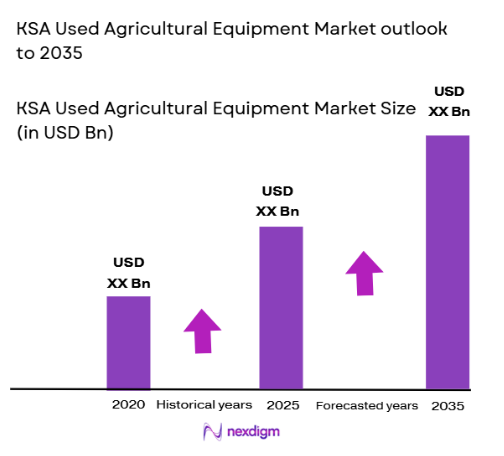
The KSA Used Agricultural Equipment market is experiencing robust growth driven by the increasing demand for cost-effective farming solutions. The market is expected to reach USD ~ billion in 2024. Factors such as the shift toward mechanization in agriculture, increased government support for agricultural development, and the rise in export-oriented agricultural production contribute significantly to the market’s growth. The rise in agricultural modernization is expected to further enhance market expansion by increasing the demand for used equipment, particularly in remote and rural farming areas.
Saudi Arabia remains a dominant player in the Middle East’s agricultural sector, with key regions like Riyadh and Jeddah leading the market. The demand for used agricultural equipment is fueled by the expansion of farming activities in these regions, supported by government subsidies and infrastructural growth. Additionally, the Kingdom’s efforts to enhance food security by increasing domestic agricultural production further drive the need for more affordable equipment. The adoption of advanced farming technologies is also contributing to the market’s strength.
Market Segmentation
By Product Type:
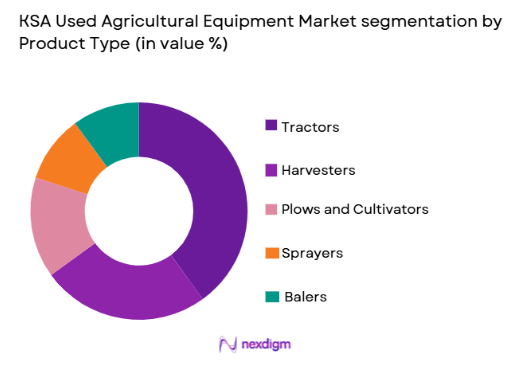
KSA Used Agricultural Equipment market is segmented by product type into Tractors, Harvesters, Plows, Sprayers, and Balers. Recently, Tractors have a dominant market share due to factors such as their versatility, widespread use in various agricultural activities, and strong brand presence. Tractors are crucial for soil preparation, planting, and harvesting, making them the most demanded product in the used agricultural equipment segment. Furthermore, the high availability of used tractors in good condition, combined with their affordable pricing, makes them a preferred choice for small-scale and medium-scale farmers.
By Platform Type:
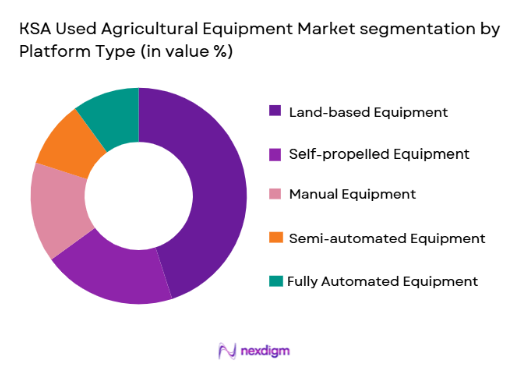
KSA Used Agricultural Equipment market is segmented by platform type into Land-based Equipment, Self-propelled Equipment, Manual Equipment, Semi-automated Equipment, and Fully Automated Equipment. Recently, Land-based Equipment has a dominant market share due to the extensive use of land tractors and other machinery for soil preparation, planting, and crop management. These land-based machines have a significant presence due to their robust performance, availability in used markets, and suitability for large agricultural areas. Their affordability compared to fully automated systems also contributes to their dominance.
Competitive Landscape
The KSA Used Agricultural Equipment market is highly competitive, with both local and international players vying for market share. Consolidation among major companies has intensified over the years as large firms focus on expanding their distribution networks and increasing their service offerings. Major players influence the market by offering competitive pricing, robust after-sales support, and financing options. This competitive environment is expected to drive further market growth, with key companies enhancing their technological capabilities and reaching more customers in rural areas.
| Company Name | Establishment Year | Headquarters | Technology Focus | Market Reach | Key Products | Revenue (USD Billion) | Additional Parameter |
| Al-Jazira Equipment | 1995 | Riyadh | ~ | ~ | ~ | ~ | ~ |
| Keenan Systems | 1980 | Jeddah | ~ | ~ | ~ | ~ | ~ |
| John Deere | 1837 | USA | ~ | ~ | ~ | ~ | ~ |
| Case IH | 1842 | USA | ~ | ~ | ~ | ~ | ~ |
| New Holland | 1895 | Netherlands | ~ | ~ | ~ | ~ | ~ |
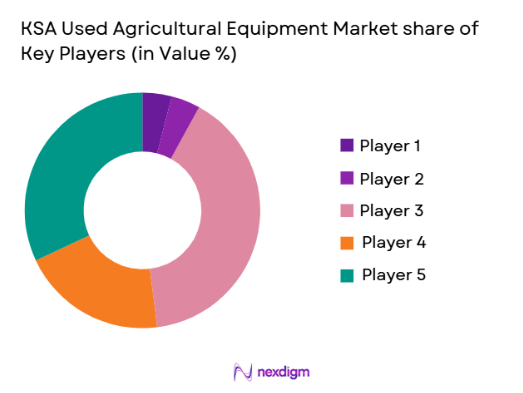
KSA Used Agricultural Equipment Market Analysis
Growth Drivers
Increased Demand for Cost-effective Farming Solutions:
As agricultural operations in Saudi Arabia continue to expand, the demand for affordable and reliable used agricultural equipment has surged. This demand is being driven by farmers’ need to reduce operational costs while maintaining high productivity. Mechanization has proven to be a critical factor in improving yields, particularly in arid regions where manual labor is insufficient. The government’s continued efforts to improve food security and promote agricultural sustainability have created an environment conducive to the adoption of used equipment. These factors combined have contributed significantly to the growth of the used agricultural equipment market. Farmers are increasingly opting for used tractors, harvesters, and other essential machinery, allowing them to scale their operations without the heavy financial burden associated with new equipment. This trend is expected to continue as long as agricultural mechanization remains central to Saudi Arabia’s farming strategies.
Technological Advancements in Agricultural Machinery:
The used agricultural equipment market in Saudi Arabia is also benefiting from technological advancements in machinery. The introduction of more efficient and environmentally friendly machines has led to greater demand for second-hand models that incorporate these new technologies. Modern used equipment, such as tractors with GPS tracking, automated plowing systems, and energy-efficient harvesters, is becoming more affordable and accessible. As the technology in agricultural machinery improves, older models that retain much of the same functionality are still valuable on the secondary market. This makes used equipment an appealing option for farmers who want to leverage modern farming technologies but cannot afford brand-new machines. Technological innovations are also reducing the maintenance and operational costs of used machinery, making them a long-term solution for many farming operations.
Market Challenges
High Maintenance Costs for Used Equipment:
While the used agricultural equipment market offers cost-effective solutions, high maintenance costs remain a significant challenge for buyers. Over time, even the best-maintained machinery will experience wear and tear, and older models require more frequent repairs and part replacements. This can result in an unanticipated cost burden for farmers who initially opt for used equipment to save on capital expenditure. Moreover, there is a lack of readily available spare parts in some regions, further exacerbating repair delays and costs. Farmers often face difficulty in sourcing genuine parts, leading to additional operational downtime and inefficiency. This challenge could deter some potential buyers, particularly those with limited access to repair services or spare parts.
Fluctuating Demand Due to Climate Conditions:
Another challenge facing the used agricultural equipment market in Saudi Arabia is the impact of unpredictable climate conditions on demand. Weather fluctuations, such as droughts, heavy rainfall, and temperature extremes, can significantly disrupt agricultural production, leading to a decline in demand for farming equipment. When weather patterns become erratic, farmers may scale back their operations, resulting in reduced equipment purchases, both new and used. Additionally, drought conditions may limit the types of crops grown, which can influence the need for specific agricultural machinery. As climate variability continues to affect agricultural production, the used equipment market may see periods of stagnation or contraction during unfavorable climatic conditions.
Opportunities
Expansion of Agriculture-based E-commerce Platforms:
One key opportunity for the used agricultural equipment market in Saudi Arabia lies in the expansion of agriculture-based e-commerce platforms. These platforms allow farmers to easily access a broader range of used machinery options, facilitating quicker purchases and better price comparisons. E-commerce platforms can provide a transparent and efficient way to connect sellers and buyers of used agricultural equipment, making it easier for farmers to find the equipment they need without relying solely on local dealerships. This shift towards online platforms also allows buyers to view detailed specifications and make informed decisions from the comfort of their homes, helping to overcome geographical barriers. The growth of such digital marketplaces presents a significant growth opportunity, particularly in rural areas where physical access to equipment may be limited.
Government Support for Agricultural Modernization:
Saudi Arabia’s government has been proactive in promoting the modernization of its agricultural sector, offering subsidies and financial incentives to farmers who adopt modern equipment. This creates a favorable environment for the used agricultural equipment market. By supporting the use of advanced machinery, the government is encouraging farmers to invest in more efficient technologies. Even if the equipment is used, it still contributes to the broader goal of agricultural modernization. Furthermore, as part of its Vision 2030, the government aims to enhance the sustainability of farming practices, creating additional opportunities for farmers to upgrade their equipment. This governmental support aligns well with the market’s growth trajectory, providing both financial backing and incentives for equipment adoption.
Future Outlook
The future outlook for the KSA Used Agricultural Equipment market is positive, driven by increasing mechanization and government initiatives aimed at promoting agricultural productivity. With expected technological advancements in equipment and the rise of e-commerce platforms, the market will likely continue its upward trajectory. However, challenges related to maintenance costs and climate variability may pose temporary setbacks. Despite these challenges, the demand for affordable farming solutions and the Saudi government’s agricultural policies will provide long-term growth opportunities for the used agricultural equipment market.
Major Players
- Al-Jazira Equipment
- Keenan Systems
- John Deere
- Case IH
- New Holland
- Kubota
- AGCO
- SDF Group
- Mahindra
- Landini
- Fendt
- Massey Ferguson
- Yanmar
- Zetor
- Claas
Key Target Audience
- Investments and venture capitalist firms
- Government and regulatory bodies
- Large-scale farming enterprises
- Agricultural cooperatives
- Agricultural equipment dealers
- Financial institutions and banks
- Equipment leasing companies
- E-commerce platforms
Research Methodology
Step 1: Identification of Key Variables
The research process begins with identifying the key variables that affect the market, such as product types, platform types, and end-user segments, based on historical data and expert opinions.
Step 2: Market Analysis and Construction
Market size and segmentation are analyzed based on available data sources, including government reports, industry publications, and company insights.
Step 3: Hypothesis Validation and Expert Consultation
The initial findings are validated through consultations with industry experts, stakeholders, and end-users to ensure accuracy and alignment with current market trends.
Step 4: Research Synthesis and Final Output
The findings are synthesized into a comprehensive report, combining data, insights, and analysis to present a clear market outlook for stakeholders and decision-makers.

- Executive Summary
- Research Methodology (Definitions, Scope, Industry Assumptions, Market Sizing Approach, Primary & Secondary Research Framework, Data Collection & Verification Protocol, Analytic Models & Forecast Methodology, Limitations & Research Validity Checks)

- Market Definition and Scope
- Value Chain & Stakeholder Ecosystem
- Regulatory / Certification Landscape
- Sector Dynamics Affecting Demand
- Strategic Initiatives & Infrastructure Growth

- Growth Drivers
Increased Demand for Cost-effective Farming Solutions
Government Support for Agricultural Modernization
Technological Advancements in Agricultural Machinery
Rising Agricultural Exports
Shift Toward Sustainable Agricultural Practices - Market Challenges
High Maintenance Costs for Used Equipment
Limited Availability of Financing Options
Shortage of Skilled Labor for Equipment Operation
Regulatory Barriers to Importing Used Machinery
Fluctuating Demand Due to Climate Conditions - Market Opportunities
Expansion of Agriculture-based E-commerce Platforms
Development of Affordable Financing Solutions
Partnerships with Local Agricultural Organizations - Trends
Increase in Precision Farming Technologies
Growing Popularity of Autonomous Equipment
Shift Toward Electric Agricultural Machinery
Use of IoT for Equipment Tracking and Management
Rise in Demand for High-efficiency Harvesting Machines - Government Regulations & Defense Policy
Agricultural Machinery Safety Standards
Import/Export Regulations for Used Equipment
Government Subsidies for Agricultural Equipment - SWOT Analysis
- Stakeholder and Ecosystem Analysis
- Porter’s Five Forces Analysis
- Competition Intensity and Ecosystem Mapping

- By Market Value, 2020-2025
- By Installed Units, 2020-2025
- By Average System Price, 2020-2025
- By System Complexity Tier, 2020-2025

- By System Type (In Value%)
Tractors
Harvesters
Plows
Sprayers
Balers - By Platform Type (In Value%)
Land-based Equipment
Self-propelled Equipment
Manual Equipment
Semi-automated Equipment
Fully Automated Equipment - By Fitment Type (In Value%)
On-premise Solutions
Hybrid Solutions
Cloud-based Solutions
Modular Solutions
Integrated Solutions - By EndUser Segment (In Value%)
Farmers
Agricultural Contractors
Agricultural Equipment Dealers
Cooperatives
Government Agencies - By Procurement Channel (In Value%)
Direct Procurement
Government Tenders
Private Sector Procurement
Online Bidding Platforms
Third-party Distributors - By Material / Technology (In Value%)
Steel
Aluminum
Composite Materials
Electronics
Hydraulics

- Market structure and competitive positioning
- Market share snapshot of major players
- CrossComparison Parameters (Market Share, Product Range, Distribution Channels, Technology Adoption, Service Support, Product Quality, Pricing Strategies, Brand Recognition, Market Reach, Customer Satisfaction)
- SWOT Analysis of Key Players
- Pricing & Procurement Analysis
- Key Players
Al-Jazira Equipment
Keenan Systems
John Deere
Case IH
Kubota
New Holland
Claas
AGCO
SDF Group
Mahindra
Landini
Fendt
Massey Ferguson
Yanmar
Zetor

- Farmers’ Increasing Need for Cost-effective Machinery
- Government Agencies’ Role in Promoting Equipment Efficiency
- Agricultural Contractors’ Shift Towards Modernization
- Agricultural Equipment Dealers’ Focus on Expanding Customer Base

- Forecast Market Value, 2026-2035
- Forecast Installed Units, 2026-2035
- Price Forecast by System Tier, 2026-2035
- Future Demand by Platform, 2026-2035


 Request a Sample
 Ask for Customization
 Get a Quote
 Enquire Now