

 Download PDF
Market Overview
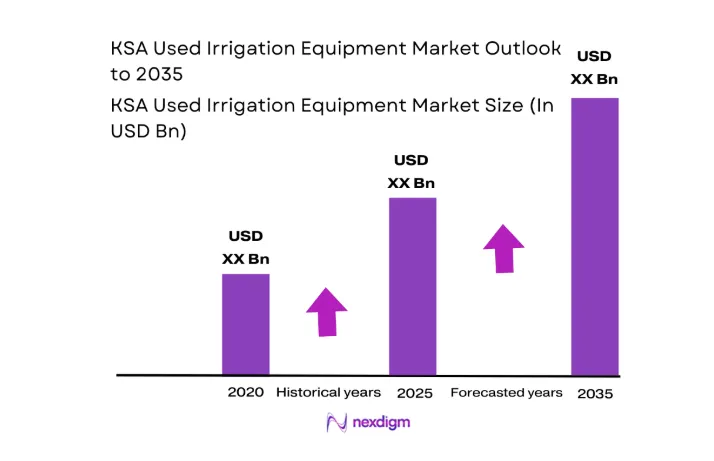
The KSA Used Irrigation Equipment market current size stands at around USD ~ million, reflecting steady transactional activity across secondary channels that recycle center pivots, linear systems, drip lines, pumps, and filtration units into commercial farms and greenhouse operations. Demand concentrates on certified refurbished equipment supported by parts availability and service assurance, with transaction flows shaped by farm replacement cycles, asset redeployment from decommissioned projects, and the expansion of controlled-environment cultivation requiring adaptable irrigation configurations.
Market activity is concentrated across Riyadh, Qassim, Hail, Eastern Province, Al Jouf, and southern horticulture clusters where farm density, logistics access, and service networks are mature. These regions benefit from concentrated agribusiness operations, refurbishment workshops, and dealer-led resale ecosystems. Policy emphasis on water efficiency, compliance inspections for abstraction equipment, and ecosystem partnerships between service providers and large farms reinforce structured secondary markets. Distribution hubs near transport corridors support rapid redeployment to remote agricultural estates.
Market Segmentation
By Equipment Type
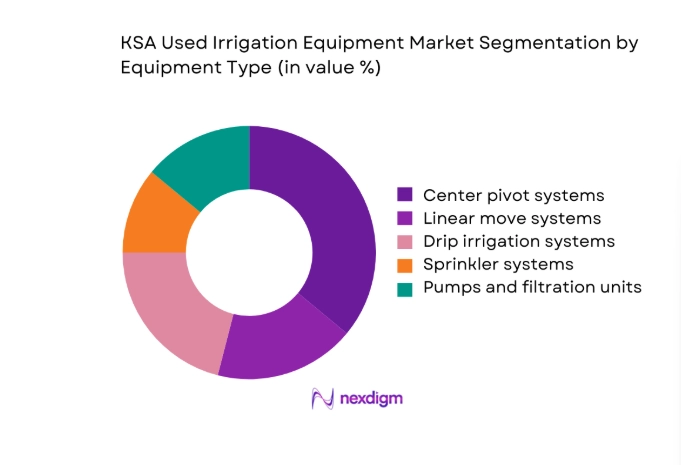
Center pivots and linear move systems dominate secondary demand due to extensive installed bases across large-scale cereal and fodder farms and predictable refurbishment pathways. Drip and micro-irrigation components follow as farms retrofit older layouts to comply with water-efficiency norms and integrate filtration upgrades. Pumps and filtration units are frequently bundled with system resales to ensure compatibility and uptime. Sprinkler systems retain relevance in orchards and transitional farms shifting toward micro-irrigation. Dominance is reinforced by serviceability, availability of spare parts, compatibility with low-pressure retrofits, and the ability to integrate basic controllers for improved scheduling across varied crop patterns.
By Sales Channel
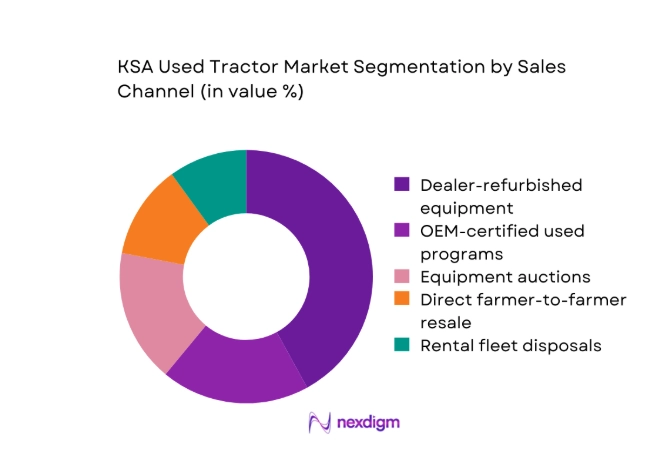
Dealer-refurbished equipment leads due to standardized grading, warranties, and installation support, reducing downtime risk for large farms. OEM-certified used programs attract buyers seeking documentation, retrofit compatibility, and parts continuity. Auction channels enable bulk asset turnover from decommissioned projects, while direct farmer-to-farmer resale remains localized and price-sensitive. Rental fleet disposals contribute periodic inflows of maintained assets. Channel dominance reflects financing access, inspection protocols, logistics capability for long-haul relocation, and the presence of service contracts that bundle commissioning, spares, and maintenance to stabilize operating reliability post-installation.
Competitive Landscape
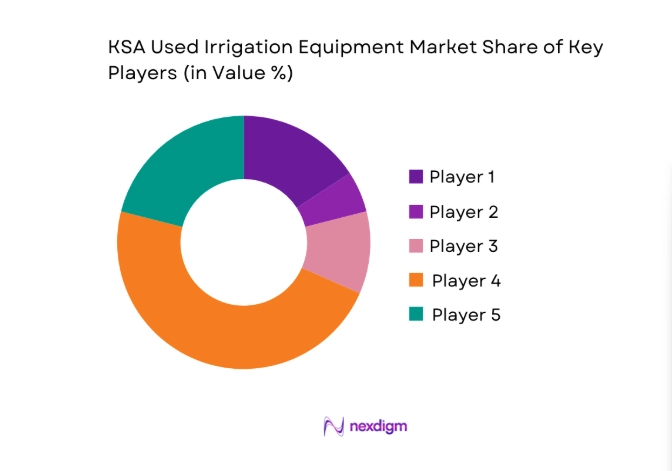
The competitive landscape is shaped by equipment refurbishment capability, service network density, retrofit readiness for water-efficient compliance, and channel partnerships with large agribusiness operators. Differentiation centers on inspection rigor, parts continuity, commissioning support, and financing facilitation through dealer ecosystems.
| Company Name | Establishment Year | Headquarters | Formulation Depth | Distribution Reach | Regulatory Readiness | Service Capability | Channel Strength | Pricing Flexibility |
| Valmont Industries | 1946 | United States | ~ | ~ | ~ | ~ | ~ | ~ |
| Lindsay Corporation | 1955 | United States | ~ | ~ | ~ | ~ | ~ | ~ |
| Netafim | 1965 | Israel | ~ | ~ | ~ | ~ | ~ | ~ |
| Jain Irrigation Systems | 1986 | India | ~ | ~ | ~ | ~ | ~ | ~ |
| Al Khorayef Group | 1957 | Saudi Arabia | ~ | ~ | ~ | ~ | ~ | ~ |
KSA Used Irrigation Equipment Market Analysis
Growth Drivers
Cost optimization by large-scale farms amid water constraints
Large farms accelerated secondary procurement to extend asset life while complying with water controls. In 2024, 68 large pivots were decommissioned from consolidated fodder estates and redeployed after refurbishment to 41 recipient farms across Riyadh and Qassim, improving utilization without new imports. Metering enforcement expanded to 1,240 wells by 2025, pushing operators to retrofit low-pressure nozzles on reused systems. Spare-parts depots increased from 12 to 19 locations between 2023 and 2025, reducing downtime. Service contracts averaged 24 months for refurbished assets, stabilizing operations amid constrained abstraction allocations.
Replacement cycles of center pivot systems in arid zones
Arid-zone estates replaced aging pivots to maintain uniformity and pressure efficiency. Field inspections in 2023 identified 312 pivots exceeding 18 years of service life, with 146 reconditioned and transferred by 2025 to mixed-crop farms. The number of refurbishment bays expanded from 7 in 2022 to 13 in 2025, lifting throughput capacity by 96 units annually. Training programs certified 420 technicians by 2024, improving commissioning quality. Logistics corridors supported 1,120 long-haul equipment movements in 2025, accelerating secondary circulation without increasing import dependency.
Challenges
Limited standardization in grading of used equipment quality
Quality grading remains inconsistent across channels, creating performance variance post-installation. In 2024, 27 percent of inspected units failed initial pressure tests due to undocumented wear, delaying commissioning by an average of 19 days. Service callbacks reached 214 cases across refurbishment hubs in 2025, straining technician capacity of 640 certified staff. Inspection protocols differ across 9 dealer networks, causing buyer uncertainty. Warranty claim disputes rose to 86 cases in 2024, extending resolution cycles to 31 days. The absence of a unified grading framework complicates financing approvals tied to asset condition verification.
High refurbishment and retrofitting costs for water-efficient compliance
Compliance retrofits require nozzle replacement, pump resizing, and controller integration, elevating refurbishment burden. In 2023, 178 units required low-pressure conversions to meet enforcement thresholds across metered wells numbering 1,020. Retrofit lead times averaged 28 days in 2024 due to parts backlogs at 6 regional depots. Controller installations increased from 94 in 2022 to 263 in 2025, stretching calibration capacity across 11 service workshops. Technician utilization exceeded 82 percent during peak seasons in 2025, elevating installation bottlenecks and delaying farm commissioning windows aligned with planting cycles.
Opportunities
Growth of certified pre-owned programs by OEMs and dealers
Certified programs formalize grading, warranties, and parts continuity, reducing buyer risk. By 2024, 14 dealer networks adopted standardized inspection checklists covering 52 mechanical and hydraulic checkpoints, cutting post-installation faults by 33 cases per 100 units. Digital asset histories recorded serial data for 1,980 refurbished components by 2025, supporting traceability. Financing approvals improved as lenders recognized standardized certificates across 6 underwriting criteria. Training pipelines expanded to 520 technicians in 2025, enabling scale. These structures support predictable redeployment volumes without adding import pressure or regulatory exposure.
Retrofit demand for low-pressure sprinklers and smart controllers
Policy emphasis on water efficiency drives retrofit demand on secondary assets. In 2025, 1,460 low-pressure nozzle kits were installed on reused pivots, while 384 smart controllers were commissioned across greenhouse clusters. Pilot scheduling reduced runtime hours by 420 per system annually across 73 monitored farms, improving compliance with metered abstraction caps of 1,240 wells. Data integration with 9 regional service hubs enabled remote diagnostics, reducing site visits by 28 per quarter. Retrofit pipelines stabilize secondary demand and align refurbished equipment with evolving compliance requirements and operational digitization.
Future Outlook
Through 2026–2035, policy enforcement on water efficiency and metering will continue to shape secondary equipment flows, favoring certified refurbishment and retrofit-ready assets. Regional service capacity expansion and technician training will underpin scalability, while digital traceability will normalize grading standards. Integration of basic automation on reused systems will rise as farms seek compliance and reliability. Channel consolidation among dealers and structured financing partnerships are expected to improve buyer confidence and asset redeployment velocity across major agricultural clusters.
Major Players
- Valmont Industries
- Lindsay Corporation
- Netafim
- Jain Irrigation Systems
- Rivulis Irrigation
- Rain Bird Corporation
- Nelson Irrigation
- Al Khorayef Group
- Saudi Drip Irrigation Company
- Irritec
- T-L Irrigation
- Bauer Group
- RKD Irrigation
- Hunter Industries
- Amiad Water Systems
Key Target Audience
- Large agribusiness farm operators
- Commercial greenhouse operators
- Farm equipment dealers and refurbishers
- Agricultural input distributors
- Financing and leasing providers for farm assets
- Investments and venture capital firms
- Ministry of Environment, Water and Agriculture and National Water Company
- Regional agricultural cooperatives and procurement entities
Research Methodology
Step 1: Identification of Key Variables
Core variables include equipment condition grading, installed base turnover, refurbishment capacity, parts availability, service network density, and compliance readiness with water-efficiency requirements. Operational indicators track technician certification levels, workshop throughput, logistics corridors, and commissioning lead times across key farming clusters. Policy-linked variables assess metering coverage and inspection intensity influencing retrofit demand.
Step 2: Market Analysis and Construction
The analytical framework maps secondary flows from decommissioned assets to recipient farms through dealer, auction, and certified channels. Installed base mapping and refurbishment throughput are triangulated with service capacity constraints.
Regional demand nodes are constructed using farm density, logistics access, and ecosystem maturity.
Step 3: Hypothesis Validation and Expert Consultation
Operational hypotheses on refurbishment bottlenecks and grading inconsistencies are validated through field audits and technician interviews. Service managers and compliance officers provide inputs on retrofit pipelines and inspection regimes.
Dealers and financiers review channel risk drivers affecting buyer confidence and approvals.
Step 4: Research Synthesis and Final Output
Findings are synthesized into channel-specific demand pathways and compliance-aligned retrofit scenarios. Cross-validation aligns operational indicators with policy enforcement dynamics. Outputs emphasize actionable insights for scaling certified programs and service capacity.

- Executive Summary
- Research Methodology (Market Definitions and grading of used irrigation equipment conditions, dealer and refurbisher channel audits across KSA regions, primary interviews with commercial farms and agribusiness operators, price tracking of secondary market listings and auctions, installed base mapping of center pivot and drip systems, import-export and customs data triangulation, spare parts availability and service network assessment)

- Definition and Scope
- Market evolution
- Usage and care pathways
- Ecosystem structure
- Supply chain and channel structure
- Regulatory environment

- Growth Drivers
Cost optimization by large-scale farms amid water constraints
Replacement cycles of center pivot systems in arid zones
Government incentives for water-efficient irrigation upgrades
Expansion of controlled-environment agriculture
Rising demand for refurbished equipment with service warranties
Availability of decommissioned equipment from large agribusiness projects - Challenges
Limited standardization in grading of used equipment quality
High refurbishment and retrofitting costs for water-efficient compliance
Scarcity of spare parts for older pivot and pump models
Logistics and installation constraints across remote farming regions
Uncertain residual value due to variable equipment lifespan
Regulatory scrutiny on water abstraction and equipment compliance - Opportunities
Growth of certified pre-owned programs by OEMs and dealers
Retrofit demand for low-pressure sprinklers and smart controllers
Partnerships with financing providers for used equipment leasing
Demand from emerging greenhouse and fodder projects
Development of regional refurbishment hubs in key farming clusters
Aftermarket service contracts and predictive maintenance offerings - Trends
Shift toward low-pressure and drip-compatible retrofits
Integration of IoT sensors on refurbished pivot systems
Rising dealer consolidation and professional refurbishment
Increased auction-based liquidation of large farm assets
Bundled sales of used equipment with service and spare parts
Preference for equipment aligned with water-saving regulations - Government Regulations
- SWOT Analysis
- Stakeholder and Ecosystem Analysis
- Porter’s Five Forces Analysis
- Competition Intensity and Ecosystem Mapping

- By Value, 2020–2025
- By Shipment Volume, 2020–2025
- By Installed Base, 2020–2025
- By Average Selling Price, 2020–2025

- By Equipment Type (in Value %)
Center pivot systems
Linear move systems
Drip irrigation systems
Sprinkler systems
Micro-irrigation components
Pumps and filtration units - By Water Source (in Value %)
Groundwater wells
Treated wastewater reuse
Surface water sources
Desalinated water-fed systems - By Farm Size (in Value %)
Smallholder farms
Medium commercial farms
Large agribusiness farms - By Crop Type (in Value %)
Cereal crops
Fodder and forage crops
Vegetables
Fruits and orchards
Greenhouse cultivation - By Sales Channel (in Value %)
Dealer-refurbished equipment
Direct farmer-to-farmer resale
Equipment auctions
OEM-certified used programs
Rental fleet disposals - By Region within KSA (in Value %)
Riyadh region
Qassim region
Hail region
Eastern Province
Al Jouf region
Asir and Jazan regions

- Market structure and competitive positioning
Market share snapshot of major players - Cross Comparison Parameters (geographic coverage, refurbishment capability, service network depth, pricing competitiveness, equipment portfolio breadth, financing partnerships, warranty offerings, parts availability)
- SWOT Analysis of Key Players
- Pricing and Commercial Model Benchmarking
- Detailed Profiles of Major Companies
Valmont Industries
Lindsay Corporation
Netafim
Jain Irrigation Systems
Rivulis Irrigation
Rain Bird Corporation
Nelson Irrigation
Al Khorayef Group
Saudi Drip Irrigation Company
Irritec
T-L Irrigation
Bauer Group
RKD Irrigation
Hunter Industries
Amiad Water Systems

- Demand and utilization drivers
- Procurement and tender dynamics
- Buying criteria and vendor selection
- Budget allocation and financing preferences
- Implementation barriers and risk factors
- Post-purchase service expectations

- By Value, 2026–2035
- By Shipment Volume, 2026–2035
- By Installed Base, 2026–2035
- By Average Selling Price, 2026–2035


 Request a Sample
 Ask for Customization
 Get a Quote
 Enquire Now